Home Blog Page 1639

Energy firm forays into electric auto manufacturing

0
The hybrid-electric van, made in Mexico.

A Mexican electrical goods and energy company is now also an automaker: Grupo IUSA officially launched a range of four electric and hybrid vehicles on Wednesday at the Latin American Mobility Summit in Mexico City.

The vehicles are a compact car, an SUV, a hybrid-electric van and a passenger bus. Sales director Agustín Ortega said that all the vehicles are manufactured at IUSA’s plant in Jocotitlán, a México state municipality about 120 kilometers northwest of Mexico City.

“The plant has the capacity to manufacture up to 20 vehicles a week, depending on the model. They’re 100% Mexican designs and we want to expand the business, depending on demand,” he said.

Ortega said that IUSA began its automotive project a year ago with the aim of capturing a segment of the growing electric vehicle market. The models presented on Wednesday are tailored to the needs of the market, he said.

Called IIK, the compact car has a range of 440 kilometers before it needs recharging while the SUV, called ATL, has a 310-kilometer range. The hybrid van can travel up to 400 kilometers with a full tank of fuel and a fully-charged battery, while the 40-seat 100% electric bus has a 200-kilometer range.

IUSA vice president Juan Carlos Peralta told the news agency NotiPress that the company was motivated to move into the electrical vehicle sector to help reduce air pollution in Mexico and the related health problems it causes.

“[We are] presenting our family of vehicles to attend to the problem of … pollution [caused by] vehicles with internal combustion engines. This is our solution to the problem,” he said.

Established in 1939, IUSA produces a range of energy-related products including solar panels at a factory next to the México state automotive plant.

Source: El Financiero (sp), NotiPress (sp) 

Ex-Pemex head was in on systematic looting of country: attorney general

0
Lozoya was arrested Wednesday in Spain.

Former Pemex CEO Emilio Lozoya – arrested on Wednesday in the south of Spain – was part of a scheme designed to “loot” Mexico, according to Attorney General Alejandro Gertz Manero.

Gertz told the newspaper Reforma that the state oil company’s purchase of a disused fertilizer plant in Veracruz for the allegedly vastly inflated price of US $475 million when Lozoya was CEO – a transaction from which the ex-official allegedly received millions of dollars himself – was one of a series of fraudulent cases in which the former official was involved.

“I don’t believe that this is an isolated case … It was conduct that was repeated in a very structured way with the aim of looting the country. I don’t see any other way to describe it,” he said.

Lozoya, CEO of Pemex between 2012 and 2016, allegedly received $10 million in bribes from Brazilian construction conglomerate Odebrecht in exchange for the awarding of a lucrative contract for work on the state oil company’s refinery in Tula, Hidalgo.

The government alleges that $4 million of that amount came his way in March 2012 when the ex-official was working on the campaign of former president Enrique Peña Nieto, and some of the funds were allegedly funneled to the campaign, an accusation still under investigation by authorities.

Pemex’s purchases of other fertilizer plants when Lozoya was CEO, including one in Lázaro Cárdenas, Michoacán, owned by the company Fertinal, are also under investigation.

The head of the government’s Financial Intelligence Unit said Wednesday that Lozoya was part of a sophisticated money laundering ring that transferred tens of millions of dollars to several countries. His arrest means that “the party is over,” Santiago Nieto said.

Information supplied to Spanish authorities by the federal Attorney General’s Office (FGR) alleges that Lozoya benefited from fraudulent activity to the tune of $280 million.

Acting on an international warrant obtained by the Mexican government for Lozoya’s role in the purchase of the Veracruz fertilizer plant, Spanish police arrested the former Pemex CEO in the southern port city of Málaga as he left an upscale residential estate in a taxi.

When he was stopped by police, Lozoya reportedly showed them a fake driver’s license issued in Mexico City.

He appeared in a Spanish court on Thursday via video link and refused immediate extradition to Mexico. Judge Ismael Moreno ordered Lozoya to remain in provisional custody on the grounds that he is a flight risk and told him that the charges he faces warrant up to 15 years imprisonment in Spain.

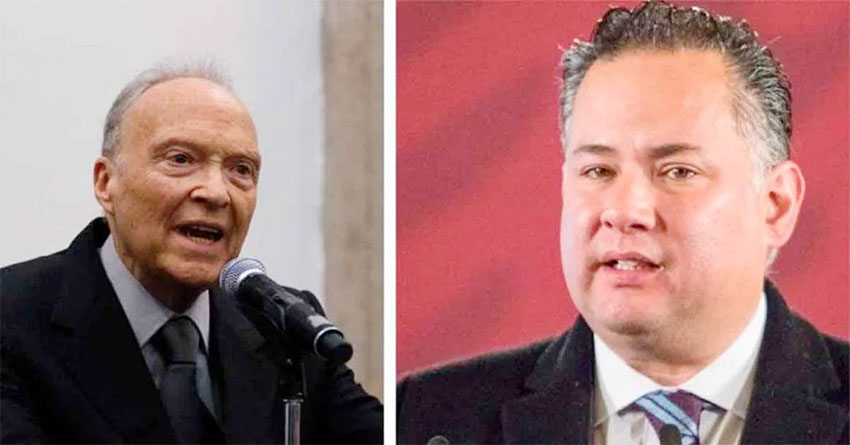
Gertz Manero, left: 'looting the country; and Nieto: 'party's over.'
Gertz Manero, left: ‘looting the country; and Nieto: ‘party’s over.’

Mexico now has a period of 40 days within which it can formally seek the extradition of Lozoya to Mexico.

Foreign Affairs Secretary Marcelo Ebrard said Wednesday that the department he heads will seek to move quickly in order to have the former official returned to Mexico, where warrants have been issued for his arrest on charges of bribery, criminal association and conducting operations with resources of illicit origin.

Shortly after the announcement of Lozoya’s arrest, his lawyer in Mexico said that his client is convinced that the case against him has no foundation.

Javier Coello said later that there is “conclusive” evidence that Lozoya “didn’t manage on his own” the fraudulent activities of which he is accused.

“In the purchase of the plants, I can guarantee that the [former] president Peña [Nieto] was well-informed, he was part of the pact,” he said.

Asserting that “everything” will be revealed in due course, Coello said that he approved of the government’s intention to “clear all this up and combat corruption.”

However, he added that there shouldn’t be “selective justice” – everyone involved in corruption should be held to account.

Reforma reported that former finance and foreign affairs secretary Luis Videgaray and two other former Pemex CEOs, including Lozoya’s successor José Antonio González Anaya, could also be implicated in the corruption of which the ex-official is accused.

Coello said that he would travel to Spain on Thursday and advise him to fight against extradition to Mexico because he’s been made “an icon of corruption here.”

Gertz said that it was unclear how long the process to extradite both Lozoya and the owner and president of the company that sold the Veracruz plant to Pemex – who was arrested in Spain last year – would take.

As things currently stand, Mexico can only apply for Lozoya’s extradition in connection with the case against him for the purchase of the fertilizer plant, he said.

However, the attorney general added that the FGR will seek to broaden the extradition case against him to include other alleged crimes, including the taking of bribes from Odebrecht.

Source: Reforma (sp), El Economista (sp), Milenio (sp)  

Following extortion wave, 19 restaurants close in Celaya, Guanajuato

0
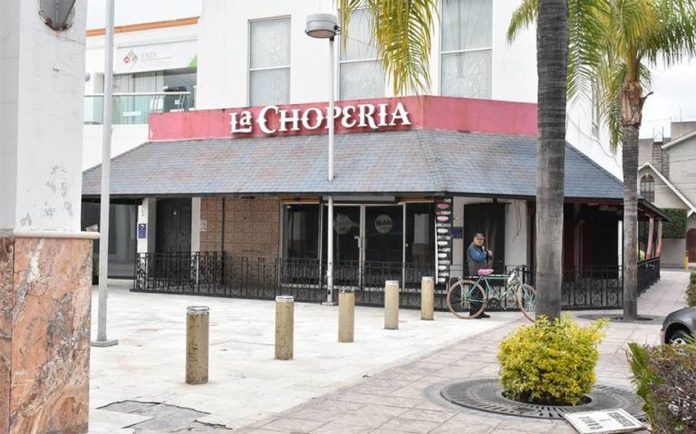
La Chopería is one of the restaurants that have closed in Celaya.

The violent culture of extortion in Guanajuato continues to wreak havoc on local businesses, particularly in Celaya’s restaurant and food services sector.

According to the national restaurant association Canirac, a total of 19 restaurants have closed down since the beginning of 2019. The city saw 15 businesses close last year and four have already shuttered this year.

Canirac director Helen Anaya Sanromán said that the problem is most serious in Celaya, but it is also a concern in other cities, such as Irapuato and Salamanca.

She said that the organization had over 100 affiliated businesses in Celaya, but that number has recently dropped to around 85.

“We have to motivate them and help them in order to reactivate the sector,” she said.

She lamented the closure of so many businesses, many of which had well-established reputations in the city.

“Yes, it’s sad,” she said, adding that some businesses closed simply out of the fear of violence and extortion generated by alarmist chain messages shared on social media.

“With much sadness we announce that we are joining the businesses that have closed due to the insecurity that exists in the state and in the city,” posted the bar and restaurant La Chopería, which closed its doors on February 3.

The situation in Celaya caused dozens of tortilla makers to close in August of last year to protest the culture of extortion and demand government action. Other businesses such as hardware stores, grocery stores and auto repair shops soon followed suit.

Extortion was also the presumed cause of the closure of a Ford dealership in the city after an attack by armed civilians damaged multiple vehicles and left the owners with multi-million-peso losses.

State authorities created a special task force in August to deal with reports of extortion and so far this year the Celaya police force has hired at least 50 new officers. Police Chief Miguel Ángel Simental said they have identified areas where they will apply a new security strategy.

A group of armed men reportedly left a burning tire in front of the local government offices on Wednesday morning with messages related to organized crime.

Simental said police are on the case and getting results and that the fire and messages need not create panic among the public.

Sources: El Universal (sp), El Otro Enfoque (sp)

Guanajuato gang boss’s niece arrested with cache of arms

0
The young women and their weapons stash.

Another relative of José Antonio “El Marro” Yépez Ortiz, presumed leader of the Santa Rosa de Lima fuel theft and extortion cartel, has been arrested as authorities attempt to disassemble the gang’s power structure.

His niece, Denise Yépez Pérez, was brought in on weapons charges in Apaseo el Alto on Tuesday.

National Guard troops detained Yépez, 22, and another woman of the same age identified as María Fernanda Mejía after neighbors called 911 to report the presence of armed civilians in the area.

The soldiers saw two armed men on the street upon arriving and followed them to a nearby house. The men reportedly escaped, but Yépez and Mejía were found with a cache of high-caliber weapons.

The two young women were aboard a red Hyundai SUV without plates that had been reported stolen in Celaya in November 2019. Upon seeing the National Guard troops, they threw down the rifles they were holding and submitted to arrest.

Among the weapons in the arsenal were three AK-47 and three AR-15 assault rifles, among other guns, as well as various rounds of ammunition and bulletproof vests.

With many of his relatives being arrested or killed recently, it has appeared as though the walls were closing in on El Marro.

His wife Karina Mora was arrested on weapons charges in Celaya on January 29, but she was released just over a week later after a judge ruled that her arrest had been unlawful.

Source: Grupo Fórmula (sp)

Over hot chocolate and tamales, business elites invited to support raffle

0
Business leaders dined on tamales last night and coughed up 1.5 billion pesos for AMLO's raffle.

Mexico’s business elite ponied up 1.5 billion pesos Wednesday night to purchase tickets in the raffle President López Obrador announced last week to cover the costs of maintaining the unwanted luxury jet of his predecessor and purchase medical equipment.

Over a dinner at the National Palace of tamales de chipilín, a tamal stuffed with the leaves of an aromatic legume, and atole de chocolate, a hot corn-based beverage, López Obrador asked some 150 company owners, chief executives and business group leaders to commit to purchasing four million of the six million 500-peso (US $27) tickets that will be offered in the raffle.

The president said Thursday morning that about half of those who attended committed to buying tickets.

The businesspeople – among whom were Mexico’s richest individual, Carlos Slim Helú, and the heads of companies including broadcaster Televisa, the airline Interjet, cinema chain Cinépolis and bread maker Bimbo – were given copies of a letter of intent that gave them the option of checking boxes to voluntarily commit to buying tickets worth 20, 50, 100 or 200 million pesos.

The head of state development bank Banobras, Jorge Mendoza, made it clear that any money spent on raffle tickets would not be tax deductible.

The businesspeople who committed to buying tickets placed their signed letters of intent in a tómbola, or lottery machine.

After the two-hour dinner, the president of paper and cardboard company Bio Pappel told reporters that the majority of businesspeople had made a commitment to purchase raffle tickets.

“There was no pressure, the president was very clear. He said: ‘I thank you for coming, this is a commitment that you should make [but] no one is obliged to because business owners already comply with the payment of taxes,” Miguel Rincón Arredondo said.

José Zozaya, president of railroad company Kansas City Southern de México, also said that López Obrador didn’t attempt to force the dinner attendees to buy tickets, stating that there was no “obligation” but rather “a request.”

Bosco de la Vega, president of the National Agriculture Council, said that he had made a commitment to purchase tickets but didn’t reveal how many he would buy. Asked whether the tamales were the most expensive he had ever eaten, he responded: “Until now, yes.”

Carlos Bremer, CEO of a financial services company and director of a youth sports foundation that last year paid 102 million pesos for a Mexico City mansion formerly owned by accused drug trafficker Zhenli Ye Gon, joked that he and other businesspeople would have to leave their offices and sell their tickets on street corners.

Slim, a telecommunications mogul who turned 80 late last month, said that he had “of course” made a commitment to purchase raffle tickets because the money raised will be used for a good cause.

Antonio Suárez of canned tuna conglomerate Grupomar said that he wouldn’t buy 40,000 tickets – the minimum number listed on the letter of intent – but committed to buying a few thousand and gifting them to his employees.

López Obrador first floated the idea of holding a raffle to offload the presidential plane used by his predecessor Enrique Peña Nieto in January. He announced last Friday that a raffle would go ahead but said that the plane wouldn’t be up for grabs but rather 100 people would win prizes of 20 million pesos (just over US $1 million) each. The president is determined to sell the luxuriously outfitted Boeing 787 Dreamliner but has had no luck in finding a buyer.

As part of wider cost-cutting measures implemented by his government, López Obrador flies coach on commercial airlines when he travels long distances within Mexico.

Source: El Universal (sp), Milenio (sp) 

LeBarons return to Guerrero to visit family of slain teens

0
Shalom and Adrian LeBaron take flowers to a funeral of two murdered teenagers. Behind them are Bryan, left, and Julian LeBaron. lexie harrison-cripps

Four members of the LeBaron family continued their campaign this week to tackle violence in Mexico by making an impromptu visit to Guerrero to support the parents of two teenagers who were murdered near Iguala on Sunday. 

The LeBaron family had no personal connections to the teenage victims or their family but were moved to show their support when Julian LeBaron heard from local radio host, Moisés Ocampo Román, that children are being killed in Guerrero. LeBaron was accompanied by his cousin Bryan, aunt and uncle Adrian and Shalom, and local activist José Díaz Navarro.

The LeBarons met with the parents of Alexis Robles Bahena, 16, and Adilene, 14, who were killed on Sunday night as they were packing their taco stand into their father’s car on the road from Cocula to Iguala. Masked gunmen held down the father, Pedro Franco, while killing the two children; Franco’s life was only spared for lack of bullets. 

The LeBarons have been campaigning for justice since nine members of their family were killed in a brutal assault in November last year in Sonora. Adrian LeBaron, who lost his daughter and four grandchildren in the attack, said “when this happened to my children and grandchildren, it woke me up to the reality.”

The family also visited the Cocula garbage dump where the government claimed the missing 43 students from the Ayotzinapa Rural Teachers’ College were killed. As part of a prepared speech Adrian LeBaron said they came to the dump “so that people would not forget.”

At the site, local journalist and activist Ignacio Suárez Nanchez pointed out flaws in the government’s official version of events. Julian LeBaron responded, “The first victim of crime in Mexico is the truth.”

The 43 students went missing on September 26, 2014 near Iguala in Guerrero. According to the former federal government’s version, the students were killed by gang members after they were handed over to them by corrupt municipal police.

Summarizing the purpose of the family’s campaign, Adrian LeBaron said “we will keep going until there is no pain, until there are no victims, until we are invited to a party in the village and not to a funeral.”

Five Federal Police trucks with around 50 officers escorted the family at all times. 

Journalists grilled family members as to why the police were guarding them and not the local people. Bryan LeBaron responded, “You are right. It’s not fair to guard us while the towns are abandoned. I don’t know the reason. But if we, who have the voice and to whom you are listening, don’t raise that voice for other victims then we are cowards.”

This was the LeBarons’ second visit to Guerrero in the past few days. On Saturday, they attended a peace march in Chilapa. “It was the first time in five years that the people had taken to the streets,” said Navarro, who also confirmed that “the march would not have been possible without the presence of the LeBaron family.” 

Due to the level of crime in Guerrero, the United States advises against any travel there and has banned U.S. government employees from traveling to the state.

Mexico News Daily

Fireworks will fly at Mazatlán’s 6-day carnival bash

0
Costumed dancers are part of Mazatlán's annual carnival.

Mazatlán, Sinaloa, is getting ready to let go of its worries and party, with six days and nights of carnival festivities lined up for the end of this month.

The theme for this year’s Mazatlán Carnival, slated to light up the streets and shores of the coastal city on February 20-25, is “Somos América” (We Are America).

Also known as “The Pearl of the Pacific,” Mazatlán is one of the most popular tourist destinations on Mexico’s Pacific coast, and the festival’s lineup is ready to live up to that fame.

The events will be topped off with nightly concerts by popular Mexican and international artists. Remmy Valenzuela, Pepe Aguilar, Carlos Rivera, Yuri, Danna Paola and Mazatlán’s own Banda Los Recoditos are among the headlining acts.

Colombian reggaeton artist J Balvin will also perform.

Each evening will include traditional events such as the quema del mal humor (burning of the bad mood), during which a selected person or theme that has been bringing society down over the last year is metaphorically torched along with a large visual likeness of it. The subject of this year’s burning has yet to be announced.

There will also be dances, parades, food fairs, light shows and coronations of the carnival king and queen, among other events.

Mazatlán’s signature carnival tradition, called the Naval Combat, is a grand fireworks display that dramatizes the defense of the port during the French invasion of 1864.

Most of the events are free to the public, though some, such as the concerts, require tickets. They can be bought on the Mazatlán Carnival website (Spanish only).

Source: Dónde Hay Feria (sp)

Anti-graft NGO finds new public universities offer questionable education

0
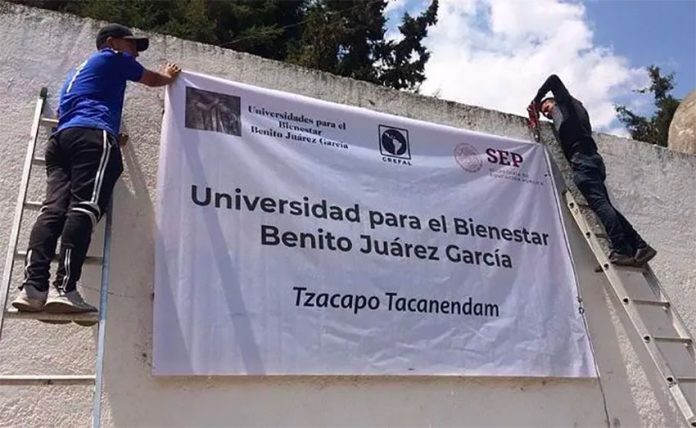
The new schools got low marks from anti-corruption group.The new schools got low marks from anti-corruption group.
The new schools got low marks from anti-corruption group.

A corruption fighters group has slammed the federal government’s new tertiary education scheme in a new report.

Public universities established by the current government are operating outside existing regulations and the quality of the education they offer is questionable, according to Mexicans Against Corruption and Impunity (MCCI).

In its report Universities in Limbo, MCCI said that none of the 30 Benito Juárez Well-Being Universities (UBBJ) it visited in 14 states last October can award degrees to students because they are not certified by the Secretariat of Public Education (SEP) to do so.

The organization also said that all but four of the UBBJ campuses fail to meet the government’s own requirement of being located in towns where the nearest tertiary education institute is at least 50 kilometers away.

“On average, the 30 universities are 22 kilometers from another higher education institute,” the report said.

MCCI claimed that partisan politics played a role in decisions about where the campuses should be located.

Fifty of 100 UBBJ campuses are in municipalities governed by the ruling Morena party, the report said, while a further seven are in municipalities governed by Morena’s coalition partners.

The anti-graft group also said that it detected “atypical” spending on the tertiary education scheme, stating that not a single peso was spent on the program in the first three quarters of last year.

In the fourth quarter, however, the government allocated 880.2 million pesos (US $47.3 million) to the universities, the report said.

MCCI said that assessing the educational programs on offer at 26 of the UBBJ campuses it visited was difficult because their chancellors refused to provide any information.

In such cases, representatives of the organization spoke with principals of high schools in the same municipality, who said that they were unaware of the operation of the universities and questioned the quality of the education they purport to offer.

UBBJ students who spoke with MCCI complained that the campuses they attend are subject to flooding, that classrooms don’t have windows and lack basic educational infrastructure. They indicated that they studied at the government’s new universities because they failed to gain admission to other tertiary education institutes or because they simply wanted to collect the 2,400-peso monthly scholarship on offer.

“As we say in the title [of the report], it’s a program that is in limbo,” said MCCI executive president María Amparo Casar.

“Does it look good? No, it doesn’t look good at all. In terms of its design, in terms of implementation, I don’t believe that it can be a program that meets its objectives.”

In light of its findings, MCCI made five recommendations to the government: increase the number of places available at existing universities rather than create new ones from scratch; build regional campuses of existing public universities; concentrate spending on UBBJ universities in marginalized municipalities; ensure resources are used for their intended purpose; and ensure compliance with SEP requirements so that the new public universities can award degrees.

It’s not the first time that the MCCI has been critical of the federal government.

The organization published a report last year that claimed the government’s youth employment scheme was tainted by corruption.

It was also part of a collective that launched legal action against the Santa Lucía airport with the aim of reviving the previous government’s US $13 billion airport project, which was canceled by President López Obrador after a legally questionable public consultation.

Source: Reforma (sp) 

Cumbre Tajín 2020 aims to reawaken pride in Veracruz’s Tontonac roots

0
Recording artist Lila Downs will be one of the performers at the Cumbre Tajín.

Veracruz is set to celebrate its Totonac heritage with the 21st edition of the Cumbre Tajín (Tajín Summit), to take place in and near the El Tajín archaeological zone, a UNESCO World Heritage Site in the northern part of the state.

One of the largest regional indigenous celebrations in Mexico, the Cumbre Tajín will stage its main events on March 13-15. According to Xochitl Arbesú Lago, secretary of Tourism and Culture for the state of Veracruz, this year’s theme, Ven a Despertar, refers to an awakening of culture, consciousness and pride in Veracruz and the Totonac people.

Like most of Mexico’s regional fairs, the main draw is music with local, Mexican and international artists performing at over 50 concerts. Headliners include Lila Downs, Grammy nominee Ximena Sariñana and actress/singer Regina Orozco.

One of the invited bands is Tercera Raíz from Coatzacoalcos, a band that fuses reggae, ska and Caribbean music, which will perform March 14. The group’s name is an allusion to the third ethnic strand of Veracruz, and Mexico in general — its African heritage, which is all but forgotten.

2020 marks a significant reorganization of the event with the aim of making it more inclusive. In the past, the event was held over five consecutive days at the Takilhsukut Park and El Tajín. Starting this year, the main events last three days, with other events scheduled for the weeks before and after, and some events will be held in Papantla, designated a Magical Town by tourism authorities. Another significant change is that almost all events are free or with entrance fees of a few hundred pesos.

For the main weekend, there will also be guided tours of the archaeological site, demonstrations of local cuisine, Totonac traditional medicine/rituals, handicrafts, art and regional/indigenous dance and music. Light and sound shows focused on the Pyramid of the Niches remain a perennial attraction.

The first of the peripheral events is the Carrera de Pescado de Moctezuma on March 5-6. Commemorating the tradition of carrying a fish from the coast of Veracruz to the ancient city of Teotihuacán north of Mexico City, the long-distance relay running event has six or 12-person teams covering the same route.

On the 12th and 13th is the off-road motor race called the Ruta Extrema Jarochazo with over 300 participants. Rituals for the spring equinox will be held at the pyramid on March 19 and at the Vega de Alatorre Horse Race on March 21. State authorities expect to draw 250,000 visitors to the region during the period.

The reason for the changes is to encourage tourists and other visitors to explore the Totonac region, with its beaches, traditional communities and more. One event that is being promoted along with the Cumbre Tajín is the Fiestas del Petroleo of the nearby oil refining city of Poza Rica.

The Cumbre Tajín is an important event for the entire state of Veracruz. It is expected to bring in 6 million pesos (US $319,000), with an overall influx of 90 million pesos to the businesses of the state’s northern region. The event also generates 8,500 seasonal jobs, most of which benefit the local Totonac population.

The event is organized by El Tajín, A.C. with the support of the Secretariat of Education and Culture of the State of Veracruz, other state agencies, the Universidad Veracruzana and the municipality of Papantla. Tickets are available through Ticketbox.

Source: La Jornada (sp)

Stakes are high as rising mayhem tarnishes Cancún’s longstanding allure

0
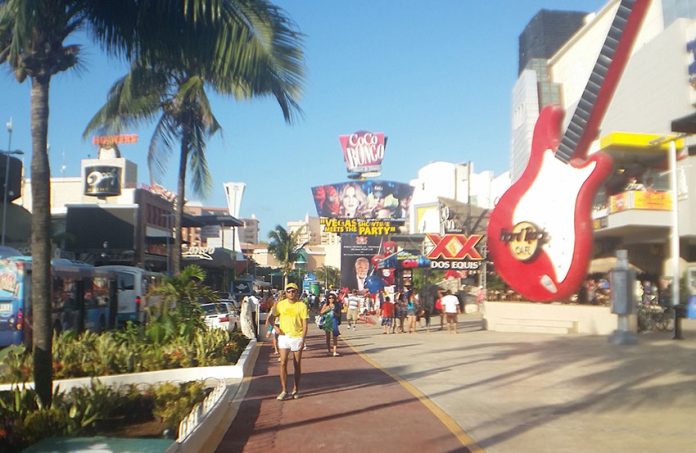
Cancún: a sinister reputation.

Earlier this month, an important arrest was made by the state police of Quintana Roo. It’s hardly a rare occurrence in the state, but this one in particular induced a sigh of relief from law enforcement across the southeast. They had finally caught one of the perpetrators involved in the kidnapping, torture and execution of police commander Archi Yamá.

In September of 2019, Yamá had been arriving home in Cancún when several men captured and transported him by van to an unknown location. Four days later his body was found by the side of the road wrapped in plastic bags. His head was also discovered nearby.

The killing was just another in a long and unrelenting line of violent encounters that the city of Cancún, and surrounding Quintana Roo, had been learning to accept as the new normal. In very recent memory, Cancún had been known simply enough for its global attraction to tourists: pristine white beaches, hotel resorts brimming with all-inclusives and the only real crime to be wary of a pinched purse or sleight of hand on the casino floor.

In the last three years however, Cancún has adopted a far more sinister reputation, and with the rate of murders there doubling from 2017 to 2018, it has become more difficult for the city to fix its eyes on the beaches and ignore the danger on the streets: a lifeguard shot dead in a five-star resort; seven dead in a cartel firefight; five mowed down the following month in a popular local bar. However you frame it, the situation is spiraling.

The stakes are high for the state of Quintana Roo. The year 2017 saw an all-time high of 13 million tourists welcomed to the region, but tales of lawlessness have taken their toll on its prestige and, increasingly, visitor numbers. What is currently a modest slump in tourism feels like a brick wall to an area that has worn the crown of getaway favorite since the 1980s, so understandably — even if just for appearances — the authorities have been mobilized to attack this new threat head on.

All 11 local police forces now take instruction from the central government as an attempt to bypass local channels of corruption, and armed patrols are constant, conflict now readily expected.

But the instability of the region may in part lie with these militarized solutions themselves. A constant campaign to target cartel leaders has created vacuum after vacuum of power, into which conflict for territory has flooded. Since 2017, the emergence of the Jalisco New Generation Cartel (JNGC) has only been encouraged by the chaotic power struggles between police and gangs, both of whom have practiced a tormented restraint so as not to disrupt the tourism industry.

The unwritten code in the area has always been to limit conflict around tourists, not because militarized cartel factions have any great sympathy for incoming holiday-makers, but because the fallout of violence involving tourists turns their local conflicts into global news. The Jalisco New Generation Cartel has no such code, a fact that security forces naturally intuit but of course are institutionally slow to realize, which has worked to the advantage of the new kids on the block, who have effectively seized the area from the historic Los Zetas.

As if this weren’t enough, collusion between high ranking politicians and the violent criminal groups in question has been rife. Roberto Borge, governor of Quintana Roo from 2010-2016, is currently awaiting trial after accusations that he hired armed groups to force landowners from their properties.

The court will hear evidence about forged documents, stolen deeds and excessive force used by authorities in a trial expected to expose just some of the corruption ingrained in the local political system. It’s no surprise that a unified front has been so elusive to local government when confronting the cartels means also confronting their own colleagues.

The authorities are struggling for an answer and beginning to learn the lesson that some of the more volatile states have been coming to terms with since the war on drugs began; how do you fight an enemy when the warfare is more damaging than compliance? The more they struggle, the greater the chances of collateral damage, toppling dominoes large enough to potentially sink the tourism economy altogether.

This is far from hypothetical, as a cursory look west to the historically champion coastal resort of Acapulco lays bare — a story of a city seized by the cartels, a tourism economy dismantled, and fractured criminal networks holding almost all sectors of the city to the proverbial ransom. Brutality is ever present, bodies appear daily on the streets, in the ocean or outside the house of a disagreeable political figure.

This is no longer the place that the Kennedys came to vacation or where John Wayne famously basked in the sun, no matter how much the tourism board may want you to believe otherwise. The capital of paradise is not teetering on an edge, it’s long since tipped, the gruesome overtaking the glamorous.

Notwithstanding, we mustn’t confuse the threat to tourism with the threat to tourists. Visitors have been relatively safe in this whole equation and would continue to be so in any eventuality. The violence in Cancún is isolated mainly to the city streets, not the hotels and their allotted portion of paradise. The victims of street warfare would be the residents, families who arrived for employment in a low-paying but secure tourism industry and occupy the fringes of the city.

As violence tears the area apart, residents are caught in the crossfire, and if and when tourism stalls and contracts as a result, it will be those who rely on arriving visitors who end up negotiating the Darwinian landscape of the failing local economy.

The various possible outcomes from the conflict in and around Cancún don’t immediately inspire hope. Of course, the wave of violence needs countering as a matter of urgency, but the authorities must recognize who has the most to lose. As is often the case, the civilians in the epicenter are most at risk, from stray bullets and shrapnel, but also from the wavering industry on which they have not only built their living but their lives.

As the security forces fight a war on two fronts, it’s important for them to realize they’re not the only ones doing so.

Writer Jack Gooderidge is based in Campeche.