Home Blog Page 1685

UNESCO declares talavera intangible cultural heritage

0
Talavera recognized by UNESCO for its heritage value.

The United Nations Educational, Scientific and Cultural Organization (UNESCO) has declared the Mexican and Spanish pottery style known as talavera an intangible cultural heritage.

The pottery is made in the Mexican states of Puebla and Tlaxcala and the Spanish towns of Talavera de la Reina and El Puente del Arzobispo.

In Mexico, the communities of Atlixco, Cholula, Tecali de Herrera and Puebla city, where the pottery is produced, are colloquially referred to as the “Talavera zone.”

Puebla Tourism Secretary Fabiana Briseño Suárez said the centuries-old tradition begun in Spain includes Islamic, Egyptian, Persian, Moroccan and Spanish influences, all of which integrated with the history and art in Mexico after being brought to Mexico during the Spanish conquest.

“An example of [this integration] is the large number of buildings, churches, fountains and facades in Puebla that are masterfully adorned with talavera,” she said.

UNESCO said that although some of the techniques employed to make talavera have changed in both Mexico and Spain, such as the use of electric potter’s wheels, the processes of production, decoration and glazing are still artisanal and identical to those practiced in the 16th century.

“The theoretical knowledge and practices related to this element of living cultural heritage include the preparation of the clay, its formation with a potter’s wheel or mold, the decoration of the formed piece, the preparation of the pigments and glazes and the firing in the kiln, operations that all require great skill,” said the organization.

Source: El Financiero (sp)

Lawyer sends message to Peña Nieto after ex-security chief’s arrest

0
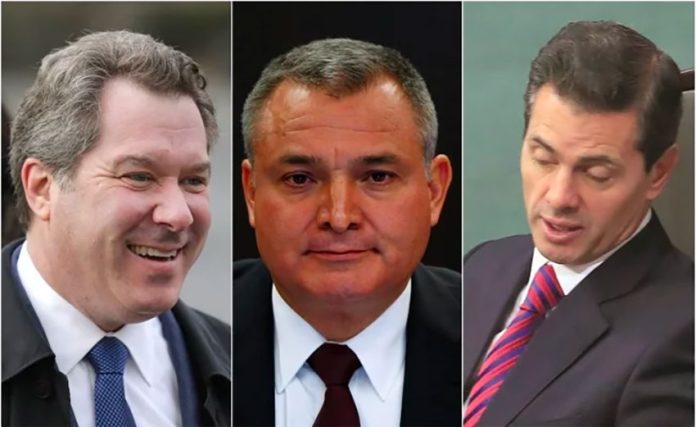
Lichtman, García and Peña Nieto
Lichtman, García and Peña Nieto: García is the first ex-official to fall following the Guzmán trial.

The lawyer for convicted drug trafficker Joaquín “El Chapo” Guzmán wants to know if former president Enrique Peña Nieto still wants to sue him for defamation now that another ex-government official is facing charges.

Jeffrey Lichtman used Twitter on Wednesday to ask Peña Nieto the pointed question after the arrest of Genaro García Luna, security secretary during the administration of former president Felipe Calderón, on charges that he allowed the Sinaloa Cartel to operate in exchange for multimillion-dollar bribes.

“Will @EPN [Peña Nieto] still sue me for defamation as he threatened to a year ago?” Lichtman wrote.

“Or will he and Felipe Calderón hire a different type of lawyer to represent them?” he added, suggesting that the ex-presidents could also be arrested for collusion with organized crime.

In his opening statement at the New York trial of Guzmán in November 2018, Lichtman charged that both received millions of dollars in bribes from the Sinaloa Cartel.

Eduardo Sánchez, presidential spokesman at the time, quickly rejected the claim, pointing out that the Peña Nieto government arrested Guzmán and extradited him to the United States.

“The assertions attributed to his lawyer are completely false and defamatory,” he wrote on Twitter.

Calderón also rejected Lichtman’s claim, calling it “absolutely false and reckless.”

This week he denied any knowledge of García’s alleged collusion with the Sinaloa Cartel and said he was surprised by the accusations against him.

The assertion that Peña Nieto was on the Sinaloa Cartel payroll resurfaced at the Guzmán trial in January when a former Colombian drug lord who worked with El Chapo claimed that he received a US $100-million bribe in October 2012, two months before he took office.

“Mr. Guzmán paid a bribe of $100 million to President Peña Nieto?” Lichtman asked Alex Cifuentes Villa in court on January 15.

“Yes,” Cifuentes replied, asserting that he was told as much by Guzmán. He also said that Peña Nieto had asked the cartel for US $250 million.

The assertions were rejected by the ex-president’s chief of staff, Francisco Guzmán.

In a statement to United States authorities in 2016, Cifuentes said that Calderón had received bribes from the Beltrán Leyva Cartel but at Guzmán’s trial he said that he didn’t recall having made the claim.

Former security secretary García was also named at the trial when the brother of Sinaloa Cartel leader Ismael Zambada testified that he gave him a suitcase containing $3 million in bribe money.

There were suspicions before the trial began that witnesses might name senior government officials who were on the cartel payroll. Several were named, but García is the first to be arrested.

Source: El Universal (sp) 

Gunmen attack police station, kill 3 officers in Guanajuato

0
Safest city in Guanajuato, says mayor.

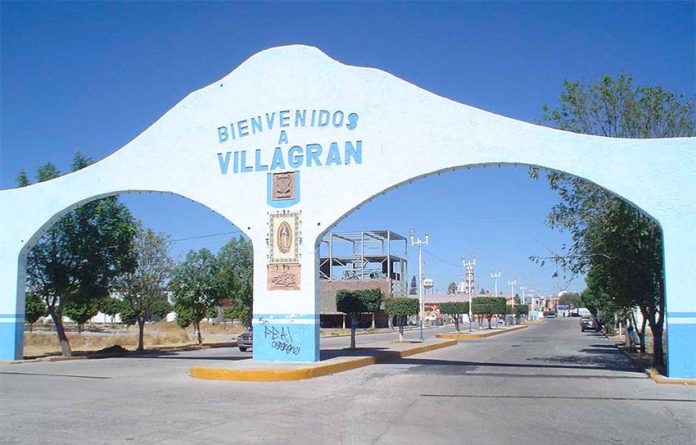
Gunmen attacked the municipal police station in Villagrán, Guanajuato, on Wednesday, leaving three officers dead and one seriously wounded.

Upon fleeing the scene, the attackers kidnapped three other officers and a judge.

During their escape, the gunmen burned a vehicle on a bridge in nearby Sarabia, nine kilometers west of Villagrán, where an army base is located, presumably to block the route of security forces in pursuit.

The attack occurred around 8:00pm when at least 15 armed civilians arrived at the station aboard three vehicles as the officers were changing shifts.

They attacked the station with high-powered rifles and grenades, initiating an “intense” gunfight that lasted about 10 minutes, according to neighbors.

The National Guard and state police arrived on the scene to secure the area and track the possible escape routes taken by the attackers, but there have been no arrests.

Minutes after the attack, another group of armed men set fire to a truck to block access to the army barracks in nearby Sarabia, nine kilometers west of Villagrán.

A message presumably left by the Jalisco New Generation Cartel (CJNG) was found in the community of Valtierrilla, Salamanca, but its contents were not released.

The attack on police came just after Villagrán Mayor Juan Lara Mendoza declared on Tuesday that his city was the safest in Guanajuato.

Two of Lara’s nephews were arrested in March during an operation to find José Antonio “El Marro” Yépez Ortiz, presumed leader of the Santa Rosa de Lima Cartel. The mayor has denied having any connection with the cartel.

Santa Rosa de Lima is located in the municipality of Villagrán. The cartel of the same name competes with the CJNG for control of the region.

Sources: El Financiero (sp), Milenio (sp), Proceso (sp)

Submarine captured in Peru with tonne of coke was Mexico-bound

0
The narco-submarine captured in Peruvian waters.

A submarine carrying over a tonne of cocaine was bound for Mexico when it was captured off the coast of Peru on Saturday, according to Peruvian officials.

“We’re talking about more than a tonne of cocaine, [but] we’re still weighing [it],” Attorney General Jorge Chávez said.

Traveling aboard the submarine were two Colombians, an Ecuadorian and a Mexican. All four were arrested.

Chávez said the vessel was loaded in a mangrove forest in Ecuador near the border with Peru.

He did not explain why the ship entered Peru’s territorial waters, to the south of Ecuador, if it aimed to travel north to Mexico.

Painted a greyish color meant to blend in with the surface of the ocean, the partially submersible craft was towed to the port of Paita, about 1,000 kilometers north of Lima.

“This is the first submarine captured in Peru. As of now, we know that the ship’s destination was Mexico,” said Chávez.

“We’re asking the navy for a technical report on its construction,” he said.

He said his office was unaware of which criminal organization the men were working for.

Drug cartels began to use submarines to transport their products in 2005, and it is believed that they are built in Colombia, Ecuador or Guyana.

Peru produces over 400 tonnes of cocaine a year, according to that country’s anti-drug agency, and the majority of it is exported via maritime routes. Peru is one of the world’s largest producers of coca and cocaine, according to the United Nations, although Colombia is the world leader.

Source: Milenio (sp)  

Families say victims’ belongings stolen after Oaxaca bus accident

0
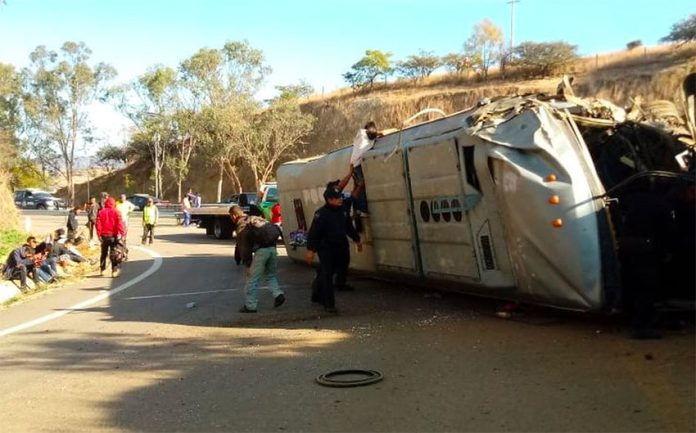
The bus that was carrying farmworkers home to Oaxaca.

Survivors and relatives of passengers who died in a bus accident in Oaxaca on Wednesday say that some of the victims’ belongings were stolen after the incident.

The bus was transporting Oaxacan laborers from Hermosillo, Sonora, when it rolled over on the Oaxaca-Mexico City highway near the town of San Pablo Huitzo. The accident left two dead and over 40 injured.

After the incident, some people reported that their wallets, cell phones and other belongings had disappeared.

Police said they had taken some items for safekeeping and were investigating those that were still missing.

Providing an update on the accident, Health Secretary Donato Casas said that only one of the seriously injured had been discharged from the hospital as of Thursday and that 10 still remained.

Red Cross official Moisés Santiago said a shelter had been set up for the 24 victims who were still unable to complete the journey to their hometowns due to minor injuries.

He said that 15 others are already with their families and added that the Oaxacan government has offered to help with transporting them home so they can arrive in time to celebrate the holidays as planned. The victims are from four municipalities in the southern sierra.

Relatives of the victims hope to meet with representatives of the Sonoran company that hired the agricultural workers so that it will take responsibility for the medical costs and provide compensation.

Source: Milenio (sp)

Government orders dismissal of head of exploration at Pemex for corruption

0
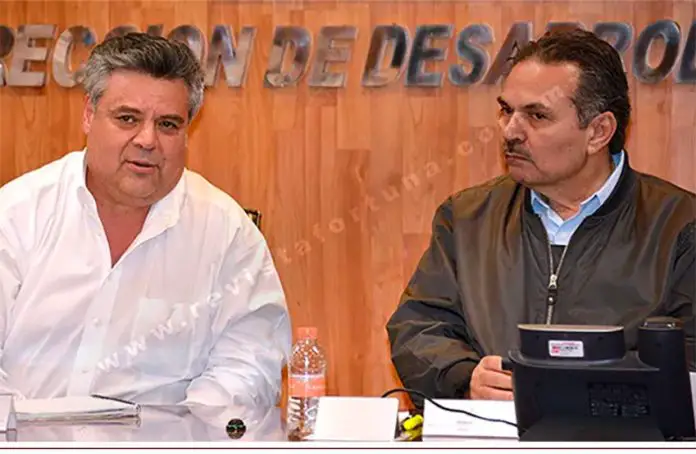
Lozada, left, and Pemex CEO Octavio Romero.

The federal government has ordered the dismissal of the head of exploration and production at Pemex and disqualified him from holding any public position for 10 years for his alleged involvement in the embezzlement scheme known as the “Master Fraud.”

The Secretariat of Public Administration (SFP) said in a statement Wednesday that it filed complaints against Miguel Ángel Lozada Aguilar with the federal Attorney General’s Office (FGR) in April after an investigation detected that he had likely engaged in criminal activity.

An FGR investigation found irregularities in Lozada’s financial circumstances. He omitted details from his declarations of assets for four consecutive years from 2014 to 2017.

The official’s failure to disclose two bank accounts and the financial benefits he obtained from the ownership of a property violated federal law, the SFP said. Lozada was unable to justify why he didn’t report the details, the statement said.

The SFP said the sanctions complied with a request from President López Obrador to remove officials from Pemex who were involved in the “Master Fraud,” a scheme in which 11 federal agencies diverted billions of pesos in government funds during the administration of former president Enrique Peña Nieto. The scheme employed phony contracts with public universities and shell companies.

The statement noted that López Obrador said in January that if any high-ranking Pemex officials appointed by his government are found to have been involved in the “Master Fraud,” they must be dismissed.

Lozada was notified of the sanctions against him on Wednesday and it will be up to Pemex to remove him from his role, the SFP said.

“. . . The Secretariat of Public Administration will supervise the effective application of the sanctions and be respectful of the decisions . . . taken by other authorities,” the statement said.

“Secretary Irma Eréndira Sandoval Ballesteros reconfirms her commitment to continue combatting corruption and impunity . . . within the framework of the new public ethics that guide the government of Mexico.”

Source: El Universal (sp), Milenio (sp) 

Chiapas works to rebuild a lost heritage in handcrafts

0
The Chiapas Artisans' Museum has 500 pieces on display.

With a large indigenous population that continues to follow centuries-old traditions, Chiapas is one of Mexico’s principal producers of handcrafts.

In the 2019 national folk art competition, the state’s artisans competed against over 1,000 entries from 24 states, taking home eight prizes in the toy, fiber, silver/goldwork, traditional clothing and embroidery categories.

In 1982, Chiapas founded the Ethnographic Museum, which built a collection of over 14,500 handcraft items from all over the state. But a fire in 2002 destroyed the complex along with 6,600 pieces in the collection, the video and book libraries and administrative offices.

Fifteen years later, in 2017, the state invested 58 million pesos (US $3 million) to reestablish the institution, now called the Instituto Casa de Artesanías de Chiapas (Chiapas Handcraft House Institute).

It is considered to be a continuation of the 1982 project, with the same mission of promoting the state’s various handcraft traditions.

However, in a number of ways it is more ambitious. The main facility is a store located in the state capital of Tuxtla Gutiérrez, which sells about 50,000 items per year. There are also branch locations at the city’s airport, two at the archaeological site of Palenque, one in San Cristobal de las Casas and even one at the Mexico City airport.

Also part of the main facility is a new museum, called the Museo de las Artesanías de Chiapas (Chiapas Artisans Museum), is located in the main store. It has a collection of 500 pieces on permanent display that exhibit examples from all of the state’s main handcraft traditions. The museum has another room dedicated to temporary exhibitions, mostly handcrafts from other parts of Mexico in collaboration with Fonart (National Fund for the Development of Handcrafts).

The mission of the institution is to promote the state’s handcrafts, not as merchandise but rather as cultural objects. To this end it provides information to the public on the work and culture behind the works of art for sale, with activities such as presentations, conferences and demonstrations on how crafts such as textiles, wood carving, lacquerware, jewelry and more are made.

The institute has over 25,000 Chiapan artisans registered with it and has programs to support their work in addition to sales. In October 2019, 180 artisans received grants of 4,000 pesos to buy supplies. It sponsors three main handcraft competitions, one of which offers a purse of 591,000 pesos.

Source: Milenio (sp), La Voz del Sureste (sp)

AMLO’s pressers: 53% of his statements were untrue or misleading

0
True, false or misleading? Fact-checker keeps tabs on AMLO.

More than half of the statements made by President López Obrador at his morning press conferences during his first year in office were false or misleading, a fact-checking initiative found.

At news conferences between December 1, 2018 – the day López Obrador was sworn in – and the same date this year, Verificado said it identified 538 verifiable claims by the president.

Of that number, 240 were true, 150 were misleading, 136 were false and 12 are still under investigation, said Verificado, which was founded by a small group of journalists in 2017.

In other words, 53% of statements made by AMLO, as the president is commonly known, were false or misleading, while 45% were true.

Verificado’s analysis of statements made by the president in the first week of his second year in office found little variation in the percentages: between December 2 and 6, 49% of verifiable claims were false or misleading, while 47% were true.

Among those found to be false were claims about migration, crime, the economy, government welfare, education, Mexican history and the justice system.

On December 2, the president said that monthly deportations of foreigners had fallen to 40,000 from a high of 140,000 in May.

However, Verificado said that official statistics show that only 102,705 foreigners were deported to their countries of origin in the first nine months of the year. The highest number of deportations in a single month was 19,410 in June, the fact-checker said, 86% fewer than AMLO’s claim for May.

The same day, the president said that homicides in Mexico City had fallen to less than four a day compared to six when his government took office.

However, Verificado found that even in the month with the least number of murders in the capital this year – October – the daily homicide rate was just under five. The number of murders in Mexico City has in fact risen this year compared to 2018, the fact-checker said.

On December 3, AMLO claimed that the number of students who enrolled in the first year of high school increased by 20% this year as a result of government scholarships. However, a government reported showed that enrollments only increased by 2%, Verificado said.

Among the other false claims made by López Obrador last week were that slavery was abolished in Mexico just over 100 years ago (it was in fact outlawed more than 200 years ago), foreign direct investment (FDI) was at its highest level ever (statistics for the first nine months of the year show that FDI reached its second highest level ever) and “there is now no impunity” (impunity rates are above 90% in 31 of Mexico’s 32 federal entities, according to a report by the think tank México Evalúa).

Among the president’s misleading claims last week were that no journalist receives money from the government (it did, however, allocate more than 395 million pesos in the 2019 budget to media advertising) and that the minimum wage is higher in China than in Mexico (China doesn’t have a national minimum wage).

One subject on which AMLO didn’t slip up was food importations.

After noting on December 5 that corn is native to Mexico, López Obrador declared that the country buys more foreign corn than any other nation in the world. That statement was found to be true.

Mexico News Daily 

Farmers storm Palace of Fine Arts over controversial Zapata painting

0
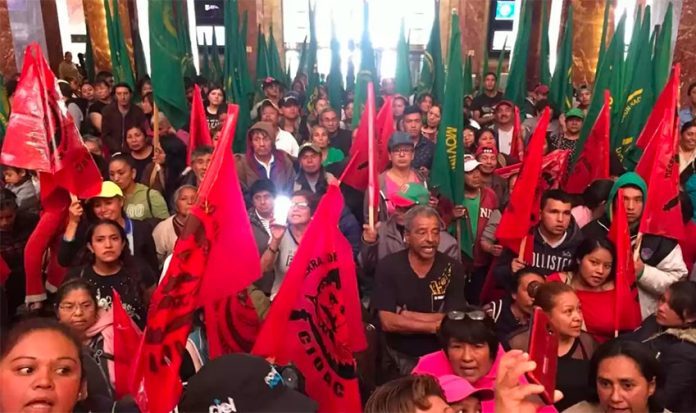
Farmers protest the Zapata painting on Tuesday.

About 200 farmers stormed the Palace of Fine Arts in Mexico City on Tuesday to demand the removal of a painting that depicts a nude and feminized Emiliano Zapata riding a sexually aroused horse.

“Burn it, burn it,” farmers shouted while inside the auditorium and museum in the capital’s historic center.

“It denigrates the personality and career of [revolutionary] General Emiliano Zapata by presenting him in a way that I’m ashamed to describe . . . on a horse, without clothing, with high heels,” said Federico Ovalle, leader of one of the farmers’ groups demanding the removal of La Revolución from the Zapata Después de Zapata (Zapata After Zapata) exhibition.

“. . . Like almost all farmers in Mexico we’re followers of the general and we think that presenting this painting is grotesque, it scorns and shows contempt for the country’s campesinos,” he added.

Antonio Medrano, leader of another farmers’ group, said the disgruntled farmers were even prepared to pay for the painting – “if this thing has any value” – in order to get rid of it.

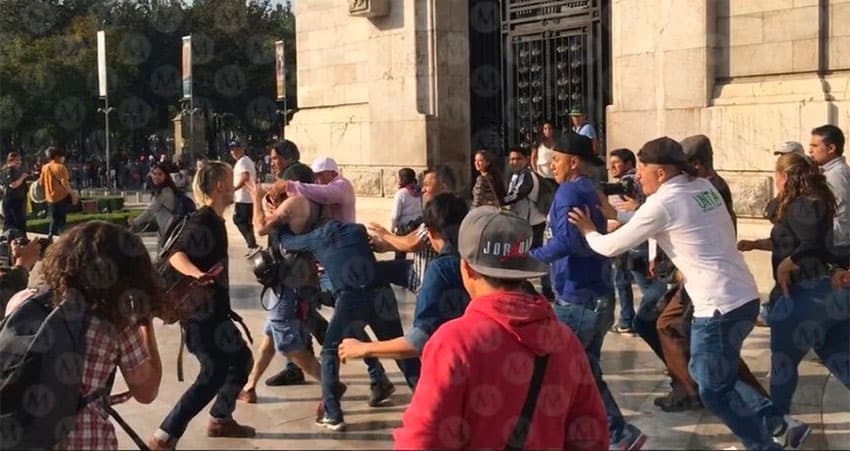
Farmers scuffle with LGBT community during a protest by the former.

Another farmer described the painting by Chiapas artist Fabian Cháirez as “an insult to our revolutionary leaders, adding “the painting must be removed.”

The farmers said that if the painting and other artworks depicting Zapata that they consider offensive are not withdrawn from the exhibition within two days, they will launch both “radical” and “legal” action.

Descendants of Zapata announced on Monday they will sue Cháirez, as well as the Secretariat of Culture and the Palace of Fine Arts for using the painting in a promotion for the exhibition.

Shortly after the farmers stormed into the palace, director Miguel Fernández Félix addressed the men, telling them that the exhibition represented a variety of views.

He also invited the farmers to look through the exhibition in order to reach a more informed point of view. But they declined the offer and yelled insults at the palace director.

According to media reports, a group of farmers verbally and physically attacked members of the LGBTI community who had gathered outside the palace to show support for the inclusion of the painting in the exhibition that commemorates the 100th anniversary of Zapata’s death.

Later Tuesday, the Secretariat of Culture and the Palace of Fine Arts said in a joint statement that they condemned “any act of violence that violates human rights and freedom of expression and creation.”

Source: El Financiero (sp), El Economista (sp), EFE (sp) 

Dolphin Discovery to build new park in Cancún, its 24th

0
Visitors swim with dolphins at a Dolphin Discovery park.

A Mexican firm that has become one of the world’s specialists on swimming with dolphins has announced the construction of a new park in Cancún. It will be Dolphin Discovery’s largest in the country.

Company CEO Eduardo Albor Villanueva said the US $10-million project will consolidate the firm as the world’s largest dolphin swimming experience company, surpassing United States-based Sea World.

He said the investment will make the Caribbean coast of Mexico the company’s principal source of visitors, welcoming one-quarter of the two million people who visit the company’s parks every year.

The company expects to continue to see 6% annual growth in visitor numbers in Mexico and elsewhere.

Dolphin Discovery began in Quintana Roo in 1994, and since then has grown into a multinational corporation with 23 dolphin parks and nine waterparks in Mexico, the Caribbean, the United States and Europe.

The company announced that it plans to invest US $20 million in new projects in 2020, half of which will go to the new Cancún park, which will be located five kilometers from the airport, near the Hotel Moon Palace, and 20 kilometers from downtown Cancún.

“The project hopes to offer our visitors and the community in general . . . the opportunity to get to know sea mammal species like dolphins, while at the same time promote protection of the environment and marine mammals through interactive programs . . .” reads the project’s environmental impact statement.

The new dolphin park is the first of its kind in two years after a 2017 Green Party initiative placed a temporary moratorium on the construction of establishments that keep marine mammals in captivity.

Source: El Economista (sp)