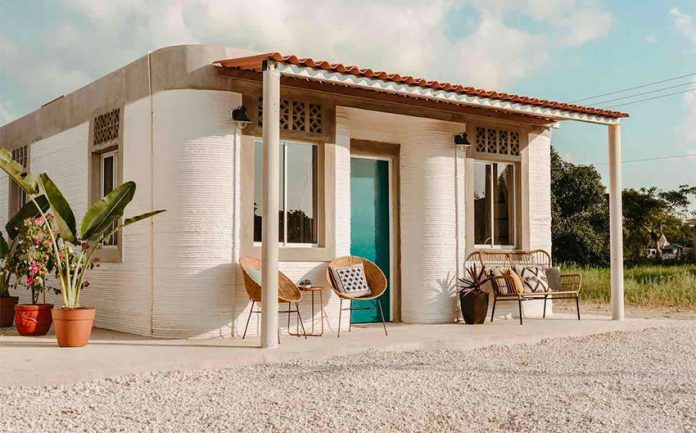
The future of home construction has arrived in Mexico: a giant 3D printer built two houses in Nacajuca, Tabasco, last week.
Built by the United States non-profit New Story in conjunction with Mexican social housing enterprise Échale and U.S. construction technology company Icon, the homes will form part of the world’s first 3D-printed neighborhood.
Fifty homes designed to withstand seismic activity and prevent flooding are expected to be built in Nacajuca with 3D printers by the end of 2020. The local government donated land for the project and will provide the infrastructure required by the new neighborhood such as electricity and roads.
The CEO and co-founder of New Story told CNN that vulnerable families living on about US $3 a day will have the opportunity to move into the neighborhood once it is finished.
Brett Hagler said that low-income residents in Nacajuca currently live in “pieced-together” shacks that flood during the rainy season.
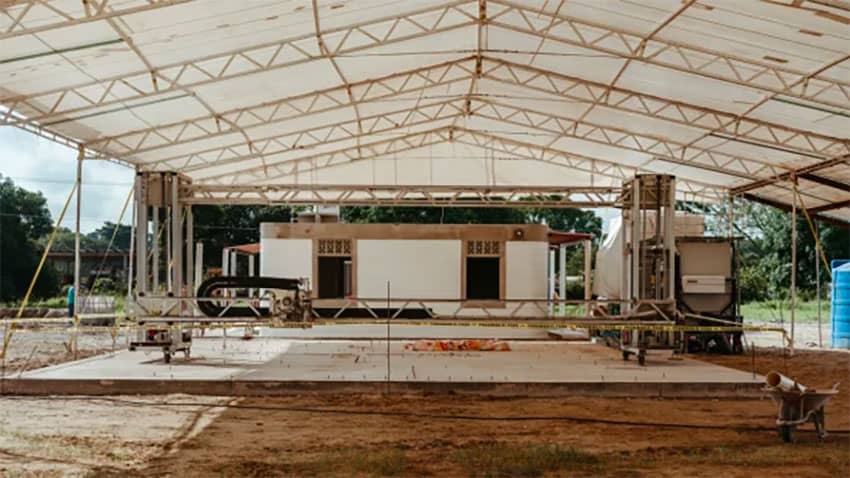
The house-building 3D printer.
“Some of the women even said that the water will go up to their knees when it rains, sometimes for months,” he said.
New Story has built more than 2,700 homes in Mexico, Haiti, El Salvador and Bolivia since it was founded in 2014 but the Tabasco project will be the first completed using a 3D printer.
“We feel like we’ve proved what’s possible by bringing this machine down to a rural area in Mexico, in a seismic zone, and successfully printing these first few houses,” Hagler said.
The Vulcan II printer was made by Icon, a Texas-based company that began collaborating with New Story two years ago.
The 10-meter-long printer pipes out a concrete mix that is used to build the walls of the homes one layer at a time. A 47-square-meter home with two bedrooms, one bathroom, a living room and a kitchen can be built in a few days.
Each 3D-printed home in the Nacajuca neighborhood will have curved walls and lattices to improve airflow and a reinforced foundation to help it withstand earthquakes. Échale has partnered with New Story to complete parts of the homes that can’t be 3D-printed.
New Story + ICON + Échale | “3D Printed Housing for Those Who Need It Most”
“3D printed homes allow for safer, faster and higher quality housing,” the developers said in a promotional video.
Icon CEO and co-founder Jason Ballard explained that the construction process with the 3D printer has improved by “10 times” during the past year.
Referring to the Nacajuca project, he told CNN that “it is so rare that the-most-in-need of our sisters and brothers globally get first access to advanced technologies and breakthroughs in materials science.”
The innovative home-building technology has the potential to change the world, Ballard added.
“We think part of what 3D printing allows us to do is to deliver a much higher-quality product to the housing market at a speed and price that’s typically not available for people” in low-income housing, he said.
“It is a house that anyone would be proud to live in.”
Mexico City's Capitanes begin playing in the NBA next season.
The Mexico City basketball team Capitanes will join the National Basketball Association’s minor league next year, NBA officials announced on Thursday.
The Capitanes will become the 29th team in the NBA G League (named after the main sponsor, Gatorade) and the first from outside the United States and Canada.
The team, which was founded in 2016 and currently plays in Mexico’s professional league, will make its debut in the 2020-21 G League season and play its home games at the Juan de la Barrera Gymnasium in Mexico City. The Capitanes’ participation in the second-tier league is guaranteed for five seasons.
“Bringing an NBA G League team to Mexico City is a historic milestone for the NBA which demonstrates our commitment to basketball fans in Mexico and across Latin America,” NBA commissioner Adam Silver told a press conference at the Mexico City Arena prior to a game between the Dallas Mavericks and the Detroit Pistons.
“As the first G League franchise based outside of the U.S. and Canada, we look forward to welcoming Capitanes to the NBA family.”
NBA commissioner Adam Silver, center, announces the new G League team.
G League president Shareef Abdur-Rahim said the NBA has long had a focus on growing basketball in Latin America and other parts of the world, adding that “having a team in Mexico City is an important step in realizing that vision.”
Capitanes’ co-owner Gilberto Hernández said the team is “honored” to join the U.S.-based league.
“This is a landmark moment not only for our organization, but for the game of basketball and our passionate fans in Mexico. We are thrilled to be a part of the NBA family and can’t wait to begin competing in the G League next season,” he said.
The schedule for the 2020-21 season, which begins next November, will be announced in August.
The Capitanes’ inclusion in the minor league raises hopes that Mexico could one day have a team in the top-tier NBA competition.
In an opinion piece published in the magazine Americas Quarterly earlier this year, a Mexican businessman and former finance undersecretary wrote that having an NBA team in Mexico makes sense.
Gerardo Rodríguez said that including teams from most countries in the world is not possible because they would be too far away from the United States. Inclusion of a Mexican team, however, is not constrained by geography, he noted.
“That’s why Mexico holds the key to the NBA’s future expansion,” Rodríguez wrote.
Both Mexico City and Monterrey have the population and “economic gravitas” to sustain an NBA franchise, he argued, adding that an NBA team in Mexico could attract talented basketball players from other Latin American countries who grew up in similar cultures.
“Mexican basketball has struggled for many years to develop a solid talent pool that can compete internationally,” Rodríguez said, but “a Mexican [NBA] franchise would help revitalize national basketball in Mexico and bring publicity to the country as a whole.”
He conceded that “there are significant challenges that would need to be addressed to have an NBA team based in Mexico” but added that “with proper planning it could be a reality sooner than people think.”
With the Capitanes’ participation in the G League confirmed, that reality now appears closer than ever.
68 indigenous languages make Mexico linguistically diverse.
Mexico is one of the 10 most linguistically diverse nations in the world but as speakers of some of its least spoken tongues told the lower house of Congress in November, that diversity is under threat.
In recognition of 2019 being the International Year of Indigenous Languages, the Chamber of Deputies heard the testimonies of a number of speakers of dying indigenous languages.
Speaking in her native pápago, Doraly Velasco León began by relating the difficulties of preserving the language of her ancestral land, which has been divided by the border between Mexico and the United States.
“Only eight speakers [of pápago] remain, including the one addressing you today . . . Our language is in its death throes, but not our world view or our historical memory, because we have left perennial footprints in our path along those lands that sustain our lives, in our songs and traditions.”
She denounced the extinction of her native tongue, charging that it was not a natural occurrence, but rather the result of borders and walls that divide the lands she and her people call home.
Noé Ávalos Hinojosa, one of fewer than 19,000 speakers of Huave from Oaxaca’s Isthmus of Tehuantepec, cited cultural and generational factors for the loss of his language.
“In the past, our grandparents taught us our language at parties . . . Now, that knowledge is disappearing among children and young people and they’re starting to have a negative attitude toward our native tongue,” he said.
One of fewer than 500 speakers of Kumeeyaay, Norma Alicia Meza Calles said that a lack of attention from the government has played a role in the death of her language.
“We aren’t folklore. We are a form of life that needs to be treated with respect. We are those who take care of our environment . . . at times confronting the same government that grants permits without taking us into account,” she said.
“Public services are not part of our lives, but we still defend our lands . . . from people who have no love for their heritage. The hills, the trees, the animals are our brothers and we take care of them.”
Abel Altamirano Ramírez, one of just over 28,000 speakers of Cora, cited a lack of education.
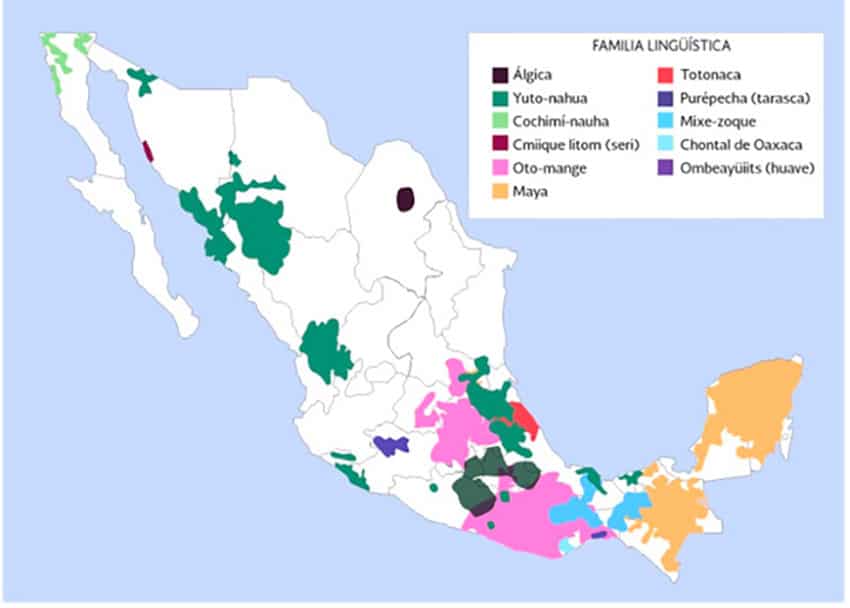
Indigenous language families and where they are spoken.
“My language is in danger of extinction because it is not maintained in education . . . If there were bilingual teachers on the staff of the secondary and preparatory schools, its use would continue, it would not be lost,” Altamirano said.
According to the National Institute of Indigenous Languages (Inali), there are 43,276 locations in Mexico in which 25 million people identify as indigenous. Among these, over seven million speak one of the country’s 68 indigenous languages.
The Inali Catalogue of National Indigenous Languages states there are 11 language families in Mexico, which are broken up into 68 language groups, of which there are 364 distinct variations.
A language family is a group of languages whose similar linguistic structures have a common historical origin. For example, Zapotec and Mixtec, the two most widely spoken indigenous languages in Oaxaca, belong to the Oto-Manguean family, along with numerous others.
A language group is a collection of linguistic variations comprised under a name traditionally given to a group of indigenous people. For example, there are at least 62 distinct variations of Zapotec.
Náhuatl, the language of the Aztecs, or Mexicas, is the most widely spoken language group in Mexico with 725,620 speakers. This is followed by Mayan with 859, 607; Tzeltal with 556,720; Mixtec with 517,665; and Tzotzil with 487,898.
However, 22 of the languages listed in the Inali catalogue have 1,000 speakers or less.
Oaxaca is the state with the most indigenous languages with 16, followed by Chiapas (14), Campeche (12), Veracruz (11) and Quintana Roo (10). According to the national statistics institute, (Inegi), Oaxaca also has the highest number of indigenous language speakers with over 1.16 million.
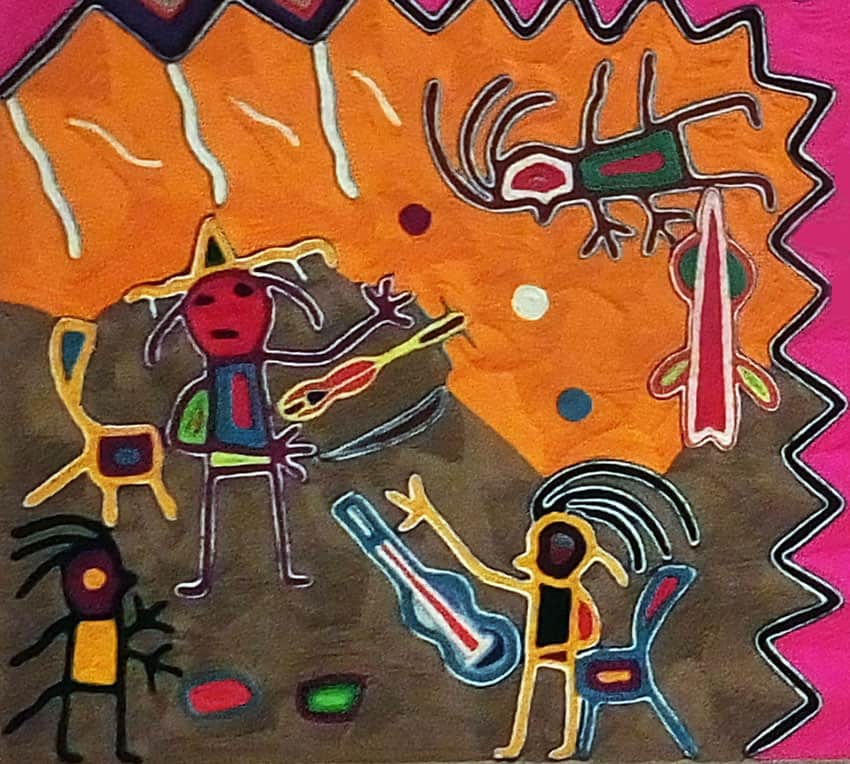
The Dead Meet beneath a Mushroom by José Benítez Sánchez is among pieces on display at Guadalajara exhibition.
Since last June, Guadalajara’s Instituto Cultural Cabañas has been hosting an exhibition of around 50 pieces of Wixárika (Huichol) art on loan from places like Harvard University and the Museum of Natural History in New York.
All of these are “yarn paintings” created by pressing colored yarn onto a flat surface covered with a mixture of beeswax and pine resin. Some of the pieces are so large I would call them murals.
The Wixáritari are an indigenous people living in the Sierra Madre Occidental range of western Mexico and, based on carbon dating from their sacred fireplaces, it seems they have been living right there for at least 15,000 years.
As I wandered through the six salons showing the art of this ancient people, I was mesmerized by the beauty of these brightly colored “yarn paintings” and at the same time deeply curious to know what all those mysterious images meant.
“You’re in luck,” said a friend, “next to every picture frame there’s a detailed explanation of what it’s all about.”
Image 1: The Dead Man’s Journey by Guadalupe González Ríos.
I walked up to one of these explanations (in Spanish), began to read, and instantly realized that simply locating the things that were described was going to be a daunting task, apart from the far greater challenge of actually understanding what the artist was trying to say to me — but, I thought, “This is why the descriptions are here: the artist wants us to look at them.”
The best I could come up with was to photograph both art and explanation and wait to do my analyzing at home.
Back at home, I discovered that these indigenous artists were telling some fascinating stories which revealed a great deal about how they look at the world.
Since there is still time for you to see the exhibit if you are located near Guadalajara, I’ll describe just one of the pictures, hoping I can entice you to go see the original at Hospicio Cabañas and perhaps investigate some others on your own.
The picture I want to describe is called El Viaje del Difunto by Guadalupe González Ríos: The Dead Man’s Journey (Image 1). It is practically a mural and so complex that I could imagine people discussing it for hours, maybe days. All I will do here is give a very brief synopsis of the two-page description which goes with the picture.
This is the story of a man who died and went to the underworld. Five days after his death, a shaman follows the man’s footsteps and attempts to rescue his soul.
Image 2: The Dead Man’s Journey, upper left corner.
In Image 2 we see the tomb of the dead man in the upper left corner and immediately to the right of it the nierika or portal which the shaman uses to follow the man’s footprints along the path. The dead man first comes to the sacred fig tree where newly arrived souls are obliged to throw objects at its branches.
Men must throw vagina-shaped rocks while the souls of women throw straight sticks. These elements, explains the artist, symbolize sexual transgressions.
Farther along the trail (Image 3, center) the voyager comes to a crow. In his lifetime, the man often frightened this crow while working in the fields, and now he must placate the bird, presenting it with an ear of corn and begging it for mercy.
Just beneath the crow, on the other side of the trail, we see an orange circle which represents a pool of dirty, parasite-infested water. This is what he must now drink in the underworld and it forces him to reflect on all the times he was able to drink clean and delicious water during his lifetime. “After death, everything is reversed,” comments the artist.
Now the hapless wanderer is transformed into a fly, which we can see above the crow’s wing. Unfortunately, the next thing he comes to is a river which cuts across the trail. To get to the other side, he must beg the help of a dog, whose ears seem, to me, curiously long.
“But the dog refuses,” we are told, “because the man used to kick and beat that dog and never gave it anything to eat.”
Image 3: The Dead Man’s Journey, center.
Luckily, the man had been buried with two tortillas, exactly for a situation such as this. These, I think, are represented by the two white circles near the dog. The dead man throws them to the dog and manages to cross the river.
After this, the poor soul undergoes all sorts of torments for his sexual misdeeds. These punishments typically include being skewered and roasted or being boiled alive. The worst punishment of all is dying a second time and this one is reserved for those who sinned by having sex with a mestizo.
At long last, the shaman catches up with our wanderer at — of all things — a party, where the souls of the dead are “dancing in wild abandonment” to violin and guitar music, raising clouds of dust. All this can be seen in the lower left corner of Image 4.
The shaman now fires an arrow into the dead man (long red triangle), “liberating him from all the possessions he brought with him to the underworld.” The shaman then washes him, gives him food and releases him into heaven.
In heaven (Image 1 — again), our lucky soul is received by the owner of the celestial realm, our Mother Young Eagle who, I think, is the large, white-faced figure at the far left of the full picture. Next to her you can see the small figure of a child.
It should be noted that for children there is a shortcut through the underworld, leading straight to heaven. This is represented in the yarn painting by a trail which forks off from the main trail (where we saw the footprints — remember them?) and passes through lots of flowers, finally arriving at a portal to heaven which is “for kids only.”
Image 4: The Dead Man’s Journey, lower left corner.
If you are now curious to see more of these yarn paintings, you will find the exhibit Grandes Maestros del Arte Wixárika (Grand Masters of Wixárika Art) in downtown Guadalajara at the Instituto Cultural Cabañas, which is open Tuesday to Sunday, 10:00am to 6:00pm but closed on Mondays. Tuesdays are free. Note that the Wixárika exhibit will end on December 31.
The writer has lived near Guadalajara, Jalisco, for more than 30 years and is the author of A Guide to West Mexico’s Guachimontones and Surrounding Area and co-author of Outdoors in Western Mexico. More of his writing can be found on his website.
Mexico City is paying police officers 1,000 pesos (about US $50) a month to exercise with the expectation that they will lose weight and become better equipped to perform their duties.
More than 1,000 officers have signed up for the Healthy Police program, which involves attending fitness classes and following a healthy eating plan.
At a recent fitness session on a sunny morning in the capital, instructor Javier Ramírez told the news agency AFP that the three-month old program “is a way to fight the obesity problem we have in Mexico, the sedentary lifestyle.”
“We want [police] to be in optimal condition so they can do their jobs effectively,” he added.
Taking a break from the session of push-ups, squats and crunches, 36-year-old policewoman Graciela Benitez told AFP that her health was poor and she got tired at work before starting the program.
Officers take off weight with jumping jacks.
“I used to feel sleepy after lunch. I was tired when I got to work. Now, I don’t get tired. My body feels the difference,” she said.
Benitez has shed 10 kilograms since joining the program, which also offers nutrition advice.
Mauricio Barrera, a 26-year-old officer who has lost 16 kilograms since starting the program, said the experience has been life-changing, adding that he now finds it easier to get through his 12-hour shifts.
“This was all completely new to me . . .The first month was tough, both mentally and physically,” he said. “But the program has helped me understand that obesity is an illness.”
Authorities in Mexico City hope that officers like Benitez and Barrera will serve as an example to other overweight and obese police in the capital’s 83,000-strong force.
A castle on the lake is one of the attractions at Luztopía.
Christmas began in November in Monterrey this year with the return of the Luztopía Festival of Lights, a recent tradition that celebrates Christmas on a grand scale.
Now in its third year, the festival features 200 giant figures that illuminate 1.2 kilometers of pathways along the Paseo de Santa Lucía riverwalk and elsewhere in Fundidora park, in the heart of Monterrey.
Luztopía is one of the largest Christmas festivals in Mexico. This year’s theme is “Trip around the World,” bringing light installations that include such world renowned landmarks as the Eiffel Tower, the Taj Mahal, the Chichén Itzá pyramid, the Statue of Liberty and the Leaning Tower of Pisa, among others.
Other eye-catching attractions include a 12-meter-tall castle on the lake, Christmas Town, Santa Claus’s house, a giant Christmas tree and a magic tunnel. Food trucks, an artisans market and concerts will also be part of the event.
Tourism promoters in Nuevo León are expecting the festival to attract lots of visitors to Monterrey during the holiday season.
“Luztopía is without a doubt one of the biggest events in the north of the country,” said the director of the Nuevo León Tourism Development Corporation, Miguel Ángel Cantú.
Fun for the whole family, Luztopía opened on November 21 and runs until January 12. Apart from Christmas Eve and New Year’s Eve, it is open daily from 4:00pm to 11:00pm.
Avoid lines at the festival entrance by purchasing tickets on the Luztopía website for 60 pesos (US $3).
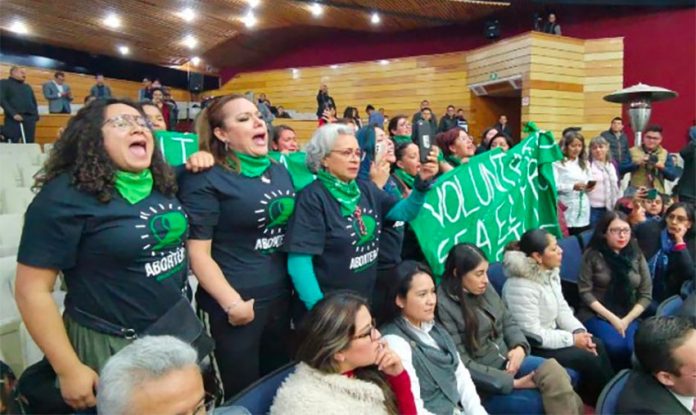
Pro-abortion lobby in the Hidalgo state Congress on Thursday.
The Hidalgo Congress has rejected a bill to legalize abortion in the first 12 weeks of pregnancy.
Fifteen lawmakers voted against the proposal Thursday, 10 voted in favor and five abstained. The bill divided lawmakers from the Morena party, which dominates the 30-seat legislature. Seven party representatives supported the proposal, six voted against it and two abstained.
Lawmakers from the conservative National Action Party voted uniformly against legalization and with the support of the six Morena representatives, as well as Labor Party, Institutional Revolutionary Party and Nueva Alianza deputies, succeeded in defeating the proposal.
The bill, which sought to modify both the state criminal code and health law, will now be re-analyzed in Congress committees.
Groups both in favor of and against the legalization of abortion watched the vote from inside the legislative chamber.
After the proposal was defeated, members of the pro-abortion Marea Verde (Green Tide) movement broke into a chant that labeled lawmakers who didn’t support the bill as traitors.
Rebeca Ramos of the feminist organization Information Group on Reproductive Choice, told the newspaper Reforma that in contrast to what happened in Oaxaca, where abortion was legalized in September, “prejudices prevailed” in the Hidalgo Congress.
Lawmakers who voted against the bill turned their backs on arguments based on human rights, women’s health needs and international recommendations, she said.
Ramos added that prosecution rates for illegal abortions are higher in Hidalgo than most other states.
“It’s among the five [states] with the highest number of complaints and sentences for the crime of abortion,” she said.
Over the past 12 years, 1,180 women from Hidalgo have had legal abortions in Mexico City, which until September was the only federal entity where the service was legally available.
Between 2007 – the year in which first-trimester abortion was legalized in Mexico City – and 2019, only women from the capital and neighboring México state have accessed legal abortions in greater numbers than those from Hidalgo.
Highway robberies have totaled 1,500 so far this year, generating over 1.3 billion pesos (US $68 million) in losses, according to the Nuevo León Chamber of Industrial Transformation (Caintra).
Executive director Guillermo Dillon Montaña said that over 1,800 Caintra-affiliated businesses both big and small have been affected by highway robberies from January to the first half of December.
Of all the robberies in the country, 87% were concentrated in just 10 routes or specific points.
The route with the highest number of incidents was the Progreso-Monterrey highway between Tamaulipas and Nuevo León with 260 robberies. Next up were the Puebla-Veracruz highway with 212; Toluca-Orizaba with 97; and Celaya-León and Irapuato-Guanajuato with 46.
With some exceptions most of the robberies occurred at night.
“At Caintra over half of our partners report having had at least one theft of cargo or even the whole truck,” said president Adrián Sada Cueva. “It’s a very big challenge that we have to deal with and we hope that all the initiatives of the federal and state governments will yield results in the coming year.”
He added that the number of highway robberies has been high for years.
Another activity that has troubled Caintra and its affiliates this year has been the high number of railroad blockades, such as those by teacher training college students in Michoacán.
“We believe that the impact to economic activity is not negligible. We want to see the use of public force and authority, because the rule of law is not being respected,” said Dillon.
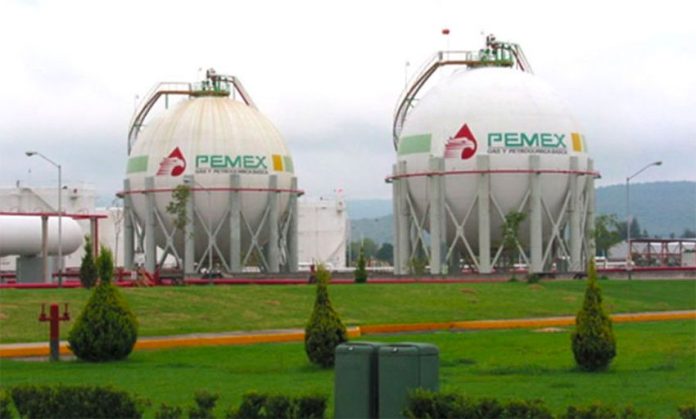
Pemex holds all the cards when it comes to storage facilities.
In conjunction with the deregulation of the fuel markets, the Secretariat of Energy (Sener) created the public policy on minimum stocks of oil products in August 2017.
The policy obliges importers of refined products to maintain minimum inventories of gasoline, diesel and jet fuel in all regions of the country in order to reduce the risk of lack of supply and not to depend wholly on Pemex’s infrastructure.
However, following a dramatic realization that markets have not developed as anticipated, Sener issued a change to the policy on December 6. The amendment was issued to accommodate the current nature of the fuels market and the lack of infrastructure in the private sector.
Only five storage terminals are in operation across the whole country, mainly due to a lack of clarity in real market pricing and clients willing to exit Pemex contracts and lock in private contracts for the long term.
This has been a real issue since Mexico lacks any tangible third-party infrastructure, meaning the population is at the beck and call of Pemex assets only. Importers have struggled to attain long term contracts with end users since Mexicans recognize that it is hard to fulfill their demand without storage tanks, transloading facilities and consolidated logistics in the form of trucking.
In essence, we are experiencing a standoff situation where importers are hesitant to invest in infrastructure and clients locally do not want to sign long term contracts with suppliers due to a lack of infrastructure and their concerns over being left shortly of supply.
CFE power generation plants
The Federal Electricity Commission (CFE) has announced it will develop seven power generation plants next year that will collectively provide additional capacity of 3,762 megawatts (MW) to the national electric system.
CEO Manuel Bartlett joined President López Obrador at his morning press conference Monday, confirming that the development of the seven plants will require a joint investment estimated at 58.64 million pesos (US $3 million).
He added that six of them will use natural gas and fuel, while the seventh — CI Baja California Sur VI — will begin operating solely with fuel oil, although second stage plans will have it using natural gas.
The seven centers will be located in San Luis Río Colorado, Sonora; Baja California (two projects); San Luis Potosí, San Luis Potosí; Salamanca, Guanajuato; Dos Bocas, Veracruz; and Mérida, Yucatán.
It is intriguing to see a government push for the use of fuel oil at these plants, supporting Pemex refinery production where bottom of the barrel fuel oil is produced in higher quantities than gasoline and middle distillates such as diesel.
The timing of this announcement sits uncoincidentally close to the introduction of IMO 2020 where the International Maritime Organization, headquartered in London, will implement a low sulphur regulation that comes into effect on January 1. The policy requires all shipping companies to reduce their sulphur emissions by 85%.
Consequently, higher demand for low sulphur distillate fuels will push refineries worldwide to use middle distillates such as diesel-based MGO (marine gasoil describes marine fuels that consist exclusively of distillates and is similar to diesel fuel, but has a higher density), diesel (especially ultra-low sulphur diesel) and jet fuel to blend down high sulphur fuel oil and produce the compliant fuel.
Pemex does not have the capacity to produce more of the middle distillates necessary meaning the company is now “long” fuel oil, allowing us to understand better why Bartlett will continue to use fuel oil in plants: to support another state entity, Pemex, by buying its refined fuel production.
Private win for renewable energy certificates
Mexico, the world’s 12th-largest emitter of greenhouse gases, has been seen a forward thinker on climate policy and sustainability in the past decade. There had been a real shift and sustained focus on developing wind and solar assets in the country before the advent of the Morena party this time last year.
However, in late October, all those previous efforts were called into question when the Secretariat of Energy and the López Obrador cabinet decided to ruffle the feathers of pro-renewable lobbyists and companies.
Morena announced it was going to adapt the market rules for clean energy certificates, known as CELs. The rationale for creating the credits was to give producers incentive to adopt more renewable energy assets and help Mexico achieve its national climate goals. Those goals include increasing clean energy’s share of the national energy market from 25% in 2018 to 35% in 2024 and 50% by 2050.
The certificates would only be available for projects that commenced operations after 2014. But the new rules make older producers, including non-operating hydroelectric dams, eligible to receive the incentives too. Beyond the obvious market interference, the changes further compromised Mexico’s clean energy goals by effectively allowing the Federal Electricity Commission to utilize older energy production.
It did not take long for the largest wind and solar companies that had won projects in Mexico to revolt against the change. Consequently, a federal judge in Mexico City overturned the rule change within days. Critics feared that if older government-supported assets were subject to accessing loans, newer projects would have a lower asset value and undermine investment in clean energy.
On Tuesday of this week, the federal judiciary decided to keep the original market rules in place, indicating that the original design of the CELs will remain unchanged until the final resolution of the amparo lawsuits. An amparo lawsuit can be translated loosely as a guarantee of protection of an individual’s constitutional rights: this protection is provided for under Mexico’s constitutional law and the Amparo Law.
The Energy Secretariat’s move to grant old, state-run clean energy producers the right to sell CELs, originally designed for renewable power plants, was met with heavy criticism by Mexican wind and solar associations. The temporary win for supporters of renewables and foreign direct investment will praise this ruling, proving that the judicial system in Mexico works in benefit of laws constituted for the benefit of the nation.
It remains to be seen whether the suspension can be overturned but this news will be welcomed by foreign investors concerned about the rule of law in Mexico as well as aiding Mexico in achieving its targets in the Paris Agreement on climate change.
The writer is the founder of Indimex Group, a Mexico City company focused on the procurement, marketing, trading and optimizing of refined petroleum products as well as investing in and operating physical assets for the movement of fuels in Mexico and the United States. His bulletin about developments in the Mexican energy industry appears weekly on Mexico News Daily.
Police in Guanajuato, Mexico’s most violent state in the first 10 months of the year, will be the best paid in the country starting in January.
Governor Diego Sinhue Rodríguez Vallejo announced on Wednesday that state police will receive salaries of 24,400 pesos (US $1,280), leaving officers with take-home pay of just over 20,000 pesos.
Speaking at a graduation ceremony at the state police academy, Sinhue said that raising the salaries of officers from their current net rate of 15,000 pesos will cost the government 450 million pesos (US $23.6 million) next year.
The pay rise will lift officers’ salaries above those of their counterparts in Sonora, who are currently the best paid in Mexico with monthly net wages of just over 19,000 pesos.
The benefits afforded to police in Guanajuato are already among the best in the country.
Officers have access to housing credits, pension funds and education scholarships for their children, while the families of police killed in the line of duty receive financial support from the government in addition to life insurance payouts.
Sinhue said the aim of the pay increase, which will also lift Guanajuato officers’ salaries above those received by members of the National Guard, is to prevent corruption in the state force and encourage greater commitment to the job.
He said Guanajuato officers will also be provided with the equipment they need to do their job effectively, highlighting that the state force will take possession of 40 new police cars and 420 body-worn cameras.
The state government invested about 200 million pesos in police equipment and training this year, the National Action Party governor said, and will lay off more government personnel in 2020 to increase spending on security.
There were 2,255 homicides in Guanajuato between January and October, according to the National Public Security System, 3% more than in Baja California, which was the second most violent state.
The Jalisco New Generation Cartel and the Santa Rosa de Lima Cartel are engaged in a turf war in the state, once considered among the safest in Mexico.