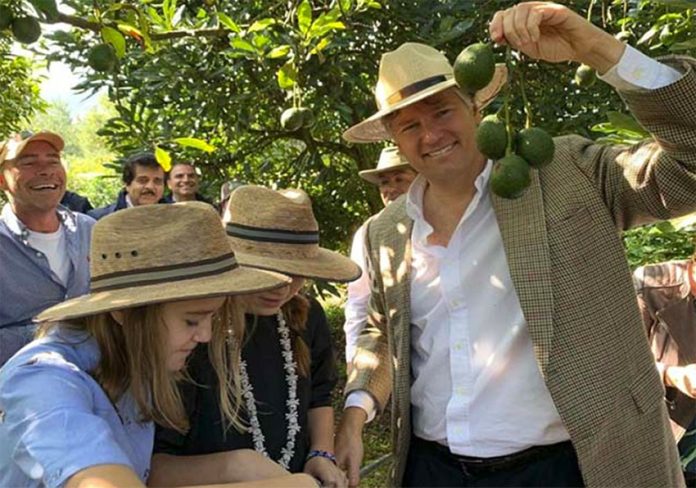
Ambassador Landau and his family at an avocado orchard.
United States Ambassador Christopher Landau defied his own government’s travel advice to visit an avocado orchard and participate in Day of the Dead celebrations in Michoacán on Friday.
The Uruapan-based Mexican Avocado Producers and Packers Association said that Landau visited an orchard to learn about the production chain of avocados, millions of which are shipped annually from Michoacán to the United States.
He traveled later to Pátzcuaro to join Day of the Dead celebrations.
The U.S. Department of State warns Americans not to travel to Michoacán due to crime. The Level 4 advisory — highest on the scale — only applies to Michoacán and four other states: Colima, Guerrero, Sinaloa and Tamaulipas.
For U.S. government employees, travel is limited to federal Highway 15D – in order to transit Michoacán between Mexico City and Guadalajara, to Morelia and Lázaro Cárdenas.
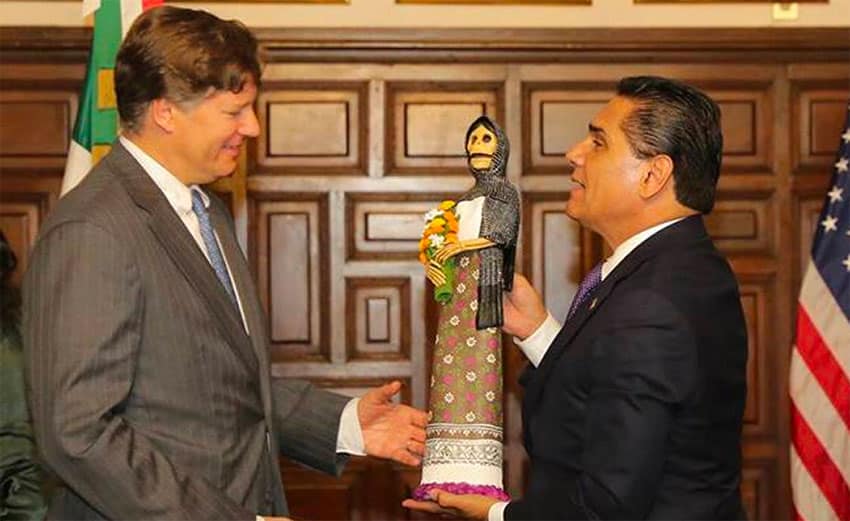
The governor, right, presents the ambassador with a traditional Day of the Dead figurine.
To reach Morelia, the State Department says government employees may travel by air or by land using Highways 43 or 48D from Highway 15D. Travel to Lázaro Cárdenas must be by air only and government employees must limit their activities to the city center or port areas.
But Landau was apparently undeterred by the U.S. government’s travel advisory and news of violence in the state. A photo shows the ambassador grinning while holding up an avocado at the orchard, whose location was not disclosed.
Landau, who has been the United States’ top diplomat in Mexico for less than three months, traveled to Morelia on Thursday with his wife, daughter and a friend of his daughter.
He met the same day with government officials including Governor Silvano Aureoles as well as business leaders, academics and members of civil society.
Landau said on Twitter that his visit to Michoacán was motivated by the advice of his followers, including Aureoles, on the social media platform. On October 5, he asked his followers where in Mexico he should go to celebrate Day of the Dead.
Aureoles responded: “The magic of the Night of the Dead is only experienced here, especially in the Pátzcuaro lake area. This is one of our most important traditions, rooted in the heart of the Michoacán people, and it fills us with joy to share it.”
In a post on Thursday, Landau wrote:
“You suggested it to me and I took notice! On the invitation of Governor Silvano Aureoles (via Twitter) I’m here in the great state of Michoacán to share the Day of the Dead celebrations. [There is] great economic potential [in Michoacán] as well as cultural and historical wealth.”
At his meeting with the governor, Landau heard about Michoacán’s tourist destinations, the annual arrival of the monarch butterfly and investment in the port of Lázaro Cárdenas.
Aureoles presented the ambassador with a typical Day of the Dead figurine made by Michoacán artisans.
“I expressed our gratitude to the ambassador for his openness, warmth and interest in getting to know more of Michoacán . . .” the governor said.
Tourists will not have to pay higher taxes after all.
The Senate has put the brakes on hefty hikes to two tourist taxes that were approved by the lower house of Congress.
The Chamber of Deputies last week approved a 388% increase to the DSM immigration services tax and a 58% hike to the DNR non-resident tax.
To enter the country by air, tourists would have been required to pay a total of 1,265 pesos (US $66), 98% more than they currently pay.
However, the Senate voted against the proposal following strong criticism of the increases by the tourist industry and business groups.
Senators with the ruling Morena party, which leads a coalition with majorities in both houses of Congress, said that approving the tax hikes would cause Mexico to lose competitiveness as a tourism destination.
They claimed that migrants who use air transportation to return to their countries of origin to visit their families would have been the most affected by the higher taxes.
Luis Alegre Salazar, a Morena deputy and president of the lower house tourism commission, said that experts weren’t consulted before the Chamber of Deputies passed the increases. He voted against the hikes.
One-fifth of all DSM and DNR tax revenue will go the National Immigration Institute in 2020 while the remainder will be used for investment in infrastructure.
Revenue from the DNR tax, approximately 6 billion pesos (US $314.6 million) annually, was previously allocated to tourism promotion.
But the federal government disbanded the Tourism Promotion Council and said that DNR revenue would help finance construction of the Maya Train on the Yucatán peninsula.
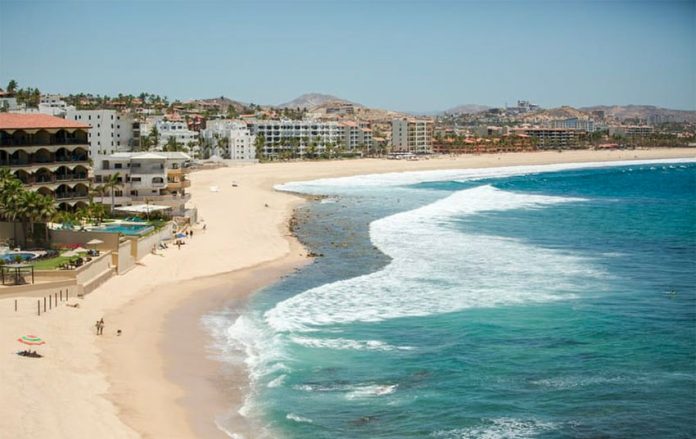
Foreigners will pay an extra US $18.50 to enjoy this beach.
Foreign visitors to Baja California Sur will pay a 350-peso (US $18.50) tourist tax effective November 9, the state government said on Friday.
The tax will apply to all foreign tourists who stay in the state for more than 24 hours.
Foreigners who fly into Baja California Sur will be able to pay the tax at kiosks in airports while the state’s port authority will be responsible for collecting the tax from travelers who arrive by sea. Hotels and other accommodation providers will charge foreign visitors who enter via land.
Governor Carlos Mendoza Davis said that visitors will also be able to pay the tax on a website and mobile app.
The Baja California Sur government expects to raise at least 490 million pesos (US $25.6 million) annually from the tax, which was approved by the state Congress in 2016 but not enacted by Mendoza until now.
“The charge of 350 pesos per visitor will form the Baja California Sur Sustainability Fund with which public security, healthcare, education, housing, employment, sports, culture, agriculture, fishing and tourism and social infrastructure will be strengthened,” he said on Twitter on Friday.
The governor has previously justified the imposition of the tax by pointing to the poor quality of life of many people who live in tourism-oriented parts of Baja California Sur such as Los Cabos.
The decision to enact the tax was made despite a recommendation by the Senate that it not be introduced on the basis that it could frighten off tourists and cause a loss of jobs.
The state’s announcement came a week after the lower house of the federal Congress approved steep hikes to two taxes that foreigners pay to enter Mexico: the DSM immigration services tax and the DNR non-resident tax.
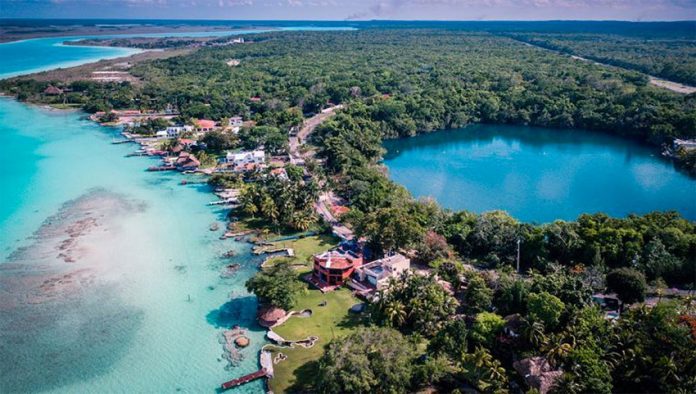
Landowners in Bacalar want more details before climbing aboard the Maya Train.
The National Tourism Promotion Fund (Fonatur) is seeking 1,000 hectares of community land in Bacalar, Quintana Roo, for a real estate project that will complement the Maya Train. But landowners are holding out for more information.
The tourism fund, which is in charge of the rail project that will link locations in five southeastern states, also wants another six hectares of Bacalar ejido land for the construction of a Maya Train station in the southern Quintana Roo town.
Ejido commissioner Luis Chimal Balam said that negotiations between Fonatur chief Rogelio Jiménez Pons and communal landowners have gone nowhere since the last meeting more than a month ago.
The ejido assembly has been clear that it will not authorize the use of such a large parcel of land without being certain that the community will be adequately compensated.
“They want to do business with our land but it’s not clear how we will benefit,” Chimal said. “They talk about being partners but they haven’t shown us a concrete proposal.”
He also said there is no formal agreement with Fonatur for the land where construction of the station is proposed although the landowners are willing to provide the six hectares.
“The last thing was that the assembly asked Rogelio Jiménez to show where the station will be, where the land they need is. We showed him three places, he liked one and said they were going to do studies to present to the assembly, but he later said that they want 1,000 hectares next to it . . .” Chimal said.
“Rogelio Jiménez came to me twice to tell me that they’ve planned a population center next to the station but my people also need resources . . .” he added.
Jiménez confirmed in an interview with the newspaper El Economista that Fonatur wants the large piece of land for a real estate project but stressed that the government would not expropriate the land.
He said the communal landowners will have the opportunity to partner with Fonatur and rent the land to the real estate investors. Fonatur will provide its expertise in attracting investment for the project, Jiménez said.
The almost 1,500-kilometer-long railroad, which is scheduled to begin operations in 2023, will run through five states: Chiapas, Tabasco, Yucatán, Quintana Roo and Campeche.
The government once again defended its actions in Culiacán at Thursday's press conference.
Security experts have slammed the government for revealing the name of a defense official in charge of the operation to capture a son of Joaquín “El Chapo” Guzmán in Culiacán, Sinaloa, last month, claiming that the official’s life has been placed at risk.
Acting on an instruction from President López Obrador, Defense Secretary Luis Cresencio Sandoval told reporters at the presidential press conference on Thursday that Juan José Verde Montes, director of the Drug Trafficking Information Analysis Group (GAIN), led the operation to arrest Ovidio Guzmán López on October 17.
However, López Obrador said on Friday that a different military leader was actually in charge of the security forces that arrested the 28-year-old suspected Sinaloa Cartel leader. He said that Verde Montes was in charge of the operation at “a national level.”
Sandoval said that Verde Montes was in fact leading a team in Mexico City that coordinated the Culiacán operation. The name of the commander who led the operation in the Sinaloa capital can’t be revealed because an investigation into the events in Culiacán is currently taking place, he said.
The decision to disclose the name of the GAIN director was heavily criticized by experts on national security and the Mexican military.
“It’s regrettable that they’ve provided the name of the colonel . . . because apart from ruining his military career, they’re placing his life in real risk,” said César Gutiérrez Priego, a lawyer who represents members of the military.
He said that Cresencio should have assumed operation for the failed operation in Culiacán but had instead “sacrificed one of his soldiers.”
The defense secretary and López Obrador “washed their hands” of responsibility, Gutiérrez said.
“This is unprecedented. I’d never heard a defense secretary blame one of his subordinates in order to excuse himself,” he added.
Jorge Luis Sierra, an expert on Mexico’s armed forces, said it was “not common” for the Secretariat of National Defense to reveal the names of the chiefs of military operations.
He pointed out that soldiers, military commanders and government officials have been murdered in the past after participating in operations against drug cartels, asserting that the life of Verde Montes has been placed at risk.
Defense Secretary Cresencio: ‘sacrificed a soldier.’
National security expert Javier Oliva Posada said that López Obrador’s lack of familiarity with the armed forces and its protocols was a factor in his instruction to Cresencio to reveal the GAIN chief’s name.
“The president made a mistake. He doesn’t know the armed forces, he doesn’t know the protocols and he’s the commander. He’s obliged to look after the integrity of his subordinates. This could diminish the morale of military personnel and affect the operating capacity and effectiveness of GAIN,” he said.
“. . . If something happens to [Verde Montes] or his family, the president will be responsible, he’s his boss and he’s the commander [of the armed forces].”
Security analyst Alejandro Hope claimed on Twitter that Verde Montes had been “crucified” by the government.
“If an official of the armed forces or police makes a mistake or commits a crime, he deserves a sanction after a process that adheres to the law. What he doesn’t deserve is it be crucified and to have his life placed at risk by an unprecedented revelation at a morning press conference,” he wrote.
In addition to asserting that Verde Montes was not in fact leading the Culiacán operation on the ground, López Obrador said today that the GAIN director will continue to have the same protection already afforded to him as a senior government official.
“He will have the protection that we all have,” the president said in response to a question asking whether he would be given special protection.
López Obrador said that all public servants face risks before adding, “he who owes nothing fears nothing.”
Verde Montes is “not alone, we’re a team and we all act with responsibility,” he said.
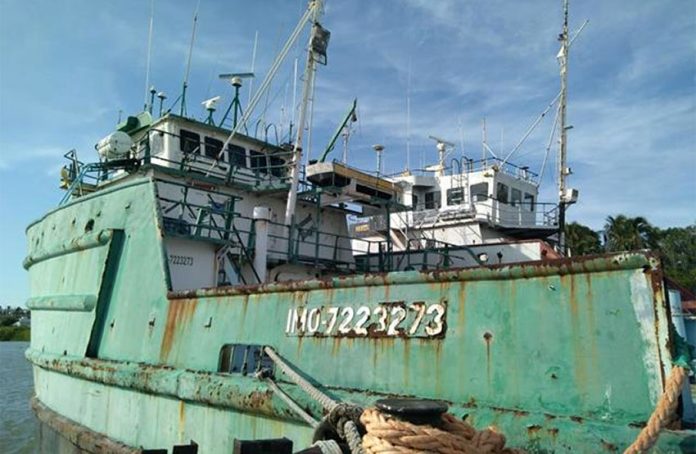
This 55-meter cargo vessel is probably suitable for transporting fuel—legal or otherwise.
Cars, real estate, watches and boats will go on the block on November 10 at the federal government’s fifth auction of assets seized from criminal organizations.
The director of the Institute to Return Stolen Goods to the People announced on Friday that 45 lots with a combined starting price of 32.5 million pesos (US $1.7 million) will be on offer at the Mexico City auction at Los Pinos, the former presidential residence that the government has converted into a cultural center.
Ricardo Rodríguez Vargas said the funds raised will be used to buy musical instruments for children in Oaxaca who play in bands.
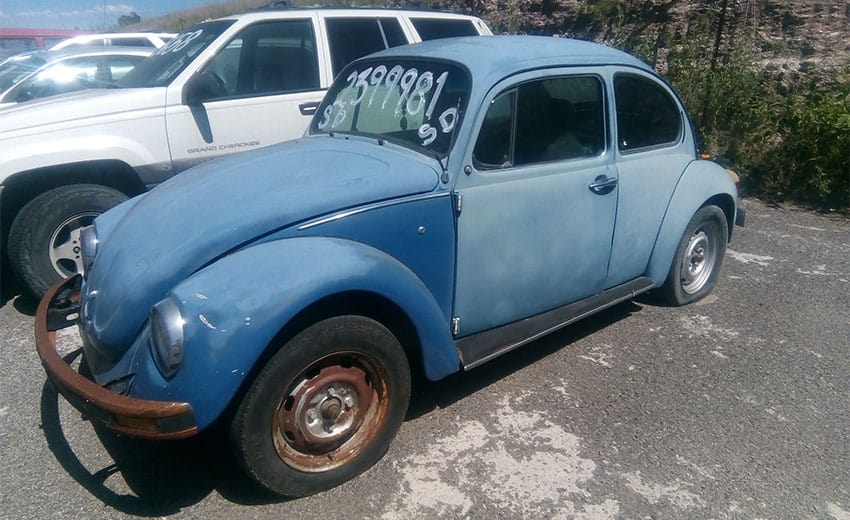
A Mustang, Corvette and cars made by Jaguar and Mercedes will be among 24 vehicles up for grabs, Rodríguez said, as will a Volkswagen beetle with a starting price of just 2,000 pesos (US $105).
Of nine properties to go under the hammer, seven are in Sinaloa and will have starting prices between 1.2 million and 11 million pesos, he said.
A 1995 Narco-Beetle.
The official said that bidding for 10 luxury watches will begin at prices 50% below their real value and that for the first time, the government will offer boats for sale. Two cargo vessels that also have the capacity to transport fuel will be on the block, Rodríguez said.
Tickets for the auction costs 100 pesos and can be purchased at convenience stores and supermarkets. Bids will also be accepted via telephone.
“Those who participate help because these resources go to noble causes, just causes . . .” President López Obrador said at his morning press conference.
Proceeds from previous government auctions were to go to disadvantaged communities, addiction centers and road work.
“Great grandmas and 5-year-olds” hike up from Amatitán to the cross once a year.
I have been describing interesting trails in western Mexico for around 35 years.
The very first I wrote about was the long, steep sendero leading to Las Piedras Bola, Jalisco’s Great Stone Balls, a site so unusual and curious that it actually made the cover of National Geographic back in August of 1969.
The hike to the Piedras was memorable because our guide, a 10-year-old boy, managed to get us lost just long enough for the first feelings of panic to tingle the hairs on the back of my neck.
I decided then and there it was my sacred duty to make my routes so obvious that my readers would be able to reach their destination entirely on their own.
For years I drew trail maps (with lots of landmarks) to show the way until at last, handheld GPS units came along, making it a whole lot easier to record and follow trails, step by step.
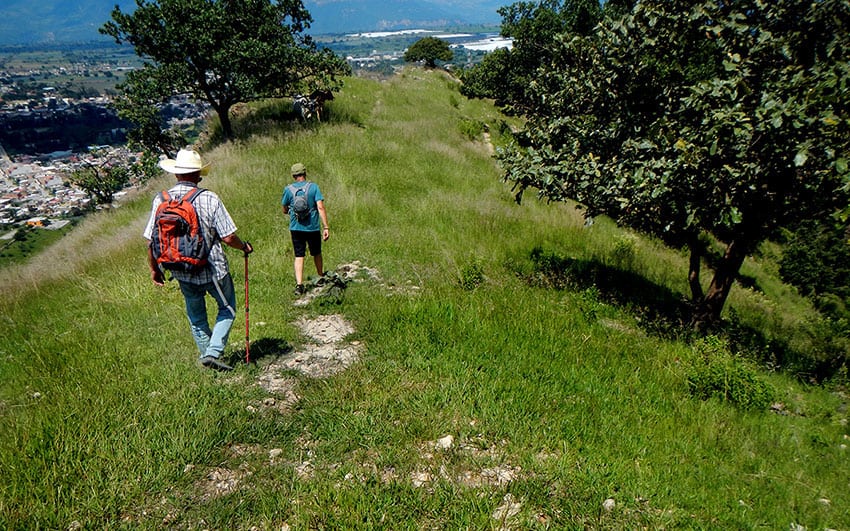
Hiking along the trail, well marked except at two crucial points.
Now I’m happy to report another milestone for hiking in Mexico: the (Spanish-only) web page of Senderos de México, an organization dedicated not only to helping people find their way along Mexico’s vast network of rural trails, but also to rescuing, rehabilitating and preserving ancient footpaths, some of them in use before the arrival of the conquistadores.
“The problem,” says Javier Michel Menchaca, one of the organization’s founders, “is that mechanization is reaching remote communities and many of our nation’s great old trails are simply vanishing.”
This realization prompted the founding of Senderos de México five years ago and the rehabilitation and sign-posting of numerous trails, 10 of which are listed on their website.
As for standardizing trail information, they have consulted with similar organizations in the United States and Spain to create a national system that will make it easy for people to understand distance, difficulty and direction of a trail as well as the attractions hikers might see along the route.
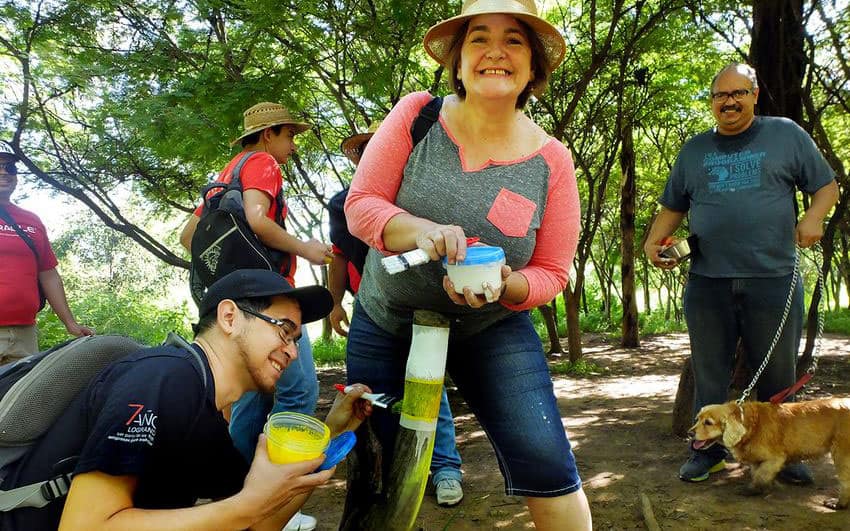
The trail-marking system they have chosen is the Grande Randonnée (GR) code used in France, Spain, Portugal and the Netherlands. This extremely simple system consists of two parallel bars of color to show you’re on the right trail. These are painted on trees and rocks with “eco-friendly” paint.
Right-angle versions of the bars indicate a left or right turn. If you should see the two bars crossed, however, it means you’ve wandered off the right path and you’d better backtrack. Here in Mexico, Senderos is using white and red bars for long trails and white and yellow for short ones.
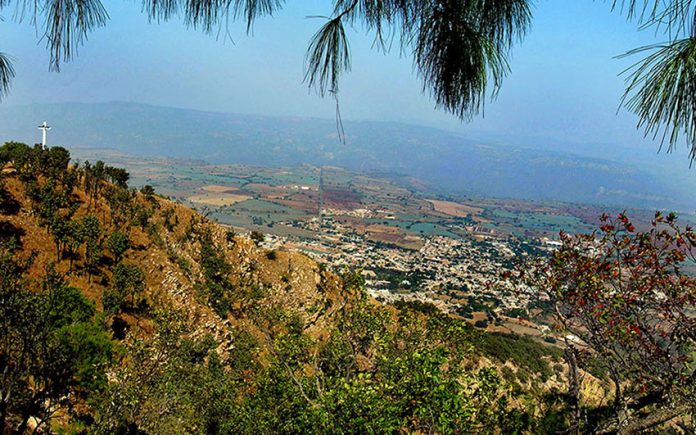
View to the north, from the cross.
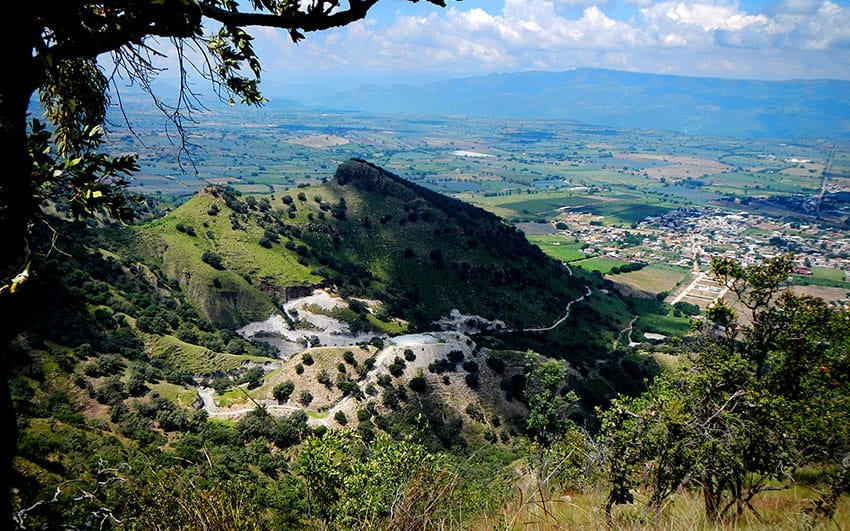
I decided to test the efficacy of this system by visiting a site recently signposted by Senderos. This is a steep hill called El Cerro de Amatitán, located 32 kilometers northwest of Guadalajara. Its peak is 1,793 meters (just over a mile) high and the cerro is famed for its beautiful vistas.
I had my eye on two Senderos trails up to the top of the mountain, one from the north and the other from the south.
“This,” I told my hiking partners, “will be a real test of the trail signs. We’ll go up the mountain one way and come down the other and if we survive, it means the system really works.”
We headed for the town of Amatitán, parked where the trail called “El Sendero del Agave” begins and, voilá, immediately spotted yellow and white stripes painted on a small rock. This sendero takes you through fields of blue-green agaves around to the south side of the mountain and then leads you to the top.
Our path was actually an old road — older than we could imagine, in fact. Alongside it we soon came to a plaque explaining that we were walking along what used to be called El Camino Real, once upon a time the royal road leading from Guadalajara to the port of San Blas, and paved with stone “Roman style.”
After a rather long meandering walk along wide dirt roads through agave fields, we reached the base of the Cerro de Amatitán and there the ubiquitous and handy trail markers suddenly ended.
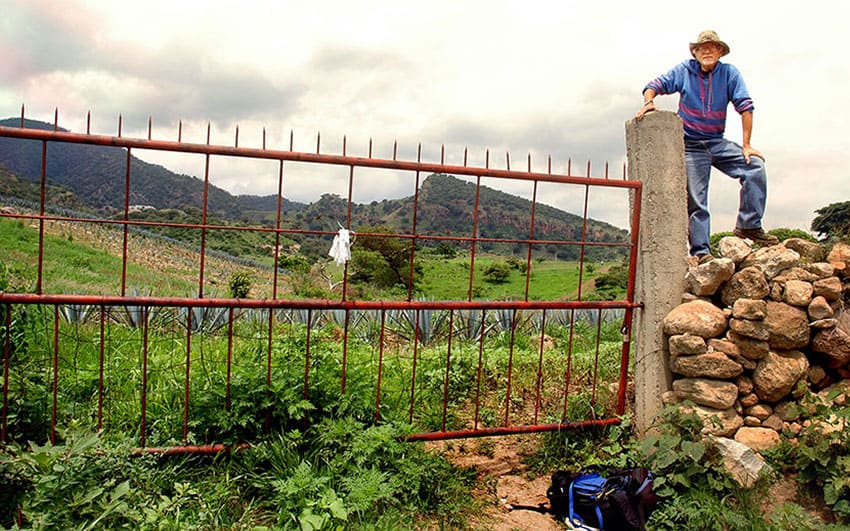
Says John Pint, “Every good hike begins with a fence or a gate.”
Unfortunately, exactly at that point heavy maleza (brush), stone walls and barbed wire were sealing off our access to the mountain. Try as we might, we could not find a convenient connection between the road we had been following and the trail heading up the mountainside.
“Senderos de México forgot to tell us we’d need a machete,” I cried to my compañeros as I battled through the two-meter-high brush — sprinkled with an abundance of thorn bushes, I might add.
At last I clambered over the formidable combination stone wall and barbed wire fence, only to find my friend Rodrigo Orozco munching an apple next to a thick tree — with white and yellow stripes on it.
“Yippee!” I shouted, “we’re back on the trail!”
Well, back on the trail only in a manner of speaking. You see, that lovely trail lasted only 10 minutes and did not appear again until we reached the very peak of the mountain. Fortunately, the signs continued guiding us, painted on rocks and trees.
“I now have a new understanding of the word sendero,” I told my fellow hikers. “It means ‘way’ in the vaguest possible sense, which may or may not include a path.”
Senderos de México volunteers marking a trail in Centinela Park, Guadalajara.
Well, bushwhacking our “way” up Cerro Amatitán was doable, but slow because the difference in altitude from the bottom to the top was 519 meters.
Sweating profusely, we finally reached the very pinnacle of the mountain, which offers a splendid view in every direction.
In a few minutes we arrived at a huge cross, the object of a yearly pilgrimage which, I told my compañeros, “is made by just about everybody in Amatitán, including great-grandmothers and 5-year-olds.”
With this consoling thought, we headed down the northern side of the hill, still guided by the white and yellow trail markers — only this time there really was a trail!
The views on the north side were much more stunning than those we had seen on the way up, but we dared not gaze upon them while walking because that trail I was so delighted to be on just happens to be strewn with billions of small, nearly round stones.
Yes, hiking on the north side was like dancing on ball bearings, and we had to watch our every step.
[soliloquy id="93182"]
Once again the Senderos markers guided us all the way down to the base of the mountain and then, alas, once again seemed to disappear. “So how do we get into Amatitán?” we asked ourselves when we ended up facing a high wall.
We began scouting around and soon Rodrigo shouted: “I found a gate in the wall, let’s go this way!”
Well, Rodrigo’s gate turned out to be locked and guarded by a whole lot of cows as well as a sea of thick, black — well, let’s call it mud. Now thoroughly pooped out (in every sense of the word), we dragged our tired bodies through the “mud,” climbed over the fence, slogged through even more goo on the other side and came to yet another stone wall, this one even higher than the last and cleverly combined with a barbed-wire fence.
Ah, yes, it just isn’t a real Mexican hike without stone walls and barbed wire!
Eventually we staggered into town, weary but triumphant: we had conquered the mountain and survived not one but two senderos!
Here I must mention that, despite the above description, I do greatly appreciate the hard work of Senderos de México and its many, many volunteers to put up all those signs, but it certainly would have been nice to have a good old-fashioned map as a backup!
I suggest that once you have found a trail you like on the Senderos website, you then search Wikiloc for a detailed map just in case one of those crucial trail signs has mysteriously evaporated.
The writer has lived near Guadalajara, Jalisco, for more than 30 years and is the author of A Guide to West Mexico’s Guachimontones and Surrounding Area and co-author of Outdoors in Western Mexico. More of his writing can be found on his website.
A Toluca rail car: auditors have found spending irregularities.
The Federal Auditor’s Office (ASF) has detected “erratic and discretional” conduct in the use of public resources in the final year of the government of former president Enrique Peña Nieto.
In a report submitted to the lower house of Congress on Thursday, the ASF said that 60% of all budget funds approved by lawmakers in 2018 were reassigned without proper justification. The total amount of funds in question is 3.62 trillion pesos (US $189.5 billion).
“In the stages of exercise and control [of budget funds], an erratic and discretional tendency was detected,” the ASF said, explaining that spending was not “equal or similar” to that approved by lawmakers.
The ASF found irregularities in spending on a number of infrastructure projects including the canceled Mexico City airport, the unfinished Mexico City-Toluca train and the new Guadalajara train.
Just under 1.6 billion pesos (US $83.5 million) paid to airport contractors was questioned by the ASF as was 272.2 million pesos spent on the Mexico City-Toluca train.
Among the irregularities detected in spending on the latter project were improper and duplicate payments and the adjustment of costs that had been agreed to with contractors.
Spending of 315.4 million pesos on the Guadalajara train, including payments for unforeseen costs, was flagged as questionable by the ASF.
Chief auditor David Colmenares told lawmakers that the ASF detected 933 separate cases of suspicious spending that could result in the filing of criminal complaints.
He said that spending that the ASF had never previously looked at was considered in the audit of the 2018 public accounts.
That included an inspection of the financial records of municipal governments as well as those of all 31 states and Mexico City in order to establish how they used federal resources.
The ASF said the use of 28.86 billion pesos (US $1.5 billion) by state and municipal governments needs to be clarified.
The ASF also reported that ISSSTE, the State Workers’ Social Security Institute, recorded a loss of 3.98 billion pesos in 2018 and that the government-owned National Lottery was running a deficit of 6.1 billion pesos at the end of last year.
RC planes will take to the skies above Torreón in November.
There will be lots of small planes buzzing around the Laguna region in Coahuila next month at the 2019 Del Norte Fly Fest in Torreón.
The event is expected to bring 400 pilots of radio-controlled (RC) airplanes and 2,500 invited guests.
State tourism undersecretary María Eugenia Villarreal Abisaíd said that the event will be a big economic boost for the city, filling around 800 hotel rooms per night.
“We’re very happy to have this event,” she said. “It’s the second year we’ve done it. It’s a specialized, private event, but we’re looking to open it up to the general public in 2020.”
The Fly Fest will bring RC pilots from Coahuila and 10 other states as well as a special guest from the United States.
Freestyle world champion Jase Dussia from Michigan will participate in the freestyle competition, which will be accompanied by music and judged on the artistic and technical skills the pilots can display in a period of four minutes.
The Fly Fest will take place on November 15-17 in the municipality of Matamoros, part of the Torreón metropolitan area.
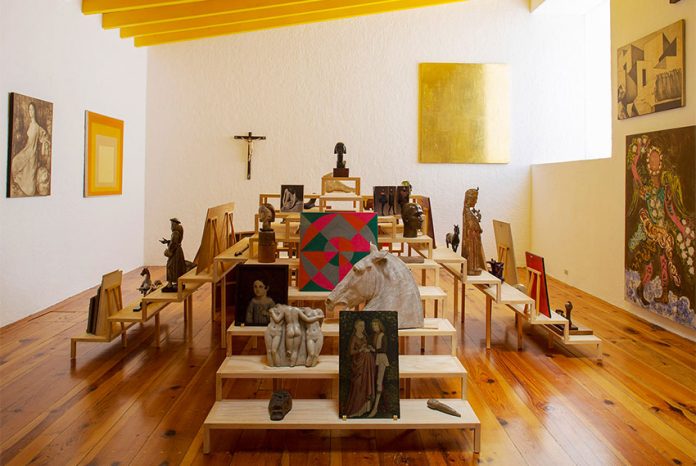
Design of the Altar Shelf draws on Barragán's signature geometric style.
The personal art collection of eminent Mexican architect Luis Barragán is on display at his house in Mexico City.
Designed with the architect’s signature geometric style in mind, the temporary shelves used to display the pieces were created by local design studios Sala Hars and AGO Projects.
Called the Altar Shelf, the construction is a symmetrical, four-sided piece meant to display Barragán’s collection of paintings, statues and artifacts from all angles.
“Our intention was to create a setting that allows the viewer at all times, and from all angles, to see the pieces from sides that have never been accessible to the public, providing a new reading of the work as a constellation.”
Drawing on forms Barragán himself used in his work, the pyramidal Altar Shelf “pays subtle homage to the architect’s broad ideas and inspirations — from the famous floating stair to the religious imagery within the house.”
The curation of the pieces follows no particular order, contrasting with the rigid, geometrical formation of the display apparatus. Other paintings and sculptures are set along the walls surrounding the Altar Shelf.
Barragán was born in 1902 in Guadalajara. His work focused on bright, bold colors and their interplay with geometry and light. A devout Catholic, his beliefs are reflected in the religious imagery adorning his house.
He completed his home and studio in 1948, and in 1980 he was awarded architecture’s most coveted trophy, the Pritzker Prize. The home-studio has been a UNESCO World Heritage Site since 2004.
It is just one of many structures the architect designed in Mexico City, along with the Casa Gilardi, with its walls of striking primary colors, the pastel pink Casa Prieto López and the gold-paneled chapel at the Capuchinas Sacramentarias convent.
The installation is part of an exhibition called Emissaries for Things Abandoned by Gods, which features work by contemporary artists from all over the world in other rooms of the house. It began in September and runs until December 15.
The house is located at Gral. Francisco Ramírez 12-14, Ampliación Daniel Garza.