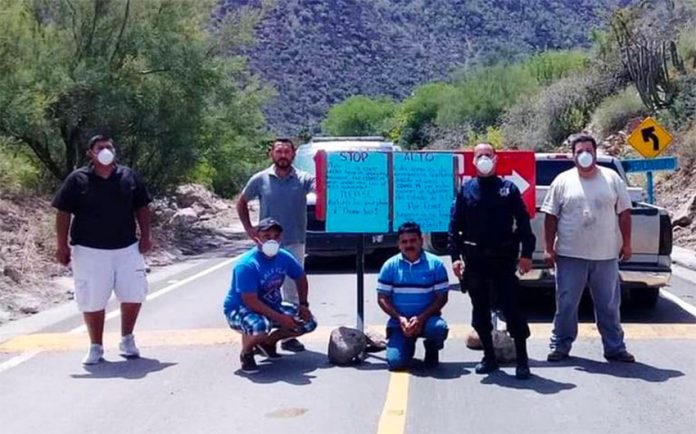
San Javier residents block the road into their community in light of the coronavirus emergency.
Residents of indigenous communities across the country are starting to say no to visitors, closing off access to their towns in order to avoid Covid-19 outbreaks in areas with high concentrations of vulnerable people and few medical resources.
Residents of San Javier in the Baja California Sur municipality of Loreto came to a consensus to close off the town on Thursday, citing the high percentage of elderly people and a lack of medical supplies.
Local authorities said there were currently no confirmed cases of Covid-19 in Loreto, and the citizens of San Javier are hoping their isolationist tactics will keep it that way.
In the south of the country, residents of San Juan Bautista Valle Nacional in northern Oaxaca voted by 80% to close the municipality off to outsiders to avoid contagion.
Mayor Rey Magaña García said that the vast majority of the municipality’s 53 communities voted to block access roads to all who are not residents, including relatives from other areas.
He also cited the risk to the municipality’s vulnerable population as a reason for taking the action, noting that Valle Nacional receives a lot of traffic moving between the state’s Cuenca del Papaloapan and Valles Centrales regions.
Restaurants in the municipality remain open, but only for take-out orders, tourist centers like the Monte Flor and El Zuzul swimming holes are closed and police are patrolling the river to ensure people aren’t gathering to swim.
Several communities in the Chiapas municipality of Ocozocuautla took similar measures to avoid Covid-19, blocking highways, closing tourist services and publicly requesting that people not visit.
In the north, authorities in two Chihuahua municipalities have been told by the state government that their decisions to close their towns were illegal.
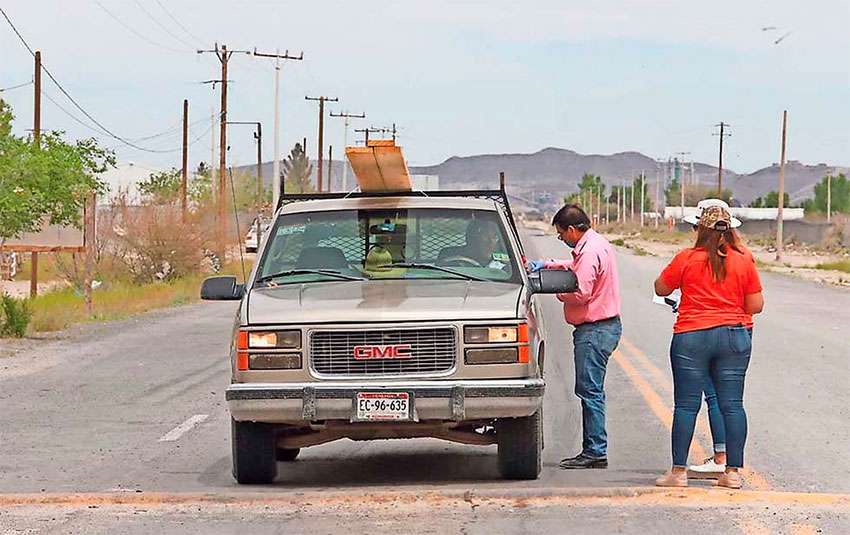
Residents of Samalayuca formed brigades that began to stop and try to “persuade” visitors not to enter the municipality on March 26. Four days later, Mayor Javier Meléndez Cardona announced the all-out closure of access to anyone not from the 1,500-population town.
“Please don’t come,” he said on social media, adding that parks, tourism and other attractions were all shut down anyway. Samalayuca is known for its white sand dunes, waterparks, cave paintings and agricultural festivals.
A vehicle is checked on a highway in Samalayuca, Chihuahua.
The restriction applies only on weekends and will remain for the duration of the month-long emergency period.
Over 600 kilometers away, the municipal government of Urique, located in the famous Copper Canyon region, has prohibited outsiders from both entering and leaving the town.
Municipal representative Angélica Torres said that the decision aims to protect the town’s indigenous residents, who make up around 70% of its population.
“[Indigenous residents] are a bit more rooted in their customs and they don’t pay attention to whatever normal preventative measure we might tell them, like washing their hands, keeping their distance, sneezing into the arm,” she said of the threat the virus poses to them.
“They definitely don’t comply with these types of measures and the truth was that this was one of the situations we thought about most … that if there is contagion in the municipality, they’ll be the main ones affected,” she said.
Speaking to both the local community and tourists from across the globe, Torres pleaded with people not to visit the popular tourist destination during the Covid-19 pandemic crisis.
“We’re issuing this request to the community and to tourists in general not to come to our municipality for the wellbeing of our Rarámuri people, who are our most vulnerable population … [and] for the wellbeing of everyone,” said the local government in a statement.
“Please pardon the inconvenience. We’ll get through this crisis together,” it said, adding that the closure will be lifted on April 20.
A spokesperson for the state Ministry of the Interior, Alejandro Solís, said that both municipalities were alerted that their closures were illegal by state Interior Minister Luis Fernando Mesta Soulé on March 30.
“In the end it’s a crime to impede the transit of other people,” said Solís.
“We understand perfectly that the authorities are worried about their citizens, but … in this case they’re violating a [constitutional] right,” he said.
There is currently no effort at the state level to open up the communities, he said, as they are hoping the communication will be sufficient for the municipalities to make the decision to do so themselves.
Chihuahua had 11 confirmed cases of Covid-19 as of Friday, and the number of suspicious cases had dropped to 20. Oaxaca had 22 confirmed and 73 suspicious cases. Chiapas had 18 confirmed cases and Baja California Sur had 21.
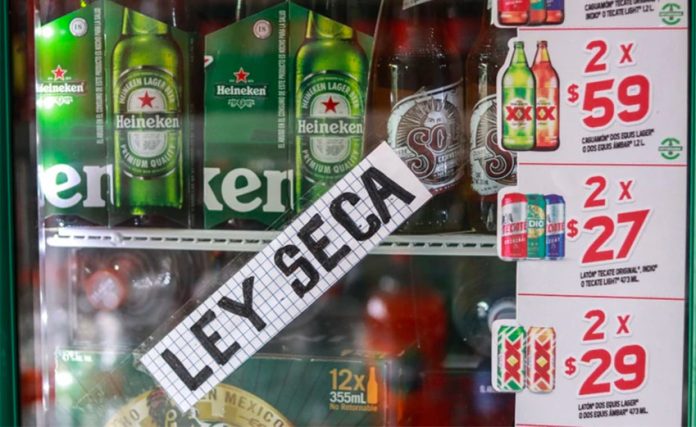
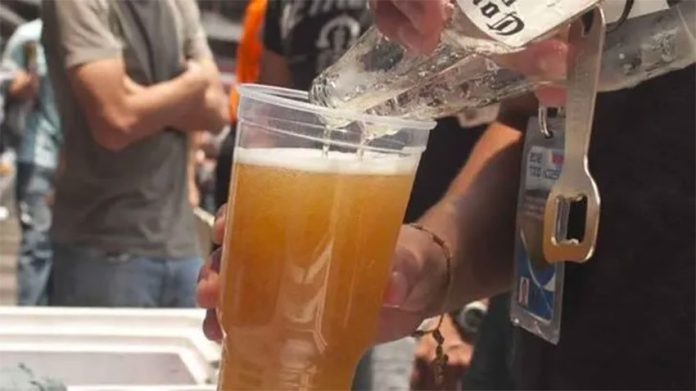
Ley seca, or a 'dry law,' is being introduced in various states.
“Dry laws” that put restrictions on alcohol sales, commonly enacted during elections, are popping up in communities across the country, triggered by the month-long coronavirus emergency.
The laws range from restrictions on hours of sale to all-out prohibitions on the sale and consumption of alcohol.
State and local authorities in Tabasco, Baja California Sur, Sonora, Campeche and Quintana Roo are the most recent to announce that they will restrict or prohibit alcohol sales, following a trend that began on Thursday in Nuevo León.
The strictest regulations in the country have been applied in Tabasco, where even consuming alcoholic beverages has been prohibited for the duration of the emergency period. The governor announced the restrictions in a taped recording on Wednesday, but did not explain what the benefits of the measure might be.
Municipal authorities in Los Cabos, Baja California Sur, announced the prohibition of alcohol sales beginning on Monday, threatening any businesses that fail to comply with fines ranging from 8,600-16,800 pesos (US $345-$673).
Also in Baja California Sur, the municipality of Comondú announced on Friday the immediate prohibition of alcohol sales for the remainder of the month-long emergency declaration, with sanctions running from fines to shutting down businesses.
Less restrictive actions were announced in Sonora, Campeche and Quintana Roo, which will take lighter measures such as restricting the hours in which alcohol can be sold.
Authorities in Sonora said the temporarily adjusted sales schedules would be based on population sizes in the municipalities.
Alcohol sales in Campeche will be prohibited from noon to 6:00 p.m., making beer, wine and spirits available in the evening.
In a move contrary to its very raison d’être, Quintana Roo, the home of such popular tourist and party destinations as Cancún, Tulúm and Cozumel, will also restrict alcohol sales, but only slightly.
The prohibition will only restrict the sale of alcoholic beverages from 10:00 p.m. to midnight from Monday to Saturday in certain municipalities, including those in which the state’s popular tourist destinations are located.
Alcohol sales will continue to end at 5:00 p.m. on Sunday in the state and normal sales hours will resume on April 10.
The only reason that has been given for the dry laws was offered by Nuevo León Governor Jaime Rodríguez, who predicted physical conflicts arising among people imbibing while cooped up in their homes due to the coronavirus quarantine.
President López Obrador weighed in on the subject at his press conference on Friday, indicating that health officials would have to decide whether alcohol consumption should be restricted during the coronavirus emergency.
But he suggested the value of doing so appeared doubtful.
Beer drinkers in areas that have not enacted dry laws may still have reason to worry about the availability of the beverage as major beer makers have announced they will halt production after the government deemed the industry “nonessential.”
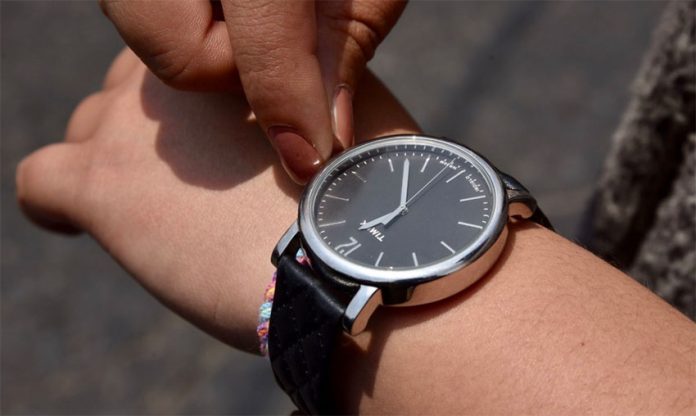
Clocks across the country are set to spring forward an hour at 2:00 a.m. on Sunday for daylight saving time, but with a few exceptions.
Neither Sonora nor Quintana Roo will change their clocks for trade and tourism reasons, while 33 northern border municipalities in the states of Tamaulipas, Nuevo León, Coahuila, Chihuahua and Baja California have already changed theirs.
Their time changed on March 8 to be in sync with communities across the border. For them, daylight saving ends November 1.
For the rest of the country daylight saving time remains in effect until October 25.
The practice was first implemented in Mexico in 1996 during the administration of President Ernesto Zedillo Ponce de León to make better use of daylight hours and conserve electricity.
But calls to end the practice have surfaced in Sinaloa and Mexico City in recent years, as opponents cite international trade and health concerns as reasons to let the clocks run their course unaltered.
President López Obrador has a long history of challenging daylight saving time, causing some to speculate that his administration might put it to a public referendum, possibly ending the practice, but no such move has been made.
Over 60 varieties of corn designated as part of Mexico's heritage.
A controversial federal law to promote and protect native corn was approved recently by the Senate, ending the possibility of what one supporter calls the “intellectual plundering” of indigenous communities.
One of the bill’s sponsors, Morena party Senator Ana Lilia Rivera, stated that one of the motives behind the law was “… the debt that [Mexico] still has with indigenous communities since the implementation of the North American Free Trade Agreement [NAFTA] in 1994.”
The bill seeks to guarantee the preservation and promotion of native Mexican corn varieties against competition from modern hybrids and genetically modified corn.
All corn produced and sold in Mexico will be labeled to indicate how it was produced. “Native corn” applies to crops created solely by traditional agricultural methods while “Hybrid corn” applies to those grown using more modern agricultural techniques, which have caused concerns related to nutritional value.
“Genetically modified corn” refers to those varieties that have been developed to be resistant to certain kinds of infestations and adverse climate conditions such as drought.
The law designates over 60 varieties of corn developed with traditional and indigenous agricultural methods as part of Mexico’s national heritage, making its conservation a human right on par with nutrition, health and culture.
The law was proposed and passed because of the coming implementation of the USMCA, the new trade agreement between the United States, Mexico and Canada, which will replace NAFTA. The latter allowed large quantities of cheaper, foreign corn, principally from the U.S., into Mexico. Today, Mexico produces only a fraction of the corn it consumes.
Genetically modified corn and modern hybrid varieties are seen as a concern because of the possibility that foreign companies can patent seed varieties that were already developed under traditional Mexican agriculture. Victor Manuel Chima of the Fray Francisco de Vitoria Human Rights Center calls such a possibility a “… a kind of intellectual plundering of [indigenous] communities.”
Senator Rivera asserted that because of this new law “… never, ever, will anyone be able to patent or create economic or commercial rights [that would take precedence] over the human right to corn.”
Another concern is the contamination of native varieties by crossing them with foreign, genetically modified corn. The law establishes the Consejo Nacional del Maíz (National Corn Council, or Conam) to document and establish regions where native corn varieties are grown, and from this information create policies to support such production.
One objection to the law came from the Consejo Nacional Agropecuario (National Agriculture Council) which believes it will prohibit the cultivation of naturally bred hybrids within Mexico along with genetically modified corn. Others point out that the consumption of genetically modified corn has not been proven to be harmful to human health.
Chima stated that despite the new law native corn is still in danger because the communities that grow these varieties “have been marginalized for many years.”
He said, “With this law, we look to replace the importation of tonnes of corn from the United States with the development of public policies to guarantee production, not only for consumption, but also to guarantee that this corn is nutritious and of quality.”
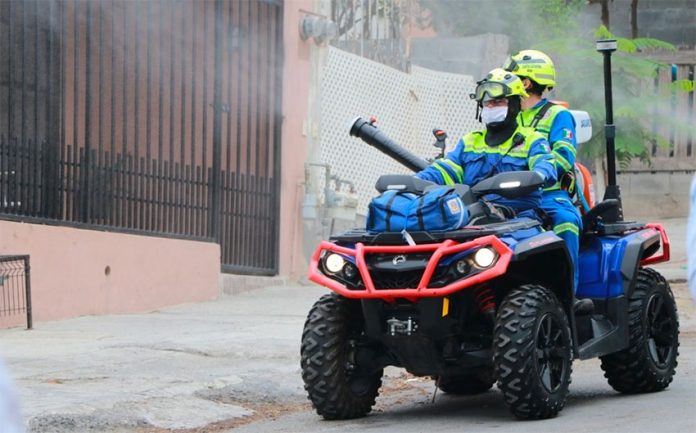
A quad is used to spray a disinfectant in public areas of Santa Catarina, Nuevo León.
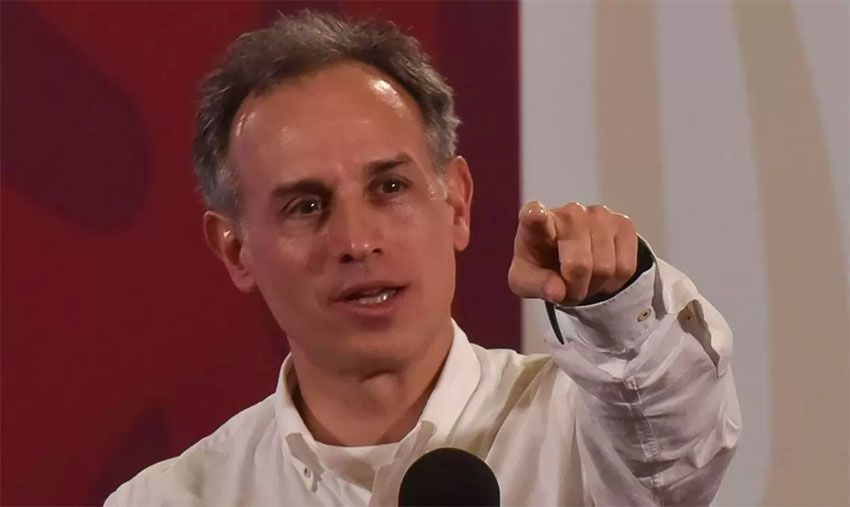
The Semana Santa (Easter Week) school and work holiday begins next week, but Deputy Health Minister Hugo López-Gatell reminded the public on Friday that people will have to spend it at home in the continued effort to mitigate the spread of the coronavirus.
“There are no vacations because there is an order to temporarily suspend all [nonessential] activities in the public and private sectors,” he told his daily coronavirus update press conference.
The epidemiologist said “if we don’t move around, the virus doesn’t move around and there isn’t transmission. Stay home, don’t go on vacation, stay where you are.”
He reminded the public that the goal of the mitigation efforts is to flatten the epidemic curve, or lower the rate of transmission so that infections are spread out over time rather than spiking all at once, and people must stay at home in order for that to happen.
There were 1,688 confirmed cases and 60 deaths from Covid-19 as of Friday evening, while 8,602 possible cases had tested negative and 5,398 suspicious cases were being investigated.
Mexico City has seen the majority of the deaths with 15, followed by Jalisco with sixand Baja California and Sinaloa with five each. Men represent 58% and women 42% of the confirmed cases.
Following recommendations by a coronavirus expert at the National Autonomous University and authorities in the United States that citizens wear face masks, López-Gatell said there is no evidence that the masks have been successful in slowing the spread of the virus in other countries.
But, he said, people can use them as an “auxiliary prevention measure.”
Proponents of the masks believe they lower the chances of transmission by people who are infected but present no symptoms.
“It’s common for waves of information to rise with the hope of finding alternatives [to physical distancing] … but the popularity of this information doesn’t necessarily correspond with the scientific soundness of evidence,” he said.
However, he said there is no harm in wearing face masks, but asked the public not to use N-95 respirator masks, which should be reserved for medical personnel.
As for the public’s response to the emergency declaration so far, López-Gatell was “satisfied,” but said that it was still too early to be able to observe the effects of the preventative measures on the spread of the virus.
He stressed that there’s still a long way to go before the end of the pandemic and that everyone’s cooperation is vital to mitigating its effects.
“It’s clear that no one is exempt from the risk [of infection]. We can’t give ourselves the luxury of discord, of believing that we can save ourselves individually. I’m making a call for patience … with an attitude of compassion and solidarity that will keep us united today and tomorrow.”
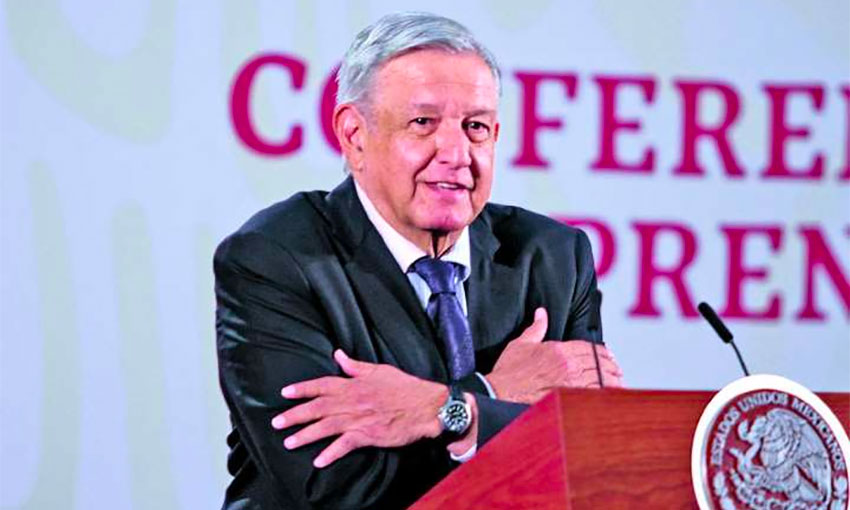
President López Obrador on Friday ruled out any possibility of implementing “draconian measures” to contain the spread of Covid-19 but said that the government will consider banning alcohol sales.
Speaking at his regular news conference, López Obrador said his administration wasn’t considering imposing a curfew or any other “authoritarian” measures as part of efforts to limit the coronavirus outbreak.
There won’t be any “draconian measures” of “questionable effectiveness,” he said.
With regard to the possibility of enforcing a nationwide ley seca, or dry law, that bans alcohol sales, López Obrador said that it will be up to health officials to make a decision.
“[The specialists] have to look at it because there has been controversy about this. In the case of Mexico City, it was decided not to impose the so-called dry law. In other states where it has been established there is a little bit of protest but the governors are listening to the people,” he said.
“[The decision] corresponds to [the government’s] medical team; they’re very good, they could say the consumption of alcoholic beverages is not appropriate under these conditions,” López Obrador said.
Tabasco is the only state to have decreed a dry law due to the coronavirus pandemic but Sonora, Campeche and Quintana Roo have restricted alcohol sales to certain hours.
Nuevo León Governor Jaime Rodríguez Calderón appeared to announce a prohibition on alcohol sales at a press conference on Thursday but quickly clarified that his government was not planning to implement a dry law. Nevertheless, the governor’s initial remarks triggered panic buying of alcohol in the northern state.
López Obrador pointed out that the panic buying in Nuevo León caused people to gather together and in doing so violate the government’s “healthy distance” recommendations.
“It can’t be said that the aim of flattening the famous [epidemic] curve has already been achieved but we’ll be able to do it in a few more days,” he said.
The government declared a health emergency on Monday that suspended all non-essential activities until April 30 as the number of confirmed cases of Covid-19 in Mexico passed 1,000.
More than 400 additional cases were reported over the next three days, taking the total number of cases in the country to 1,510. As of Thursday, 50 people in more than 20 states had died of the disease that was first detected in Wuhan, China, in late 2019.
Like many other populist leaders around the world, including United States President Donald Trump, Jair Bolsanaro in Brazil, and Imran Khan in Pakistan, Mexican President Andrés Manuel López Obrador (commonly known as AMLO) has mostly taken a dangerously dismissive and outright irresponsible attitude toward the coronavirus.
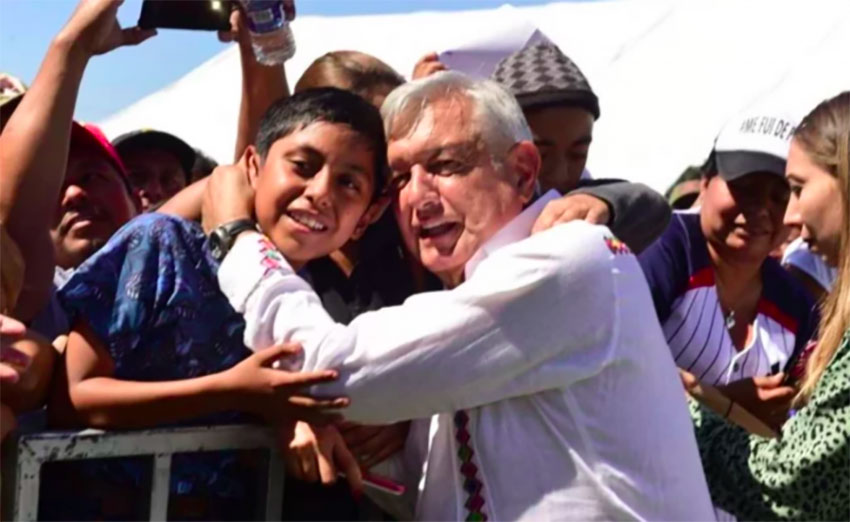
Late into March, he failed to adopt any necessary preparation for the Covid-19 pandemic. Instead of encouraging social distancing, he encouraged Mexicans to go to fiestas, eat in restaurants, and go out shopping. He has continued to attend rallies, kissing people.
Like “Dr. Beetroot,” a former South African minister of health who spewed criminally-negligent falsehoods that garlic, lemon, and olive oil could cure AIDS, AMLO exhibited pictures of saints as protection against Covid-19.
Some necessary response measures are finally under way in Mexico, but mostly not thanks to AMLO. Like in Brazil where some city and state-level officials — including those who used to be Bolsanaro’s closest allies — have begun breaking away from that president’s blatantly wrong response to Covid-19, some mayors and governors in Mexico are beginning to act on their own, including counter to AMLO.
On March 22, the mayor of Mexico City, Claudia Sheinbaum, cancelled large gatherings and shut down schools and businesses.
Spreading the AMLOve—and perhaps a virus too.
Only more recently, when Covid-19 reached the community-based spread phase in the country, did AMLO start sounding a little more cautious. On March 24 and 25, the Ministry of Health finally banned large events and the AMLO government suspended all non-essential activities, though with few details on its implementation and enforcement. The Mexican government also created a cartoon superhero heroine, Susana Distancia, to motivate Mexicans to stay six feet apart.
Even though he campaigned as the end-to-impunity, anti-corruption candidate, AMLO himself continues to violate all of the new regulations. Instead of focusing on beefing up his feeble Covid-19 response and following his own restrictions on travel, AMLO spent March 29 traveling to Sinaloa to meet the mother of the notorious drug trafficker Joaquín “El Chapo” Guzmán.
He shook her hands vigorously in front of TV cameras, tightly surrounded by his officials and local representatives as he received pats on the back. Perhaps Susana Distancia should confront AMLO — from six feet away, of course!
AMLO and his administration have already recklessly endangered the lives of many Mexicans. The country’s infection numbers remain relatively low, but are rapidly rising. On March 26, 475 tested positive for coronavirus; on March 30, 993 tested positive and already 20 deaths had been registered. Moreover, these numbers likely vastly underestimate the actual level of infection, since little testing occurs in Mexico and testing kits are critically lacking.
Mexico’s poorest, whom AMLO seeks to empower, are the most vulnerable. By wasting time and sending the wrong messages, AMLO missed an opportunity to contain the spread of the pandemic in Mexico when it was most containable.
His reluctance to acknowledge the seriousness of Covid-19 — while he clung to a false hope that the pandemic would somehow bypass Mexico despite its interconnectedness with the Covid-ravaged United States — resemble the dithering we’ve seen from Trump, Bolsanaro, and Khan: It’s a misguided attempt to save the country’s faltering national economy. Like the other leaders, AMLO has been trading people’s lives for the delusion that Mexico’s economy can be sheltered from the pandemic.
For over a year, Mexico’s economy has hovered just barely above a recession. That’s very bad for any political leader. In AMLO’s case, the poor performance of the economy also eviscerates his capacity to deliver on the immense redistribution promises he had made to voters. And the 2020 outlook for the Mexican economy is bleak. Many economic forecasting and credit agencies just put forward a devastating prognosis: the most optimistic is from Goldman Sachs, which expects a 1.6% contraction; the most pessimistic predict a 5.8% to 8% contraction. None predicts growth.
Meanwhile, the coronavirus pandemic and the needed response measures hit the poor particularly hard. Like others in Mexico’s informal sector (which constitutes some 60% of the work force), they are highly vulnerable to businesses being forced to shut down and to people avoiding the streets to buy their wares. Their capacity to withstand an economic contraction is limited.
Mexico’s medical sector, overall, is gutted after years of spending cuts — including a 44% cut to a public health and welfare agency by AMLO himself. Budget cuts have left hospitals and clinics short of beds, medical equipment, test kits, and personnel. Around 10,000 medical professionals were laid off in 2019, causing the cancellation or delay of many medical procedures, including surgeries for children.
After recent protests by medical personnel, the AMLO government promised to spend US $150 million on hiring 40,000 medical professionals and procuring additional supplies. But filling the vacancies and getting tests and other supplies in will take time. These measures are barely a drop in the bucket as Mexico confronts Covid-19 with one of the slimmest public health budgets in history of $5.4 billion, equivalent to 2.5% of GDP. Even before Covid-19, Mexican medical experts believed that $341 million per month was needed to keep the medical system afloat.
AMLO compounded their vulnerabilities by shutting down Seguro Popular, an insurance arrangement for people in the informal sector, which covered 60 million people. He complained that Seguro Popular was too costly for its beneficiaries, perniciously “neoliberal,” and rife with corruption. That move is part and parcel of his kneejerk liquidation of the policies and institutions built by previous administrations. He sees the programs of his predecessors as complicit in perpetuating a “mafia of power” and a hinderance to the Fourth Transformation he claims to be implementing.
Instead of Seguro Popular, AMLO announced in January 2020 the creation of Insabi, a medical care program that is supposedly cost-free. But, as has been the fate of other programs announced by a leader who is not interested in policy details and who does not heed warnings about downsides, Insabi — a highly centralized version of Seguro Popular — so far exists mostly on paper.
AMLO offers a hug to reporters at his daily press conference.
Moreover, despite AMLO’s promises to the contrary, Insabi has made some procedures costlier, while eliminating coverage for some. And the cost of medication went up, once again hitting the poorest the hardest. The poor in Mexico, who constitute close to half of the country’s population, have no safety net. It wasn’t until late March that AMLO’s government at least sped up transferring resources that had been previously allocated to Insabi.
AMLO’s dismissive attitude toward Covid-19 will not insulate him from the effects of the illness. If large segments of Mexico’s population become ill, the country’s economy will remain suppressed for far longer than necessary. If the outbreak drags on, manufacturing centers and other key businesses may lose far more business and lay off many more workers. And tourists won’t want to visit an infected country.
The AMLO administration’s response to Covid-19 starkly contrasts with the response of the Felipe Calderón administration to the H1N1 swine flu in 2009. The Calderón administration responded with swift, resolute, and effective measures, even if economically costly ones. Rapidly, the Calderón administration banned all public gatherings, shut down schools, and in Mexico City, also all non-essential services. It maintained transparency about the spreading epidemic and closely cooperated with the United States and Canada.
Tragically, AMLO failed to learn from Mexico’s globally-recognized leadership in responding to H1N1. The poor will be hurt as much by Covid-19 as by AMLO’s mishandled policy response. Many elderly poor continue to be family breadwinners in the informal sector.
For a poor family to lose grandparents in Mexico entails other socio-economic consequences: with lower-class parents frequently commuting two to three hours each way to work, it is often the grandparents who see children off to school or watch them afterward. Without the grandparents around, gang recruitment of kids left on the streets on their own may rise.
And how will social distancing be maintained when Covid-19 arrives in Mexico City’s vast crowded slums, or the poor rural communities in Guerrero or Chiapas, with very weak policing and healthcare systems? Perhaps some of Mexico’s criminal groups may act as enforcers of social distancing and care providers there, as is already happening in the favelas of Rio de Janeiro. Their power will thus grow.
Mexico must and still can act better. AMLO must wake up from his delusions and begin adopting and enforcing serious measures to stop Covid-19’s spread, leading by example. But if AMLO persists with spending his political capital and time on visiting the mothers of imprisoned narcos and violating the government’s own regulations, Mexico’s governors and mayors must start acting on their own.
They must impose restrictions on gatherings and work with their medical professionals to prepare for isolating those who contract the virus. And they must not ignore the poor, helping with the provision of food and water so that people can minimize leaving their homes while avoiding starvation.
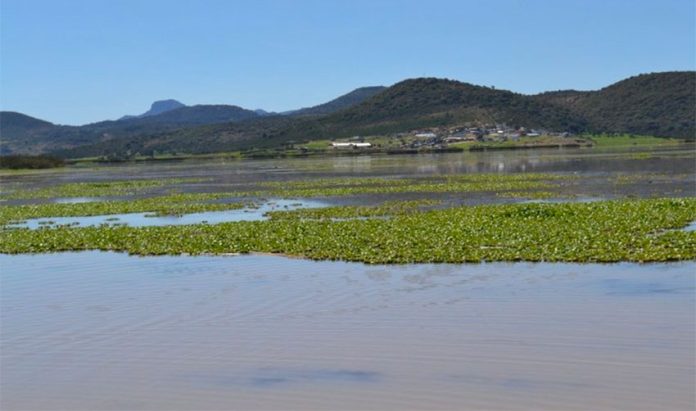
The capacity of Hidalgo’s Tecocomulco Lake to store water has been drastically reduced by the invasion of two aquatic plants and the accumulation of mud on its bed, says the state chief of the National Water Commission (Conagua).
Armando Hernández Mendoza told the newspaper La Jornada that the 1,679-hectare lake, located southeast of the state capital Pachuca, is at risk of drying up because of the proliferation of tule – a species of the plant family commonly known as sedges – and water lilies as well as the large amount of mud on its bed.
He said that the lake has become more like a flat plate than a bowl, with water depths of just 60-70 centimeters. Hernández explained that Tecocomulco Lake depends on subsurface flows from the north of Puebla and that if there are no new flows soon “it could dry up.”
Jaime Martínez Parras, chief of the Tecocomulco Lake Basin Commission, said that the proliferation of tule and water lilies – the two plants now cover more than 70% of the lake’s surface – also pose a threat to a range of wildlife, explaining that large numbers of axolotls (Mexican salamanders), Montezuma leopard frogs and charales, a native species of silverside fish, have died.
He explained that the water that flows into the lake originates in areas where cattle are raised and crops are grown and as a result brings with it large quantities of nutrients that allow the two aquatic plants to proliferate. Cutting and disposing of the tule and lilies is only a temporary solution, Martínez said.
Both he and Hernández believe that the lake, which attracts migratory birds and is designated as a wetland of international importance under the Ramsar Convention, will cease to exist as a water body within 60 years.
Another lake in Hidalgo that currently has much less water than it should have is the Laguna de Metztitlán, which has lost 95% of its water due to drought and seepage.
Some 200 to 300 liters of water per second continue to flow into the lake, a key source of water for agriculture, but greater quantities of water are lost due to percolation, or seepage.
Thirty-five companies will contribute to a project that intends to manufacture 15,000 ventilators to treat coronavirus patients, said the chief of one of Mexico’s largest business groups.
Enoch Castellanos, president of the National Chamber for Industrial Transformation (Canacintra), said in an interview that the ventilators will be made from a design developed by Mexican designer Alfredo Bonilla.
A prototype has already been made at Creativika, an innovation center in León, Guanajuato, and is currently being tested by Mexican Social Security Institute (IMSS) medical personnel.
Once the federal health regulatory agency Cofepris has granted approval for the new ventilator to be used, mass production will commence, Castellanos said.
“We believe that because we’re in the middle of a health emergency, [the permits] will be issued relatively quickly and production will be taking place in the coming weeks,” he said.
The Canacintra chief said that the 35 companies participating in the ventilator project will provide different parts for their manufacture.
“Having so many companies from so many sectors as members of Canacintra allows us to form a complete chain of production,” Castellanos said.
Motors for the ventilators, for example, could be donated by Bosch, the German multinational engineering and technology company, while metal components could come from small and medium-sized metal-mechanic businesses, he said. Castellanos added that the donation of the different parts required will help to keep production costs low.
The delivery of 15,000 ventilators to Mexico’s public hospitals will significantly increase the number of the machines they have available to treat Covid-19 patients with severe symptoms.
President López Obrador said in late March that Mexico had about 5,000 ventilators to respond to the coronavirus crisis. About half of the machines are in IMSS hospitals and the other half are in other public hospitals.
However, López Obrador said that the government had authorized the purchase of an additional 5,000 ventilators from China.
Half of the new machines are expected to go to hospitals operated by IMSS, which on March 30 asked the Finance Ministry (SHCP) to approve the use of just over 2.2 billion pesos (US $88.9 million) to purchase 2,500 ventilators.
In a letter sent to the SHCP, IMSS director of administration José Antonio Olivarez said that the situation the country is facing due to the growing coronavirus outbreak is “similar in nature to a natural disaster.”
Obtained by the newspaper El Universal, the letter said that IMSS intended to purchase three different brands of ventilators ranging in price from 316,239 pesos (US $12,725) per unit to 1.05 million (US $42,200) pesos per unit.
The acquisition of the new ventilators “will increase the quality and efficiency” of care IMSS hospitals can provide to patients with Covid-19, Olivarez said. The newest ventilators IMSS hospitals are currently using have already been in service for seven years.
Mexico currently has 1,510 confirmed cases of Covid-19 and has recorded 50 deaths, figures much lower than many other countries, but there are fears that the healthcare system will be overwhelmed if social distancing measures don’t succeed in reducing the rate of infection.
Countries such as Italy and Spain have faced critical shortages of ventilators, while New York Governor Andrew Cuomo warned on Thursday that at the rate the state is currently using the life-saving machines, it would not have ventilators available for new Covid-19 patients in six days.
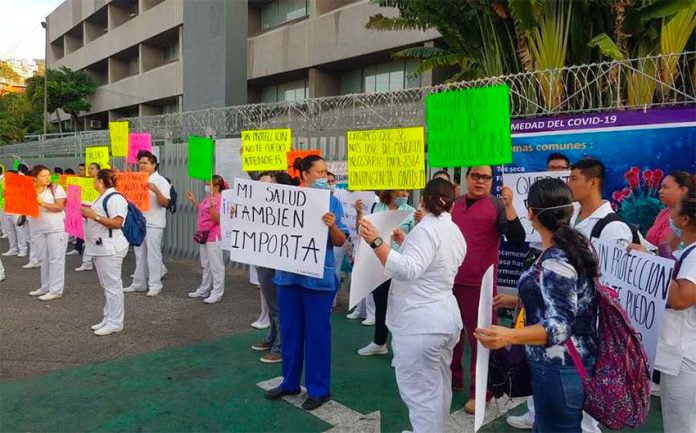
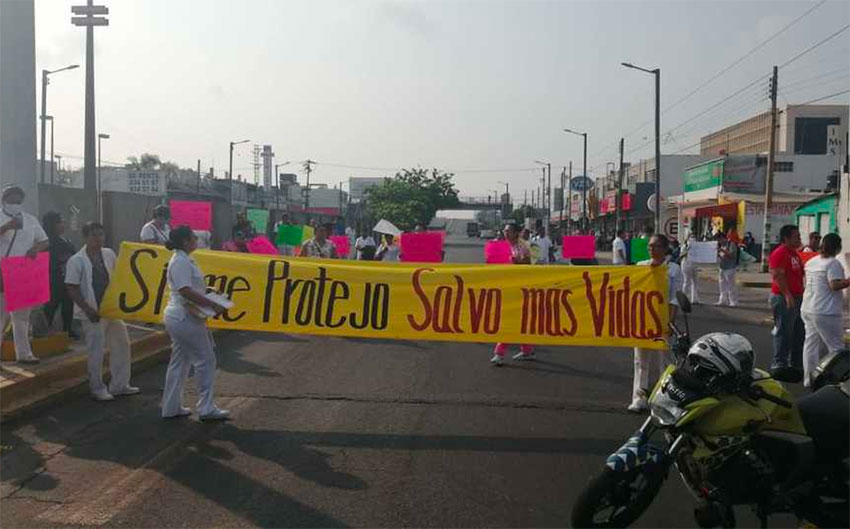
More doctors and nurses at hospitals across the country have joined the protests to demand adequate supplies and staff to treat patients with Covid-19.
Hospital staff in several México state municipalities protested earlier this week to denounce the inadequacies in their stocks of face masks, gowns, gloves, ventilators and other equipment necessary to treat a Covid-19 outbreak.
And according to medical personnel in Veracruz, Guerrero and Sonora, the problem is not unique to México state.
Román, a nurse who protested outside a Mexican Social Security Institute (IMSS) hospital in Veracruz city on Friday morning, said ethically they cannot not stop treating patients, but they need to be protected in order to do so.
He said that without sufficient personal protection equipment, “we risk our lives, those of our families and those of the people in society whom we treat.”
He and others at the protest demanded gowns, face masks, face shields, goggles, disinfectant and other supplies.
“At the beginning of our shifts, they give us some gloves that don’t work,” said nurse Jazmín Ramírez.
IMSS hospital staff in Acapulco, Guerrero, also protested outside their facility on Friday morning.
“Here in this institution we are the ones who are most in contact with these patients [infected with Covid-19] and [protection] protocols are not being followed as they should be,” said nurse Hugo Edwin Pérez Radilla.
The head nurse at Acapulco’s Vicente Guerrero hospital, Estefania Vargas, confirmed that the majority of those protesting are treating patients unprotected.
“We are orderlies, janitors, lab techs, nutritionists, nurses, doctors, radiologists and we’re all at risk by not having adequate equipment,” she said.
Doctors, nurses and other health workers mount a roadblock in Veracruz.
The medical workers in Acapulco likewise assured the public that they would not strike or otherwise halt treatment.
In Sonora, Health Minister Enrique Clausen saw backlash to a video in which he called on medical students in their fourth semester or later to unite in “the war against Covid-19,” claiming the crisis is a good chance to prove to themselves that the medical field is their calling.
Doctors and nurses in the state took their protest online, posting photos of themselves holding signs with the hashtag #LaVocaciónNoMeProtege (The calling does not protect me) to draw attention to the similar lack of supplies in their state and the government’s failure to solve the problem.
“We’re here, we’re going to keep working. We’re worried about our people, but we can’t do it simply because we’ve been called to do it, … we need personal protection equipment to protect ourselves and the public,” a medical resident who joined the online protest told the news website La Silla Rota.
Preferring not to give his last name, Luis said the majority of the 200 resident doctors in Sonora are located in poor rural villages far from big cities or isolated mountain towns that receive little support, and usually of poor quality when they do.
“Many rural health centers do not have adequate equipment, face masks, hand sanitizer, gloves,” he said, adding that what they do have is “of poor quality, for example, face masks that don’t really cover anything.”
With respect to the health minister’s call to medical students to join in treating Covid-19 patients, Luis did not agree and said that there are more than enough out-of-work licensed general practitioners who could help.
“I think it’s wrong for the health minister to risk using the students. He said those from fourth semester on, but we really just have basic knowledge. We’ve seen patients, but only passingly,” he said.
“There are shortages in all of the [state’s] health clinics and we’re asking Minister Enrique Clausen to … help us with this. We want to protect our health and that of our families,” he said.
Health workers aren’t the only ones protesting the lack of supplies in their hospitals. Residents in Morelos threatened to burn their hospital down earlier this week if it accepted Covid-19 patients, claiming it is not sufficiently stocked or staffed to deal with coronavirus cases.