A Holbox conservation program has produced savings on water, energy and plastic consumption.
Hotels and restaurants on a popular holiday island destination in Quintana Roo achieved big savings for the environment in the first year of a conservation program.
The 12 hotels and two restaurants that are members of a hotels association on Isla Holbox decided to take action in March 2018 in response to sanitation problems on the island that were threatening to interfere with tourism.
With planning help from the environmental nonprofit Casa Wayuu and funding from the Mesoamerican Reef Fund, the businesses made a plan to reduce energy consumption and move away from single-use plastics.
In the program’s first year, the businesses cut liquid petroleum consumption by 65,187 liters, equivalent to the annual consumption of 220 households. They also cut electricity consumption by 830,130 kilowatt-hours, enough energy to supply 79 houses for a year, and water consumption by 41,939 cubic meters, equivalent to the water used by 114 people in a year.
The businesses also eliminated the use of PET plastic, and achieved a reduction in the consumption of other plastics by working with providers to find reusable food containers that can be returned after use. These actions prevented the generation of 8,973 kilograms of PET, equivalent to almost 300,000 half-liter bottles.
Bárbara Hernández, the head of the hotel association, said the program has also been a success in making a cultural change among hotels on the island.
She noted that staff at the Las Nubes de Holbox Hotel have started voluntarily cleaning up trash at the Yum Balam nature reserve near Holbox once a month.
Walmart México is now offering three-hour delivery on certain products purchased online in an effort to compete with Amazon.
In addition to perishables and other food items, the store is now ready to provide same-day delivery for over 12,000 home and electronics products, such as cell phones, laptops, televisions and other appliances.
“At Walmart of Mexico and Central America we will continue to reinvent the rules of retail, since we are convinced that by combining the best of the digital world with physical stores, we will generate great benefits for our clients,” said Gabriela Buenrostro, the company’s assistant director of corporate communications.
The company announced an investment of over 20 billion pesos (US $1 billion) in Mexico and Central America this year, 13% of which will be dedicated to improving e-commerce operations. It also opened two e-commerce distribution centers, one in Guadalajara, Jalisco, and the other in Monterrey, Nuevo León.
Walmart’s main competition, Amazon, launched its Mexico division in 2015. It offers same-day delivery on select items, but only in Mexico City.
Four municipalities in Baja California had no electricity for several hours on Monday after a technical problem forced the temporary suspension of service.
The Federal Electricity Commission (CFE) said the National Energy Control Center (CENACE) ordered the suspension because of a technical failure in two generators at a Mexicali power plant belonging to the company InterGen. The failures led to a shortage of 20.24 megawatts.
CENACE decided to suspend energy distribution to maintain stability in the national electrical system.
“This measure affected 22% of consumers in the state of Baja California,” said the CFE. “That included consumers in the municipalities of Rosarito, Ensenada, Tijuana and Tecate.”
Some 31,500 electrical customers were affected.
Consumers began reporting losing power at 3:00pm on Monday. At first the blackouts were attributed to high demand and heat.
According to Ensenada Civil Protection head Jaime Nieto de María y Campos, most service was reestablished within two to six hours.
CFE personnel were working with the CENACE to reestablish service.
Tijuana was hit hardest, with as much as 80% of the city losing power. No power for traffic signals caused traffic chaos, and at least three people are reported to have been trapped in elevators.
According to Tijuana fire chief José Jiménez, half of the people affected by the blackout had service again by 6:00pm.
He described the cleaning up of police forces in Sonora as a “pilot program” that will be evaluated after three months before it is implemented in other states.
“Intelligence work indicates that there is complicity, links, penetration of organized crime in some security forces . . .” the secretary said.
Durazo explained that officers who fail to pass control and confidence tests will be dismissed and replaced temporarily with armed forces personnel so that municipalities are not left without an adequate local police force.
“. . . Personnel that do meet the requirements will be trained or re-trained. In other words, [it’s a matter of] getting them to adequate standards of professionalization in order to be able to provide security services,” the security secretary said.
Durazo said that while the purging process is taking place, municipal forces will be placed under military command.
“Why a navy command, a military command? Because if we’re going to purge [officers], we need complete confidence in the people in charge of the security forces. Once they are professionalized, the security forces will return to local command,” he said.
Durazo said that criminal gangs across the country attempt to infiltrate police forces.
“All the organized crime groups make an effort to get into security forces but the president has made it very clear that there will be a very clear line that separates organized crime from the uniformed forces. There will be no uniformed crime, we’ll purge the security forces . . .”
In Sonora, where homicides increased by more than 50% in the first seven months of the year, state Security Secretary David Anaya Cooley said the presence of federal security forces is needed to “weaken” organized crime groups.
Official statistics show that there were 679 victims of intentional homicide in Sonora between January and July, a figure that includes 17 police officers.
“The deaths of these police officers are still under investigation,” Anaya said before asserting that some of the slayings were “without a doubt” linked to police complicity with organized crime.
The US Embassy is considering limiting employees' movements, according to one news report.
A 61-year-old employee of the U.S. Embassy in Mexico City lost a gold Rolex watch valued at US $8,000 in a mugging at a store in Polanco on Sunday.
According to witnesses, the woman was inside a store at 513 Horacio street when a young man pushed her to the ground, threatened her with a gun and removed her watch.
The aggressor is described as being well-dressed and thin, 1.65 meters tall and appearing to be about 25 years of age, with brown skin, dark hair, a straight nose, oval face, with no facial hair or tattoos.
Witnesses said the robber escaped in a red Audi whose plate number was MUJ-5335.
Police reviewed security camera footage from the business where the theft took place as well as other businesses, and were able to track the thief’s escape route. One of the cameras may have even captured his face.
The watch is described as silver with a pink face and a metal band. Mexico City police have the watch’s serial number, and are working with embassy staff to capture the robber.
Muggings have risen 28% in Mexico City in the first six months of the current administration’s term.
This is not the first time that an employee of the U.S. Embassy has been robbed in Mexico City.
The embassy is considering the possibility of limiting its employees’ movement on the streets, reported the newspaper El Universal, or even taking the more extreme measure of issuing a travel warning for Mexico City, a measure that has been taken in places like Ciudad Juárez, Tijuana, Michoacán and Acapulco.
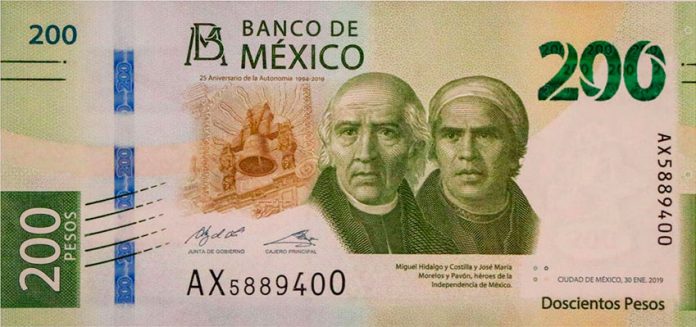
Independence heroes are featured on one side of the new bill.
The 17th-century poet and writer Sister Juana Inés de la Cruz has been featured on Mexican banknotes for 41 years. Today it was time to say farewell.
Sister Juana first appeared on the brown 1,000-peso banknote in 1978. The other side of the bill showed a landscape of the Santo Domingo Plaza in Mexico City.
After Mexico’s currency was reorganized in 1993, Sister Juana moved to the 200-peso note, where she has remained until today.
The note shows the baroque poet’s face with a fragment of her famous poem You Foolish Men. The opposite side shows a landscape of the Panoayan Hacienda in Amecameca, México state, where Sister Juana lived as a child.
On Monday, Mexico’s central bank (Banxico) began circulating the new 200-peso notes which will gradually replace the Sister Juana bills.
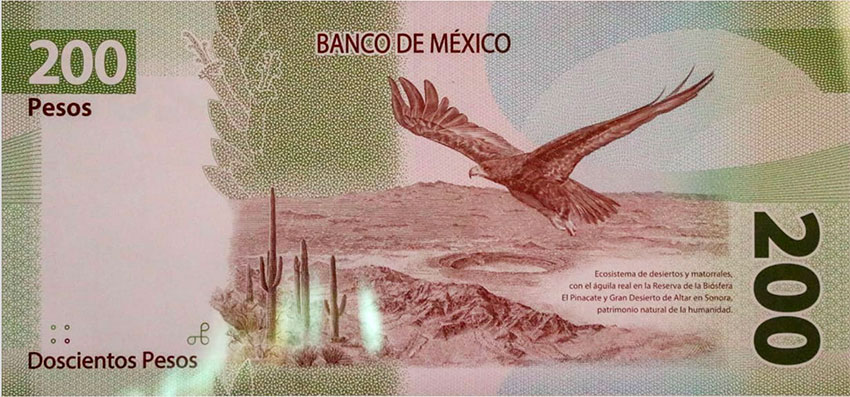
El Pinacate biosphere reserve in Sonora is featured on the reverse side of the new banknote.
Former professor Berenzon was fired for plagiarism.
A former professor dismissed by the National Autonomous University (UNAM) for plagiarism is now apparently employed by the National Council of Science and Technology (Conacyt).
The newspaper El Universal reported that Boris Berenzon Gorn has been a member of Conacyt director María Elena Álvarez-Buylla’s staff since May 30 and that he was seen working with the science agency’s communications team at an event on August 6.
Berenzon was dismissed by the School of Philosophy and Letters (FFyL) at UNAM in 2013, four months after researcher Juan Manuel Aurrecoechea filed a complaint against him for plagiarizing at least 18 paragraphs of his 1988 book Puros Cuentos.
Aurrecoechea said the plagiarized paragraphs appeared in a book published in 2010 that was based on Berenzon’s 2001 doctoral thesis, El discurso del humor en los gobiernos revolucionarios (The Discourse of Humor in Revolutionary Governments).
The FFyL council fired Berenzon on the grounds that he committed a “serious” breach of his academic responsibilities.
Not citing sources correctly could not be considered “a mere methodological error,” the FFyL council said upon dismissing the former professor, who became the first UNAM academic to be fired for plagiarism.
Berenzon has also been accused of plagiarizing his master’s thesis, El Universal said.
Six years after his dismissal from Mexico’s most prestigious university, Berenzon’s history of plagiarism apparently didn’t disqualify him from employment at the government’s leading scientific body.
“It is a pleasure to have the support of Dr. Boris Berenzon Gorn in this fight against neoliberal science. Welcome to the Conacyt work team,” director Álvarez-Buylla wrote on Twitter on Saturday above a photograph of the ex-professor.
However, the tweet was deleted just minutes after it was posted and on Sunday morning Álvarez-Buylla wrote on the same social media platform that her account had been hacked.
“A tweet was sent from my personal Twitter account of which I disapprove. I do not know the origin and intention of the message. The account has already been recovered,” she said.
Álvarez-Buylla, who has been accused of acting illegally by taking important decisions without seeking approval of the Conacyt board, hasn’t clarified whether Berenzon actually works at the science council or not.
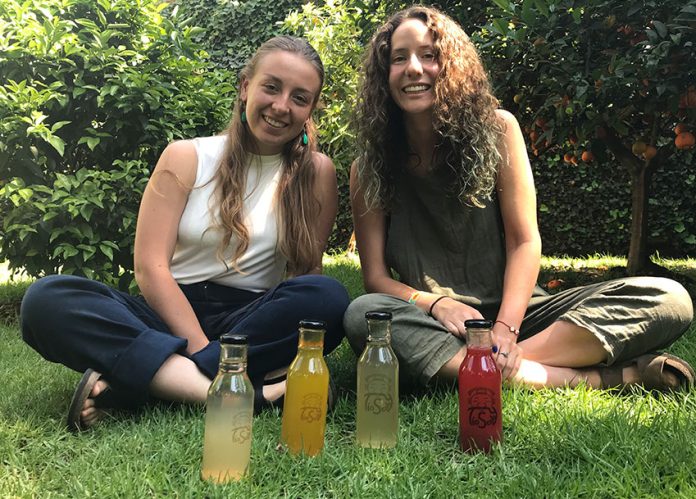
Kombucha makers Pesqueira, left, and Diaz of Tío Scoby.
Tío Scoby is a small business. As in, really small. Run by two women out of a home near the National Autonomous University in Mexico City, it produces 50 liters per week of kombucha, a fermented beverage touted for its many health benefits.
But keeping it small is part of their goal, say owners Lucía Pesqueira Mateos and Mariana Diaz. Small size helps maintain quality control.
“We want to make this for our community for people to have healthier options,” said Diaz, who studies architecture at the Universidad Iberoamericana.
Specifically, in the case of Mexico, Diaz said, options healthier than soda are needed.
“I never really liked drinking soda, but I do like the fizziness,” Diaz said. “Sometimes I want to have something fizzy, but also something cold, light and refreshing and with unique flavors from different vegetables and fruits.”
Tío Scoby likes to experiment with different flavors for their kombucha.
Kombucha, Diaz said, fulfills all those needs. And Tío Scoby’s products offer her favorite qualities of the beverage.
Kombucha is one of many fermented beverages beloved the world over. Although the exact origins are not known, it is thought to have originated in Manchuria where the drink is traditionally consumed. Made with natural sugars, green or black tea and often a fruit or vegetable for flavor, it has a light alcohol content of about 0.5%.
The drink has become a fad in the past decade or so in the United States and elsewhere. And the fad is starting to kick in in Mexico as well. Some small cafes and large supermarkets carry Mexican kombuchas.
After sampling the beverage on a trip to Costa Rica, Diaz didn’t like many of the kombuchas she tried at various stores upon her return to Mexico. So she decided to make her own.
“Kombucha is similar to beer in that it has yeast,” said Pesqueira, a microbiologist. “SCOBY is an acronym for Symbiotic Culture Of Bacteria and Yeast, which is present in all kombuchas.”
The yeast transforms the sugars into ethanol and CO2 resulting in the slight alcohol concentration. The fizziness results from the CO2. The yeast also has bacteria that take ethanol and convert it into organic acids that are very good for your digestive system.
It has sugar, but the sugar has been transformed. So when you drink a kombucha, you’re drinking vitamins and beneficial bacteria. The body’s highest concentration of bacteria is the gut, and these microorganisms feed the good bacteria.
Because it’s a bit sour, kombucha hasn’t totally caught on in Mexico. But it’s not a stretch to see why Tío Scoby’s products are in demand. While not accustomed to kombucha itself, many Mexicans are familiar with other fermented, ancestral drinks such as pulque (fermented agave nectar), tejuino (fermented corn), tepache (fermented pineapple and sugar) and various fermented cacao beverages.
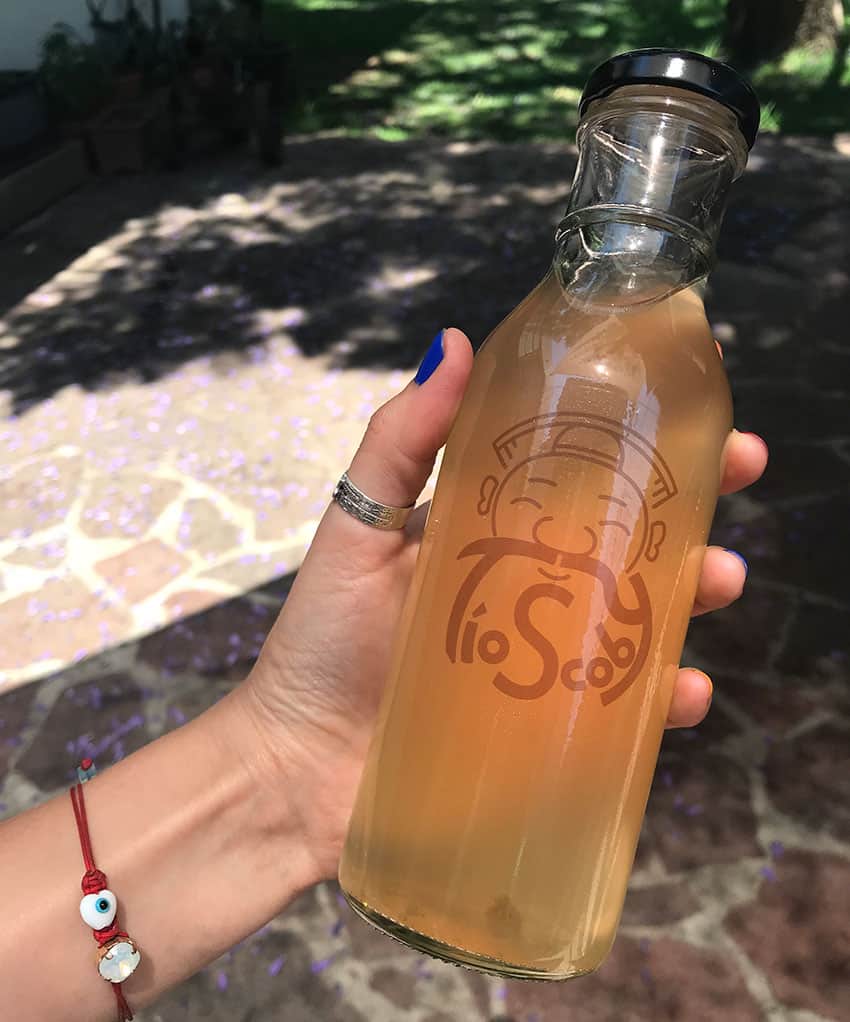
“Pulque is another probiotic beverage and it’s alive. All these probiotic beverages are alive. That’s what makes them unique. Pulque and kombucha are living beverages,” said Pesqueira, who recommends drinking a third of a 360ml bottle of Tío Scoby daily for healthy digestion.
“In Mexico we are not as familiar with fermented foods or beverages compared to Asia, for example. In Europe, you have a lot of fermented fruits and beverages, pickles, sauerkraut. We’ve been making fermented foods here for centuries as a way to preserve food. It’s interesting how we have lost this really important resource. Everything now is pasteurized and, when you do that, you lose a lot of beneficial properties.”
The SCOBY itself is a living organism from which all kombucha is made. It can be split off from a mother SCOBY and can also regenerate from smaller pieces. The SCOBY Tío Scoby uses was given to Diaz by a woman in Guatemala.
“Yeast is a type of fungus, but on a microscopic level,” Pesqueira said. “Kombucha has so many types of bacteria and yeast . . . and the most common would be like what you find in beer. There are different types of SCOBY in Asia and in the U.S. . . . Sometimes one is fizzier than the other. It’s hard to determine how much of a specific microorganism exists in each SCOBY.”
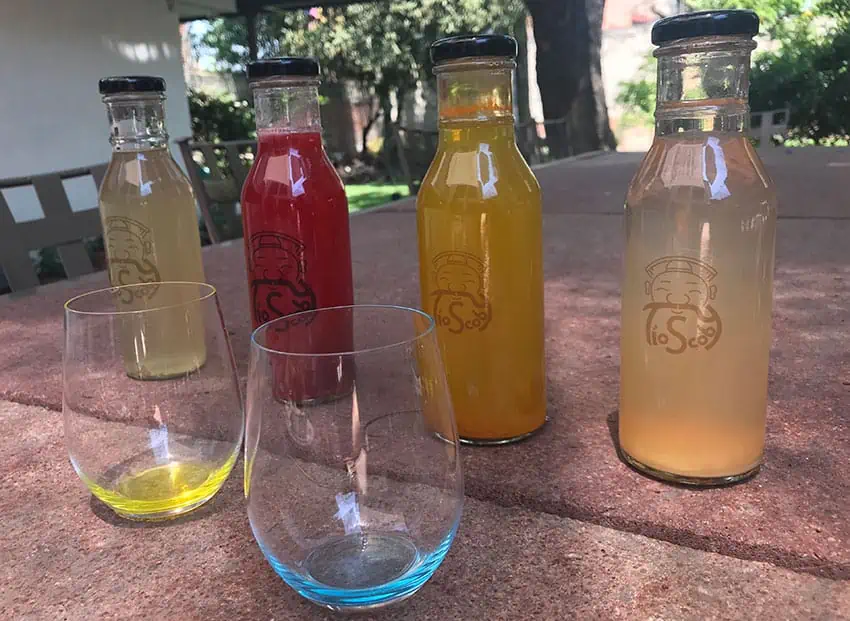
Drink one-third of this bottle every day for healthy digestion, its makers say.
Fermentation of a batch of kombucha takes about seven to 10 days in Mexico City, depending on the season. Because it’s a natural process, it is affected by the elements. Fermentation takes longer in colder regions, which is why Diaz and Pesqueira recommend refrigerating each bottle of Tío Scoby and consuming it within a month.
“Refrigeration slows down fermentation, but the fermentation actually never stops,” Diaz said.
On a sunny Sunday afternoon on the city’s southside, Pesqueira and Diaz reflected on what it’s taken to start Tío Scoby and where they’d like to see it go. The women prepare kombucha with rotating flavors, always loving to experiment, though they almost always have a berry, orange, ginger or unflavored version in stock.
“We just started to read about it and then we started to do it,” Diaz said. “We are still reading up on it, seeing what we’d like to add, learning more things all the time. We’ve had a request to make it fizzier, so we might make one option with more fizz. We’ve also been thinking about starting to make kefir — a fermented milk drink popular in Eastern Europe and Russia.”
Recently, Diaz and Pesqueira teamed up with local bartenders to make a “mezkombucha” using kombucha as a mixer for mezcal. While admittedly the high alcohol content of mezcal kills some of the good bacteria in kombucha, Pesqueira said it’s a healthier alternative than mixing with soda or juice that has added sugar. It can also help counter the effects of a hangover, Diaz said.
These businesswomen are obviously trying to bring kombucha onto the Mexican scene in unique ways.
“Our next step is to sell from coffee shops and yoga centers. Now we do deliveries each week,” Pesqueira said. “We’re not looking to have our own storefront. We sell at bazaars, but they are quite expensive. Some ask 2,000 pesos for two days and our kombucha is only 50 pesos per bottle, so we would have to sell a lot of kombucha to get a return. But it’s also good for us to get the name out there and to meet people and share what kombucha is.”
Additionally, Diaz and Pesqueira have begun giving classes on the health benefits of kombucha as well as teaching how to make it.
“Often Tío Scoby has been the first experience that someone has had with kombucha,” Diaz said. “We get asked so many questions and we love to explain. We send voice messages, articles we’ve read or things we’ve written. I love that people are taking an interest in their health. It speaks about a new curiosity in people in Mexico. There are certainly those who don’t want to try it because it’s different. The fact that it’s something different can be an obstacle, but also an opportunity.”
• To place an order with Tío Scoby, message Diaz and Pesqueira on Instagram.
Megan Frye is a writer, photographer and translator living in Mexico City. Her experience includes newsroom journalism and non-profit administration. She has been published in several international publications.
The glory days appear to be over for Yucatán honey producers, who are facing the most difficult conditions they have seen in the last 50 years.
Between 2008 and 2012, honey production in the state reached record levels of 12,000-14,000 tonnes a year. This year, production is expected to be 4,000-7,000 tonnes at most, and the trend will most likely continue downward.
Yucatán beekeepers feel discouraged because they lack both funding and support.
“There’s worry, almost desperation,” said Nelly Ortiz Vázquez, president of the Yucatán School of Agronomic Engineers and director of the state’s Beekeepers’ Association.
“We haven’t only lost influence in international markets, but also at the national level. Yucatán fell from first to third and fourth places in honey production, surpassed by states like Jalisco and Veracruz.”
Conditions are not good for Yucatán honey producers.
According to official numbers, around 11,000 honey producers depend on beekeeping to make a living in Yucatán.
“We have no idea what could happen in 2020. Plants aren’t flowering, there’s no nectar, no support. How will we care for and conserve our bees?” she added.
She said that in the last 10 years Yucatán has faced severe deforestation that has affected all types of plants across the whole state. Bee populations have also declined because of the varroa mite.
“In Mérida, for example, although they talk about planting trees and reforestation, the urban growth and the area covered by concrete gets bigger and bigger with more residential neighborhoods. In rural areas, fires, indiscriminate felling, neglect, etc., have caused many traditional plants to die,” she said.
Market factors have also played a role in the decline of Yucatán’s honey industry.
One of its main markets is Europe, where consumers bought large quantities of the sweetener from 2005 to 2010. However, over time orders declined after China began selling a cheaper honey made from sugar beets.
“The Chinese imitate everything, even the image of the Virgin of Guadalupe, and now with the beet-based honey that they are mass producing and selling cheap, they’re taking foreign markets, like those in Europe, for example,” said Ortiz. “It’s not only affecting Yucatán, but all of Mexico’s honey production.”
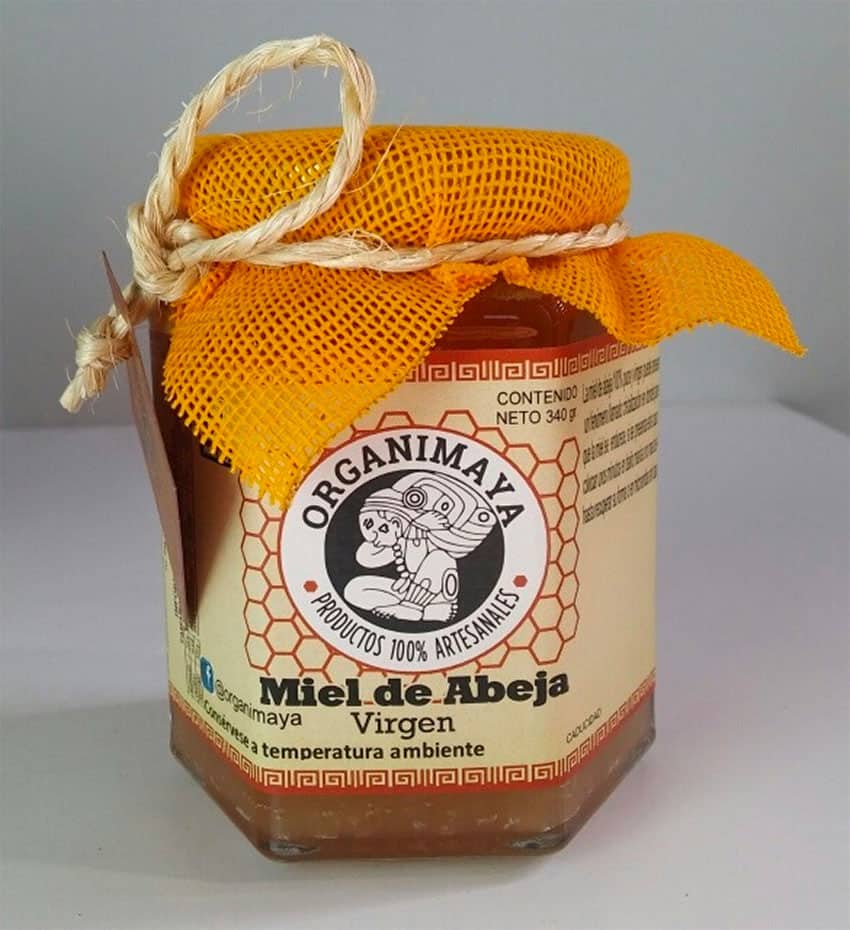
The cheap Chinese honey has caused the Yucatán product to fall from 50 pesos per kilo in its glory days to just 12 pesos per kilo today.
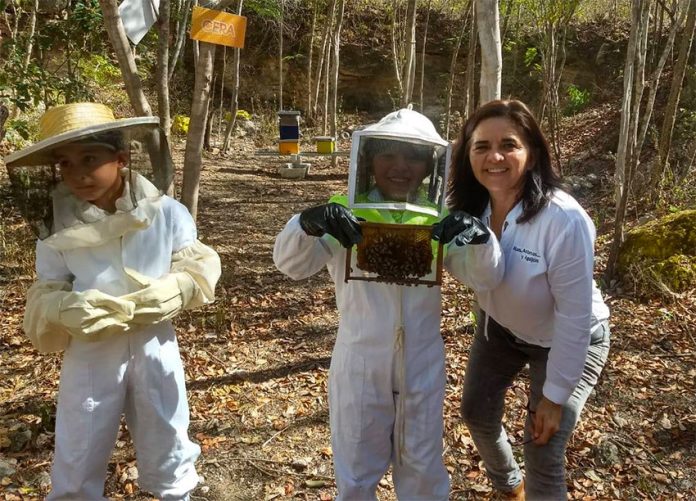
In response to the crisis, the state’s Secretariat of Rural Development announced the installation of 28 enlarged beehives with queen bees imported from Italy. The trial run aims to strengthen hives and achieve better honey production by improving the genetics of Yucatán bees.
Rural Development Secretary Jorge André Díaz Loeza stated that his department will invest 20 million pesos (US $992,000) in the project.
Ortiz hopes that the introduction of the new queen bee species will make Yucatán bees more resistant to climate change and pests like the varroa mite. She said it’s a question of culture and persistence, and that beekeepers are looking for new ways to keep their hives alive.
Sonora’s rising homicide numbers are due to a 40% deficit in police numbers, according to National Defense Secretary Luis Cresencio Sandoval.
Intentional homicides in the first seven months totaled 537, up nearly 50% over the same period last year, according to federal crime statistics.
The highest murder numbers are being seen in the capital, Hermosillo, and the municipality of Cajeme, Sandoval said. The former accounts for nearly 23% of all murders. By the end of August, there were a total of 159, 37 of those in that month alone.
Sandoval said that elements of organized crime have been detected in the state’s many police forces, and that the government will initiate a purge campaign in Hermosillo, Cajeme, Guaymas, Empalme and Navojoa to rid the forces of corruption.
“Military personnel will head [the operation], which will help with the purging process, and it begins today in Guaymas and Palme,” he said on Monday.
Currently deployed in the state are 4,323 soldiers, 568 marines, 1,186 National Guardsmen, 706 Federal Police, 1,173 state police and 3,973 municipal police. Sandoval plans to have 1,800 National Guard personnel stationed in eight coordinated regions in the state by the end of the year.
President López Obrador held his morning press conference in Sonora on Monday, during which he said the military will reinforce the work of Sonoran police forces in order to ensure public security.
“There are four municipalities where there is already an agreement that the armed forces help with public security in order to reinforce municipal police forces, such as Guaymas, Cajeme and Navojoa . . .” he said without naming the fourth.