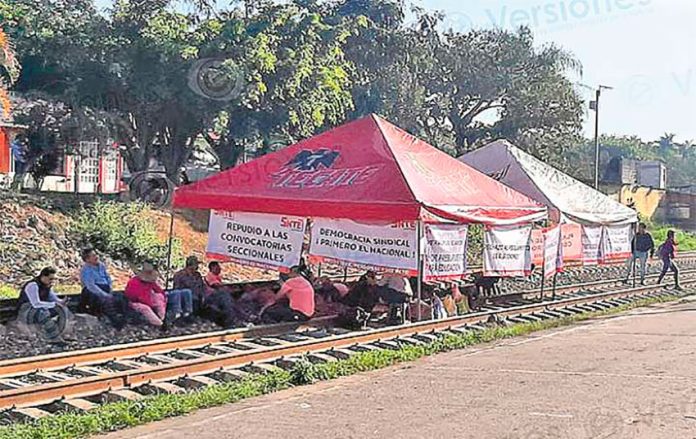
Members of Mexico’s largest teachers union, the SNTE, took a leaf out of the playbook of its more dissident counterpart on Tuesday by blocking train tracks to pressure the government to meet its demands.
The militant CNTE teachers union has been successful in obtaining more than 800 million pesos (US $40.9 million) in unpaid bonuses in Michoacán by blocking tracks, the newspaper Reforma reported, noting also that it has won promises from the government related to the allocation of teaching positions in states such as Oaxaca and Chiapas.
In that context, some members of the SNTE teachers union “copied” the railroad blockade strategy in Veracruz, Puebla and Tlaxcala on Tuesday to demand that President López Obrador and Labor Minister Luisa María Alcalde ensure that new labor laws guaranteeing them the right to elect their union leaders in free and secret ballots are adhered to.
Reforma reported that there were blockades on tracks in the Veracruz municipalities of Coatzacoalcos, Fortín, Córdoba and Orizaba as well as in the Puebla municipality of Rafael Lara Grajales and in Huamantla, Tlaxcala. Members of a group called Maestros por México (Teachers for Mexico) – linked to former, long-serving SNTE boss Elba Esther Gordillo, who was absolved of corruption charges in 2018 – led the blockades at several points.
Freight trains transporting products including steel, fertilizers, auto parts and foodstuffs, among other goods, were held up by the blockades.
Protesting teachers warned that rail blockades in states such as Hidalgo, México state, Nuevo León, Jalisco and Michoacán, will follow if the Labor Ministry doesn’t ensure that their demand for union democratization is met. They also called for teachers who were dismissed during the administration of the previous government to be reinstated and for more funds to be allocated to education.
Rail blockades by members of the CNTE union in Michoacán lasted 18 days in early 2019, costing the economy at least 18.5 billion pesos.
Tijuana residents received US $476 million in remittances.
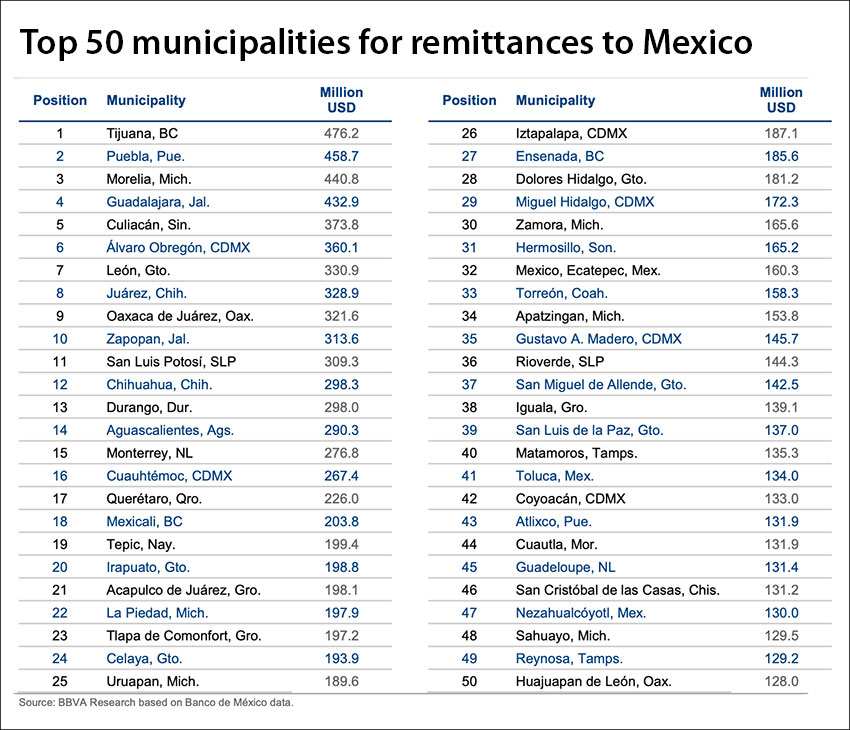
Residents of Tijuana, Baja California, received more money in remittances sent home by Mexicans living abroad in 2019 that those of any other municipality, according to a report by the bank BBVA.
Completed by the bank’s research division, the report shows that US $476.2 million in family remittances was sent to the northern border city last year.
Puebla city ranked second, with residents receiving $458.7 million, followed by Morelia, Michoacán, $440.8 million; Guadalajara, Jalisco, $432.9 million; Culiacán, Sinaloa, $373.8 million; Álvaro Obregón, Mexico City, $360.1 million; León, Guanajuato, $330.9 million; Juárez, Chihuahua, $328.9 million; Oaxaca city, $321.6 million; and Zapopan, Jalisco, $313.6 million.
The top 50 municipalities in terms of remittances received – among which were also large cities such as Monterrey, Acapulco and Hermosillo as well as municipalities with much lower populations – accounted for 30.7% of the total of just over $36 billion that was sent to Mexico from abroad in 2019.
Just under 95% of remittances came from the United States, BBVA said, noting that the monetary transfers exceeded their historical peak for the fourth consecutive year.
The 50 municipalities that received the most remittances from the US in 2019.
Michoacán, Jalisco and Guanajuato were the biggest beneficiaries among Mexico’s 32 federal entities, receiving $3.58 billion, $3.5 billion and $3.29 billion respectively.
“In general, the states that receive most remittances are those that have seen the most migrants depart over the last 50 years,” BBVA said. “For at least 15 years, Michoacán, Jalisco and Guanajuato have been the country’s top three recipients of remittances.”
Residents of México state and Oaxaca received $2 billion and $1.8 billion in remittances, respectively, to rank fourth and fifth. Rounding out the top 10 were Puebla, Guerrero, Mexico City, Veracruz and San Luis Potosí.
The five states that received the lowest amounts in remittances were, in order, Baja California Sur, Campeche, Quintana Roo, Yucatán and Tabasco. The states with the highest growth in remittances received in 2019 were Chiapas (21.4%), Tabasco (19.6%), Mexico City (18.6%), Chihuahua (13.2%) and Sinaloa (13.1%).
BBVA also reported that California was easily the largest state of origin for remittances. Just over $10.5 billion was sent from the Golden State, a figure that accounts for almost a third of the $34.11 billion in remittances from the United States.
Texas ranked second with remittances of $5.56 billion followed by Illinois, Florida, New York and Georgia, with amounts of between $1.2 billion and $1.5 billion each.
BBVA said that total remittances to Mexico could grow 6% this year to $38.2 billion, which would ensure that a new record is set for a fifth consecutive year.
While more money is flowing into the country in the form of remittances, less is leaving, the BBVA reported.
The bank said that remittance outflows, or remittances sent from Mexico to another country, decreased by 1.9% to $981.2 million in 2019.
The United States is the main destination for remittances from Mexico, receiving 40% of the total last year, followed by Colombia, China, Peru, Honduras and Guatemala.
Fishboats attack the Sharpie in the Gulf of California on Tuesday.
Conservationists and federal inspectors were assailed by fishermen who hurled Molotov cocktails and fishing net weights at them Tuesday as they carried out surveillance operations in a protected area of the Gulf of California.
The federal environmental agency Profepa said in a press release that fishermen in two skiffs known as pangas attacked the crew aboard the Sea Shepherd Conservation Society vessel M/V Sharpie while in the Upper Gulf of California Biosphere Reserve.
“Over 20 smaller boats gathered around the two skiffs, attacking and provoking [the authorities], first verbally, then physically, aiming to stop [their] efforts to curtail illegal fishing,” said Profepa.
“At first, the fishermen threw fishing net weights at the inspectors; later, Molotov cocktails. … after an initial pursuit, [the conservationists] decided to avoid confrontation but not before notifying the navy, which arrived aboard [a patrol boat] to provide security,” it added.
The inspectors and conservationists used anti-piracy tactics such as high-speed maneuvering and defensive water cannons to repel the attacks. The use of Molotov cocktails caused military on board to fire a warning shot, which convinced the fishermen to stop their attack and disband.
Profepa said that a second boat called the M/V Farley Mowat was also attacked. It was carrying 15 Sea Shepherd conservationists, two Marine infantrymen, two National Guard troops, one member of the National Aquaculture and Fisheries Commission and one Profepa inspector.
The conservationists reported seeing a minor among the attacking fishermen.
“Today on World Wildlife Day, I watched a young child throw lead weights at our ship during an attack,” said Sea Shepherd Captain Jacqueline Le Duc.
“Witnessing this firsthand was extremely sad. Sea Shepherd is here to save a species on the brink of extinction so that future generations can continue to enjoy the biodiversity this area has to offer. We should be teaching younger generations the importance of the conservation of nature, not the exploitation of it.”
The Upper Gulf of California Biosphere Reserve is a protected conservation area for the vaquita, a critically endangered marine mammal. The Autonomous University of Baja California Sur reported last year that only 22 vaquitas remained in the Gulf of California.
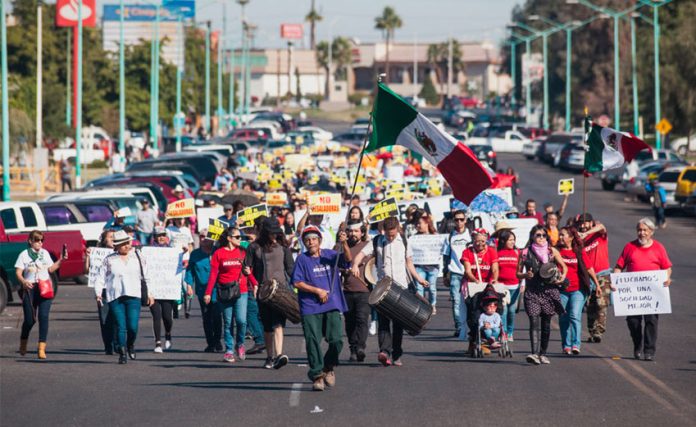
Protesters march last year in protest against the Mexicali brewery.
A public consultation will be held to decide whether the United States company Constellation Brands will be allowed to open its new brewery in Mexicali, Baja California, President López Obrador said on Tuesday.
The president said that the Environment Ministry has already approved moving forward with a vote to determine the fate of the US $1.5-billion brewery, which is currently under construction.
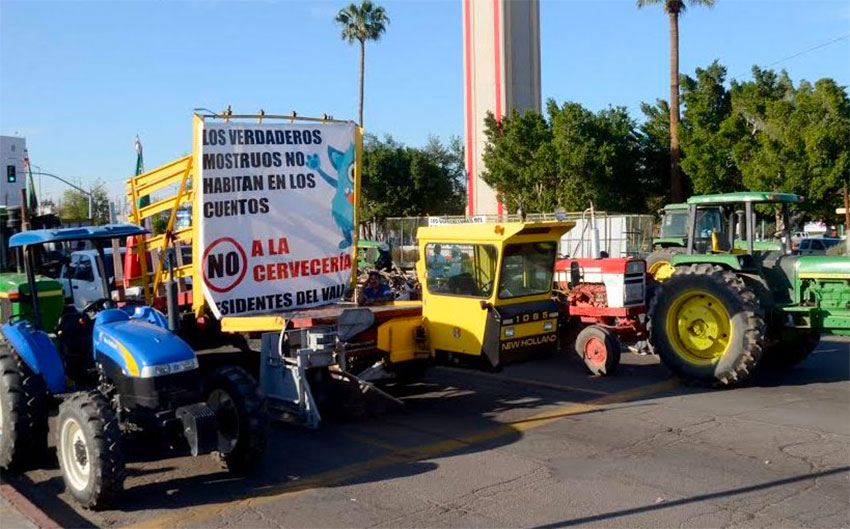
Farmers in the area have protested the construction of the brewery since 2016, claiming that its production will put a strain on the state’s water supply. They have fought various legal battles in an attempt to halt the project.
However, Environment Minister Víctor Toledo assured federal authorities in January that the brewery would not affect the region’s water supply. For its part, Constellation Brands, which produces Corona and other Grupo Modelo beers, has claimed that there will be enough water for farmers, citizens and the 1 billion liters of beverages it plans to produce annually.
Speaking at his regular news conference on Tuesday, López Obrador said that citizens deserve the right to have their say about the brewery in a consultation. It was the same mechanism he implemented to test support for the previous government’s airport project at Texcoco, México state, which was subsequently cancelled.
Farmers have expressed concerns about the brewery’s water consumption.
“The company says that there will be no impact, that it’s an investment that will create jobs in the area. It should have the confidence of the citizens, and they should decide,” he said.
The president said that his government plans to go ahead with the consultation even though United States officials have warned against it.
“We were sent messages, even from the U.S. Embassy … that if the consultation happens, it’ll end badly for the country,” he said.
“People say: ‘it will set a bad precedent if there’s a consultation, because it will impact investment.’ No, the bad precedent was already set when, without taking people into account, they gave out the permits,” he said.
The federal government’s announcement of its intention to hold a consultation comes a year after electoral authorities in Baja California reversed a decision to allow a vote on the controversial brewery. The Baja California Electoral Institute (IEE) received a request supported by more than 18,000 signatures for a plebiscite and approved one before five of six members on its general council subsequently voted against the consultation going ahead.
Clemente Ramos Mendoza, president of the general council, said at the time that the IEE is not the authority to which citizens should have turned in order to try to stop the construction of the brewery.
“There are federal tribunals for that … administrative courts. They are the relevant authorities,” Ramos said in March 2019.
In response to López Obrador’s announcement on Tuesday, Constellation Brands reiterated in a statement that the operation of the brewery would not affect local water supply, noting also that the plant has been granted all the required permits.
The company, which is also the largest importer of beer to the United States, called for the rule of law to be respected in order to provide certainty for investors and citizens alike.
Separately, Constellation Brands indicated in a March 2 letter that was published by the newspaper Reforma that it would consider other locations for a new brewery if Mexico became too problematic.
“The company no longer has the time to embark on a public consultation in which its future in Mexico is still uncertain,” said the letter, signed by Constellation Brands’ Mexico president Daniel Baima.
Constellation confirmed that the letter was authentic, the news agency Reuters reported.
If the company decides to continue construction of the brewery in Mexicali – and its operation is given a green light at the government’s planned consultation – it is expected to open at the end of 2021.
Anielka Garcia Villajuana, center: pioneer of the Patronato.
It’s always the same story. The election, the passion, the waving of the fist, the belief. Mr. ‘manifesto-of-change’ stands on the steps of the town hall, in the parliamentary chamber, or in front of the presidential residence, and professes a revolution in government. An end to corruption, an overhaul of burgeoning bureaucracy, a new way forward for the Mexican people.
Then comes the inevitable descent, often more insipid than dramatic, and so the process begins again.
Mexico is bored stiff, more than bored: disdainful at best, furiously distrustful at worst. The country sees this on a daily basis, the self-perpetuating actions and processes of institutionalized politicians, the literal systemic nature of the problem. But what is rarely seen or acknowledged is that the beginning of a sea change is already quietly rolling through society.
This isn’t a new phenomenon, it fact it’s been around us the whole time, but is now perhaps starting to reach (whisper it) a critical mass; and these initiatives are harder to identify because inherent in their genus is not placing importance on the validation of being lauded. Moreover, the structures inherent in these parallel systems are civilian-led, structured from the bottom up allowing for a foregrounding of real people over grand projects, grass-roots development and concerted local participation over bloated grand designs.
A particularly interesting individual in this context is Anielka García Villajuana, president of the independent non-profit Patronato de la Ciudad de Campeche. The Patronato was set up 20 years ago to oversee Campeche’s transition to a UNESCO World Heritage Site, but under García has morphed into a multi-directional body, which while retaining that initial focus now also works across wide-ranging socio-environmental programs in the city and its environs.
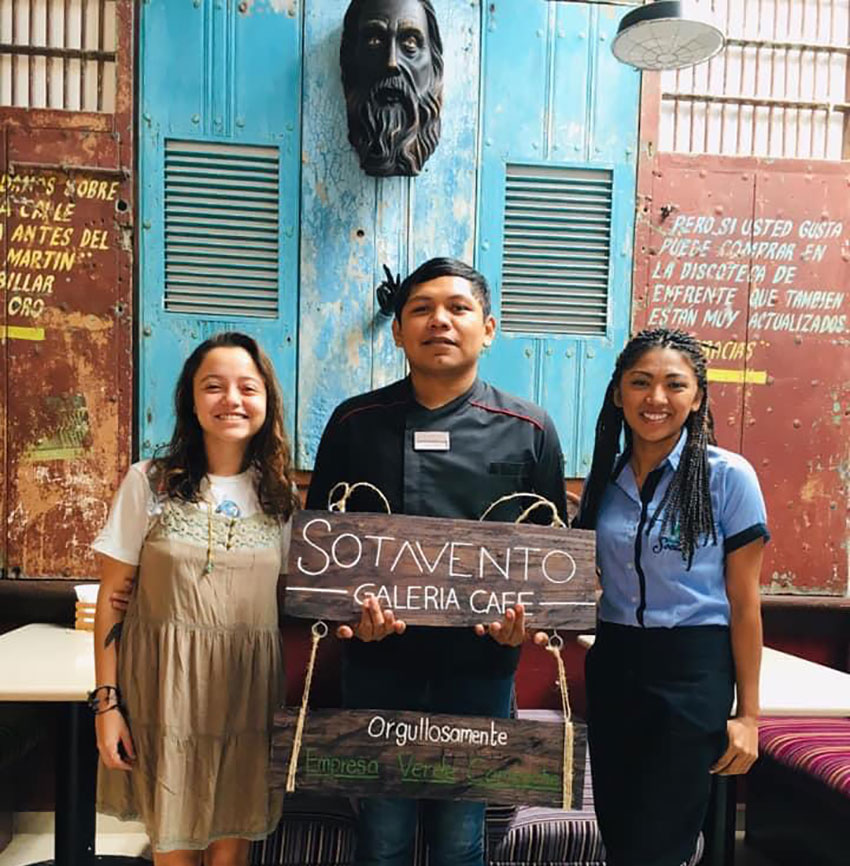
Empresa Verde works with business and the Patronato alike.
Perhaps the greatest signpost to this evolution is García’s instinct for people: “There really are good people everywhere, all too often fighting a daily fight against the odds just to be allowed to get on with things. We try to work alongside existing projects and just give them agency. None of it can be about us, we’re just here to say: ‘We believe in you, how can we help?’ And then get our hands dirty too.”
Projects can take the form of environmental initiatives, cultural events, educational workshops, even medical programs. Essentially, the aim is not to introduce a higher standard of living, fix a road with an x amount of net spend or provide a particular service, but to participate intrinsically alongside and within society, to act and encourage action across existing progressive, civic endeavors and in that way to encourage more change-making from the bottom up. It’s not a physical evolution of society, but a cultural one.
Obvious to all is that there are gaps in governmental works in Campeche, and where these demonstrate their slack, García has picked it up, working in areas where there is often a clear absence of state systems, such as sustainability in businesses. Enter Empresa Verde, an expanding citywide collection of sustainable businesses, working on everything from intelligent purchasing to elimination of single-use plastics to waste separation and reuse.
This then feeds into El Campanario, a piece of land on the outskirts of the city loaned by local businessman Juan Pérez Hernández that serves as a not-so-final destination for organics from these businesses and that also doubles as a space for urban growing courses, animal rescue and organic small-scale farming. This process has been infrastructurally supported by other local businesses including El Surco S.A. de C.V., which has helped clear land, transport materials, and much more.
Not to mention the now-famous “Doctor en Bici,” Luis Fernando Hernández, who visits marginalized communities on weekends to provide free medical consultations. “He is doing such great work,” says García.
“Nothing at all needed changing, but we realized we could help by encouraging people to donate medicines and be a reception center for these, so that’s what we’re doing. Not much really.” Her tone, unsurprisingly, is self-deprecating.
Luis Fernando Hernández: The ‘doctor en bici.’
Essentially — perhaps without even realizing it — García, who is emphatically not alone in working this way, is fracturing a system that has failed so many. “Traditionally authorities would see an existing project which was working,” she says, “and — at worst — want to co-opt it, or at very best just get in the way. What very rarely happens, but in my view is exactly what we should be doing, is giving amazing people and projects licence to run … to just get on with things. It should involve us all sweating and bleeding together, because that’s how community comes together, and the better societies are formed.”
García’s words ring true from a local governmental level all the way through to national leadership. Normal processes involve each new political remaking and relaunching for ego’s sake, there is no vested interest in continuation or maintaining what works, rather pretending everything that came before was a waste of time, scorching the earth and presenting yourself and your new initiatives as those of the returning King.
Placing the people at the center of the change is quietly radical, but it’s also the next logical step. While the interventionist state may have its place (something that García herself understands), it perpetuates the resilient legacy of colonialism, an era in which something would be adopted, changed or quashed on the whims of plutocrats, not the affected people. At least remnants of this attitude linger on today, and the only way to reject a recklessly interventionist patronage seems to be in its restructuring, and the re-centering of the community.
On the face of it, it appears as though we have seen something similar enacted on a national scale before, through Mexico’s National Anti-Corruption System (NACS). Despite being introduced by the government, it is comprised entirely of non-governmental interests. The organization is essentially presided over by a board of civilians, with the goal being to kick the entire political football from the field of interests.
But this theorized structure hasn’t yet been able to yield the fruits imagined of a truly democratized institution, likely because generating an anti-system just ends up being co-opted by existing paradigms — it remains in discourse with the structures that created it. It may give the illusion of purity, but inevitably leaves the door wide open to the influences of the government they exist to challenge.
The NACS framework seems on face value to be a wider extrapolation of García’s networks, but it falls short in how it came to be and therefore its cross-societal structures. These initiatives cannot be brought to life from one place, they have to come from everywhere, and consequently be cross-societal, multi-sectoral, and a truly amorphous network. We can’t just replace the sullied with the unsullied. Instead, our answer may need to mirror the complexity of the society it seeks to unify.
Countless humble pioneers working in this way across the country display a clear message: they are here to help and get things done, but not by fixing the government’s mess, instead by existing in parallel. Such a philosophy is coming to be productive in Mexican society; it encourages change-makers and innovators, but recognizes that the political powers still have a responsibility to work with them and get their own house in order.
Meanwhile, behind closed doors, right across the country, incredible things are happening; pioneers of change continue to toil below our radar, quietly demonstrating the raw power of people.
Police arrested 68 presumed pickpockets during the Electric Daisy Carnival (EDC) music festival held at Mexico City’s Hermanos Rodríguez Racetrack on the weekend.
Pickpockets are a common problem at music festivals in the capital, where large crowds of people are distracted by the spectacle of the concerts, as well as inebriation from drugs and alcohol. An estimated 287,522 people attended the EDC festival.
One YouTuber named Yulay made a video during the festival to show how the swift-fingered criminals operate.
Yulay was joined by Marlon, a masked actor who revealed to viewers just how easily pickpockets can get away with people’s cellphones, wallets and other valuables when they’re distracted.
“Many people are going to be having fun. These places get crowded. People come who want to take advantage of that. Today we’re going to investigate the pickpockets,” says Yulay in the video.
Así OPERAN CARTERISTAS en el EDC MÉXICO (Documental) Yulay
Marlon tells Yulay that in a festival like EDC, a pickpocket can go home with between 20 and 30 stolen items in a day.
The video shows Marlon taking several wallets and cellphones from festivalgoers, but a disclaimer says it was made merely for educational purposes, and all items were returned to the owners.
The pickpocket says that attendees should be vigilant of their belongings in order to avoid being robbed, especially at night, when thieves use the cover of darkness to get away more easily.
The video was not Yulay’s first to deal with pickpockets. He posted one in July of last year about thieves operating on the Mexico City Metro.
“It’s a well-paying job,” says the “actor” featured in that video. “Those who know how to [pickpocket] well earn up to 25,000-30,000 pesos (US $1,285-1,540) a day.”
In addition to pickpockets, the 2,634 police officers at the EDC festival also arrested seven people for allegedly selling drugs and confiscated around 200 doses of presumed psychotropic substances.
López Obrador, left, and lotteries chief Ernesto Prieto with raffle tickets.
President López Obrador said on Wednesday that tickets for the so-called presidential plane raffle will now go on sale next Tuesday after the federal government faced a barrage of criticism for its plan to commence sales on the same day as the national women’s strike.
One hundred prizes of 20 million pesos (just over US $1 million) – which together roughly add up to the estimated value of the unwanted luxury jet – will be up for grabs in the raffle, for which 6 million tickets will be on offer at 500 pesos (US $26) each.
Proceeds will be used to purchase medical equipment and cover the costs of maintaining the Boeing 787 Dreamliner used by former president Enrique Peña Nieto. López Obrador had floated the idea of raffling off the plane itself but announced on February 7 that no one will actually walk away with the aircraft, for which the government has failed to find a buyer.
To be run by the National Lottery, the raffle will be drawn on September 15.
Figueroa: ‘a chauvinist, patriarchal government.’
López Obrador has refused to fly in the luxuriously outfitted Dreamliner used by Peña Nieto, and it is currently in a hangar in California.
The president’s announcement that raffle tickets would go on sale Monday triggered immediate criticism from feminist groups, human rights defenders and gender experts.
“The most feminist government that Mexico has had — yeah, right,” the collective Brujas del Mar, one of the strike organizers, wrote on Twitter.
The director of the National Shelter Network, a non-governmental organization that operates shelters for women at risk of domestic violence, told the newspaper El Universal that the president’s decision to start selling the raffle tickets next Monday served as evidence that Mexico is governed by a “chauvinist, patriarchal government that [seeks to] make invisible the state of emergency in … our country, where women are murdered every day.”
Declaring that the sale of raffle tickets has no place on March 9, Wendy Figueroa called on López Obrador to “understand that these [feminist] movements are not against him – they are due to a situation of emergency.”
She charged that the president’s actions – he has also come under fire for his “tone-deaf” response to recent femicides – show that “he doesn’t understand the country’s reality.”
Aleida Hernández Cervantes, a gender expert at the Center for Interdisciplinary Research in the Sciences and Humanities at the National Autonomous University, described the plan to start selling the raffle tickets on March 9 as a “political error.”
She charged that it showed a “lack of sensitivity” toward the movement in which millions of Mexican women are participating. Hernández was also critical of politicians who have only recently jumped on the feminist bandwagon after previously ignoring the dire situation women in Mexico face.
“This strike is also a call to them [and] to the government, society, the media, universities, companies, so that each of them … review what actions they must take to respect the rights of women and really join the [feminist] movement,” she said.
Elsa Conde, a member of the feminist group Ciudad y Género (City and Gender), called on López Obrador to have greater sensitivity toward the feminist movement in order to show that he supports its demand for a safer society for women.
It appears that the president was listening.
“The distribution of the tickets will start on Tuesday, it won’t be Monday,” López Obrador told reporters at his regular news conference on Wednesday morning.
He also said that both female and male federal government employees who wish to participate in the national women’s strike will not face any repercussions or have their pay docked.
“I said from the beginning, women and men who wish to participate are guaranteed the right of protest, there will be no reprisals.”
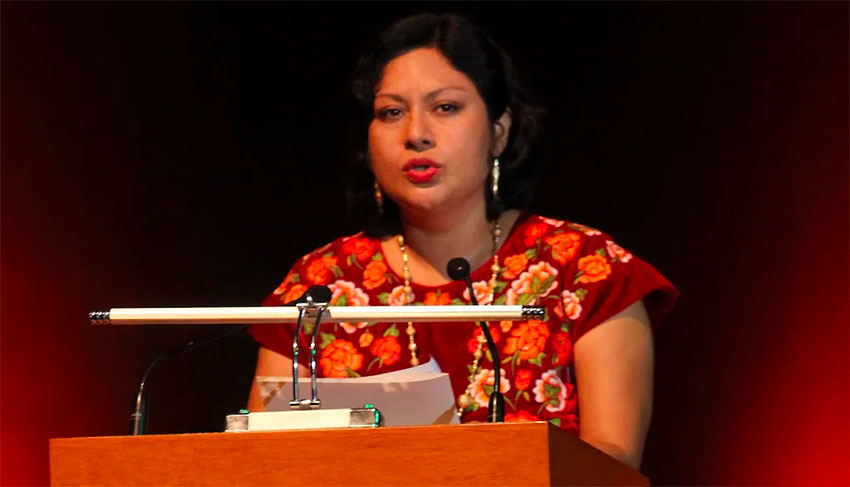
Irma Pineda Santiago is taking the voice of Mexico’s indigenous people — and her own — to the United Nations.
On January 1, 2020, she began her term as a representative to the Permanent Forum on Indigenous Issues (UNPFII), one of four representatives from Latin America and the Caribbean.
Her personal and professional history have paved the way.
Pineda is a Zapotec (or Binnizá) born in Juchitán, Oaxaca, in 1974. Unfortunately, this Isthmus of Tehuantepec community has witnessed violence, even in its recent history. Pineda’s father disappeared unaccountably in 1978.
Despite the difficulties, Pineda earned both bachelor’s (communication) and master’s (education and cultural diversity) degrees to become a poet, essayist, translator (Zapotec/Spanish) and professor at the National Teachers University (UPN) in Ixtepec.
Her writing has appeared in various anthologies and other publications in Mexico and abroad and translated into English and other languages. She has published bilingual books of poetry such as Xilase Nisadó (Nostalgia for the Sea, 2006) and Doo yoo ne ga’ bia’ (From the house of the navel to the 9 rooms, 2009).
She creates and publishes her works in Diidxazá — literally, “language of the cloud people” — a Zapotec dialect of the isthmus, to make it more visible and appreciated. Bilingual versions of her writings feature her own translations into Spanish.
Her work as a writer and teacher naturally led to activism, particularly in the preservation of indigenous languages and cultural rights. For her, the emphasis on language allows her to tackle the rest.
“With the visibility of the language, we can bring to light other issues that concern our communities. For example, in my work, I talk about the violence against indigenous communities by the military, … the constant struggle of indigenous communities against mega-projects … (and) migration. Literature has enabled me to highlight these issues so they can now be discussed in forums such as the United Nations.”
Recognition as a writer, academic and activist granted her opportunities abroad, including residencies in Canada and the United States and academic presentations in the Americas and Europe.
She became the logical choice when it came time for Mexico’s Ministry of Foreign Affairs and the National Institute of Indigenous Peoples (INPI) to choose a representative to the UNPFII, even more so as the nominations were assigned during the International Year of Indigenous Language in 2019.
Juchitán poet Pineda.
Pineda considers the post to be a “great honor, above all considering the fact that my work has been about the defense and promotion of the Zapotec language.”
She is one of 16 members of the UNPFII, whose preliminary meeting was held in Finland in February. Their first formal meeting will be in New York in April. In the meantime, forum members continue to coordinate online.
Pineda believes that it is important for international organizations and governments to pay attention to the knowledge and cosmovision of the original peoples of Latin America and the Caribbean. “We have a lot of work to build bridges between various indigenous organizations and governments.”
Mexico News Daily interviewed Pineda at the International Congress on Languages at Risk, where she drew out five main focuses for her term.
The first and foremost is the preservation and promotion of indigenous languages, not only to make them more visible to the world but also more attractive to native communities.
The second is the availability of education, especially to indigenous girls, as they are often pulled out of school early. But in addition to the national curriculum, she wants schooling that is adapted to the values and knowledge of indigenous communities.
The third is related to the environment on both the global and local levels. “When we look at indigenous communities or where they have more control over the land, they conserve the environment better. … If the land is being better cared for, it must mean that indigenous communities know how to do this. We need to learn from these indigenous communities.”
The fourth relates to the rights of women — that indigenous women know what those rights are and have the means to assert them.
The last is the right to consultation. This means that local, especially indigenous, communities have the right to approve or reject projects and other proposals that affect their lives and land.
When asked what foreigners living in Mexico can do to get to know and appreciate Mexico’s indigenous cultures and peoples, Pineda’s response was, “I think that one of the nicest ways … is through the arts — literature, music, textiles, graphic work. … It is a good door though which to start learning about the culture because you are starting from its beauty.”
Pineda does not deny that indigenous cultures have problems and conflicts but those can be contextualized through artistic expression.
Although she hasn’t been with the UNPFII long, she has already learned much, including that indigenous people in many parts of the world share the same concerns: particularly discrimination, language loss and educational issues.
Pineda still considers herself a writer first and foremost. “Poetry (and literature in general) has enabled me to bring the language to many people who had never heard an indigenous language before, … who didn’t even know that such languages existed.”
A sample of Pineda’s poetry in her native Zapotec can be heard here.
Chicken Florentine Pizza is a good dish for rotisserie chicken.
I could talk about edible bugs – inspired by this story – but I won’t, at least not until I have the chance (ulp) to try some myself.
Instead, let’s talk about the ubiquitous rotisserie chicken, found at pollerías in every Mexican neighborhood and in supermarkets too. Here in Mazatlán, instead of being trussed, the birds are flattened and then skewered onto the rotisserie. (They kind of look like roadkill and it took me a while to get used to it.) Some are simply salted, while in other places the birds are marinated in secret concoctions and then roasted.
However they’re done, the point is that they’ve been cooked for you – and often at the same or even less cost than what you’d pay for a whole, uncooked chicken. Your options are almost endless as to what you can do with this moist, flavorful, ready-to-use meat: create a quick chicken noodle soup, stir-fry or pot pie; use it in nachos, tacos and burritos; make a chicken salad; add to pasta primavera or pesto; add some to a Caesar or Cobb salad … the list goes on and on.
I like to shred the meat: Cut or pull the big sections off the bone, then use two forks to pull it into long, thin pieces.
The other thing I do is make chicken stock. I throw the carcass (minus most but not all of the skin), an onion, a couple of carrots, a stalk of celery and a little salt and pepper in the crockpot with enough water to cover and cook it on low overnight or for 8-10 hours. In the morning, I strain it, freeze some and save the rest in the fridge for a flavor-boost in soup, beans or whatever.
Barbecued Chicken Pizza is one of a long list of options.
While this may seem like a no-brainer, I know I tend to use the same recipes time and again, so I thought I’d share some more unusual ones.
Barbecue Chicken Pizza
2 Tbsp. olive oil
1 medium red onion, sliced
2-3 cloves garlic, minced
1 tube refrigerated pizza crust or prepared crust like Boboli
¾ cup barbecue sauce
2 cups shredded cooked chicken
6 bacon strips, cooked and crumbled
¼ cup crumbled Gorgonzola or Blue cheese
2 jalapenos, seeded and minced
2 cups shredded mozzarella cheese
Preheat oven to 425°. In a large skillet, heat oil over medium heat. Add onion and garlic; cook and stir 4-6 minutes or until softened. Reduce heat to low; cook 20 minutes or until deep golden brown and caramelized, stirring occasionally. Unroll and press dough onto bottom and ½ inch up sides of a greased cookie sheet. Bake 8 minutes. (If using a pre-baked crust, continue from here.) Spread barbecue sauce over dough; top with chicken, onion mixture, bacon, Gorgonzola and jalapenos. Top with mozzarella. Bake 8-10 minutes or until crust is golden and cheese is melted. –TasteOfHome.com
Chicken Florentine Pizza
1 tsp. Italian seasoning
½ tsp. garlic powder
3 cups cooked cubed chicken
1 cup ricotta or requesón
1 prebaked 12-inch pizza crust
1 package (10 oz.) frozen chopped spinach, thawed and squeezed dry or equivalent fresh
2 Tbsp. oil-packed sun-dried tomatoes, drained and chopped
½ cup shredded mozzarella
¼ cup grated Parmesan cheese
Preheat oven to 425°. Mix Italian seasoning and garlic powder; toss with chicken. Spread ricotta or requesón on pizza crust. Top with chicken, spinach and tomatoes. Sprinkle with mozzarella and Parmesan cheeses. Bake until crust is golden and cheese is melted, 10-15 minutes.
Chinese Chicken Salad
This has a lot of ingredients but is actually quite easy to prepare. To make chipotle pepper purée buy a small can and whir in blender.
¼ cup rice wine vinegar
2 Tbsp. smooth peanut butter
1 Tbsp. chopped fresh ginger
2 tsp. chipotle pepper purée
1 Tbsp. soy sauce
1 Tbsp. honey
2 tsp. toasted sesame oil
½ cup vegetable oil
Salt & pepper
½ head shredded Napa cabbage
½ head shredded romaine lettuce
2 shredded carrots
¼ pound julienned snow peas
¼ cup chopped cilantro leaves
¼ cup thinly sliced green onion
2 cups shredded rotisserie chicken
½ cup chopped roasted peanuts or cashews
¼ cup chopped fresh mint
Optional: chile oil
Whisk vinegar, peanut butter, ginger, chipotle purée, soy sauce, honey, sesame oil and oil in a medium bowl. Add salt and pepper to taste. Combine cabbage, lettuce, carrots, snow peas, cilantro and green onion in a large bowl, add dressing and toss. Transfer to a platter and top with shredded chicken, chopped peanuts and mint. Drizzle with chile oil, if desired. – Bobby Flay
This chicken is also useful for making a stock that can provide a flavor-boost in soup, beans or whatever.
Chicken Alfredo Roll-Ups
2½ cups whole milk
4 oz. cream cheese, softened
½ cup grated Parmesan cheese
Juice of 1 lemon
2 Tbsp. fresh parsley or cilantro, minced
Salt & pepper
4 cups shredded rotisserie chicken
12 cooked lasagna noodles
Preheat oven to 350°. In large skillet over medium heat, melt butter. Add garlic and cook until fragrant, 1 minute. Whisk in flour; cook 1 minute more. Pour in milk, whisking constantly, and bring to a simmer. Stir in cream cheese and Parmesan and simmer until sauce thickens, 2 to 3 minutes. Add lemon juice and parsley. Season with salt and pepper. Spoon a thin layer of sauce onto bottom of a baking dish. Spread sauce onto each cooked noodle, top with chicken, then roll up snugly. Place roll-ups in baking dish seam-side down. Spoon remaining sauce on top. Bake about 20 minutes. – Delish.com
Janet Blaser of Mazatlán, Sinaloa, has been a writer, editor and storyteller her entire life and feels fortunate to write about great food, amazing places, fascinating people and unique events. Her work has appeared in numerous travel and expat publications as well as newspapers and magazines. Her first book, Why We Left: An Anthology of American Women Expats, is available on Amazon. Contact Janet or read her blog at whyweleftamerica.com.
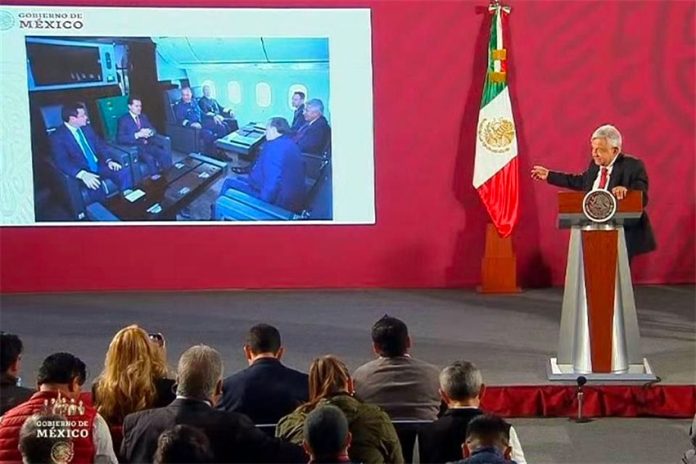
The president displays a photo of Peña Nieto and his cabinet aboard the presidential plane.
President López Obrador bought the first raffle ticket for the presidential plane at his Tuesday morning press conference and announced that the tickets would go on sale to the public next Monday.
He said that the raffle will act as a kind of “vaccine” against government corruption, claiming “we’ll see if someone dares to do something like this again.”
López Obrador has refused to fly in the luxuriously outfitted plane used by the former president, and it is currently in a hangar in California, where the costs of its upkeep have totaled almost as much as actually flying it. He said it will be returned to Mexico after maintenance work is finished.
National Lottery director Ernesto Prieto announced that the tickets were distributed all over the country on Monday. The ticket numbers run from seven zeros to 5,999,999.
“Today I am going to turn in the first ticket sale for the presidential plane. I’m going to hand over number 0 so that [President López Obrador] can pay with this 500-peso bill,” he said at Tuesday’s morning press conference.
The president attempted to sell the Boeing 787 Dreamliner used by his predecessor, Enrique Peña Nieto, for domestic and international flights but unable to find a buyer, decided to hold a raffle for it in January. The plane had a price tag of US $130 million.
The raffle has been described by opposition politicians as a smokescreen intended to divert the public’s attention away from insecurity and slow economic growth.
At the press conference, López Obrador showed reporters a photo of Peña Nieto aboard the presidential plane with members of his cabinet and called them “pharaohs” and “sexennial monarchs.”
“Those were the times of pharaohs, of sexennial monarchs, and it wasn’t just the previous government. Let’s not forget that it was Calderón who bought the plane,” he said, reminding the press that the Dreamliner is a long-haul aircraft not meant for domestic flights.
“It’s for flying [at least] five hours daily … and landing it after a relatively short distance is not recommended.”
He said that once the plane is returned to Mexico in April or May, his administration will organize public visits “because this is a vaccine against this epidemic [of corruption], a good preventative vaccine.”