Home Blog Page 1781

More power outages in Baja California Sur; emergency declared for third time

0
Lights out in La Paz.

Baja California Sur is being hit by blackouts again as the electrical grid struggles to supply the state with electricity.

Neighborhoods in La Paz started to report power outages around 4:00pm on Monday. At the same time, the National Energy Control Center (Cenace) declared that the state’s grid was operating in a state of emergency, which would lead to continued blackouts.

An emergency is declared when an electrical system has an operating reserve of less than 4%.

It was the third time in 15 days that such an emergency declaration has been made.

Governor Carlos Mendoza Davis said the blackouts will continue until the problem is addressed, and asked the federal government to do so with the the Federal Electricity Commission (CFE) and the Energy Secretariat.

“This is not going to get better; I worry that we are reaching the limits,” he said. “The solution could be underwater cables, but that’s not an immediate solution. Another solution to the blackouts could be to expand our production of electricity, which isn’t a good solution because we’d be producing very expensive electricity, and burning fuels with high levels of contamination.”

Mendoza said that although an underwater cable would take time to construct, it “would pay for itself.”

He also noted that Baja California Sur is not connected to the CFE’s National Interconnected System.

Source: Milenio (sp), BCS Noticias (sp)

Youth employment program subject to ongoing monitoring: secretary

0
Secretary Alcalde defends program.

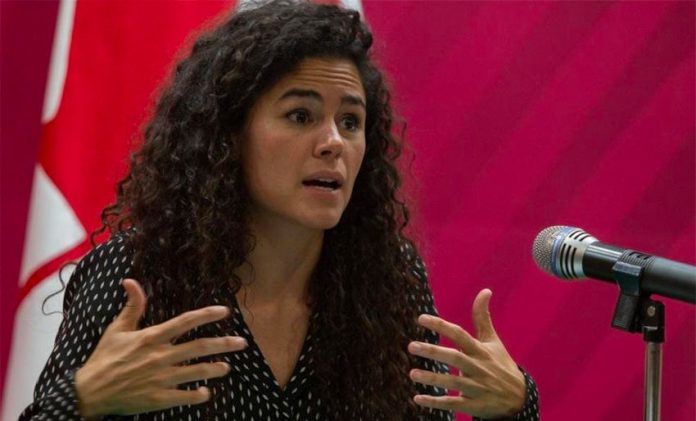
Labor Secretary Luisa María Alcalde is insisting that a federal youth employment program launched earlier this year has been a success despite reports of corruption and irregularities.

In an interview with W Radio, Alcalde acknowledged that there have been complaints of irregularities in 300 work centers associated with the “Youth Building the Future” program, but the number of complaints is not significant.

“I would say that they are not significant statistics,” she said. “Let’s remember that there are 158,000 work centers where almost a million young people are being trained.”

The Youth Building the Future program offers government scholarships of 3,600 pesos (US $183) a month to more than 900,000 young people to work for around 158,000 employers across the country, including businesses, nonprofits and government agencies.

But a report yesterday by the newspaper Milenio revealed a series of irregularities. Federal delegates in nine different states told the newspaper that some young people enrolled in the program are being pressured to give part of their scholarship money to their employers in exchange for not having to work.

Other participants have complained that they are being charged money by their employers to be able to work, or that employers are withholding payment.

Alcalde said her office will work to eliminate irregularities in the program.

“It’s important that the young people protect their right to participate in the program, and if someone asks for part of their scholarship, they should say no and switch employers,” she said.

The secretary said the government is working with the program’s private sector participants to find new opportunities.

“The private sector has expressed to us that the program has served as a good mechanism to recruit, identify talent, and hire skilled young people,” she said. “We continue to work closely with the private sector, with chambers of commerce, we are constantly having meetings to plan, follow up, monitor and evaluate the program, as well as to talk about future opportunities.”

Source: Milenio (sp)

Community police find The Monster, Guerrero gang leader’s war tank

0
Guerrero gang leader's converted dump truck.

Community police in Guerrero have found a dump truck repurposed as a war tank that belonged to the leader of the Los Rojos crime gang, Santiago “El Carrete” Mazari Hernández, who was arrested two weeks ago.

Members of the United Front of Guerrero Community Police (FUPCEG) located the vehicle – which they nicknamed “El Monstruo” (The Monster) – in El Tecomazuchitl, a community in the state’s Sierra region.

The tank was taken to Tlacotepec, the municipal seat of Heliodoro Castillo, and parked at the entrance to the town where it will remain on display.

“We want society to see how El Carrete spent the money that he obtained from the kidnappings and extortion he carried out from the Sierra,” said FUPCEG spokesman Salvador Alanís Trujillo.  

“El Monstruo” is reinforced with steel plates and has small openings on its sides to allow occupants to shoot from within the vehicle.

The tank also has a cupola, or hatch, on its roof that can be used as a lookout and to fire at enemies.  

According to FUPCEG members, Mazari, who was arrested on August 1 after a three-day confrontation between community police and Los Rojos, planned to use the tank to carry out an incursion into Filo de Caballos, a town in the municipality of Leonardo Bravo notorious for violence and the cultivation of opium poppies.

Alanís Trujillo said that in the same community where the converted dump truck was found, “El Carrete” had set up a training camp for about 70 armed members of Los Rojos.

The camp was used as a base for criminal activities that included kidnapping and extortion primarily targeted at business owners and politicians in Morelos, the community police spokesman said.

Source: El Financiero (sp), Milenio (sp)

Ex-cabinet secretary Robles jailed; faces trial over missing 5 billion pesos

0
Rosario Robles was ordered to be held in preventative custody.

After a hearing that lasted more than 12 hours, a judge ruled early Tuesday morning that a high-ranking cabinet official from the administration of former president Enrique Peña Nieto be held in preventative custody as she awaits trial on corruption charges.

Judge Felipe de Jesús Delgadillo Padierna decided that Rosario Robles, who served as both social development secretary and agrarian development and urban planning secretary under Peña Nieto, poses a flight risk.

She will be held in the Santa Marta Acatitla jail in Mexico City for at least two months while the investigation against her goes ahead.

Prosecutors had asked Judge Delgadillo to lock Robles up for six months.

In her defense, Robles said she does not have the financial resources to flee, and noted that she had returned from abroad to face justice.

The Attorney General’s Office says that through omission, Robles allowed over 5 billion pesos (US $258 million) to be misappropriated from the federal budget while she was leading the two secretariats.

The scheme was carried out through allegedly phony contracts with universities and shell companies as part of the so-called “Master Fraud.” Robles faces up to 23 years in prison.

Robles’ defense attorney, Óscar Ramírez, said that while she was a cabinet secretary, Robles had detected possible irregularities in the budgets of the departments she was leading and reported them to then-president Peña Nieto several times.

The defense presented proof of the claims, including a document prepared by Robles for José Antonio Meade, who took over as social development secretary in 2015. The document alerts Meade to the irregularities and a related investigation by auditors.

“She informed the incoming secretary, which means that omission is not the issue here,” said Ramírez.

Source: El Financiero (sp), Milenio (sp), El Universal (sp)

Aborted landings up 84% due to heavy traffic at Mexico City airport

0
Aircraft on the tarmac at Mexico City airport.

Aborted landings at Mexico City airport increased 52% in the first five months of the year, and those caused specifically by crowding on the runways rose by 84%.

Data obtained by the news agency Bloomberg through a freedom of information request shows that pilots of 541 planes were forced to perform go-arounds – as aborted landings are called – before they could touch down at the Benito Juárez International Airport between January and May.

Of that number, 83 were caused by the presence of aircraft that had not yet cleared the runways.

In the first five months of 2018, there were 357 go-arounds of which 45 were due to clogged runways.

Bloomberg reported that aborted landings are still rare in Mexico City but the increase to six out of every 1,000 landings between January and May compared to four in the same period last year is nevertheless cause for concern.

Go-arounds cost airlines both time and money because they force planes to use more fuel.

Richard Bloom, an aviation security professor at Embry-Riddle Aeronautical University, said that for every 1,000 landing attempts at a global level, between one and three will result in a go-around.

The increase in aborted landings in Mexico City should at the very least “lead to a review of the typical factors involved in go-arounds,” he said.

Gabriel Yee, flight operations manager for Aeroméxico, said that sudden changes in weather conditions have caused aborted landings in Mexico City in recent months.

However, he told Bloomberg that Mexico City airport doesn’t have a policy known as “minimum runway use” to get planes off the runway quickly, adding that “there’s no denying the airport has more operations than before.”

Passenger traffic grew 6.6% last year to 47.7 million people. The airport has two runways but they can’t be used simultaneously because they are too close together.

Yee pointed out that there is no short-term solution other than finding ways to make the airport “work more efficiently.”

To ease congestion at Mexico City airport, Latin America’s busiest airport, the federal government is pursuing a three-pronged plan – but relief is still some way off.  

The Defense Secretariat has been given the responsibility of building a new airport at the Santa Lucía air force base in México state and the existing airports in Mexico City and Toluca will be upgraded. A third terminal will be built at the existing facility in the capital.  

The Santa Lucía project, however, is currently mired due to legal opposition and even if it materializes, aviation experts doubt that it will be able to meet the growing demand for runway space caused by the rise of budget domestic airlines.

In that context, President López Obrador’s decision to cancel the previous government’s Texcoco airport project – after a legally questionable public consultation – becomes an even greater target for criticism.

Aviation experts at Mitre Corp.’s Center for Advanced Aviation System Development have questioned the viability of the Mexico City and Santa Lucía airports to operate simultaneously due to their proximity to each other.

Aeroméxico CEO Andres Conesa said that he had similar concerns.

“We haven’t seen the analysis,” he said. “We’d like to see the ability to increase operations in this dual system. We prefer to have one airport because we’re under a hub-and-spoke model.”

As for Toluca, the chances of success of the plan to increase traffic at that airport is dependent on cost, the CEO of budget airline Volaris told Bloomberg.

“We stopped operating out of Toluca because of what it cost us,” Enrique Beltranena said. “We need more clarity” about how much it would cost to return.  

Source: Bloomberg (sp)

The dreaded 502 error is a digital publisher’s worst nightmare

0
The 502 landing page generated by Kinsta, the company whose servers host Mexico News Daily.

In the old days the worst that ever happened was the press would break down. But the press crew would go to work, fix the problem and get it rolling again, usually in a matter of hours, or less.

It was mechanical, and simple.

These days, we’ve got things like 502 errors to deal with. They are generated when a connection to a website cannot be made, usually due to an overloaded web server.

So the techs and engineers go to work and if we’re lucky the problem is quickly resolved. If not, several days can elapse before the problem has been identified.

It’s technical, and not always simple.

But in the meantime, thousands of Mexico News Daily readers — in our case 2,409 over the course of five days — can be affected.

The number of readers who were locked out was only 1.28% of the total readership during that period, but enough to keep a publisher awake at night wondering when the nightmare would end.

What made the issue even more worrisome was the phone call that came last week from a guy who said, in very broken English, that he was a hacker and had hacked Mexico News Daily.

Oh, sure, I thought as I looked at a monitor that indicated there were 450 readers on our site at that moment. You’re not much of a hacker, I said to myself, brushed him off and hung up.

The next day 585 readers encountered the dreaded 502 error message and could not read the news.

From Thursday through Sunday we employed all kinds of measures to reduce website load, but not until Sunday night did we begin to see any improvement. By Monday afternoon, as of this writing, there had not been a single 502 for nine hours.

Were we hacked? It appears unlikely, but I’m not going to declare either way.

Just so you know, if you see the 502 error there are two choices: wait a day or two, perhaps longer, and it will likely resolve itself.

Or you can do this: go through the following steps, advancing one by one until the problem is resolved. First refresh the page; then close all browser windows, open a new one and go back to Mexico News Daily; then clear the browser cache; then clear cookies; then restart the computer. I found clearing cookies did it for me, so you could always do that first. But start with the others if you would prefer not to delete cookies.

It pains me to have to ask a reader to go through all that to correct a problem that we created. But that is the nature of the error. The page has been cached by your device, or another server between us and you, and we’re stuck with a bad situation all around.

Although everything is running smoothly at the moment, the big test will come this evening when we send 50,000 email newsletters to the subscribers of two mailing lists.

My stomach roils at the thought that the nightmare is not over.

But I’ll still take a web server over a press any day.

The writer is publisher and editor of Mexico News Daily.

Corruption charged in delivery of youth employment program scholarships

0
The program pays youths 3,600 pesos a month.

State-based federal officials have denounced a range of corrupt practices in the delivery of the government’s youth employment program.

Delegates in Aguascalientes, Campeche, Chiapas, Guerrero, Nayarit, San Luis Potosí, Sonora, Tabasco and Yucatán all say that some young people enrolled in the “Youths Building the Future” program are handing over part of their 3,600-peso (US $183) monthly scholarships to their employers in exchange for waiving their obligation to show up to work.  

The officials told the newspaper Milenio that the moches – cuts or kickbacks – paid by the youths to companies and other organizations registered as employers in the program range between 500 and 1,600 pesos per month.   

They also said that in some cases, employers are withholding part or all of the remuneration to which apprentices are entitled.

Tabasco delegate Manuel Merino Campos said that authorities have detected 140 companies that engaged in illegal acts in connection with the program. All of them lost their accreditation to participate in the scheme, he added.  

Merino said more than 200 young people in Tabasco filed complaints stating that companies charged them unjust fees to participate.  

As a result of the corruption allegations, the program has been temporarily suspended in the Gulf coast state.

Guillermo Díaz Robles, the Sonora director of the employment program, said the participation of 18 companies in that state has been terminated after it was discovered that they too were charging their apprentices fees in exchange for employment. However, no legal action was taken against them.

Another 12 Sonora companies are under investigation, Díaz said.

Guerrero delegate Iván Hernández Díaz told Milenio that the intention to implement the same practice was detected in the state’s Sierra region although it was civil society organizations rather than companies that planned to collect fees from their young employees.

However, authorities intervened to put an end to the plan before it started and revoked the organization’s authorization to take part.

In Yucatán, the federal government’s social programs coordinator said authorities will carry out an audit of the employment scheme’s operation to ensure that young people are actually attending the jobs and training to which they have been assigned.

“There are companies that have told the young people . . . to give them a part [of their scholarship] and don’t [worry about] showing up . . .” Joaquín Díaz Mena said.

In Nayarit, Chiapas and San Luis Potosí, authorities have detected the presence of ghost, or shell, companies that have registered in the “Youths Building the Future” program in order to recruit young people and provide them with sham employment opportunities.

In San Luis Potosí, cases have been detected in which the “employed” youths and the phony companies split the scholarship resources equally, delegate Teresa Pérez Granados said.

The claims of corruption within the youth employment program come less than a week after the Labor and Social Welfare Secretariat said it had reached its goal of giving scholarships to a million young people.

However, whether that number of people are actually engaged in active employment is now in doubt.

The states in which the highest number of ninis (ni trabajan ni estudian) meaning “they don’t work, they don’t study” have enrolled in the scheme – whether they are actually working or not – are Chiapas, Tabasco, Veracruz, México state, Guerrero, Michoacán and Mexico City.

The states with the lowest take-up are Baja California, Baja California Sur, Nuevo León, Aguascalientes, Sonora, Coahuila and Colima.

Baja California Sur delegate Víctor Castro Cosío said that the program’s rollout in the state “can be considered a failure.”

He explained that only 3,000 signed up for the program while authorities were hoping to attract 11,000 would-be apprentices.

“. . . We didn’t reach our goal, we think, because many young people here preferred to look for work elsewhere, as the 3,600 pesos a month didn’t seem like a lot.”

Source: Milenio (sp)

Deported migrants featured in new interactive border wall art in Tijuana

0
Deported migrants' mural in Tijuana.

The border wall that cuts off Tijuana’s beach from its American counterpart was transformed last Friday into a canvas that tells the stories of deported migrants.

The interactive art installation at Playas de Tijuana by Lizbeth De la Cruz Santana consists of portraits of four deported migrants, spanning the height of a section of the border fence along Tijuana’s beach.

Visitors who hold their cellphones up to a QR barcode affixed to one of the murals can access audio on the project’s website narrating each migrant’s story.

The subjects are a United States veteran, two mothers who were forced to leave behind their U.S.-born children and a man who was deported just months before he would have qualified for DACA — the 2012 program designed to shield from deportation people who were brought to the U.S. when they were young.

De la Cruz Santana, 28, herself the child of a Mexican migrant, said that each of those depicted in the installation is someone she knows, and that she felt compelled to share their stories to bring awareness to the dangers and hardships faced by migrants during their journey north and during deportation.

She added that she hopes the project, which is part of her doctoral dissertation and funded through a grant provided by the Mellon Public Scholars Fellowship, could help raise money to provide legal assistance for deported migrants.

“Technology is one of the best ways and venues for people to tell their stories.”

Mauro Carrera, a muralist and partner with De la Cruz Santana on the project, said he hopes the project shows “the people behind the politics.”

De la Cruz said that while mounting the installation she was struck by the stark contrast between the bustle and liveliness of beachgoers, restaurants, bars and a bullring on the Mexican side of the border fence, and the nervous quiet of parked Border Patrol vehicles on the U.S. side.

“If you look past this wall on the U.S. side, there’s nothing. I wanted to erase the border.”

Source: Milenio (sp)

Migrant shelter director kidnapped after refusing to give up asylum-seekers

0
Méndez was kidnapped August 3.

A Catholic priest who runs a migrant shelter in Nuevo Laredo, Tamaulipas, was kidnapped on August 3 after refusing to hand over Cuban asylum seekers to an organized crime gang.

Nine days ago, armed civilians stormed the Casa del Migrante AMAR shelter with the intention of kidnapping several Cuban refugees in order to ransom them back to their families.

Instead, the gunmen found their way blocked by Aarón Méndez, who steadfastly refused to turn over the Cubans. They took Méndez instead.

In an interview with the news agency EFE, Méndez’s colleague Erbin Ortiz said Cuban migrants are thought to be “the most worthwhile migrants to kidnap for organized crime” because of the speed with which family members pay ransoms.

Ortiz said that after Méndez’s kidnapping, Casa del Migrante AMAR contacted federal authorities, who placed the shelter under 24-hour protective surveillance. However, so far the shelter’s workers have received no news regarding the case or ransom demands from the priest’s kidnappers.

“We all live in fear that the criminals could return and take more people.”

Ortiz said that Méndez had given himself “100%” to the shelter and the task of defending migrants’ rights since 2009.

Casa del Migrante AMAR has 100 beds to offer temporary refuge to migrants hoping to cross into or seek asylum in the United States near Nuevo Laredo, although Ortiz assured that the shelter often operated well beyond capacity, housing up to 450 migrants at a time.

Ortiz said that Méndez often enlisted migrants at his shelter in charitable projects around Nuevo Laredo, including handing out food in impoverished communities, cleaning parks and painting schools around the northern border town.

Without news on the investigation into their director’s disappearance, shelter workers reached out to President López Obrador on Twitter:

“We demand that López Obrador find [Méndez] alive and to stop stigmatizing those who defend migrants at the northern border.”

Source: Milenio (sp), El Sol de México (sp)

Youth sports foundation purchases narco-mansion for 102 million pesos

0
The mansion that went on the block on Sunday.

A mansion owned by accused drug trafficker Zhenli Ye Gon was sold to the Butaca Enlace Foundation at the latest federal government auction, held by the Administrative Allocation of Goods Service (SAE) on Sunday.

The foundation paid 102 million pesos (US $5.2 million) for the mansion, which is located in the Lomas de Chapultepec neighborhood of Mexico City. The four-story building has 10 bedrooms, 14 bathrooms, a pool and an elevator.

The Butaca Enlace Foundation has helped over two million young people participate in athletic events over the past 11 years. In 2011, the foundation supported the participation of over 50,000 athletes at the Pan American Games in Guadalajara.

The foundation’s director, Carlos Bremer, is also director and CEO of Grupo Financiero Value, a financial services company that was founded in 1992. He is also known for his participation in Shark Tank México, a program that seeks to promote entrepreneurship.

The Mexican government seized the mansion in 2007 after Ye Gon was arrested in the United States on drug trafficking charges. Police found more than US $200 million in cash in one of the bedrooms. Ye Gon, who was born in China and became a Mexican citizen in 2003, was extradited to Mexico in 2016.

The mansion was transferred to the SAE in 2012, and the furniture and other items found inside the house were auctioned off.

At the presidential press conference this morning, SAE Director Ricardo Rodríguez called the auction a success.

“This auction was very special because we raised 125.8 million pesos, 102 of which were from the Lomas de Chapultepec mansion,” he said. “It was a very special event because it was the most valuable piece of real estate that we have dealt with. We raised four times more than in the vehicle auction.”

The proceeds will be used to give scholarships to 544 Mexican athletes.

Before the auction, Ye Gon unsuccessfully filed for an injunction to prevent his property from being auctioned off. His lawyer, Juan Luis Gómez Jardón, told Grupo Fórmula that his client will continue taking legal action to recover his old home, and that the proceedings will now involve Bremer, who bought the house.

“The businessman Carlos Bremer bought a legal problem when he bought Zhenli Ye Gon’s house for 102 million pesos,” said Gómez. “The government sold the Lomas de Chapultepec house without fulfilling the legal requirements.”

Source: El Financiero (sp), El Sol de México (sp), El Universal (sp), Milenio (sp)