Home Blog Page 1782

Mexican athletes make history with 136 medals at Pan American Games

0
Medal-winning Mexican archers in Lima, Peru.

Mexico finished third on the medal tally at the Pan American Games in Lima, Peru, winning a total of 136 medals, including 37 gold.

It was Mexico’s best performance at the regional sporting event in terms of medals won although the gold tally was five less than the record 42 taken home by Mexican athletes at the 2011 games in Guadalajara, Jalisco.

The only other time that Mexico has placed so highly on the medal tally was at the 1955 Pan American Games in Mexico City at which it also finished third.

Mexico’s medal haul – 37 golds, 36 silvers and 63 bronzes – was won by athletes competing in 31 different sports including athletics, gymnastics, weightlifting, rowing, judo, squash, diving, swimming and shooting.

Not a single day passed during the 16-day event on which the Mexican team didn’t win at least one gold medal, a feat that had never been achieved before.

paolo longoria
Racquetball player Paola Longoria has won more gold medals at the Pan American Games than any other Mexican, after winning three more in Lima.

The gold medals came in 14 different sports: athletics, canoeing, cycling, diving, water skiing, Basque pelota, gymnastics, weightlifting, modern pentathlon, racquetball, rowing, taekwondo, archery and triathlon.

The opening and penultimate days of the games were the most successful days for the Mexican delegation, with athletes winning five and seven gold medals respectively.  

On July 27, Paola Fragoso was triumphant in her taekwondo weight division, Crisanto Grijales won the men’s triathlon, Mariana Arceo came out on top in the modern pentathlon, Jonathan Muñoz lifted his way to glory in the 67-kilogram weightlifting division and Daniela Souza overcame her Brazilian opponent to win the final of the 49-kilogram weight division for taekwondo.

On August 10, Kenia Lechuga took top spot on the podium after rowing to victory in the women’s single sculls and Mexico had a highly successful day on the Basque pelota court, winning five gold medals in singles and doubles events.

The seventh gold on Saturday went to Mexico’s female racquetball team.

Mexico’s performance in the Peruvian capital far exceeded the expectation of the Mexican press and National Sports Commission director Ana Gabriela Guevara, who predicted a haul of 19 gold medals.

The United States finished first on the medal tally with 120 golds out of a total of 293 podium placings.

Brazil ranked second with 55 golds out of 171 medals, while Canada placed fourth with 35 golds.

Cuba, Argentina, Colombia, Chile, Peru and the Dominican Republic took out spots fifth to tenth respectively. Athletes from 30 countries participated.

The next edition of the Pan American Games will be held in Santiago, Chile, in 2023.  

Source: El Universal (sp), Milenio (sp)

Bids sought for 12,000-strong security force for federal buildings

0
Private security firms have been contracted in the past to watch over federal facilities.

The federal government has called for bids from security companies interested in providing between 12,000 and 15,000 guards to protect almost 3,000 public buildings.

The Secretariat of Communications and Transportation (SCT) published a tender on July 29 that specifies that only one company will be awarded the 16-month government contract. The successful bidder will be announced on August 23.

The guards will provide security for 2,937 buildings belonging to most federal government secretariats and agencies.

The buildings include office blocks and public hospitals located in various states and Mexico City.

The decision to seek a single company to provide the large security contingent is a radical departure from the way in which guards have been traditionally hired.

Most security contracts have previously been awarded by individual government departments to small and medium-sized companies based in the area where the protection was sought.

But most of those companies would not have the capacity to provide the number of guards sought by the government and would therefore be precluded from bidding under the new procedure.

The Federal Protection Service, a government security agency, could be among the bidders, the newspaper Reforma reported.

However, the agency currently only employs 4,000 guards, a number which would not even meet the personnel requirements for federal buildings in Mexico City.

Source: Reforma (sp)

Day Zero for water: Mexico on the list of water-stressed countries

0
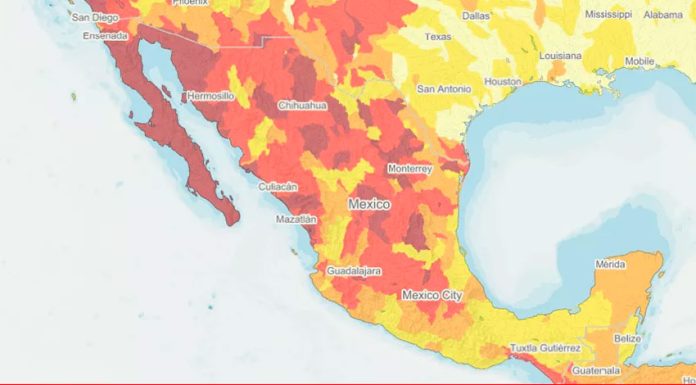
The water stress map of Mexico indicates risky areas with the dark shades.

About a third of the world’s population of over 7 billion live in countries at high risk of running out of water in the near future, and Mexico ranks high on the list, according to a study by the World Resources Institute.

The institute categorized countries into five different levels according to their relative risk of consuming all of their water resources, ranging from “Low Baseline Water Stress” to “Extremely High Baseline Water Stress.”

Mexico falls into the high-stress category, the second-highest on the list, meaning that the nation consumes between 40% and 80% of the water supply available in a year. Overall, Mexico ranks 24th out of the 164 nations included in the study.

However, a more detailed look at the maps included in the study shows that some regions of Mexico are under significantly more baseline water stress than others. Fifteen states, all in northern and central Mexico, fall within the “Extremely High Baseline Water Stress” category, meaning that they consume between 80% and 100% of available water every year.

Among the states most vulnerable to water crises Baja California Sur is in the lead, followed closely by Guanajuato, Mexico City, Aguascalientes, México state, Querétaro, Hidalgo, Chihuahua, Zacatecas, Sonora, Sinaloa, Nuevo León, Morelos, Jalisco and Tamaulipas.

Several Mexican states, mostly located in the Gulf region, are at medium to high risk of suffering drought, including Tabasco, Veracruz, Tamaulipas, Tlaxcala, Yucatán, Colima and Puebla.

Mexico is one of 44 countries, representing one-third of the world’s population, deemed most at risk of hitting “Day Zero,” the point at which there is not enough water to meet the needs of its citizens.

“Water stress poses serious threats to human lives, livelihoods and business stability. It’s poised to worsen unless countries act: population growth, socioeconomic development and urbanization are increasing water demands, while climate change can make precipitation and demand more variable.”

However, the institute stressed that decisive action could have a significant and swift impact on countries’ available water resources.

It said that to step back from impending disaster, countries should implement several strategies, including increasing agricultural efficiency, investing in gray and green infrastructure and treating, reusing and recycling water.

“The data is clear: there are undeniably worrying trends in water. But by taking action now and investing in better management, we can solve water issues for the good of people, economies and the planet.”

Source: El Financiero (sp)

Commando kills 8, wounds 3 in Irapuato pool hall

0
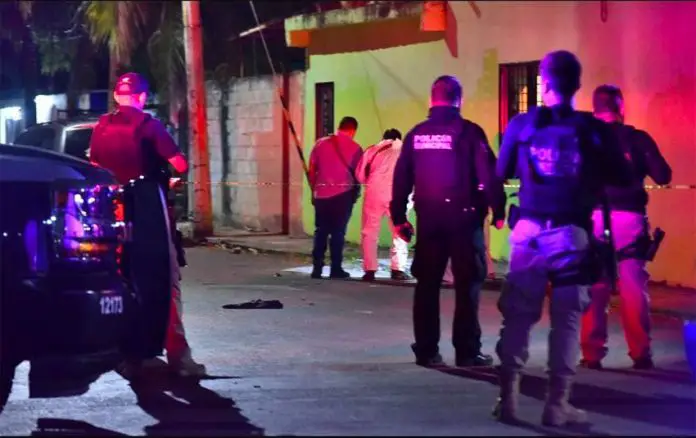
Police outside the pool hall were eight people were killed.

A commando attacked a pool hall in the city of Irapuato, Guanajuato, on Saturday night, killing eight people and injuring three others.

The attack took place in Irapuato’s Che Guevara neighborhood, right next to a police station.

The group of about 10 armed men started shooting at people on the street around 10:00pm and then entered the pool hall, where they started shooting at patrons.

Three people died in the building, while another died outside, two on the way to the hospital and two others at the hospital. Three others were seriously injured.

Irapuato Mayor Ricardo Ortiz Gutiérrez said the attack happened so quickly that officers who were stationed at the nearby police station were not able to respond until the aggressors were already fleeing the scene.

“It was very fast, 35 seconds, they just came and started shooting and we couldn’t respond or anything,” he said.

There were 31 homicides in the state over the weekend. The dead include a municipal police officer from the city of León, five civilians who were killed in a clash with security forces in the municipality of Yuriria, and a National Guardsman who was shot dead in the same municipality during a shootout with organized crime.

Lieutenant Anastasio Carlos was the first member of the new security force to fall in combat.

Source: El Universal (sp)

Nissan loses speed; production fell 22% in July

0
July was not a good month for Mexico's largest automaker.

July was a historically bad month for the Japanese automaker Nissan, the largest automotive manufacturer in Mexico.

Nissan produced 38,409 cars last month, a decline of 21.6% compared with the same month in 2018. Meanwhile, sales of Nissan vehicles continued a 26-month decline, dropping 13.5% compared with July 2018.

Last December, Nissan announced that it would lay off 1,000 workers in its three Mexico plants because of “challenging” conditions in the internal market and a global restructuring of the firm.

Nissan produces and exports more cars in Mexico than in any other country.

The Japanese company also produces more vehicles than the other 20 automakers that operate in the country, accounting for around 20% of production. Although Nissan has lost around four percentage points of production share in the past two years, it remains the top vehicle producer.

Nissan has experienced significant growth since 2009, related to the economic crisis. However, according to professor Manuel Valencia of the Monterrey Technological Institute, the company is stagnating after its decade of growth, while its competitors are adapting to changing market conditions.

The trouble for Nissan México come at a time when the company is struggling around the world. In the second quarter of the year, Nissan’s net income was 95% lower than in the same period in 2018.

Source: El Universal (sp)

Data center malfunction responsible for card, debit card chaos

0
Many of these were out of service on Saturday.

A data center malfunction left bank customers across Mexico unable to make purchases and withdraw cash with their credit and debit cards for several hours on Saturday.

Prosa, an electronic transaction services firm that processes card payments for several banks, said an electrical fault at its data center in Santa Fe, Mexico City, caused the widespread failure of payment terminals and ATMs.

Bank customers were also unable to make online purchases using credit and debit cards.

Prosa said its services were restored just before 11:00pm on Saturday.

Customers of Banorte, HSBC, Invex, Santander, Scotiabank and Banjército were among those affected by the widespread system failure.  

BBVA Bancomer and Banamex, which have the most cards in circulation in Mexico, said that their systems were not affected and that customers were able to withdraw cash at ATMs.

However, the two banks’ cards were rejected at point-of-sale terminals.

Customers took to social media to express frustration at their inability to make payments and access cash, while chaotic scenes were reported at supermarkets, where many shoppers were forced to abandon carts filled with groceries.

Many businesses announced on social media that they could only accept cash payments.

Sources from Prosa told the newspaper El Financiero that it was the first time that a data center malfunction had caused a problem of the magnitude seen on Saturday.

The service outage raised questions about the reliability of Mexico’s electronic banking system a day after it was revealed that the federal government is considering a ban on the use of cash to purchase gasoline and pay tolls as a means to fight tax evasion and money laundering and to encourage more people to open bank accounts.

Source: El Financiero (sp)

Semi slams into toll plaza washrooms in Veracruz, killing 3

0
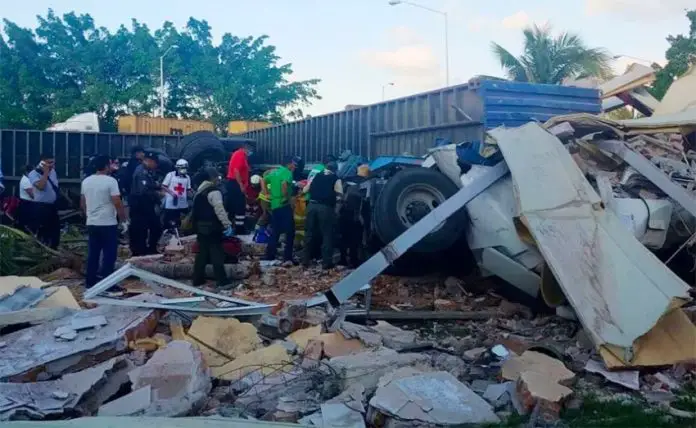
The wreckage after yesterday's accident in Veracruz.

Three people died and seven others were injured when a semi-truck crashed into motorcycles and washrooms at a toll plaza in Veracruz on Sunday afternoon.

The double-trailer semi traveling on the Veracruz-Xalapa highway in the municipality of Emiliano Zapata apparently lost its brakes and hit several vehicles before slamming into the washrooms, trapping several people.

A large number of people and vehicles had parked at the toll plaza as part of a gathering of members of a motorcycle club.

According to unofficial reports, the driver of the semi had fallen asleep at the wheel.

Police, Civil Protection, firefighters and ambulances attended the scene and closed the highway.

With the help of bystanders, authorities were able to rescue a young woman around 7:50pm, who was taken to a hospital.

Emergency responders worked into the night, and were able to find three bodies and rescue a total of seven people with injuries.

Source: El Universal (sp), Al Calor Político (sp)

Corn, tortillas on the agenda in Tláhuac, Mexico City

0
Corn-based delicacies from around Mexico will be offered in Tláhuac.

Saturday marks the beginning of the 26th edition of the annual Corn and Tortilla Culinary Exposition in Tláhuac, promising a host of uniquely Mexican gastronomic treats and traditions in the southeastern Mexico City borough.

From August 10-18, Tláhuac’s Plaza de la Igualdad will be the official meeting point for foodies hoping to sample a rich variety of corn-based specialties from around the country.

Regional variations on esquites — a boiled corn snack often accompanied by onions, chiles, epazote, mayonnaise and lime juice — are some of the fair’s most eagerly awaited offerings. Event organizer Isabel López said that rare esquites with sausage, as well as versions with with marrow and rabbit meat, are some of the most coveted variations.

Other popular treats expected to make an appearance at the exposition include chileatole (a thick cornmeal stew), quesadillas, tlacoyos, tamales, tacos, various corn-based deserts, and even beverages made with corn, like atole and agua de elote.

In between bites of corn delicacies, participants will also be able to enjoy a wide variety of concerts, including performances by the Iztapalapa Children’s Orchestra, the Mexico City Ballet and the Secretariat of Culture Symphony Orchestra, as well as theater and dance shows and other artistic presentations.

But federal lawmaker María Guadalupe Espinosa de los Monteros García said the exposition is about more than just delighting the senses with culinary treats and art.

“The exposition was born out of the need to commercialize the important production of corn in the region. That’s why in 1993 we held the first edition, and every year since then we have continued to offer gastronomic and artisanal corn products.”

She added that last year the event was attended by between 350,000 and 500,000 people, generating 3.5 million pesos (US $180,000). This year, organizers hope to generate as much as 6 million pesos, which will then be given to local farmers.

The exposition is free and open to the public.

Source: El Universal (sp), Revista Entérate (sp)

Mexico says drug trade a regional problem after Trump issues threat

0
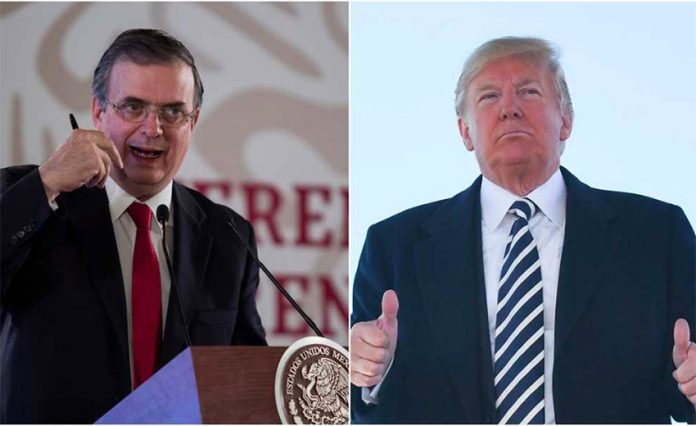
Ebrard, left, and Trump: drug problem is a regional one.

Mexico has responded to a threat from United States President Donald Trump to cut off financial aid if it doesn’t do more to stop drug trafficking by asserting that the production, transport and distribution of narcotics is a regional problem.

In a presidential memorandum released by the White House on Thursday night, Trump said the Mexican government needs to ramp up efforts to eradicate opium poppies, intercept illicit drugs and prosecute and seize the assets of traffickers.

“. . . Mexico needs to do more to stop the deadly flow of drugs entering our country,” he wrote, declaring that included the development of “a comprehensive drug control strategy.”

“. . . Mexico’s full cooperation is essential to reduce heroin production and confront illicit fentanyl production and every form of drug trafficking, including through United States ports of entry.”

If Trump is unable to certify that Mexico is doing more to combat the drug trade, the United States government could withhold financial assistance to Mexico and block international development bank loans.

In Thursday’s memorandum, the U.S. president made such a ruling for Bolivia and Venezuela, which he said had “failed demonstrably” during the past 12 months to uphold their anti-drug commitments.

“Without further progress over the coming year, I will consider determining that Mexico has failed demonstrably to uphold its international drug control commitments,” Trump wrote.

Mexico’s Secretariat of Foreign Affairs (SRE) responded to Trump’s memorandum in a statement published yesterday.

“The production, transport and distribution of narcotics . . . by transnational organized crime networks, as well as the associated violence, represent a regional problem, whose attention requires the collaboration and coordinated efforts of the governments in the region,” the SRE said.

The foreign ministry defended Mexico’s efforts to combat the drug trade, stating that the country “has made efforts to combat the production and trafficking of drugs in its territory, often with a very high cost in human and financial terms.”

The SRE charged that the trafficking of drugs and associated violence is fueled by the high levels of drug consumption.

“Drug use reduction goals are not always met by the countries in the region,” the SRE said, making a thinly veiled reference to the United States, the world’s largest market for narcotics.

“In our own case, the new federal administration of Mexico is promoting strong prevention campaigns aimed at dissuading [drug] use among the young population,” the statement said.

The SRE expressed its concern about the “massive” amount of firearms that are smuggled into Mexico from the United States, pointing out that it has been proven that guns sourced from the U.S. are used in thousands of murders every year.

It said that the illegal drug trade is supported by millions of dollars that are laundered in “the financial systems of the countries in the region” and therefore “a comprehensive solution to the cancer of drug trafficking” also requires a joint effort to “prevent and penalize money laundering.”

The statement concluded by saying that Mexico remains committed to continuing cooperating with other countries in the region to combat the production and trafficking of narcotics.

Christopher Wilson, deputy director at the Wilson Center’s Mexico Institute, said the warning from Trump is “something that has to be taken seriously, but still it is truly unlikely that it would actually occur.”

He added that United States financial assistance to Mexico isn’t significant considering the size of the Mexican economy, asserting that what’s more important is bilateral cooperation on law enforcement issues.

“It is unclear if that is truly at risk, but that would be very negative to the interests of both United States and Mexico,” Wilson said.

Since Mexico agreed to increase enforcement against undocumented migrants as part of a deal with the United States that ended Trump’s threat to impose tariffs on all Mexican goods, the Mexican government has received almost no criticism from its United States counterpart and some praise.

Trump said on July 1 that Mexico is doing a “great job” in stemming illegal migration as more than 20,000 federal security force members patrolled both the southern and northern borders.

Even as he threatened to cut of financial aid if Mexico doesn’t do more to combat the illicit drug trade, the U.S. president acknowledged that many Mexican military and law enforcement professionals are already “bravely meeting this challenge and confronting the transnational criminal organizations that threaten both of our countries.”

Source: El Universal (sp), Associated Press (en) 

Lawmakers describe social media shaming nicknames as ‘digital violence’

0
#LadyCensorship: Sosa and Rósete want a law against 'digital violence.'

A federal lawmaker has introduced a bill that would ban social media public shaming with the use of “Lady” and “Lord” nicknames, a common practice in Mexico to denounce bad behavior.

But critics were quick to come up with a new hashtag for Deputy María de Jesús Rósete Sánchez — #LadyCensura, or Lady Censorship.

Written by fellow Deputy Olga Patricia Sosa, the bill would classify the use of such nicknames as “digital violence.”

“We’ve decided to present a bill to include the term ‘digital violence’ as a category of violence, defined as an action using information technology with the goal of causing psychological or emotional harm to a woman,” Rosete told the Permanent Commission of the Chamber of Deputies.

“A Mexico that prevents and punishes gender violence against women in cyberspace is possible.”

Rosete noted that many of the people who have been given “lord” or “lady” nicknames are people who were recorded in unfortunate situations that will be immortalized on the web.

“The problem is that these attitudes especially target women,” she said. “Although it’s important to mention that digital violence doesn’t only have sexual goals; it can be related to different issues like age, social condition, gender, sexual preference, nationality or ethnic origin.”

Deputies Rósete and Sosa are both members of the conservative Social Encounter Party.

There have been several notable incidents that produced popular hashtags.

One was #LadyProfeco, the daughter of the then-head of the consumer protection agency. She threw a tantrum at a Mexico City restaurant in 2013 when she couldn’t have the table she wanted. Andrea Benítez called her father, who shut down the restaurant. He was forced to resign soon after.

Another was #Lord Audi, who drove illegally in a bicycle lane in Mexico City in 2016 and struck a cyclist. He fled the scene after telling police they should call his father. “This is Mexico, dude, got it?”

Source: El Universal (sp)