Home Blog Page 1803

8-year-old will represent Mexico thanks to Chinese airline

0
Samantha receives her ticket to China from airline representatives.

An 8-year old mathematician from Mexico City will represent Mexico at the Aloha International Mental Arithmetic Competition in Guangzhou, China, with the help of a Chinese airline.

Identified only as Samantha, the young girl will have only a few minutes to complete dozens of complicated math problems using only her own mental abilities and a soroban, a small Japanese abacus developed over 500 years ago.

Samantha, who lives in the capital’s Iztacalco borough, had been featured on social media outlets for selling homemade cookies to raise the large amount of money she needed to purchase her airfare to China.

But then China Southern Airlines stepped in. General manager Wu Yingjun gave Samantha a round-trip ticket to the competition, saying,“The happiness I feel in being able to help Samantha comes straight from my heart; she is the future of Mexico as she represents this nation in China.”

To express their gratitude, Samantha and her family in turn gave Wu Yingjun and several other airline representatives several boxes of her homemade cookies.

Seven hundred children from 40 countries will compete at this year’s edition of the competition. Ninety-one Mexicans will participate.

Source: W Radio (sp), El Mañana (sp)

Army general believed to have been No. 2 at Pemex fuel theft ring

0
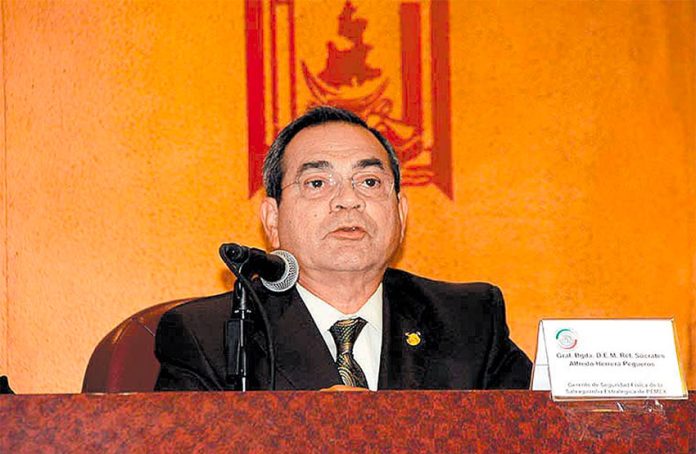
Fuel theft suspect Herrera.
Fuel theft suspect and army General Herrera.

A fuel theft ring involving high-ranking officers of the Mexican army is coming apart after the arrest of a general who was a subdirector of operations at Pemex.

Agents the Attorney General’s Office (FGR) arrested General Sócrates Alfredo Herrera Pegueros in Guerrero on Thursday after he failed to show up for court hearings in May and June to respond to criminal allegations against him and other officers.

Herrera is described as the “second in command” to General León Trauwitz, former head of security at Pemex, who is accused of leading the fuel theft operation. He faces charges of organized crime and fuel theft.

The Attorney General’s Office (FGR) has arrested five people in relation to the case. On June 22, a judge threw out an injunction protecting Trauwitz from arrest, but he has not been located and is believed to have left the country.

In June, Sergeants Ramón Márquez Ledezma and José Carlos Sánchez Echavarría and Lieutenant Oziel Aldana Portugal were indicted for allegedly working under General Trauwitz in the fuel theft scheme.

The case first came to the attention of federal prosecutors in March 2017 when three former soldiers reported having witnessed official complicity in fuel theft. However, the case was not pursued until President López Obrador took office in December 2018.

In addition to the five soldiers, 16 government officials have been arrested for crimes related to fuel theft.

Source: Milenio (sp), Excélsior (sp), Infobae (sp)

Flight school begins operating at Cuernavaca, Morelos, airport

0
Yesterday's ceremony to open the new flight school in Morelos.

A new pilot training program at the Aviation School of Mexico at the Cuernavaca, Morelos, airport will raise the state’s profile in national and international aviation, predicts Morelos Governor Cuauhtémoc Blanco.

Speaking at the new program’s inauguration on Thursday, Blanco said the Cuernavaca airport has become an important center for pilot training in Mexico and around the world.

“This is allowing Morelos to truly become a host to the world, as students from around the country and other countries will be able to study aviation here,” he said.

The French aircraft manufacturer Airbus is also a participant in the program.

Aviation School director Alfredo Velázquez Maciel said the airport has the best hangar for pilot training in the country.

He said the school will offer 30,000 flight instruction hours in 2019, of which 40% will take place in Morelos.

Airport manager Federico Misael Álvarez Dávila said the investment in Cuernavaca shows that the city’s airport could be an alternative to the over-saturated Benito Juárez Airport in Mexico City.

State officials said they will meet with the federal Communications and Transportation Secretariat to discuss the possibility of including Cuernavaca in a Mexico City airport system.

Source: Milenio (sp), La Unión de Morelos (sp)

Security survey: 74% feel unsafe; Acapulco worst city for corruption

0
Los Mochis, Sinaloa, is the second-worst city in the country for police corruption.

Almost three-quarters of Mexicans feel unsafe in the city in which they live, according to a new survey that also found that Acapulco is the worst city for police corruption.

Carried out by national statistics agency Inegi in the first half of June, the National Survey on Urban Public Security found that 73.9% of respondents consider their city unsafe.

The figure is slightly below those recorded by the same poll in March and June last year, when 74.6% and 75.9% of respondents said their city was unsafe.

Ecatepec, a México state municipality that is part of greater Mexico City, recorded the highest perception of insecurity among residents followed by Coatzacoalcos, Veracruz; Naucalpan, México state; Villahermosa, Tabasco; Tapachula, Chiapas; and Uruapan, Michoacán.

The percentage of residents who said they felt unsafe in those cities ranged between 97.4% and 88.9%.

In contrast, the cities where the lowest perceptions of insecurity were recorded were, in order: San Pedro Garza García, Nuevo León – an affluent municipality in the Monterrey metropolitan area; Mérida, Yucatán; San Nicolás de los Garza, Nuevo León; Los Cabos, Baja California Sur; Durango, Durango; and Puerto Vallarta, Jalisco.

The percentage of residents who said they felt unsafe in those cities ranged between 18.9% and 43.1%.

The survey also determined the percentages of people who were recent victims of crime and acts of police corruption.

At a national level, Inegi said that at least one person in 34.9% of households was a victim of robbery or extortion during the first half of 2019.

Atizapán fared worst and three other México state municipalities in the metropolitan area of Mexico City – Chimalhuacán, Cuatitlán and Ecatepec – were also among the five worst cities in the country in terms of victim rates for those two crimes. León, Guanajuato, ranked second worst.

Tampico, Tamaulipas; Los Mochis, Sinaloa; Campeche, Campeche; San Pedro Garza García, Nuevo León; and Los Cabos, Baja California Sur, recorded the lowest rates of victims of robbery and extortion.

The survey determined that 15.5% of respondents came into contact with public security authorities during the first half of the year and of those, 47.3% were victims of an act of corruption.

Just under 74% of poll respondents who had an encounter with police in Acapulco, Guerrero, reported being forced to pay a bribe or suffering from some other act of corruption, making the Pacific coast resort city the worst in the country in that respect.

Los Mochis, Sinaloa, recorded the second highest police corruption rate, with 71.9% of polled residents reporting that they were victims.

Next worse were the México state municipalities of Naucalpan, Tlalnepantla and Atizapán followed by Tuxtla Gutiérrez, Chiapas, and Ecatepec.

Source: El Universal (sp), Debate (sp) 

Nervous foreign investors are pulling back, see higher risk in Mexico

0
Canadian investors have been turned off by the electricity commission's wish to renegotiate contracts.

Foreign holders of government securities have begun withdrawing their investments due to declining confidence in the federal government and the Mexican economy, and the expectation that the Bank of México will cut interest rates.

Statistics from the central bank show that the value of government bonds and federal treasury certificates in the hands of foreign investors was 2.11 trillion pesos (US $111 billion) on July 9, the lowest amount since December 14.

Since February 8 – when the value of government debt in foreign hands hit a record high – investors have offloaded securities worth 162 billion pesos (US $8.5 billion), the newspaper El Universal reported.

Foreign investment in treasury certificates, which are easier to cash in, has declined to its lowest level since March 2018.

“Investors are already starting to get nervous and while they perceive greater risk, we may see more sales of government securities and the interest rate for bonds may go up,” said Ernesto O’Farrill, general manager of Bursamétrica, a Mexico City brokerage firm.

Despite decisions such as the cancelation of the new Mexico City airport, the federal government generated confidence among investors during its first months in office after presenting a 2019 budget that was described as fiscally prudent and realistic by many analysts.

The first sell-off of government issued securities by the López Obrador administration in the middle of January garnered strong interest from investors.

More than 300 institutional investors from the Americas, Europe, Asia and the Middle East participated in the auction and demand to purchase securities exceeded supply fourfold.

But investor confidence has waned on the back of downgrades to Mexico’s sovereign rating and that of Pemex, and the possibility that more ratings cuts are still to come.

“Investors are anticipating rating agencies’ adjustments and they deduce that Moody’s will strip Pemex’s investment grade in coming months like Fitch did at the start of last month,” O’Farrill said.

He predicted that agencies will also downgrade Mexico’s sovereign rating but not below investment grade. Fitch cut its sovereign rating for Mexico to one notch above junk status last month but if it, and other rating agencies went lower, a huge sell-off of government bonds would occur.

“Ninety-five per cent of investors are in government securities because Mexico has investment grade,” O’Farrill said.

Other factors that have made investors nervous are the widespread cuts to growth forecasts for the Mexican economy and Carlos Urzúa’s resignation last week as finance secretary.

El Universal reported that investors now see instability in the implementation of public policy and have responded by withdrawing their investments in government securities. The pullback could hasten as the Bank of México draws closer to cutting interest rates, which many analysts believe will happen in August or September.

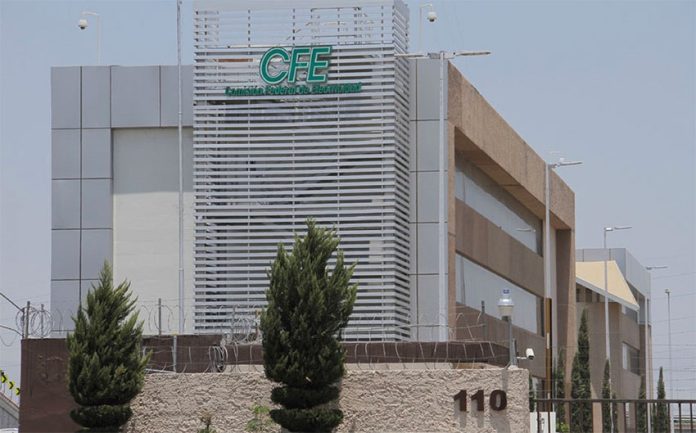
Yet another factor weighing on some investors’ minds is the decision by the Federal Electricity Commission (CFE) to seek international arbitration aimed at annulling clauses in seven pipeline contracts.

One of the contracts the utility is seeking to renegotiate is for the Texas-Tuxpan gas pipeline, which was jointly built by the Canadian company TC Energy (formerly TransCanada).

Canadian ambassador Pierre Alarie spoke out against the CFE’s move, while the embassy’s deputy head of mission said that the legal action has triggered concern among Canadian investors.

“The truth is that since the actions of the CFE, I receive calls every day with regard to the signal that Mexico is sending to Canadian investors. They ask for our advice in order to know if Mexico still wants more investment and what to do with their current and upcoming investment. Yes, they’re actions that cause concern,” Jean-Dominique Leraci said.

Source: El Universal (sp), Milenio (sp) 

Subsidiary of electricity commission will provide internet to rural areas

0
internet in mexico

President López Obrador announced today that the Federal Electricity Commission (CFE) will provide internet service throughout Mexico through the creation of a new subsidiary.

“We have just created the company that will connect the entire country to the internet,” the president said at his morning press conference. “Today we will give you the name: it’s a subsidiary of the CFE. Why was this company placed under the CFE? Because this way, it will be able to use all of the CFE’s infrastructure, all of its lines. It will have all of the lines and fiber optic cables needed to get the entire country online.”

The president said the subsidiary has been approved as a non-profit service by the CFE board of directors.

Internet service will be delivered through the government’s new Integration Centers, federal facilities intended to deliver services such as social, health and education programs in rural areas. The government announced last week that 10,000 such centers would be installed throughout the country in an effort to provide services to the 200,000 communities in which fewer than 500 people live.

The centers will also house branches of the new Bank of Well-Being, a new institution that replaces Bansefi, the federal government savings bank.

The president said this morning that internet service will be delivered to the centers by the CFE through fiber optic cables and then on to residents through a wireless connection.

Source: El Financiero (sp), Forbes Mexico (sp)

Transport secretary predicts 2-year-old highway will need major surgery

0
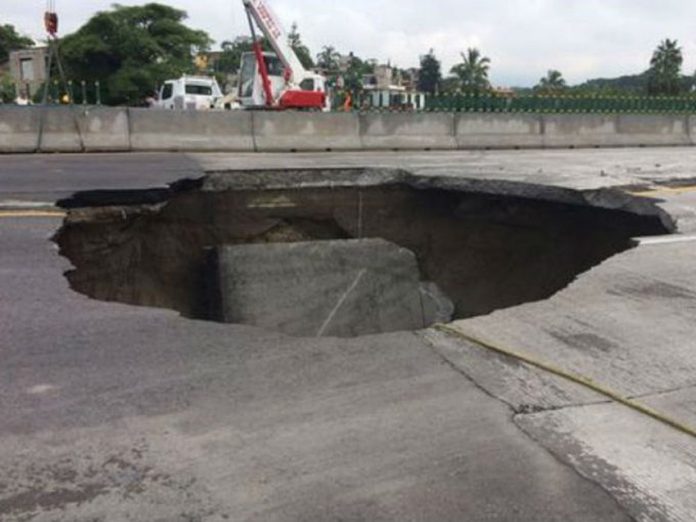
The Paso Express sinkhole that killed two people in July 2017.

The two-year old Cuernavaca Paso Express highway will likely require “major surgery,” according to the federal communications and transportation secretary.

The 14.5-kilometer stretch of road has been plagued with problems since it opened, including the appearance of a sinkhole in July 2017 that trapped a car, killing both occupants.

Javier Jiménez Espriú didn’t provide details about the work that will be carried out on the highway but said that technical studies are already under way. He stressed that there is no current risk to motorists using the road.

“We’re carrying out a study of the entire Paso Express, it will take a couple of months,” Jiménez told reporters at the National Palace, adding that all of the “delicate points” have already been identified.

“Everything’s under control and there’s no risk of any serious issue . . . Once we have the complete study we’ll probably carry out a major surgery,” he said.

Morelos authorities warned last August that there were at least five danger spots on the 10-lane highway, which was built by a private consortium consisting of the companies Aldesa and Epccor and cost almost 1 billion pesos (US $52.7 million at today’s exchange rate).

The highway’s problems, and in particular the sinkhole, were a significant source of tension between the previous federal government and former Morelos governor Graco Ramírez.

Former transportation secretary Gerardo Ruiz Esparza repeatedly denied responsibility for the problems, claiming that the Morelos government, the municipality of Cuernavaca and the principal contractor were to blame.

Ramírez said he warned Ruiz and former president Enrique Peña Nieto that the highway wasn’t ready to open when it did but they failed to heed his advice.

Local residents were aware of drainage problems on the section of the highway where the sinkhole appeared and warned officials about a damaged culvert but no action was taken to repair or replace it.

The secretary also said that the environmental impact statement for the Santa Lucía airport will be ready in coming days, whose completion will allow the project – currently stalled because of legal action – to begin.

Source: Reforma (sp) 

Government expects confiscated jewelry to sell like hot cakes

0
AMLO presents a check to the mayor of Metlatónoc, proceeds of an auction of narco-real estate.

Confiscated jewelry and watches are expected to “sell like hot cakes” at the government’s third auction of assets seized by federal authorities.

The fundraising goal for the auction being held by the System of Administrative Allocation of Assets (SAE) is 21.8 million pesos, the total of the starting bids for the 148 lots.

The July 28 auction will sell off jewelry being held by federal prosecutors, courts and tax authorities.

Ricardo Rodríguez, head of the Institute to Return Stolen Goods to the People, the so-called “Robin Hood” agency that manages the SAE auctions, said he expects the auction to surpass its goal and raise between 30 million and 35 million pesos. The proceeds will pay for road repairs in mountain communities in Michoacán.

“We expect them to sell like hot cakes,” said Rodríguez. “I think it’s going to be very attractive for those who want to participate.”

He said it was hard for the SAE to establish the market value of the pieces “because of how extravagant and unique they are,” and that the 21.8-million-peso figure is just an “initial reference point.”

Top-priced item is a 3-million-peso Piaget watch made of 18-carat white gold and encrusted with 49 diamonds.

Of the 148 lots, 133 were confiscated by federal prosecutors. Some of the others were gifts illegally given to public servants.

President López Obrador said the items will be on display for a week, beginning Sunday, at the former presidential home, Los Pinos.

He also announced that the government’s fourth auction will sell off land and cash confiscated from drug traffickers.

“In the next auction, we’ll sell confiscated goods and parcels of land, and money in cash, especially dollars,” he said.

On hand at today’s press conference were two Guerrero mayors, each of whom was presented with a check for 21.15 million pesos, cash generated by the auction of confiscated narco-properties.

The mayors represent Metlatónoc and Cochoapa El Grande, two of Mexico’s poorest municipalities.

Source: El Financiero (sp), Milenio (sp)

Yucatán governor celebrates 24 billion pesos in investments in 9 months

0
The new NH Collection Hotel in Mérida.

The governor of Yucatán says his government has attracted investment projects worth 23.7 billion pesos (US $1.25 billion) since it took office just over nine months ago.

Speaking at the opening of the NH Collection Hotel in Mérida, Mauricio Vila Dosal said the projects will create 17,010 direct jobs and 54,120 indirect ones.

Vila attributed the strong showing to his government’s focus on promoting Yucatán to investors.

“Thanks to the promotion work in recent months at both a national and international level, Yucatán has recorded an unprecedented flow of investments, which allowed the state to achieve fourth place nationally in terms of job creation in June,” he said.

The governor added that his administration is aiming to grow the manufacturing and industrial sectors, among others, and wants all of Yucatán’s municipalities to benefit from the state’s increasing prosperity.

Among the projects Vila highlighted was a US $120-million wind farm in the municipality of Dzilam de Bravo and a US $30-million solar plant in San Ignacio, Progreso.

He also spoke about Grupo Kuo’s plan to invest 6.6 billion pesos to install new production lines and expand its food processing plant in the municipality of Tixpéhual, which will create 3,000 jobs, and the 720-million-peso Crown Park Yucatán project, which involves the development of a 150-hectare site in Hunucmá.

An industrial zone, a business center and a residential area are planned for the latter project, Vila said, adding that it will generate 120 direct jobs and 360 indirect ones.

The National Action Party governor said the port of Progreso will also benefit from the increased investment.

“Some of the firms will use the port to move their products to other parts of the world, consolidating its standing as one of the most important logistics points in the country,” Vila said.

The governor also said that during the first half of 2019, a total of 8,579 new jobs were created, a figure that is 32% higher than the same period last year.

Source: El Economista (sp) 

Workers remove 160 tonnes of water lilies from Guerrero beach

0
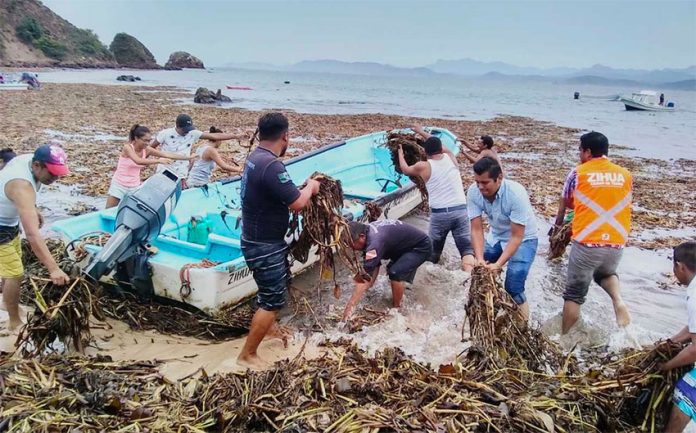
Workers clean up the tonnes of water lilies that arrived on this Ixtapa beach.

It’s not just sargassum that’s washing up on Mexican beaches.

Local government and tourism workers this week removed more than 160 tonnes of water lilies from Playa El Varadero, a beach on Isla Ixtapa, a small island off the coast of the Guerrero resort city of the same name.

Recent heavy rains carried the plant into the sea from the Pantla river, whose mouth is near Isla Ixtapa.

Zihuatanejo public services director David Luna Bravo said that local hoteliers and restaurant owners contributed to the clean-up efforts.

After the water lilies are collected, they are transported by boat to Playa Linda on the mainland.

In just two and a half hours on Tuesday, 10 dump trucks were filled with lilies, Luna said.

Ricardo Pineda, owner of El Indio restaurant, said that water lilies wash up on Ixtapa beaches practically every year but explained that he hadn’t seen such a large quantity of the plant for three or four years.

Having to dedicate time to cleaning up El Varadero beach has caused restaurant owners to fall behind in other tasks they need to do to prepare for the peak tourist season, he added.

“It’s the season now . . . but thankfully . . . the authorities are helping us,” Pineda said.

On the other side of the country, record quantities of sargassum have been invading the Quintana Roo coastline, including 35 tonnes of the weed that washed up on Cancún’s Playa Delfines on Tuesday.

Source: Quadratín (sp), Milenio (sp)