Torture victim and Ayotzinapa suspect Carlos Canto.
The legitimacy of the federal government’s version of the 2014 disappearance of 43 students in Iguala, Guerrero, was once again called into question yesterday when a video showing the torture of a suspect was published on YouTube.
It also cost the undersecretary of security in Michoacán his job — he is allegedly the interrogator in the video.
The torture victim, identified as Carlos Canto, is seated with his eyes blindfolded and his hands bound. Behind him, a man in a federal Attorney General’s Office uniform interrogates Canto, repeatedly asking him about the events that took place in Iguala the night the students disappeared.
Near the end of the video, the police officer behind Canto places a plastic bag over his head and pulls it tight, cutting off the man’s oxygen.
The video confirms a report published by the United Nations in March 2018 that found that 34 people were tortured in connection with the investigation of the students’ disappearance, including “beatings, kicks, electric shocks, blindfolding, attempted asphyxia, sexual assault and various forms of psychological torture.”
Revelan video de torturas a involucrado en caso Ayotzinapa
Video of the investigation in which the suspect was tortured.
Based on the United Nations’ findings, a federal judge ruled last November that the statements upon which the findings were based were obtained illegally in violation of detainees’ human rights and must be dismissed. Following the ruling, three men who had previously been accused of being the actual perpetrators of the crime were released from custody.
From early in the investigation the government’s version has been widely questioned both within Mexico and internationally. Many believe that the army might also have been involved in the students’ disappearances.
Carlos Canto, the man in the video, is one of the 34 people mentioned in the report. He was detained by agents from the federal Attorney General’s Office (PGR) and navy marines on October 22, 2014 just one day after the federal government took over the investigation from widely criticized state authorities. They were under enormous pressure.
Canto was also beaten and given electric shocks during interrogations, according to evidence given by his sister.
The voice of the uniformed officer in the video has been identified as that of Carlos Gómez Arrieta, then-head of investigative police at the PGR. Today, the Michoacán government announced he had resigned his post in the Secretariat of Security.
The video could have serious consequences for the Ayotzinapa case. In addition to supporting the United Nations’ findings of institutional torture in the investigation that produced the federal government’s version of events, it could open new lines of investigation based on the heretofore uninvestigated locations mentioned by Carlos Canto during his interrogation.
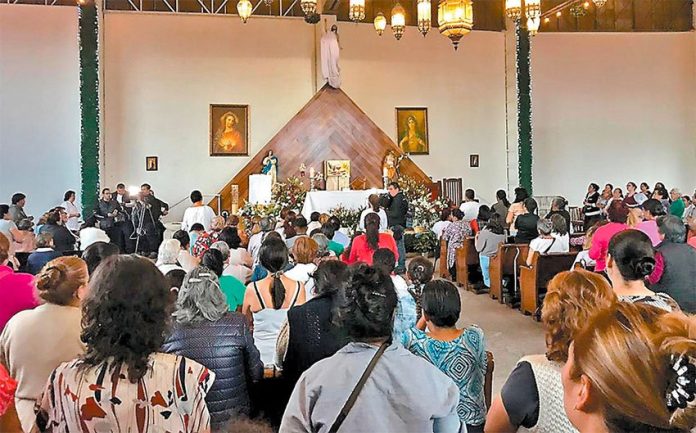
Parishioners of the Mexico City church whose priest was arrested on homicide charges this week prayed yesterday for his release, while the brother of the victim revealed that his sibling was tortured before he was murdered.
A congregation of the Cristo Salvador church gathered to pray for Francisco Javier Bautista Ávalos, who was arrested in connection with the June 11 murder of Leonardo Avendaño, a 29-year-old deacon at the same church.
“Holy Father, you know the priest as we know him, help us to move hearts . . . listen to us so that the father is protected wherever he is, so that he soon leaves that place,” said a woman leading the prayers.
The parishioners, who also prayed for Avendaño, called for authorities to carry out an exhaustive investigation into the crime because they believe the priest is innocent.
Earlier yesterday, supporters of the priest protested outside the Mexico City Attorney General’s Office to demand his release.
Leonardo Avendaño was last seen with the priest from his church.
More than 6,000 people have signed an online petition directed to Mayor Claudia Sheinbaum that expresses support for Bautista, who led the funeral service for his alleged victim, and expressed hope that the murderer would be caught.
Meanwhile, Josué Vicente Avendaño told the newspaper El Universal that his brother was beaten and tortured before he was killed.
He rejected a version of events that suggested that his brother was accidentally strangled to death during a sex game.
“My brother was tortured, [his injuries] weren’t from a game or anything like that. It was something that was planned in advance, my brother was tortured and then after that, the cause [of death] was asphyxiation . . .” Avendaño said.
He said that his brother’s body was badly bruised, his nose was broken, his face swollen and some of his teeth were missing.
“In the autopsy [report], ‘blows and severe bruising’ appeared, there’s another term that I don’t remember but in the autopsy it said that he was tortured,” Avendaño said.
He also said that Bautista was someone who his brother trusted completely, and that the priest had called him when Avendaño was missing. During the conversation, the victim’s brother said he detected the tone of a “worried person” in Bautista’s voice.
“At the moment I suspect everyone. . . Who could it be? I don’t have the authority to say yes [it was the priest] or who might be guilty, I’ll leave that to justice. . .”
Colorful sunrises and sunsets might be seen from the Yucatán peninsula.
A massive dust cloud from the Sahara Desert in northern Africa is forecast to arrive in areas of the Yucatán peninsula and northern Mexico on Saturday and Sunday.
According to meteorologist Juan Antonio Palma, the distinctive yellow dust is picked up by storms that form in the far west of the world’s largest desert, where it is then carried by eastern trade winds across the desert, countries and the ocean.
Over 100 million tonnes of dust is blown from Africa to North and South America every year, affecting air quality across the continents. Some of the dust reaches as far as the Amazon basin, where it plays a key role in restoring minerals to depleted rainforest soils.
Research suggests that the dust may also play a role in the suppression of hurricanes and be harmful to coral reefs.
However, the meteorologist said the dust’s arrival was no cause for alarm and will likely provide for spectacular orange and red sunrises and sunsets across the Yucatán peninsula.
“It’s normal for the dust to reach the Yucatán peninsula, and in fact it arrives every year in varying intensity.”
He added that the dust does not present any public health risk, but that it might affect regular patterns of precipitation.
However, health professionals warn it can aggravate breathing problems, and trigger asthma.
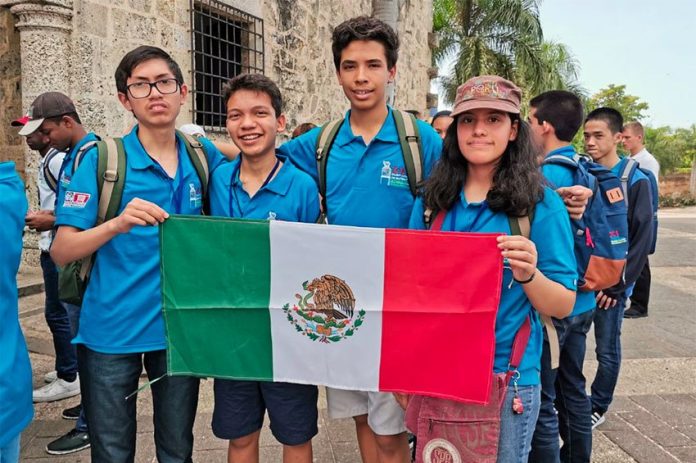
The math olympiad winners in the Dominican Republic.
Two teams of young Mexican mathematicians rose to the top of the Central American-Caribbean Math Olympiad (OMCC), winning gold and silver medals at the event hosted by the Dominican Republic.
First place was won by the team of Karla Rebeca Mungía from Sinaloa and Daniel Ochoa Quintero from Tamaulipas, while their peers Jacob from Yucatán and Luis Eduardo Martínez from Nuevo León placed second.
Mexican teams have consistently ranked at the top among their regional peers, bringing home gold medals for the past 11 years, the organizers of the Mexican Math Olympiad (OMM) said.
The president of OMM’s organizing committee, Rogelio Valdez Delgado, commended the sponsorship of the disposable consumer product firm Bic, which paid for the youths’ transportation, lodging and travel expenses. He also thanked the support given by the National Council of Science and Technology (Conacyt).
Three of the four students belong to the group of 12 math whizzes that will be traveling to South Africa in early August to participate in an international olympiad.
The team of primary and secondary school students were in the news last month when it was revealed they would be unable to send a full complement to the match because of budget cuts at Conacyt.
But Guadalajara filmmaker Guillermo del Toro and beer maker Grupo Modelo came forward to help out. The former will pay for the students’ flights while the latter has offered to pay for the team’s accommodation.
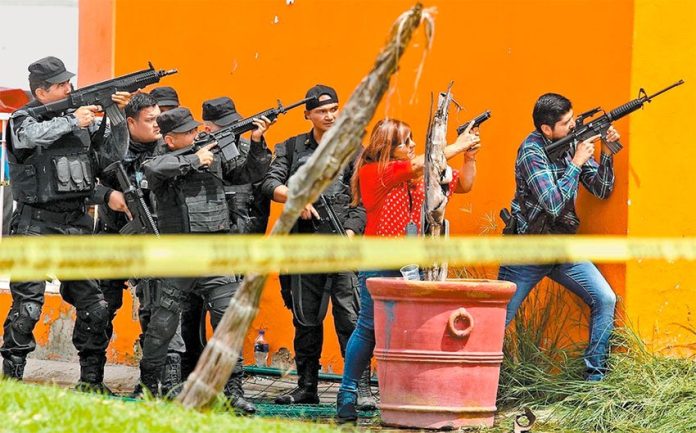
Police take aim during a gunfight yesterday in Tlajomulco, Jalisco.
Five people were killed on Friday in four coordinated attacks against Jalisco state police in the municipalities of Tlajomulco and Zapopan. Two of the dead were police officers.
The first attack happened at 7:00am, when a civilian with an assault rifle shot at a police commander as she was driving in her pickup truck. The commander was unhurt but her husband, who was in the passenger’s seat, was seriously injured.
Two hours later, detective Jesús Adán Martín del Campo was killed as he left his house in Tlajomulco. His nine-year-old son was wounded with a bullet to the leg.
After the Tlajomulco attack, police began patrolling the area and were hit with grenades and rifle fire from a residence near where Martín was killed. The grenades did not detonate, but 300 police officers and soldiers fought for an hour and a half to take control of the property in the Jardines de Edén residential area.
Six officers were injured and two alleged criminals were killed, and three people inside the house were taken into custody. It is not known whether those arrested were suspects or people being held against their will in the house. Police also secured 20 rifles, 20 handguns and two grenades from the house.
Shortly after the battle, another off-duty officer from a homicide unit was killed in a nearby housing development. His body was found naked, in the street in front of his residence.
“The officer from homicide, when he realized that people were coming into his house, tried to escape,” said Jalisco Attorney General Gerardo Solís Gómez at a press conference. “They probably caught him when he was taking a shower, which explains how they found him.”
Another person, who police say they are fairly certain was involved in the killing of the homicide agent, was found dead nearby, apparently having been hit by a car and killed as he left the scene on a bicycle.
Solís assured reporters that the attacks took place because state authorities “are damaging the interests of organized crime.”
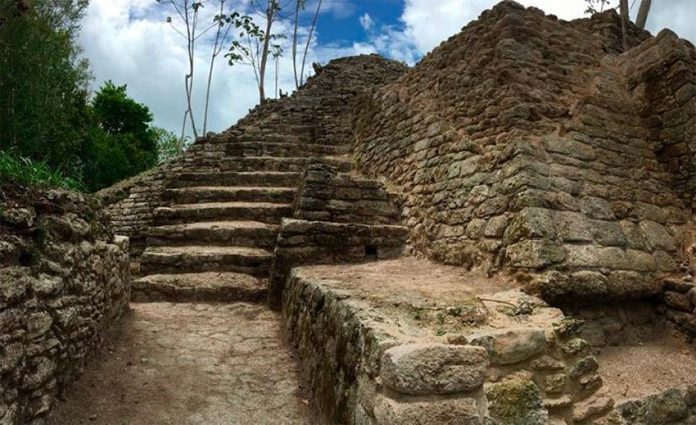
Ichkabal in Quintana Roo: more research to be done before it can open.
Deeper research into the ancient Mayan city of Ichkabal will be carried out before it is opened to the public, said the Quintana Roo chief of the National Institute of Anthropology and History (INAH), providing a better experience for visitors when it does open.
Margarito Molina told the newspaper El Economista that obtaining resources to carry out the additional research is a priority for INAH.
Researchers’ conclusions about the geopolitical organization of the city and the lives of its erstwhile Mayan inhabitants will enable visitors to have a more educational and informative experience at the southern Quintana Roo site, he said.
“The site is very old, it dates from the early pre-classic period. The important thing is to keep carrying out research for its opening in order to be able to present to the public the interpretation, the results of the research and an understanding about the culture,” Molina said.
“A visitor can’t [just] see the structures and understand the daily life of the settlement. That’s the work of archaeologists, historians and also linguists,” he added.
[wpgmza id=”147″]
Beyond the additional research, INAH director Diego Prieto said that before the site can open a range of infrastructure needs to be built at the site including a formal entrance, an interpretation center and public washrooms.
Luis Chimal Balam, head of the Bacalar ejido, said earlier this year that INAH has proposed paying 400,000 pesos (US $21,000) for each of the 121 hectares covered by Ichkabal and the surrounding area that needs to be developed to access the site.
But the 165 ejidatarios decided that they don’t want to give up ownership of the land. Instead, they wish to be partners in the development of the archaeological site and direct beneficiaries of the tourism it attracts.
Located around 60 kilometers west of Laguna de Bacalar in the municipality of Othón P. Blanco, Ichkabal is one of the most important Mayan cities of the pre-classical era.
It was inhabited by kings of the Kaan dynasty and some of its structures are taller than the pyramids at Chichén Itzá in Yucatán.
The Quintana Roo government has said that the recovery and opening of Ichkabal could attract investment in hotels and real estate to the tune of US $1 billion over the next 15 years.
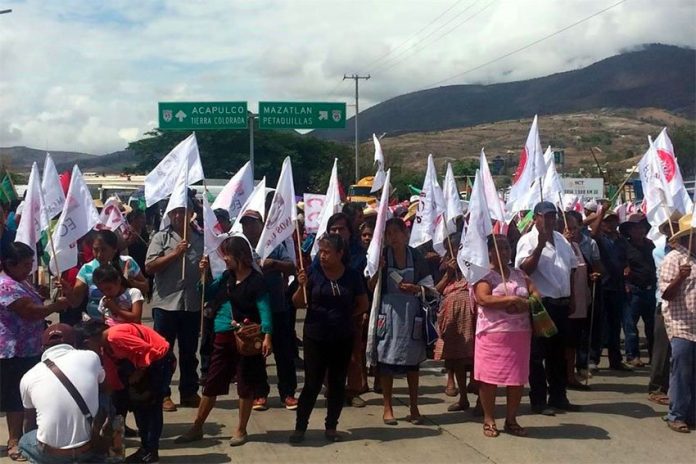
A highway blockade — one of many — protesting delay in delivery of fertilizer.
The wait for fertilizer in Guerrero has been a long one — and it’s not over yet. Most farmers are still waiting for the federal government to deliver the promised supplies.
Just 18% of 180,000 tonnes of the product pledged to farmers in the southern state had been distributed as of yesterday, according to a report in the newspaper Reforma, while the Secretariat of Agriculture publicly acknowledged that delivery is delayed.
However, the coordinator of the National Fertilizer Program said the pace of distribution has been increasing and that once peak operational capacity is reached, deliveries will be made to more than 10,000 farmers per day.
Jorge Gage Francois predicted that would occur by Tuesday at the latest.
The official anticipated that 55% of the fertilizer will have been distributed by the end of June and that by July 15, all farmers in the state will have the product they were promised.
Fertilizers for the cultivation of corn, beans and rice are being delivered from 82 distribution centers, Gage said.
Since late last month, farmers in several parts of Guerrero have been protesting against the slow delivery. On May 31, about 400 farmers detained soldiers and police officers in the municipality of Heliodoro Castillo to demand that the government honor its agreement.
They argued that the delivery of the fertilizer was urgent because the rainy season had started, and they might miss their chance to plant.
This week, farmers from the municipalities of Zapotitlán Tablas, Atlixtac, Acatepec and Olinalá have maintained blockades at different points of the Tlapa-Chilapa federal highway, and three councilors from Zapotitlán were detained and held hostage.
Farmers from Teloloapan blocked the highway from that municipality to Iguala and another group of growers broke into a government rural development center.
Leaders of the National Union of Agricultural Workers (UNTA), the Guerrero State Corn Council and the National Farmers Confederation, among other groups, have warned that the protests against the government’s failure to distribute the fertilizer will continue next week.
Marco Reyes, UNTA’s Guerrero leader, predicted that corn production will fall this year due to the delay in the fertilizer’s delivery.
The state governor blamed the delay on the number of bureaucratic procedures farmers must complete in order to obtain the fertilizer.
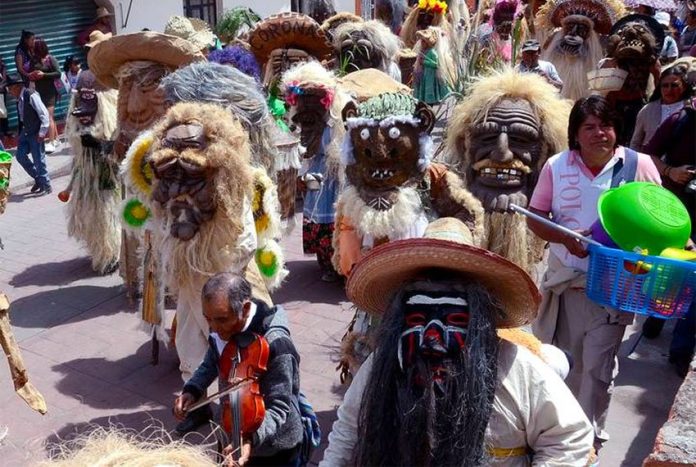
The masked dancers of Temascalcingo, calling for rain.
The state of México town of Temascalcingo was transformed Thursday for a grand fiesta as residents donned masks and danced in a plea to the heavens to open and unleash rains for thirsty crops.
Known for being the birthplace of celebrated landscape painter José María Velasco, the town celebrates the Catholic feast day of Corpus Christi, held 60 days after Easter, but fuses it with older pre-Columbian traditions of ceremonies to end drought and ask for good harvests.
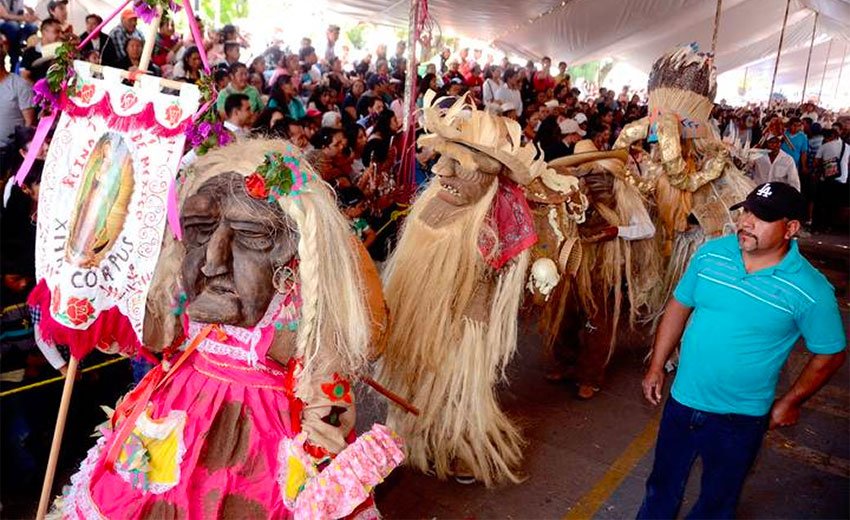
Every year, the festivities begin on Wednesday when dancers of all ages from each of the pueblo’s neighborhoods take to the streets, their faces covered by larger-than-life masks handcrafted from cactus fibers to recall the features of aged ancestors.
As they dance through the streets of Temascalcingo to the music of a violin, drums and bells, the masked dancers, called Xitas, are joined by another dressed as a bull with a cob of corn in its mouth to symbolize fertility.
On Thursday, the Xitas are once again called into the streets by church bells to accompany each neighborhood’s patron saint to altars erected specially for the celebration. After prayers of thanks, the fiesta is rejoined by all the residents, who dance and share freshly prepared mole, tortillas, beans, chicken in pork skin and pulque.
Residents dance wearing masks to represent the ancestors.
Later in the day, the dancers throw candy to young children before everyone gathers in a large circle for a ritual theater and dance presentation that symbolizes the circle of life for the town’s crops and residents.
Legend has it that the unique festival began long ago when, after a series of serious droughts which were thought to be a divine punishment, all the pueblo’s residents fell asleep and received a vision from God, who instructed them to begin to dance to bring the rains. During the annual rain dances, the residents began to use their famous masks to symbolize the wisdom of the elderly.
However, other sources discount the myth, asserting the existence of records documenting the unique fusion of the Catholic feast and pre-Hispanic traditions from as far back as 1526 — just one year after Hernán Cortés ordered the death of the last Aztec emperor, Cuauhtémoc.
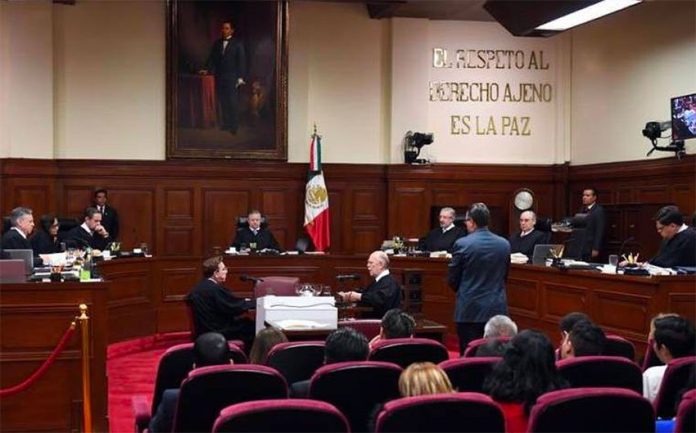
Mexico's Supreme Court has ruled that asking for financial records violates the constitution.
The Supreme Court (SCJN) has ruled that it is unconstitutional for federal law enforcement authorities to request the bank records of accused criminals without a court order.
With six magistrates voting in favor and five against, the court determined that article 142 of the Credit Institutions Law – which allows the federal Attorney General’s Office (FGR) to obtain the financial records of suspected criminals – violates people’s constitutional right to privacy.
The ruling leaves thousands of cases pursued by the FGR, including those against former Pemex CEO Emilio Lozoya and ex-governors, hanging by a thread, the newspaper Milenio said.
The SCJN will sit again Monday to determine whether its decision will apply retroactively or only to future cases.
Some justices warned that depriving the FGR of its capacity to seek and obtain bank records will place money laundering, tax fraud and organized crime investigations at risk.
“The consequences that the establishment of this ruling might have concerns me,” said Jorge Mario Pardo Rebolledo.
Once the court’s ruling is formally pronounced, he said, financial evidence held by the FGR will “automatically” become “illegal – all the information, all the requests for bank information on which investigations are being processed.”
“. . . The Supreme Court must . . . be sensitive to the consequences of the judgements that it is establishing,” Pardo said.
Eduardo Medina Mora acknowledged that the right to privacy is of the utmost importance but argued that the right should be superseded when federal authorities are investigating crimes such as tax fraud, money laundering, terrorism or organized crime.
However, six judges including Chief Justice Arturo Zaldívar Lelo de Larrea didn’t share his view.
“There is something that is very important – at least for me – to take into account. The seriousness of the crime, the seriousness of the situation doesn’t excuse non-compliance with the constitution. The fight against crime must respect the constitution and human rights,” Zaldívar said.
“. . .I don’t think that being more relaxed with constitutional requirements is the right path for a constitutional court or for a democratic constitutional system. . .”
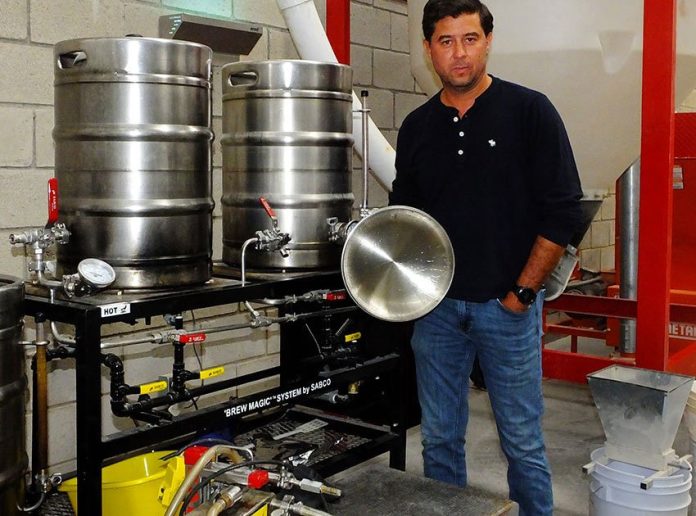
Fortuna had its start when Morales, pictured, and four friends purchased this small brewing system.
In April of this year, 265 breweries from 14 countries entered their finest beers in the second Aro Rojo International Beer Contest held in Tampico on Mexico’s northeastern coast.
This year the prize for Mexico’s best brewery was awarded to Cervecería Artesanal Fortuna, located on the outskirts of Guadalajara, Jalisco. Two of Fortuna’s beers — in a tough competition with 1,200 others — ran away with gold medals.
By pure chance, Fortuna is located only seven kilometers from my door, so I decided to pay them a visit, first to taste their beer and secondly to see if I could discover just what has made them so successful.
I was born in Milwaukee, once famous for its beers. When I moved to Mexico, I happily found beers just as good as those in my old hometown and several much better.
Noche Buena and Negro Modelo were dark beers I especially appreciated, but for many years they were hard to find as the whole country was in the grip of a few powerful breweries that forbade the sale of competing beers in their territories.
The spice path through the beer garden is lined with plants like mint and rosemary.
I remember when — in all of western Mexico — the only place you could find Cerveza León was in the refrigerator of a meat packer who happened to be from Yucatán, where León is made, and who would occasionally drive a few six-packs on a 2,000-kilometer journey to his store in a country town outside Guadalajara.
Then a beer revolution took place. Microbreweries popped up here and there in Mexico, offering competition where there was none before. To my amazement, I was even able to find Mexican stouts that could give Guinness a good run for their money. From that point on, the number of microbreweries in Mexico began to grow exponentially and today there are around 800 of them.
Cervecería Fortuna is located at the edge of the huge Primavera Forest, a flora and fauna sanctuary popularly called “The Lung of Guadalajara.” Upon my arrival, I was greeted by Juan José Morales, director of the brewery and one of the four founders of Fortuna. I asked him how they got started.
“It all began during a trip to California,” Morales told me. “We tried an ale there that was simply out of this world. We were familiar with ale made by Mexican microbreweries, but what we found in California was far superior and we wondered why.”
Morales and friends investigated and came to the conclusion that the secret of making perfect ale was to use nothing but the four classic ingredients of beer: malt, hops, water and yeast, adding no preservatives. “On top of that,” added Morales, “we don’t pasteurize our beer. When you pasteurize, you lose 30% of your freshness and aroma. Instead we follow a very strict regimen for keeping it refrigerated, from the moment it’s bottled here at our plant until it’s poured into your glass. We aim to be the very best in Mexico for quality.”
Morales suggested I take their standard tour of the brewery and then come to him for answers to any questions I might have.
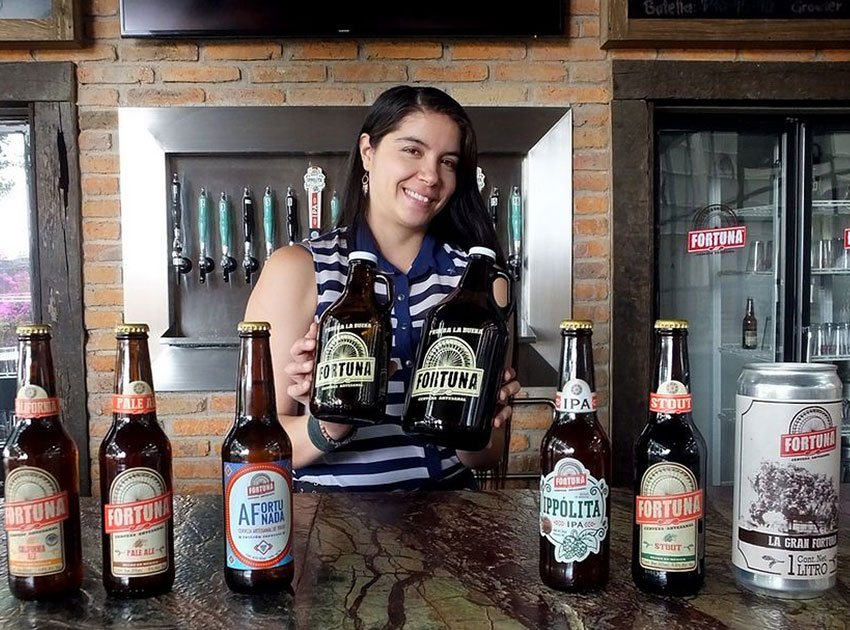
At the bar you can get Fortuna in bottles, cans and growlers.
The tour of the brewery lasted just over an hour. The place is gleaming and the equipment is ultra-modern, with LED screens flashing left and right. Nevertheless, the tour is very personalized, allowing you to smell, touch and taste the barley and hops and get a good look at every step that transforms them into the products that are eventually stored in a huge cold locker whose temperature is maintained at exactly 11 C.
Along the way, I met Fortuna’s braumeister, Marcelo Oehninger, who described himself as a “Swiss Chileno.” He is, I discovered later, one of very few brewmasters in Mexico fully trained and certified in Germany.
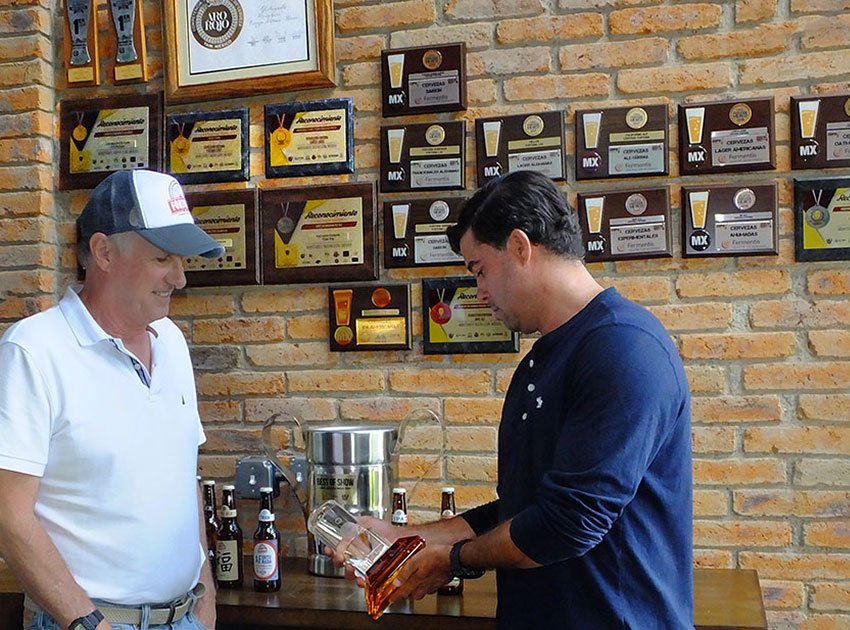
After my tour, I caught up with Juan José Morales in front of a wall covered with medals and awards many of which, I learned, Fortuna had won just in the last few weeks.
One of their top winners is Cañita, a beer they recently added to their line. “We wanted to make a lager beer,” Morales told me, “but we wanted it to be something really special. You won’t believe it, but it took us two years to find a formula that we really love.”
Cañita, you could say, is Fortuna’s answer to Corona, and, after tasting it, I think Corona had better watch out!
“But we also like to make really creative beers here,” Morales told me, “beers that no one else has ever made, beers with our own special Mexican ingredients. A few years ago I bought some sake yeast with the idea of actually trying to make sake here, but my brewmaster said that would introduce bacteria that would contaminate the factory. ‘Instead of that, how about making a beer?’ he suggested.
Fortuna’s latest award names it the Best Mexican Brewery of 2019.
“Okay, I said, let’s try. So we brought in rice, malt and Japanese hops and experimented and came out with a Mexican-Japanese beer we call Sake Ale and it’s creating quite a stir and starting to win awards. Now all the Japanese restaurants in Guadalajara are looking for it!”
Fortuna now has nine beers in their line and, yes, they are looking into even more “beers that no one else has ever made.” However, Juan José Morales observed that “Once you have a good product, next you must give your customers the very best service possible, so this has become our main focus.”
The Fortuna brewery also has a huge beer garden which can accommodate up to 200 people. The garden really is special. Huge Indian laurels provide shade for paths lined with aromatic plants like rosemary and mint.
At the bar I had a chance to try several of their craft beers. I was especially impressed by their IPA (India Pale Ale), which is brewed with an unusually large amount of hops, a formula developed by the British to preserve their beer during the long hot voyage from England to India.
I was amazed. I found this and several other of their ales delicious. I could taste different subtle flavors in each, which I might imagine came from spices, but I knew nothing had been added. I must mention that up to this moment I was not a fan of ales, but Fortuna’s have totally captivated me.
I guess I experienced just what the company’s four founding fathers felt when they tried craft ale in California and decided to bring it to Mexico.
[soliloquy id="82019"]
If you live in the Guadalajara area, you might want to visit Fortuna to take a tour or pick up a mix of their most popular beers. Check their web page for details.
Anywhere else in the country, you can taste their products by ordering them from Amazon México. And don’t forget: it’s not pasteurized, so the shelf life is only six months. Keep it nice and cold!
The writer has lived near Guadalajara, Jalisco, for more than 30 years and is the author of A Guide to West Mexico’s Guachimontones and Surrounding Area and co-author of Outdoors in Western Mexico. More of his writing can be found on his website.