Family outings on the household motorcycle are no longer permitted in Yucatán if any of the passengers are under the age of 5.
Lawmakers have approved a modification to the state’s traffic regulations that will effectively prohibit children under 5 to ride on motorcycles with their parents.
The modified law also states that older children will only be able to ride if they can hold on by themselves and reach the foot pegs.
The proponent of the law, Víctor Sánchez Roca, explained that it will provide greater safety and protect the lives of minors.
The overhaul of traffic regulations also means that all drivers’ license applicants must pass a driving test.
Next up on the agenda to improve road safety is a meeting next week to discuss three-wheeled motorcycle taxis, or mototaxis, which are illegal for safety reasons.
But their popularity has grown exponentially due to increasing demand and tolerance by authorities.
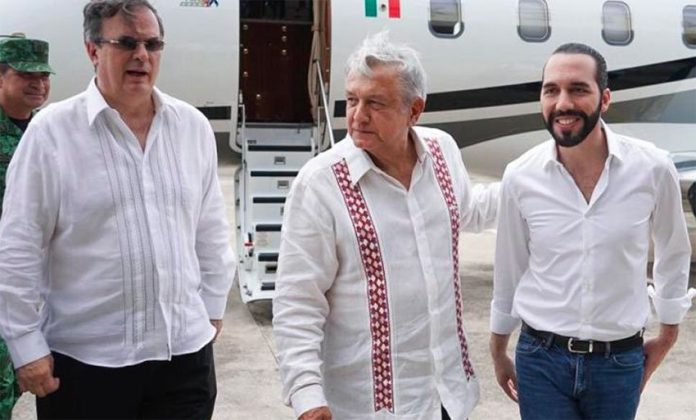
Ebrard, left, and López Obrador greet El Salvador's Bukele yesterday in Chiapas.
The federal government announced that it will provide a US $30-million grant to El Salvador for a reforestation program as part of a development plan that aims to improve economic and social conditions in Central America and slow migration to the United States.
President López Obrador and Salvadoran President Nayib Bukele signed a cooperation agreement for the program in Tapachula, Chiapas, a city just north of the border with Guatemala through which tens of thousands of migrants have passed in recent months.
The reforestation project – which is based on the government’s domestic Sembrando Vida (Sowing Life) program – intends to plant timber-yielding and fruit trees on 50,000 hectares of land in El Salvador and is expected to create 20,000 jobs.
“I’ve always maintained that the countryside is the most important factory in the country,” López Obrador said.
“Everything depends on getting that factory going and that’s what’s being done with this program. It will improve the environment, [create] production and work, and people, especially young people, won’t have the need to go elsewhere to make a living. Mexicans and Central Americans should be able to work and be happy where they were born, where their families, customs and cultures are. That can be achieved with this program.”
The president also said that similar programs are in the works for Honduras and Guatemala, the two other countries in the Northern Triangle of Central America.
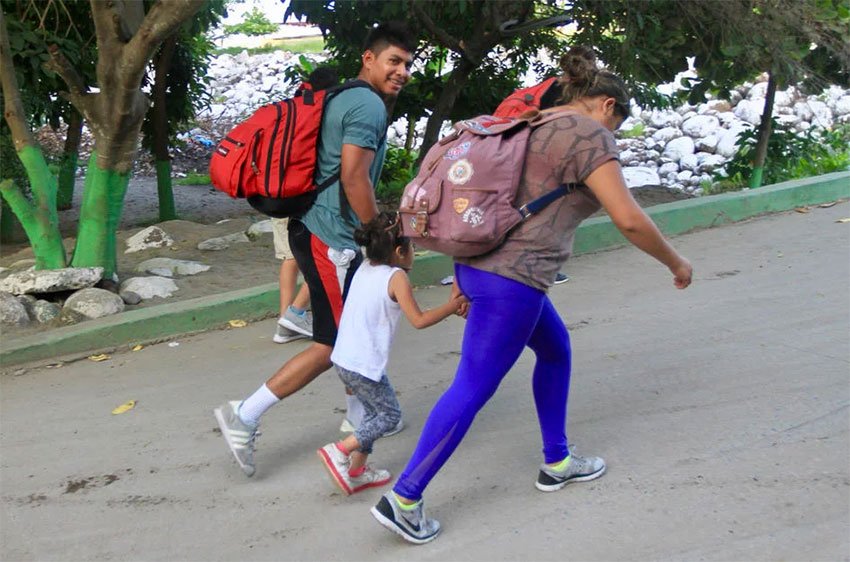
High levels of violence and poverty have caused large numbers of people to flee the three countries, many of whom have arrived in Mexico as part of several large migrant caravans that have traveled through the country to the northern border since late last year.
Immigration control, López Obrador said, cannot come only through “the use of force, only coercive measures, closing borders, but through understanding the root of the problem and seeking solutions.”
The announcement of the development program comes as Mexico faces intense pressure from the United States to reduce migration through the country to the northern border.
On June 7, Mexico committed to enforcing stricter immigration policies as part of an agreement with the United States that ended President Donald Trump’s threat to impose escalating tariffs on all Mexican goods.
The effectiveness of Mexico’s anti-migration measures, including the deployment of the National Guard to the southern border, will be assessed by the United States in the third week of next month.
Would they stay home and plant trees instead?
If the measures are considered not to be achieving the desired results, Mexico will take “all necessary steps under domestic law” to implement a safe third country agreement, according to a “supplementary agreement” to the bilateral pact.
Despite the pressure from the United States, Foreign Secretary Marcelo Ebrard said that Mexico is providing the grant to El Salvador without any political or financial conditions.
He added that a Mexican team will go to El Salvador to launch the program as soon as Bukele wishes, explaining “the funds are available to start the program today.”
More than $100 million will eventually be allocated to the program, Ebrard said.
News of the tree-planting project was met with skepticism by Salvadoran migrants at the Mexican Commission for Refugee Assistance in Tapachula.
A 24-year-old man who crossed the border earlier this week told the Associated Press that “it’s very good that they’re providing work” but added that the program won’t work if it doesn’t put an end to violence.
“Even if there are [development] projects, people are going to keep leaving,” said Carlos Vindel, who fled El Salvador after gangs tried to recruit him.
President Bukele, who took office at the start of this month, has promised a crackdown on criminal gangs but according to Vindel, that will only make things “more critical.”
“There will be more violence because the gangs always respond,” he said.
Marisol Martínez, a Salvadoran woman who left El Salvador with her 13-year-old daughter and 14-year-old son due to gang threats said that “poverty is not going to change” as a result of the reforestation program.
In addition to the tree-planting endeavor, the Comprehensive Development Plan for Central American and southern Mexico proposes a range of infrastructure projects including a US $300-million regional electrical interconnection project, a 600-kilometer gas pipeline and a highway linking Guatemala to Tenosique, Tabasco.
Ebrard said last week that Mexico was confident that development in the region “really can [reduce] migration in the short and long term.”
However, in the meantime, the government is left with the dual challenge of stopping the flow of migrants and attending to those who are already here and those who will be returned to Mexico from the United States under an expansion of the so-called “Remain in Mexico” policy.
Mexico’s agreement to take in more asylum seekers as they await the outcome of their claims in the U.S. will place even more pressure on already overcrowded migrant shelters, a situation that has forced some migrants to sleep in parks or on the street.
As they wait for an opportunity to file visa requests in Tapachula, that’s the reality faced by Honduran woman Yesenia Hernández, her husband and their two children. But going home isn’t an option.
“If there were opportunities, work, hospitals and all that, we wouldn’t come,” Hernández said. “And if there was no violence.”
Federal Police officers who do not fulfill the physical requirements to join the National Guard are being transferred to the National Immigration Institute (INM) where they will help control illegal immigration.
At least 625 officers who were too heavy to join the new security force are manning INM checkpoints on Mexico’s northern and southern borders and along migrant routes.
After working with the INM for six months or however long the immigration emergency lasts, the officers will be able to decide whether to stay with the INM or try to join the National Guard again. However, if they decide not to work with the INM, the officers will be out of a job when the Federal Police is absorbed into the National Guard at the end of the month.
In an audio recording that was leaked to the newspaper El Universal, Federal Police commander Raúl Ávila Ibarra tries to convince a group of officers to join the INM, which he assures them pays better than the Federal Police.
“Those of us who are too heavy, we’ll have at least six months to make a plan that isn’t too hard, so we can fulfill the parameters they’ve given us,” he said. “Like a lot of you, I don’t fulfill the weight requirements, and it requires a commitment . . . it will be my personal decision if I want to continue or look for another option.”
One officer who was sent to work with the INM complained on social media about working conditions, saying that they were “tricked” into being sent to military bases along migrant routes where they are forced to sleep outside without adequate protection from the elements and possible aggression.
“After June 15, we were commissioned by the INM, but we were sent to military bases, and from there we are transported in open vehicles,” he wrote. “And we are vulnerable to everything, because we don’t carry guns or any weapons to defend ourselves from aggression.”
The anonymous officer said he would blame Federal Police Commander Benjamín Grajeda and secretary general Abraham Rodríguez Solís for anything that happened to the officers as a result of the conditions.
A study by the national statistics agency found that 79% of Mexico’s police suffered overweight or obesity to some degree in 2017.
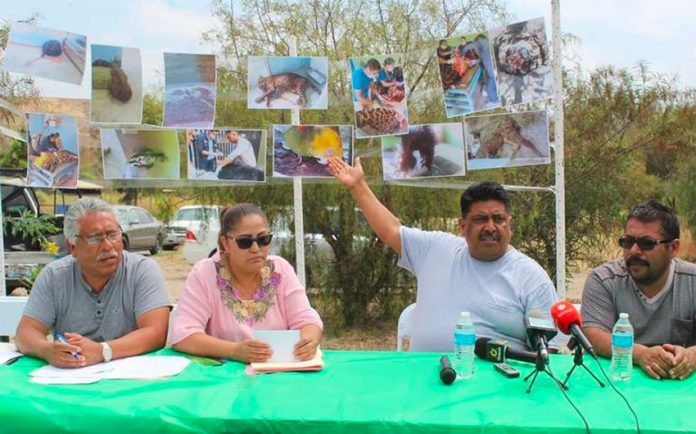
Photos of dead animals form a backdrop to press conference on conditions at zoo.
Ineptitude and corruption have caused the death of up to 70 animals at the Parque Morelos zoo in Tijuana, Baja California, claim park vendors and former employees.
Vendors association president Dominga Monroy accused the municipal government of abandoning the zoo, causing “severe deterioration.”
Mayor Juan Manuel Gastélum Buenrostro has visited “the nice area at the entrance” of the park, said Monroy, but has never stepped inside and is oblivious to its condition.
Former employee Juan Alberto López stated that between 50 and 70 animals of all species have died in recent months due to a scarcity of medications to treat their illnesses.
” . . . Many of the animals died because the former zoo coordinator, Doctor Roberto Armenta . . . was inept and dedicated only to neutering dogs and cats. When an animal fell ill, we reported it to him but he didn’t care, he would just send his assistant to check on them,” accused López.
He also said that instead of hiring a firm to cremate the dead animals, Armenta buried them near the zoo’s kitchens.
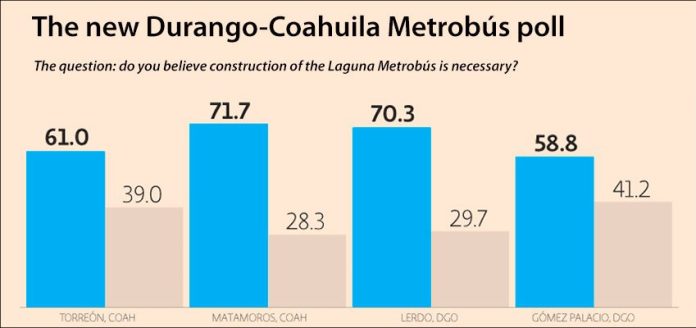
Blue results indicate those in favor of continuing with the transit project.
The results of a polling agency’s survey were markedly different from those of an impromptu show-of-hands consultation conducted by President López Obrador over a planned infrastructure project in Durango.
A telephone poll by Massive Caller, a Mexican polling company, found that 63.1% of residents of the Laguna metropolitan area were in favor of continuing with a Metrobús project which the president promised to cancel after his impromptu consultation last Sunday.
The poll consulted 1,200 adult residents of the Coahuila municipalities of Torreón and Matamoros and the Durango municipalities of Gómez Palacio and Lerdo.
Support for the Metrobús was slightly lower in Gómez Palacio — where the show-of-hands vote took place —where 58.8% said they supported the project.
Rogelio Barrios, president of a Laguna chamber of commerce, said that in light of the poll the cancellation should be reconsidered because it will have a negative impact for the people who travel between the municipalities in the metropolitan area.
López Obrador announced he would pull federal funding for the Durango portion of the Metrobús after his consultation of people attending a rally in Gómez Palacio produced a strong show of opposition.
But he indicated later that he was open to a more formal consultation to determine whether the project should go ahead.
The Metrobús would connect the four municipalities and two states of the Laguna region with a 32.5-kilometer route, 31 stations and 525 vehicles, serving up to 170,000 trips daily.
Work on the Coahuila portions of the Metrobús, which represents 24.8 kilometers of the 32.5-kilometer route, is already 90% complete. The state government has said it plans to finish its section of the system regardless of whether the route will continue across the Nazas River into Durango.
The Metrobús is opposed by bus drivers who are concerned the new system won’t include them.
According to Massive Caller, the poll has a margin of error of plus or minus 3.4%.
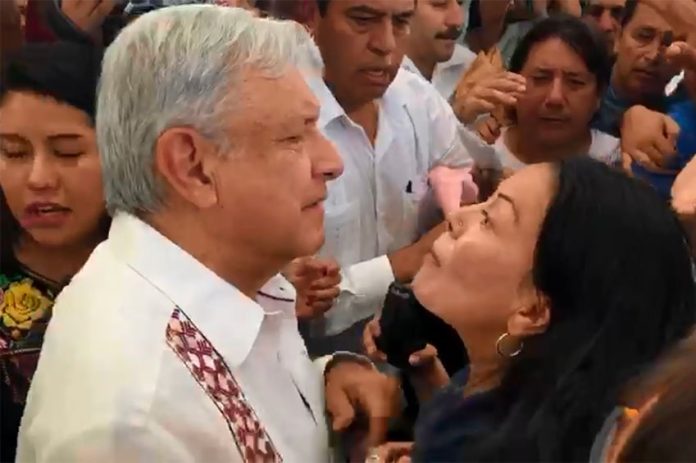
Faceoff: after snapping a selfie with the president, this woman launched into a tirade.
There was chaos yesterday at a Chiapas airport when President López Obrador arrived for a meeting with El Salvador President Nayib Bukele as teachers and other protesters yelled and shoved to try to approach the head of state.
The president had flown to Tapachula to meet with the Salvadoran president and to announce an investment in a binational project that will aim to provide jobs in the Central American country.
But he had barely stepped off the plane when he was plunged into the middle of a teeming crowd of angry protesters, principally members of the CNTE teachers’ union.
The scene was one of mayhem as the president and his team tried to push their way through the throng of teachers who clutched at the president’s clothing, shouted demands and complained about Chiapas Governor Rutilio Cruz Escandón Cadenas.
One especially persistent protester managed to push her way through the crowd while yelling that López Obrador he had “let down the people of Chiapas.”
She was briefly held at bay by presidential staff but before they could completely block her access, she broke away and elbowed through to the president, where she stopped and posed to take a selfie with him before continuing her verbal barrage.
Continuing his slow advance toward a waiting vehicle, López Obrador, who appeared to have been accidentally struck and shoved several times himself, cried out, “Don’t push, don’t push! Stay calm! Don’t squish me!”
Several protesters and teachers also managed to break through the lines to the president, handing him handwritten demands and complaints. Finally, the president’s desperate team began to push back against the crowd, making space for him to climb into the waiting van, provoking cries of “Mentira, mentira, la misma porquería!” (“Lies! Lies! The same old shit!”)
As the president waved to the assembled crowd, CNTE teachers who had not managed to hand him their lists of demands threw them at him before he finally climbed all the way into to the vehicle and was driven to his meeting with the Salvadoran president.
The government has not purchased enough, says the pharmaceutical industry.
The pharmaceutical industry has told the federal government that it won’t take responsibility for problems created by its new model for purchasing and distributing medications, including medicine shortages.
Industry leaders took advantage of the attendance of the president’s chief of staff, Alfonso Romo, and Health Secretary Jorge Alcocer at an industry meeting to warn the government of the negative consequences of the new system.
The government announced a new centralized and consolidated purchasing model last month that it says will allow medicines to be obtained at cheaper prices.
Medicines will be purchased from a wider range of suppliers and the Mexican Social Security Institute (IMSS) will be responsible for their distribution to public hospitals and health care clinics.
The government says the new model will help stamp out corruption in the purchase and distribution of medicines.
However, the pharmaceutical industry is skeptical that the model will function effectively and has already warned that IMSS doesn’t have the capacity to adequately store and transport the massive quantities of drugs required by patients in the public health system.
The chairman of the board of the National Chamber of the Pharmaceutical Industry (Canifarma) said yesterday that industry leaders told Romo that when the new model fails “we don’t want to be [held] responsible.”
“We told him in a very clear and blunt way,” Rodrigo Puga said.
He said the government is already blaming the pharmaceutical industry for medicine shortages that have plagued public hospitals and health clinics in recent months but denied that drug companies are at fault.
The government’s health sector budget cuts have caused the shortages, according to state authorities and medical personnel.
Puga said that Canifarma has explained the reasons for the shortages in 40 letters to the president’s office but government officials haven’t taken any notice of them.
Chief of staff Roma, Canifarma’s Puga and Health Secretary Alcocer after signing their agreement yesterday.
In an opening address to the pharmaceutical industry convention, the chairman called for “clear rules” to govern the new purchasing model.
“In addition to coordination between the public and private sectors, the change in the purchasing model for public [medicine] requires greater planning, clear rules and a solid legal framework that provides certainty to the participants and contributes to the strengthening of this mechanism in the future,” Puga said.
For his part, Romo described the public health system as “disastrous” and blamed its poor state on neglect and mismanagement of federal governments over the past 70 years.
He said it was inconceivable that there is not a public health system that provides care for everyone.
“We have to really build something that we will never regret, you can count on us. I’m at your orders here and if we fail, we all fail and if we do well – as we’re going to – we’ll do well together and another thing: I’m going to go at your speed, as fast as you want,” Romo said.
Romo and Health Secretary Alcocer signed a letter of intent in which the government committed to continue to collaborate with the sector.
Despite that undertaking, federal authorities continued to face criticism and questioning about their approach to purchasing medications under the administration of President López Obrador.
Ángel Sosa, a member of the Canifarma supply commission, took aim at the bidding process that the government launched earlier this week.
“It’s a tendering process that favors the reduction of prices, that establishes conditions that are difficult, and in some cases impossible, for the industry to meet,” he said.
“To participate knowing beforehand that you’re not going to be able to comply is schizophrenic. There’s no way to present an offer that is financially sound for both parties.”
Enrique Martínez Moreno, general director of the Pharmaceutical Institute (Inefam), said there was a 23% shortage of medicines across the nation in the first quarter of 2019 as a result of the government’s reduction of purchases.
“What was bought in the first quarter of 2019 should have been at least equal to 2018 but that wasn’t the case . . . maybe that’s what we’re suffering from. The [23% shortage] is an average, we see states in which it is worse. . .” he said.
People with HIV or AIDS have been hit particularly hard by the lack of antiretroviral drugs.
The Inefam chief said the National Center for the Prevention and Control of HIV/AIDS only obtained 60,847 medicine orders between January and March compared to 238,176 in the same period last year – a 74% decline.
Martínez added that the government has slashed this year’s budget for the purchase of medications by 12 billion pesos (US $628.8 million).
“There is a significant reduction of 14% with respect to last year’s budget, which was above 81 billion pesos, while this year it’s expected to be 69 billion,” he said.
Martínez claimed that the medication prices listed in the government’s tender are lower than they should be, adding that he didn’t know how they had been decided.
David Palacios, a former IMSS administrative director, charged that the social security institute doesn’t have the logistical capacity to distribute the government’s medicine purchases, a claim that the chief of Canifarma also made this week.
“The problem is logistics . . . I don’t know how IMSS is going to do it,” he said.
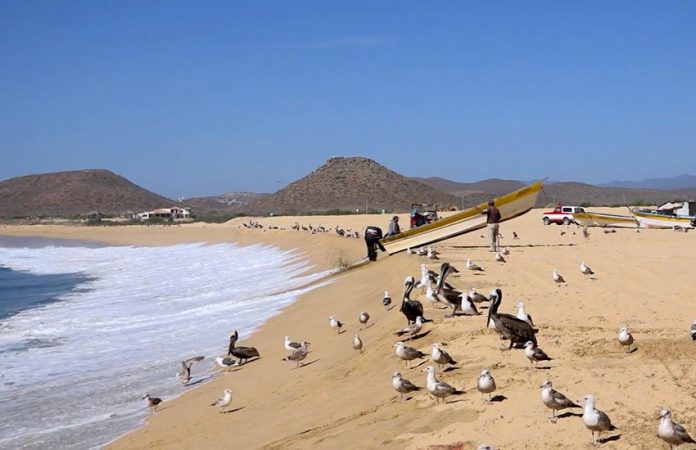
Fishermen at Puntos Lobos beach, Todos Santos. Patrimonio
In January 2015, an allegedly illegal mega development known as Tres Santos broke ground south of Todos Santos, a popular beach town on Baja California Sur’s west coast.
The plan was to build 4,400 luxury homes, a beachfront hotel, restaurants and other businesses on a fishing beach and one of the only swimmable spots in a region beloved by surfers for its powerful waves.
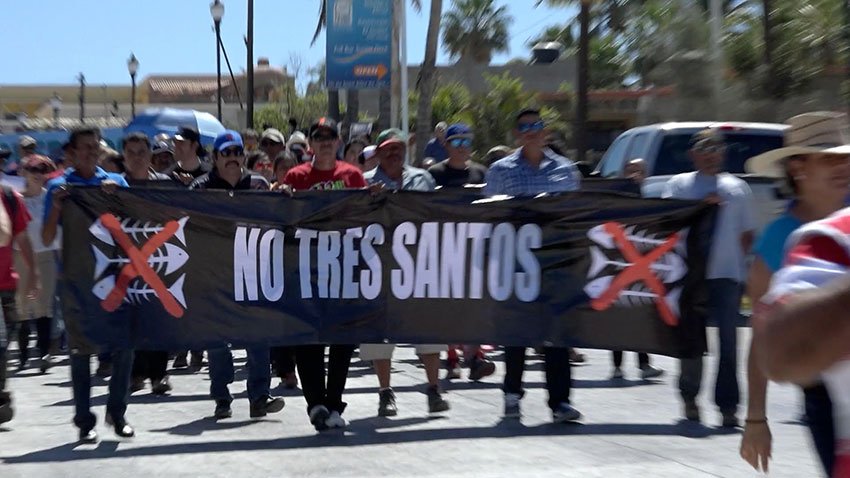
Opponents to the project included local fisherman who feared the development would erode their beach, and Todos Santos residents who worried the sharp population increase would deplete an already stressed natural aquifer on the arid peninsula, among other social and environmental concerns.
After nearly three years of protests and lawsuits aimed at proving the land rightfully belonged to the fishermen, most of the Tres Santos development came to a halt.
The story of the Tres Santos battle can now be seen on film.
Villagers protest the Tres Santos mega development. Patrimonio
The bilingual documentary Patrimonio by American filmmakers Lisa F. Jackson and Sarah Teale tells how fishermen and other residents fought off Tres Santos, a project spearheaded by development groups in the United States and Mexico.
Having made the rounds at film festivals around the world and winning a number of special selection awards, it is now available on iTunes Movies.
“We went down to the beach to get some fish and saw all these surveillance stakes and heard there was a big development going in there and that the fishermen were totally cool with it. So we decided to ask the fishermen and they were not cool with it,” Jackson said.
“They were terrified. They were feeling pressure on their space, they were getting notices of petty violations, and they were feeling the hot breath down their necks so they really were the first ones to feel the impact and the first ones to ask the developers where their permits were and point out they were wrecking the dunes, tearing up protected mangroves and filling in an arroyo.”
Jackson was sued by Tres Santos for her involvement on behalf of the fishermen, and the fishermen’s counsel, La Paz lawyer John Moreno, was jailed for three months.
Patrimonio alleges that Baja California Sur Governor Carlos Mendoza Davis was paid off to allow the construction to take place and Jackson said the state’s attorney general had probably been paid off as well in order to bring the false claims against Moreno.
The Hotel San Cristóbal at Punta Lobos. megan frye
The film focuses on what activists say was the greed of the United States and Mexican developers and the incapacity of the Baja California Sur justice system.
Tres Santos was the brainchild of the Colorado-based real estate developer Black Creek and its Mexican subsidiary, MIRA. Only three parts of the projected mega development were built: Hotel San Cristóbal on Punta Lobos beach, Jazamango restaurant and the Todos Santos Colorado State University campus.
“The only thing that stopped the development was at the federal level,” Jackson said. “A ruling that the fishermen’s concession was inviolate, federal judges ruling that John Moreno had a right to post bail, federal judges ruling that fishermen had a right to their beach. Locally, nothing could move because of corruption.”
Still, in late April, a new 343-luxury home project was announced for Cerritos beach, just south of where Tres Santos was to be built. It is not clear if the project is related to anyone at Black Creek or MIRA.
“Some people had said that [former president Enrique] Peña Nieto had a master plan to build resorts, villas and marinas all the way up to Ensenada from Los Cabos, so you can’t let down your guard,” said Jackson, who is also a Todos Santos resident.
“Everybody is always looking over their shoulders. Part of it is the charm of Todos Santos and the beauty of the coast, and so it’s always going to be under threat. And that can equally come from too many foreigners coming and building McMansions out on the beach, which they are not supposed to do. In fact, they recently stopped a construction on the beach, Semarnat [the federal Environment Secretariat] stepped in.”
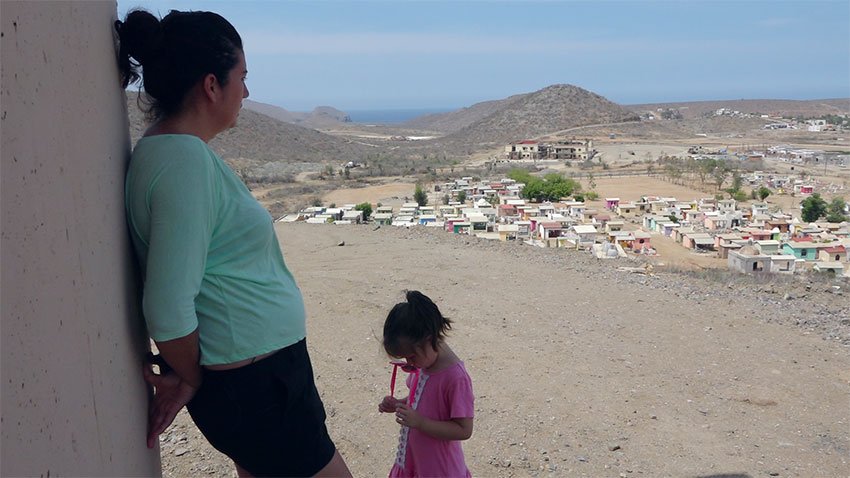
María Salvatierra and her daughter and the Colorado State University campus in the distance. patrimonio
Jackson said that while Todos Santos has an urban development plan that limits the size and footprint of houses and where they can be built, the rules are rarely enforced.
“People are constantly checking that stuff out, which is good,” Jackson said. “We got grazed by the bullet with Tres Santos and still have the Hotel San Cristóbal, part of the Tres Santos development, and which a good Category 3 hurricane is going to take out to sea, because they just built it on the dune right at the tideline.”
Tres Santos was by all accounts, as promoted to its mostly U.S. and Canadian potential clients, a holistic living option for people looking to escape the hustle and bustle of Gringolandia. There would be yoga studios, bike trails and an organic farm. The project’s sales material promised to offer a relaxing atmosphere for residents and guests of the Hotel San Cristóbal.
Tres Santos gifted land valued at US $4.3 million for the Colorado State University (CSU) campus. Patrimonio co-director and producer Teale says the gift was merely a way to use CSU’s reputation as an environmentally conscious institution to bring more faith to the project as well as money: the only people who can study at CSU’s Tres Santos campus are current CSU students or alumni.
In 2016, Teale said, the cost for a two-month program at the Todos Santos campus cost $20,000.
“At first, none of us realized the depth of corruption behind it and we didn’t realize what the money was behind it,” Teale said.
Lisa F. Jackson and fisherman Rosario Salvatierra. patrimonio
“So the story just sort of kept going and got more frightening and very interesting. It tells a much bigger story of development companies thinking that they can walk into local communities and just take over, and that’s happening all over the world.”
Teale has been traveling to Todos Santos regularly for more than 22 years, during which time she’s been very inspired by its people.
“The people of Todos Santos are very libertarian and fierce and Baja is a bit different than mainland Mexico in that they’ve always pretty much been left alone,” Teale said.
“I was so proud of them for standing up for their rights; they are so profound and brave. And when you’re there filming, the developers and authorities can’t do . . . as they’d like because you’re there documenting it. They knew that people who had connections were watching it.”
One of the most alarming aspects of the Tres Santos project for Teale and others was the greenwashing campaign — making a product appear environmentally responsible — and association with CSU.
“Tres Santos had it in the contract that nobody in CSU was allowed to bring up any issues with the development,” Teale said.
[wpgmza id=”210″]
“What kind of institution goes into a business relationship with a money-making . . . developer? If they had looked for five minutes they would have said they didn’t want anything to do with it. But instead they signed a contract including such ridiculous points as saying they would keep the flowers in bloom during tourist season.
“We wrote a clear presentation of the issues with the development and gave it to the CSU board of trustees and they didn’t care . . . we saw that people were fully aware of the water issues we raised yet did nothing. It was quite shocking.”
María Salvatierra grew up in Todos Santos and is the daughter of a retired fisherman. She was hoping to study at the new CSU campus until she found out that it was not available to locals.
Once her family and others started asking questions regarding where water would come from for the new megaproject, she said they realized how many illegal permits the developers had gotten at both municipal and state levels.
“My family basically lives from fishing,” Salvatierra said “We were worried about how many people would be out of work, how many families would be without resources because there are so many people who depend on fishing for their livelihoods.”
Salvatierra felt from the beginning that the developers cared little for the environment, even in the case of such a delicate ecosystem as the desert.
“The Mexican government isn’t very interested in environmentalism,” Salvatierra said. “What they are interested in is money and they don’t care so much about the water, trash, etc. Tres Santos didn’t come with anything to give to the village, they just came to sell this place to people who had the money to purchase it. The hotel is functioning, but truly the jobs there pay very low.
“The developers didn’t have the intention of taking care of anything, they didn’t even care about the destruction of the dunes and what that could mean for the beach. They came to make their money and that’s it.”
Megan Frye is a writer, photographer and translator living in Mexico City. She has a history of newsroom journalism as well as non-profit administration and has been published by several international publications.
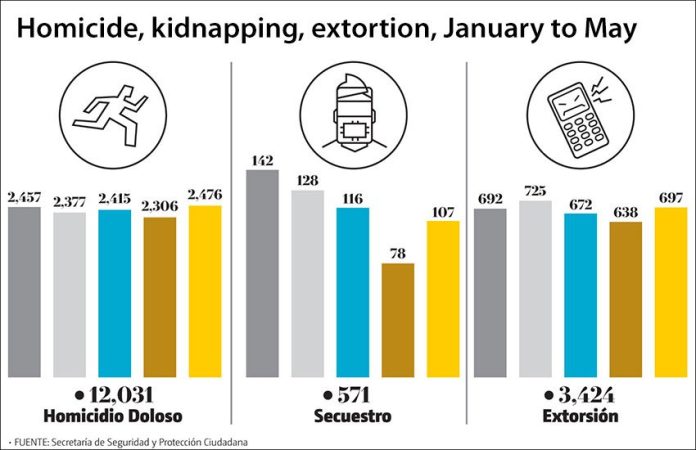
May was the deadliest month so far in 2019 with 2,476 homicides, according to the National Public Security System (SNSP).
The most violent month this year had been January when 2,457 people died violent deaths.
Although there were fewer homicides in May 2019 than in the same month last year, the first five months of 2019 were worse than the same period in any year for which the SNSP has data, registering 4.26% more homicides than the first five months of 2018.
Of the 2,476 homicides committed in May, 1,758 were committed with firearms and 209 with blades.
With homicides in general on the rise, femicides have remained steady throughout 2019, with 73 gender-motivated murders of women in May, the same number as in February.
Kidnappings jumped to 107 in May, compared to 78 in April, but the number was still lower than in January, when there were 142.
Last year, there were 28,957 homicides, the most violent year in Mexico since the SNSP started keeping records in 1997. But if the trend of the last five months continues, 2019 will set a new record.
Guanajuato continues to lead in homicides, recording 1,181 in the first five months the year, more than any other state. Much of the violence is related to fighting between the New Generation Jalisco Cartel and the Santa Rosa de Lima Cartel for control over fuel theft and other crime.
President López Obrador has said that crime rates in general have been controlled. In April he said that new social programs and security policies would bring a decline in homicides over the next six months.
The federal government has deployed the National Guard in strategic areas to combat violence and insecurity. The priorities are the states of Guanajuato, Jalisco, Michoacán, México state, Guerrero, Mexico City, Veracruz and Morelos.
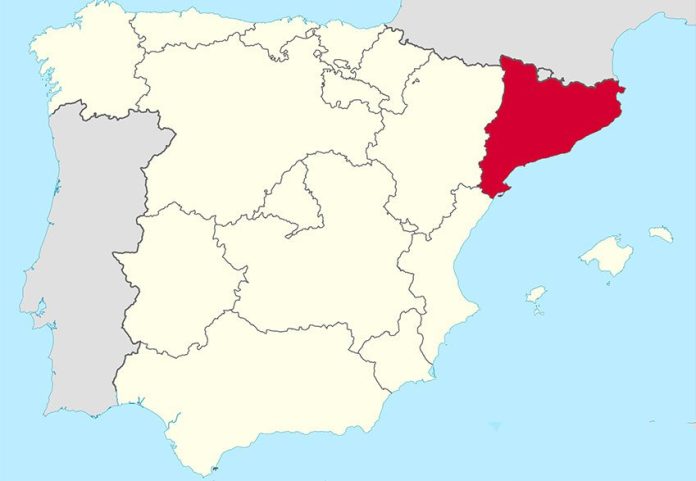
Sorry: highlighted in red is Catalonia, a piece of Spain that has apologized for the conquest.
Spain has refused Mexico’s request for an apology for the conquest, but that didn’t stop Catalonia from doing so.
The government of the autonomous Spanish region yesterday offered an apology to the indigenous peoples of Mexico for the killings and other offenses committed by Spaniards during the 16th-century conquest of the territory now known as Mexico.
Issued by the Catalan minister of foreign action during a visit to the National Institute of Indigenous Peoples (INPI), the apology came almost three months after President López Obrador revealed that he had written both the king of Spain and Pope Francis asking that they apologize for the indignities suffered by native peoples during the conquest.
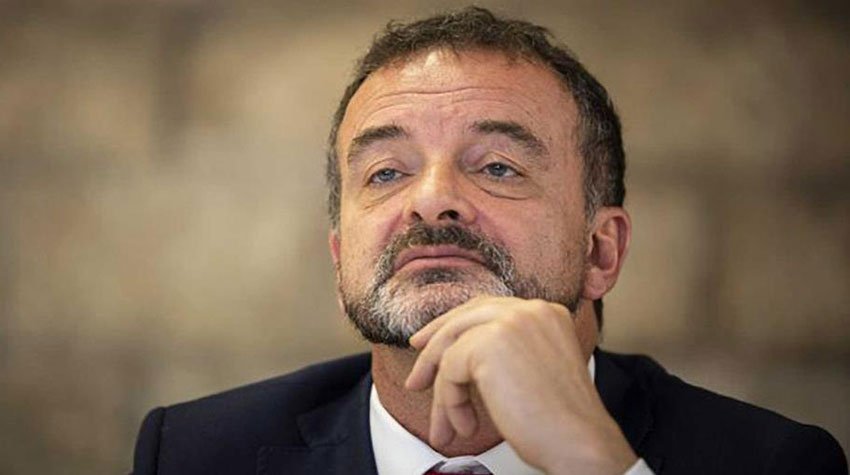
Alfred Bosch said the Catalan government will work hand in hand with Mexico and its indigenous peoples to recover “all the dignity that never should have been lost.”
“What is clear is that the conquest and colonization introduced discrimination and marginalization” to Mexico, he said.
A spokesman for Mexico’s indigenous peoples said they supported Catalonia’s efforts to win independence from Spain.
Bosch told reporters that during a meeting with INPI officials, the Catalan government committed to collaborating with Mexico to improve the economic and social development of indigenous peoples and to help preserve their linguistic and cultural traditions.
The Catalan minister also said that he offered to act as an intermediary between the governments of Mexico and Spain to help them reach a common position on the subject of the conquest.
Bosch has recently taken a close interest in the relations between the two countries and in April offered an apology to Mexico’s indigenous peoples on behalf of the Catalan government while speaking in the Catalonia parliament.
INPI international relations director Saúl Vicente Vázquez said he was honored to have received the apology from the Spanish autonomous community.
He also said the indigenous peoples of Mexico supported Catalonia’s efforts to win independence from Spain.
“People have every right to maintain their identity, their culture . . . and in this conversation today we’ve found that in current times it is highly important to reflect on these issues, the reality of the people of Catalonia, to whom we send a fraternal greeting,” Vázquez said.
Hugo Vilar Ortíz, an INPI indigenous rights official, said indigenous peoples are now waiting for an apology from the Spanish government.
“It would be very meaningful if the Kingdom of Spain, the Spanish state, offered an apology to the [indigenous] peoples. To this day we feel the effects [of the conquest] because it wasn’t just a physical annihilation, it also had effects on culture and identity,” he said.
But there appears to be no likelihood of that occurring any time soon.
In March, the government of Spain said it “vigorously” rejected López Obrador’s request for an apology, asserting that “the arrival 500 years ago of the Spaniards on territory that is now Mexican cannot be judged in the light of contemporary considerations.”
Speaking to reporters in Belgium yesterday, Spanish Foreign Minister Josep Borrell made light of Bosch’s apology and charged that the Mexican government hadn’t afforded “the slightest importance” to his visit.
He also dismissed any possibility that the Catalan minister could act as a mediator between Mexico and Spain, declaring “Mr. Bosch has no sense of the ridiculous, that’s clear.”