Home Blog Page 1828

Poll finds support for closing border to migrants and deployment of National Guard

0
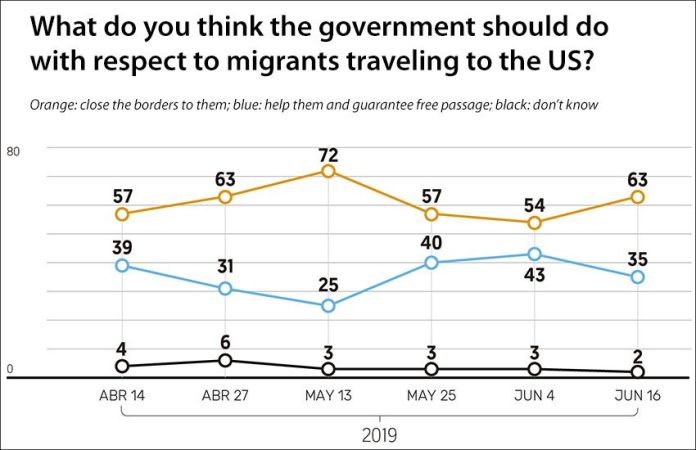
Change in sentiment regarding migrants between April 14 and June 16
Change in sentiment regarding migrants between April 14 and June 16. el financiero

Almost two-thirds of respondents to a new poll believe that the government should close the southern border to migrants, and an even higher percentage support the deployment of the National Guard to enforce stricter immigration policies.

The poll published today by the newspaper El Financiero found that 63% of the 410 people surveyed would like to see the border with Guatemala closed to migrants, a 9% increase compared to two weeks ago.

In contrast, 35% of respondents believe that the government should support migrants and facilitate their journey through the country to the northern border.

Mexico’s commitment to send 6,000 National Guard troops to the southern border as part of an agreement with the United States that ended President Donald Trump’s tariff threat found support among 68% of poll respondents while 29% opposed the move.

Three-quarters of those polled said that Mexico should deport undocumented Central American migrants and 67% said that the southern border should be militarized.

While the deployment of the National Guard found strong support, another aspect of the deal with the United States – Mexico’s agreement to accept the return of a greater number of asylum seekers as they await the outcomes of their claims in the U.S. – was rejected by a majority of respondents.

Just 36% said that migrants should be accepted under the so-called “Remain in Mexico” policy while 60% said that they should not.

Despite Mexico’s commitment to ramp up immigration enforcement, 64% of respondents said that Trump won’t respect the June 7 agreement that indefinitely suspended the imposition of escalating tariffs on all Mexican goods.

At the start of the third week of July, the effectiveness of the anti-migration measures will be assessed and if the United States decides that they are not achieving the desired results, Mexico will take “all necessary steps under domestic law” to implement a safe third country agreement, according to a “supplementary agreement” to the bilateral pact.

Just over half of the poll respondents said the government “acted with dignity” in the negotiations with the United States while 41% said that it caved in to U.S. demands.

However, 57% of those surveyed said that it remains to be seen if the negotiation was a success or failure for Mexico.

Source: El Financiero (sp) 
Refinery will have impact on air, water quality but remains viable: environmental report

0
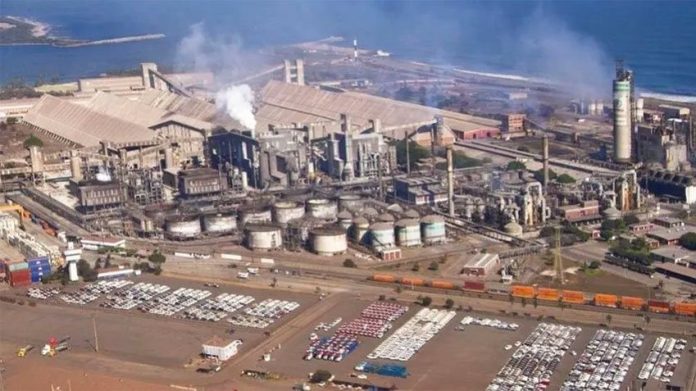
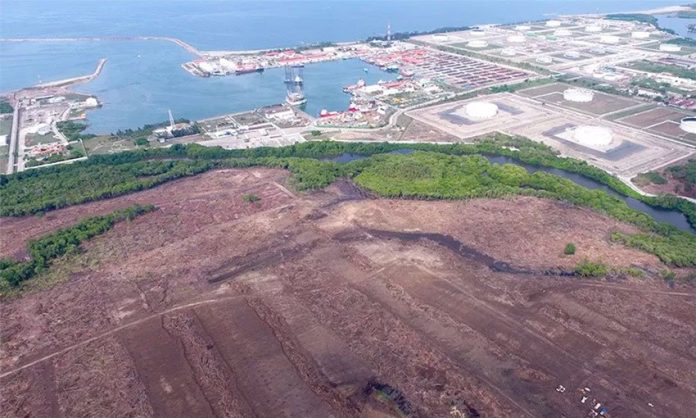
The site of the new refinery.

The government’s plan to build a new oil refinery on the Tabasco coast involves high risks of flooding and other environmental problems but remains viable, according to an environmental impact statement (EIS) prepared by the state oil company.

Released by the Security, Energy and Environmental Agency (ASEA) late Tuesday, the document — parts of which were not made public — says the refinery site is subject to flooding from both sea and river water and susceptible to storm tides and erosion.

The EIS also says the refinery will affect the quality of air and water in the area and have an impact on local wildlife.

However, Pemex said that the impacts “will be controlled, mitigated or compensated” and that the operation of the refinery “will totally comply” with existing environmental laws and is economically viable.

ASEA has 60 days to assess the EIS. The agency is part of the Secretariat of the Environment and its chief is a presidential appointee whose appointment doesn’t require approval by Congress.

The state-owned company and the Secretariat of Energy were given the task of building the refinery in the Gulf coast port of Dos Bocas after the federal government last month scrapped the bidding process on the grounds that the bids from private companies were too high and the project would take too long.

While Pemex acknowledged the environmental risks of the project, parts of its EIS that detail the extent of the predicted impact were blacked out because the government says the information should remain confidential and that its release could increase financing costs.

Among the classified information are details about which species of wildlife will be displaced, how much vegetation will be affected, the volumes of water that will be required to build and operate the refinery and the area of land for which change of land use permits will be required.

Details about estimated greenhouse gas emissions during different stages of the project, the quantity of waste that will be produced and the impact on nearby beaches were also withheld.

Once the refinery is in operation, Pemex said, it will aim to reduce contamination by producing gasoline and diesel that have low sulfur contents and by using emissions control systems.

The refinery is expected to process 340,000 barrels per day of Mexico’s flagship grade, Maya heavy crude.

President López Obrador says the US $8-billion project will help to reduce Mexico’s reliance on fuel imports.

He officially launched the project at a groundbreaking ceremony on June 2 and has pledged to have the refinery ready for operation by mid 2022.

Major ratings agencies have been critical of the project, arguing that it is unnecessary and will divert resources from Pemex’s profitable exploration and production activities.

A financial analysis of the project completed by the Mexican Institute for Competitiveness, a think tank, determined that the refinery project only has a 2% chance of success.

Earlier this month, Fitch Ratings downgraded the heavily indebted state oil company to junk status and if another ratings agency follows suit, there would be a sell-off of up to US $16 billion worth of Pemex bonds.

Source: Reuters (sp), Reforma (sp) 

Barrier installed off Playa del Carmen in ‘trial and error’ fight against sargassum

0
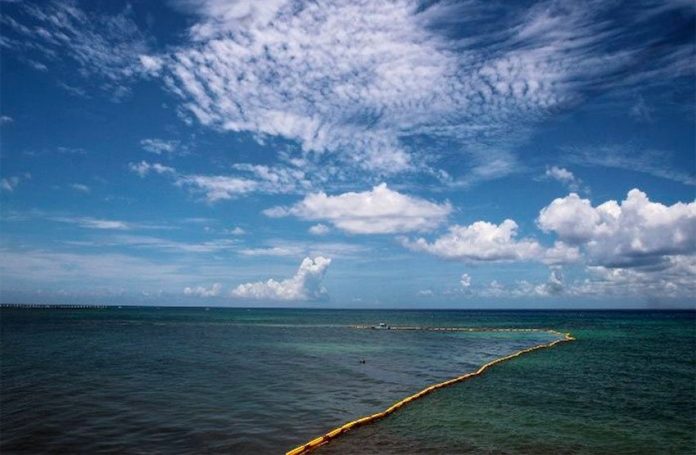
Sargassum barrier in Playa del Carmen.

In the face of potential economic disaster, local authorities erected a 2.5-kilometer-long barrier to prevent sargassum from continuing to wash up on the shores of Playa del Carmen, Quintana Roo.

With the approval of the Navy Secretariat, officials from the municipality of Solidaridad — of which Playa del Carmen is the seat — contracted with the company Ar.Co to build the barrier and carry out other sargassum prevention and cleanup jobs.

Ar.Co was also hired last year to build a barrier to protect Playa’s beaches from the sargassum invasion but with limited success. So much seaweed accumulated that it frequently washed over the barrier and on to the beach.

Mayor Laura Beristain Navarrete said the local hotel association, which supported the decision to contract Ar.Co, has invested 30 million pesos (US $1.5 million) to combat the problem, though she added that no definitive solution had yet been found.

“It isn’t a nice topic, and I don’t mean the sargassum but rather the amount [we’re receiving] this year; we don’t have a comprehensive solution. Everything is trial and error, but we’re working so that this summer is a good one for us.”

She added that in addition to the barrier, administrative employees of the federal office of maritime land zones (Zofemat), hotel owners and residents are working together to clean Playa del Carmen’s beaches of the accumulated sargassum.

Much is at stake. In a May report, the federal government warned that Quintana Roo beaches, including Playa del Carmen, could see a colossal drop in tourism if efforts fail to halt the predicted 1.56 million-tonne tide of the brown macroalgae.

Cancún and Puerto Morelos Hotels Association president Roberto Cintrón said the state and national economies could be put at risk by the sargassum invasion: 50% of foreign tourists travel to Mexico exclusively to visit Quintana Roo’s white sand beaches.

Additionally, a report published on June 15 as part of a study by scientists from various Mexican institutions found that 78 marine species, mostly fish and crustaceans, were fatally affected by the enormous amounts of decomposing sargassum on the Caribbean coastline in 2018.

As predicted, this year is shaping up to be worse for sargassum quantities.

Cleanup crews in Playa del Carmen are removing 100 tonnes of sargassum daily — nearly four times what was collected last year.

Playa del Carmen is not the first beach town in the state to install a barrier against sargassum. Puerto Morelos constructed two kilometers of barriers that convey the seaweed into waiting vehicles, which then bury it in designated areas.

However, the local government did not erect barriers along the remaining 17.7 kilometers of beach in Puerto Morelos, and hotel owners have largely been left to fend for themselves or construct their own barriers.

In an interview with the newspaper El Universal, Puerto Morelor Mayor Laura Fernández Piña said she expects the newly-installed barriers to halt approximately 65% of the incoming sargassum.

Source: El Universal (sp), Jorge Castro (sp)

Fuel theft reduced by 93% in Guanajuato: Pemex CEO

0
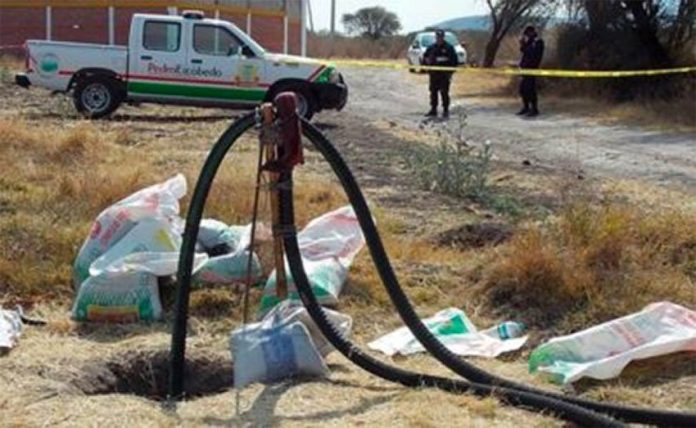
Fuel theft on the decline.

After a months-long battle against fuel theft, Pemex officials say that the federal government’s anti-fuel theft strategy is paying off in Guanajuato, one of the states most plagued by the crime, where a 93% drop in fuel theft has been seen since December 2018.

On a visit to the city of León for the annual Mexican Petroleum Congress, Pemex CEO Octavio Romero Oropeza said that fuel theft has long been one of the company’s principal problems and that Pemex’s future performance depends heavily on its ability to reduce theft.

“Pemex’s new business plan depends on our ability to rescue the company, financially as well as operationally, always with a basis in ethical principles and free from corruption.”

Pointing to a graph, Romero said that Pemex lost a total of 100 billion pesos (US $5.2 billion) to fuel theft in the four-year period from 2014 to 2018, which he pointed out was enough to settle 78.4% of the company’s debt for 2019.

On a more positive note, he said that the success of the government’s anti-fuel theft strategy is projected to save Pemex 32.6 billion pesos (US $1.7 billion) this year.

The CEO also highlighted Pemex’s goal of zero debt and that in April and May, Pemex saw positive results in its finances for the first time in years.

He added that the company is in the process of ridding itself of corruption and outdated work practices and hoped to provide new contracts to both Mexican and foreign companies that are willing to work for mutual benefit in accordance with Pemex’s new guiding ethics and values.

Romero said that Pemex is especially eager to work with companies that propose innovative ideas using new technologies and that he expects Pemex’s transformation over the next two years of his administration to reposition it as a model company.

Source: El Financiero (sp), Noticieros en Línea (sp)

Woman dies after surgery by Tabasco doctor known for cheap liposuctions

0
A liposuction procedure proved tragic in Tabasco.

A 30-year-old woman died in the Tabasco municipality of Comalcalco after receiving a liposuction from an uncertified doctor.

Tirso Aguilar, president of the Tabasco College of Plastic Surgeons, said that when the woman arrived at a Comalcalco hospital, she was intubated and suffering from a heart attack and brain death. Doctors tried to revive her for 15 minutes, but were unsuccessful.

Aguilar said the doctor in the case is named Cámara, and that he is an intern who is not certified to perform the procedure.

He is known in Comalcalco for offering cheap liposuctions. He was in the process of removing fat from the woman’s abdomen, back, bottom and chest when she started to suffer from progressive respiratory failure.

Doctor Cámara had previously offered liposuctions from a house that he had set up as a clinic in Comalcalco. That clinic was shut down by federal inspectors, but Cámara opened a new one in another building and continued performing the illegal procedures. The new clinic remained open in spite of being reported for violations.

Aguilar added that liposuctions should only be performed in established clinics by certified doctors.

Source: Diario de Yucatán (sp)

4th sentence for ‘monsters of Ecatepec’ brings prison time to 114 years

0
Ecatepec couple have each been sentenced to 114 years.

A husband-and-wife pair who terrorized the sprawling Mexico City suburb of Ecatepec are facing at least 114 years behind bars after being sentenced for four crimes that include femicide, hiding human remains and human trafficking.

On Thursday, a judge sentenced Juan Carlos Hernández Bejar and Patricia Martínez Bernal, known as the “Monsters of Ecatepec,” to 40 years each for the femicide of Arlet Samanta on April 25, 2018. Hernández told the court that he had maintained a relationship with Samanta, who lived in the same apartment building as the couple in Ecatepec, and described her as “beautiful, intelligent and perceptive.”

But after Martínez grew jealous of Samanta, she “gave the order” that her husband’s lover be killed. Hernández and Martínez conspired to lure Samanta to their apartment, where Martínez stabbed her to death in the bathroom.

The couple had previously been sentenced to 40 years for the September 2018 femicide of Nancy Noemí, four years for selling Noemí’s baby to another couple and 30 years for hiding a body. The sentences will run consecutively and total 114 years. They also face five other criminal proceedings for femicide and one for forced disappearance.

Hernández and Martínez were arrested on October 4, 2018, when they were transporting human remains in a baby carriage. In a subsequent police search of their residence, more body parts were found.

Police say that for six years the couple had been killing women by luring them to their apartment with the pretext of selling used clothes and other items. The couple has confessed to killing as many as 20 women and eating and sexually abusing some of their remains.

Source: El Financiero (sp), Milenio (sp), Excelsior (sp)

Stray bullet kills girl, 6, in shooting outside Ciudad Juárez kindergarten

0
Six-year-old Violeta was on her way to her kindergarten graduation when she was killed.

Violeta Castorena would have graduated from kindergarten on Tuesday but a stray bullet cut her life short during an attack in Chihuahua.

The six-year-old girl and her parents were on their way to her last day in kindergarten at the Luis Donaldo Colosio school in Ciudad Juárez when armed civilians traveling in a truck opened fire on their target, a man who was also walking his daughter to school.

His daughter made it safely inside the building but the bullets found their target, reaching him and the innocent Violeta as well. The man was killed instantly, but the young victim lived long enough to be taken to hospital, where she died from a gunshot wound to the head.

No arrests have been reported by Juárez police.

The Network for the Rights of Children in Mexico reported in April that children and teenagers are increasingly becoming targets and victims of acts of violence. They were victims in 767 homicides in 2015. Last year the figure was 1,238.

Source: Infobae (sp)

Mexico is first to approve USMCA trade deal with Senate vote of 114-4

0
Senators and Jesús Seade, second from left, celebrate trade deal's approval.
Senators and foreign affairs undersecretary Jesús Seade, second from left, celebrate trade deal's approval.

The Senate yesterday approved the new North American trade agreement, making Mexico the first country to ratify the deal that will replace the 25-year-old NAFTA.

Senators voted 114 to four in favor of the United States-Mexico-Canada Agreement (USMCA), which was signed by the leaders of the three countries last November.

President López Obrador congratulated lawmakers in a video posted to social media and described the ratification as “very good news” for Mexico.

“. . . The majority of lawmakers from all of the country’s parties voted [in favor]. That means there is unity, that we’re in agreement with strengthening our relationship with the United States and Canada. We’re opting for, we’re choosing free trade. We don’t have any doubt,” he said, neglecting to mention that three Morena senators voted against ratification.

The president said the agreement will bring foreign investment to Mexico, generate jobs and guarantee a market for Mexican products in the United States, “with the bonus that there will be well-being in our country, with the bonus that there will be justice in our country.”

“It’s balance, growth with well-being, progress with justice because progress without justice is a backward step. That’s why I’m very pleased that this treaty has been ratified, with all respect, we’re ahead of Canada and ahead of the United States . . .” López Obrador said.

The Business Coordinating Council, a leading business organization, said that ratification of the trilateral pact would help generate investor certainty, better opportunities for workers and favorable conditions for the development.

United States President Donald Trump, who repeatedly threatened to withdraw from NAFTA during a contentious and drawn-out negotiation to reach the new pact, congratulated López Obrador for Mexico’s approval and said that it’s “time for Congress to do the same here!”

Once ratified by the United States and Canada, the USMCA will enter into force and remain valid until 2035 unless it is renegotiated.

Canada is moving ahead with its ratification process but Democratic lawmakers in the United States have threatened to block its passage. Speaker Nancy Pelosi said yesterday that she still has many concerns about the USMCA.

However, U.S. Trade Representative Robert Lighthizer said he believed that concerns about the enforcement of labor and environmental provisions in the agreement can be resolved quickly.

Mexico’s lower house of Congress approved a landmark labor reform package in April that was considered crucial for the ratification of the trade deal in the United States.

The updated three-way trade pact includes new chapters on anti-corruption measures, labor and digital trade, and stipulates new rules for telecommunications, small and medium-sized businesses, intellectual property, competitiveness and the environment.

Mexico also agreed to establish high-wage areas where auto-sector workers will earn at least US $16 per hour.

Under the terms of the USMCA, new cars must have at least 75% regional content in order to qualify for tariff-free access to the North American market.

Source: El Universal (sp), Reuters (en) 

Government’s overpayment for fertilizer plants under the microscope

0
The Fertinal plant in Lázaro Cárdenas, Michoacán.

Mexican and United States authorities are investigating overpayments of hundreds of millions of dollars in the state oil company’s purchase of several fertilizer plants and a phosphorite reserve during the presidency of Enrique Peña Nieto.

The investigations have implicated high-level officials in the previous administration for bribery, including the former president himself.

The plant that has received the most attention is the Agro Nitrogenadas plant in Pajaritos, Veracruz, which was purchased by Pemex from steelmaker Altos Hornos in 2014 for US $475 million, which the current government says was more than nine times the plant’s value.

Both Altos Hornos CEO Alonso Alcira and then-Pemex CEO Emilio Lozoya are facing criminal charges for the transaction.

But at least three other facilities purchased under Peña Nieto have also fallen into disuse: two fertilizer plants in Lázaro Cárdenas, Michoacán, and Camargo, Chihuahua, and a phosphorite reserve in Baja California Sur.

The Lázaro Cárdenas plant was owned by Fertinal, a fertilizer company that owed US $264 million in debt in 2015, when Pemex purchased the company for US $635 million. According to a sworn statement by a witness made to investigators at the U.S. Department of Justice, Peña Nieto received a bribe from Fertinal’s majority shareholder Fabio Massimo Covarrubias in exchange for approving the overpayment.

Another investigation by Mexican authorities has targeted Lozoya and former energy secretary Pedro Joaquín Coldwell for allegedly receiving bribes relating to the purchase of Fertinal.

According to President López Obrador, both the Veracruz and the Michoacán plants were once owned by Fertimex, a state-owned fertilizer company that was privatized during the presidency of Carlos Salinas de Gortari.

“Let’s remember that the state had a company called Fertimex, which produced all the fertilizer,” he said in his morning press conference on Wednesday. “We became self-sufficient in the production of fertilizer. With the privatization started by Carlos Salinas, Fertimex was dismantled.”

During the presidency of Peña Nieto, Pemex Fertilizers, a subsidiary of the state oil company, began buying back former Fertimex facilities as part of a supposed effort to promote domestic fertilizer production and reduce the dependence on imports. But in the first two years of the venture, fertilizer production in Mexico declined even further.

López Obrador promised there will be a thorough investigation of damage done to the public purse by officials in the former government.

“These are losses for the government, for the treasury,” he said. “This money belongs to all Mexicans, and we are obligated to protect the budget.”

Both Peña Nieto and Coldwell denied the accusations. “I categorically reject these false accusations against me . . . . They are lying, of course,” said the former president.

Source: Reforma (sp), El Universal (sp)

Police arrest man believed to be Gulf Cartel’s Oaxaca plaza chief

0
David, left, and Carlos Ríosare suspected Gulf Cartel operators in Oaxaca.
David, left, and Carlos Ríos are suspected Gulf Cartel operators in Oaxaca.

The suspected leader of the Gulf Cartel in the Central Valleys region of Oaxaca was arrested yesterday by federal agents and state police in Oaxaca city.

Carlos Abraham Ríos Suárez, also known as El Oaxaco, is suspected to be involved in the cartel’s drug trafficking operations, namely shipping illegal substances to the United States.

Ríos has also been linked to extorting local businesses and trafficking in firearms.

Federal officials reported that Ríos was arrested without violence, and that four restricted firearms were seized in the process.

Ríos rose to the regional cartel leadership after the arrest of his brother David. In statements to authorities, David Ríos has confessed that his brother operates with the support of the Familia Michoacana cartel.

Carlos Ríos is also the state chairman of the Autonomous Confederation of Workers and Employees of México, and his arrest triggered a series of protests by affiliated taxi drivers.

They demanded the release of their leader and used their vehicles to block traffic going in and out of Oaxaca city.

Source: El Universal (sp)