A change in the route of the Maya Train provides an opportunity to relieve the pressure of urbanization and population growth faced by Tulum, according to a state government official.
The National Tourism Promotion Fund (Fonatur) announced this week that the train will no longer run directly between Valladolid, Yucatán, and Cancún, but instead from the former city to Tulum via Cobá, Quintana Roo.
At Tulum, travelers will be able to take another line north to Cancún, or south into Campeche and Chiapas.
Eduardo Ortiz Jasso, director of the Quintana Roo Strategic Projects Agency, said the route modification will attract real estate development and encourage population growth in the center of the state and alleviate pressure on Tulum as a result.
The once sleepy Caribbean coast town has seen rampant construction of hotels, restaurants and other tourism-oriented infrastructure in recent years although some projects have been halted or blocked due to environmental concerns.
As a result of Fonatur’s announcement, Ortiz said the design of a new town in the area where the Cobá train station will be built is already under analysis.
The official said the development will seek to benefit people already living in communities in the area, where there has been little previous investment.
“The section that was eliminated, Valladolid-Cancún, didn’t benefit any town. In contrast, the new line will mean urban and real estate development in an area that currently lacks development opportunities . . .” Ortiz said.
He also said that the addition of the stretch of railway linking the archaeological sites of Cobá and Tulum will make travel on the Maya Train more attractive to visitors and allow the creation of new tourism products.
The Quintana Roo government is reviewing land it owns along the proposed route with a view to ceding it for the development of the rail project.
Ortiz said that by July at the latest the government will commission three studies of the land between Valladolid and Tulum: an analysis to determine where rights of way need to be obtained, a topographic survey and an aerial photography study.
It is estimated that the route change will knock as much as 7.5 billion pesos (US $394.8 million) off the cost of the Maya train project, which was originally expected to be built for between 120 and 150 billion pesos (US $6.3 billion to $7.9 billion).
Some experts have warned that construction of the railway, which is scheduled to begin operations in 2023, poses environmental risks to underground water networks on the Yucatán peninsula and the long-term survival of the jaguar.
Francisco Javier Bautista Ávalos, parish priest at the Cristo Salvador church in the Tlalpan borough of Mexico City where the victim was a deacon, had reported Avendaño’s disappearance to the deacon’s family on June 11.
After Avendaño was found dead in his pickup truck the next day, Bautista led the victim’s funeral service, and expressed hope that the murderer would be caught.
“We are sad, but at the same time, we have faith, and it gives us strength to know that he is with God,” said Bautista at the service.
But after interviewing the priest, police began noting inconsistencies in his testimony, and after reviewing messages on Avendaño’s cellphone discovered that the two had met the night Avendaño went missing. Police began searching for the priest on June 16.
Today, a judge ordered that he be held in preventative custody.
Authorities indicated that the motive for the crime was a personal conflict, but Avendaño’s family say that the murder was premeditated, and was an attempt to prevent Avendaño from going public with certain accusations.
The Archdiocese of Mexico released a statement promising to cooperate with the authorities in the investigation.
“The Catholic Church in Mexico City trusts that the work of the authorities tasked with the investigation and prosecution will be effective, rigorous and respectful of the law and human rights of the victims, the families and those who are eventually charged with the crime,” read the statement.
Avendaño had recently graduated from the Intercontinental University with a master’s degree in psychoanalysis. He had previously completed a bachelor’s degree in theology from the same institution, and he had hoped to study to become a priest himself.
Mexico City Attorney General Ernestina Godoy will hold a press conference today where she will make public more details of the case.
Supporters of the jailed priest protested today in Mexico City carrying placards to demand his release. “We are with you, Father,” read one.
Property seized from ex-Veracruz governor Javier Duarte was to become a research center to study orchids and coffee cultivation. The plan has been cancelled.
The ongoing operation of 26 scientific research centers is at risk due to budget cuts implemented by the federal government, scientists warn.
As part of the government’s austerity program, President López Obrador signed a memorandum on May 3 that instructed the Secretariat of Public Administration to make additional cuts to public spending in a range of areas, including funding for the research centers operated by the National Council of Science and Technology (Conacyt).
One scientist said the scientific sector has faced budget cuts for the past five years but described the latest one as a tipping point.
“. . . Now we’ve crossed a red line that means the dismissal of operational personnel . . . and other restrictions,” said Fabián Rosales of the National Institute of Astrophysics, Optics and Electronics (Inaoe).
Miguel Rubio, director of the Institute of Ecology (Inecol), said the budget cuts extended to allowances for gasoline, which makes it difficult for researchers to conduct field work.
“. . . Obviously we have to go out into the field, our raw material is biological material and the data we collect. If the gasoline allowance is insufficient, that limits us from performing one of our essential activities. We can’t do ecology from Google Earth,” he said.
Rubio highlighted the importance of the work carried out by Inecol researchers, recalling that in 2004 the United States implemented an embargo on Haas avocados from Michoacán because it feared they were introducing fruit flies to that country.
However, Inecol scientifically proved that was not the case and a California court lifted the ban, he said.
“As a result of that, an economic spillover of US $6.5 billion has been generated and development in the Uruapan area has taken off. There are several projects like this that are in danger, ones in which we apply knowledge to solve social problems. Austerity measures make sense for the bureaucratic secretariats but for research centers the cuts . . . hit the essential, not the superfluous,” Rubio said.
Morales said the gasoline cuts also threatened the work of Inaoe researchers, explaining that it would possibly prevent them from traveling to the Large Millimeter Telescope located on top of the Sierra Negra volcano in Puebla.
“You have to go up the mountain in 4x4s; the resources for gasoline are essential in order to reach the telescope,” he said.
López Obrador’s May 3 memorandum also slashed by half the funding allocated to the research centers to contract third parties, including those who carry out maintenance of highly-specialized equipment.
Eugenio Rafael Méndez, a coordinator at a Conacyt research center in Ensenada, Baja California, said that maintenance of the northeast earthquake monitoring network will be affected.
“Maintaining the network is a matter of national security,” he said. “The equipment . . . is deteriorating and if it stops operating, we’ll lose a comprehensive vision of the country’s seismic activity.”
The president has said that implementing austerity measures will free up resources that can be directed to the heavily indebted state oil company but Méndez pointed out that scientific studies also have the capacity to help Pemex.
He explained that an oceanography team from the Ensenada Conacyt center had analyzed and modeled water currents in the Gulf of Mexico in order to avoid oil spills reaching the United States coastline.
“When deep water exploration started, they realized that there was a security problem on the [oil] platforms. The research team saved Pemex millions,” Méndez said.
The budget cuts have even forced Inecol and a Conacyt technology center in Jalisco to impose restrictions on their employees with regards to the use of electricity.
Bans on the use of air conditioners and the charging of electronic devices as well as strict closing times are among the measures introduced to help cut power costs.
While Conacyt’s total budget was slashed by 12% – or almost 3 billion pesos (US $157.7 million) – this year, cuts to spending at its research centers have ranged between 30% and 50%.
Director María Elena Álvarez-Buylla has pledged that Conacyt will “do more with less” but scientists are skeptical about the claim and question the logic of López Obrador’s cuts.
“The president hasn’t realized that science is also an ally for the development of the country,” Méndez said.
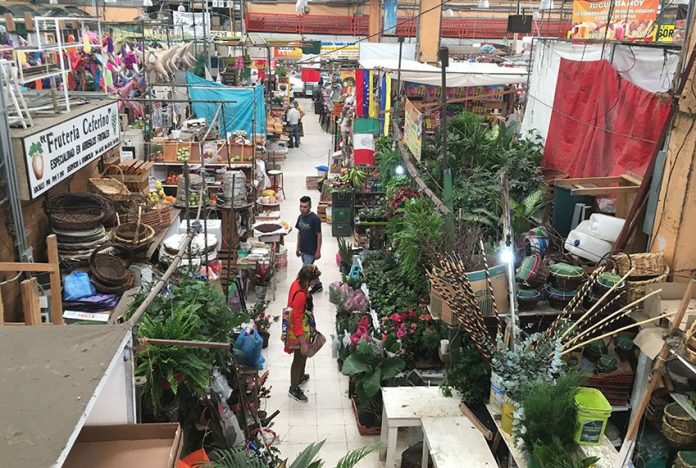
Walk across the 50-plus seating area at Cha-Cha-Cha for views from above into Mercado de Medellín.
Amidst the precious, luxurifying streets of high-grade tourism in the middle of Colonia Roma resides a market to harken at least a few decades back in the history of Mexico City, even if it’s not entirely Mexican.
Officially named Mercado Melchor Ocampo, this delightfully organized, utilitarian but gourmand-applicable market is colloquially referred to as Mercado Medellín because it runs along Medellín street. Yet the name is also appropriate as it features a number of South American and Caribbean imports, most noticeably Colombian.
On an early morning, before the Jehovah’s Witnesses have had a chance to set up their kiosk at the “food court” entrance on Coahuila, you enter to the sound of chopping carrots, onions and tomatoes. A kid consolidates bottles of hand sanitizer, preparing for the contaminated hordes.
At Cocinas Juanita e Hijas – as the name suggests – the women are in charge, razzing a young coworker about his T-shirt featuring a bird in a gas mask.
“What’s with the bird on your shirt?” one of them asks. He begins to answer, but they just laugh. They’d made their point: the shirt is dumb.
Under Juanita’s clear plastic tablecloths pamphlets from the Secretary of Social Welfare are on display with information to ensure that, as the pension system moves into the digital era, seniors aren’t duped out of their rightful payments.
A grandfather, father and son walk by, each sporting a variation of Spider-Man-themed gear. It’s a warm and cordial family scene.
Into the market proper and the Colombian, Venezuelan, Brazilian and Cuban flags come into view, hung proudly from rafters or across shelves. Produce vendors shine and stack everything neatly – best product to the front.
It’s nice to enjoy the quiet market mornings, when all but a few are still setting up. At Las Delicias juicery they offer straight-up squeezed and pressed juices, as well as a number of proprietary blends designed to cure the hangover or the prostate – and morning is certainly the best time to take care of either.
At Amor Perfecto, they serve some of the neighborhood’s best espressos and lattes, all made with Colombian beans, and it’s one of the few cafés that’s (almost consistently) open by 8:00am.
As the morning advances, the butchers begin to chop and sewing machines whir. The no-nonsense, practical man running the housewares and furniture section in the back might just be the only market vendor in the whole of Mexico City that can consistently make change, right down to the peso.
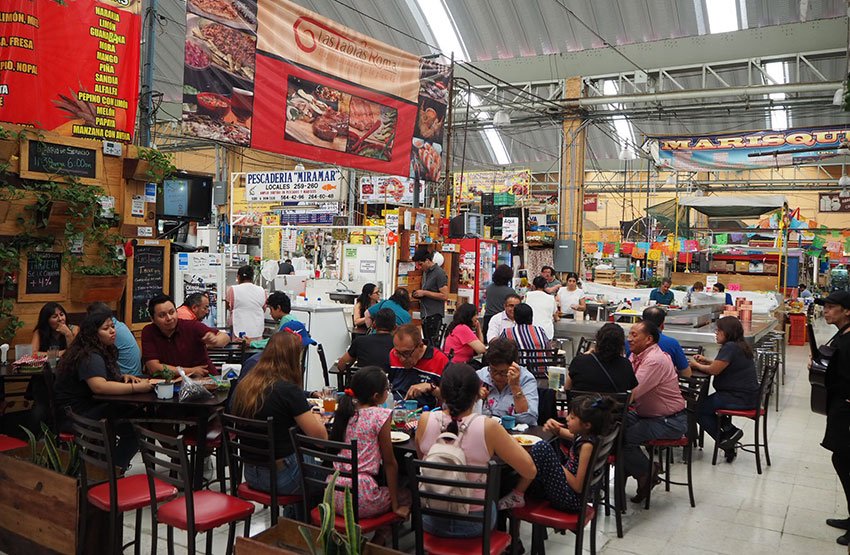
The Sunday crowd at Las Tablas Roma.
The flower vendors are always the most assertive dealers: self-confident egomaniacs certain that everyone needs some “more goddamn flowers in their lives.”
Fortunately, there are a number of beautiful fruit and vegetable stands to price shop, as their prices seem to vary quite a bit from location to location.
Local Verde 63 – the hippie shop with handmade soaps and lotions, fresh herb crackers and crystal bracelets – truly has the best eggs in the market. They are tiny, perfectly oviform and crack gorgeously into the frying pan. The yolks are creamy but not cloying, salty like a mild cheese.
At Pablo García Peluquería (barber shop), I’d always assumed Nicolas Cote was the owner because he was the only one I’d ever seen at the hair chair. Yet, even though he’s been cutting hair for 72 years, he’s only been working at Medellín for eight.
Querétaro, Mérida, Álvaro Obregón, Morelia – Cote rode his scissors through a big piece of Mexico, but the shops seemed to close down wherever he went, and he finds himself, once again, back working in Mexico City.
He’s deliberate with the clippers and will make conversation if you want to, but he’s not pushing anything. Cote wears his soft wrinkles kindly and has that beautiful, full head of white hair that makes for a trustworthy barber. Even though you’re balding, you think his special brand of tonic might just work this time.
Upstairs, Restaurante Cha-Cha-Cha provides an uncommon, top-down view. Decked out with cutouts and giant photos of film stars of years gone by, Cha-Cha-Cha’s Yucatan and Central American specialties are good and cheap, with the full-coursed comida corrida running from 50 to 70 pesos.
But the view, right up in the rafters overlooking the bright green foliage of the plant vendors, is the real draw, a chance for a rare look at a market unselfconsciously just “hanging out.”
In the middle, with the prime real estate, is Las Tablas Roma – the grill. Fresh steaks, fish, and seafood – most of them coming from right inside the market – are seared to order on the hot flattop grill. They’ve been a Roma staple since 1958. They were originally just outside of Centro Médico, but the ‘85 earthquake forced them to move, and they’ve been at Medellín ever since.
A just sliced, wonderfully prepared 250-gram ribeye with fixings for 170 pesos is the real reason to come, but Las Tablas is known for their alambres (usually grilled steak, veggies and melted cheese). They have 17 alambres on the menu with ingredients ranging from standard to offbeat: chiles, mushrooms, Argentine sausages, shrimp and even pineapple create unique combinations that can mix and match into dozens of options.
Rosa Martha Jasso has been managing Las Tablas Roma since 2001 and is one of Medellín Market’s more well-known personalities, always ready to welcome new guests. She says Sunday is without a doubt her favorite day in the market because it’s family day.
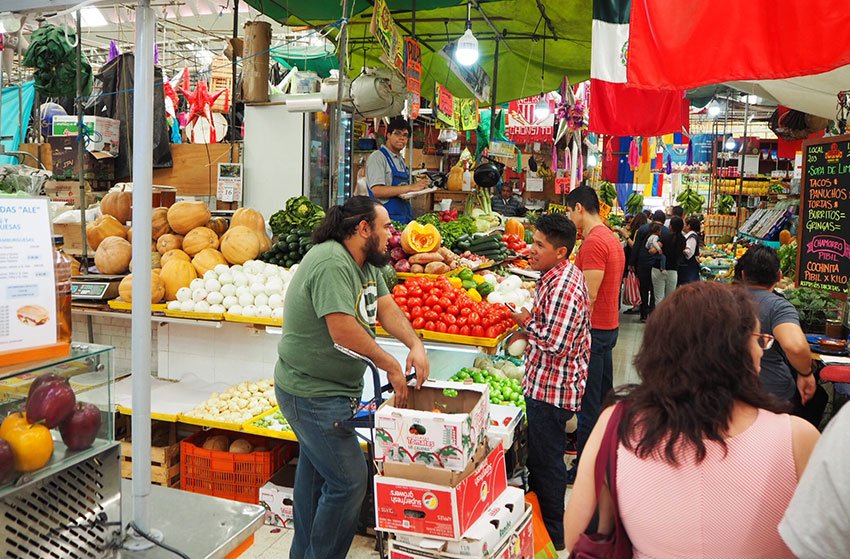
A vegetable stall at Medellín.
“I get to spend my time with special, friendly clientele on a daily basis,” says Jasso. “They come from all over the world, and I enjoy sharing good food and conversation. I love my job!”
At Delicatessin La Reyna, they specialize in housemade Italian and Spanish-style sausages and imports from Argentina and Uruguay. Or take home a bone of serrano ham for the perfect DIY broth. Other shops specialize in European cheeses, hard to come by Asian staples, or simple items from points north, like Heinz hamburger pickles.
But still holding strong to the market’s identity as “Little Havana,” Helados Palmeiro Cuban ice cream keeps a steady crowd throughout the afternoon. Everything is made natural, right there behind the counter. Coconut and mandarin appear to be among the favorites, but nothing beats the mantecado, a traditional Cuban vanilla custard from grandma’s secret recipe.
In the middle of the market, towards Medellín street, you dive deeper into the dedicated Latin American imports: whole cacao; famed Caribbean rums; anise-flavored Colombian aguardiente; dozens of sweets and snacks; and coffee, coffee, coffee. Depending on where you’re buying, the thick cornmeal arepas, deep-fried empanadas and sweet and salty dough ball buñuelos could be claimed by any number of flags flown throughout the market.
But the tradition is solidly Mexican – a comfortable hybrid at least, I realize as I chat with a man about his experience selling at Mercado Medellín.
Coffee is their most popular product, he tells me. “This is the largest Colombian community in the city,” he says, friendly and forthcoming until his father intervenes, asking me for identification and rebuking his son for putting their lives in danger talking to a nosy journalist.
I show them a previous article from Mexico News Daily with my name attached.
“What’s the name of your business?” I ask the son, hoping he’ll warm up after his father walks off.
“That, I can’t tell you.”
• Mercado Medellín is located at Medellín 234, Colonia Roma, Mexico City and is open 8:00am to 7:00pm Monday through Saturday and 8:00am to 6:00pm Sundays.
This is the 15th in a series on the bazaars, flea markets and markets of Mexico City:
At least 4,000 IT engineers are needed at companies operating across a range of sectors in Querétaro, according to the president of a local business association.
Jorge Buitrón Arriola, head of Vórtice IT, a group made up of technology companies, said there is a lack of qualified personnel, including information technology graduates, to fill the vacant positions in the state.
Even some young people with technology-related degrees lack the abilities that companies are looking for, he said.
Buitrón explained that some companies that have recently moved to Querétaro need between 500 and 1,000 IT engineers but will need to recruit staff from other states or abroad.
He added that more needs to be done to develop a greater understanding of the needs of technology industries and to develop the talent they require.
For those with in-demand knowledge and skills, employment in the sector can be lucrative.
According to Vórtice IT, monthly salaries for IT engineers range from 18,000 to 150,000 pesos (US $950 to $7,900), depending on the level of specialization.
Among the abilities that are highly sought after are those related to machine learning, open-source software, the internet of things, Blockchain and cybersecurity.
To identify ways in which local talent can further develop their skills in order to become more attractive to local tech companies, Vórtice IT has established a working group made up of representatives of both tech companies and educational institutions.
“The goal is to have talent that is constantly in training in order to meet the expectations of the investors who have bet” on having business success in Querétaro, Buitrón said.
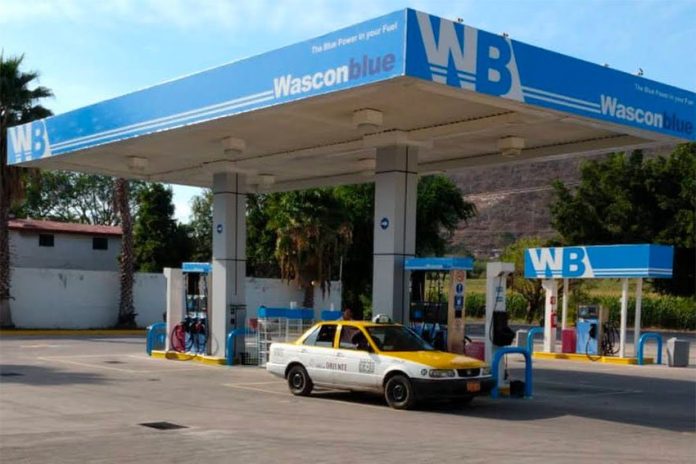
A new Mexican gasoline retailer that sells a product described as more environmentally friendly will open its first gas station on June 24 in Morelos.
Wascon Blue will sell Pemex gasoline mixed with ethanol and an additive it calls Blue Power, which was created and tested by engineers at the National Autonomous University and the National Polytechnic Institute.
According to the company’s website, the mixture generates 50% to 70% fewer greenhouse emissions than regular fuel and performs 10% better in terms of mileage, putting it in compliance with the U.S. Environmental Protection Agency and many European standards.
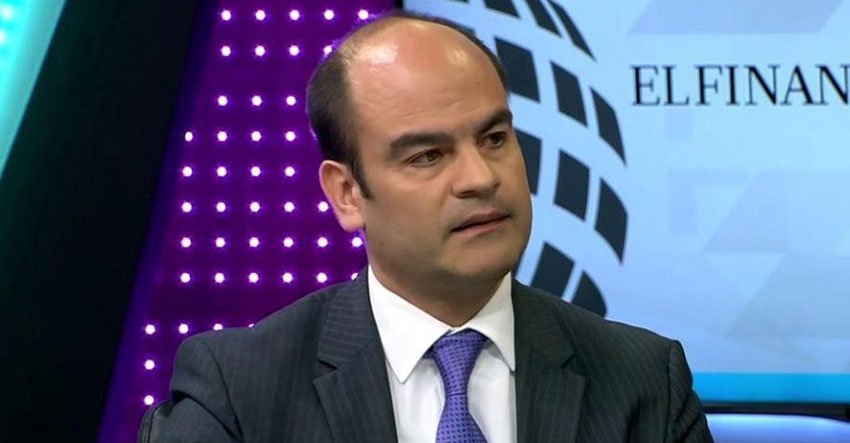
In an interview with the newspaper El Financiero, Wascon Blue general manager Enrique Olivera Melo said the gas station in Ayala, Morelos, will be the first of 50 to open in two states before the end of the year.
“We are currently in talks with a gasoline retail group so that we can open gas stations in Morelos and Querétaro, which is where we are permitted to distribute our product according to European standards, which has not yet been approved in Mexico City,” said Olivera, a former director of operations at Exxon Mobil.
He added that Wascon Blue plans to invest 20 million pesos (US $1 million) in the construction of two fuel distribution centers in Querétaro and Morelos within the same period.
“Our [first] customers will receive some promotions; we want them to try our alternative and to compare its power and benefits with those of other products.”
He also highlighted that the retailer’s mixture offered customers a purer fuel for a cheaper price.
“. . . they will be getting regular 90-octane gas for the price of 87-octane, or premium 95-octane gas for the price of 92-octane.”
Wascon Blue’s gas stations will be self-service, where motorists will fill up their own tanks.
“This has been approved by the Secretariat of Energy. We hope to have the country’s first such station up and operating this year.”
Mérida chamber of commerce president Salum suggests placing a natural gas supply vessel in Progreso.
There is anger and concern about power outages and natural gas shortages on the Yucatán peninsula even as energy authorities reject the claim that future electricity supply is threatened.
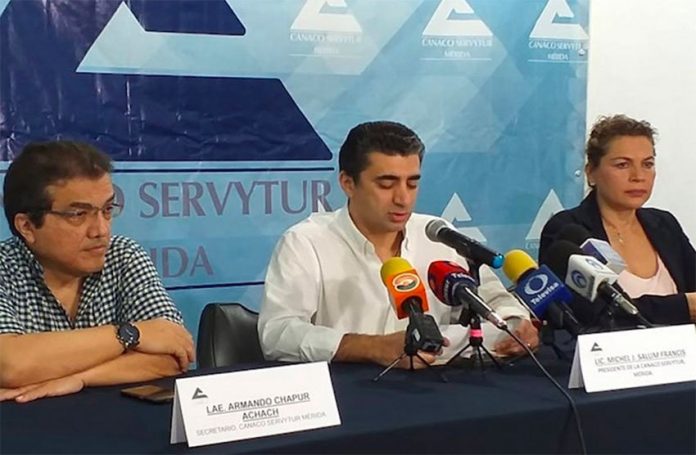
Michel Salum Francis, president of the Mérida chapter of the Mexican Chamber of Commerce, told a press conference yesterday that outages have a severe impact on business, especially the hotel sector, and could even cost lives.
There have already been three widespread blackouts on the Yucatán peninsula this year and yet another outage left the west side of Mérida in the dark on Monday night.
Energy experts have blamed the power cuts on a lack of natural gas to generate power, and the National Energy Control Center (Cenace) said Monday that it intended to declare a state of emergency on the peninsula for that reason. But it backed away from its warning yesterday.
If an emergency was declared, Cenace could prioritize the supply of energy to certain areas of the peninsula’s cities and towns.
Adrián Calcaneo: paying the price for focusing too much on crude oil.
“We’re very angry. It’s not possible that they leave the peninsula without energy,” Salum said, charging that authorities have failed to implement measures and develop strategies to address the region’s power problems.
He said that a supply vessel should be permanently stationed at the port city of Progreso to provide natural gas to power plants in the state of Yucatán.
However, Salum added that he didn’t expect the federal government to do very much to resolve the region’s energy issues, suggesting that Mexico is heading down a similar path to that taken by Venezuela, where there are shortages of a wide range of consumer products, including electricity.
According to the president of the energy commission of the Mexican Employers Federation, companies in the southeast of the country are only operating at 65% capacity because the National Natural Gas Control Center has reduced gas supply.
Edmundo Rodarte said the petrochemical and power generation industries are worst affected, explaining that “we’re fighting to have the supply of natural gas regularized.”
While the Yucatán peninsula needs more natural gas, statistics show that domestic production of the hydrocarbon fell in the first four months of this year to the lowest level since 2005.
CFE’s Bartlett: no worries.
Average production between January and April was just under 4.8 billion cubic feet per day, which is only 0.5% below levels recorded in the same period last year.
However, production levels have been now been declining for five consecutive years, according to the state oil company Pemex.
The Yucatán peninsula is particularly affected by the decreased output because a large part of the energy consumed in the region is generated in power plants that depend on natural gas.
Energy sector specialists told the newspaper El Financiero that declining investment for natural gas production and exploration in recent years, along with the federal government’s historical tendency to favor oil production, are the main reasons behind the reduced output.
“There is an emphasis toward crude fields,” said Adrián Calcaneo, an energy sector analyst at the business intelligence company IHS Markit.
“That means that there is less attention, [although] not abandonment of gas fields. Historically there hasn’t been interest from the government [in gas production and exploration]. Not just this government but also in the past. Now we’re paying the price for not having focused on gas and having focused on crude.”
Edgar Ocampo, an independent energy analyst, said there are significant natural gas reserves in states such as Nuevo León, Coahuila, Tabasco and Campeche but accessing them would involve the use of hydraulic fracturing, or fracking, an extraction technique that has been rejected by the government.
Ocampo predicts that there will be more power outages on the Yucatán peninsula due to a lack of gas and believes that the only way to guarantee electricity supply is to schedule planned power outages.
“In the short term, there’s no other option. They will have to program them, if the demand [for power] is very high and capacity falls, [the answer is] staggered blackouts. No other solution will arrive in less than two or three years,” he said.
“The problem on the Yucatán peninsula is that electricity demand is growing at an abnormal pace. The national average is between 2.5% and 3% annually, [whereas] on the peninsula it’s 4% because there is a very large real estate boom,” Ocampo said, adding that most new homes and other developments have air-conditioning systems that consume large amounts of energy.
In the long term, the analyst said, three are three options to increase power supply to the region: construction of a new electricity transmission line, development of infrastructure to increase natural gas imports or construction of a new stretch of gas pipeline.
While the private sector and analysts are concerned about the electrical supply, the Federal Electricity Commission (CFE) has maintained that the supply is secure and that there is no shortage of natural gas.
CFE President Manuel Bartlett wrote on Twitter yesterday that there is no risk to energy supply on the peninsula, even in peak demand periods, and released a technical analysis to back up his claim.
He also posted an “explanatory note” issued yesterday by Cenace that said that “the declaration of a state of operational emergency” as a result of electricity demand exceeding supply “has no foundation at this time.”
Coffee producers who won a previous Cup of Excellence competition in Mexico.
Looking for an excellent cup of coffee? Wait to see what the judges decide at a coffee competition Friday in Veracruz.
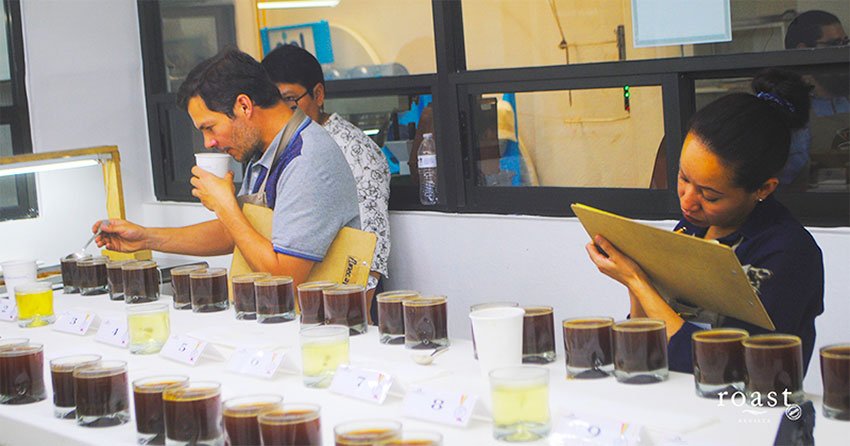
A jury of 23 coffee experts from all over the world will judge 40 Mexican coffees in the seventh Cup of Excellence México competition in Xalapa, the state capital.
The 40 varieties of coffee went through a pre-selection process for which there were 248 entrants, and then were vetted by a jury of Mexican coffee experts. The international jury will choose the top 30 varieties, which will be included in an international auction to take place on August 8.
The auction is an opportunity for producers to sell coffee for more than the market price. In 2017, Veracruz producer Rodolfo Jiménez López sold half a kilogram of coffee for over US $100.
The top three coffees will win the distinction of Cup of Excellence, bringing them to the attention of the world’s top coffee buyers.
Judges at one of the six previous competitions.
“International tasters and buyers even come to visit the farms where the winning coffees are grown, so it opens up a door to the world for the farmers,” Cup of Excellence organizer Amanda Santos Chávez told the newspaper El Universal.
Veracruz has the best representation at the competition with 18 samples of its coffee. Other entries are from Puebla, Chiapas, Guerrero, Oaxaca and México state. In the six competitions that have taken place in Mexico since 2012, coffees from Veracruz have won first place five times, and second place four times.
“This event is very important for coffee producers, because the best coffees come to compete,” Luis Herrera Solis, coordinator of the Mexican Coffee Association, told El Universal.
Judges will select Mexico’s top three coffees.
“Most of these coffees come from very small producers, and because of the training they get, they can produce excellent coffee.”
The Cup of Excellence was founded by the Association for Coffee Excellence in 1999 to help farmers sell high-quality coffee for higher prices.
The first competition took place in Brazil, but coffee producers from other countries quickly joined in. Mexico has been participating in the international competition since 2012, along with 11 other countries.
Beer maker Grupo Modelo is the latest in a slew of Mexican businesses to take an innovative approach to environmentally friendly practices with a new interlocking beer can design that will do away with the brand’s six-pack rings.
The design and campaign for the new “Fit Packs,” a collaboration between the maker of Corona and the United States advertising company Leo Burnett, won a bronze lion Monday at the Cannes Lions International Festival of Creativity in France.
Marketing vice-president Carlos Ranero of Grupo Modelo’s parent company Anheuser-Busch InBev explained in a short video presenting the campaign that the beverage industry produces over 15 million tonnes of plastic packaging every year, much of which ends up in the world’s oceans, harming plant and animal life.
Ranero pointed out that although other solutions have been tested to eliminate the plastic rings, alternatives inevitably use other materials that also generate waste. To bypass the problem, Corona’s new cans use no packaging to hold them together.
Instead, the company redesigned the cans themselves so that the top of each can screws into the bottom of another, creating a stackable tower of up to 10 beer cans. Ranero added that because of the portable nature of the interlocking cans, it won’t be necessary to use plastic bags to carry them.
Case of Corona? No, make that a stack.
Corona brand director Clarissa Pantoja said the company hopes not only to eliminate its own use of plastic, but to revolutionize the entire beverage industry’s approach to packaging. She said Corona will make its blueprints for the interlocking cans open source so that other companies can also reduce their impact on the environment.
The new Fit Packs are not Corona’s first attempt to scale back its environmental footprint. Earlier this month, the brand launched Desplastifícate (Deplasticize),a campaign that seeks to clean two million square meters of beach this summer in 23 countries.
In another campaign launched in early June, the company teamed up with the environmental organization Parley for the Oceans for the campaign Corona Better World. Consumers in Mexico, the United States, Canada, the United Kingdom, Italy, Spain and Brazil will be able to trade in three empty PET plastic bottles for one bottle of beer.
Additionally, Corona will clean a square meter of beach for every six-pack sold of a limited edition campaign beer bottled especially for the initiative.
Last year, the brewer tried replacing the plastic in the six-pack rings with a biodegradable product. A pilot program was run in Tulum, Quintana Roo, also in partnership with Parley for the Oceans.
The principal inter-city bus lines in border states will support the federal government in its efforts to control illegal immigration by requiring that passengers present identification for long-distance travel.
In his morning press conference on Tuesday, President López Obrador announced that bus companies will be required to ask passengers for identification.
“We’re asking for cooperation and understanding from drivers, and from passengers, because we’re going to need to ask for identification to buy tickets for long trips on public transportation,” he said. “It’s proven that, on buses, a significant percentage of the riders aren’t from the country, and don’t have any documents.”
The new rule is already being implemented in the state of Tamaulipas, and in the biggest cities in the state of Chiapas. However, bus stations are still not asking for identification in border municipalities in the Sierra Mariscal region of Chiapas, where users of inter-city transit are largely Guatemalan.
Bus stations will accept a variety of documents, including passports, voter identification cards and driver’s licenses. For legal migrants who have other forms of identification, bus companies can decide whether or not to allow them to board.
The new measure has sparked opposition from civil society organizations, charging that it will harm the millions of Mexicans who don’t have identification documents.
An open letter from the Institute for Women in Migration and signed by dozens of other civil society organizations said the measure violates Article 11 of the constitution, which guarantees the right to unrestricted travel in the country without the need for documentation.
“The announcement by [bus companies] Flecha Amarilla and ADO is more evidence that the Mexican state is restricting the rights of the citizens of Mexico, and giving private companies the power to enforce immigration laws,” the letter reads. “In addition, these measures exclude millions of people who live in Mexico who don’t have these documents, and who travel on the highways in different modes of transportation, which includes young people, agricultural day laborers, indigenous people, immigrants who do hold documents, returned or deported Mexicans or people whose voter cards have been stolen, or have expired.”