Home Blog Page 1830

Big-box retailers express concerns over uncontrolled welfare handouts

0
Sales growth is down at big-box stores.

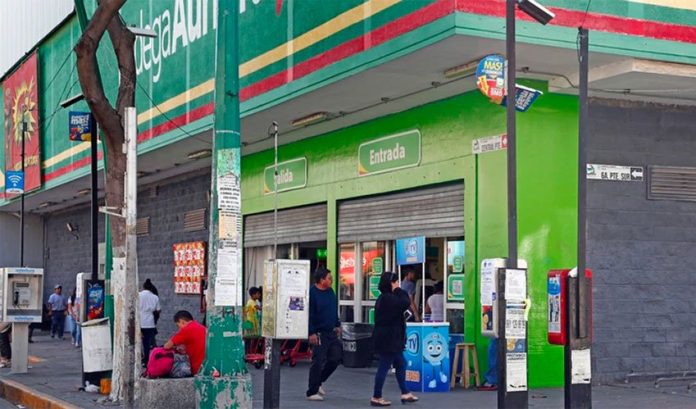
Big-box retailers are worried that a rollback of regulations for welfare programs will result in more money being directed toward the informal economy.

President López Obrador has said that the government will hand out 201 million pesos (US $10.4 million) in social support funding this year, raising the average family income by 5%. Retailers had expected to see a corresponding increase in sales, but the reverse has been true.

The association representing stores including Chedraui, Soriana, Coppel and Elektra reported sales growth of just 3.2% the first five months of the year, the lowest growth for the period in the last five years.

The National Association of Supermarkets and Department Stores (ANTAD) blamed the lower than expected numbers on new regulations that allow beneficiaries to withdraw cash from welfare cards.

“We are worried that welfare benefits will end up in the informal economy because before there were regulations to prevent the benefits from being turned into cash and being spent on alcohol or cigarettes,” ANTAD president Vicente Yáñez said.

Markets have seen a good start to the year in terms of sales.

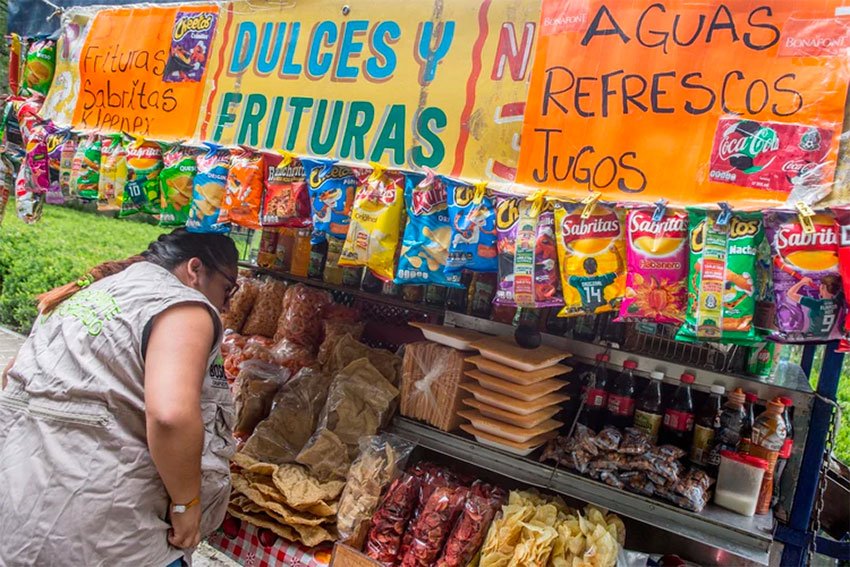
The benefits were previously distributed through payment cards that could only be used to purchase certain items in certain stores. Starting this year, however, benefits are deposited on debit cards from which recipients can withdraw cash at ATMs. Yáñez and other experts fear that could lead to more money being directed to the informal sector, where between 40% and 50% of retail sales in Mexico take place.

Alejandra Macías Sánchez, research director at the Center for Economic and Budgetary Research, an NGO, told El Financiero that benefits used to be directed toward female heads of households and that the distribution of benefits to others could be contributing to the decline in sales for big-box retailers.

“Young people and elderly people are getting the benefits, but not female heads of household, as was done under the Prospera program,” she said. “As a woman, you look out for the good of your family. But for a young person or an elderly person, that’s not necessarily the case.”

On the other hand, allowing benefits to be converted into cash has benefited the country’s markets, according to Gabriel Leyva, director of supply and distribution for Mexico City’s Economic Development Secretariat.

“We’ve had a good start to the year,” he told El Financiero. “According to our numbers, there’s been a 40% decline in the waste of goods in the basic basket [of consumer needs].”

Source: El Financiero (sp), Infobae (sp)

Migrants in Chiapas shelter riot to demand better conditions and visas

0
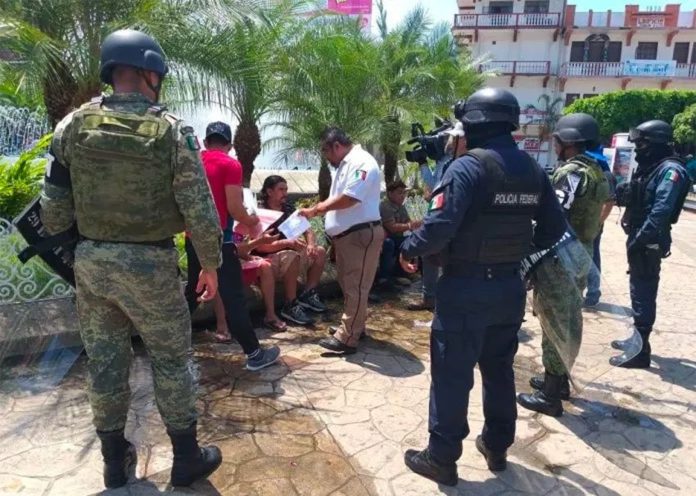
Security forces stand watch as an immigration agent speaks with migrants in Chiapas.

A group of African migrants rioted at a temporary shelter in Tapachula, Chiapas, yesterday to demand food, better conditions and the prompt issuance of visas that allow them to travel to the northern border.

Immigration authorities said the incident occurred at around 4:00pm at the front door of a shelter that has been set up on fairgrounds in the southern city to house the large number of migrants currently awaiting the outcome of their visa requests.

The newspaper Milenio reported that members of the National Guard, Federal Police and the navy attended the disturbance and managed to foil an attempted breakout from the facility.

Shortly after, National Immigration Institute (INM) vehicles arrived with additional food supplies, Milenio said.

During the commotion, migrant women complained about the conditions in the overcrowded detention facility and shouted for help.

“We don’t have access to anything and they [immigration authorities] don’t do anything [about it],” one African woman said.

“. . .They don’t let us leave here and we don’t know why. What is the process to leave this place? They don’t tell us anything, they don’t care.”

Another African woman said there are migrants from Cameroon, Ghana, Nigeria, the Congo, Angola, India and Bangladesh being held at the shelter and complained that there is no food.

Other migrants complained about severe overcrowding, delays in the processing of their visa requests and the inability to communicate with their families.

At the start of this year, the INM issued more than 10,000 humanitarian visas to migrants that allowed them to work in Mexico and access services for up to a year, or travel to the northern border to apply for asylum in the United States.

However, in more recent months, authorities started implementing stricter immigration policies amid increasing pressure from the United States to stop the flow of undocumented migrants from Central America.

The number of arrests and deportations increased and the INM stopped issuing humanitarian visas.

The tougher approach to dealing with the migrants has caused overcrowding at some immigration facilities including the Siglo XXI migrant detention center in Tapachula, where there have been several riots and mass escapes in recent months.

Now, as the result of an agreement reached with the United States to stave off tariffs threatened by President Donald Trump, Mexico has committed to even stricter enforcement against undocumented migrants.

On Saturday, police stopped four semi-trailers carrying almost 800 undocumented migrants in Veracruz, and authorities have pledged to block the bank accounts and pursue criminal charges against those responsible for the people smuggling attempt.

However, even though the presence of security forces has been beefed up in the south of the country, soldiers found themselves outnumbered and outmaneuvered in a confrontation with smugglers and informal merchants at the Suchiate river on the Mexico-Guatemala border on Sunday.

Yesterday, Milenio reported that there was no federal security presence at the river crossing at Ciudad Hidalgo, Chiapas, where tens of thousands of migrants, including several large caravans, have entered Mexico since late last year.

Source: Milenio (sp), Infobae (sp) 

New border crossing planned for Tijuana-San Diego

0
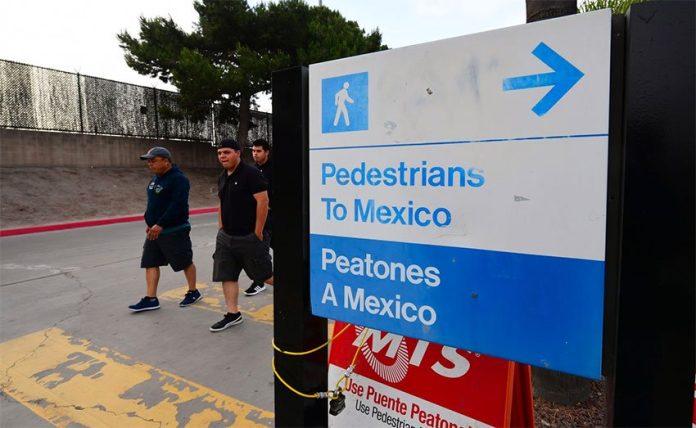
The Otay-Mesa crossing at Tijuana-San Diego.
The existing Otay-Mesa crossing.

Mexico and the United States are planning a new US $100-million border crossing between Tijuana and San Diego.

An official with the federal Transportation and Communications Secretariat (SCT) said the new border crossing, to be known as Otay Mesa II, will cover 314,773 square meters and be located three kilometers east of the first Otay Mesa crossing.

Cedric Escalante Sauri explained that Mexican authorities are in the process of obtaining the rights-of-way for the highway that will lead to the crossing and that tenders will be invited to operate the concession.

The Tijuana-San Diego crossing is the busiest along the entire border in terms of private vehicles and pedestrian traffic, according to Escalante.

He said there are 54 border crossings in total and that the value of trade shipped by highway between the nations in 2017 was worth $384.7 million, while $79.9 million in goods were shipped by rail.

Of the eight biggest border crossings Tijuana-San Diego sees the highest volume of passenger vehicles, buses and pedestrians with 30%, 38% and 30% of the total respectively.

In terms of cargo trucks, the Nuevo Laredo-Laredo crossing between Tamaulipas and Texas is the biggest with 2.2 million crossings per year.

Source: Revista Transportes y Turismo (sp)

Sinaloa Congress says no to same-sex marriage by 20-18

0
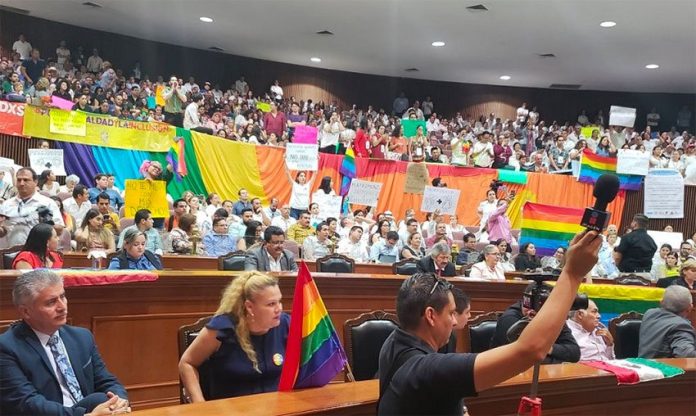
Sinaloa deputies vote as supporters and opponents of the bill watch.

Sinaloa lawmakers voted Tuesday against a measure that would have legalized same-sex marriage in the state with 20 votes against and 18 in favor.

Most of the yes votes came from the ruling Morena party, which holds 23 of the 40 seats in the Sinaloa Congress. But six defectors from Morena, along with deputies from the other parties, were able to block passage of the bill.

Catholic Church groups that were on hand for the vote celebrated the outcome, while LGBT groups expressed their anger, at one point breaking down an access door to the state legislature.

Morena Deputy Francisca Abelló criticized the opposition for voting against the bill.

“Those of us who talk about a secular state, the essence of the Mexican constitution, and the Mexican state itself, should ask ourselves, should the state impose administrative and legal regulations on the private lives of individuals?” she said.

PRI Deputy Elva Margarita Inzunza Valenzuela said she was voting against the bill because legalizing same-sex marriage would represent an attack on the family, and that she fears same-sex couples will be able to adopt children in the future.

“This would create an atrocious and uncertain future for our society,” she said. “We cannot accept the questioning of the concept of family, understood as being between a man and a woman. The family is the natural base.”

Legislation allowing same-sex marriage currently exists in 15 states and Mexico City. At least 10 of those states also allow same-sex couples to adopt children. Hidalgo and San Luis Potosí are the most recent states to have legalized same-sex marriage, while lawmakers in Yucatán recently voted down a proposal to do the same.

A 2015 ruling by the Supreme Court found that state laws against same-sex unions were unconstitutional, and recommended that such laws be changed. However, same-sex couples in the 12 states where same-sex unions are banned must still appeal to federal courts to be able to get married.

Source: El Universal (sp), Noroeste (sp), Animal Político (sp), Infobae (sp), Informador (sp), Línea Directa (sp), El Sol de Sinaloa (sp)

AMLO asks Facebook’s Zuckerberg for help to expand internet coverage

0
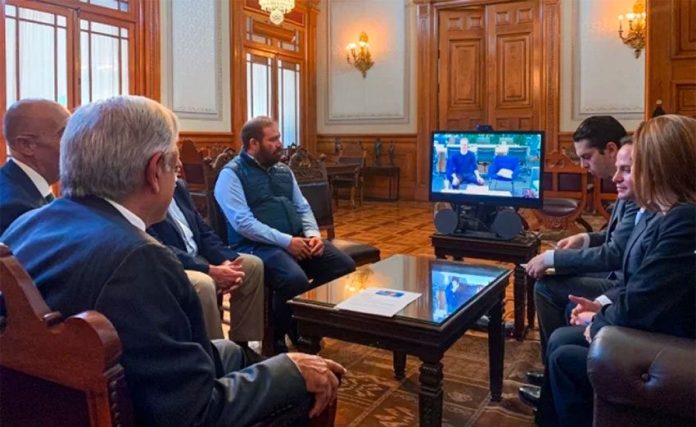
The president, left, chats with Facebook's Zuckerberg.
The president, left, chats with the Facebook CEO.

President López Obrador spoke to Facebook founder and CEO Mark Zuckerberg via video link yesterday and asked him to partner with Mexico to expand internet coverage across the country.

“If you consider it interesting, we invite you to participate to form a partnership. It would be something extraordinary if Facebook helped in the communication, in the connectivity of Mexico, especially for the benefit of the poor,” the president said.

In a video posted to social media, which only shows López Obrador’s pitch to Zuckerberg and not the latter’s response, the president set out the shortcomings of internet coverage.

He said coverage is limited to 20% of Mexico’s territory, where 80% of the population lives.

The other 20% – the country’s “poorest” people – don’t have access, the president said.

“Our intention is to connect all the towns, close to 300,000 locations that don’t have [internet] communication,” López Obrador said.

The president explained that the national electricity grid covers 95% of Mexico’s territory, adding that “we want to take advantage of that infrastructure so that with optical fiber, and possibly antennas, we can communicate.”

“It’s a program to communicate and inform, to improve education and health,” López Obrador said.

He told Zuckerberg that his government’s aim is to implement a non-profit project to provide internet services at very low costs to Mexico’s most marginalized people, adding, “your support is very important for us.”

In a social media post accompanying the video of his remarks, López Obrador extolled the virtues of internet connectivity.

“There’s no need to travel abroad frequently, now we can communicate through video conference,” he said.

The president’s conversation with the 35-year-old Facebook chief follows his announcement last month of the creation of a new state-owned company to provide internet services.

“With all respect, what are we going to say to the companies that have had the [internet] concessions and haven’t connected the country? Step aside because the government is now going to have a company to connect all Mexicans to the internet, that’s the commitment,” López Obrador said at an event in Nayarit on May 11.

The president, an avid social media user, also revealed yesterday that his YouTube channel – on which his daily press conferences are transmitted – will be awarded with a “gold-play button” in recognition of passing one million subscribers.

López Obrador said that his spokesman, Jesús Ramírez, will attend a ceremony at which the “button” will be symbolically conferred.

“I very much thank those from YouTube, Twitter and Face[book], they behave very well, they’re advancing communication a lot and above all the debate is good, sometimes the tone rises, it heats up, everyone participates [and] expresses themselves . . . even the bots participate,” he said.

A report published by Bloomberg in April said that a hate-filled campaign against reporters who question or criticize the president appears to be widely driven by bots.

Source: EFE (sp), Bloomberg (en), Milenio (sp) 

Dynamics of domestic worker relationship a difficult adjustment

0
household cleaning supplies
Domestic workers essential to making a household work.

Ana is the name of the woman who helps in our home. She’s privy to some of the most intimate details of the house: what and how much food we have (and waste), whether or not my daughter has wet the bed, our laundry for goodness’ sake!

She knows the trash schedule in our neighborhood better than we do, and worries about what we’ll have for lunch before I even start thinking about it.

She is wonderful, if a bit indulgent, with my child and my dogs — she heats tortillas to throw into their food bowls! — and has never, ever shown us any unkindness.

Though she’s worked hard all of her life, she is poor, but she doesn’t live in such dire circumstances as others in her position. She raised three children of her own alone, and though she’s only a couple of years older than me, helps regularly with several grandchildren during what little time off she has.

Of all the things culturally that have been new, surprising and uncomfortable, the sharp division among social classes and the dynamics of the señora de la casa/muchacha (lady of the house/“girl” — what most here call domestic workers) relationship has been the most difficult to get used to.

I’ve been impossibly American about it, insisting that she use the informal tú with me and not allowing my child to emit anything that could even be perceived as a demand, but I feel the built-in distance keenly.

The fact that someone comes to my home three times a week to do the work that would otherwise be done by us — that really should be done by us — while her own house sits empty feels decadent and pompous, and although my Spanish is excellent, I stumble awkwardly over my words when talking about her: she’s a grown woman, not a muchacha, and I refuse to use that name for her.

Even if she were a young girl (how young have domestic helpers been and for how long to have had such a name for them stick?), she is doing a real, proper job, which dignifies a real title. Usually I say something like la señora que nos ayuda en la casa (“the lady who helps us at home”), which hardly sounds professional, but at least that way I don’t make her seem like some kid that just hangs around my home.

Other foreign women and I sometimes try to calm our discomfort through humor (“Hey, I know what we should do today! Let’s go get our nails painted and complain about our muchachas!”); we women, after all, are presumed to be the beneficiaries of domestic help, though both women and men are.

In a rapidly-changing society in which both partners find it both necessary and desirable to work outside the home, a vacuum is left where previously la señora de la casa would have taken care of things like cleaning, food preparation and childcare. It’s a lot more work than it sounds like, and I find men of all nationalities fairly oblivious (willfully, I suspect) to the sheer amount of things that must get done for a household to run properly.

Though many people see it as low-skill labor that basically anyone could do, it’s important work, and without it it’s nearly impossible to get any other kind of work done. The home and family, after all, is the prime social unit, and the point from which we all begin and end our days.

Just because it’s traditionally been looked after by women doesn’t make it less valuable, and the lip service paid clearly doesn’t match the real benefits given for keeping it running; praise rings empty when not followed by deed.

With my husband often working in another city and me working many hours from home, we are completely dependent on Ana for the work that simply must get done, whether we have time for it or not. She is an essential and integral part of making our lives work, as domestic workers are all over Mexico.

Amazingly, she does not seem to understand her value to us, and hearing her talk about some of her other clients it becomes clear why. I feel both eternally grateful and ridiculously guilty for our perceived sainthood by comparison: paying a decent wage and showing basic human kindness is not difficult, but it is not something that most domestic workers expect, and doesn’t seem to be something that Ana expects.

The specifications of the new law regarding worker rights for domestic laborers are revealing, and confirm my suspicions about the fate of a majority of them around the country. The fact that it’s necessary to stipulate, for example, that workers have nine consecutive hours of rest and that they must be allowed to eat the same food as those they serve speaks of wide patterns of not just abuse, but elitist attitudes I hoped only existed in the movies.

When an acquaintance detailed a long list of complaints about her muchacha on Facebook, among them the fact that she’d had a beer from the fridge without asking permission, I was shocked that she thought it improper for the person that was caring for her home and children from sunup to sundown for 150 pesos a day to sit down for a moment of rest and consume something from the home she helps sustain.

Now the fact that Ana asks permission to leave early for a doctor’s appointment, makes an announcement that she is grabbing some of “my” coffee, and consistent deference and cheerfulness even when it’s clear she’s had a bad day makes sense.

We’ve helped Ana a lot over the years, with loans, gifts, medicines that she couldn’t afford. We are her highest-paying clients, and even so, I don’t think we’re giving her even half of what she deserves (one part of our “when we get rich . . .” fantasies is to hire her full time with generous salary and benefits).

We don’t think we’re saints for helping her — I shudder at the idea of others thinking we want to be congratulated for being “such good people,” the Mexican version of white saviors. We help her because it’s what she deserves as a worker, independently of how well she does her job, or how much we like her.

We do so because even though her rights hadn’t been specified by law before, they always should have been, and because every working person deserves security, to have their basic needs met and money and time left over for leisure.

The new Mexican law stipulating official contracts and minimum wage for domestic workers is a huge step in the right direction, and I applaud the effort. I hope the government will publish a clear step-by-step guide for setting everything up, and that employers will not simply ignore the law.

I’d especially like to know what to do in Ana’s case, as we are not her only employers. Giving vacation pay and time off for unforeseen necessities is easy enough (and something we already do), but how do we set up health service when we are not her only clients? Hopefully these are issues that will be studied and teased out with straightforward guides available.

The vast number of mostly poor women who keep our homes running deserve a living wage, respect and the same benefits that other workers are entitled to. It’s way past time to give those to them.

Sarah DeVries writes from her home in Xalapa, Veracruz.

Outage comes after warning of electrical emergency on Yucatán peninsula

0
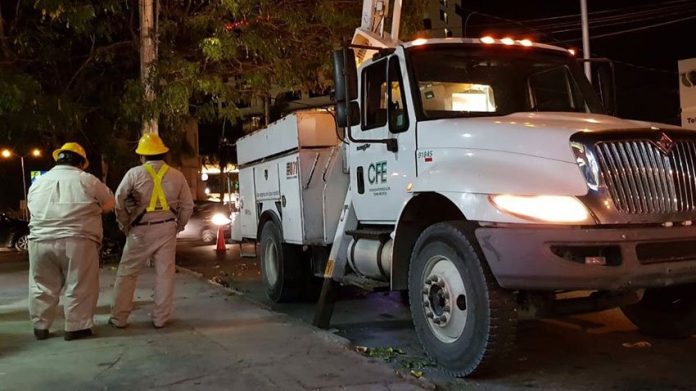
The Federal Electricity Commission said there would be no further outages.
The Federal Electricity Commission had said there would be no further outages.

A power outage left part of Mérida in the dark last night just hours after the National Energy Control Center (Cenace) announced its intention to declare a state of emergency on the Yucatán peninsula due to a lack of natural gas to generate energy.

Lights went off in the west of the city just after 10:00pm and power hadn’t returned by midnight, according to a report published early this morning by the newspaper El Universal.

Cenace said in a statement earlier yesterday that in the coming months – it didn’t specify when – there will be a shortage of natural gas on the Yucatán peninsula and power stations in Mérida, Campeche and Valladolid will operate at only 25% capacity.

The Mérida III combined-cycle plant will operate at half-capacity during high-demand daylight hours but will disconnect from the grid completely during low-demand periods, the federal agency said.

At least 985 megawatts (MW) of power are needed to guarantee power supply on the Yucatán peninsula but it is anticipated that output could fall to as low as 732 MW.

“In that context, while dispatchable generation is less than 985 MW. . . we inform . . . that a state of operational emergency will be declared for the Yucatán peninsula . . .” Cenace said.

While an emergency declaration is in effect, Cenace may issue special instructions to citizens with regard to energy use or prioritize electricity supply to certain areas of the Yucatán peninsula’s cities and towns.

“. . . It doesn’t mean that there won’t be power but in such a case . . . Cenace can take extraordinary measures,” said Paul Sánchez, founder of Ombudsman Energía México, a civil society organization.

Today, however, Cenace backed away from the declarations it made Monday.

In an “explanatory note,” it said that it has asked the national gas network to make a “greater effort” to transport larger quantities of natural gas to the peninsula, which will increase availability at the three power stations where capacity was to be cut.

Cenace also noted that the Federal Electricity Commission is building a new stretch of pipeline from the port city of Campeche that will be capable of proving diesel to power stations on the peninsula 24 hours a day, adding that transmission lines between Ticul, Yucatán, and Escárcega, Campeche, can provide backup energy supply if required.

“The declaration of a state of operational emergency” referred to in yesterday’s statement “at this time has no foundation . . .” Cenace said.

However, as last night’s blackout indicates, power supply issues on the Yucatán peninsula are far from resolved.

Residents have already suffered three widespread blackouts this year, one in March and two in April.

The first two outages were blamed on fires beneath transmission lines but energy expert Edgar Ocampo Telléz said that a lack of gas to generate power was the real reason.

He warned in April that an increased demand for energy in the warmest months of the year and a shortage of gas will cause more power outages on the Yucatán peninsula.

The electricity commission insisted in April there would be no more outages and that there was no shortage of natural gas.

Source: El Universal (sp), El Financiero (sp), Notimex (sp) 

12 Federal Police get 34 years for 2012 shooting of CIA agents

0
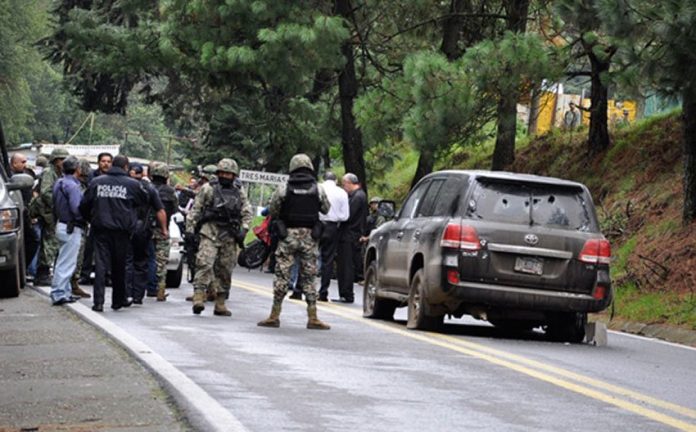
Scene of the 2012 attack.

A federal judge has sentenced 12 Federal Police officers to 34 years in prison for the attempted murder almost seven years ago of two CIA agents as they traveled in an armored diplomatic vehicle on the Mexico City-Cuernavaca highway.

The police shot at the vehicle on August 24, 2012 as it passed Tres Marías, a community in Morelos around 50 kilometers south of central Mexico City.

The two United States agents, Stan Dove and Jess Hoods, were wounded in the attack. Fabián Molino, a Mexican marine who was driving the SUV, was unharmed.

The officers involved in the shooting denied that their aim was to kill the people traveling in the vehicle, stating that they opened fire because they believed the car was involved in the kidnapping of a former official of the National Institute of Anthropology and History.

Fourteen police were detained in relation to the incident but two were absolved yesterday of involvement in the crime. However, the acquittal was immediately appealed by the federal Attorney General’s Office.

All 14 officers claimed that during the investigation into the incident, they were interrogated by FBI and DEA agents at the Attorney General’s Office without the presence of a lawyer.

Authorities initially called the shooting an accident but three months later the 14 officers were charged with attempted murder.

Suspicions were raised by the fact that none of the officers was in uniform.

That was revealed after the group’s commanding officer had insisted they were in uniform. He was subsequently charged with providing false information to investigators.

Juan Manuel Pacheco also ordered his men to hide their vehicles, which were unmarked.

There was speculation at the time that the Beltrán Leyva Organization could have planned the attack. Mexican and U.S. officials confirmed that might have been the case, according to an Associated Press report.

A foundation dedicated to the study of organized crime said soon after the incident that it raised questions about the Federal Police.

“The shadowy details of this case raise serious questions over just how reliable they can be in the fight against organized criminal groups,” wrote InSight Crime.

In addition to imposing the custodial sentence, the judge ruled that the 12 convicted officers must pay compensation to the victims of just over 1.8 million pesos (US $94,000).

Source: Milenio (sp) 

San Miguel de Allende kidnapping gang boss gets 60 years

0
Alleged ex-terrorist and convicted kidnapper Escobar.

The Chilean leader of a kidnapping ring that operated in San Miguel de Allende, Guanajuato, for 10 years has been sentenced to 60 years in prison.

Raúl Julio Escobar Poblete received the hefty sentence on Friday for the 2017 abduction of French-American woman Nancy Michelle Kendall who was freed after spending 78 days in captivity.

The criminal gang he headed is also believed to have carried out several other kidnappings in San Miguel, including abductions of 1994 presidential candidate Diego Fernández de Cevallos; Mónica Jurado, the former daughter-in-law of ex-president Vicente Fox; and the owner of the fast food chain, Pollo Feliz.

Escobar, allegedly a former guerilla fighter from Chile who is accused of assassinating a senator in that country in 1991, was arrested on May 30, 2017, as he followed a taxi driver he had paid to deliver a package to Kendall’s husband that included instructions for the payment of a US $1-million ransom and a finger that had been severed from his wife’s hand.

After Friday’s sentence was handed down, Guanajuato Attorney General Carlos Zamarripa Aguirre said that attempts are being made to bring to justice those who collaborated in the kidnapping ring with Escobar, who used various aliases and was known in Chile as Comandante Emilio.

Among the suspected accomplices are Escobar’s ex-wife, Marcela Mardones, who was arrested in Chile after fleeing Mexico in the wake of her ex-husband’s arrest, and Isabel Mazarro Gómez de Santiago, a more recent partner of the convicted kidnapper who was detained in Spain in 2017.

Another person allegedly involved in the kidnapping ring’s activities is believed to be in France.

“We are certain that they participated in several kidnappings committed in San Miguel de Allende in the past decade. . . ” Zamarripa said.

The attorney general described part of the modus operandi of the gang. Its members used stolen cars during abductions, and always wore gloves to ensure they didn’t leave fingerprints and hoods to conceal their identities.

The gang very rarely used telephones as a means to negotiate with victim’s families, preferring instead to take out advertisements in newspapers or deliver messages by mail or taxi.

Victims were held hostage for periods of up to a year and a half and large ransoms were usually sought in dollars, Zamarripa said.

The kidnapping ring allegedly kept some victims captive in coffins and employed other unusual techniques such as playing loud music with revolutionary themes, serving hostages bacalao a la vizcaina (a codfish dish) at Christmas and providing them with the book Man’s Search for Meaning by concentration camp survivor Viktor Frankl.

Source: El Universal (sp) 

Smugglers defy outnumbered marines at Guatemala border

0
Marines on patrol at the Suchiate river.

Mexican soldiers found themselves outnumbered and outmaneuvered in a confrontation with smugglers and informal merchants at the Suchiate river on the Mexico-Guatemala border on Sunday.

As part of the new deal between the United States and Mexico to avoid President Donald Trump’s threat to impose blanket tariffs on all Mexican goods, soldiers, marines, Federal Police and the National Guard have been deployed to the southern border to stop the flow of migrants entering the country through Guatemala.

According to various news outlets, forces have begun regular patrols in Chiapas in the cities and towns of Tapachula, Comitán, Comalapa and Ciudad Hidalgo and along the river. On Sunday morning, they met with the first serious challenge to their authority.

At 9:00am, a small patrol of marines confronted a group of merchants as they secured articles meant for sale aboard a makeshift raft and prepared to cross the river. The marines warned that without proper documentation, the group’s merchandise would be classified as contraband and confiscated.

News of the marines’ threat spread quickly among other merchants who were also preparing to cross the river, and soon a group of 20 was shouting at the soldiers, angry at the prospect of seeing their sales hindered.

“Get out of here or we’ll burn your vehicle,” cried one.

In the face of the verbal onslaught, the marines gripped their automatic rifles nervously and watched the merchants’ advance across the river before finally climbing into their patrol vehicle and driving away, reported the newspaper El Universal.

The merchants, called balseros for the makeshift rafts used to transport merchandise across the river to avoid duties, say they have seen business suffer because of Mexican authorities’ crackdown on illegal entry into the country.

However, informal merchants, business owners and even local government officials concurred that, despite their illegal nature, local economies on both sides of the border and the jobs of thousands depend on informal commerce such as that carried out by the balseros, who frequently transport migrants across the river as well.

Loyda González, the manager of a store in Ciudad Hidalgo, said his business relies heavily on goods smuggled across the river.

“Yes, well, right now about 80% of the business here is from Guatemala.”

Shortly after the marines withdrew from the brief confrontation at the river, Suchiate Mayor Sonia Eloína Hernández Aguilar approached the merchants, who addressed her familiarly, to help them calm down.

She said informal jobs such as balseros, bicycle vendors, money changers and shop owners made possible by constant contact between border communities are the only economic opportunity for most of the region’s families, and that many would decide to migrate themselves if the informal economy were shut down by authorities.

The mayor was accompanied by Guadalupe Polanco, the leader of a group of balseros at another crossing on the river, who calculated that close to 500,000 people depend on informal border jobs for their sole income.

The mayor expressed support for the merchants and smugglers, who plan to present their case directly to President López Obrador and ask for special permission to continue their irregular cross-border trade.

Source: El Universal (sp), Televisa (sp)