Home Blog Page 1900

Border delays costing estimated US $800 million a day

0
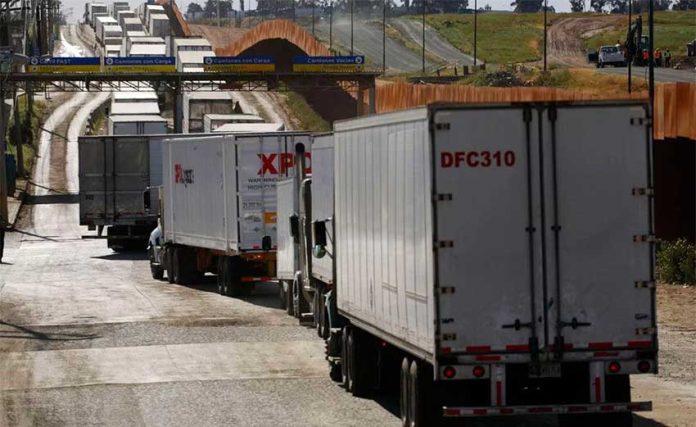
trucks at the border
Cost of the border waits is adding up.

Delays at the Mexico-United States border are costing Mexican exporters US $800 million a day, according to the president of the Confederation of Industrial Chambers (Concamin).

Thousands of trucks have faced long wait times at several ports of entry to the United States since early last week following a decision by U.S. Customs and Border Protection to reassign 750 border officials to deal with a massive influx of migrants. Some lanes at border crossings have been closed as a result.

Francisco Cervantes said that the US $800 million figure is an estimate because Concamin is waiting for the National Council of the Maquiladora Industry (Index) to provide information about the losses of its member companies.

He warned that if the delays continue, the United States will suffer from a shortage of Mexican products such as auto parts and fresh food.

Eduardo Solís, president of the Mexican Auto Industry Association (AMIA), said that sector is “obviously” affected by the long wait times at the border.

He called on Mexican authorities to promptly reach an agreement with their United States counterparts to allow cross-border flows to return to normal.

Delays could also create gasoline shortages.

Gasoline importers have complained that it is taking them up to three days to cross the border and return, whereas it normally takes 16 hours.

Julio Jáuregui, CEO of importer Enermex, said the delays have been most severe at ports of entry in Tamaulipas including Nuevo Laredo, Reynosa and Matamoros, all of which share borders with Texan cities.

He explained that the Mexican market is very sensitive to any fuel import delays because Mexico only has storage capacity for three days.

In Chihuahua, Governor Javier Corral said yesterday it was urgent that the governments of Mexico and the United States reach an immigration agreement to deal with migration flows from Central America and to normalize cross-border trade.
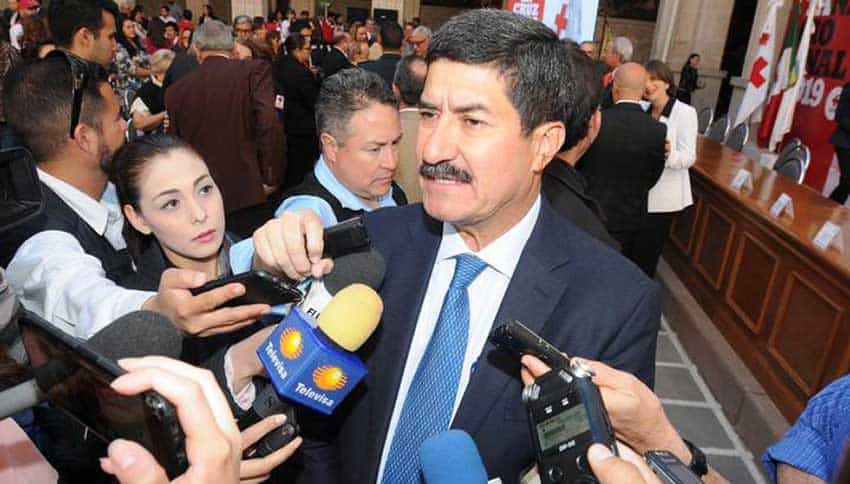
Governor Corral: US 'shooting itself in the foot'
Governor Corral: US ‘shooting itself in the foot’

“Mexico . . . needs to decide if it is going to continue allowing the passage of these migrant caravans and this unusual migration from countries such as Cuba . . .” he said.

Corral said he has been in contact with Foreign Secretary Marcelo Ebrard to ensure that the government is well-informed about the magnitude of the problem caused by delays at the border, stating that “in the beginning, it appeared to us that the president didn’t have sufficient information” about their impact.

The governor said that he understood that the United States government was trying to pressure its Mexican counterpart into doing more to stem migration flows but contended that it was going about it the wrong way.

“. . . What the government in Washington doesn’t understand or doesn’t fully understand is that the border is a binational community that interrelates in multiple ways, which shares many economic, cultural and social activities as well as family ties . . .” Corral said.

The governor said cross-border shipments at Chihuahua ports of entry were below 40% of what they normally are. Some businesses have begun using air charter services to transport goods from Ciudad Juárez to Santa Teresa, New Mexico – a distance of less than 40 kilometers.

Echoing comments made by Business Coordinating Council (CCE) president Carlos Salazar Lomelín about United States President Trump, Corral said that the U.S. government is “shooting itself in the foot” by taking decisions that slow down trade at the border because the economy in that country also suffers.

Two-way daily trade between Mexico and the United States is worth US $1.7 billion, and 83% of that trade occurs across land borders, according to the U.S. business organization Council of the Americas.

Source: El Economista (sp), El Universal (sp) 

Sinaloa announces Sunwing to offer new Mazatlán-Canada flights

0
Tourism chief Torruco, and Governor Ordaz.
Tourism chief Torruco, and Governor Ordaz enjoy Sinaloa fare at Tianguis Turístico.

A new agreement between a Canadian airline and the government of Sinaloa will mean additional escape options for Canadians wishing to flee the frigid north for sunny beaches.

On the second day of the 2019 Tianguis Turístico tourism fair in Acapulco, the Canadian company Sunwing Airlines announced a deal with Sinaloa Governor Quirino Ordaz Coppel to increase flights to Mazatlán from the provinces of Quebec and Ontario and the city of Regina.

Sunwing product development vice-president Eric Rodríguez thanked Governor Ordaz and the company’s hotel partners for their dedication, saying the new deal would not have been possible without their support.

“Mazatlán is the only destination in Mexico where Sunwing is considering an increase in flights. This is a big bet, which reflects a commitment from the state, the governor and hotel owners, and it speaks of quality and a high level of satisfaction; [Mazatlán] is a very complete destination with both culture and beach.”

Afterwards, the governor met with national airline Viva Aerobus corporate communications director Walfred Castro, who confirmed the June 8 opening of a new route from Mazatlán to Tijuana. Another from Los Mochis to Monterrey, Nuevo León, opened last week.

Representatives from Mazatlán held a carnival for guests at the tourism fair, complete with a gastronomic exposition and artisanal products from all over the state.

Ordaz said he was pleased to be able to “show all of our wealth, all the beautiful sites and above all, what we’re capable of doing and the great talent of Sinaloans, together with our great friend and ally Miguel Torruco, secretary of tourism.”

The tourism chief said the state was on the right track and predicted more innovations were on the way as a result of the interstate highway, opened six years ago, that connects Mazatlán with the neighboring state of Durango.

“There will be regional development, which is what tourists are demanding these days,” Torruco said.

Source: El Universal (sp)

Phone dialing changes coming August 3: no more pesky prefixes

0
Dialing becomes simpler on August 3.

A simpler, streamlined dialing process is less than four months away from implementation, a new system that will eliminate several prefixes and will only require remembering a string of 10 digits.

The Federal Telecommunications Institute (IFT) first announced the new standardized dialing system in the fall of 2017, explaining that current prefixes — including 01, 044 and 045 — would be phased out this summer.

Those prefixes were used to dial long-distance landlines and local and long-distance cellphones but come August 3, they will become outdated complications.

Starting on that date, it won’t matter what type of phone, or where it is located, that the caller is dialing.

The only numbers to dial will be the area code — two or three digits long — and the local phone number — seven or eight digits long, effectively making all phone numbers in the country 10 digits.

Those numbers should be dialed for local and long distance calls alike.

Callers from abroad can also stop using the extra 1 that was required when dialing cellphone numbers. Such calls will only require Mexico’s two-digit country code, 52.

The IFT also explained that nationwide and local emergency numbers, such as  911, will remain the same.

Source: El Financiero (sp)

Mexico GDP growth won’t touch 2% this year or next: IMF

0
international monetary fund

The International Monetary Fund (IMF) has cut both its 2019 and 2020 growth forecasts for Mexico to below 2%, citing the government’s policy direction and cancelation of infrastructure projects as factors.

In its World Economic Outlook report published today, the IMF lowered its forecast for this year to 1.6% from the 2.1% predicted in January. For 2020, the organization trimmed its outlook to 1.9% GDP growth from 2.2%.

Changes to economic policy and moves to overturn or weaken the education and energy reforms introduced by the previous government were cited by the IMF as contributors to a weakened capacity for growth.

IMF chief economist Gita Gopinath told a press conference that a “more restrictive monetary policy and political uncertainty related to the new government” have had an impact on investment in Mexico.

Gian Maria Milesi-Feretti, a deputy director in the IMF research department, said investors’ confidence in Mexico was also down due to last year’s contentious negotiations between Mexico, the United States and Canada to reach a new trade agreement, and uncertainty about when it will be ratified.

The decision by President López Obrador to cancel the partially-built US $13-billion Mexico City airport was also a factor, the IMF said, as were “shifts in perceptions” about the policy direction of the new administration.

The IMF forecasts for Mexico in 2019 and 2020 are consistent with the mean figures for both years in the Secretariat of Finance’s most recent outlook.

However, they are well below the 4% average growth that López Obrador has said his government will deliver during its six-year term.

The IMF also cut its growth outlook for the global economy this year to 3.3% from a 3.5% forecast in January but maintained a 3.6% prediction for 2020.

“This is a delicate moment for the global economy,” Gopinath said.

Source: El Economista (sp) 

Racist comments follow actress’s appearance in Huawei phone campaign

0
Aparicio target of racist comments on Instagram.
Aparicio target of racism on Instagram.

An indigenous actress and star of the award-winning film Roma has once again been thrust into the spotlight after racist comments were posted on Instagram in reaction to a publicity video for a new Huawei smartphone.

But when rival manufacturer Motorola’s name appeared in the comments, that company was quick to enter the debate.

In the promotional video for Huawei’s new P30 Pro actress Yalitza Aparicio says she has used her fame to rewrite the way Mexicans see themselves.

“I brought the color of Mexico to the world. I demonstrated that a Mexican can be wherever she wants to be, and that any day is a good day to rewrite the rules, rewrite the photography and rewrite Mexico.”

Several users reacted positively to the video but several others did not.

One stated that he intended to switch phone companies because of the actress’s appearance.

“No, if I have to keep seeing this ridiculous ugly chick, I’m going to have change over to Motorola.”

While some took advantage of the discriminatory comments to add their voices of prejudice others, including the rival cellphone maker, raised their voices in support of Aparicio.

“We love to receive new customers, but it would be better under other circumstances; Motorola applauds Yalitza’s success and that of all Mexicans who achieve their dreams!” Motorola México wrote.

Huawei had a more tepid response for another user who expressed his displeasure at seeing Aparicio in the video, and wrote that he intended to buy a different phone.

“We are sorry you will no longer get to try out the P30 Pro’s ‘Super Zoom.’ We hope you come back soon.”

This is not the first time that the Roma actress’s fame has drawn racist comments. In February, a video in which soap opera star Sergio Goyri expressed disbelief that a “damn Indian” who only says “yes ma’am, no ma’am” could be nominated for an Oscar for best actress, circulated widely on social media and in the news.

Natividad Gutiérrez Chong, a sociologist at the National Autonomous University of Mexico, said the young Mixtec actress’s talents have frequently been reduced in mainstream society because of a colonial mindset inherited from the Spanish, which diminishes the role of indigenous women to domesticity.

Source: El Financiero (sp), Milenio (sp)

NGO proposes killing refinery project, says it has 2% chance of success

0
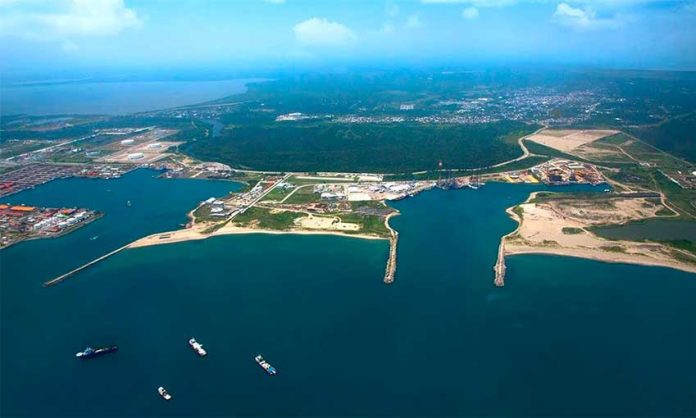
Site of the Dos Bocas refinery.

A Mexican think tank has proposed the cancelation of the federal government’s 160-billion-peso (US $8.5-billion) refinery project in Tabasco after determining that it only has a 2% chance of success.

The Mexican Institute for Competitiveness (Imco) carried out a financial analysis of the project planned for the Gulf of Mexico coast at Dos Bocas. The results were not positive.

The think tank said the purpose of the analysis was to determine whether the refinery project was compatible with the federal government’s austerity policy and if it would generate economic benefits for the state oil company.

Using the Monte Carlo simulation method, 30,000 different scenarios – each with varying refining margins, investment totals, construction times and operational costs – were considered.

“The analysis concluded that in 98% of the scenarios, the Dos Bocas refinery investment project generates more costs than benefits. In other words, it destroys value for Pemex,” Imco said.

Going ahead with the decision to build the refinery, it added, “could generate a serious crisis for the public finances of the whole country.”

Imco said that “Pemex needs a credible and reasonable business plan” and to achieve it, the company needs to focus on investments that generate value.

“In accordance with the available information that was incorporated in this exercise, construction of a refinery at Dos Bocas has a high probability of being an obstacle to reaching that objective,” the statement said.

The think tank also published an infographic outlining “five reasons why building a new refinery in Mexico is a bad idea.”

  1. There is a global decrease in demand for fossil fuels and an increase in demand for clean energy sources.
  2. In 2017, Mexico’s refineries operated at less than half their full capacity so the current refineries can increase their production.
  3. Oil refining is the least profitable stage of the petroleum value chain.
  4. Investment costs and construction times for a project of this nature are very high and volatile.
  5. Production of crude in Mexico has fallen during the past 18 years. If the decline continues, petroleum will have to be imported to supply the new refinery.

President López Obrador has pledged that construction of the refinery in his home state will help reduce Mexico’s reliance on petroleum imports.

But Imco said the project should be canceled, and advised the government to explore “other options” to improve domestic supply of gasoline and diesel, such as directing investment to logistics and fuel storage.

Resources earmarked for the Dos Bocas refinery should be reassigned to “activities that increase the financial viability of Pemex, such as exploration and production,” the think tank concluded.

The government has announced construction will begin this year, although an environmental impact study has not yet been done.

Source: Notimex (sp) 

Mustang, Corvette and Cadillacs added to Guanajuato police fleet

0
Hot wheels: Guanajuato police unveil their new patrol cars.

That Corvette seen traveling at high speed on highways in Guanajuato is not fleeing the police — it is the police.

The state has added several luxury and sports cars to its fleet of patrol vehicles, but they didn’t have to purchase them.

The government announced that six Camaros, a Corvette, a Mustang and two Cadillacs seized from crime gangs have been repainted and furnished with the insignia of the state police.

The state security secretary said the new vehicles will help to meet the objective of converting the Guanajuato police into the best in the country.

During a ceremony led by Governor Diego Sinhué Rodríguez Vallejo, it was explained that the new patrol cars will give the force a new image, one of trust and one that reflects respect, admiration and strength, along with humility, service and courtesy.

The state government also announced the creation of two new police divisions. One is a 201-member rural police force that will be deployed in northern and southern Guanajuato municipalities with high rates of robbery.

sporty police car
Police will patrol in style.

A second, smaller force of 37 officers will make up the a tourist police division that will be stationed principally in Guanajuato and San Miguel de Allende, as well as in the “magical towns” of Comonfort, Dolores Hidalgo, Jalpa de Cánovas, Salvatierra, Mineral de Pozos and Yuriria.

Security has been a complicated issue for the state, which last year led the country in homicides with 3,290, three times more than the 2017 figure. The murders are largely the result of turf wars between crime gangs fighting over pipeline fuel theft.

Source: El Universal (sp), Milenio (sp)

Trump’s threats against Mexico represent ‘terrorism:’ activist priest

0
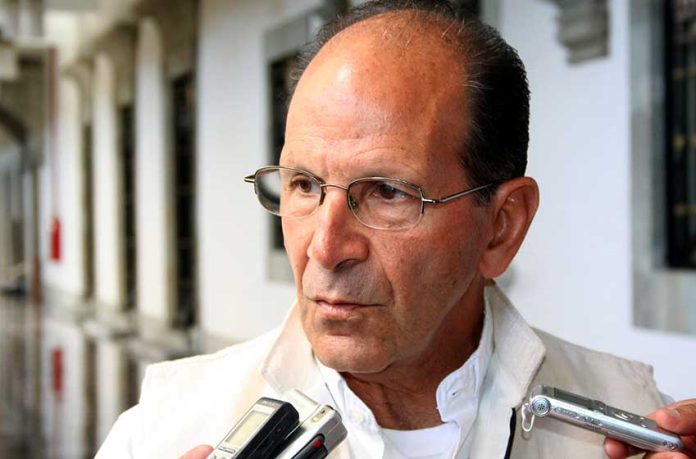
Human rights and migrants' advocate Solalinde.

United States President Donald Trump’s threats to close the U.S. border are “terrorism” aimed at coercing Mexico to implement stricter immigration policies, according to a Catholic priest and migrants’ advocate.

In an interview with the media organization Grupo Healy, Alejandro Solalinde also said that Trump “hates everyone but especially migrants,” denied the existence of the so-called “mother of all caravans” and claimed that United States “operators” manipulate information about migration flows for political gain.

Asked whether the U.S. president’s border shutdown threats were generating hysteria in Mexico, the priest responded flatly:

“It’s terrorism, it has to be said . . . even if he doesn’t end up doing it . . .”

Solalinde, director of a migrant shelter in the state of Oaxaca and well known human rights activist, said the threats have already succeeded in scaring the federal government, and there is evidence that Mexican authorities are helping the Trump administration carry out its immigration agenda.

A report in The New York Times last month said “authorities are blocking groups of migrants at border towns, refusing to allow them on to international bridges to apply for asylum in the United States, intercepting unaccompanied minors before they can reach American soil, and helping to manage lists of asylum seekers on behalf of the American authorities to limit the number of people crossing the border.”

Nevertheless, the U.S. president has often asserted that Mexico isn’t doing anything to stem migration flows from the Northern Triangle of Central America although he stated last week that “Mexico has been capturing people and bringing them back to their countries.”

Solalinde said that he wasn’t surprised by Trump’s tough stance on immigration because “Donald Trump hates everyone but he especially hates migrants.”

Referring to the United States’ decision to cut off aid to Central American countries, the priest said it was “undeniable” that Honduras, Guatemala and El Salvador had taken U.S. money without using it for its intended purpose, acknowledging that Trump sometimes “tells the truth as well.”

Solalinde added that “previous governments of Mexico have also stolen United States money – they deceived them, it’s not true that they did what they said they did because they provoked circular migration.”

The priest claimed “the only thing that is going to stop migration flows, especially from the Northern Triangle, is investment in development . . . employment is the only thing that is really going to stop migration.”

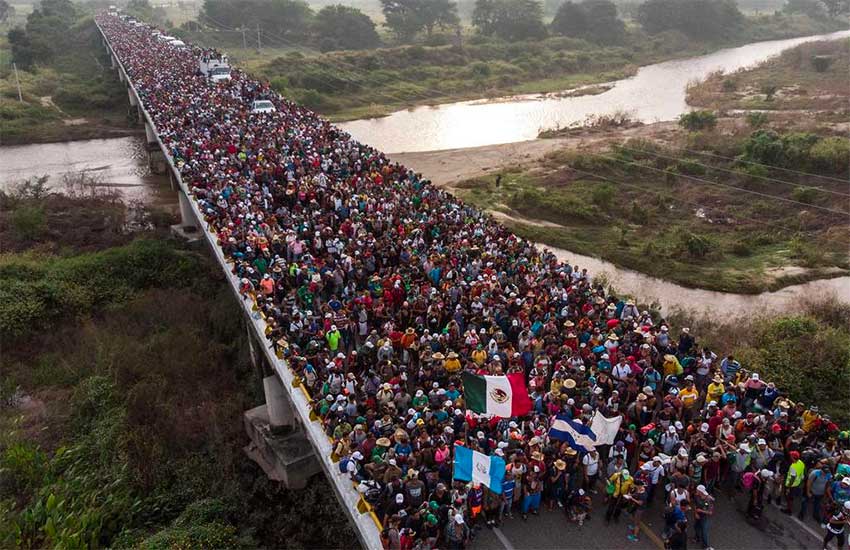
Migrants cross the Suchiate river between Mexico and Guatemala.
Migrants cross the Suchiate river between Mexico and Guatemala in October last year.

Trump’s recent border closure threats came in the wake of Interior Secretary Olga Sánchez Cordero’s claim on March 27 that a “mother of all caravans,” which could have “more than 20,000 people”, is forming in Honduras.

Solalinde said that there was no evidence that such a caravan was gathering and charged that “North American operators” were involved in creating a myth about its existence as well as generating hype and hysteria about real flows of migrants traveling through Mexico to the United States.

“There is a geopolitical and geostrategic interest of the United States to demonstrate that they [the migrant caravans] are a danger, an invasion,” he said.

“These manipulations of the caravans benefit Donald Trump,” Solalinde added, claiming that United States interests want to “destabilize Mexico . . .  create a point of tension between the U.S. and Mexico, and that point is migration.”

The day after Sánchez Cordero referred to the “mother of all caravans,” Trump took to Twitter to assert that Mexico and Central American countries do nothing to stem “illegal immigrants” to the United States.

“Mexico is doing nothing to help stop the flow of illegal immigrants to our country. They are all talk and no action. Likewise, Honduras, Guatemala and El Salvador have taken our money for years and do nothing . . . May close the southern border!” he wrote on March 28.

Following that threat and several others, President López Obrador has remained diplomatic, a strategy Solalinde described as “very prudent.”

In an extensive interview, the activist priest also asserted that Mexican criminal groups are involved in human trafficking and the organ trade and that he was aware that some of the migrants who were kidnapped in Tamaulipas last month have been killed.

Solalinde said that he believed that López Obrador “loves migrants because they are poor” and “wants to help them,” a claim supported by the federal government’s decision to grant more than 10,000 humanitarian visas earlier this year that allows emigrants to work in Mexico and access services.

However, the priest added that there was a risk that pressure from the United States and the influence of Interior Secretary Sánchez and National Immigration Institute chief Tonatiuh Guillén could persuade the president to adopt policies that don’t reflect his “political will.”

Source: Frontera. Info (sp) 

Energy expert says Yucatán power outages due to gas shortage not fires

0
Expect the lights to go out again this month and next on the Yucatán peninsula, expert warns.

The Yucatán peninsula will suffer more power outages this month and next due to an increased demand for electricity and a shortage of gas, according to an energy sector expert.

There have been two major blackouts on the peninsula recently, one on Friday and another last month.

Both were blamed on fires beneath electrical transmission lines but energy analyst and researcher Edgar Ocampo Telléz said that a lack of gas to generate power was the real reason.

“. . . It’s ridiculous [to say fire was the cause] because fires have always occurred on the Yucatán peninsula and blackouts haven’t occurred, it’s absurd,” he said.

Ocampo, an academic at the Autonomous Technological Institute of Mexico (ITAM), told the newspaper El Financiero that residential and commercial growth in the peninsula’s two biggest cities – Mérida and Cancún –  place additional pressure on electricity supplies, especially in the hottest months of the year.

“Our calculations were that we would have blackouts in May but they came earlier. If we’re having blackouts in April, I don’t want to imagine May,” he said.

“In reality, the problem isn’t serious . . . [but] from my point of view, the peninsula is going to suffer periodic blackouts.”

Ocampo said that the Federal Electricity Commission (CFE) may be forced to resort to turn off the power as part of a “scheduled blackouts” initiative to save electricity which, he said could provide a partial solution to the problem.

He explained that there is one pipeline that sends gas to the peninsula and that it has the capacity to transport 300 million cubic feet per day. But Pemex only sends between 60 and 80 million cubic feet, Ocampo said, which is insufficient to produce enough energy to meet demand at peak times.

A total of 400 million cubic feet of gas per day is needed to generate sufficient energy when temperatures soar in May, meaning that even if the pipeline operated at full capacity, blackouts would still occur.

Mexico buys around 5 billion cubic feet of gas from the United States every day but most “stays in the center of the country,” Ocampo said, “because the demand in the center is brutal.”

With a gas shortage already causing blackouts, the energy expert said that new residential and commercial developments on the Yucatán peninsula should be curtailed.

“If the commission [the CFE] knows perfectly well that it can’t generate [enough electricity], why continue to do electricity feasibility studies?” Ocampo said.

Source: El Financiero (sp) 

President addresses tourism conference but his focus is not marketing

0
Hotels' spokesman Barrios at Tianguis Turístico yesterday.
Hotels' spokesman Barrios offers advice to AMLO at Tianguis Turístico yesterday.

A tourism sector leader has called on the federal government to provide at least US $125 million annually for tourism promotion to ensure that visitors continue to vacation in Mexico.

But President López Obrador is more focused on attending to the needs of residents in the country’s top destinations than attracting foreign visitors to them.

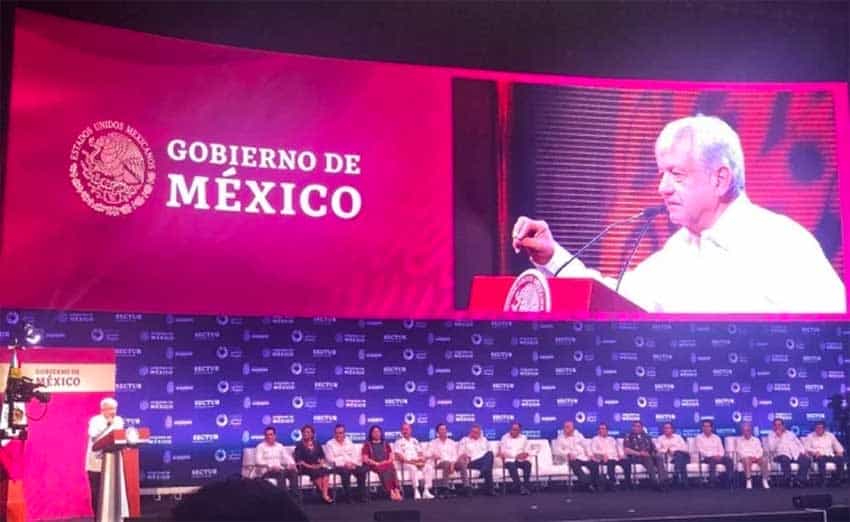
Speaking in Acapulco, Guerrero, yesterday at the opening ceremony of the 2019 Tianguis Turístico – Latin America’s largest tourism industry event – Luis Barrios, president of the National Association of Hotel Chains (ANCH), said that private tourism companies are investing a lot of money in marketing but it’s not enough.

He pleaded with López Obrador to not “leave us [the tourism sector] exposed” to the risk of a prolonged downturn in visitor arrivals.

As other tourism representatives have warned, Barrios said the government’s decision to disband the Tourism Promotion Council (CPTM) will result in Mexico losing market share to other holiday destinations in the region.

“Mr. [President], you are a marketing genius, you’ve taught us catchy words every time you make a speech. Now, I tell you: he who doesn’t advertise, doesn’t sell,” he said.

To fill the gap left by the disbandment of the government’s tourism marketing agency, the secretariats of Foreign Affairs (SRE) and Tourism (Sectur) reached an agreement last week that will train diplomatic staff in tourism promotion.

But there is skepticism in the tourism sector and among former tourism officials that Mexico’s embassies and consulates will be as effective as the specialist marketing agency.

“The government committed a very serious error by disappearing the CPTM because tourism competition at a global scale is very strong and Mexico doesn’t have the possibility to continue promoting itself as it did before,” said Rodolfo Elizondo Torres, federal secretary of tourism from 2003 to 2010.

He agreed with Barrios that the task can’t be solely left up to the private sector because its funding alone will fall short of the amount that is required.

The Maya Train, which will receive funding previously allocated to the CPTM, has the potential to be a great project but there are other ways to finance it, Elizondo said.

President López Obrador is focused on social spending and addressing insecurity.

The former tourism chief’s successor, Gloria Guevara, stressed the importance of creating a body to replace the CPTM, arguing there is no point in developing new tourism products and destinations if they are not marketed.

Enrique de la Madrid, Sectur chief for the second half of Enrique Peña Nieto’s presidency, said that a lack of tourism promotion will place investment in hotels and restaurants – as well as the sector as a whole – at risk.

“If we take away tourism promotion money, the number of tourists [who come] to Mexico will fall and that’s dangerous [for the economy],” he said.

José Manuel López Campos, president of the Confederation of Chambers of Commerce, Services and Tourism (Concanaco), proposed the creation of a trust fund that combines private and public money for the purpose of tourism promotion.

“Nobody will visit a place they don’t know exists,” he said, adding that without promotion, Mexico’s tourism destinations “run the risk of becoming the best-kept secrets on the planet.”

The Concanaco chief urged the government to resume funding for the magical towns scheme, which like the CPTM is a victim of López Obrador’s program of austerity.

For his part, the president told attendees at the opening of the 44th Tianguis Turístico that his administration is focused on two main initiatives in the nation’s primary tourism destinations.

One is the 8-billion-peso (US $421.8-million) Mi México Late (My Mexico Beats) infrastructure program, which López Obrador launched last month to put an end to the “offensive” contrast between luxurious hotels and poor neighborhoods in Mexico’s most popular resort cities.

The leftist leader said yesterday that 500 million pesos (US $26.3 million) has already been allocated to Acapulco’s El Renacimiento neighborhood to improve drainage and public lighting as well as to create recreational and sporting complexes, among other projects.

Similar urban development programs are planned or under way in marginalized neighborhoods of tourism-oriented cities such as Los Cabos, Baja California Sur; Playa del Carmen, Quintana Roo; and Puerto Vallarta, Jalisco.

López Obrador said the second priority in Mexico’s tourism destinations is to improve public security, charging that “for a long time,” the violence problem was “neglected.”

Despite the government’s withdrawal of tourism promotional funding, Tourism Secretary Miguel Torruco said that investors have “complete confidence” in López Obrador and that 22,000 new hotel rooms will be built annually during his six-year term.

He also said the government will aim to attract more high-spending tourists from countries such as China, Russia and the United Arab Emirates – presumably by promoting Mexico in those countries via its embassies.

López Obrador yesterday stressed the importance of tourism to the economy – it’s one of Mexico’s biggest foreign currency earners – and has pledged that he is committed to ensuring that the sector continues to grow.

But some question how wide and serious that commitment really is.

“. . .  not everything should be [focused on] the Maya Train,” said Barrios, the hotel association president.

There are already signs that tourism has declined since the elimination of the CPTM, including lower hotel occupancy rates this year in Cancún and Mexico City and a fall in international visitor numbers to Cancún in January.

The situation led National Tourism Business Council (CNET) president Pablo Azcárraga to declare last week that the Mexican tourism industry is in crisis.

He said that a lack of marketing and insecurity will cause tourism GDP growth to slow to 1.6% from 3%.

Source: Milenio (sp), El Universal (sp), El Economista (sp)