President López Obrador has called on the government of the United States to pass stricter legislation on gun sales after a shooting in El Paso, Texas, killed 21 people, including eight Mexican citizens.
The president said on Monday that permissive gun laws in the United States “have negative effects on many Americans and also on us.”
“We’re making a special effort to address the damage caused by guns in our country,” he said. “According to current legislation, there is more gun control here than in other countries.”
The president also mentioned the “fast and furious” gunwalking scandal in which U.S. government officials allowed weapons to be smuggled into Mexico during the administrations of presidents George W. Bush and Barack Obama.
“If we look at this objectively, we’d have to say that the two main political parties in the United States have not taken gun control seriously,” he said. “For example, in Operation Fast and Furious, where [arms smuggling] was allowed, those who controlled the presidency then are now in the opposition. I’m only saying this to be balanced.”
The president said he will avoid making in-depth statements about U.S. politics because he doesn’t want to interfere in the electoral processes of other countries.
“We don’t want what we say to be used for electoral ends,” he said. “We need to remember that there are elections, and we don’t want to get involved.”
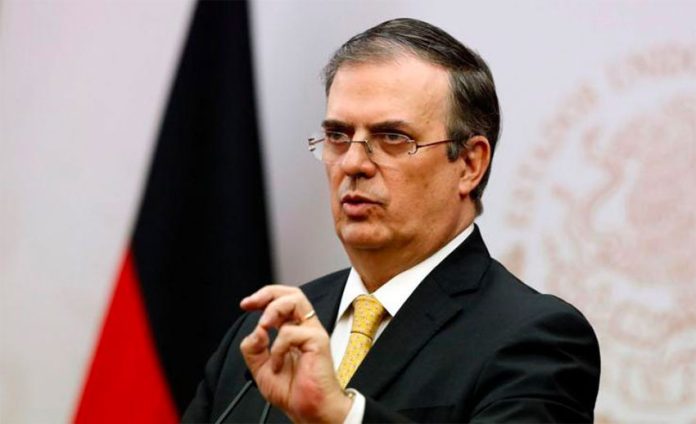
López Obrador added that he has instructed Foreign Affairs Secretary Marcelo Ebrard to explore legal actions that Mexico can take in response to the deaths of the Mexicans in the shooting.
“Marcelo has instructions to file the required complaints,” he said. “We’re going to make a complaint about terrorism with the United States government, so that it will take action according to its own laws.”
When people can't wash dishes for lack of water, they need disposables, says Juan Carlos Collazo.
Ben (Dustin Hoffman), the aimless graduate in the 1967 movie of the same name, was given career advice by a neighbor. “One word: plastic.”
But unfortunately, as with so many new technologies, plastic has turned out to be not only a blessing, but an environmental curse.
To help get a handle on plastic pollution, Mexico City’s government will ban plastic bags effective December 2020 and most other single-use plastic products effective January 2021. The ban was approved by the capital’s Congress, 51 in favor, zero against, and one abstention.
Mexico City will be in good company, joining many other major cities and countries in banning bags and other plastic items — Washington, D.C, San Francisco, Seattle, Boston, Kenya, Chile, the United Kingdom, Australia and China.
Banned items will include plastic cutlery such as forks, knives, spoons, coffee stirrers, trays, plates, cups and straws. Q-Tips, balloons, coffee capsules and tampon applicators made from plastic will also be banned.
The moratorium on single-use plastic takes effect in 2020 to give businesses time to change their production lines to biodegradable materials. “These are gradual processes, as the conversion of technologies requires time to minimize the economic impact,” said National Action Party politician Mauricio Tabe Echartea.
Mexico City currently recycles six out of every 10 plastic bottles, a level on par with European countries. However, even easily recyclable plastic such as PET (polyethylene terephthalate) cannot be considered truly sustainable. New bottles must have “virgin” PET introduced along with recycled material.
Additionally, the polymers in PET break down after repeated recycling, meaning that after only two or three cycles they must be dumped in landfills or incinerated. Mexico currently generates around 722,000 tons of PET waste per year.
Glass and aluminum, on the other hand, can be recycled repeatedly. From an environmental perspective, glass bottles are the clear winner. It takes twice as much fossil fuel to produce a plastic bottle and the manufacturing process releases five times the greenhouse gases while requiring 17 times as much water.
The new law makes an exception for biodegradable plastics. These are defined as “material susceptible to a minimum of 90% biodegradation in six months.” But, for biodegradable plastics to break down, they must be in an environment with the right amount of heat, moisture, carbon dioxide and microorganisms. A biodegradable plastic bag thrown into the ocean, for example, will not decompose.
The National Association of Plastic Industries (ANIPAC) issued a statement lamenting the new ban. The industry group claims the economic effect will be too great for citizens of the capital to bear and rejects the value of biodegradable plastics because of the strict conditions needed for them to break down. ANIPAC urges the government to reconsider its time frame.
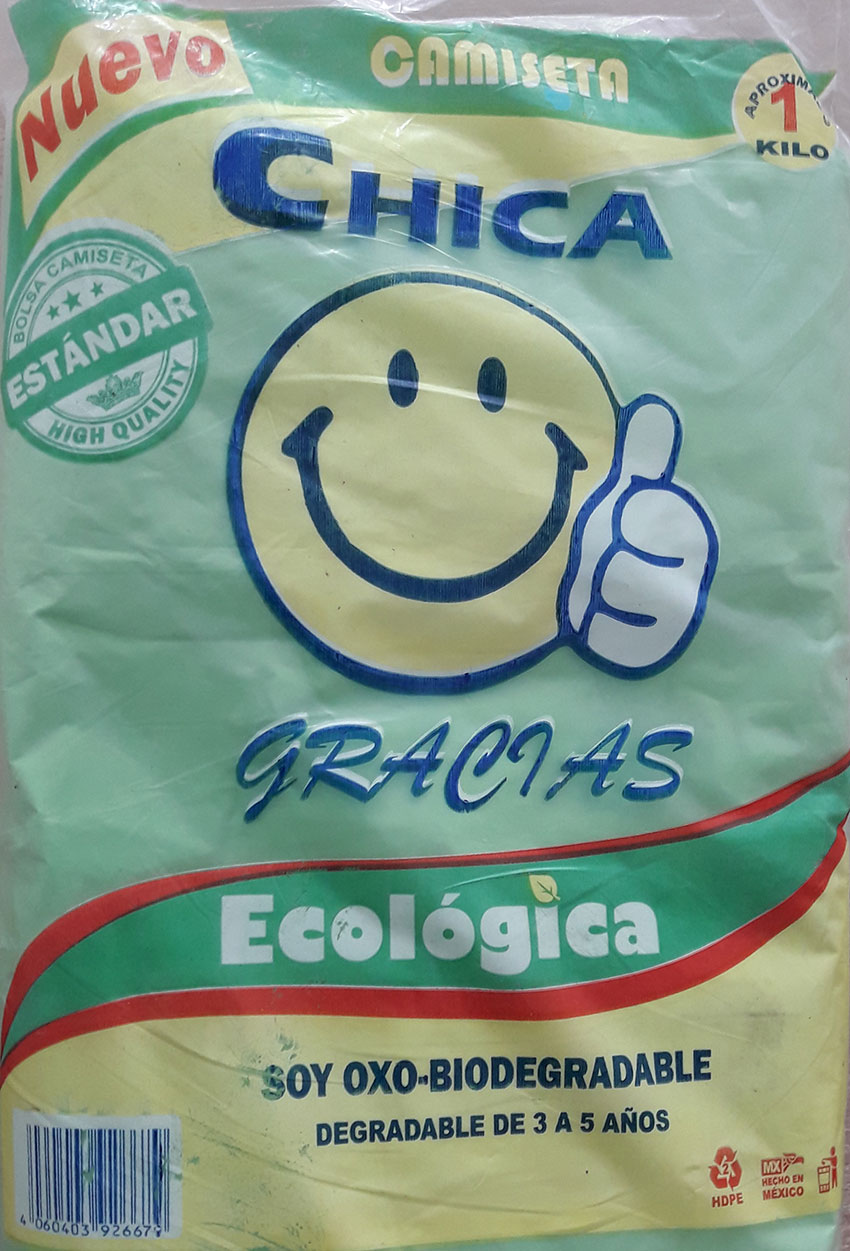
This bag will be among the products banned.
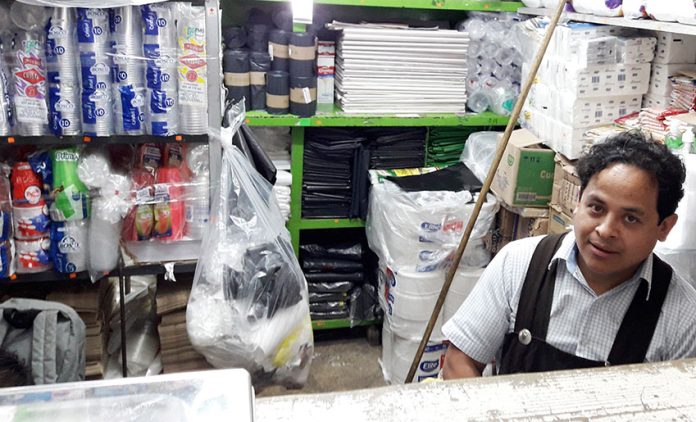
The ban will affect small family-run businesses as well. Public markets in Mexico City have puestos dedicated to disposable plastic and Styrofoam products. Mexico News Daily spoke to Juan Carlos Collazo, an employee of Materias Primas Charlie located in Mercado Independencia, where plastic cups, Styrofoam trays and dozens of other single-use items are sold.
“Plastic and Styrofoam are what we sell the most. We sell other things too, like napkins and sugar, but what [the city government] is taking away from us is essential to our business. We can buy biodegradable materials, but they cost much more. Containers for hot drinks cost 40 to 50% more,” Collazo said. When asked about the environmental impact of Styrofoam and plastics, Collazo mentioned Mexico City’s water problems.
“Around here, the water cuts off all the time. When people can’t wash their dishes, they need disposables . . . If everyone is using more water to wash plates in homes as well as in businesses, we’re going to run out of water even more frequently.”
Collazo points to labeling on Dart brand Styrofoam cups which he sells: “Dart Cups—The Environmental Option.” The plastic sleeve around the cups states that Dart never manufactures with CFCs (chlorofluorocarbons), that the cups are recyclable and that their manufacture uses less energy and a cleaner manufacturing process than paper cups.
But Mexico City currently does not have a recycling program for Styrofoam. The process to recycle is said to be very costly and can only been done at a loss. Unlike paper, Styrofoam can persist in the environment for a million years.
While vendors will continue to sell single-use plastics until the ban takes effect, Collazo says that to stay in business he will have to change his inventory. Even the oxo-biodegradable bags he currently sells will be banned. “We will have to use biodegradable, even if it is more expensive.”
If the graduate’s neighbor were giving him career advice today, it might be: “Plastic, but not single use.”
Mexico is looking into taking legal action against the United States over the murder of eight Mexican citizens in a mass shooting in El Paso, Texas, on Saturday.
Foreign Affairs Secretary Marcelo Ebrard told a press conference Sunday that Mexico is considering the mass shooting an act of terrorism against the Mexican-American community and against Mexicans in the United States, and that the attorney general is exploring legal action that would rule the shooting as such.
Designating the attack as an act of anti-Mexican terrorism would give Mexico access to all the evidence that comes out of the investigation into Saturday’s shooting. Ebrard said that such a designation would be the first of its kind.
“There will be legal action against whoever ends up being responsible for the sale of the assault weapons to the person responsible, and whoever pulled the trigger,” said Ebrard. “We are going to request access to the investigation to find out how the weapon was sold and how it got into his hands.”
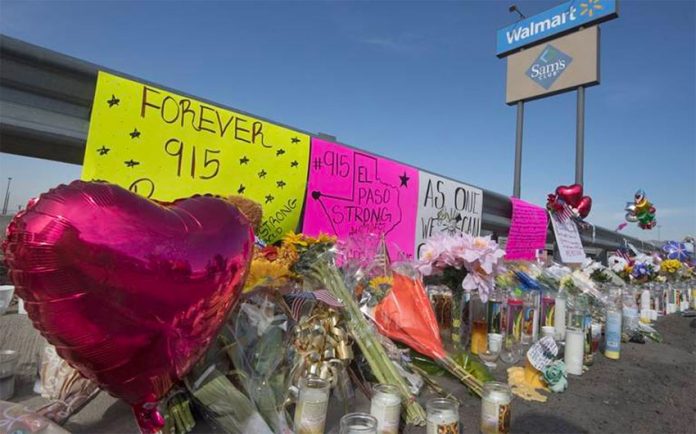
A total of 22 people were killed in the shooting, which took place at a Walmart in the Cielo Vista shopping center in El Paso. The shooter has been identified as 21-year-old Patrick Crusius, of Allen, Texas.
Authorities say Crusius is the author of a 2,300-word “manifesto” posted to the message board 8chan before the attack, which speaks of an “invasion” of Mexican and Latino immigrants into the United States.
Ebrard added that Mexico will send a diplomatic note to the United States asking it to “take a clear position against hate crimes,” and that Mexico will consider requesting that Crusius be extradited to Mexico to face charges for the murders of Mexican citizens.
“Mexico considers this individual to be a terrorist,” he said.
Ebrard was scheduled to travel to El Paso on Monday where he was to meet with Mexican consuls from around the United States.
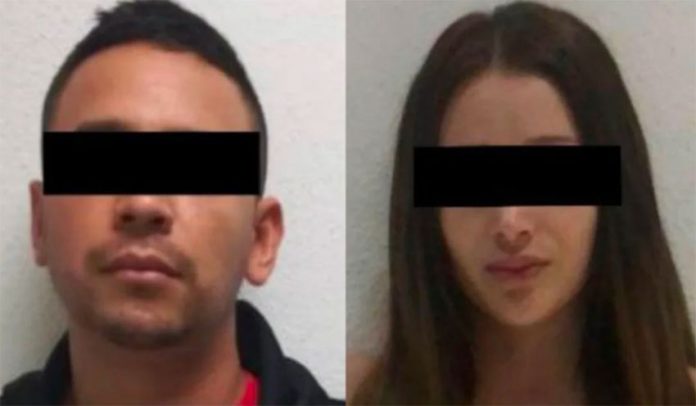
Herrera and de la Cruz are believed to be close to the Jalisco cartel leader.
Police have captured a man and a woman suspected of being close to the leader of the Jalisco New Generation Cartel (CJNG).
Authorities said that both Edgar “El Caimán” (The Alligator) Herrera Pardo and his swimsuit model girlfriend, Maine de la Cruz, have close ties to cartel boss Nemesio “El Mencho” Oseguera Cervantes.
Federal Police identified de la Cruz when she boarded a bus in Querétaro City bound for San Luis Potosí. Police detained the bus as it pulled into the terminal, boarded it and found that Pardo was also aboard. They were taken into custody without a struggle.
Both Pardo and De la Cruz were wanted for drug trafficking. Pardo is thought to be one of “El Mencho’s” eight most-trusted henchmen and the cartel’s plaza boss in Tijuana. He is also wanted in the United States.
De la Cruz is a former beauty queen who earned fame in Tijuana when she won a bikini contest hosted by the popular gambling hall Casino Caliente. Authorities said she also has strong ties to the infamous and elusive cartel chief.
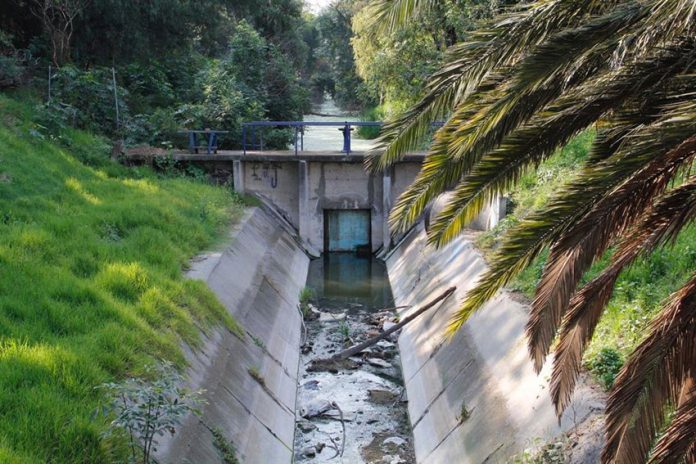
Area bordering the canal will be declared one of environmental value.
Mexico City Mayor Claudia Sheinbaum has announced the start of work to rehabilitate an 8.4-kilometer stretch of the National Canal.
Sheinbaum said on Sunday that the 12-kilometer-long canal, which runs through the Mexico City boroughs of Coyoacán, Xochimilco and Iztapalapa, will be designated a special area, protecting it from being urbanized or run through pipes.
“This month, we are declaring it an area of environmental value,” she said. “That means that no one will be able to develop this area, that no one will be able to culvert the canal, and that it will be protected as an open public space, to protect the environment.”
She added that the project will protect the canal’s flora and fauna, and that the area around the canal will be reforested.
The work will start at the Miramontes pumping station in Coyoacán.
The company Consorcio Virgo was awarded a contract for the rehabilitation, an investment of just over 170 million pesos (US $8.7 million) for this year. Similar amounts will be invested in 2020 and 2021.
The project will include improving and building parks around the canal, improving the water quality and pedestrian access, and building flood barriers. Several Mexico City government departments will participate, including the Environment, Tourism and Mobility secretariats.
Sheinbaum said she will invite neighborhood associations to participate in the upkeep of the artificial, pre-Hispanic canal.
The rehabilitation of the canal is part of an initiative by Sheinbaum’s government to rehabilitate public parks.
“We want public parks in Mexico City to be real green spaces, spaces of environmental protection, but also spaces of social coexistence,” said Sheinbaum. “We don’t want malls to become the only spaces of coexistence, spaces that are only associated with consumption.”
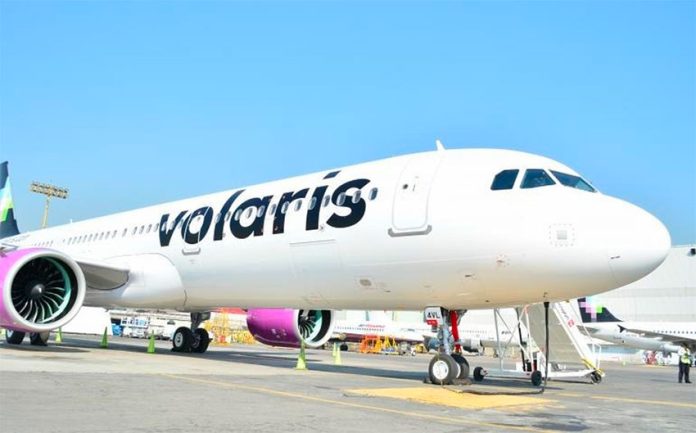
Volaris was the domestic market leader in the first half of the year.
A 2.5% decline in the number of passengers flying into Mexico on foreign airlines in the first half of the year was the major contributing factor behind the commercial aviation industry recording its weakest growth for Mexico since 2011.
Data from the Civil Aviation Agency (DGAC) shows that 16.6 million passengers flew into Mexico on foreign airlines between January and June compared to 17 million in the same period last year.
A graph published by the newspaper El Economista shows that no year-over-year decline was recorded in foreign airline passenger arrivals during the first half of any year between 2013 and 2018.
Between January and June, a total of 50.1 million passengers flew into Mexican airports either from abroad or locations within the country, a 4.8% increase compared to the first half of 2018.
The growth in overall passenger numbers is the weakest since the first six months of 2011 when the number of people flying to Mexican destinations declined by 0.1%.
The decline in passengers flying into Mexico on United States airlines was – at 5.1% – more than double the overall drop in arrivals on foreign carriers.
United States tourist numbers were also down.
Interior Secretariat (Segob) statistics show that 5.7 million United States citizens flew into Mexico in the first half of the year, a decline of 0.4% compared to the same period in 2018.
The consultancy Gemes said in a report that the Segob figures “renew doubts about the behavior” of the United States market – the largest source of visitors to Mexico – and represent the “worst performance” in attracting U.S. tourists since 2012.
El Economista reported that visitor numbers from Canada, the second most important country for Mexico’s tourism market, are also on the wane.
The disbandment of the Tourism Promotion Council and consequent lack of international tourism marketing and insecurity in Mexico are the main reasons cited for the decline in international visitors.
While the number of passengers flying into Mexico from abroad on Mexican airlines increased in the first half of the year, growth was weaker than in 2018.
DGAC figures show that 7.9 million passengers flew into the country on Mexican airlines between January and June, a 10% increase compared to the same period last year.
In the first half of 2018, passenger numbers on Mexican airlines operating internationally grew to 7.2 million from 6.3 million the year before, a 14% spike.
Domestic passenger numbers increased in the first half of the year but again the growth was not as strong as that recorded in 2018.
A total of 25.6 million passengers took flights between Mexican destinations, an 8.5% increase compared to a year earlier.
In 2018, 23.6 million passengers flew domestically, a 9.2% increase over 2017 numbers.
Volaris was the domestic market leader in the first half of this year, transporting 8.1 million passengers. It also recorded the strongest growth, increasing its passenger numbers 22.6% compared to 2018.
Interjet transported 5.2 million passengers between January and June, a 3.6% increase compared to 2018, while 4.8 million people traveled on VivaAerobús, 18.6% more than the first half of last year.
Passengers traveling on Aeroméxico Connect declined 6.1% to 3.8 million, while 2.6 million people flew domestically on Aeroméxico, a 3.3% fall.
The flag carrier remains the leading Mexican airline for international flights even though passenger numbers declined 2.8% in the first half of the year to 3.2 million.
In contrast, Interjet’s international passenger numbers surged 27.5% to 2.2 million.
Domestic auto sales continued their long downward slide in July with a 7.9% decline in sales compared to July 2018. It brings to 26 the number of months sales have been dropping.
Auto dealerships sold 105,699 cars in July, the lowest July sales since 2009, according to data collected by the national statistics institute, Inegi. They sold 744,296 vehicles from January to July, down 6.6% from the same period last year.
The industry expects the trend to continue for the rest of 2019, which would make this year the third consecutive year of declining auto sales.
The July slump did not affect all brands equally: Nissan, the market leader, saw a 14.5% decline and General Motors and Volkswagen fell 5.6% and 7.2% respectively.
On the other hand, Suzuki and Mitsubishi both saw significant gains. Their sales were up 29.3% and 26% respectively.
Guillermo Rosales, general manager of the Mexican Automotive Dealers Association, said negative influences such as rising debt, declining purchasing power and a pessimistic outlook for the political and economic future have only deepened in recent months.
A Veracruz journalist who was supposed to have been provided security was murdered in a hail of bullets Friday night in Actopan.
Jorge Celestino Ruiz Vázquez was a reporter for the daily Gráfico de Xalapa, one of the state capital’s oldest newspapers.
Gunmen shot and killed the journalist at about 9:00pm in the Bocanita neighborhood.
According to the newspaper Ríodoce, Ruiz had received death threats and his house had been shot at on three separate occasions, triggering an order that he and his family be provided with security.
But it appears the order was not fulfilled. The state attorney general said today the reason why security measures were not provided will investigated.
Veracruz Governor Cuitláhuac García Jiménez condemned the killing and promised to apprehend those responsible.
“We condemn the cowardly killing of Jorge Ruiz, reporter for a local newspaper. We will catch those responsible; his murder will not go unpunished. For the last several hours we have been coordinating an operation to capture the culprits.”
Ruiz was the third journalist murdered this week. Yesterday morning, reporter and local official Edgar Alberto Nava was shot on a beach in Zihuatanejo, while the body of Guerrero journalist Rogelio Barragán was found in the trunk of a car in the state of Morelos on Tuesday night.
Nine reporters have lost their lives in Mexico this year.
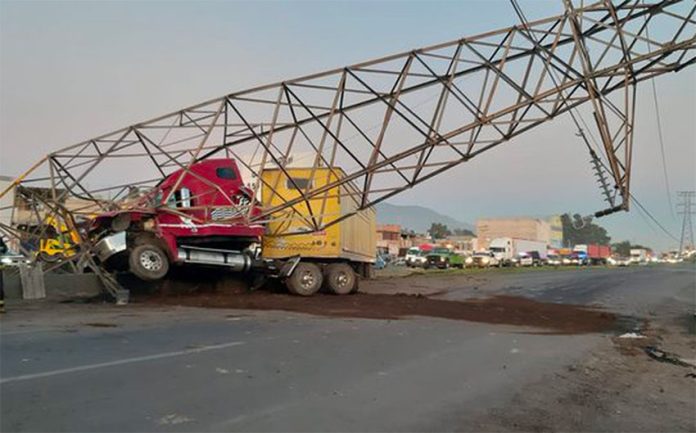
A tractor-trailer plowed into an electrical transmission tower in México state this morning, knocking it over and closing down the highway.
According to local sources, the driver of the truck fell asleep at the wheel on the Texcoco-Lechería Highway in Ecatepec and crashed into the tower around 3:00am.
“I heard a huge crash, and then our electricity went. When we looked out, we saw what had happened, but with the tower like that we didn’t get any closer and decided to call the police instead,” said Juan Villa, a resident of the Llano de los Báez neighborhood where the collision took place.
Emergency personnel extracted the driver from the truck’s damaged cab and rushed him to hospital, while police, firefighters and Federal Electricity Commission workers secured and closed off part of the highway and restored power to the neighborhood.
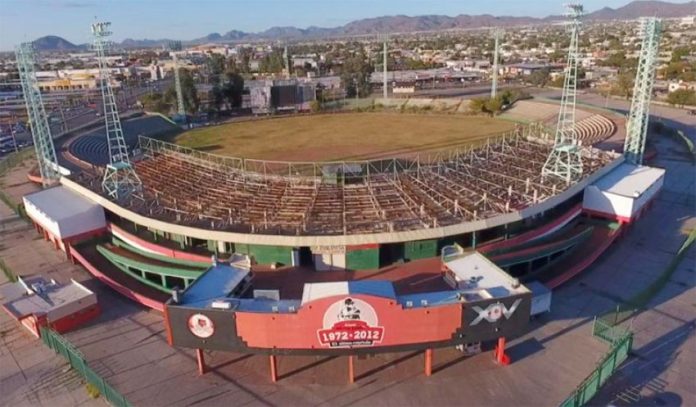
The federal government will pay the state of Sonora more than 1 billion pesos to purchase two stadiums that will become baseball schools.
President López Obrador announced this week that the Secretariat of Finance will release funds for the purchases, adding that state development bank Banobras will also provide financial support.
According to a report published by news website Animal Político, the purchase of the Héctor Espino stadium in Hermosillo and the Tomás Oroz Gaytán stadium in Ciudad Obregón will cost 1.057 billion pesos (US $54.7 million).
López Obrador said the federal government has advised its counterpart in Sonora to use the funds to pay workers’ pensions.
The baseball schools that the government plans to build will also offer regular middle school and high school classes.
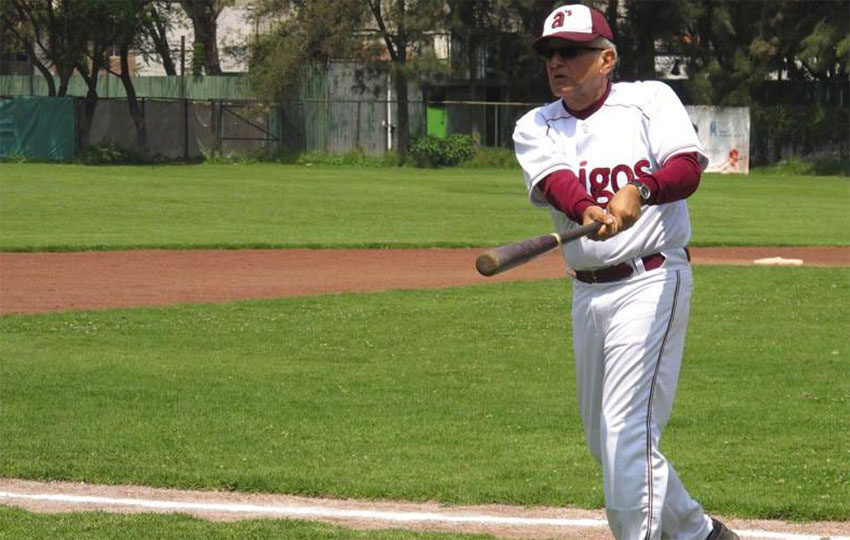
AMLO up to bat.
“. . . The stadiums are very well located, facilities will be built, a good project will be carried out in each one of them,” the president said.
López Obrador, whose favorite sport is baseball, added that the private sector will be invited to participate in the projects at some point in the future, explaining that the construction of hotels and shopping centers in the stadium precincts is under consideration.
Sonora Governor Claudia Pavlovich thanked the president for the government’s purchase of the stadiums, observing that the state government doesn’t have the resources to rehabilitate them.
However, critics quickly claimed that the outlay is incongruent with the government’s austerity measures and questioned López Obrador’s priorities.
“. . . There are no resources for syringes, gauzes, medicines, doctors, nurses, [medical] evaluations, police, postgraduate scholarships, science, culture or research centers, but for the president’s favorite sport: the Finance Secretariat will release 1 billion pesos . . .” Denise Dresser, a political scientist and columnist, wrote on Twitter.
In addition to pointing to budget shortfalls in healthcare and science, scores of social media users complained that such a large quantity of money was going to baseball when funding for daycare centers has been slashed.
The stadium outlay is not far short of the 1.7 billion pesos in funding allocated this year to the National Sports Commission (Conade), whose budget was chopped from the approximately 7 billion pesos it received annually during the last six years.
Conade argues that the funding is insufficient and this week shut down its drug testing laboratory.
“The closure of the laboratory is more than anything due to the cost of maintaining it,” said Conade chief Ana Gabriela Guevara.
She added that establishing the laboratory within Conade was a mistake because it made it appear as though the commission was involved in the drug-testing process when in fact it was not.
“Even though the World Anti-Doping Agency requests that there be no intervention on the part of the government inside the laboratory, in the end we’re linked [to the results],” Guevara said.
Announcing last month that she had become a citizen of Uzbekistan and would no longer represent Mexico, fencer Paola Pliego slammed Conade for not supporting her after she tested positive for the banned substance modafinil in the lead-up to the 2016 Olympics.
It was later revealed that the test carried out by a Conade laboratory had mistakenly shown that Pliego had taken the banned drug when in fact she had not.