Home Blog Page 1972

This award-winning substitute for Styrofoam packaging is made from mushrooms

0
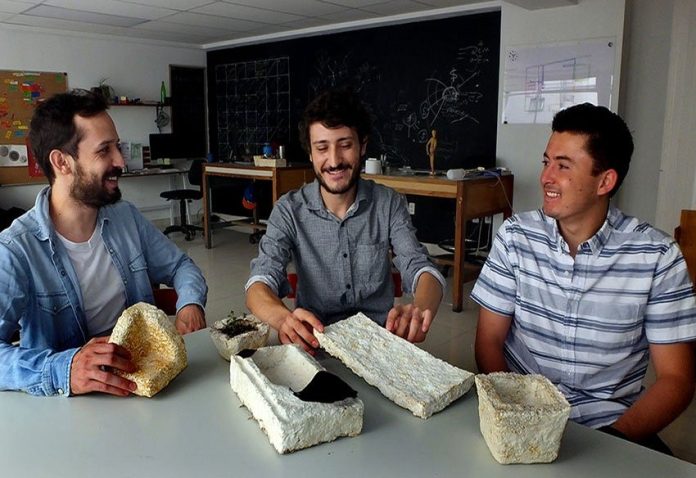
Three-fourths of the Radial team with samples of their Styrofoam substitute.

A project initiated by students at Guadalajara’s ITESO University won out among 1,000 competitors for the fourth small-business grant awarded annually by FedEx México.

PAPEL, Laboratorio de Ideas received 475,000 pesos (US $24,700) for their creation of a substitute for expanded polystyrene foam packaging material with excellent performance characteristics such as impact absorption, low density, resistance to fire and water and good thermal, acoustic and electrical insulating properties

“Our substitute,” commented representatives of the PAPEL team, “is based on a process with no carbon footprint. On top of that, it’s 100% biodegradable and useful as compost. We hope it will become an ecological alternative to Styrofoam for packaging, and will help reduce global warming.”

FedEx hopes the prize will help PAPEL to move forward toward production and eventually reduce the amount of polystyrene foam — which is highly toxic — now used as packaging material in Mexico: over 32,000 tonnes per year, according to the UNAM Foundation.

To learn more about the company that is producing this ecological Styrofoam substitute, I contacted PAPEL and asked if I could pay them a visit. They kindly invited me to their facilities, which are located at the west end of Guadalajara.

A lampshade: mushroom shaped and mushroom grown.

Upon arrival, I found myself at the door of a company called Radial, not PAPEL. When the door opened, I was warmly welcomed by Ricardo Muttio, Amador Duarte and Rodrigo Martín, who explained to me that they were long-time members of the PAPEL Idea Lab and now they had turned one of those ideas into a small company called Radial Biomateriales.

“Even though most of us are into design and architecture,” Rodrigo Martín told me, “our projects at PAPEL have always been environmentally friendly, for example rainwater catchment and composting. One of those projects revolved around growing mushrooms at home.

“Well, after working with these little mushroom farms for a while, we discovered that changes had occurred at the bottoms of the flowerpots in which we had been growing the mushrooms. Everything that was left in there had solidified into a resilient mass, which had taken on the shape of the inside of the pot as if it had come out of a mold. As architects and designers, we found this very interesting and we decided to focus on biomaterials.”

The team found that two big companies in the United States have been making things out of fungus-based biomaterials for 10 years.

“That encouraged us,” continued Martín, “but I should mention that we are not only interested in making biomaterial to substitute for Styrofoam, but we’re also working on mushroom-based substitutes for wood and for leather.

“To us it looks like the world has passed through stages as far as building material goes. We had the Stone Age, the Iron Age, the Plastic Age and now we are entering the era of biomanufacturing. Instead of big factories using up great quantities of oil, of energy, we are creating a paradigm of using living organisms to do the job for us.
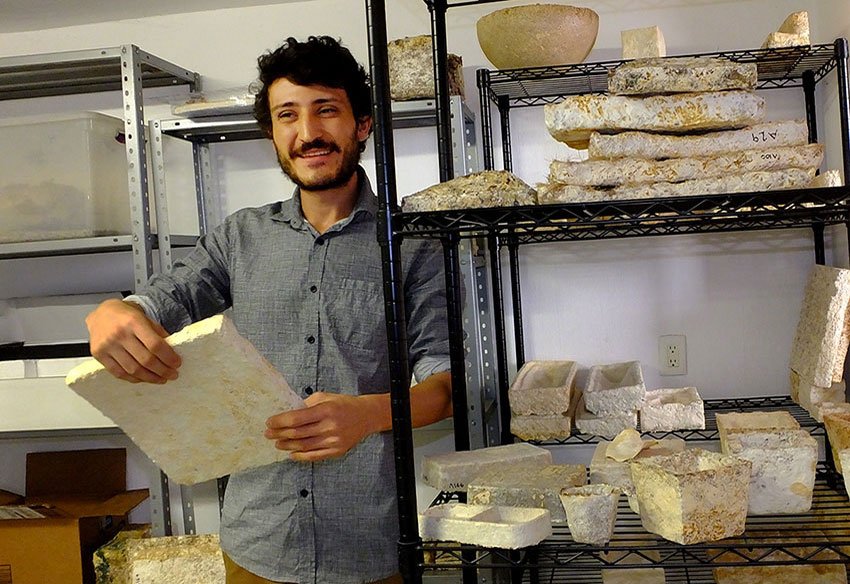
Amador Duarte demonstrates substitutes for Styrofoam and wood.

“We are doing it with mushrooms, but other people are using algae, bacteria, yeasts, collagen: many living organisms. They’re even producing lab-grown hamburger meat and skin substitutes. Biotechnology is going in this direction and we decided to start a Mexican company here in Guadalajara to make these things.”

The researchers showed me several kinds of packaging materials with different textures, including one that was soft and fuzzy to the touch, a natural characteristic of the mushroom that was used. Their wood substitute, instead, was hard but also lightweight.

“It’s based on sawdust and you can work it just like wood,” they told us. What surprised me was their “mushroom leather.” It was tough, flexible and soft. “You can dye it or stamp a form into it,” they said, ”and it’s almost entirely mushroom. Instead of feeding a cow for two years, you can grow your leather in 20 days.”

“OK,” I asked my hosts. “How does all this work? What is the mushroom doing?”

“It’s all in the roots,” replied Amador Duarte. “The mushroom is just the fruit of something growing underground. That something is called mycelium, which looks like a network of roots and it’s this mycelium which solidifies the material. We take farm or industrial residue like straw, sawdust, corn husks or agave bagasse, grind it up and let the mycelium turn it into a solid mass.

“So we are using biology to transform waste at a far lower cost than making things out of petroleum. This means a smaller energy footprint and a biodegradable product. You unpack your new fridge, break up the packaging material with your own hands and throw it into your garden or sprinkle it into your flowerpots and it turns straight into excellent compost.”
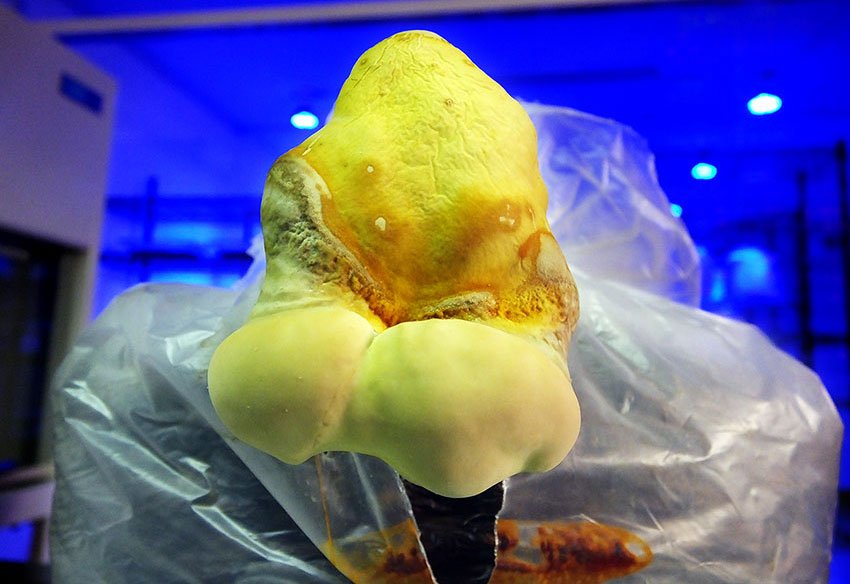
In its natural cycle, the mycelium produces this Lingzhi mushroom.

The founders of Radial began their research as students of design, business management and architecture, “We arrived at ITESO with no interest in biology and chemistry, and now, all of a sudden, here we are wearing lab aprons and face masks, bent over trays of fungi, behaving like biologists and botanists.”

This gave me pause for thought. It was my generation that happily filled our planet’s garbage dumps and oceans with polystyrene foam, a poisonous substance that won’t break down for hundreds or thousands of years, that will continue all that time to find its way into the bellies of fish, fowl, animals and people.

We did it without thinking as we tossed those wonderfully insulating coffee cups into the trash, blissfully ignorant of their impact on the environment.

Many of those of my generation are so set in their ways that no ecological message will ever get through to them, but their children go to school and at all levels of schooling, that message of concern about the environment is getting through, raising awareness, as the Radial researchers demonstrated to me.

This awareness is deviating the new generation from the routines and ruts in which so many of us born in the 20th century may be stuck.

There seems to be hope after all.

[soliloquy id="82679"]

The writer has lived near Guadalajara, Jalisco, for more than 30 years and is the author of A Guide to West Mexico’s Guachimontones and Surrounding Area and co-author of Outdoors in Western Mexico. More of his writing can be found on his website.

Hidalgo fair is opportunity to enjoy tacos of barbacoa

0
Barbacoa tacos will be the center of attention in Actopan.
Barbacoa tacos will be the center of attention.

Fans of barbacoa can have their fill starting next week at the Barbacoa Festival in Actopan, Hidalgo.

From July 5-14, foodies and festival-goers will be able to enjoy 10 whole days of hearty eating at Mexico’s oldest and most famous celebration of Hidalgo’s most celebrated dish.

The festival began as a unique feature of the over four-centuries-old patron saint celebrations. Barbacoa is a special preparation of meat wrapped in agave leaves and slow-cooked overnight in a pit. Famous in Hidalgo, it shares table-space at the festival with its porcine cousin ximbó.

Hidalgo is also famous for its pulque — an alcoholic beverage made from fermented agave sap — and flavor-infused curados, both of which will also be available in great abundance and variety at Actopan’s festival.

On July 8, the region’s most celebrated barbacoa masters will display their skills, each vying to impress diners with their special recipes and cuts of meat in a competition that marks the height of the festival.

In between bites of tacos and sips of pulque, festival-goers will be free to wander between musical acts, an artisanal market, theater and circus performances, dances and a variety of rides and attractions for children and families.

Entrance to the festival is free.

Source: El Universal (sp), Chilango (sp)

Crime, corruption behind decline in Mexico City mayor’s approval rating

0
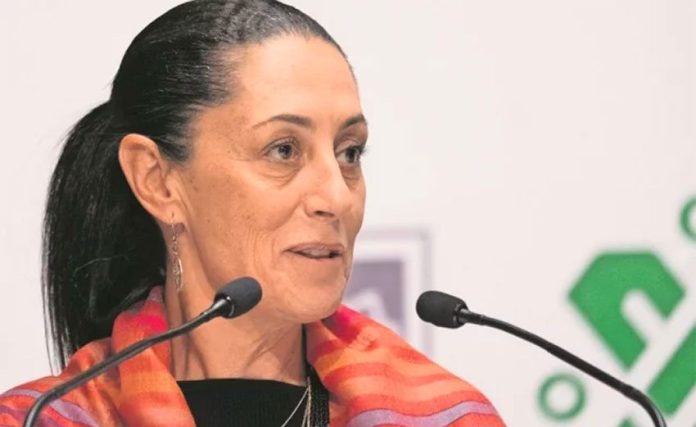
Mexico City Mayor Claudia Sheinbaum.

A perceived failure to combat crime and corruption as well as the lack of a major accomplishment are the main factors behind a slump in the approval rating of Mexico City Mayor Claudia Sheinbaum, a new poll shows.

Published today by the newspaper El Universal, the poll shows that 39% of respondents approve of Sheinbaum’s performance, a 15% decline since March.

A higher percentage of respondents – 42.8% – said they disapprove of the mayor’s performance, while just under 14% said they neither approved nor disapproved.

Asked to name the biggest mistake of the administration of the Morena party mayor since it took office last December, just under 30% of respondents cited the failure to combat high levels of crime.

More than three-quarters of those polled said they disapproved of the way that Sheinbaum and her administration are dealing with crime, while 86.5% said there had been minimal or zero progress in combating it.

High-impact crimes such as kidnapping and robberies of businesses have increased on Sheinbaum’s watch, and Attorney General Ernestina Godoy said last month that violence in Mexico City had reached “crisis” levels.

The mayor denied that was the case earlier this month but has now agreed to the deployment of the National Guard in five boroughs starting July 1.

Failure to combat corruption was cited by 7% of respondents as the biggest mistake of the Sheinbaum-led government, while just under 6% of those polled said it hadn’t put a foot wrong.

Other mistakes cited by respondents included the failure to combat drug trafficking, the government’s environmental policies, non-compliance with promises and the implementation (or lack thereof) of social programs. However, none of those errors was mentioned by more than 4% of respondents.

Just over 2% said the biggest mistake of the government was to have a woman in the top job, while similar percentages cited one of a failure to combat poverty, create jobs, increase access to health care, reduce traffic or improve public transportation as the number one boo-boo.

Asked to cite the greatest achievement of the six-month-old government, 36.2% of poll respondents said there wasn’t one.

Just under 12% said the implementation of social programs was the administration’s major accomplishment, while 5.5% cited its environmental policies.

Sheinbaum presented an ambitious new environmental plan this month, which aims to provide water service to every home in Mexico City in six years’ time, reduce air pollution by 30% and plant 15 million trees, among other goals.

Between 4% and 5% of respondents cited one of improvements to public services, the promotion of culture, the combatting of crime or the provision of water supply as the government’s greatest achievement.

Sheinbaum was given an average score of 5.9 out of 10 for her overall performance, a decline of 0.9 points compared to the poll published by El Universal in March.

Just under 40% of respondents believe that Mexico City will improve under the Morena party mayor’s leadership, a decline of more than 20% compared to when she took office and down 10% on March numbers.

A third of those polled said the capital will stay the same with Sheinbaum at the helm of the government, while 22% believe it will get worse.

Source: El Universal (sp) 

First woman to be named Nissan country president to head up global sales

0
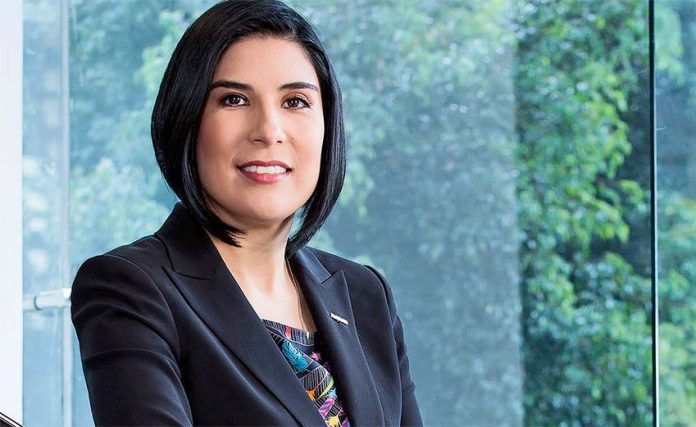
Mayra González, Nissan's new head of global sales.

Nissan México president Mayra González, the first woman to lead a country subsidiary of the Japanese auto maker, is off to Japan to take up a new post as head of the company’s global sales.

After graduating with a degree in marketing from the Monterrey Technological Institute, González, 40, began her career as a salesperson at an automotive dealership, and started working in sales at Nissan in 2001.

She worked her way up in the company to become the first woman on the company’s operations committee in 2012, and president in 2016.

Looking back on her presidency, she thinks she successfully led the company through a difficult time.

“I think that when I started leading the company, I was driving a ship through calm waters,” she said. “But then we went into a stormy ocean, and there were a lot of complications. And more than what I brought, I think that what I focused on was creating the right team to pilot that ship as best as possible, and that’s what we’ve done.”

She believes it was her achievements during her career that propelled her into the president’s job “and not because of a plan to present an image of diversity in the company,” she told the newspaper El Universal.

Source: El Financiero (sp), El Universal (sp)

Ayotzinapa teaching students vandalize education secretariat

0
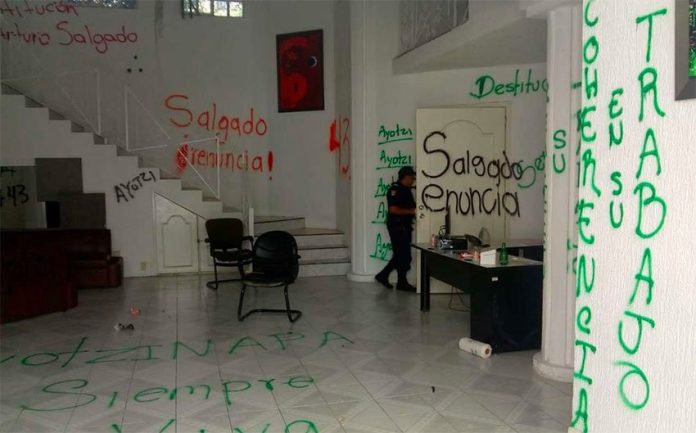
Education Secretariat offices after students went on a spray-painting spree.

Students from the Ayotzinapa teachers’ college in Guerrero vandalized four offices belonging to the state Secretariat of Education with spray paint on Thursday to demand the resignation of the education secretary.

Students from the Raúl Isidro Burgos college accused Arturo Salgado Uriostegui of infiltrating personnel within the school to create division between teachers and the administration.

The students also demanded that striking teachers resume classes or that the state government send replacements. The teachers have been on strike since May 23 when students forcibly shaved the heads of two of them.

Yesterday morning, several groups of students traveled by bus to the state capital, Chilpancingo, where they spray painted exterior and interior walls, floors, staircases and furniture with slogans demanding Uriostegui’s resignation, and others that made reference to the 2014 disappearance of 43 students, who were also from the Ayotzinapa school.

Officials from the secretariat promised to meet with the students to hear their demands.

Source: Milenio (sp), Quadratín (sp)

Was it a joke? Overweight cops assigned to immigration get oversize pants

0
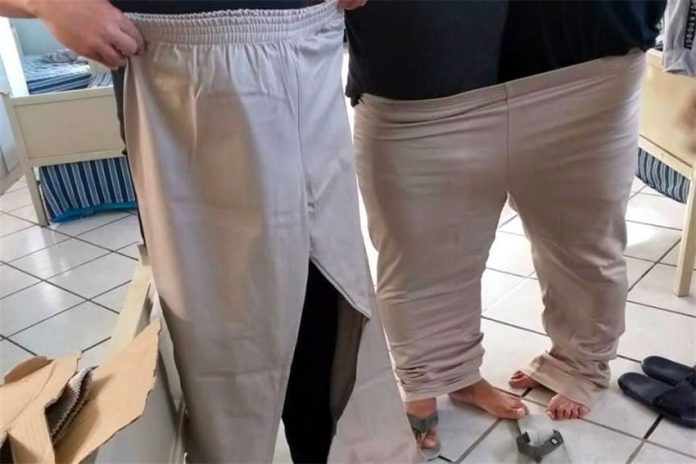
Two people can fit snugly into one pair of officers' new pants.

First, the overweight Federal Police officers sent to work with the National Immigration Institute (INM) were called fifí, or elitist by the institute’s chief.

Now they have been mocked with oversize uniforms whose pants are big enough to fit two people.

The officers went to work at the INM because they were too heavy to join the National Guard but their new uniforms are too big even for them.

One Federal Police officer who was sent to the INM for immigration enforcement in Tapachula, Chiapas, told Radio Formula that the new members were provided with low-quality uniforms made up of hat, t-shirts and pairs of 3XL pants, which he said can fit two or three people.

“It’s sad to see how the members of the institute step on us and humiliate us in this way,” he said. “What kind of image are we going to present to citizens if we’re dressed like this?”

A bit loose around the waist.

The officer noted that the uniforms given to the Federal Police officers are not the same as those used by regular INM officers.

Photos posted by the officers on social media show them using cords to stop the pants from falling down — they don’t have belt loops. Other photos indicate that the pants can indeed fit two people inside.

The police have already complained about working conditions. In response, INM director Francisco Garduño called the federal cops “fifís” (elitist) and said they were complaining because they are accustomed to staying at hotels and eating at buffets, although he later apologized.

On Thursday, Security Secretary Alfonso Durazo acknowledged that the officers are working in substandard conditions and that working conditions in the INM as well as for all security forces need to be improved.

“We can’t, as citizens, or as the government, be so demanding of them, when historically we haven’t concerned ourselves with guaranteeing them a dignified life,” he said. “Peace and security can only be the fruit of justice, and that justice needs to start with the improvement of the conditions of those Mexicans who are willing to give their lives, if necessary, to protect the public.”

Source: Reforma (sp), Milenio (sp), Excelsior (sp)

Quintana Roo prohibits bullfights, cockfights, sets rules for owning pets

0
bulfight
Not allowed in Quintana Roo.

The Quintana Roo Congress has passed a new animal protection law that bans both bullfighting and cockfights in the state.

The Congress said in a statement that the Animal Protection and Welfare Law incorporates proposals made by the public and prohibits acts that involve suffering or harm to animals such as bullfighting and cockfights.

The law also establishes new regulations for the breeding, rearing, sale and exhibition of animals as well as for the capture of lost or abandoned animals.

In addition, it limits the number of animals that can be kept in shelters and establishes requirements for owning a pet.

Quintana Roo becomes the fourth state to outlaw bullfighting after Sonora, Guerrero and Coahuila, and the second to prohibit cockfights after Veracruz.

In contrast, bullfighting is considered intangible cultural heritage in the states of Aguascalientes, Hidalgo, Guanajuato, Michoacán, Querétaro, Tlaxcala and Zacatecas.

Several states, including Puebla, México and Tlaxcala, have also afforded the same status to cockfighting.

In Mexico City, lawmakers have presented several bills that sought to ban bullfighting but as yet none has been approved.

Most recently, Morena party lawmaker Leticia Varela argued that the blood sport must be outlawed because Mexico City already guarantees dignified treatment for all living beings.

“We’re obliged to comply with what the supreme law of the country’s capital establishes,” she said.

The deputy’s proposal was referred to Congress committees for analysis.

The environment committee of the lower house of the federal Congress is also examining the issue and planning to present a bill to ban bullfighting.

“Although some people think that bullfighting is tradition and culture, it can’t be considered in that way because it doesn’t cultivate the spirit or the intellectual faculties of those who practice it, and for those who attend [the fights], even less so,” said federal deputy Pilar Lozano.

Source: Infobae (sp) 

Pemex fracking plan was approved on Tuesday but vetoed by AMLO

0
López Obrador speaks at his morning press conference as Pemex CEO Romero looks on.

The president has vetoed fracking operations that the state oil company had planned to carry out at a site in Tamaulipas.

On Tuesday, the National Hydrocarbons Commission (CNH) granted Pemex approval for hydraulic fracturing in the Huampa oil field. On Wednesday, it was vetoed by President López Obrador.

He told his morning press conference that the fracking request had been filed last November, but in fact it was filed by Pemex in February, in spite of López Obrador’s longtime opposition to the use of fracking to extract shale oil and gas.

During his election campaign last year he pledged that he would ban its use.

The plan approved by the CNH represented an investment of US $20 million over three years in the Tamaulipas field.

The Mexican Alliance Against Fracking said it was alarming that plans by Pemex and approvals by the CNH would ignore the president’s often-stated stand against hydraulic fracturing.

Source: Milenio (sp)

Government apologizes for Coahuila massacre that cost 300 lives

0
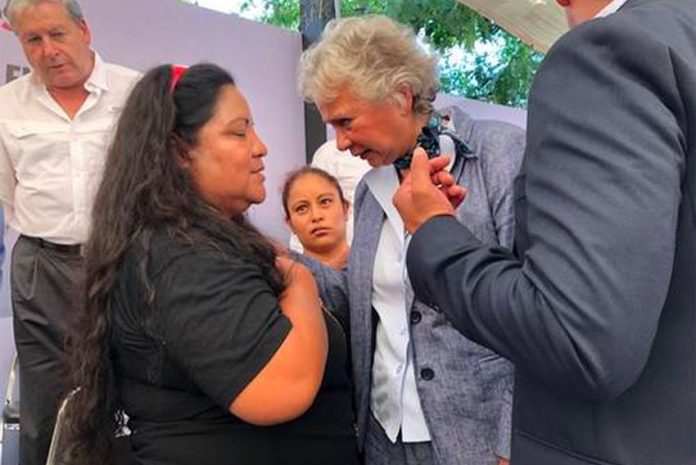
Interior Secretary Sánchez, right, with relative of a massacre victim.

The federal government has apologized for its role in allowing a 2011 massacre in the city of Allende, Coahuila, when as many as 300 people were killed or disappeared at the hands of the Zetas cartel.

Interior Secretary Olga Sánchez Cordero offered the apology at an event Thursday in Allende, which was also attended by Coahuila Governor Miguel Ángel Riquelme Solís and Allende Mayor Antero Alvarado Flores, who also offered apologies on behalf of their governments.

“I hope this apology will allow us to heal, in some way, and prevent this type of event, which has hurt us so much as a society, from happening again,” said Sánchez Cordero.

Hundreds of people attended the event, which was held in the main square of Allende in front of the municipal palace.

The public apology came after a March 2018 report on the massacre by the National Human Rights Commission, which found that authorities were implicated in the events, and recommended a public apology from the government.

Posters display photos of those who were among the 300 who were killed or disappeared.

In the presence of family members of people who were killed and disappeared in the massacre, Sánchez acknowledged that local police participated in the disappearances, while higher-level officials had advance knowledge of the Zetas’ plan and did nothing to prevent it.

“High-level authorities knew that this criminal organization was planning an attack in Allende, and they made an agreement that they would not interfere,” she said. “These authorities, while the massacre was taking place, in spite of the fact that it’s their responsibility to protect the physical integrity of the residents, in spite of the calls for help, they made the decision not to intervene.”

But for some Allende residents who lost loved ones in the massacre, the government apology wasn’t enough. Alejandra Hernández, whose father was kidnapped, told La Jornada that she didn’t see much use in an apology eight years after the fact.

“They should have come before,” she said. “Now, they’re asking for forgiveness, but when the problems were going on, they never showed up.”

The massacre took place over three days between March 18 and 20, 2011. It was triggered by two Zeta-linked traffickers from Allende, Hector Moreno Villanueva and José Luis Garza Gaytan, becoming protected witnesses in the United States.

The Zetas responded by killing family members, friends and employees of the two men. Hernández’ father was targeted because he had been an employee of Garza.

Source: Reforma (sp), La Jornada (sp)

1,800 National Guardsmen will patrol in 5 CDMX boroughs starting July 1

0
National Guard patrol vehicles will be seen in five city boroughs starting Monday.

The federal government will start deploying 1,800 National Guard troops to five crime-plagued Mexico City boroughs on July 1, the security secretary announced.

Alfonso Durazo said yesterday the guardsmen will carry out operations in Iztapalapa, Gustavo A. Madero, Tlalpan, Xochimilco and Tláhuac.

Sprawling, densely-populated Iztapalapa, located in in the east of the city, and Gustavo A. Madero, in the extreme north, are the first and second most dangerous boroughs in the capital, according to a recent criminal analysis completed by law enforcement authorities in Mexico City.

Units of 450 troops will be deployed to four of the five boroughs with Xochimilco to be patrolled by guardsmen based in neighboring Tlalpan.

The National Guard will collaborate with Mexico City police to combat high-impact crimes such as homicides, kidnappings and robberies.

Durazo said the first deployment will patrol areas of Iztapalapa, Gustavo A. Madero and Tláhuac that border México state.

“In the first stage, the National Guard in coordination with the Mexico City government will only attend to three boroughs in their peripheral part adjacent to México state, which are the most densely populated and have the highest crime rates,” he said.

The Mexico City Attorney General’s Office (PGJ) said this month that a lot of murders and other crime occurs on the outskirts of the capital, where criminals can easily move into neighboring México state and escape the jurisdiction of the capital’s police force.

Announcing the Mexico City deployment of the National Guard at his morning press conference yesterday, President López Obrador noted that crime rates in the capital are on the rise, “especially homicide, which has risen from two to six a day.”

The new security force is eventually expected to be deployed to all 16 boroughs in the capital even though none were identified by the federal government as priority regions.

However, López Obrador said that organized crime groups have arrived in the capital because the previous Mexico City government allowed them “to put down roots.”

“At first, we thought that sending the National Guard wouldn’t be necessary, but because of the situation, the mayor agreed that the National Guard will be deployed to all of Mexico City,” he said.

“A greater presence of elements and greater protection for the citizens of the capital are needed.”

The PGJ criminal analysis said the Jalisco New Generation Cartel – Mexico’s most powerful criminal organization – has started operating in Iztapalapa, Tláhuac, Tlalpan and Gustavo A. Madero, while the Tláhuac Cartel continues to operate in the borough of the same name.

In addition to the escalating murder rate, kidnappings and robberies of businesses have soared since Mayor Claudia Sheinbaum took office last December.

The national murder rate also remains stubbornly high, with 2,476 homicides in May, the highest number of any month this year.

The day before the National Guard begins operations in Mexico City, 52,000 troops of the new security force will be deployed to 150 hot spots around the country, Security Secretary Durazo announced last week.

Source: El Universal (sp)