Home Blog Page 1991

Foundations of abandoned airport’s terminal will be left under water

0
lake texcoco and airport
What was to have been an airport will be a lake instead.

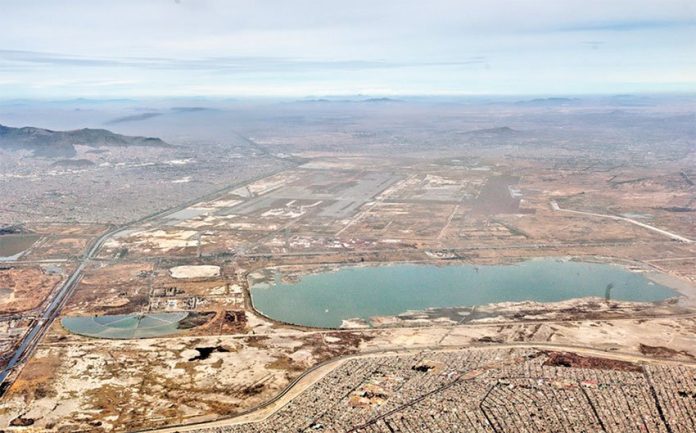
The foundations of the X-shaped terminal building and a section of runway at the abandoned airport project in Texcoco, México state, will be left under water as the result of the restoration of a drained lake.

More than 14 billion pesos (US $728.7 million) was spent on those two elements of the project before the airport was canceled following a public consultation last October.

The federal government is now pursuing a project to convert the airport site and surrounding areas into a massive ecological park.

Architect Iñaki Echevarría, who is leading the project for the National Water Commission (Conagua), told the newspaper Milenio that part of the project entails restoring the Casa Colorada lake – which will cover the terminal foundations and runway – as well as the Xalapango, Texcoco Norte and Nabor Carillo lakes.

Water that previously ran into the first three lakes from seven Valley of México rivers was diverted to five smaller lakes at a cost of 17 billion pesos in order to allow the airport to be built.

Echevarría said there was no reason to remove the terminal foundations before refilling the Casa Colorada lake because they are 4.5 meters below the water table.

“There are certain pieces [of infrastructure] that don’t need to disappear to recover the proper functioning of the site,” he said.

Echevarría rejected the claim that the foundations could be used to build a sports center.

“No! That’s a misconception that people have, that it can be used, that something can be put on top . . . It’s 4.5 meters below the water table so you’d have to be constantly pumping [water out] so that it doesn’t flood,” he said.

Flooding the base of the unbuilt terminal is the most viable option, the architect added.

Construction of the Lake Texcoco Ecological Park will be divided into four phases and is expected to take five years.

The first phase involves construction of a 300-hectare park between Lake Nabor Carillo and the Peñón-Texcoco highway. Echevarría said that work will start in the next two months and the park will open in the second half of next year.

The second phase of the project will focus on the conversion of the airport site, the third will develop the northern Caracol area while the fourth will see the construction of sports and cultural infrastructure in a zone that borders the México state municipality of Nezahualcóyotl, the project chief explained.

In addition to restoring the lakes, artificial shores will be built to encourage native birds to nest.

At least 130 different types of vegetation that was stripped from the site before and during construction of the airport will also be reintroduced.

Once completed, the park will be one of the largest natural reserves in the world, Echevarría said, pointing out that it will be 20 times bigger than Mexico City’s Chapultepec Forest.

The park will help to prevent flooding in surrounding México state municipalities, reinvigorate native flora and fauna, mitigate air pollution and serve as an attraction for the more than 20 million people who live in the Mexico City metropolitan area.

Conagua estimated in March that the preliminary studies required for the project would cost 221 million pesos (US $11.5 million) but has not yet publicly revealed the total cost of developing the urban park.

Source: Milenio (sp) 

180 wineries expected for San Luis Potosí wine festival

0
wine festival

The ninth edition of the International Wine Festival in San Luis Potosí promises to bring dozens of wine varieties close to the eager palates of wine enthusiasts.

Organizing committee president Alejandro Espinosa Abaroa says the fair expects to receive more than 5,000 visitors and see an economic spillover of between 4 million and 5 million pesos (US $208,000-$260,000) during its two-day run June 14 to 15 in the city’s Center for the Arts.

The event will host 500 wine labels from 180 different wineries from all over the world, including Spain, Argentina, Uruguay, France, Italy, South Africa, the United States and Chile, as well as many Mexican wineries, which will make up 40% of the total.

The festival has come of age in nine years; the first edition of the fair was attended by only 30 wineries.

In addition to wine tastings from 3:00-11:00pm on Friday and from 1:00pm-8:30pm on Saturday and wine and sommelier competitions, the festival will also feature a wide array of music, including a flamenco show with music and dancing, French folk music, Mexican rock and a DJ.

Festival-goers will also have the opportunity to sample local craft beer and local and national gastronomy. This year, chefs from the state of Michoacán were invited to showcase their regional cuisine.

“We try to raise awareness that this is not just a festival for [the state of] San Luis Potosí, but rather for the whole country. In nine years, we have had no mishaps. [This year] the Institute for Innovation and Gastronomy will hold a forum for students as well as a gastronomy competition, whose theme will be ‘the flavors of Mexico,’” Espinosa said.

He said visitors are expected from all over Mexico and that the city’s hotels have already filled up. A large number of international visitors is also anticipated.

“This is the most important wine event in all of Mexico. This year we are going to have visitors from Portugal, Argentina, Uruguay, France, Spain and Italy, and many other wine-producing countries around the world.”

Source: El Universal (sp), El Exprés (sp)

Mammoth tusks, camel skull among 10,000-year-old fossils in Puebla

0
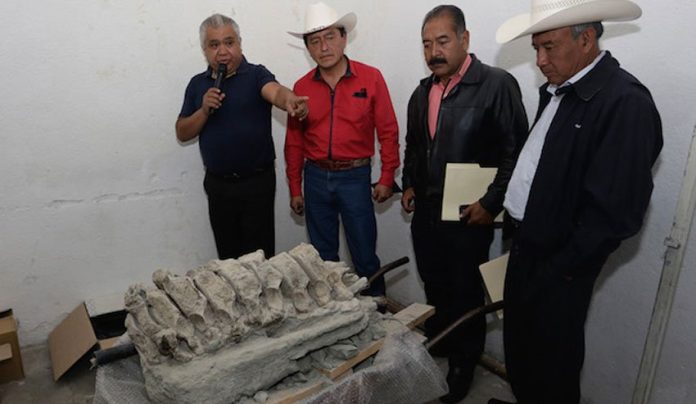
Members of Tepalcayotl with fossils that have been discovered in Puebla.

Mammoth tusks, a camel skull and the fang of a giant wolf are among a range of Ice Age fossils recently discovered in Puebla.

Residents of Chietla, a neighborhood in the municipality of Puebla 45 minutes from the state capital’s city center, have discovered dozens of fossils near the Chiquihuitepec hill in the Alseseca river basin area.

The discoveries, which also include handmade weapons such as lances, are believed to belong to the late Pleistocene era, or Ice Age, which ended around 11,700 years ago.

The fossils were formally presented yesterday by the Tepalcayotl Association, a non-profit group dedicated to the conservation of ancient cultures and traditions.

Association secretary Héctor Aguilar Rosas said the discoveries have been made during the past one and a half years.

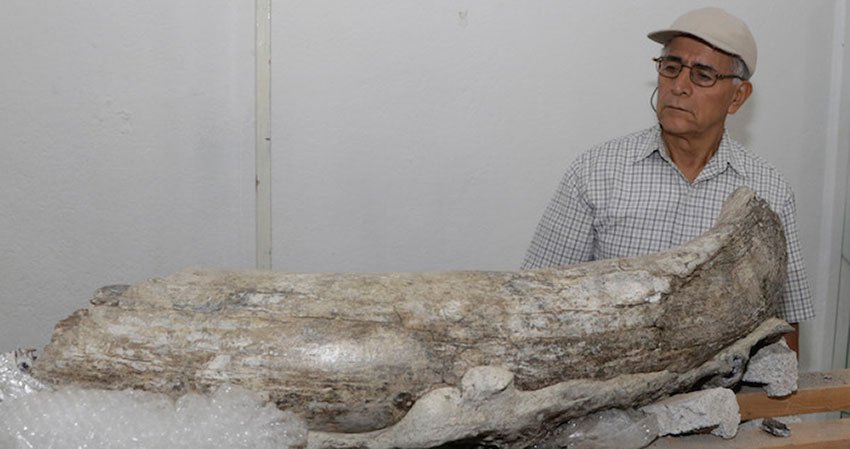
Remains of a mammoth that could be 14,000 years old.

“Different pieces continue to be found. Some residents have them at their homes. The truth is we don’t have a complete register of the finds,” he said.

However, many of the fossils have been transferred to a municipal government office for safekeeping, Aguilar said, adding that some of the remains are of a Columbian mammoth “that could have lived 14,000 years ago.”

He explained that some of the pieces, which also included ribs, vertebrae and teeth, have arrowhead indentations.

[wpgmza id=”207″]

Tepalcayotl president José Rosendo Muñoz Chetla said he will seek financial support from the National Institute of Anthropology and History as well as state and municipal authorities to build a new museum to house the fossils in the area where they were found.

Residents are also calling for the restoration of the Tepalcayotl archaeological area as well as pre-Hispanic settlements located near the Chiquihuitepec hill that are believed to have once been occupied by the Olmec and Chichimeca peoples.

Source: Milenio (sp), Sin Embargo (sp) 

Advocacy group rejects claim it received government funding or aid

Commission president Rosi Orozco.

This is in response to the article Human trafficking activist benefited personally from contracts: lawmaker published on May 22, 2019.

Because as stated on your webpage you “strive for accuracy, balance and fairness in your coverage,” we believe it is important that you have the correct information related to your article. Although the article is based on information gathered from other sources, we will address the false statements that were published in your news outlet.

The United Against Human Trafficking Commission (Comisión Unidos Vs Trata), presided over by Rosi Orozco, since its inception in 2012 has been supported by private donations and does not depend on government funds in any way, nor has it recently received any direct or indirect awards from any government agency or ministry.

The use of properties seized from criminal organizations by the Mexican System of Administrative Allocation of Assets (SAE), arranged under authorized leasing contracts and maintenance commitments was, until the last few days, a legal use of property in Mexico.

NGOs that provide attention to victims rescued from violence and other crimes used this benefit to provide shelter, protection, security, privacy and well-being to the children under their care. It is fair to mention that Fundación Camino a Casa A.C., an organization that is not presided over by Rosi Orozco, took advantage of this benefit, but none of the contracts came under her signature or name.

Every citizen or NGO had a right to solicit these properties under their rules. The SAE published its rules and procedures in their web page. These properties were then leased as a means to produce income for the state.

With regard to the recent announcement of President Andrés Manuel López Obrador related to the decision made to auction all seized real estate and other goods, the new director of the recently created Institute to Return Stolen Goods to the People, recklessly mentioned, without having the full disclosure of information, that Rosi Orozco benefited personally from these properties.

Ricardo Rodríguez, head of the new institute, had to correct himself in a widely shared interview by the renowned journalist Adela Micha. Rosi Orozco, an activist for 14 years who has made a lifetime commitment dedicated to defend and protect children and teenagers rescued from sexual slavery, is in total agreement with President López Obrador concerning the eradication of corruption and the auctioning of all goods seized from criminals, because our organization has always made it clear that the fight against human trafficking is also an open war against organized crime that affects many criminal and political interests.

This being said, the only petition made by Rosi Orozco was to give the shelters enough time to find new facilities that provided the victims safety and well-being. It is important to clarify that our organization is perfectly structured. It is led by an executive board and works under strict accountability standards, the general assembly of members is advised by important philanthropic organizations such as Rotary International.

The executive board approves all budgets and projects. The United Against Human Trafficking Commission’s work has been recognized by different governments and supported by many people in different administrations. Our main achievements are helping to pass the Mexican human trafficking law to prevent, punish and eradicate this crime.

We also strive to provide long-term protection to victims. We have been able to successfully help more than 200 victims to heal and recover. We have a trajectory that has provided education, information and prevention programs to different institutions and communities, as well as training for law enforcement and those in charge of administering justice.

In recognition of this work, Rosi Orozco was honored with the Ignacio Manuel Altamirano Medal, an award given by the president of the High Court of Justice of Mexico City for social merit. Orozco, as well as the organization she presides over, the United Against Human Trafficking Commission, received this recognition from the mayor of Mexico City, Claudia Sheinbaum.

The United Against Human Trafficking Commission holds consultative status in the United Nations Economic and Social Council and has actively participated in many national and international forums, conferences and UN initiatives, especially in the area of human rights in both New York and Geneva.

Journalists should dig further into the careers of those who have accused us of corruption, carefully reviewing their work, claims, the questionable statistics they provide and their true achievements as human trafficking activists.

Do they have any hard, reliable evidence to back up their accusations? The United Against Human Trafficking Commission has always strived to conduct its work with integrity, and will continue to keep the dignity and protection of victims at the forefront of its mission and work.

The writer is the legal representative of the United Against Human Trafficking Commission AC.

Solar plant will bring electricity to isolated Oaxaca community

0
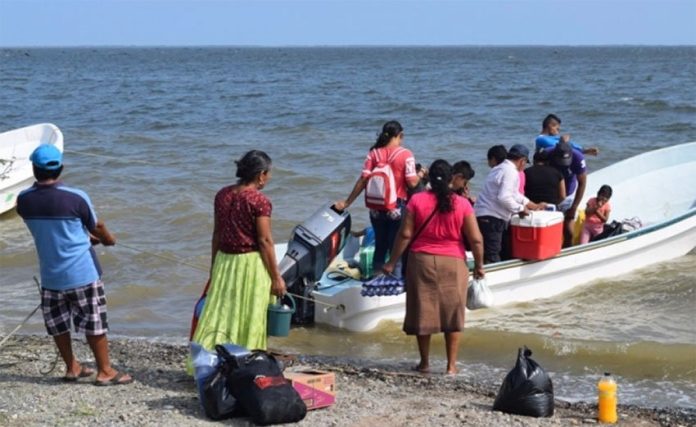
Santa María residents board a boat to reach their homes.

The federal government will spend 40 million pesos (US $2 million) to build a solar plant that will provide electricity to the community of Santa María del Mar, an indigenous Huave community in the Isthmus of Tehuantepec, Oaxaca, that has gone without electricity for the past nine years.

Community official Efraín Solano Alinarez said the community had signed an agreement to build the plant with representatives from the National Institute of Indigenous Peoples and the Federal Electricity Commission, the two federal agencies that will share its cost.

Santa María del Mar has been demanding access to electricity from the federal government since the inauguration of President López Obrador on December 1.

For almost 10 years, Santa María del Mar has been engaged in a bitter conflict with neighboring San Mateo del Mar, another Huave community, over access to 1,165 hectares of communal land claimed by both communities.

Near the start of the conflict, residents of San Mateo del Mar cut off the electricity supply to Santa María.

[wpgmza id=”206″]

They have also maintained a blockade on the only highway connecting Santa María to the rest of the state, forcing residents of the latter to travel by boat to reach their community. In 2017, three Santa María residents drowned when their launch overturned in Laguna Superior.

On June 19, 2018, a court issued a definitive ruling in favor of Santa María del Mar, but the conflict has continued, causing problems for Santa María in terms of access to education, health care and food.

Residents are also demanding the federal government build another road connecting them to the rest of the state, as well as a health clinic.

Source: El Universal (sp) NSS Oaxaca (sp)

Guadalajara airport protest resumes; landowners reject appraisal

0
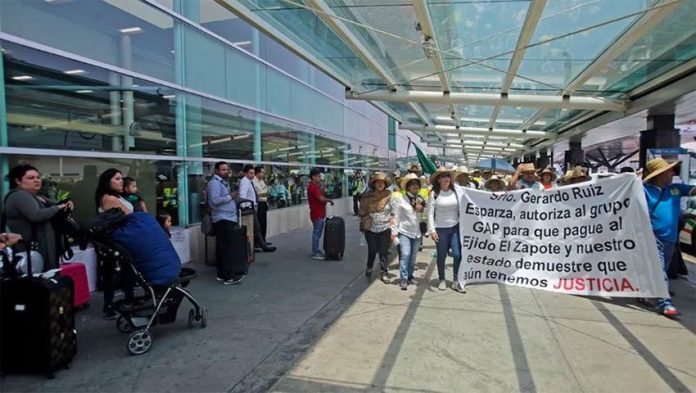
Landowners protest at Guadalajara airport.
Landowners protest in Guadalajara.

Communal landowners in Jalisco are once again protesting to demand “fair” compensation for land that the federal government expropriated almost 70 years ago to build the Guadalajara International Airport.

The El Zapote ejidatarios have protested inside the Miguel Hidalgo y Costilla airport in recent days and maintained a carpark sit-in.

The government expropriated 307 hectares of land for the airport in 1951 although an expropriation decree wasn’t published until 1975.

El Zapote landowners claim they were never adequately compensated for the expropriated land and have maintained that they are still the rightful owners.

Over the years, the ejidatarios have staged scores of protests to pressure the Secretariat of Communications and Transportation to pay them what they say they are owed.

Nicolás Vega Pedroza, a representative for the ejido of El Zapote, told the newspaper El Economista that the current protest is not only to demand payment but also to express opposition to a decision by a federal court in January to appoint Jorge Morett Ramírez as the government appraiser.

Vega accused Morett of wrongfully reducing the amount owed to the landowners.

He said the appraiser valued the land at 1.317 billion pesos (US $68.7 million) but indicated that 600 million pesos must be deducted from that figure because it has already been paid, an assertion that the landowners reject.

They also charge that Morret’s valuation significantly underestimates the true value of the land.

According to appraisals paid for by the landowners, the land is worth more than 3.2 billion pesos (US $166.9 million). The ejidatarios also want an additional 947 million pesos in damages.

“The ejido is willing to negotiate, but something fair,” Vega said.

Source: El Economista (sp) 

Public consultation to decide fate of Sinaloa fertilizer plant

0
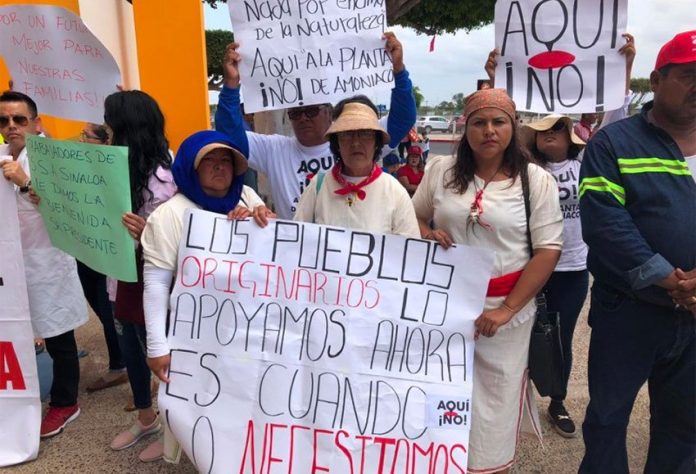
'Not here!' declare signs of protesters awaiting AMLO's arrival in Los Mochis.

President López Obrador said Sunday an investigation will determine whether a fertilizer plant in Sinaloa will “harm or benefit citizens,” but he will leave the final decision on the matter to a public consultation.

The president visited Los Mochis, Sinaloa, where he was greeted by hundreds of people protesting the construction of what the previous federal government described as the “most modern fertilizer plant in the world.”

“We have to analyze this, because in issues like this there are always many interests; I was not born yesterday . . . ” he said.

Construction of the US $5-billion plant in Topolobampo began in August last year, just over a year after the federal environmental protection agency reversed an earlier ruling to shut it down.

Three months later, work on the site was suspended by a judge after the Yoreme people living in the region accused the developers of neglecting to consult and inform them about the project, as mandated by law.

In March, a federal judge issued another suspension order over possible effects of the plant on the Santa María, Topolobampo and Ohuira lagoons.

The company building the plant, Gas y Petroquímica de Occidente (GPO), insists that it has complied with all the requirements of the law. It would produce 770,000 tonnes of ammonia and 700,000 tonnes of urea per year for the domestic market.

Source: El Universal (sp)

Homicides up again in Tijuana, overwhelming morgue

0
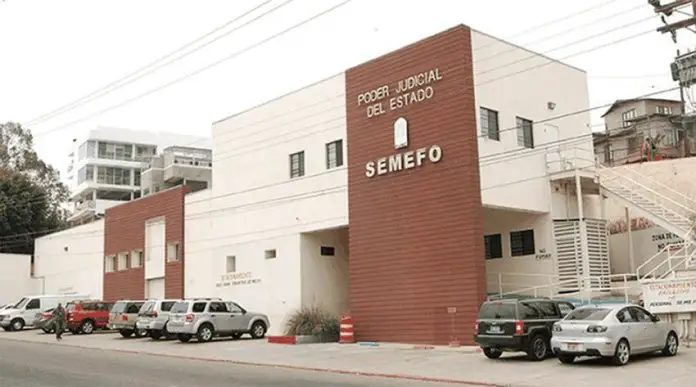
The Tijuana morgue, overwhelmed again.

Despite a decline in homicides in Tijuana following the implementation of a new security strategy in early February, the total number of murders in the northern border city in the first four months of 2019 increased 24% compared to the same period last year – and the morgue is once again overwhelmed.

There were 633 homicides in the Baja California border city between January and April, according to the National Public Security System, compared to 481 in the first four months of 2018.

Tijuana’s morgue – equipped to store 100 bodies – is currently holding 230.

“We have too many bodies here,” morgue director César González Vaca told the newspaper Milenio.

“We’ve had very high increases year over year and we’re overwhelmed . . . Just in 2018, we had 4,300 admissions [of bodies], which by far exceeded the quantities of other years. There has been a growth in admissions of between 500 and 700 bodies every year,” he explained.

tijuana morgue
There was a surplus of bodies in the morgue a month ago. Today it’s worse.

In January, the reality faced by the morgue was shown starkly in a photograph that circulated on social media.

The disturbing image, which was compared to photos taken in Nazi extermination camps, showed a pile of naked and bloody dead bodies with their legs contorted and tangled together.

González acknowledged that the image was “chilling” but added that it was also “real.”

In addition to a shortage of space, the Tijuana morgue lacks basic materials and equipment.

“We need X-ray machines but also the most basic things: gloves, scalpels . . . chisels to open up skulls . . . stretchers, cold room equipment and especially personnel and software that helps us to [provide] attention to families that come to look for their disappeared relatives,” González said.

Long lines of people searching for their missing loved ones arrive at the morgue every day.

However, photographs and details of the bodies at the morgue aren’t stored on a computer but rather in so-called “books of death.”

The rudimentary corpse register is far from foolproof.

Photocopied photographs of Jonathan Zavala, a 25-year-old man who was murdered and dismembered by a criminal gang in June last year, were included in the “books of death” for more than seven months.

The man’s father perused the books no less than seven times but failed to identify his son.

“My son was in the photographs the whole time but they’re not clear . . . they didn’t look anything like him,” Marcos Zavala said.

He eventually found out in February that Jonathan’s remains had been buried in a common mass grave shortly after arriving at the morgue, a fate that befalls most unidentified bodies.

González explained that the haste with which unidentified bodies are buried is due in large part to the severe overcrowding at the morgue.

After finding out that his son was buried in one of more than 60 common graves in Tijuana, Marcos Zavala was determined to have his remains exhumed.

“I started asking around in funeral parlors to find out how much they’d charge me to remove him and they wanted around 50,000 pesos [US $2,600], 5,000 for each body that was above my son and another 5,000 to get him out,” he said.

Zavala said that state authorities offered to pay the exhumation expenses but ultimately failed to fulfill their promise. Once funeral costs were added, he was left 60,000 pesos out of pocket.

Still, Zavala is happy that he was finally able to locate his son and give him a proper funeral. He advised other people searching for their loved ones to “open your eyes very wide” – especially when looking through the “books of death.”

Source: Milenio (sp) 

Rojos plaza boss suspected of recruiting police arrested in Morelos

0
Rojos plaza chief Vázquez.

Federal Police have arrested a man they say is a leader of the Los Rojos cartel in southwestern Morelos, where he is suspected of having recruited a network of police officers.

José Ignacio Vázquez Calderón, also known as “El Machín,” faces charges of organized crime, extortion and kidnapping.

Federal prosecutors say he is a member of the inner circle of cartel leader Santiago Mazari Hernández, also known as “El Carrete.” They say they have evidence that Vázquez visited Mazari on several occasions.

Working under Los Rojos plaza boss Manuel Peralta Jaime, Vázquez extorted businesses and local governments and was in charge of a cartel cell that hung narco-banners. Peralta was arrested last May in Zacatepec.

Vázquez is also accused of recruiting and managing a network of corrupt police officers in Morelos who would warn gang members about police operations.

Police located Vázquez with the help of the National Intelligence Center. He was taken into custody in Xochitepec without incident.

Los Rojos is a criminal group that operates mostly in Morelos and Guerrero. According to Morelos officials, fighting between Los Rojos and the Jalisco New Generation Cartel is the cause of much of the violence in Morelos.

Source: Milenio (sp) Excelsior (sp)

Sargassum predicted for Yucatán no longer expected to land

0
Sargassum on a beach at Telchac Puerto, Yucatán.

A mass of sargassum seaweed that was three to four times times larger than Mérida, the capital of Yucatán, was initially forecast to land on the state’s coast on the weekend.

But authorities said yesterday such an occurrence was unlikely.

The Cancún-based sargassum monitoring network predicted that the mass of macroalgae could be pushed toward the Yucatán coast by southerly winds blowing from the Gulf of Mexico, along with ocean currents.

The report also stated that the seaweed could affect more than 120 kilometers of coastline.

Yesterday, the state Sustainable Development Secretariat said the possibility was “very remote.”

It predicted the sargassum will be taken away from the coast in a northward direction toward the Florida peninsula.

Some areas of Yucatán have seen sargassum on the beaches, but nothing comparable to the situation in the neighboring state of Quintana Roo.

Source: El Financiero (sp), El Diario de Yucatán (sp)