Luxury SUVs will go to the National Guard or be auctioned off: AMLO.
Two luxury SUVs gifted to the Mexican government by the King of Jordan will either be sold at auction or given to the National Guard, President López Obrador said today.
“Whether two vehicles – of the most extravagant kind you can imagine – will be sold or given to the National Guard is under review,” the president told reporters at his morning press conference.
“[They are] two vehicles that the King of Jordan gave to the president’s office and which we didn’t know existed but now they’ve appeared,” López Obrador said.
Although it is unclear whether they will go under the hammer, the president said the two SUVs will be put on display at the government’s second luxury vehicle auction, which will be held at the former presidential residence, Los Pinos, on May 26.
Around 30 million pesos (US $1.5 million) in revenue that the auction is expected to generate will fund a national anti-addiction strategy, López Obrador said.
The president explained that his newly created “Robin Hood” agency – the Institute for Returning to the People What Was Stolen – will organize the auction.
The same agency, he added, will be responsible for selling properties seized from corrupt politicians.
Future money raised by selling off seized assets will be given to the poorest municipalities in the country, where residents will decide how to spend it, López Obrador said.
“The public should decide if it’s invested in roads, on improving schools or on the many other needs that the forgotten people of Mexico have.”
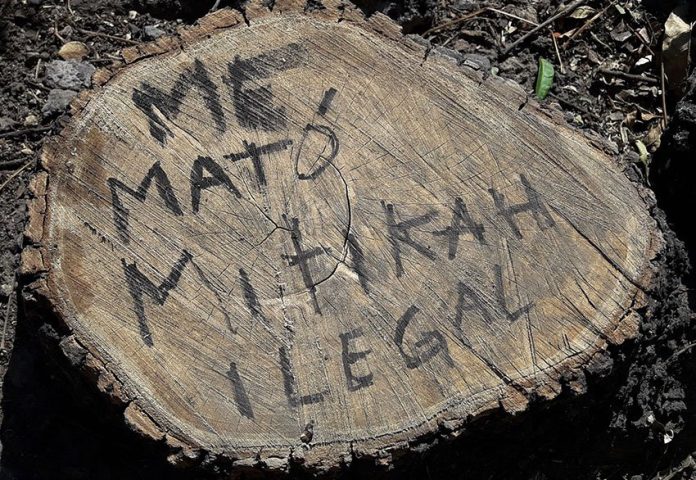
'Mitikah killed me,' reads the stump, once a tree that had to come down for a new commercial center.
Real de Mayorazgo is a narrow, winding street that takes you through Colonia Xoco, a Mexico City neighborhood that feels like a quaint pueblo in the middle of a bustling metropolis.
It is the home of the Cineteca Nacional, where you can see movies from around the world for 50 pesos or less. It’s also home to dozens of shops, street vendors, three EcoBici bikeshare stations, and at its western end, the Coyoacán Metro and Centro Coyoacán shopping center.
There’s a constant flow of people squeezing past each other on its small sidewalks.
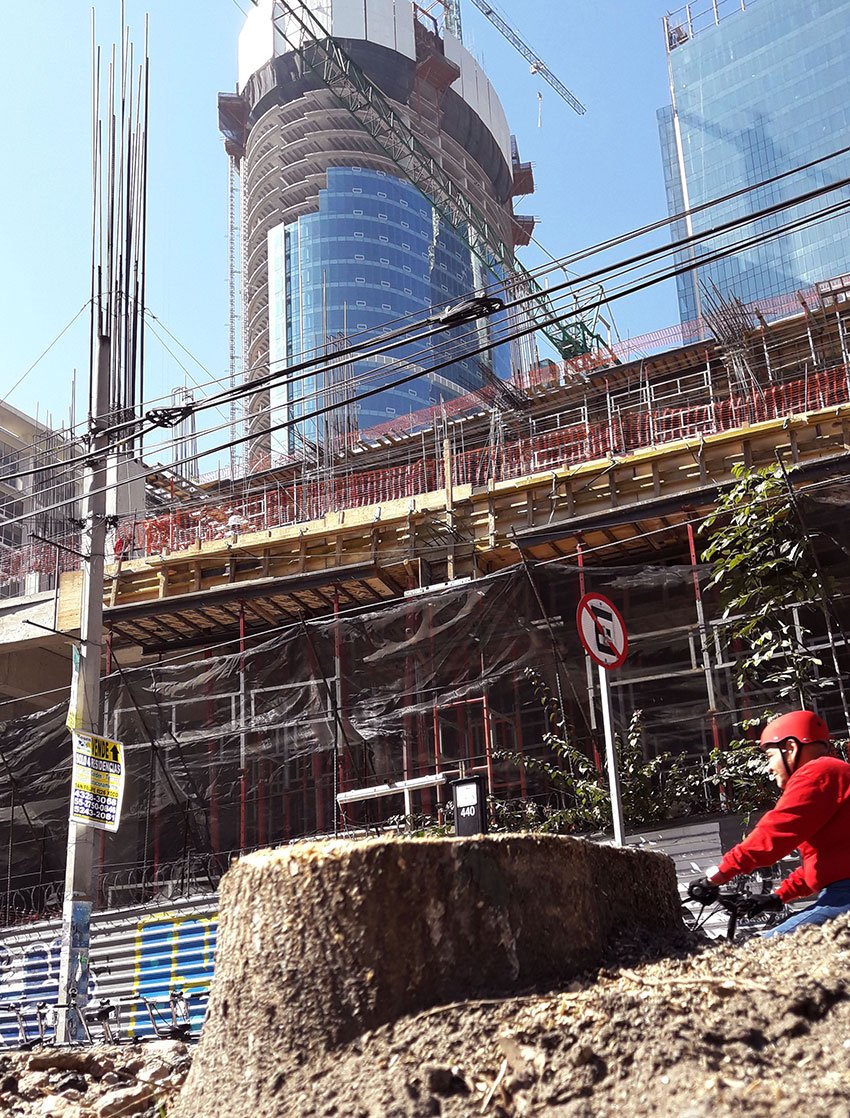
On Saturday, May 4, employees of the new luxury tower Mitikah illegally cut down 58 trees from Real de Mayorazgo. Their plan is to construct a parking ramp beneath the street.
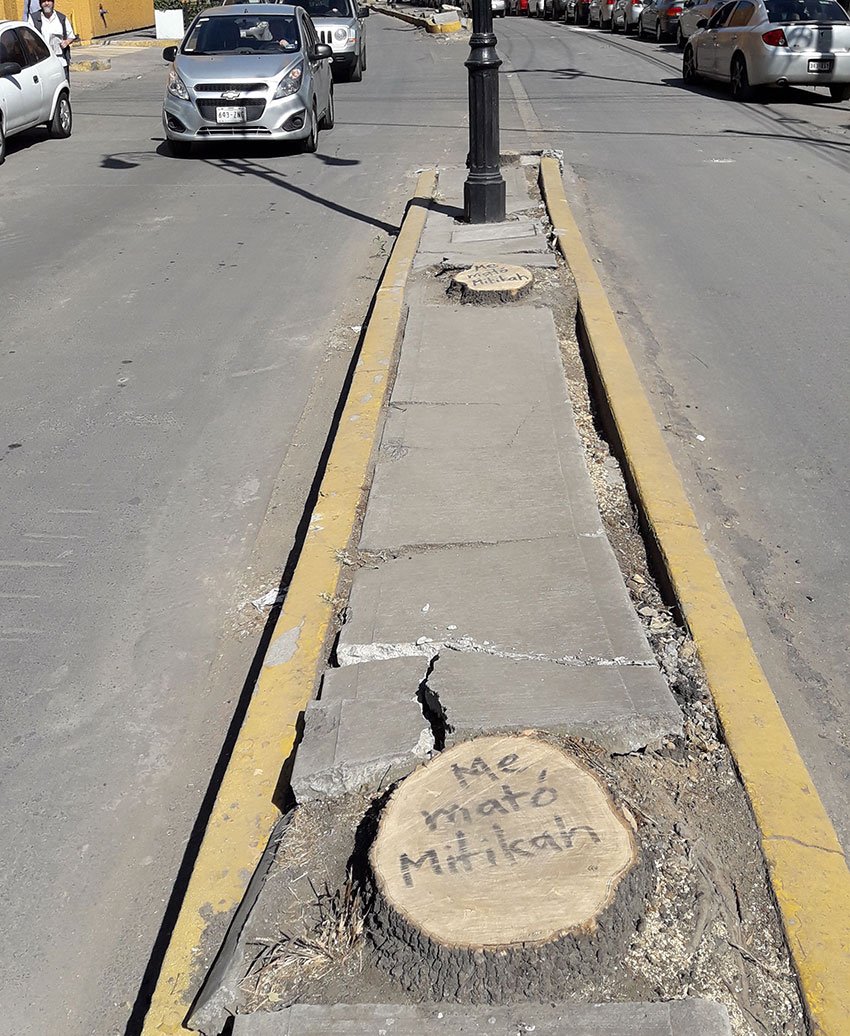
If you walk down Real de Mayorazgo now, the first thing you notice is the sun. What was once a pleasantly shady promenade is now a blazing hot stretch of sun-baked concrete. The stumps, ugly reminders of the 80-year-old trees that once stood, are witness to Mitikah’s actions.
As the tower rises so the trees come down.
Someone has scrawled “Mitikah killed me” on each one with a black Sharpie. Other neighbors have left flowers, as one would in a cemetery.
The construction of a new luxury tower in Xoco has been controversial from the start. Walking around the neighborhood, you find dozens of printed signs that read “Mitikah: There is no roadway, no water and no more space! Neighbors of Coyoacán: spread the word!”
Apart from the noise and the traffic that come with a large construction project, the neighbors fear for their water supply. Mexico City’s water problems have been felt here many times before, and Xoco residents are not convinced that there will be enough water for them and the tower.
Mexico City has more social infrastructure than just about any other city in the country. This is especially true in the south of the city. Parks, exercise equipment and bike lanes are all placed continually throughout the area. Art installations, like outdoor sculptures, also help make the city more beautiful and walkable.
The simplest and most elegant social infrastructure, however, are trees. Trees are the life of any neighborhood. They give birds a place to nest and sing. Trees provides shade from the blazing Mexican sun. This increases street traffic. More street traffic means more customers for street vendors.
This was especially true on Real de Mayorazgo, where local merchants sold everything from organic coffee and popcorn to lipstick and sunglasses. Many of those merchants have now packed up and gone to shadier streets. Others continue there, wearing large hats and sunglasses to provide some protection from the sun’s damaging rays.
A boulevard of stumps.
Residents of Xoco gathered on the corner of Real de Mayorazgo and Avenida Universidad last week. They carried large signs accusing Mitikah of ecocide and “Xococide,” demanding that the city revoke their construction permits.
Large color pictures of before and after show the marked effect the lack of trees has on this main thoroughfare. Many also blame the borough of Benito Juárez for their slow response and failure to stop the cutting.
While employees of Mitikah claimed they had permits to cut the trees down, they never showed their permits and were allowed to cut down every tree.
The Mexico City government has promised to fine Mitikah up to 50 million pesos (US S $2.6 million) and has jailed the nine employees who cut the trees down.
Xoco residents are not satisfied. Levying fines and jailing the workers who cut the trees on their boss’s orders will not affect the developers. They will continue to fund and develop their luxury tower. The money levied by the government cannot replace the trees.
Mitikah put up a large sign on one of the trailers outside the construction site. At the top, it reads “Mitikah, Living City, contributes to the harmony of its environment.”
There are several paragraphs of text describing planned green spaces and a water collection and filtration system, accompanied by a rendered image of a plaza. At the bottom, large text proclaims, “At Mitikah, our neighbors are our priority. We’re here to listen to you.”
Someone has already defaced the sign. For the residents of Xoco, actions speak louder than words.
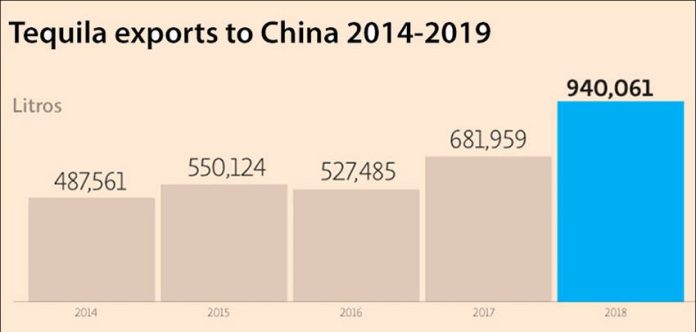
Tequila has been winning acceptance in the Chinese market, driving up exports 38% last year compared to 2017.
According to the Tequila Regulatory Council (CRT), Mexico sent 940,061 liters of the beverage to China in 2018, compared to just 681,959 in 2017.
CRT president Miguel Ángel Domínguez Morales said the dramatic increase is the result of many years of consistent pressure.
“China is a great opportunity for us. First we had to fight to get China to give us the Tequila denomination of origin. We worked our way through nine years of paperwork and traveled there to see government officials.”
Despite the export numbers, the results fell short of the CRT’s expectations, which foresaw China moving up to occupy second place behind the United States as the most important export markets for tequila.
But Domínguez said hopes are high for strong future exports because of China’s taste for strong spirits.
“We have a good relationship with them and we’re looking into how we can push our products even more, because [China] is an incredible market . . . It’s growing at a good pace, and we see a lot of opportunity for growth over there.”
Tequila started its steady penetration of the Chinese market in 2013 when it shipped 524,960 liters after the Mexican and Chinese governments signed an agreement permitting Mexico to export tequila and pork.
Mexico exported 224 million liters of tequila to 120 countries in 2018, up 5.1% over 2017. The U.S. took 82% of that, or 183.8 million liters.
An artisans’ association will seek government assistance in Puebla and Tlaxcala to combat the sale of fake Talavera pottery.
The Talavera Regulatory Council (CRT) will ask authorities in the municipality of Puebla as well as those in San Pablo del Monte and San Miguel Tenancingo in Tlaxcala to provide training to pottery workshops so that they can become certified Talavera makers.
Fernanda Gamboa Serdán, secretary of the organization that represents nine certified Talavera producers, said there are 70 businesses in those three municipalities that make and sell imitation products at cheaper prices, sometimes without telling their customers that they are not buying an authentic piece.
Such businesses represent unfair competition for certified Talavera makers but for decades municipal authorities have done nothing to stop them attempting to pass off their products as the real deal.
Gamboa stressed that the aim of the CRT is not to have the uncertified workshops shut down but rather to help them improve their practices so that they are aligned with formal Talavera production requirements.
She said the only way that can be achieved is with the support of the municipal governments, adding that if the CRT approached the workshops to offer training, it would be rejected.
Talavera pottery with designation of origin status must be produced following strict stipulations that date back 500 years.
Gamboa explained that the certification process takes a year and includes education about things such as appropriate kiln temperatures and which colors are permitted for decorating the pottery.
She said Talavera must be fired at 900 C and can only be painted with six natural pigment colors: blue, yellow, black, green, orange and mauve.
“The Official Mexican Standard [NOM] is clear about the certification process, it can’t be flexible in its requirements but we’re going to support whoever is interested in achieving it so it’s a question of will,” Gamboa said.
Following certification, potters receive holographic stickers that serve as proof of their products’ authenticity, she explained.
The CRT secretary said that accrediting pottery workshops – even if as few as 15 agree to undergo certification – will be an important step forward for the Talavera industry but added that for the initiative to be a success local authorities must support it.
Authorities in Tlaxcala have already indicated that they will support the CRT proposal while talks with the Puebla government will take place after the June 2 state election, Gamboa said.
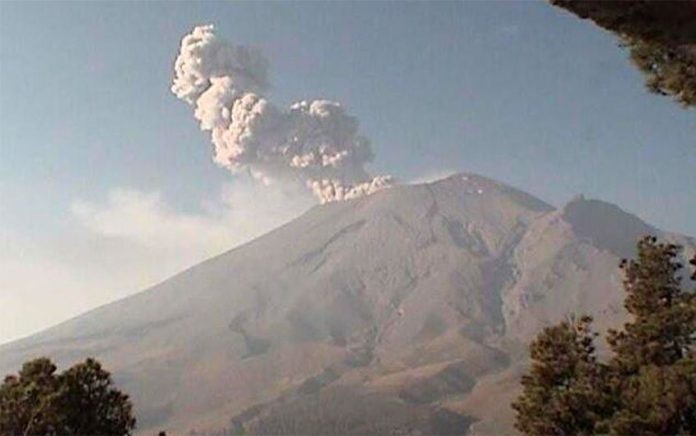
Mother Nature is not cooperating with efforts to reduce air pollution in Puebla: the Popocatépetl volcano erupted twice this morning, sending water vapor, ash and gases into the sky.
The National Disaster Prevention Center (Cenapred) said the first explosion occurred at 8:17am and that a second less intense one followed at 8.31.
A first plume of smoke measuring approximately 1.6 kilometers emanated from the volcano and dispersed towards the northeast while a second smaller one headed southeast.
State Civil Protection said that ash was expected to fall in several municipalities including Puebla, San Pedro Cholula, Atlixco and San Martín Texmelucan.
The eruptions occurred just over a week after the alert level for El Popo was reduced one notch to yellow Phase 2.
Cenapred warned the public to not approach the volcano and especially its crater due to the danger of falling ballistic fragments. A 12-kilometer “security radius” around Popocatépetl remains in place.
Guillermo Pacheco, interim governor of Puebla, said on Twitter that his government is monitoring activity at the volcano in coordination with federal authorities.
“Municipal authorities and the public are informed of Civil Protection protocols. Evacuation routes have been rehabilitated and drills have been carried out,” he added.
Like Mexico City, Puebla is currently suffering from high levels of air contamination caused mainly by recent wildfires in central and southern Mexico.
Pacheco said that he has directed authorities to apply “strict actions aimed at the reduction of contamination in the metropolitan area of Puebla.”
In Mexico City, air quality remains poor despite heavy rain falling in most parts of the metropolitan area last night.
The sprawling, heavily-populated southeastern borough of Iztapalapa was the most polluted part of the capital at 3:00pm today.
The Environmental Commission of the Megalopolis (Came) reminded residents that additional vehicle restrictions implemented yesterday remain in force between 5:00am and 10:00pm.
All schools and many universities in the Mexico City metropolitan area cancelled classes today to help reduce further contamination and health risks for children, who are considered particularly vulnerable to respiratory illnesses.
Severe contamination has lingered in the Valley of Mexico this week as fires continued to burn in and around the capital. High temperatures and a lack of wind have exacerbated the situation.
An Environmental Contingency that was declared in the 16 México state municipalities of the Valley of Toluca – located around 60 kilometers southwest of Mexico City – also remains active.
Air pollution has also affected Querétaro, leading the state Secretariat of Sustainable Development to declare an Environmental Contingency late yesterday in four municipalities: Querétaro, El Marqués, Corregidora and San Juan del Río.
Residents challenge federal authorities in Oaxaca.
Three suspected fuel thieves were released from federal custody after a confrontation between residents of San José Cosolapa, Oaxaca, and agents from the Attorney General’s Office (FGR).
The incident took place yesterday when the federal agents searched several home searches in the commnity of Refugio and arrested the three suspects.
But citizens accused the agents of acting without search or arrest warrants and abuse of power and blocked the route out of town, preventing the agents from leaving.
The residents attacked the federal officials with sticks and stones after which the FGR released the alleged thieves, who then left town.
The Oaxaca state Public Security Secretariat would later report that the National Guard, in charge of patrolling the border with Veracruz, has taken over the case and will attempt to capture the three suspected criminals once more.
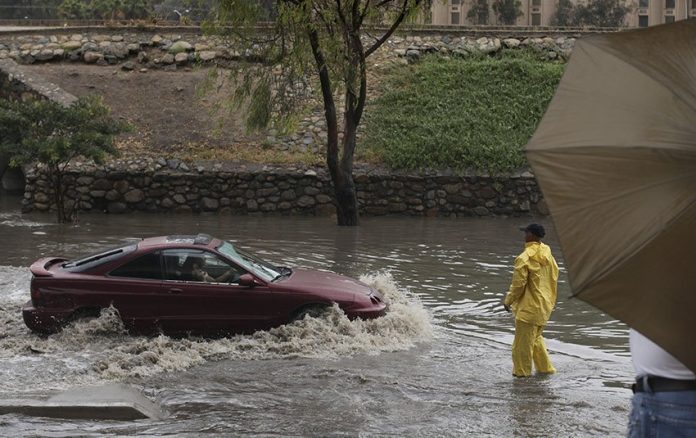
Hurricanes can bring heavy rainfall in addition to strong winds.
A new forecast predicts there will be 19 hurricanes during this year’s Pacific and Atlantic hurricane seasons.
The National Water Commission (Conagua) is forecasting 33 tropical cyclones for both coasts.
The agency expects 11 hurricanes and eight tropical storms on the Pacific coast, and eight hurricanes and six tropical storms for the Atlantic-Gulf of Mexico.
The number is above the historic average, although still lower than the total in 2018, which Conagua described as “atypical.”
Specialists also expect hurricanes this season to be stronger than last year, and reach categories as high as the maximum of 5 on the Saffir-Simpson scale.
The Pacific hurricane season began Wednesday and the Atlantic hurricane season begins June 1. Both end on November 30.
Jalisco is one of five problem states for corrupt judges according to a map of corruption allegations against federal judges and magistrates across the country.
Since the previous federal government, the Supreme Court has been focused on the issue in Jalisco, where corruption cases, collusion between officials and organized crime and sexual and labor harassment have been a problem for the federal judicial branch.
Late last year then-Chief Justice Luis María Aguilar Morales presented a map detailing judicial corruption allegations, identifying Jalisco, Puebla, Veracruz, San Luis Potosí and Zacatecas as “red flags.”
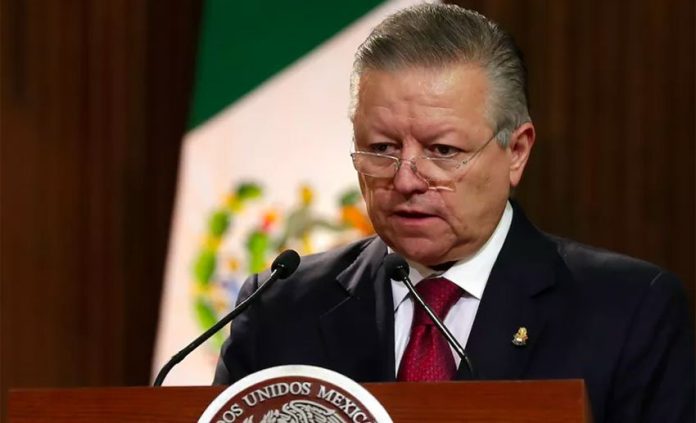
Current Chief Justice Arturo Zaldívar Lelo de Larrea has focused on addressing corruption in the third circuit in Jalisco, which has been considered a center for corruption for at least eight years, when investigations of judicial officials were first ordered.
But in spite of the investigations, judicial corruption is still rampant in the state.
On May 3, the chief justice told El Universal that a “renewal” was under way in the third circuit, which includes investigations, disciplinary actions and reassignments of federal judges and magistrates.
“We think reassignments are important to bring in new blood,” Zaldívar said.
The judicial branch is also collaborating with the Financial Intelligence Unit (UIF) to detect irregularities in the income of federal officials.
The UIF recently froze 50 million pesos (US $2.6 million) in bank accounts belonging to a federal magistrate who is accused of giving favorable rulings to members of the Jalisco New Generation Cartel (CJNG). According to Reforma, the magistrate is Isidro Avelar Gutiérrez.
Last April, Senator Ricardo Monreal accused Avelar of having met with relatives of Nemesio “El Mencho” Oseguera Cervantes, leader of the CJNG, and having ordered the release of his son, who was accused of money laundering and organized crime.
Avelar is one of those judges who have been reassigned. He is now working at a federal court in Chilpancingo, Guerrero.
Sources told El Universal that judges and magistrates accused of corruption are reassigned when there is not enough evidence to open a formal investigation against them. Once an investigation is opened, they must be suspended.
Between 2017 and 2018, the Supreme Court ordered 36 disciplinary proceedings against federal judges, magistrates and secretaries, of which seven were in Jalisco.
There was good news today for President López Obrador, whose optimism over Mexico’s financial outlook is not shared by many economic analysts — foreign investment is up.
The president told reporters this morning that Foreign Direct Investment was up 6.9% in the first quarter compared to the same period last year.
According to the Secretariat of Economy, the first three months of this year saw Mexico capture a total of US $10.16 billion.
With 36.7% of the total, the manufacturing sector captured the greatest portion of investment, followed by financial services and insurance at 23.8%.
The United States continued to be the largest source of foreign investment, with 43.1% of the total. Spain was second, contributing 13.8% of the total, followed by Belgium with 6.9% and Canada with 5.8%.
Reinvestment of profits was the principal origin, responsible for 83.4%. New investments represented 22.5%.
President López Obrador’s chief of staff said in March that Mexico should aim for as much as $40 billion a year in foreign investment.
The president, a frequent critic of ratings agencies and analysts who have not been swayed by his upbeat outlook, described the investment figure as “a good sign. Let’s see what the experts say . . . I don’t see any financial problem.”
The Pueblos Mágicos program will once again receive government funding after it was suspended late last year.
At a tourism fair in the city of Zacatecas on Wednesday, Tourism Secretary Miguel Torruco Marqués announced that each of Mexico’s 121 Pueblos Mágicos — or magical towns — will receive 2.5 million pesos (US $131,000) from state and federal governments over the next year.
The funding, which will be split between the two levels of government, totals 302.5 million pesos (US $15.8 million), rather less than the 586 million pesos provided by the government in 2018.
The funds are intended to improve buildings and roads, as well as for beautification efforts like street sweeping and painting. Torruco said that the funding will start in the middle of this year.
“We’re going to paint all of the Pueblos Mágicos in coordination with state and municipal governments, and you will see our Pueblos Mágicos become more beautiful over the course of this year and the first half of next year,” he said. “And we are also working on other projects, like complementary tourism products. There will be good news very soon.”
Torruco added that based on the first 150 days of the López Obrador administration, Mexico is the seventh-most-visited country by international tourists, and that between January and March of this year, 11.1 million tourists visited Mexico, a 4.8% increase compared with the same period in 2018.
As part of the federal government’s austerity policy, funding was suspended late last year for the Program for Sustainable Regional Tourism Development and Pueblos Mágicos, provoking complaints from local authorities who rely on the funds for infrastructure maintenance and improvement. The designation of new magical towns was also suspended.
The Pueblos Mágicos program was founded in 2001 to promote tourism in the cities and towns recognized as having unique cultural and historical attributes.