Children’s Day was widely celebrated Tuesday, particularly in Veracruz where the the Jalisco New Generation Cartel (CJNG) joined in the fun.
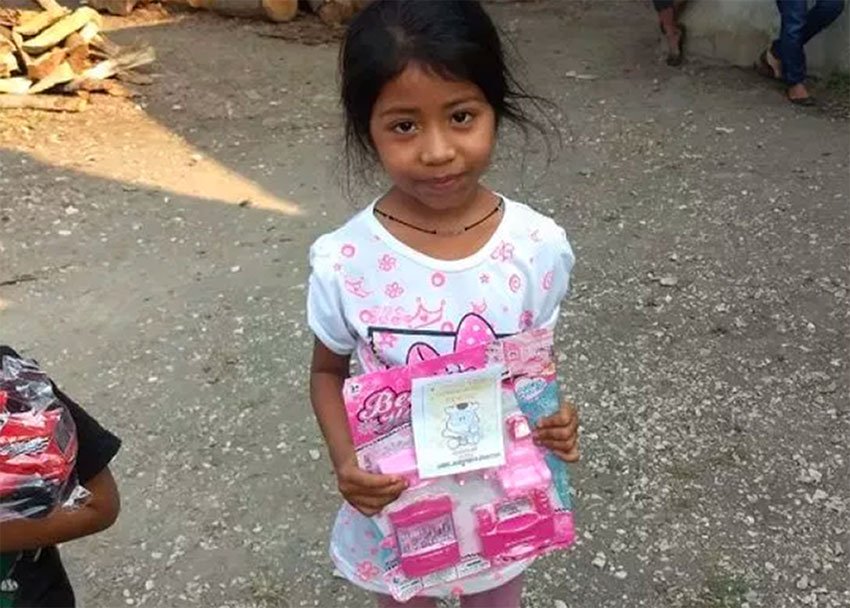
Toys were handed out to poor children in 15 municipalities in the mountainous central region of the state, presumably by the notorious drug cartel.
Accompanying each bag of gifts was a card that read, “The CJNG wishes you a happy Children’s Day.”
While its members were delivering the gifts, the criminal organization issued a statement on social media to announce that it had taken on the task of delivering gifts to “the towns most forgotten by the authorities.”
“We bring a moment of joy and happiness to the children. The Jalisco New Generation Cartel not only looks after the safety of the people of Veracruz, it also seeks to give support to those who need it the most,” continued the statement.
A girl in Veracruz with her cartel gift.
The cartel’s job, it said, “is to look after and defend the rights of the working people” and prevent others from harming society. “We are here, steadfast and ready.”
The CJNG also handed out gifts in January in celebration of Kings’ Day. Another gang, Grupo Sombra, gave away food and beverages just before Christmas in Tuxpan and Poza Rica, while the Sinaloa Cartel has engaged in gift-giving in the state for which it was named.
The practice appears to be a part of efforts by organized crime to recruit new people. Security Secretary Alfredo Durazo said last September, before he took up his post, that at least 460,000 young people were employed by criminal gangs, according to estimates by various civil organizations.
The figure is well over an estimate of 30,000 by the Inter-American Human Rights Commission (CIDH) in a 2015 report, which said children are recruited from the age of 10 or 11 to traffic in drugs, arms or people and commit other crimes such as assault and kidnapping.
The offer of money, a job and drugs makes it easy for cartels to find recruits among youths living on the street with little to occupy their time and little chance of bettering their condition, says the head of the school of law at the University of Guadalajara.
Editor’s note: Some readers have wondered why subjects’ faces are often obscured in some photos. Mexico News Daily relies on various sources for photographs, many of whom choose to mask the subjects’ identities. We only publish those photos when an unmasked version is not available.
The anchor found off the coast of Veracruz in the search for Cortés' ships.
Could an anchor half buried in the ocean floor off Veracruz be part of the wreckage of one of the scuttled ships of conquistador Hernán Cortés?
The Spanish adventurer had two options in 1519: face mutiny or quell a rebellion by scuttling 10 of his 11 ships, which would give the crews no option but to move inland with him toward the heart of the Mexica empire.
This week, that project, headed by archaeologist Roberto Junco Sánchez and anthropologist Chris Horrell, made its first significant find — an anchor dating back to the 15th century with wood still attached to it, identified as being a type of oak found only in northern Spain.
Junco, head of the Underwater Archaeology Project at the National Institute of Anthropology and History (INAH), explained that the anchor was found just 12 meters below the surface, all but covered by sediment that helped keep the piece in good condition.
Preliminary analyses of the wood have been used to date it, narrowing it down to two periods of time, either from 1417 to 1492 or from 1450 to 1530.
The data is still not enough to link the anchor to one of Cortés’ ships, explained Junco, or with the ships of other Spanish explorers.
The anchor remains where it was found, but experts continue to analyze it using a three-dimensional reconstruction. The plan is to remove and stabilize it in order to guarantee its conservation.
The researchers’ work continues as they prepare a proposal for a second season of exploration season.
The search employs a magnetometer and sonar among other technologies to locate possible parts of the ships.
“The project is in its initial stages. We have before us many more hours of diving and visiting the sites marked by magnetic anomalies, and determining if those correspond to historical or contemporary objects,” said Junco.
The area under exploration is off Playa Villa Roca, about 75 kilometers north of the city of Veracruz.
AMLO is not worried by slow growth in first quarter.
Dismissing the news that the economy contracted by 0.2% in the first quarter of the year, President López Obrador said today the economy “is doing very, very well.”
The national statistics agency said yesterday the first quarter represented the worst economic start to the year in 10 years.
The president charged this morning that “conservative analysts” are trying to argue that the government is not functioning.
“Our adversaries are betting that things are going badly, day in and day out. They’re talking about economic stagnation, that the government is not working. In fact, we are doing well, very well.”
López Obrador recommended that experts and conservative analysts remember the first quarter of ex-president Ernesto Zedillo, who faced what has been called the worst economic crisis in Mexico’s history.
Zedillo governed from 1994 until 2000 and presided over the Mexican peso crisis in his first month in office.
“I would just like to remind you of the first quarter of the Ernesto Zedillo administration when the economy shrank by 7%. Even so, the conservatives consider that administration a success . . . . So, bravo! We’re doing very well.”
However, not as well as the last three presidents. Annual growth from January till March was 1.3% this year, but under Enrique Peña Nieto the economy grew 2.7% in the first quarter. For Felipe Calderón it grew 2.2% and for Vicente Fox, 1.8%.
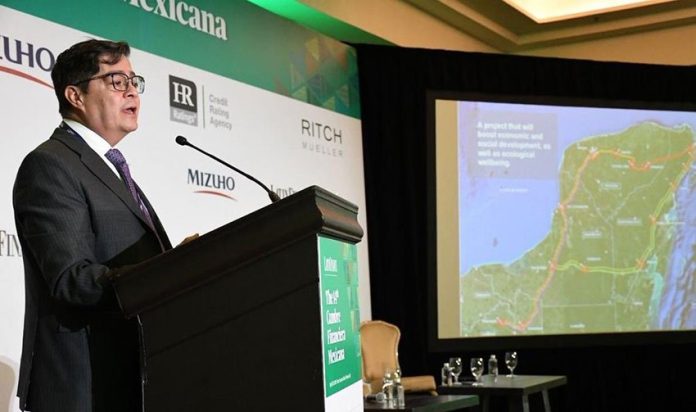
Fonatur director Varela at the launch of the tender process.
Starting the bidding process on the Maya Train project is valid even though the consultation of indigenous communities has not been completed, President López Obrador said today.
Replying to questions after the National Tourism Promotion Fund (Fonatur) announced bidding conditions and specifications yesterday, the president said he felt confident that the indigenous communities wanted the project to proceed.
“All of the legal proceedings are being followed in each case, and where the consultation is needed it will be carried out. It’s valid [to begin the tender process] because the majority of the people in the indigenous communities support this plan.
“Of course, there’s some dissent, and it should be respected, but the majority decides in a democracy; the minorities are respected, but it’s the majority that gets the chance to decide in the end. This is what is being done.”
López Obrador said the consultation on the project’s fate will be carried out according to the law. Responding to another frequent criticism of the project, he charged that those who opposed the Maya Train on the grounds of environmental degradation had been silent during decades of “neoliberal economic policies” that had also harmed the environment.
“Where did all these environmentalists come from? When did they oppose, for example, the construction of the airport on Lake Texcoco, which meant the destruction of Lake Nabor Carrillo? Did any of you read reports of anyone against it in the elitist media? Nothing.”
He added that the new administration’s transparency has opened it to disingenuous attacks from critics.
“But now that we’re the government and we have different positions and everything is, I repeat, legitimate, they all start in: have you completed the consultation? Since when have the conservatives defended indigenous communities?
“The truth of it is that they’re all very racist and classist, but they do have the right to express themselves, just as we have the right to communicate our points of view.”
Fonatur legal director Alejandro Varela said on Tuesday that the consultation of indigenous communities on the Yucatán peninsula should be carried out in September. He said the process was complicated by the region’s linguistic diversity.
“We must make sure they understand the project.”
He said publishing bidding specifications is the first stage of the project, in which as many as 4,000 questions are expected from prospective bidders.
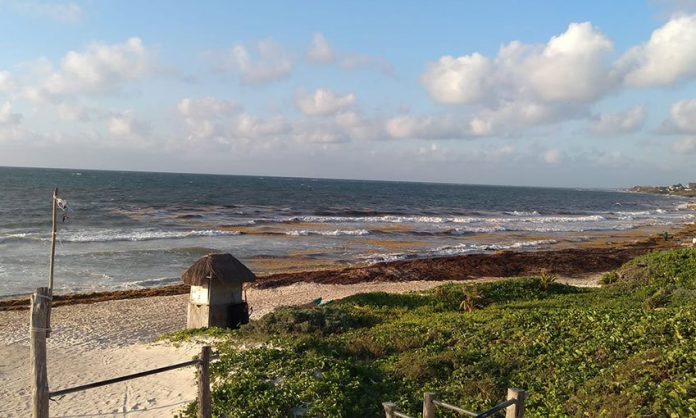
A huge tide of sargassum has once again invaded shores of the Caribbean, including some of Mexico’s most popular beaches.
But despite the magnitude of the problem, the federal government has not allocated the funding that has been requested to deal with it.
According to the Cancún sargassum monitoring network, 30 countries, territories and protectorates are forecast to receive massive amounts of sargassum, including Mexico, the United States, Cuba, Honduras, Costa Rica, Nicaragua, Guatemala, Belize, Colombia, Panama, Haiti, Puerto Rico, Dominican Republic, Jamaica and the Bahamas among others.
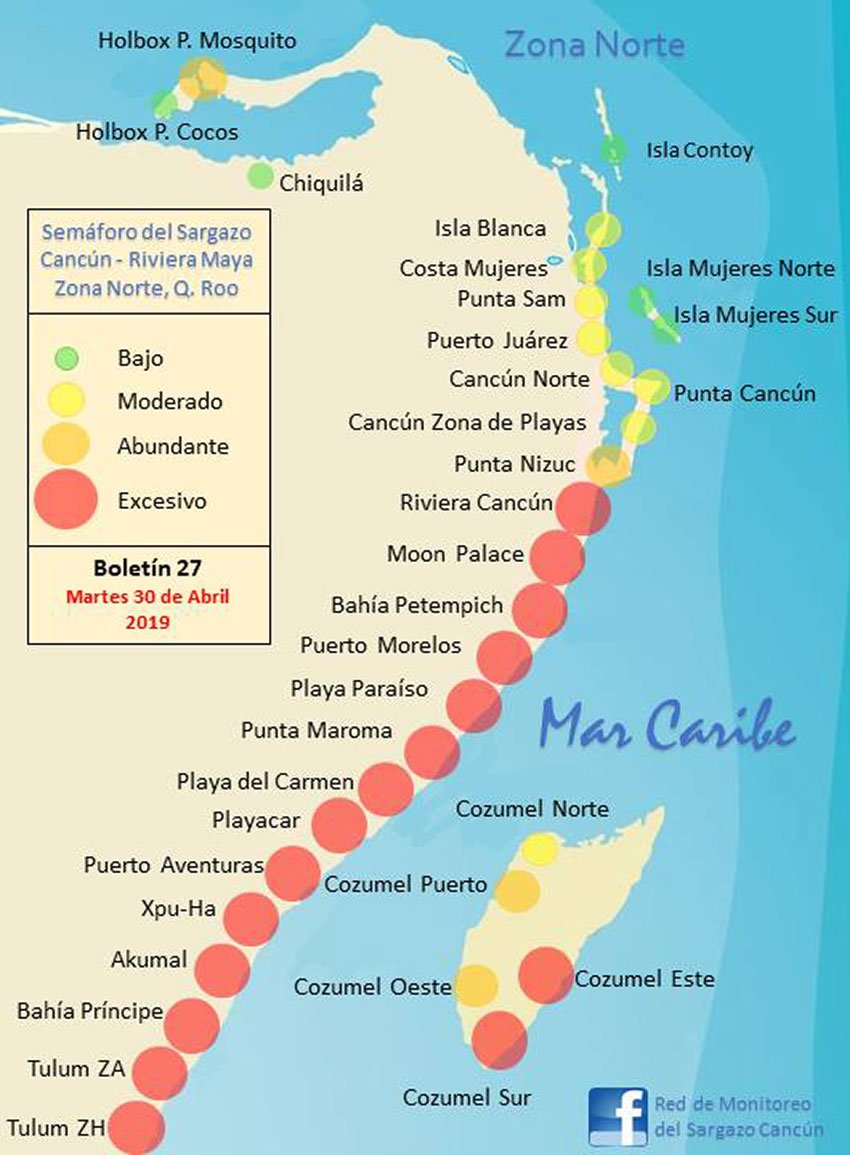
So far in Mexico, the beaches of the Riviera Maya in Quintana Roo have been the hardest hit, including Playa del Carmen, Tulum, Cozumel, Puerto Morelos the Sian Ka’an Biosphere Reserve, Othón P. Blanco and Bacalar.
Cancún Mayor Mara Lezama said the sargassum problem was especially serious because of how quickly the macroalgae often accumulates on beaches within just a matter of hours.
Sargassum conditions as of Tuesday morning, from low to moderate, abundant and excessive and indicated in green, yellow, orange and red.
Quintana Roo Governor Carlos Joaquín González has said that addressing the phenomenon is a federal matter, but the state’s requests for 405 million pesos (US $21 million) to set in motion a strategy to remove the incoming sargassum before it reaches the shore have gone unanswered.
On Monday, Cancún and Puerto Morelos Hotels Association president Roberto Cintrón, together with other local tourism industry leaders, met with the Senate to call for funds to deal with the “sargassum nightmare,” citing the seaweed’s arrival as a serious threat to tourism and the productivity of businesses in related industries.
Quintana Roo Senator Mayuli Martínez Simón urged her fellow lawmakers to create a committee to specifically deal with the sargassum problem. She also suggested changes to the law to allow the government to declare sargassum an emergency or a natural disaster, which would in turn free up funding to deal with the problem.
Senator José Luis Pech, also from Quintana Roo, agreed with the urgency of assigning funding to the problem but urged his companions to create mechanisms for transparency within any legislation that provides money for relief efforts.
Querétaro Senator Freyda Maribel Villegas Canché said sargassum also threatens the fishing industry in the Caribbean, as well as the financial stability of the many families whose income depends on the tourism industry.
A man was attacked and killed yesterday evening by a swarm of Africanized honey bees in Chetumal, Quintana Roo.
The incident took place at around 5:00pm when the victim was cutting firewood and accidentally disturbed a hive, according to witnesses.
The man managed to escape an initial attack but was not so lucky when he returned to the scene to retrieve his cargo trike and tools. The second bee attack proved fatal.
He sustained at least 500 stings.
Two other people were also attacked by the bees, but there was no report on their condition.
Firefighters arrived at the scene and removed the hive.
Peimbert, left, has accused Ruiz of crimes against humanity.
Oaxaca’s human rights ombudsman is ready to present evidence of government repression in Oaxaca before the International Court of Justice.
Arturo Peimbert Calvo said his office will file charges of crimes against humanity and present the results of investigations into several acts of alleged repression committed by the state and federal governments in 2006 and 2007.
He said a formal investigation by the World Court into the actions by ex-governor Ulises Ruiz Ortíz and senior police and military officials could follow.
“Crimes against humanity like forced disappearance, torture, improper imprisonment and political crimes have no statute of limitations, and we bring these cases before international authorities in order to give the victims justice,” said Peimbert.
The cases to be presented include repression against activists with the Popular Assembly of Peoples of Oaxaca (APPO) and teachers with the CNTE union’s Oaxaca local Section 22 in 2006 and 2007, as well as the disappearance of several activists, including Edmundo Reyes Amaya and Gabriel Cruz, of the Popular Revolutionary Army (EPR).
Peimbert claimed that such repression continues in Oaxaca and elsewhere in Mexico to counter social protests.
The case was originally filled with the court in March of last year, when Peimbert accused ex-governor Ruiz of crimes against humanity.
Ruiz, who governed the state between 2004 and 2010, is one of several members of the Institutional Revolutionary Party (PRI) vying for the leadership of its national executive committee.
He has alleged that corruption scandals involving ex-president Enrique Peña Nieto caused the party’s rout in last year’s elections.
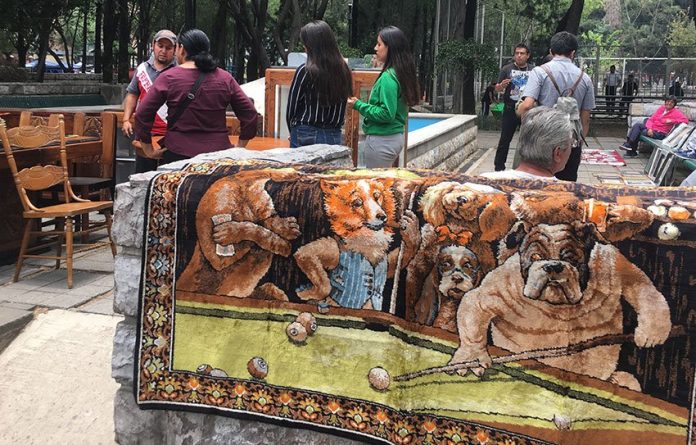
The author's new rug, purchased at the antiques market in Colonia Doctores.
Every Saturday and Sunday at Jardín Dr. Ignacio Chavez in Mexico City’s Colonia Doctores, the Tianguis de Antigüedades is a laid-back scene.
Crowds meander through the park, thoughtfully surveying the goods as romantic ballads and salsas play from some of the many vintage radios and turntables up for sale.
The merchandise ranges from cheap trinkets to genuine collectible treasures on this stretch of Avenida Cuauhetémoc, a space that only became a park after the Cine Internacional and government building were destroyed in the 1985 earthquake.
Vendors hang out together or with similarly-minded collectors, sharing photos of recent finds on their phones, smoking cigs, and sipping the occasional beer semi-hidden under a table or chair.
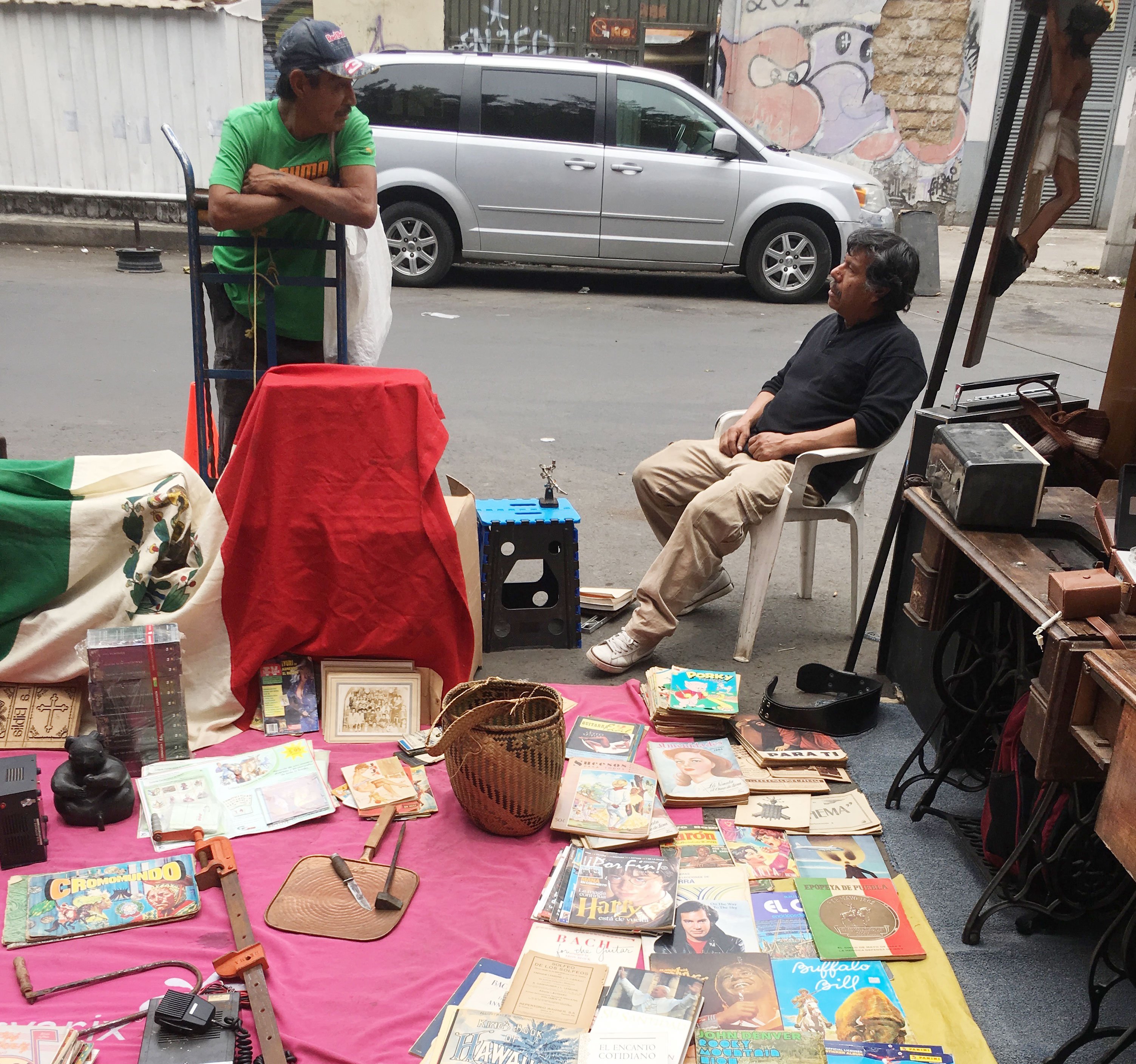
There is military paraphernalia from around the world (somewhat disturbing that it’s mostly from the Nazis), coins and pins, train sets and toy collectables, beautiful jewelry and china, vintage magazines and depraved comedic cartoon art.
As I sit taking notes, a vendor chats me up. “Are you writing in English or Spanish?” she asks.
She looks like a protective auntie in her cap with a neck flap and a sensible cotton button-down. She sells these flap hats, along with a hodgepodge of books, candle lanterns, tea sets and toy farming equipment.
“Sales are slow these days,” she says. “When there are people it’s good, but when there’s no one, it’s bad. Everyone’s on vacation right now. It’s usually really full.”
Lidia Huerta, it seems, was searching for someone to chat with. “Foreigners, when they like something, they just buy it. The peso is low for them. For Mexicans, it’s more about the price. People don’t have money to pay for things. Kids want to have fun and parents have to pay for all of it.”
“People with two legs and two arms should work,” she continues. “Mexicans like to work. But some people don’t want to.”
“You know what colonia we’re in?” she asks.
Classic to kitsch all laid out together at Jardín Dr. Ignacio Chavez.
“Doctores?” I say.
“Yeah. This is Doctores. Right over there is Roma,” she says, pointing west across the park.
“This way,” she says, pointing the opposite direction. “It’s not very good over there. A lot of criminals. Be careful in Mexico.”
I dutifully tell her that I’ll watch out for myself and move on through the market.
Three generations sit together behind a row of tables offering vintage shoes and jewelry, expertly cracking pumpkin seeds while they make deals. It’s the kind of place where vendors enjoy the haggle. As far as I can tell, it’s usually padded into the price. You won’t always get the price you want, but sellers enjoy dickering so much that they might just do it for you.
I ask a vendor about his stuffed anteater. It looks like it’s been in a scuffle or two since it was first taxidermied but is in pretty good shape.
“One thousand five hundred,” he tells me. “Because some of the claws are missing. They took some off to make necklaces.” He shows me the animal’s left side, the paws completely bare of claws.
“I’ll think about it,” I say.
“They go for like 2,000 to 3,000 pesos in other places. This one’s African. It’s the smallest of the anteater species. One thousand five hundred is a good deal, on account of the claws.”
“I like it, but I don’t think my girlfriend would like it.”
“Mount your mother-in-law on the wall!” a nearby saleswoman yells to the laughter of the crowd.
“I don’t know. I’ll think about it,” I tell the anteater man.
Sometimes hanging out feels just as good as selling at the antiques market.
“You tell me how much,” he says. Then, lowering his voice to a whisper, “Eight hundred. It’s cheap.”
I back out of the situation as another piece catches my eye. And this one is the stereotypical women-hate-it item, the classic “I’m Sam Malone from Cheers watch me toss peanuts into my mouth and talk about bras” kind of artwork: a scene of dogs shooting pool! On a rug!
It’s like a kitsch backflip!
“It’s 1,200,” the man with the rug tells me. “And that’s down from 1,500 because it’s getting to the end of the day. Made in Italy. It’s a collectible. It’s not like I have five or six more of these at home. Look at this stitching. Perfectly made. No stains. Never cleaned. You don’t clean good rugs like this, just beat the dust off them. It’s a great price. Real classic scene, this one. Made in Italy!”
All of this info appears to be true, but I waver. “I’ll think about it,” I say, as I walk away, certain to have baited the trap.
But this guy doesn’t chase me, doesn’t even try to tempt me back with a measly 50-peso reduction. Perhaps he’s better at this than I am.
With a well-tended pushbroom mustache over a handsomely wrinkled face, graying ponytail and bent silver glasses, Francisco Ordulla could certainly be picked out of any police lineup as a vintage LP vendor, and that’s exactly what his position has been here, pretty much since the market’s outset, for 20-something years.
It’s mostly American and British rock from the 60s and 70s on display, but Ordulla doesn’t really specialize in anything. He has classical, jazz, blues and native music from around the world, but most of his returning clients are in search of Mexican rock and psychedelia from the 70s.
“There weren’t as many printed as the American and British stuff, so it’s harder to find,” he says. “Me, I’m always looking for the Italian progressive rock from the 70s.”
He reckons it’s been the last five years or so that LPs have become really collectible in Mexico, so they’re only getting harder to find.
On the north side of the park are some of the larger pieces, big beautiful dressers and mirrors, some of the pricier statues and larger artworks. Lines of old Volkswagen buses, their seats removed for more efficient hauling, watch over their masters on the street behind.
A man with a magnifier stuck in his eye invites me to sit and ask some questions. His name is Javier Gómez and he fixes and sells antique clocks and watches. He’s been at the tianguis nearly every weekend for 25 years. During the week he makes house calls or works out of his house.
While we talk, a man casually hands him a can of New Mix tequila and grapefruit soda. “I owe you one,” Gómez tells him. He says that old stopwatches, watches that chime the hour and wall clocks with moving figures and music are among the hardest to fix. The most expensive pieces he sells are made by the Swiss, of course: Rolex and Patek Philippe.
Across the way, Diego Villegas appears to be one of the youngest and most popular vendors. He’s been selling used video games at the tianguis for five years and says his customers range from 10 to 50 years old.
He deals in most games and consoles, but Super Nintendo cartridges like “Megaman,” “Metroid,” “Donkey Kong,” and “Teenage Mutant Ninja Turtles” are the most popular these days, generally ranging from 100 to 1,200 pesos.
He says the Holy Grail for collectors at the moment is the Little Samson game for the Nintendo Entertainment System (NES) that can run from 50,000 pesos, without the case, to around 180,000 in mint condition. (There’s a slightly worn one for sale on eBay for 65,500 pesos at the moment.)
It’s often difficult to leave the Tianguis de Antigüedades without making at least one purchase. You can most definitely find something small and old for as little as 20 pesos, and I wet my whistle with a UNAM Pumas pin, a Puma skull and crossbones for 40 pesos.
Yet, I still can’t get the rug off my mind. I devise a plan to start low and get to my price (800) incrementally.
“Seven hundred,” I say to the rug guy, blowing it from the outset.
“No. Look here, man. One thousand two hundred was a good deal. Okay, okay, 1,000.”
I stare ahead sternly, rub my face, look to the sky like a man who knows the price of an authentic Italian rug featuring dogs playing billiards. “Okay. A thousand.”
I fork it over, accepting my place in the world of bargainers. He approaches the vendor next to him to borrow a bag for my rug. She hands him the bag, then eyes me standing there.
“Oh, it’s for this guy?” she says. “If I knew it was for the blondie I would’ve charged you for the bag.”
• Tianguis de Antigüedades Jardín Dr. Ignacio Chavez (alternately called Mercado or Bazar de Cuauhtémoc) runs Saturdays and Sundays, 9:00am to 4:00pm, along Avenida Cuauhetémoc between Dr. Liceaga and Dr. Juan Navarro in Colonia Doctores.
This is the eighth in a series on the bazaars, flea markets and markets of Mexico City:
Children’s Day left a bitter aftertaste for more than 600 youngsters who came down with food poisoning during the day’s festivities in various states, principally Veracruz and Guerrero.
Guerrero Health Secretary Carlos de la Peña Pintos said authorities learned of two separate cases in which a total of 408 children and 15 adults contracted food poisoning.
One occurred at a school in Acapulco where students and teachers sat down to a full lunch of beef barbacoa, spaghetti and cake. Later, 317 children were admitted to hospital for treatment; 269 have since been discharged.
In another case, 200 kindergarten students in Mezcalcingo in the municipality of Chilapa fell ill after eating pozole (hominy stew) with pork. Several children were taken to a local hospital emergency ward but authorities reported that their condition had been stabilized.
In a third incident in Zongolica, Veracruz, 100 children were hospitalized with symptoms that included dizziness, vomiting and diarrhea after they were served a special lunch by World Vision, a non-profit humanitarian aid organization.
The children were initially taken to a local public hospital but were later transferred to Orizaba when the number of children requiring urgent care proved to be too great for the IMSS hospital to handle.
Migrants migrate to escape unlivable homelands, such as Honduras.
Sometimes when reading about current events I have the sensation that we’ve been erroneously sucked into some horrible dimension where nothing works the way it’s supposed to and everything is just terrible.
The general humanitarian crisis of millions of people around the world doing whatever they can to escape unlivable homelands for unwelcoming new ones is among the things that most produces this feeling.
Migrant caravans with participants numbering in the thousands have been making their way up and across Mexico toward the United States, only to get backed up at ports of entry or tossed back over the border to “wait their turn,” as if Mexico were an independently-run waiting room.
Those “turns” can take months to come up, as it’s obvious that the U.S. policy for now is to discourage them from applying in the first place (by law it is their right to do so). It’s not fair to Mexico, and it’s not fair to the migrants, though you could argue that the moving pieces, though in most ways powerless, are the ones that most have agency in the situation.
That said, they’re doing what any one of us would do. We want to live in peace, we want our families to live in peace, and we especially want our children to at least have a chance at success and happiness.
But what’s in the rule book here? What do people only slightly better off owe to the desperate, especially when they weren’t the ones to decide to let them through their lives and communities?
All in all, though, there has been some grumbling, Mexicans have been good sports and seem to be doing their best to be generous and hospitable, as these are fairly well-cemented cultural characteristics.
But everyone has their limits, and reports suggest that resentment among the hardest hit (those in tiny towns along the southern border and those in big cities along the northern border) is starting to build, not to mention a growing panic about how they will sustain continuing waves of people (especially considering the added economic hardship caused by long delays at the border, a topic for another column).
So far there’s no end in sight, and many are suffering from “migrant fatigue;” travelers are disrupting the fabric of an already-stressed society, not for the purpose of disruption, but out of desperation.
Central American migrants have rightly determined that there is safety in numbers, and in traveling with others are helping to protect themselves from criminals that could easily take advantage of poor foreigners in a place where they don’t know anyone and wouldn’t be missed.
The flip side of that coin, however, is that it becomes much easier for their hosts to see a gigantic mass of people as a herd of invaders rather than individuals in need of help. Add to that terms like “catch and release,” which sound like something one does for fish or animals — soulless pests that swarm and need to be brought under control — and we have a good part of the list of requirements for justifying atrocities against an entire population.
Surely they understand the hostility with which they’ll be met in the U.S. and — increasingly — in Mexico. How bad is the suffering where they live that they prefer literally anything else to staying in their homes? Or could they simply be unable to imagine the problems that await, assuming that they can’t be as bad as what they’re running from anyway?
It seems that the more hostile U.S. President Trump becomes, the more they set out in bigger and bigger groups, daring him to escalate, daring the Americas as a whole to take some sort of drastic action. The back-and-forth by Mexican President López Obrador hasn’t helped matters, promising fast humanitarian work visas initially, then backing off when the sheer number of applicants and new arrivals became overwhelming.
Generosity in Mexico paired with the country taking on the responsibility of keeping migrants out of the U.S. is turning out to be more than the country can handle.
López Obrador has been criticized for “bowing” to Trump, but I think treading lightly around a confirmed bully that no one has been able to beat and could cause even more harm than he has already is not bad policy.It’s not great policy either, but this is the dimension we seem to have been sucked into.
All of this drama is taking place in the political, economic and moral spaces of Mexico and the United States. Many look to Canada as an exemplary model of open doors to immigrants, but all emotions aside, it’s a country that doesn’t have a thousands-mile-long gate that swings back and forth between it and all of Latin America.
It has served, however, as a model for answering these questions by its treatment of other refugees: what responsibility do we have to accommodate people who fear for their lives and find themselves obliged to make a space for themselves somewhere else?
How do we peacefully make room? Could the U.S. make space for so many? (Certainly.) Could Mexico? If we did, would most of the rest of entire country populations follow? In all of the Americas, we have serious problems with inequality. Would the arrival of so many new people improve or exacerbate the situation?
Humans migrate. It’s what we do, and it’s what we’ve always done. Except for the indigenous (and even them if you go far enough back in history, I suppose), all of us here in the Americas are the descendants of migrants or are migrants ourselves: some willing, and some unwilling. But now there are seven billion of us miracles on this earth, and dwindling resources, so what to do?
Our best bet, but one that I see as depressingly far-fetched, is to work as hard as we can to drastically improve conditions in the countries from which they are arriving.
So start pitching ideas, folks: how do we make other countries places where their people at least sense a sliver of hope?
Sarah DeVries writes from her home in Xalapa, Veracruz.