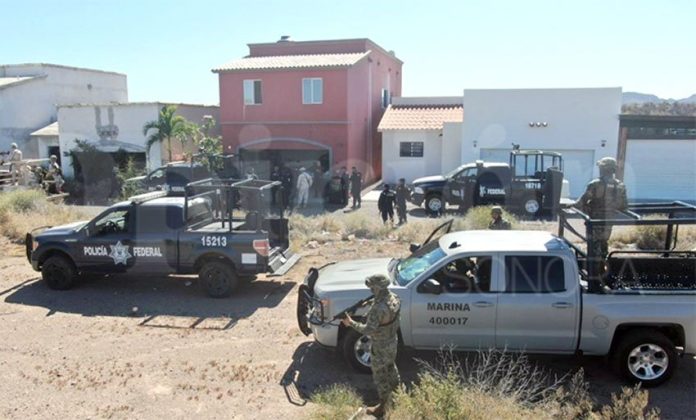
Security forces at the house where kidnapping victim was being held.
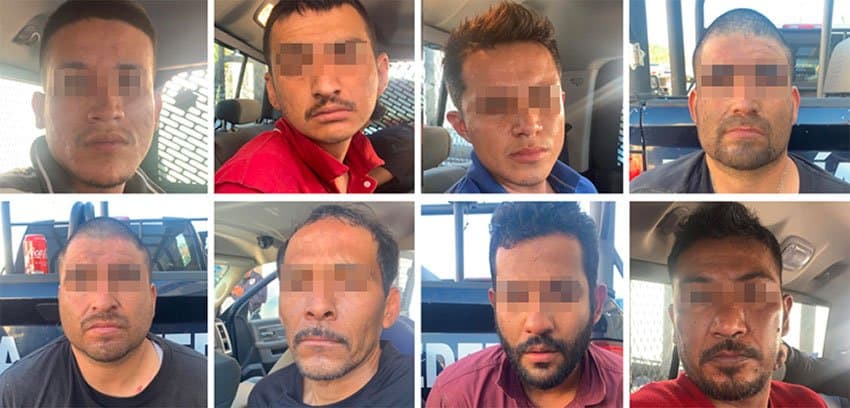
Police have arrested eight men in San Carlos, Sonora, in connection with the kidnapping yesterday morning of an 18-year-old youth.
It was also revealed that municipal police received an anonymous threat shortly after the arrests.
After Leonardo José M.R., was kidnapped at 10:00am Friday, authorities activated a Code Red alert and federal, state and local police initiated a search for him by land and air.
Four hours later, police located a safe house where the kidnappers were keeping their victim. After a firefight and attempted flight, police detained eight suspects, freed the victim and secured several vehicles, assault weapons, bulletproof vests and other equipment and clothing that may have belonged to the navy.
Leonardo José was hospitalized and treated for wounds inflicted with a machete, reported the newspaper Radar Sonora, indicating he had been tortured.
The eight suspects are considered ‘highly dangerous.’
The eight suspects, who were transferred to a municipal detention center operated by National Defense, were described as “highly dangerous” and administrative staff were asked to leave for their own safety before the prisoners arrived.
Last night, police picked up a threat over their internal radio channel: an anonymous voice said three times, “I’m coming for you, you know why.”
An unidentified source said San Carlos police chief Silvestre Armenta reinforced security measures at the police station in light of the threat, although authorities have not ruled out the possibility that the message might have been a joke made in bad taste.
San Carlos is a beachfront community within the city of Guaymas in southwestern Sonora.
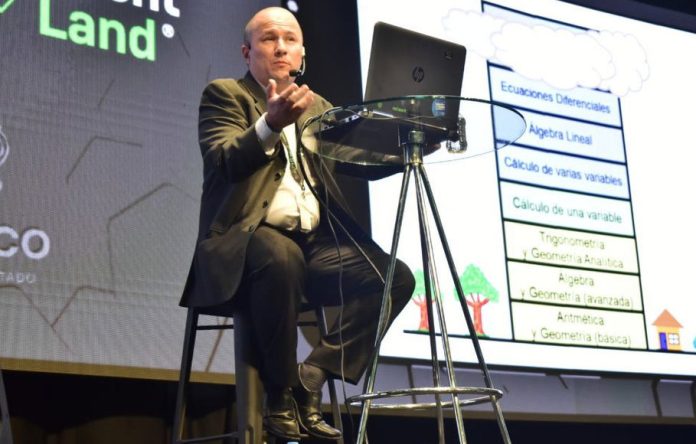
The week-long tech expo Talent Land concluded yesterday in Guadalajara, Jalisco, where Julio Ríos, the Colombian science and mathematics YouTuber known as Julioprofe, attracted more than 5,000 youths for his talk about mathematics and physics.
Ríos was received “like a rockstar,” said the newspaper Milenio to describe his arrival on the conference floor on the second day of the event.
The online math teacher expressed his amazement at the thousands of young people that gather every year for the show, organized around technology, innovation and entrepreneurship.
” . . . The idea of Talent Land is a wise one, an idea that must be commended as it attracts the young and guides them through technology to find solutions and to achieve a better society,” said Ríos.
For the last day of Talent Land, Ríos gave a math class with which he hoped to break a Guinness World Record.
Over 5,000 people attended but 887 were disqualified by a Guinness representative and the attempt to break the record failed.
Ríos and his students were not discouraged, and the class started as scheduled with the ringing of a school bell.
The class lasted just over 40 minutes, with the teacher going over basic arithmetic with his students, including addition, subtraction, multiplication and division. The teacher even used apples, pears and geometric figures in his explanations to solve several operations.
“Is this too hard?” the professor asked his students several times, only to receive a chorus of thousands of voices replying “Nooooo!”
The bell rang again to mark the end of the class, but the teacher surprised his students with a test with which their newly acquired knowledge was tested.
More than 60,000 people of all ages attended Talent Land, now in its second year, and experienced over 1,700 hours of content, from conferences on music, robots, videogames and artificial intelligence to a special Jalisco government initiative to explore the intersection between technology and agroindustry.
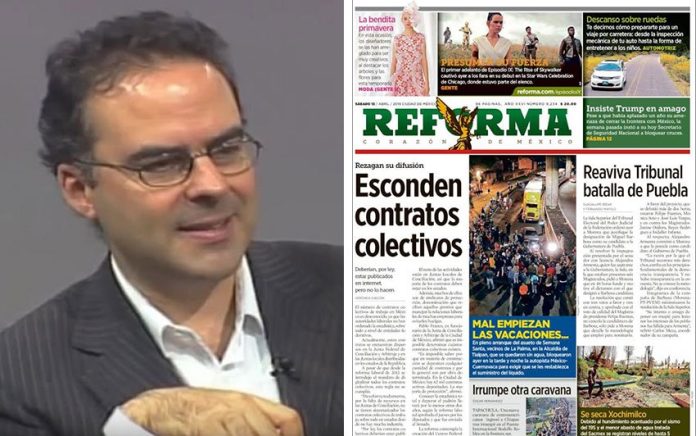
The editor of a major newspaper has received death threats after President López Obrador once again criticized the Mexico City-based broadsheet.
Earlier this week, the newspaper Reforma published a story about the beefing up of security at López Obrador’s home in the southern Mexico City borough of Tlalpan.
The article included the president’s address, an editorial decision that López Obrador condemned at his Tuesday press conference even though he acknowledged that it was already in the public domain.
The president also slammed Reforma for publishing a photograph of a narco banner on which the Guanajuato-based Santa Rosa de Lima fuel theft cartel made a threat against his life. The narcomanta also listed the address where the president lives with his wife and youngest son.
“Other media outlets didn’t do that. Don’t you think that’s bad taste? Where are the ethics? . . . It’s a very peculiar conservatism,” López Obrador said.
The leftist leader has frequently hit back at Reforma when it has published stories that are critical of his government, describing it as prensa fifí (posh or elitist press) and a bearer of conservatism and neoliberalism.
Following his most recent public complaint about the newspaper, the editor of Reforma received a barrage of threats and harassment.
Article 19, a press freedom organization, said in a statement that Juan Pardinas “was a victim of death threats, harassment and attempted doxxing via social networks by unknown subjects.”
After the president’s press conference on Tuesday, the hashtag #NarcoReforma became a trending topic on Twitter, the organization said.
“. . . It was inferred that the dissemination of the president’s address was a sign of collusion between the newspaper and organized crime . . . Under this hashtag, the home address of the general editorial director of the newspaper was asked to be disseminated and setting fire to the premises of the newspaper with Pardinas inside was encouraged,” Article 19 said.
The organization demanded that López Obrador “abstain from generating any act that inhibits the exercise of freedom of expression,” adding “this includes maintaining a stigmatizing discourse” against the media.
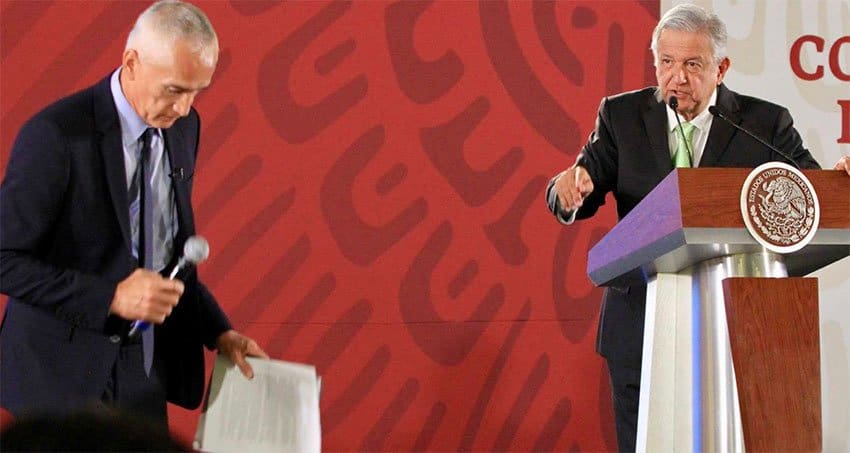
Journalist Ramos, left, with AMLO: unwelcome questions.
In addition, it called on federal authorities to investigate the threats against Pardinas and Reforma and provide protection for the former.
According to press freedom groups, 124 media workers have been murdered since the year 2000, making Mexico one of the most dangerous countries in the world for journalists. Five have been killed since López Obrador took office on December 1.
Some journalists have charged that the language the president uses to attack sections of the media tacitly endorses violence. Reporters who challenge López Obrador at his morning press conferences are quickly criticized on social media and in some cases threatened.
Article 19 said that López Obrador’s “stigmatizing discourse . . . has a direct impact in terms of the . . . risk it can generate for the work of the press because [his remarks] permeate in the discourse of the rest of society and can even generate attacks.”
After receiving an unwelcome question about Mexico’s homicide rate from journalist Jorge Ramos earlier this month, López Obrador told reporters: “If you step out of line, you know what will happen. But it won’t be me, it’s the people.”
However, yesterday he adopted a more conciliatory approach, announcing that protection would be provided for Pardinas and declaring that “media outlets will be untouchable – I absolutely respect their right to manifest ideas, the right to dissent.”
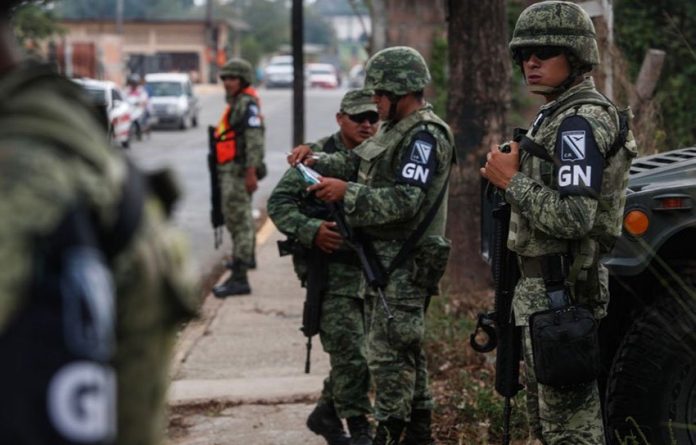
Soldiers wear National Guard insignia in Minatitlán.
President López Obrador issued a call yesterday to members of the new National Guard not to overstep their bounds in the use of force and to respect human rights while in the line of duty.
The president presented a contingent of the new security force during a visit to Minatitlán, Veracruz, in the wake of last week’s massacre of 13 people.
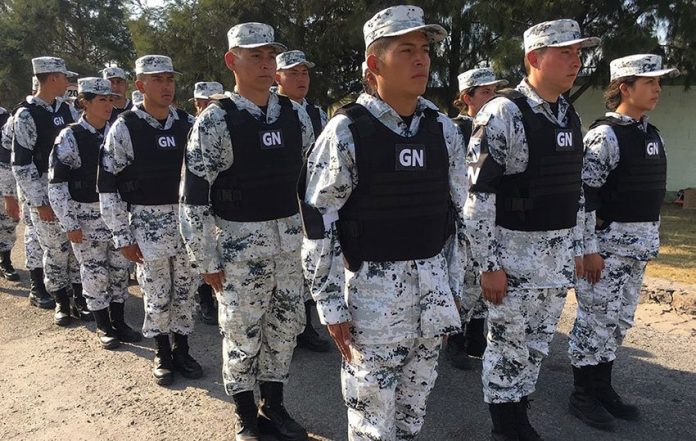
It was the force’s first deployment and evidently a hurried one: secondary laws governing its operation remain to be approved and not all its personnel were wearing the Guard’s new uniform yesterday.
The government has sent 1,059 personnel to three Veracruz municipalities — Minatitlán, Cosoleacaque and Coatzacoalcos.
Speaking to local residents, the president said more vigorous policing was only one measure in a larger plan to restore peace and prosperity to the country’s most troubled areas.
He also said special measures were being taken to ensure the appropriate use of force.
“We are putting emphasis on ensuring that [the National Guard] can carry out their duty of guaranteeing public safety while respecting human rights with a gradual and appropriate use of force so they do not cross the line, and so that human rights are respected at all times.”
Creation of the new force has been widely criticized for being another military presence on the streets of Mexico and a threat to human rights given the record of the military over the last dozen years.
López Obrador said that when he took office, the Federal Police force numbered only 10,000 officers.
In contrast, the army and navy were composed of 220,000 and 65,000 troops respectively, but they could not be used to enforce public security because of constitutional limitations.
“So we said, let’s amend the constitution; we need to create a national guard because public safety is what’s most important.”
Speaking of last week’s attack on a bar that killed 13 people, he told residents they were not alone.
“I have come to tell you that you are not alone; you have the support of your government.”
The president outlined plans to promote economic growth, providing aid to the area’s oil and gas industry, programs for agricultural workers and work and study opportunities for youths to offer alternatives to crime.
The federal government projects that the Santa Lucía airport will cost just 12% of the former government’s canceled project at Texcoco, México state, and will open in June 2021 with a capacity for 20 million passengers a year.
Project chief Sergio Samaniego said yesterday that construction of the airport at the Santa Lucía Air Force Base north of Mexico City will cost 72 billion pesos (US $3.8 billion), whereas the total cost of the Texcoco project – including the demolition of the current airport and that in Santa Lucía – would have been 600 billion pesos (US $31.7 billion).
However, once costs associated with canceling the previous government’s signature infrastructure project are taken into account, the price tag for the Santa Lucía airport increases to 172 billion pesos (US $9.1 billion), or 28.7% of the total projected cost at Texcoco.
The head of the military college of engineers, which will build the project, told a press conference that the Santa Lucía airport — to be named after the revolutionary general Felipe Ángeles — will be “austere in its design, efficient, functional, sustainable, easy to build . . . safe and emblematic.”
Brigadier General Ricardo Vallejo said the airport should be completed by June 2021 and will have a capacity for 20 million passengers in its first year of operation.
He added that the number of passengers using the airport annually could eventually increase to 80 million, explaining that “its maximum potential, its development potential, will be over 50 years.”
The first stage at Santa Lucía includes construction of two runways, a terminal building, a parking lot with space for 4,000 cars, a control tower, a maintenance hangar and a freight terminal, among other facilities.
Vallejo said that a new 46-kilometer highway will allow passengers to travel between the new airport and the existing Mexico City airport in 35 minutes. The road will cost 10 billion pesos (US $527.8 million) and be ready in two and a half years, he said.
The president explained: “I will visit Santa Lucía on Monday but if I tell you that we’re going to start to build the airport I already know what the opponents will reply. They’ll say: ‘Where’s the environmental impact statement, why isn’t the law being respected?’ That’s why it was decided to do the presentation of the project on Monday and construction will begin in June.”
He added that “the bad news” for opponents of the project is that people who live in the area have already been consulted and have given their consent for the airport to go ahead.
The design of the Texcoco airport was rather more ambitious.
“. . . Little by little we’re making progress and in June 2021 we’ll be inaugurating Santa Lucía,” the president said.
During the campaign for the 2018 presidential election, López Obrador pledged that he would cancel the Texcoco airport project should he win election, charging that it was corrupt, too expensive and not needed.
Communications and Transportation Secretary Javier Jiménez Espriú yesterday accused the Mexico City Airport Group (GACM) of negligence and hiding information about irregularities in Texcoco, explaining that the possible embezzlement of 6 billion pesos (US $316.7 million) is being investigated
While still president-elect, López Obrador held a public consultation last October that found almost 70% support to cancel the project and instead build the Santa Lucía airport and upgrade the existing airports in Mexico City airport and Toluca.
López Obrador said that if he didn’t cancel the Texcoco project, the Mexico City and Santa Lucía airports would have closed.
“The construction . . . of the airport in Texcoco was going to mean closing two airports . . . Do you know why? To make deals with the land of the two airports,” he said.
“What they [the past government] was planning . . . was the urbanization of the land. They wanted to build a kind of Santa Fe [an upscale Mexico City business and residential district] on the land of the current airport . . .” López Obrador added.
The president said it was “natural” for people involved in the “corrupt” Texcoco project to be upset, “but we have a popular mandate and we were elected to put an end to corruption.”
Lawmakers in Sinaloa have proposed banning narco ballads and reggaeton music in schools, arguing that they send “decadent messages” to children and adolescents.
The bill presented to the state Congress by Morena Deputies Pedro Alonso Villegas Lobo and Apolinar García Carrera states that school festivals should celebrate Sinaloan folklore rather than songs and dances that “denigrate children and adolescents” with their “erotic, sexual, hateful, discriminatory, misogynistic and homophobic” content.
Narco ballads, or narcocorridos in Spanish, is a subgenre of Mexican norteño music that glorifies and seeks to humanize drug traffickers, while reggaeton, a musical style that originated in Puerto Rico, is infamous for its highly sexualized lyrics.
The proposal to ban the two styles of music is based on a study carried out by researchers at the University of Helsinki in Finland that established that listening to reggaeton can lead to sexually aggressive behavior, eating disorders, low self-esteem, consumption of drugs and depression among young people.
Villegas and García say the study shows that young people are particularly vulnerable to being led astray by external influences that send different messages from those sent by authority figures such as teachers and parents.
Reggaeton lyrics can cause boys to see their female classmates as “mere sexual objects” and consequently behave aggressively towards them, they said.
“Young people are very prone to being induced, they’re at a stage when they can be easily persuaded by what’s in their environment, and these kinds of lyrics, these kinds of music that lead them to having a narco culture, a culture in which it’s very natural to abuse women, we’re against that,” Villegas said.
The bill doesn’t yet propose specific penalties that school principals and teachers could face if they don’t follow the law but Villegas said they will be added at a later date. Sanctions could include dismissal or even criminal charges, he said.
The deputy predicted that the proposal will become law because it is supported by all Morena lawmakers in Sinaloa and the party has a majority in the state Congress.
The northern state, especially the capital Culiacán, is considered a hub of Mexico’s narco culture.
A young boy’s candid response to a reporter’s question touched some chords, with the result that one of his dreams — building a sandcastle on the beach — is about to come true.
Early this week a television reporter in Monterrey, Nuevo León, asked young Andrick what he liked to do most during vacations.
“I like to build sandcastles,” he answered, to which the reporter followed up with, “Have you gone to the beach?” “No,” the boy replied.
“How do you build sandcastles then?” the reporter continued.
“Only in my dreams.”
The 16-second clip was posted online and soon went viral, with commenters on social media half-jokingly wondering if they should chip in and send the young boy to the beach.
But others decided to do more than joke about the story.
Broadcaster Multimedios Televisión started organizing Andrick’s dream vacation by approaching possible donors.
Puerto Vallarta Tourism Trust director Javier Aranda Pedredero explained that the broadcaster contacted his organization after first talking to low-cost airline VivaAerobus.
The tourism organization then persuaded the Hacienda Buenaventura Hotel in Puerto Vallarta to join the initiative, which will include Andrick’s family.
Even getting to and from the airport has been taken care of: the car rental agency Avis will provide airport transportation.
The Tourism Trust said everything is now in place to welcome the young boy and his family so they can “enjoy our beautiful beaches.”
But the holiday might not end there.
Andrick has also been invited to travel to Zihuatanejo, Guerrero.
The international trade and investment agency ProMéxico, much reviled and then ordered shut down by the new federal government, was generous with its salaries.
Under the previous government, the promotional agency ProMéxico paid salaries as high as US $21,000 a month to its employees, freedom of information requests reveal.
A report published today in the newspaper Milenio said that a high-ranking official in Washington D.C. earned that amount while two others in London, England, and Switzerland were paid more than 19,000 euros (US $21,200 at today’s exchange rate).
Other generous salaries included 17,000 euros a month for a first secretary posted to Qatar, 200,000 pesos (US $10,500) for a manager of an overseas office, 130,000 pesos for a private secretary and 50,000 pesos for a chauffeur.
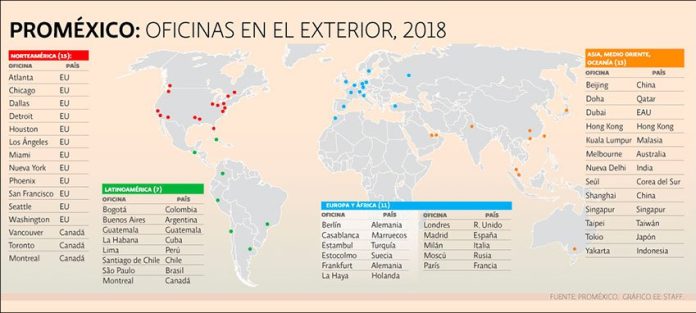
Personnel posted to 46 ProMéxico offices in 30 countries in North, Central and South America, Europe, Asia, Africa and Oceania also received generous benefits, including life insurance, holiday pay, annual bonuses, rent assistance and airline tickets.
ProMéxico also spent big during the administration of Enrique Peña Nieto to rent offices.
In six years, it paid more than 148.7 million pesos (US $7.85 million) to rent offices in 20 cities, Milenio said. Other ProMéxico offices operated out of Mexico’s embassies and consulates.
A public trust fund and a branch of the Secretariat of the Economy (SE), ProMéxico was created by former president Felipe Calderón in 2007.
Before he took office last December, President López Obrador pledged that the agency would be eliminated, taking the view that its offices generated significant expenses yet did nothing that couldn’t be achieved through traditional diplomacy.
Yesterday, he claimed that ProMéxico “doesn’t exist anymore” but the Milenio report said it is still operational.
A recent government human resources document seen by the newspaper says that public servants are still working in the agency’s overseas offices.
ProMéxico was allocated more than 914 million pesos (US $48.2 million) in this year’s budget.
Oil rigs are being frequently targeted by pirates.
Pirates attacked and plundered an oil rig last Sunday in the Gulf of Mexico, locking up the crew while they looked for loot.
Witnesses said at least six men armed with guns and knives boarded the rig at 9:30pm and proceeded directly to the third floor to wake up the crew. After locking up workers in the cafeteria, the thieves wandered freely, looting equipment, materials, money and anything of value they could carry.
The pirates departed at 4:00 am on Monday, when the rig’s captain sent an emergency alert to authorities. The navy responded 4 1/2 hours later. The crew and company lawyers have spent this week in interviews and taking inventory of damaged or stolen items, which have still not been fully identified.
It was not the first heist of this kind in the Gulf of Mexico, where pirate attacks are becoming a growing threat to oil rigs. On March 12, President López Obrador announced that the navy would maintain permanent operations off the coast of Dos Bocas, Tabasco, to protect against pirates that have in the past attacked Pemex oil rigs.
The rig that was targeted Sunday, called Fortius, is anchored several kilometers off the shore of Campeche. When fully staffed it has a total capacity of 150 people, but it is currently manned by a small maintenance team.
The owner, Mexican oilfield services firm Oro Negro, declared bankruptcy in September 2017, and is currently in the middle of a US $900-million negotiation with debtholders over the future of five oil rigs, including Fortius.
The first unit of the National Guard will begin operations today in Minatitlán, Veracruz, President López Obrador announced this morning.
The president reminded reporters at his daily press conference that National Guard units will eventually be deployed to 266 different regions in the country.
“We’re starting in Veracruz . . . the first [unit] that has been established with a sufficient number of elements, with a single command, will be in Minatitlán,” he said.
Other contingents of the new security force will begin operations in Salina Cruz, Oaxaca, and Coatzacoalcos, Veracruz, this weekend and by the middle of June, 51 units are expected to have been deployed.
“We reached an agreement that by the middle of June at the latest we’ll have 51 coordinations of the National Guard in operation . . . with 25,000 elements,” López Obrador said.
He cited the south of Veracruz, Cancún, Quintana Roo and Tijuana, Baja California, as locations where the force is urgently needed.
Accompanied by members of his security cabinet, the president traveled today to Minatitlán, where 14 people were killed last Friday during a family celebration at a bar.
López Obrador said this morning he would take the opportunity to express his condolences to the families of the victims as well as hold a public meeting with the city’s residents.
He explained that the meeting was originally intended as a forum for discussion on the government’s welfare programs but added that the agenda has been widened to include security.
“We’re going to give a response to the demand for security. The security cabinet will accompany me and a plan will be presented to protect the public within the framework of the operation of the National Guard,” López Obrador said.
The Minatitlán Chamber of Commerce said yesterday that 300 businesses closed in the city between 2015 and 2018 due to security concerns and that another 40 have shut this year.
In an interview with Milenio Television, state Public Security Secretary Hugo Gutiérrez shifted that blame to Comtelsat, the company responsible for installing and maintaining the cameras.
He said most of the cameras — not just in Minatitlán but the whole state — had failed and that the situation has “cost lives.”
Just 1,600 of 6,500 cameras are in working order, Gutiérrez said, adding that authorities have filed a complaint against Comtelsat with the federal Attorney General’s Office (FGR).
As part of the investigations into Friday’s massacre, the secretary said that authorities have had to seek out footage recorded by cameras at homes and business to try to determine the route the perpetrators took to and from the crime scene.
“If our cameras were working, locating those people would be easier,” Gutiérrez said.
“. . . Because of this great fraud, lives have now been lost.”