Home Blog Page 2037

With dedication and faith, 100 youths prepare for Passion of Christ

0
García rehearses his role as Jesus.

For young Catholics in Tlalixtac de Cabrera, Oaxaca, preparations for the town’s ambitious Passion of Christ procession begin at least a year ahead of time.

The pageant depicts the final days of Christ according to Catholic tradition, beginning with his triumphal entry into Jerusalem before the Last Supper, his trial, crucifixion and death on Good Friday.

The 44th edition of the Tlalixtac event is expected to draw 10,000 spectators, the number who attended last year.

To be selected as one of the reenactment’s 100 participants, young hopefuls must meet a wide variety of strict requirements. These include attending mass every Sunday in the year leading up to the procession, actively participating in the devotional life of the church and demonstrating moral and ethical behavior in public and at home.

In addition, they must attend prayer meetings in May and June, attend organizational meetings for the procession every eight days and carry out unpaid community service projects. As a special condition, participants may not live with romantic partners out of wedlock.

For the past five months, the young men, women, boys and girls who will portray various biblical characters in the procession have prepared almost tirelessly, both mentally and physically, with the guidance of spiritual advisors from the church.

The physical preparations entail getting the youths ready to walk barefoot in the town’s streets for over seven kilometers.

Yuridia Vianey, 13, was selected this year to play the part of the Virgin Mary after she was personally inspired by a previous Passion of Christ event to ask for the role.

“I’ve come to see [the Passion] for years now. I liked the speech that Mary delivers to Jesus in the pageant, and so I said, ‘Some day that’s going to be me,’ and it’s finally my turn to give the speech. I have participated as part of the village for three years, and so last year I asked for the role of Mary and they gave it to me.”

[wpgmza id=”180″]

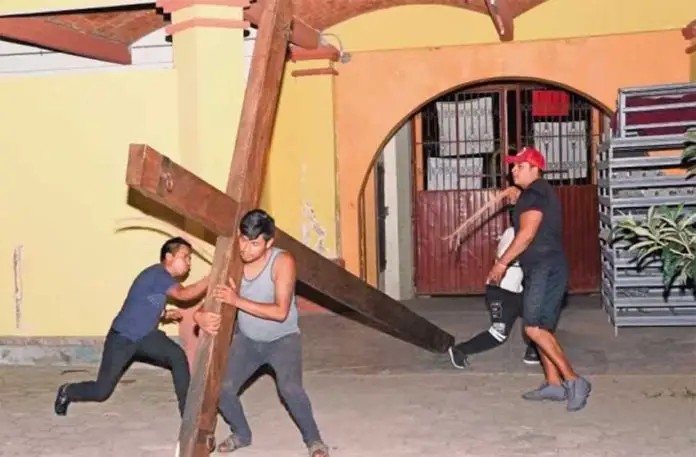
Carpinter Erick García Contreras, 23, will represent Jesus. He takes the role seriously, running several kilometers every day, eating healthily and regularly walking around town barefoot.

García has participated for 12 years in other roles in the procession, but he asked for the role of Jesus this year in the hopes of communicating his faith to spectators.

“I asked for the role to be able to get people to think about and understand what our Lord Jesus Christ did for us so they don’t do evil.”

Source: El Universal (sp)
Zihuatanejo’s king chess piece was the world’s tallest—for a while

0
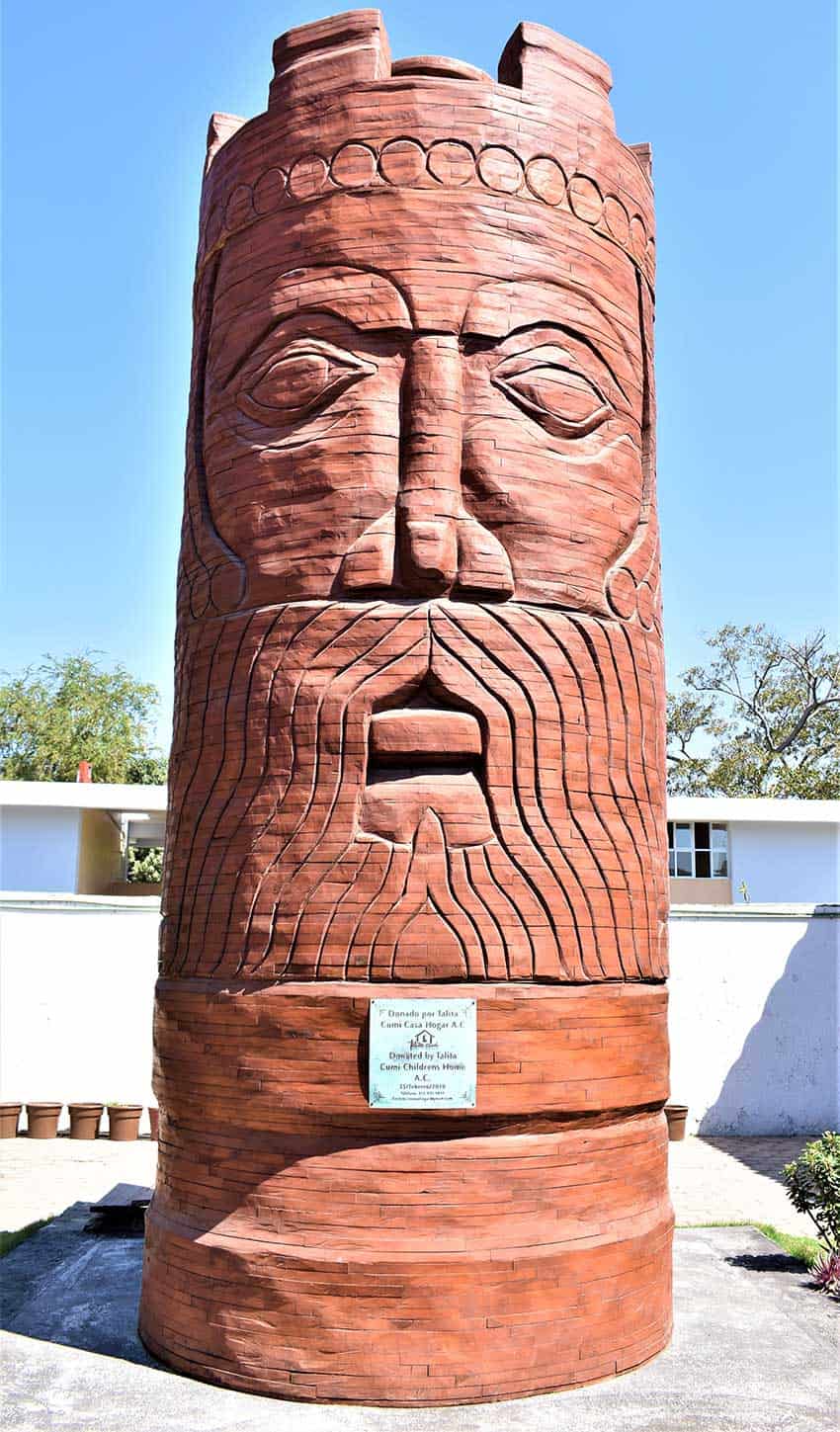
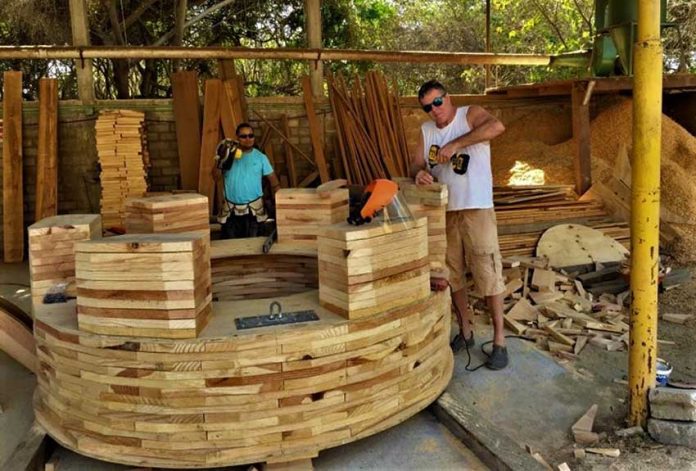
Bo Poole and Diego Pérez during construction of the giant chess piece.

While sitting at an airport and scrolling through Facebook, Canadian Larry Wright came across an article about the world’s largest king chess piece.

It is six meters high, according to Guinness World Records, and sits at the World Chess Hall of fame in St. Louis, Missouri. Inspired, he decided that he had to build one, not only bigger, but one that would support a good cause.

Wright chose an organization he has supported and volunteered for over the years — the Talita Cumi children’s home, an orphanage located in the tiny pueblo known as Las Pozas, a few kilometers from Zihuatanejo, Guerrero.

Supported mostly by donations through fundraising events including a blues festival and the kindness of visitors and volunteers, Talita Cumi is currently home to 15 children ranging in age from 2 to 17.

Wright approached friend and fellow Mexico vacationer, famed Canadian totem pole carver Jack Olson, and asked him if he would like to be a part of the project. Always looking to stay busy, even on vacation, Jack agreed to take it on.

The chess piece was the tallest in the world until recently.

Another friend, Bo Poole, heard about the project and was convinced it was a crazy idea, but Wright says that if it wasn’t for his expertise in construction, along with Mexican Diego Pérez, the project would never have happened. Even a few of the children got involved in sanding the piece.

The small but highly motivated group set out to build and carve and beat the world record. Beautifully wrought and intricate, the gigantic carving stands nearly 6 1/2 meters high and was donated to the Museo Arqueológico de Costa Grande in Centro Zihuatanejo last year.

Although not confirmed by Guinness as the tallest, the chess piece beat the world record by almost a meter (until the owners of the piece in Missouri made theirs a little higher).

No matter, Wright says, it is incredible that it was even built, a monument to what can happen when people of three countries work together. And, at a cost of US $10,000, it is truly a masterpiece in many people’s eyes.

When asked about the effort that went into the project, Wright freely admits that the whole process was much more labour intensive than originally anticipated. Olson roughed in the piece with a chainsaw and then hand-carved it with a hammer and chisel.

Putting the pieces together was backbreaking work. In all the project took four to five weeks at a local lumberyard near the children’s home in Las Pozas before it was taken by truck in pieces to its final home and set in place by a crane.

A beacon of hope and love for abandoned children, it is Wright’s wish that the piece will increase awareness for the orphanage and perhaps funding and donations for it.

• Talita Cumi is an active registered non-profit entity officially operating under the name Casa Hogar, Talita Cumi A.C. It provides a safe group home for a number of the neglected and often abandoned children in the Zihuatanejo area.

The writer is a Canadian who has lived and worked in Mexico for many years.

[soliloquy id="76634"]

Chetumal airport terminal expansion to add 2,500 square meters

0
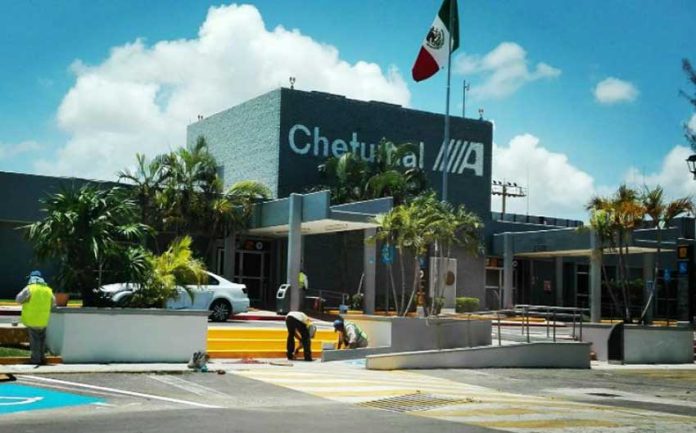
Chetumal Airport terminal to be enlarged.
Chetumal airport terminal to be enlarged.

The Chetumal International Airport terminal will be expanded this year to meet the needs of an increasing number of passengers.

Airport operator Aeropuertos y Servicios Auxiliares (ASA), a federal government-owned corporation, announced a competitive tendering process for companies interested in adding almost 2,500 square meters of space to the terminal in the Quintana Roo capital.

New stores, public washrooms, security areas, airline offices and waiting rooms are all part of the project.

ASA has a Congress-approved budget of 150 million pesos (US $8 million) to spend on the improvements.

Eight companies have so far submitted bids of between 47 million and 71 million pesos to build the terminal addition. The winning bidder will be announced on April 30.

ASA is also looking for a construction company to build a new control tower, which is expected to cost around 35 million pesos (US $1.8 million).

The airport operator first presented an expansion plan and application for funding to the federal government in 2014. Since then, the runway at the Chetumal airport has been extended but most other projects outlined in the plan were not undertaken.

The number of passengers who use the airport annually has increased from 120,000 in 2014, when Interjet was the only airline that flew to and from Chetumal, to more than 320,000 last year.

Volaris, Maya Air and VivaAerobus operate flights to the city, which is located just north of the border with Belize.

The federal government’s plan to relocate the Secretariat of Tourism (Sectur) to Chetumal and construction of the Maya Train are expected to generate further growth in passenger numbers in the coming years.

Source: Reforma (sp) 

López Obrador, Aparicio on Time list of 100 most influential people

0
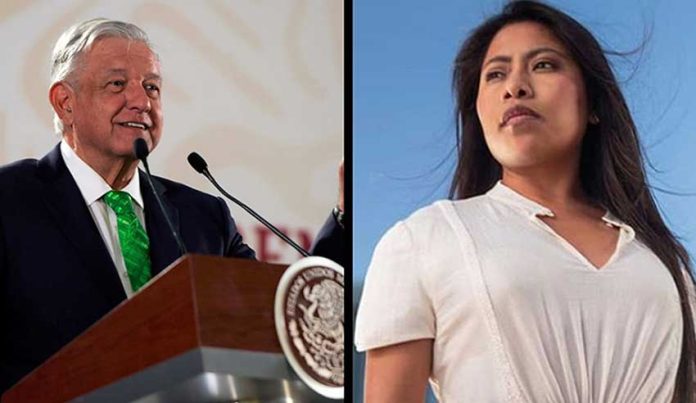
López Obrador and Aparicio among most influential.

President López Obrador and Oscar-nominated actress Yalitza Aparicio are among Time magazine’s “100 most influential people of 2019.”

The two Mexicans appear alongside notable names including Pope Francis, United States President Donald Trump, singer Lady Gaga, former U.S. first lady Michelle Obama and Facebook founder Mark Zuckerberg.

The list is divided into five categories — pioneers, artists, leaders, icons and titans.

As is customary, short biographies or tributes written by prominent figures explain why each of the 100 people on the list deserves his or her place.

In the case of López Obrador, the guest author was Jorge Ramos, a United States-based Mexican journalist who clashed with the president at a morning press conference last week over the accuracy of the government’s homicide figures.

“More than 30 million Mexicans voted for a change in the last election, and that’s exactly what they got,” Ramos wrote.

“President Andrés Manuel López Obrador (or AMLO, as he is called) travels in economy class and refuses to live in the presidential mansion of Los Pinos; his main message is against corruption; and every morning, at 7:00 am, he gives a press conference (known as la mañanera). Yes, it is in sharp contrast with previous leaders. But is that what Mexico really needs?” he continues.

Ramos goes on to point out that the president’s “full control of the Congress and his very personal style of making decisions have raised flags among those who don’t want another authoritarian populist.”

He notes that AMLO has managed to “deactivate” Trump by not responding to the U.S. president’s threatening tweets towards Mexico but adds that “to the dismay of many, the leftist politician has rejected calls to denounce the dictatorship in Venezuela.”

Ramos contends that López Obrador’s “big test” is to combat violence in Mexico before concluding with a prediction that challenges the president’s messianic status among his staunchest supporters.

“AMLO waited 12 years to become president, and he is in a hurry to act. But sooner or later he will realize that just one person cannot save Mexico. Others have tried and failed.”

Writing about Aparicio – the 25-year-old star of Roma – the film’s director Alfonso Cuarón says that the Mixtec woman from Oaxaca “defies paradigms.”

He points out that “before starring in Roma, she had no acting experience, yet she earned an Academy Award nomination for best actress in a leading role,” adding that she also overcame her fear of the ocean and learned the Mixteco language for the film.

“Yalitza can take any task that’s put in front of her and excel in ways no one thought possible,” Cuarón declares.

The director explains that he knew from the moment he met Aparicio that she “was the one” to take on the role of Cleo, a domestic worker and the protagonist of Roma.

Cuarón writes that Aparicio is “incredibly grounded in her truth and not easily swept away by the glitz and glamour of Hollywood,” adding that “she focuses on being a force of change and empowerment for indigenous women, embracing the symbolic value of what she has done and carrying that responsibility with dignity and grace.”

The former preschool teacher from the town of Tlaxiaco is one of 48 women on the Time list, an increase of three from last year and double the number that appeared on the inaugural list in 2004.

Cuarón concludes by writing that he deeply admires Aparicio and hopes that she will continue acting and evolving her craft.

“Selfishly, I want to see more of her onscreen. She has an amazing gift . . .”

Source: El Financiero (sp) 

Medical platform Doctoralia sees triple-digit growth in Mexico

0
Doctoralia's Mexico website.

Online medical platform Doctoralia has achieved triple-digit income growth in Mexico during the past two years and now has almost four million monthly users.

The website serves as a space for people to ask questions about healthcare, offer opinions about treatments they’ve received and find a doctor or other medical professional, who is matched to their needs.

The site’s revenue comes from doctors and other healthcare workers who pay a fee to effectively advertise their services as well as access a range of digital tools that help them manage their practice

Income doubled in both 2017 and 2018 and, according to Mexico CEO Ricardo Moguel, there is no reason why that level of growth won’t continue this year.

Doctoralia was founded in Spain in 2007 and amalgamated with a similar Polish service called DocPlanner in 2016.

DocPlanner Group now operates in 15 countries, of which Mexico is the company’s third largest market after Brazil and Poland.

The Mexico-specific Doctoralia platform was launched in 2012 and has proved so popular that in 2018, it generated revenue of 22.5 million euros (US $25.4 million), 16.4% of DocPlanner Group’s total global income.

The company opened offices in Mexico in 2017 and now employs 202 people, including staff at its Mexico City headquarters and consultants who work in several cities across the country.

The number of people using Doctoralia in Mexico is growing at a rate of 45% a year and last year reached an average of almost four million a month, a figure that accounts for about 13% of the 30 million global users.

More than 133,000 health care professionals are registered on the site and, on average, Mexicans use Doctoralia to make 197,000 appointments a month. Around 3,000 people leave opinions on the site in the same period.

Frederic Llordachs, a doctor and co-founder of Doctoralia, said the platform helps steer people away from unreliable online medical information that could pose a health risk.

Source: El Economista (sp) 

Immigration deports 148 Cubans; eight others make a getaway

0
Cubans head home—but not voluntarily.

Authorities have deported 148 Cuban migrants from Tapachula, Chiapas, but eight of their compatriots are being sought by police after escaping from an immigration center in the same state.

The National Immigration Institute (INM) said the Cubans’ immigration status in Mexico was “irregular” and that they were flown back to their homeland on Monday.

Hours after the deportations, eight Cubans escaped from an immigration facility in Tuxtla Gutiérrez.

The migrants were transferred to the Chiapas capital on March 15 after participating in a riot at a shelter in Tapachula, during which they demanded transit visas in order to be able to travel legally to the United States.

On Monday night, they fled an immigration detention center by jumping a gate, the newspaper El Universal reported. Witnesses said that five escapees got into a taxi and that the other three headed towards a nearby park on foot.

Municipal and state police were unable to locate the men.

Meanwhile, more Cubans are in the north of the country waiting for the opportunity to request asylum in the United States — and finding work.

In Ciudad Juárez, Chihuahua, the presence of a growing Cuban community has given rise to a new restaurant called Little Habana.

Juárez businesswoman Cristina Ibarra used to run a restaurant serving Mexican antojitos — tacos, quesadillas, gorditas, etc. — but after building up a Cuban clientele who longed for a taste of home, she decided to change tack.

Ibarra took advantage of her Cuban customers’ love and knowledge of their food by offering them jobs, which was a welcome invitation for the migrants stranded in the city. Five Cubans now work at Little Habana, which opened Monday in the heart of Juárez.

One of the employees is Daylin, a migrant who arrived in the northern border city a month ago.

She told El Universal that she was happy about the opening of the restaurant because it will allow her to cover her expenses in Juárez.

Ibarra is also happy about the arrangement, pointing out that the Cubans both wanted and needed work because they’ve been staying in hotels while in the city.

Tony Peña, a 47-year-old Cuban and new restaurant employee, said he was aware that it could take some time for the migrants to get the opportunity to seek asylum.

In the meantime, he and his fellow countrymen and women will be able to take some comfort in having a place at which they can meet with people in the same situation and eat familiar food.

Among the dishes on Little Habana’s menu are Cuban classics such as pork in red sauce, arroz con pollo (chicken and rice), tostones (fried plantains) and caldosa (a kind of stew).

Source: El Universal (sp) 

You’ll find art at Mercado Coyoacán, but the main attraction is food

0
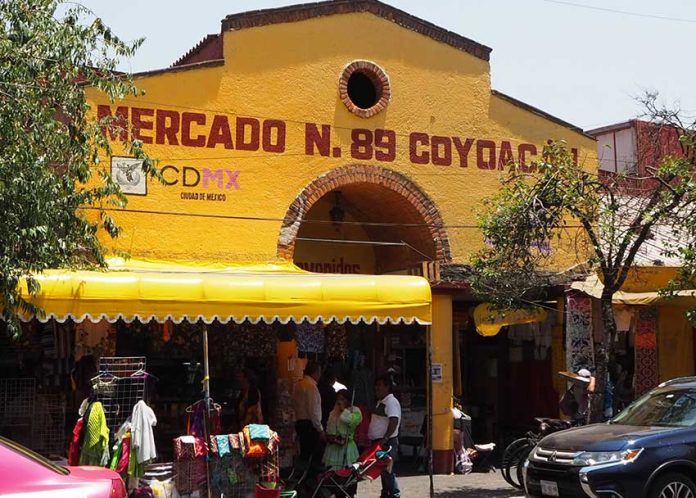
The entrance to the best seafood and barbacoa in Coyoacán – Mercado Coyoacán.

Mexico City’s Coyoacán, meaning “place of coyotes” in Náhuatl, is known as the city’s historic artistic center, thanks largely to Frida Kahlo and Diego Rivera’s influence on the neighborhood.

At Coyoacán Market, just a few blocks from the Frida Kahlo Museum, the lasting influence is apparent.

On weekends, facing the market at Parque Allende, local artists sell their (often quite good) freshly painted canvases. And inside the market is filled with bright and beautiful Tehuana fabrics, handmade bags and leather goods, and an overabundance of Frida Kahlo t-shirts and novelties.

The real draw of Mercado Coyoacán, however, is the food. Because of the huge tourist draw, everything can be a bit more expensive, but when it comes to seafood and barbacoa in particular, it’s worth its weight in pesos.

Early afternoon on a weekday – when the longest line is for the watch repair and the kid shredding a guitar along with Bohemian Rhapsody barely turns a head – is a perfect time to miss the crowds. But if you’re traveling in a duo or smaller, a Saturday or Sunday afternoon will provide the best neighborhood people watching.

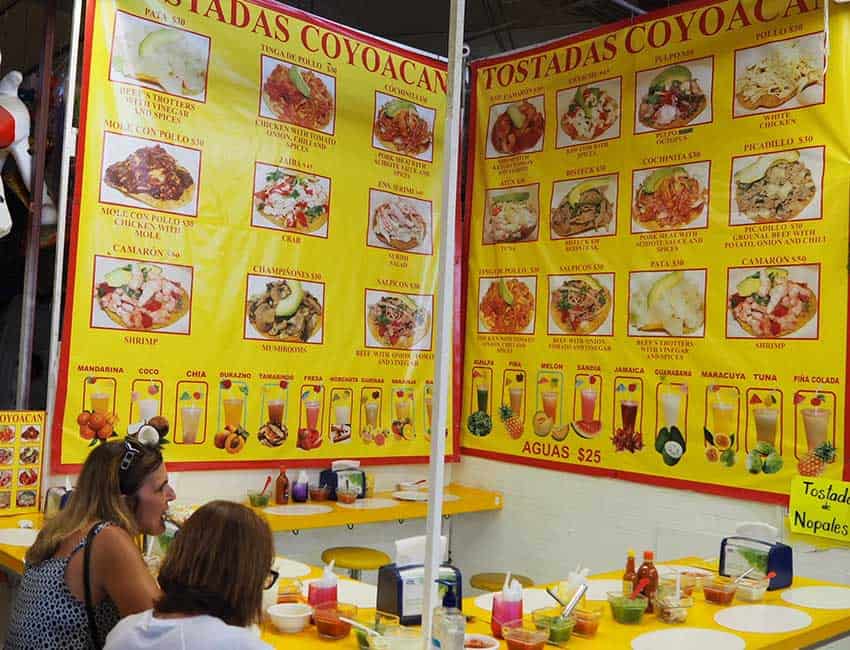
Trapped inside the menu at Tostadas Coyoacán
Trapped inside the menu at Tostadas Coyoacán.

Here are some of our favorite places to snack, or completely overindulge, at Mercado Coyoacán.

El Jardín del Pulpo

Spilling slightly out on to the sidewalk at the market entrance, on the corner of Malintzin and Ignacio Allende, is the gold standard for Coyoacán seafood delights, The Octopus’s Garden.

Although slightly pricey, the lobster and langostino plates are truly some of the best in Mexico City, and their shrimp cocktails and smoked marlin can hold their own against any marisquería. Toss on some of their housemade habanero salsa for an added kick; just be forewarned that it’s HOT.

Ostionería El Limoncito

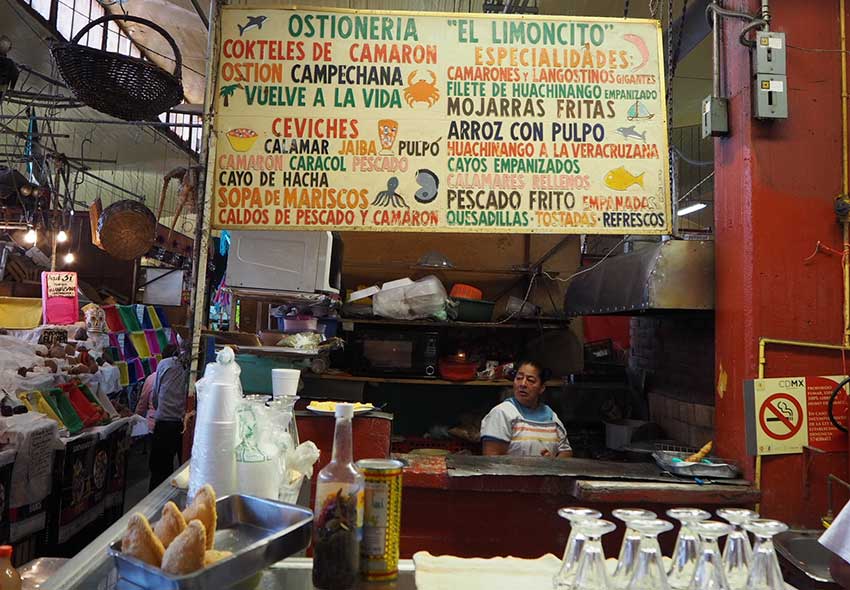
Known for the big-hearted grace, and sometimes wild antics, of its owner, Don Salvador, El Limoncito has been a Coyoacán Market mainstay for 30 years. They’re consistently lauded for their ceviches and seafood cocktails, but the fried fish tacos are one of the absolute gems of the market. And with a three-course seafood meal for 100 pesos, you really can’t afford to stay away.

Sit at the counter of Limoncito and read the board out loud – nothing there to disappoint
Sit at the counter of Limoncito and read the board out loud – nothing there to disappoint.

Tostadas Coyoacán

One of the best known stands in the Mercado, Tostadas Coyoacán is mostly responsible for the market’s world-tostada-renown, and it’s certainly for good reason. Their bright yellow menus offer dozens of topping choices – octopus, various ceviche and mole mixes, pig’s foot – many with photos.

There are six separate bar-style eating areas, with patrons seated facing each other to spark conversation. Sitting at shining yellow countertops, surrounded by giant blown-up menu items printed on yellow tarps, you get the feeling you’re actually inside the menu.

These are serious tostadas, piled high with goodness, and come out about 45 seconds after ordering – from the heaps of fresh toppings behind the counter. It’s a lively scene, with waiters-cum-barkers shouting, “There’s room over here! There’s room over here!” – a bit Disneyland, slightly crazy, but definitely tasty.

Cocina Mary

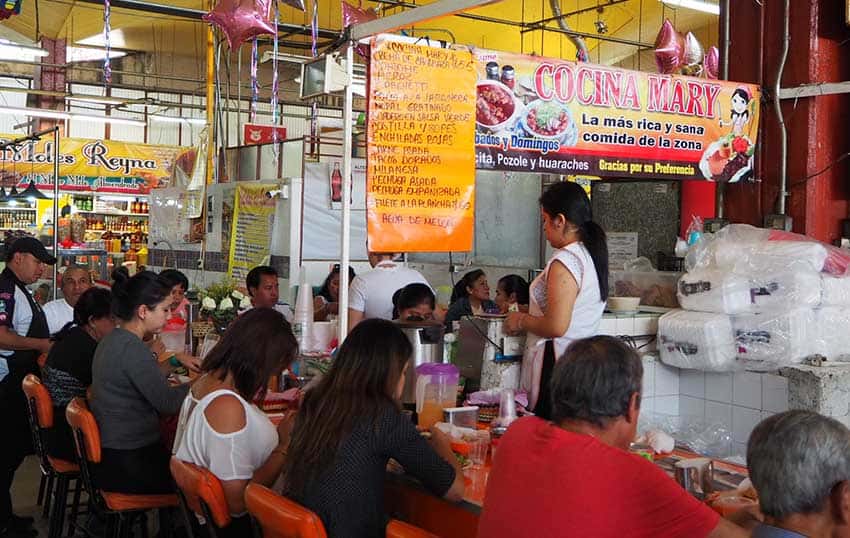
For the simple comida corrida (three courses for 55 pesos) or the standard market fare, try out Cocina Mary. It’s busy, even early on weekdays, but there’s always room at the counter. The enchiladas are famed among local workers, and the pozole on Saturdays and Sundays runs out quickly.

Always a happy crowd at the counter of Cocina Mary
Always a happy crowd at the counter of Cocina Mary.

El Borrego de Oro

Barbacoa – whole roasted or stewed sheep — is a long-running weekend tradition in Coyacán, and El Borrego de Oro is a neighborhood favorite. Only open Saturdays and Sundays, The Golden Sheep is located toward the back of the market and most often enjoyed straight from Sunday mass, so be be careful not to drip grease on the good church clothes.

The deliciously tender shreds of meat are usually placed simply on a tiny tortilla or fried in a taquito, with just a bit of onion and cilantro on top. But for the deeply unctuous, full barbacoa flavor, try some barbacoa bone broth consommé with rice and garbanzos – known to be the ideal cure for a hangover.

Mixiotes

Right nearby is the only mixiote stand in the market, also open Saturdays and Sundays. Mixiote is meat (usually mutton, chicken, goat, or pork) seasoned with pasilla and guajillo peppers (and a variety of other spices) and char barbecued on the bone inside the outer skin of the tough maguey leaf – adding a strong, smokey, bittersweet flavor. On a tortilla with a squeeze of lime or topped with onions is the preferred way to enjoy mixiote. Add a cold beer and your weekend is all set.

• Mercado Coyoacán runs along Malintzin between Ignacio Allende and Abasolo, open from 8:00am to about 7:00pm daily.

This is the sixth in a series on the bazaars, flea markets and markets of Mexico City:

Shell responds to release of list of expensive gas stations

0
Shell defends its pricing.

Royal Dutch Shell has defended the gasoline prices it offers to motorists in Mexico after the federal government revealed that it sells the most expensive fuel in the country.

Energy Secretary Rocío Nahle said Monday that Shell had the highest average prices for both regular and premium fuel between April 6 and 12.

In a statement, Shell México said that although the IEPS excise tax has been reduced, oil prices have gone up this year and eaten into the tax break that could otherwise be passed on to motorists.

The company said its profit margin was slim, pointing out that 90% of the price of fuel is made up of petroleum purchase costs, logistics expenses and taxes.

Shell added that its fuel prices were only slightly above those of its competitors.

“In the states in which we operate and in which we occupy optimal locations to attend to our customers, we maintain a competitive position [in the market], which is evident by analyzing the differences in sale prices to the public, which are very small,” the statement said.

Shell asserted that its prices are consistent with the value it offers, pointing out that more than US $1 billion is invested annually to research and develop the company’s high-quality fuels and additives.

The company also touted its safe, clean and efficient infrastructure, personalized service, the quality of the products in its convenience stores and well-trained and well-paid staff.

“Shell knows that customers have a wide variety of options when buying fuel. Mexican consumers know how to choose and choose well. That’s why we seek to offer a competitive price based on differentiated products and services which provide better engine performance as well as a better driving experience,” the statement said.

Shell also said that its gas stations only make up 1% of all filling stations in the country and therefore it has little capacity to hold sway over gasoline prices in Mexico.

The federal government will reveal the cheapest and most expensive places to buy fuel on a weekly basis after President López Obrador earlier this month accused gas station owners and fuel distributors of being “abusive” towards their customers by charging them excessive prices.

Source: Notimex (sp) 

The top-10 list of Mexico’s cleanest beaches

0
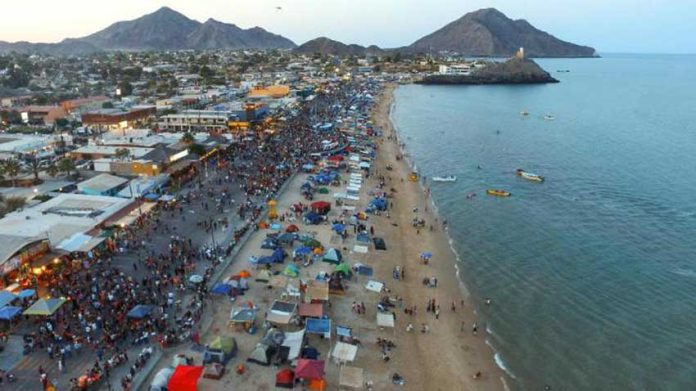
San Felipe has several beaches in the top 10 for high water quality.
San Felipe has several beaches on the list of the cleanest.

News about Mexico’s beaches has focused only on the dirty ones, which raised the question by a Mexico News Daily reader, which are the cleanest?

Among the 269 beaches tested by the health regulatory agency Cofepris, 268 were declared “safe for recreational use” because the samples collected contained less than the threshold of 200 fecal coliforms per 100 milliliters of water.

(All 269 have since been declared safe after Cofepris changed its mind about Sayulita beach in Nayarit.)

The test results varied widely, from fewer than 10 coliforms to as high as 191.

Here, then, is the top-10 list of locations with Mexico’s cleanest beaches, all of which tested for fewer than 10 fecal coliforms:

  1. El Cortéz, Los Faisanes, Burócratas, Dorado Ranch, Malecón, Bonita, Lindo México and Marina Resort beaches in San Felipe, Baja California.
  2. Malecón de Loreto and Salinitas beaches in Loreto, Baja California Sur.
  3. San Lorenzo and Bonita beaches in Campeche, Campeche.
  4. Boca del Cielo and Puerto Arista beaches in Tonalá, Chiapas.
  5. Nexpa, Maruata, El Faro de Bucerías, Las Brisas, San Juan de Alima and Pichilinguillo beaches in Aquila, Michoacán.
  6. Las Casitas, Centro, Dzul-ha, Chankanaab, Rastas, Bonita, Caletita, San Martín and Chen Río beaches in Cozumel, Quintana Roo.
  7. Playa Mahahual in Othón P. Blanco, Quintana Roo.
  8. Altata and El Tambor beaches in Bahía de Altata Navolato, Sinaloa.
  9. Playa Costa Azul in Matamoros, Tamaulipas.
  10. Playa Dzilam Bravo in Dzilam de Bravo, Yucatán.

Authorities warn that illnesses from contaminated sea water can come in the form of stomach flu, salmonella, cholera, swimmer’s ear, pink eye and skin and respiratory conditions, with symptoms such as fever, stomach cramps, vomiting, diarrhea, ear aches, headaches and irritation.

Source: Animal Político (sp)

Health agency reverses decision on Sayulita beach: it’s safe after all

0
Sayulita beach was deemed unsafe last week, but that is no longer the case.

Mexico’s health regulatory agency has reversed a previous decision that said contaminated sea water at Sayulita beach in Nayarit could present a health hazard to beachgoers.

Cofepris said that while the beach, highly popular with both Mexican and international tourists, is under a permanent sanitation watch, it fully complies with federal requirements and is safe for recreational use.

Although Cofepris initially said that data for Sayulita was not available, on Tuesday it reported that tests of the beach’s water found that fecal coliform levels were well under the limit of 200 per 100 milliliters of water.

“This tourist destination meets with the established security levels . . .” Cofepris said, explaining that a special test of the water quality found that fecal coliform counts were under 20.

The town is currently working on a project to upgrade its treatment plant, including the installation of an outfall that will carry treated wastewater offshore.

It is not the first time there has been confusion over Cofepris’s ruling on the beach’s sanitation levels. In March of last year, local newspapers reported that the agency declared Sayulita safe despite the town’s water treatment facility not operating at optimal levels.

Comments by Mexico News Daily readers after this newspaper’s story on Saturday about water quality at Sayulita indicate there continues to be some risk in swimming there.

One wrote that every guest at the complex in which he stayed had a stomach illness and that local residents were in denial.

Source: El Occidental, (sp), Eje Central (sp)

CORRECTION: The previous version of this story said the fecal coliform limit of 200 per 100 milliliters of water was that set by the World Health Organization (WHO). In fact, 200 is Mexico’s limit. The WHO threshold is half that at 100 coliforms per 100ml of water.