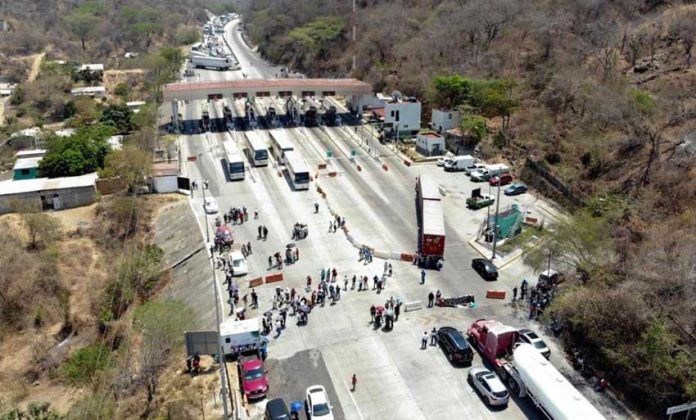
The Tlalpan toll plaza was occupied yesterday and again today.
People with an axe to grind took over highway toll booths at 13 locations in eight states yesterday, in most cases charging motorists to pass through in exchange for financial support for their various causes.
At one location, the protest continued today.
At the Tlalpan plaza on the Mexico City-Cuernavaca highway yesterday workers from the Autonomous Metropolitan University, who have been on strike for 71 days, asked motorists for a 50-peso contribution to their cause.
They returned early this morning but were forced to retire soon after by a group of people on motorcycles who charged drivers 20 to 50 pesos and expressed the demand that Mexico City not violate the rights of motorcyclists.
In Tabasco, some 250 farmers took over the Magallanes toll plaza on the federal highway No. 180 demanding government aid.
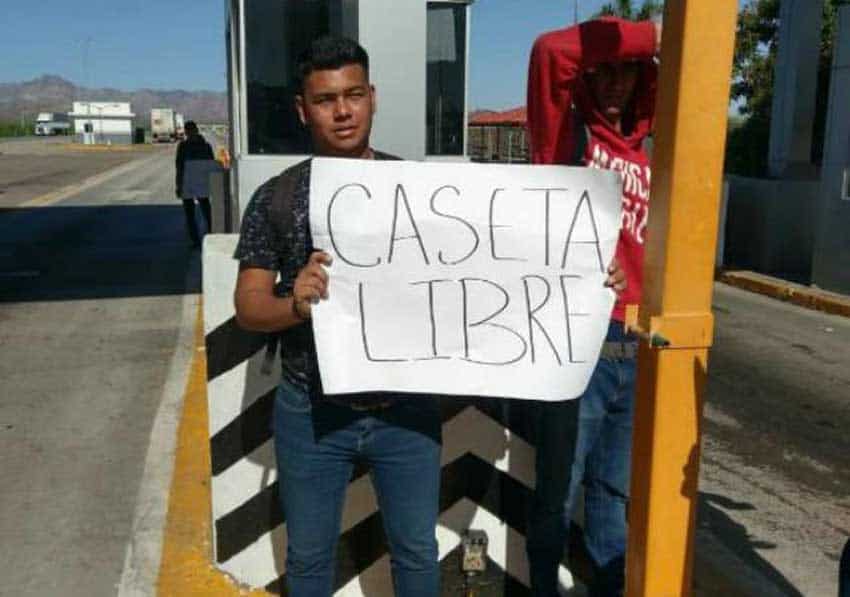
Motorists were not charged in Sonora where there is opposition to toll plazas in general.
The Chalco toll booth on the Mexico City-Puebla highway was occupied by unidentified protesters collecting monetary contributions, though it wasn’t clear what the money was for.
Farther east on the same highway another group took over the Amozoc toll plaza where motorists’ “contributions” were not voluntary — each vehicle was charged 50 pesos to get through.
A similar report came from the San Marcos toll plaza.
Farmers took over the Acayucan toll booths between the Veracruz cities of Córdoba and Minatitlán, where they asked motorists for financial cooperation because they were short of funds to buy diesel.
The day would not have been complete were it not for a teacher protest against education reform.
Teachers affiliated with the Guerrero-based CETEG union took over the La Venta toll plaza between Chilpancingo and Acapulco to demand the full repeal of the 2013 reforms.
In Sonora, where plazas have been closed previously by organizations opposed in principle to charging motorists to use highways, three were occupied on federal highway No. 15 at Hermosillo, Guaymas and Fundición, where vehicles were allowed to proceed without paying.
The protests were timed to coincide with the first day of the Easter holiday period, when many more people were on the road than usual.
The states affected were Baja California, Guerrero, México, Mexico City, Puebla, Sonora, Tabasco and Veracruz.
A new gymnasium is opened in Palenque with support from UN. unhcr
Migrants in southern Mexico will be able to get their exercise thanks to new and renovated sports facilities.
The United Nations High Commissioner for Refugees (UNHCR) inaugurated several facilities for local residents, migrants and refugees in Tabasco and Chiapas to promote “peaceful coexistence and inclusion.”
According to the United Nations news agency, the project was a collaboration between the refugee agency and the Olympic Refuge Foundation, a social initiative of the International Olympic Committee, and local authorities.
The partnership put some of its greater efforts into the Pakal-Na community gymnasium in Palenque, Chiapas. UNHCR representative Mark Manly said the new facility served the double purpose of not only providing a space that contributes to the users’ physical health, but one that also builds community.
“The Pakal-Na community gymnasium allows people to recover public space and use it to strengthen local social bonds through sports. It is an example of how these types of spaces equally benefit refugees, migrants and the local community.”
UNHCR workers hope that the facility will serve as a feasible, safe alternative for recreation for migrants, asylum seekers and residents, in an area with insecurity problems and limited access to such services.
The refugee agency had previously installed a playground and solar-powered street lighting next to the area’s train tracks, which are routes frequently used by migrants on their journey north.
In Tenosique, Tabasco, the UNHCR renovated soccer pitches and a basketball court, adding artificial grass, fencing, new paint, bleachers, lights and water dispensers.
In all, the UNHCR and its collaborators inaugurated or renovated sports facilities in Palenque and Tapachula, Chiapas; Tenosique, Tabasco; Oluta, Veracruz; and Mexico City.
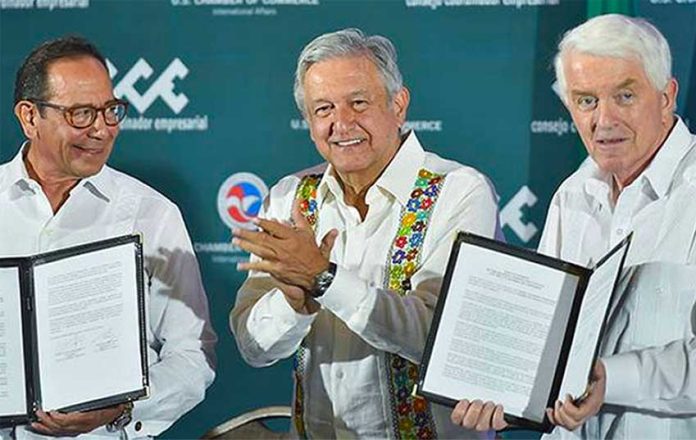
Business leaders Salazar, left, and Donohue, right, flank López Obrador in Mérida yesterday.
Border issues, metal tariffs and the tomato trade were all on the agenda at a meeting between Mexican and United States business leaders in Mérida, Yucatán, yesterday.
The United States-Mexico CEO Dialogue, a biannual event organized by Mexico’s Business Coordinating Council (CCE) and the U.S. Chamber of Commerce (USCC), was also attended by government officials from both countries, including President López Obrador.
Both business groups called on United States President Donald Trump to stop his threats to close the border, where recent delays caused by a redeployment of U.S. border agents cost Mexican exporters an estimated US $800 million a day.
A complete closure of the border would have a devastating impact on trade between the two countries, which is worth about half a trillion dollars a year.
USCC president and CEO Tom Donohue told a press conference that the United States should exempt both Mexico and Canada from steel and aluminum tariffs imposed by Trump last year before the U.S. Congress ratifies the new North American trade deal reached in November.
He described the relationship with Mexico as a top priority, adding “that is why we are the first out of the gate to warn against the disastrous consequences of closing the U.S.-Mexican border.”
López Obrador, who was seated next to the business leader, applauded warmly.
The lower house of Mexico’s Congress this week approved a landmark labor reform package, legislation that is considered crucial for the ratification of the new North American trade agreement in the United States.
In turn, Mexico and Canada want the U.S. to drop the metal tariffs imposed on national security grounds last June before their respective legislatures move to ratify the new trade pact, which will replace the 25-year-old NAFTA.
Another issue that is hindering the process to ratify the new United States-Mexico-Canada Agreement (USMCA) is migration.
In addition to threatening to close the border, Trump said on April 4 that his administration could also impose tariffs on Mexican auto imports in one year if Mexico doesn’t do more to stop northward flows of migrants.
Mexican and US politicians and business leaders at the conference in Mérida.
Despite Trump’s threats, CCE president Carlos Salazar said at yesterday’s press conference that he hoped that the United States government understood the importance of keeping the border open.
Foreign Secretary Marcelo Ebrard told reporters that a Texan businessman presented a proposal yesterday which called for both Mexico and the United States to invest in infrastructure at the border “to facilitate an orderly exchange both of people and goods.”
He also said that Mexican and United States officials reached an agreement to not allow migration to affect trade and to put an end to delays at the border that have stranded thousands of trucks for up to 20 hours.
“. . . We’re going to try to normalize the situation at the border. What the [United States] administration tells us is that [the reassignment of border agents] is not a political decision, they’re not seeking to harm Mexico but rather they suddenly had too many Central Americans [to deal with],” Ebrard said.
The highest ranking United States official who traveled to Mérida, Secretary of Commerce Wilbur Ross, didn’t address the media yesterday but at a dinner Thursday night he thanked Mexico for helping to confront the migration “crisis.”
On the sidelines of the event, Ross met with Economy Secretary Graciela Márquez, who urged the United States to end the metal tariffs.
She also asked Ross to push forward talks aimed at reaching a deal in a dispute between Mexican and United States tomato producers.
Ross’ department said in February that the United States intended to withdraw from a six-year-old trade agreement with Mexico on tomatoes, a move that clears the way for new tariffs to be imposed.
The two secretaries agreed that the U.S. Department of Commerce would continue to seek a new deal that would be beneficial to tomato farmers in both countries.
Two Pueblos Mágicos in Guanajuato are fighting to keep the magic alive amid a precarious security situation in the state.
The magical towns of Yuriria and Jalpa de Cánovas (in the municipality of Purísima del Rincón) have both suffered from violence recently and their respective mayors agree that the situation is alarming.
But Salomón Carmona and Marco Antonio Padilla Gómez are fighting back by taking action to guarantee the safety of residents and visitors.
Carmona described the security situation in Yuriria as a “disaster,” telling the newspaper Milenio that armed men recently entered a hospital in the municipality to “finish off” a man they had presumably attacked earlier.
“. . . The scourge of society is that crime is not just in this municipality and not just in Guanajuato, it’s in the entire republic,” he said.
“We’re doing our part to attend to citizens. We’d gone almost two months without a problem on that level,” Carmona added, referring to the hospital shooting.
Yuriria was the second most violent Pueblo Mágico in Guanajuato last year, recording 74 homicides. Only Salvatierra was more violent, with 93 murders.
In Purísima del Rincón, where there were 15 homicides in 2018, Padilla said that police are carrying out additional operations to combat organized crime groups.
“. . . Before they only did one or two [operations] a week, now we’ve increased them, especially on weekends when the [security] situation is worse,” he said.
The seven magical towns in Guanajuato are key tourist attractions in the state and authorities hope that visitor numbers will be strong during Holy Week, which begins on Sunday.
Federal, state and municipal authorities are contributing to a statewide security operation that began yesterday.
Guanajuato used to be considered one of the safest states in Mexico but violence has soared in recent years and in 2018 it recorded the highest number of homicides in the country.
Much of the violence is believed to be linked to pipeline petroleum theft and a related turf war between the Santa Rosa de Lima Cartel and the Jalisco New Generation Cartel (CJNG).
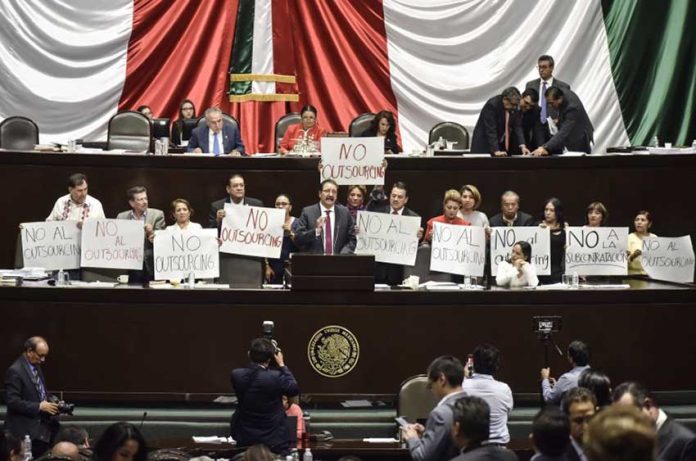
Labor Party legislators, who voted against the law, demonstrate their opposition to outsourcing.
The lower house of Congress approved a landmark labor reform package yesterday, legislation that is considered crucial for the ratification of the new North American trade agreement in the United States.
A majority of deputies endorsed changes to five different laws including the Federal Work Law.
The reform eliminates conciliation and arbitration boards, replacing them with federal tribunals and a new body called the Federal Center for Labor Registry and Conciliation.
It also democratizes unions by giving workers the right to elect their leaders in free and secret ballots, and unions will be empowered to bargain more effectively on behalf of their members.
The reform also has provisions to protect workers’ human rights and gender equality and stamp out discrimination in the workplace.
“The reform is very clear,” said Mario Delgado, leader of the ruling Morena party in the Chamber of Deputies.
“The authorities must ensure that union leadership is overhauled and that every four years workers vote on their collective bargaining contracts.”
The lawmaker said that Mexico now has the opportunity to put an end to charrismo sindical, a term used to describe union corruption.
The labor reform will be sent to the Senate for debate and a vote. Its approval of the reform is expected later this month.
President López Obrador recently called on the Congress to approve the reform so that Mexico’s labor laws are consistent with provisions set out in the United States-Mexico-Canada agreement (USMCA), which leaders of the respective countries signed in November.
“It’s in our interest to have this treaty and for there not to be any excuse to reopen the negotiation,” he said yesterday.
While Morena party lawmakers in the lower house took the president’s advice, deputies from its coalition partner, the Labor Party (PT), unanimously voted against the reform.
“ . . . If we agree with what this reform sets out . . . why vote against it? Because we think it’s inadequate, we believe that a labor reform that doesn’t include the elimination of outsourcing . . . isn’t a reform that is up to the standard of the fourth transformation,” said PT deputy Gerardo Fernández Noroña, using the term used by the president to describe the change his government will bring to Mexico.
National Action Party (PAN) Deputy Arturo Espadas said the reform had been rushed through and wondered whether lawmakers were “obeying the president of a neighboring country.”
In order for the USMCA to be ratified in the United States, the Democratic Party, which has a majority in the House of Representatives, has said that enforcement of labor provisions in the USMCA is key.
On April 2, House Speaker Nancy Pelosi said the United States Congress wouldn’t ratify the agreement until its Mexican counterpart approved the labor reform.
An annex of the USMCA, which will replace the 25-year-old NAFTA, explicitly requires Mexican workers to vote on union decisions and their contracts.
Union elections have commonly been rigged in Mexico and workers have sometimes been coerced to vote against their will.
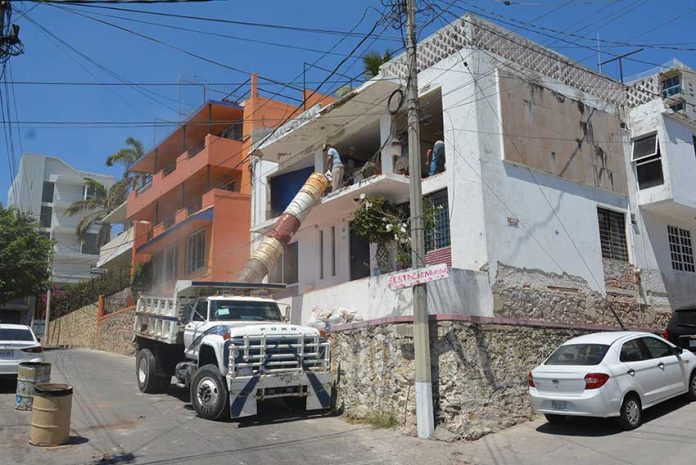
Rubble goes down the chute in the demolition stage of the renovation.
We have been in the process of renovating our recently acquired pile of bricks for three weeks as of this writing. All of our truly disruptive demolition has taken place over the past three weeks and real construction has begun.
Of the three original laborers, two remain and have been joined by two more. Their capacity for pure destruction is admirable. So far, we have removed three, dump truck loads of rubble and have another two to go.
I utilized tarps and duct tape to erect curtains between the demolition and the still livable portion of the house. This technique is capable of eliminating 95% of the dust generated by concrete saws and rotohammers. However, even with the best of dust prevention measures, the 5% that finds its way into the living space is substantial.
After work the other day, I went to the refrigerator to retrieve a cold beer. When I pulled it out, something did not look quite right. Upon closer inspection, I realized it was the only thing I had seen all day that did not possess a layer of fine dust.
Fortunately, The Captured Tourist Woman fled to Australia after the first week of major demolition and will return when her fine counsel will be required for the installation of the finishes.
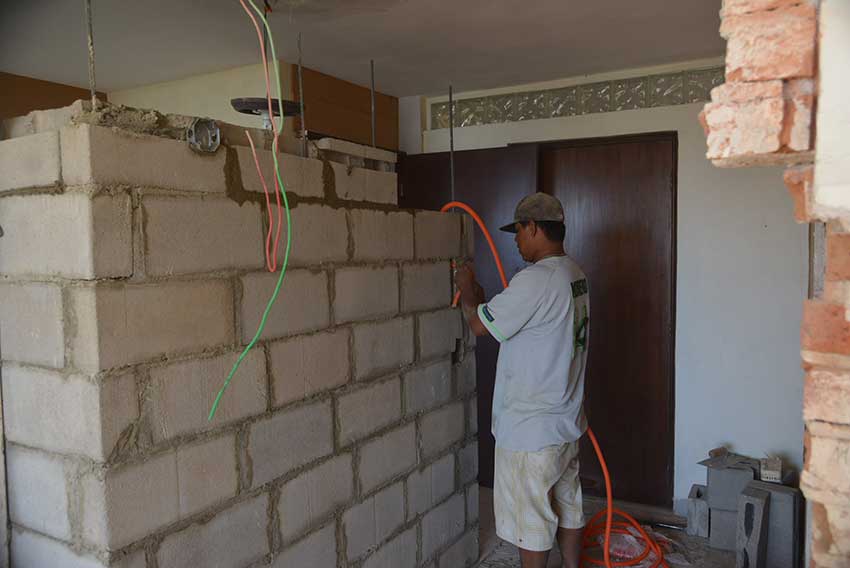
Concrete block wall such as this is not standard practice.
By the second week, it was time to start building new interior concrete block walls. The albañil (mason) showed up on Monday morning ready to lay block.
Concrete block has been around for over 100 years and has been used in Mexico for the last 50-plus years. In this area of Mexico, the block is used as a brick replacement and simply serves as infill between reinforced concrete castillos (columns) and dalas (beams).
In other parts of the world, concrete block is used as the manufacturer intended, as a CMU or concrete masonry unit. With a typical CMU the block cavities are filled with reinforcing steel and concrete and the wall becomes a structural component capable of carrying the load of a multi-story building.
On my first morning briefing with our new albañil I explained the process of building a CMU with just a bit of trepidation. My experience with several other albañiles had shown me that many tradespeople will only perform work in the same manner as their father or grandfather or uncle, or whomever they learned from.
I know there are trade schools throughout Mexico, but I have only come across one of the graduates in the last 12 years.
When the albañil said he had no problem putting the concrete and steel in the block cavities, I put my hands in the air, and exclaimed, “Halleluiah.” The ancient Aztec gods of construction have certainly smiled down upon me.
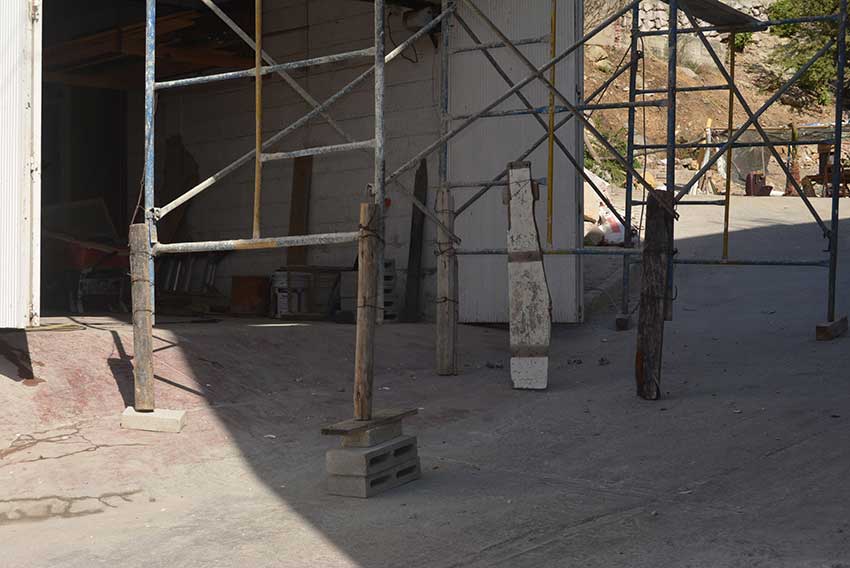
Note the scaffold extensions: creative Mexican ingenuity at work.
I knew that later I would need to make a sacrificial offering to properly demonstrate my gratitude. The yappy chihuahua next door would fit nicely on the stone altar.
My albañil is 32 years old and learned his trade from his father, but had spent a lot time laying block the Mexican way. He was more than willing to place steel and concrete inside the blocks, and expressed his opinion that it had always seemed to be the proper way to use concrete blocks.
After hearing this, I knew I needed to find a second chihuahua.
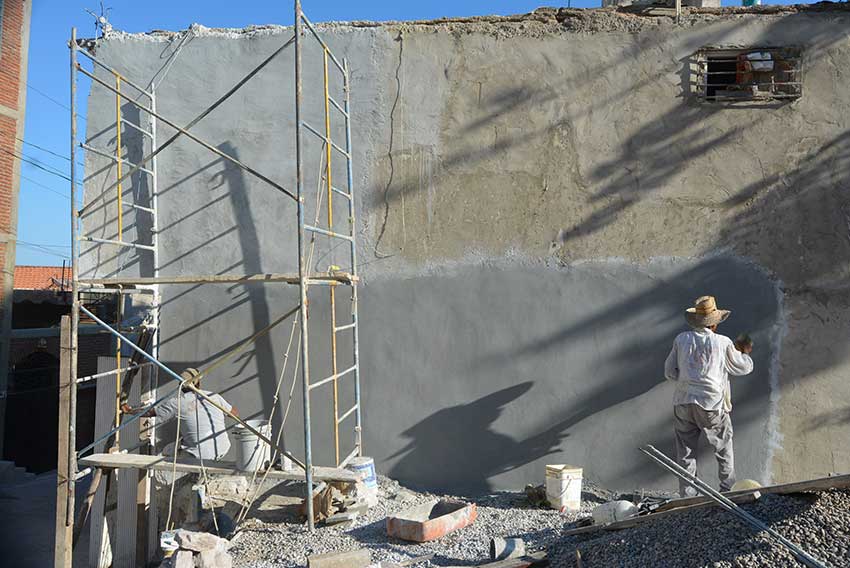
By the third week of the project, his father became our second albañil and we began the process of replastering the north wall of the house. When I wheeled out the air compressor and the stucco sprayer, they were ready to take their skills into the 21st century.
I had purposely started on the north wall of the house because it is the least visible of the exterior walls. Since I am mixing color in the last coat of plaster, the north wall gave me a large canvas to hone the new procedures.
Just so there is not any confusion about cementitious coatings, I need to interject a brief explanation. In the countries north of the border, stucco is the cementitious coating applied to the exterior of buildings, while plaster is the proper term for the same type of coating, but on the interior walls.
Plastering an exterior wall.
In other words, stucco and plaster are the very same thing. But since I am in Mexico, I will call it plaster, no matter how or where it’s placed.
Our two albañiles are working with one peón and have mastered the spray and then trowel method of plastering.
When I asked the younger albañil his opinion after the first day with the sprayer, he thought for a minute and then responded, with a big smile. “A toda madre,” which I am told is Spanish for “It’s really swell!”
In my next installment of this continuing saga, we will explore the wonderful and wacky world of residential electrical systems in Mexico.
The writer describes himself as a very middle-aged man who lives full-time in Mazatlán with a captured tourist woman and the ghost of a half wild dog. He can be reached at buscardero@yahoo.com.
State by state, Mexico is steadily implementing bans on disposable plastic objects.
The most recent state to do so is Oaxaca after the state Congress voted yesterday to ban single-use plastic, including plastic shopping bags, straws and Styrofoam objects.
The law gives establishments in the 570 municipalities of the southeastern state one year to get rid of disposable plastics in their inventory.
Municipal administrations have been given a six-month deadline to incorporate penalties in local laws to punish violations of the ban.
The move against single-use plastic in the state started in 2010, when the municipality of San Bartolo Coyotepec officially banned the use of plastic shopping bags.
In October, Oaxaca city banned the use of Styrofoam products.
The state of Veracruz led the new trend in banning plastic with a law last year that called for a reduction in the use of straws and other disposable plastic products.
Straws are also banned in Mexico’s Pueblos Mágicos, or magical towns.
The city of Monterrey, Nuevo León, has ruled that starting next year the use of straws will be banned, and a new law is in the making that will also ban plastic shopping bags.
Tijuana, Baja California, and Pátzcuaro, Michoacán, have implemented a similar ban on plastic bags, with the latter including straws in its regulations.
Guerrero has also banned those products, along with disposable plastic cutlery and Styrofoam products.
Several municipalities in México state have implemented similar regulations.
At least 16 states — Aguascalientes, Baja California, Baja California Sur, Chiapas, Chihuahua, Coahuila, Guerrero, México, Michoacán, Nuevo León, Oaxaca, Sinaloa, Tamaulipas, Tlaxcala, Veracruz and Yucatán — have in some shape or form started to phase out the use of single-use plastic.
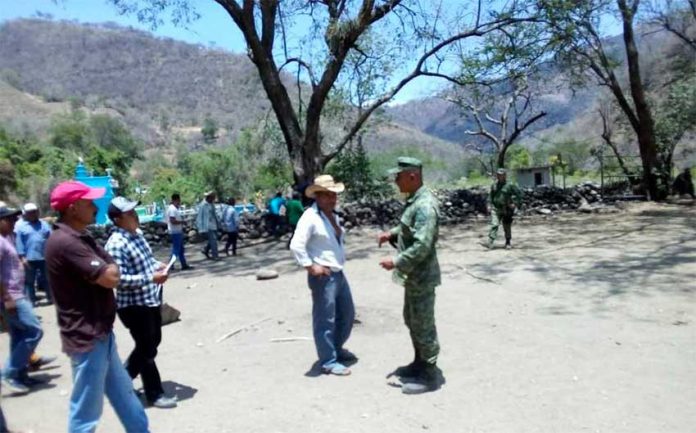
Residents of a town in Guerrero detained 40 soldiers this week to demand that they halt operations to destroy opium poppies.
On Wednesday, residents of Campo Morado, a community in the municipality of Heliodoro Castillo, set up a roadblock to prevent the soldiers — presumably deployed to destroy poppy plants — from leaving the upper Sierra region.
Farmers called on the federal and state governments to provide assistance so that local farmers are not forced to cultivate poppies to survive.
The soldiers were allowed to leave the upper Sierra region yesterday.
State security spokesman Roberto Alvarez Heredia denied that the soldiers were actually detained, explaining that residents simply “took advantage of their presence to let them know their concerns.”
The Guerrero government said yesterday that officials from several departments and military personnel had met with representatives from several communities in Heliodoro Castillo.
Preliminary agreements were signed requiring the state to provide support to the communities, as well as machinery to to carry out roadwork.
Another meeting has been scheduled for April 25 in the state capital, Chilpancingo.
The farmers claim that the state government promised last November that drug crops would not be destroyed and that alternative means of support would be provided. Neither promise was kept, they say.
Prices for Mexican opium gum plummeted by as much as 80% last year due to the rise in demand for the synthetic opioid fentanyl among United States drug users, according to an independent study.
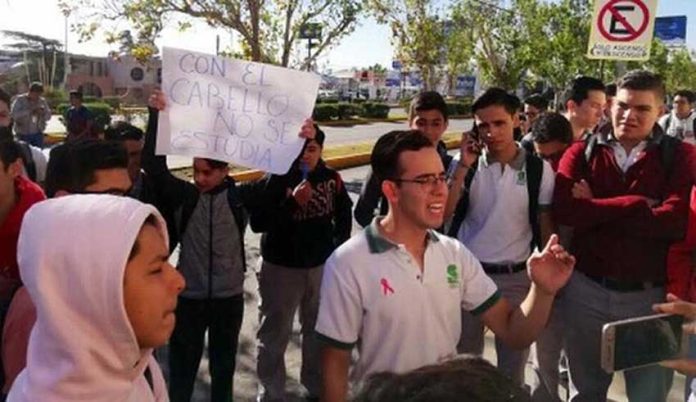
Protesting students in Chihuahua. The sign reads, 'You don't study with your hair.'
Can the length of a student’s hair have an impact on academic progress? For male preparatory school students in Chihuahua the answer is yes: they are not allowed in school if their hair is longer than two centimeters or if it is cut in what the principal’s office described as “modern styles.”
A crackdown yesterday on offending students attending at least one campus of the state-run Colegio de Bachilleres de Chihuahua (Cobach) sparked protests by students, who accused the principal’s office of violating their right to learn.
About 50 students mounted a demonstration outside the school.
State lawmaker Deyanira Ozaeta issued a statement asserting that no school’s rules should be “above the rights enshrined in the constitution,” and that denying the students entry was unacceptable and discriminatory.
The school says students — and parents — are aware of the rules and must sign off on them to be accepted by the school, which has the option to bar access if they do not comply.
The rules require that students tuck in their shirts, wear a belt, black shoes with socks and — for boys — wear their hair short.
The purpose of the rules “is to promote order, responsibility and respect among the youths,” and abiding by them “contributes to and guarantees a structure of appropriate relationships and behavior that promote the community’s development following a culture of legality.”
The school offers free haircuts to any student who wants one.
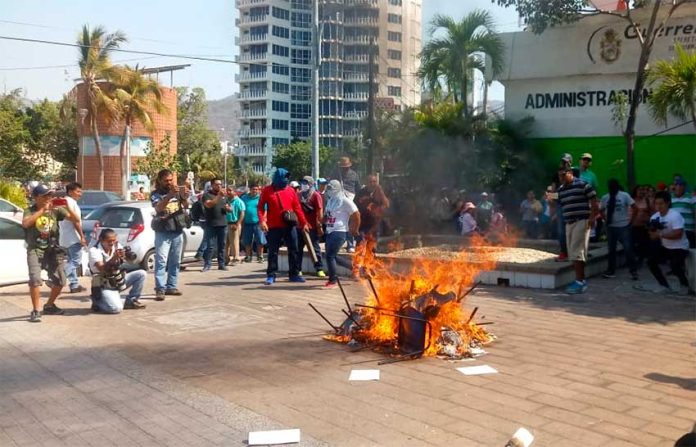
Teachers burn furniture and documents in Guerrero.
While members of the CNTE teachers’ union met yesterday with federal education officials to discuss civics classes in public schools, teachers from another union were vandalizing government offices in Acapulco.
The Guerrero teachers ransacked the offices as part of continuing demands for the repeal of the 2013 education reforms.
According to Education Secretary Esteban Moctezuma, the seventh meeting between federal authorities and CNTE leaders yesterday in Mexico City was the first time that the two parties have discussed potential changes to curriculum, such as civics, physical education and environmental science classes, with any substance.
Also substantial was the violent attack on the state’s finance department offices by teachers belonging to the CETEG, a Guerrero-based teachers’ union.
Hooded teachers armed with sticks stormed the offices, demanding that employees exit the building before proceeding to break glass in windows and doors, spray-paint the walls and burn chairs and government documents on the sidewalk outside.
The teachers also blocked the Miguel Alemán boulevard for two hours using four public buses before moving on to commandeer a toll booth on the Cuernavaca-Acapulco highway for another two hours.
In contrast, Moctezuma expressed satisfaction with the CNTE meetings, saying they helped clarify doubts about the curriculum laid out in the education reform.
“We believe that the [CNTE leadership] is truly interested in bettering many things in public education, and we want to cooperate so that anyone who has anything to say about public education in Mexico has a space to do so.”
Upon leaving the meeting yesterday, a legal advisor to the government told reporters that federal authorities “are very close” to an agreement with the teachers, who have been demanding the complete abrogation of the previous government’s education reforms.
Reaching agreements with the CNTE has been an objective for many previous governments — federal and state — but no accord has ever completely satisfied the union, renowned for its annual strikes and blockades.