Home Blog Page 2055

Tijuana migrant numbers down by 3,000 but no one knows where they are

0
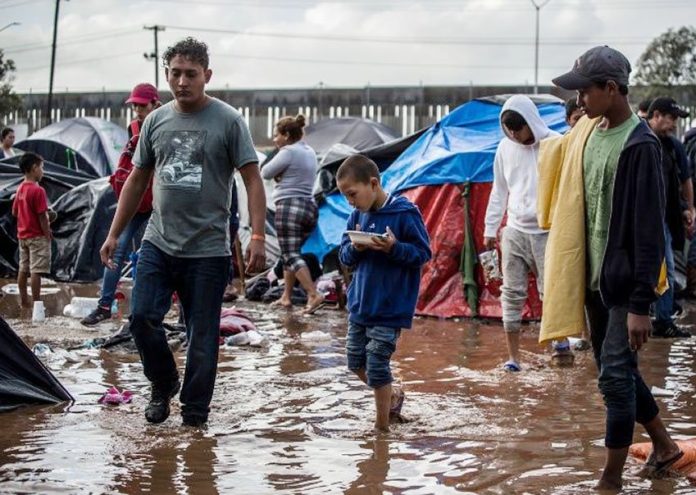
Muddy conditions at the shelter in Tijuana after heavy rains.

The whereabouts of around 3,000 Central American migrants is unknown after fewer than half of those in a Tijuana shelter were transferred to a new location.

More than 6,200 mainly Honduran migrants have arrived in the northern border city since mid-November and most had been staying in a sports complex that was converted into a temporary shelter.

However, government authorities announced last week that the migrants would be transferred from the Benito Juárez sports complex, whose grounds had become a quagmire after heavy rain, to a 9,000-square-meter-piece of land known as El Barretal, which is located in Tijuana’s eastern outskirts.

However, Rodolfo Hernández, president of the Baja California State Migrant Council, said that between last Thursday and yesterday only around 2,500 migrants had arrived at the new shelter while 300 remained in and around the previous one.

“. . . the rest, around 3,000 [migrants], nobody knows where they are,” he said.

“We’re asking other shelters to supply us with lists in order to know how many of them are in those places, others crossed the wall and went into the United States . . . We’re trying to carry out a census,” Hernández added.

Those who have moved to the new shelter, located in the notoriously violent neighborhood of Mariano Matamoros, say that conditions there are much-improved.

The El Barretal shelter has the capacity to house 2,500 people indoors and another 3,500 in an outdoor area, according to Tijuana Civil Protection authorities.

David Alejandro, a 23-year-old Honduran man, told the newspaper El Universal that there was a downpour on the last day he spent in the Benito Juárez sports complex, which ruined his few possessions.

“. . . We’re better off here . . . because there is hard ground here and there it was dirt that turned into pure mud . . . they say it’s going to rain again and we don’t have a roof here either but at least there is no mud,” he said.

Another migrant identified only as Alicia, who is accompanied by her three small children, said that living in the previous shelter in crowded conditions with no privacy and poor hygiene was difficult but that the rain made it impossible.

“. . . Here the children can play a little bit more because it’s not so dirty. They told us that women and the little ones are going to sleep indoors, that’s fine by me,” she said.

Some other migrants agreed to move to the new shelter but quickly began planning their departure.

Honduran Claudia Lorely, her husband Bryan José and two of their friends were among those who decided to leave, according to a report published by the news website Univision Noticias.

On Sunday, the four Hondurans, who left San Pedro Sula on October 13 as part of the first and largest migrant caravan, ate a Chinese meal outside the El Barretal shelter and stocked up on sports drinks before setting off for Playas de Tijuana, a neighborhood in the west of the city where the border fence separating Mexico from the United States meets the Pacific Ocean.

Once there, they planned to try to jump the fence to turn themselves into United States border patrol agents and request asylum.

“We’re going to hand ourselves in because we no longer see any other option,” Claudia said.

The Hondurans took the decision to try to cross the border illegally after coming to the realization that they wouldn’t be able to enter the United States as a group as they originally thought would be possible.

A daily “metering” system adopted by United States border authorities limits the number of migrants who are granted appointments at which they can begin the process to request asylum.

That system, coupled with an existing backlog of would-be asylum seekers who were already in Tijuana when the caravan arrived, means that most new arrivals will be forced to wait months or even years to plead their case to U.S. authorities with no certainty that they will be successful.

“It’s not as we thought it would be. We’re tired, desperate, it’s already been a long time since we left home and we want to see something clear,” Bryan said.

The United States border patrol said that 24 people were intercepted on the U.S. side of the border Saturday while more migrants have crossed or attempted to cross the border over the past two days.

Some migrants have decided to remain in Tijuana – at least for the time being – while others have sought assistance to return to their countries of origin.

Mario Madrazo, a director at the National Immigration Institute (INM), said that 453 migrants had voluntarily requested assistance to return home, adding that around 150 others would be deported after being arrested for committing misdemeanors or other crimes.

Around 100 migrants were arrested and deported after participating in a rush on the border on November 25 to which U.S. border agents responded with the use of tear gas.

Honduran migrant Yoselin Martínez told Univision that the number of people making snap decisions about their plans had spiked since Thursday when rumors began circulating that those transferred to the new shelter would be detained by immigration authorities and immediately deported.

Another migrant at the new shelter, 23-year-old Honduran Milson Martínez, who traveled more than 4,000 kilometers to the border with his partner, cousin and five-year-old nephew, said it was necessary to remain “level-headed” when planning any future move because “one could lose everything” with a poor decision.

“The truth is that they’re filling our heads with a lot of ideas, a lot of people think that those of us who are here are going to be deported . . . and others are enticing people to leave and cross the wall but I believe that we have to be calm and patient . . . We saw that we can’t enter as a group like we entered Guatemala, we have to wait,” he said.

“We know that Donald Trump’s heart won’t be touched by us, we know that it’s going to be difficult but for now we’re going to wait and see if they speed up the process to request asylum . . .”

Source: El Universal (sp), Univision Noticias (sp) 
AMLO creates super-commission to investigate missing 43 of Ayotzinapa

0
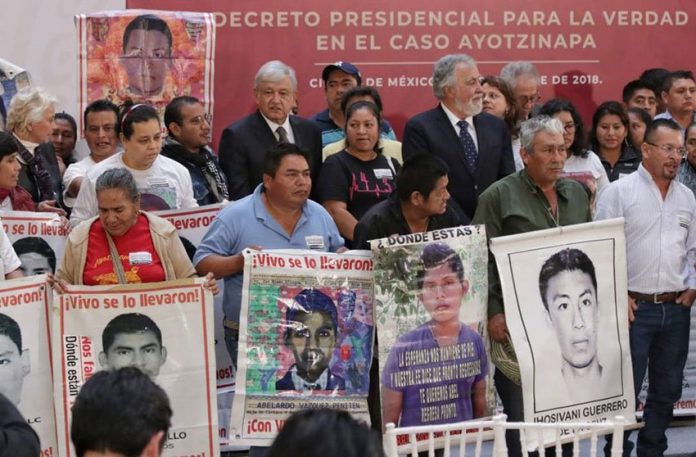
López Obrador with parents of the missing students during yesterday's signing of the decree.

President López Obrador signed his first presidential decree yesterday, creating a super commission that will conduct a new investigation into the case of the 43 students who disappeared in Guerrero more than four years ago.

Just two days after he was sworn in as president, López Obrador told parents of the missing students gathered at the National Palace that “there will be no barriers, no obstacles to arriving at the truth” about what happened to their sons.

The 43 young men, who were studying to become teachers at the Ayotzinapa Rural Teachers’ College, disappeared in Iguala in September 2014 and were presumably killed.

The case precipitated the worst crisis of former president Enrique Peña Nieto’s administration, triggered mass demonstrations in Mexico City and became representative of other disappearances and rampant violence and corruption.

The new commission, whose creation was ordered by a federal court in June, will have no limits to its investigation, complete access to existing information about the case and will offer protection to witnesses so that they can tell their stories without fear of repercussions.

Alejandro Encinas, deputy interior secretary for human rights, will head the commission, which will be funded by the Secretariat of Finance but could also receive monetary contributions from national and international organizations.

Family members of the victims, their lawyers and representatives of the secretariats of the Interior, Foreign Relations and Finance will all be part of the commission.

The Inter-American Commission on Human Rights, the Office of the United Nations High Commissioner for Human Rights and other international organizations, authorities and experts will also be permitted to “assist and cooperate” with the truth commission’s investigation.

López Obrador declared that his government will not be an accomplice to human rights violations, explaining that all lines of investigations will be pursued, including any role that the army may have played in the students’ disappearance.

“I believe that the investigation has to include the whole government, all the people involved,” he said, charging that an army probe would not inflict any damage, reputational or otherwise, on the military.

“Arriving at the truth and delivering justice doesn’t weaken institutions, it strengthens them. In this new government, the truth must reign above all else, it’s the truth that is revolutionary [and] Christian. Lying is reactionary, it’s of the devil,” López Obrador said.

According to the former government’s “historical truth,” the 43 students were intercepted by corrupt municipal police in Iguala on September 26, 2014 while traveling on buses they had commandeered to travel to a protest march in Mexico City.

The police then handed them over to members of the Guerrero Unidos gang who killed the students, burned their bodies in a municipal dump and scattered their ashes in a nearby river.

However, the former government’s conclusion was widely questioned both within Mexico and internationally and authorities were heavily criticized for their handling of the case.

Many people suspected that the army played a role in the students’ disappearance but it was never subjected to investigation.

Deputy secretary Encinas said at the National Palace yesterday that members of the new commission and other government investigators would have “free access” to all facilities where “due to the circumstances of the case it is presumed that the missing persons or remains corresponding to them may have been present.”

Questioned whether the “free access” would extend to military barracks, Encinas responded that it would because “they are the only [facilities] that haven’t been opened [to investigators].”

Scores of people have been arrested for their alleged involvement in the students’ disappearance but both the United Nations and the National Human Rights Commission have said that there is evidence that many of them were tortured by authorities and likely forced into making admissions of guilt.

A federal court judge ruled late last month that 83 statements made by people accused of involvement in the crime must be omitted from the Ayotzinapa investigation due to evidence that their human rights were violated.

Three men who had been identified as actual perpetrators of the crime and who had supported the past government’s official version of events were consequently released from custody.

Parents of the missing students have always rejected the past government’s “historical truth” but are now placing their faith in the new administration to deliver answers – and their sons – to them.

“We ask you [López Obrador], as a father, to help us, to pull us out of this dumpster where Peña Nieto left us, and for you to gain the trust of all Mexicans, because we don’t trust anyone anymore,” pleaded María Martínez, the mother of one of the missing students.

Source: El Universal (sp), El Financiero (sp) 

Ensenada wins its argument, gets admission into new border zone

0
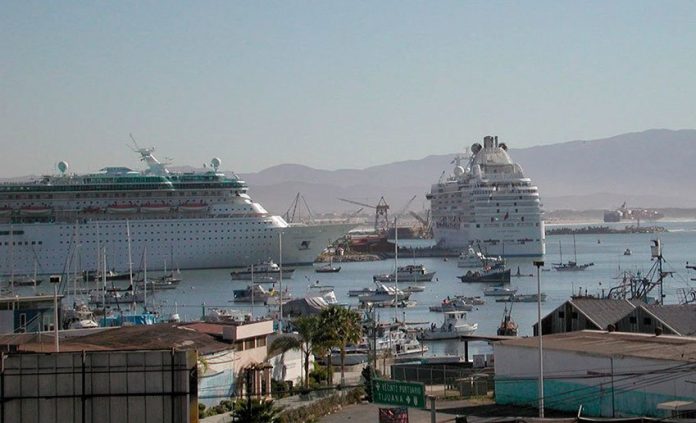
Ensenada will be a border free zone city.

Ensenada, Baja California, will be included in the new northern border free zone to be implemented by the federal government although it is located beyond the official limits.

President López Obrador confirmed Ensenada’s inclusion during a speech to thousands of supporters at Mexico City’s central square Saturday evening just hours after he was sworn in.

The free zone, which is scheduled to go into effect on January 1, will generally extend around 30 kilometers south of Mexico’s border with the United States and run from Matamoros, Tamaulipas, to Tijuana, Baja California.

Ensenada is located about 100 kilometers south of Tijuana and the Mexico-United States border.

The value-added tax rate (IVA) is slated to be cut in the free zone from 16% to 8% while the maximum income tax rate (ISR) will be reduced from 30% to 20%.

Baja California Governor Francisco Vega de la Madrid said he was pleased that Ensenada – the state’s third biggest city behind Tijuana and Mexicali – would be included in the zone.

“It’s with satisfaction that we see from the first day of the new federal administration that Baja California is considered a strategic region for the development of Mexico,” he said.

Business groups including the Mexican Employers Federation (Coparmex), the Business Coordinating Council (CCE) and the National Chamber for Industrial Transformation (Canacintra) had warned that excluding Ensenada would have a negative effect on the city and surrounding municipality’s main commercial activities of tourism and trade.

The private sector lobbied strongly for Ensenada’s inclusion in the free zone, and sent a letter to López Obrador in October.

The president of Coparmex in Ensenada said the area depends heavily on tourism and investment from municipalities located closer to the border as well as the United States and it was important to ensure that it didn’t lose competitiveness.

“The municipality is geographically and commercially isolated from the rest of the country, being 940 kilometers from Hermosillo in Sonora and La Paz in Baja California Sur . . . there’s no kind of economic contact,” Marco Navarro said.

If Ensenada wasn’t included in the border region free zone, there were fears that the city’s workforce could be lured away and that shoppers would chose to spend their money closer to the border, or in some cases, in the southern United States.

An economic loss of 900 million pesos (US $44.3 million) had been predicted in the free zone’s first year of operation.

CCE Ensenada president Jorge Cortés Rios welcomed the government’s decision, saying that it would allow the city to maintain economic growth and position itself as one of the nation’s premier tourist destinations.

Other cities that will benefit from the zone are Ciudad Juárez, Chihuahua; Nogales, Sonora; and Reynosa, Tamaulipas.

Source: El Economista (sp) 

Airport bonds buyback planned as construction carries on

0
mexico city airport
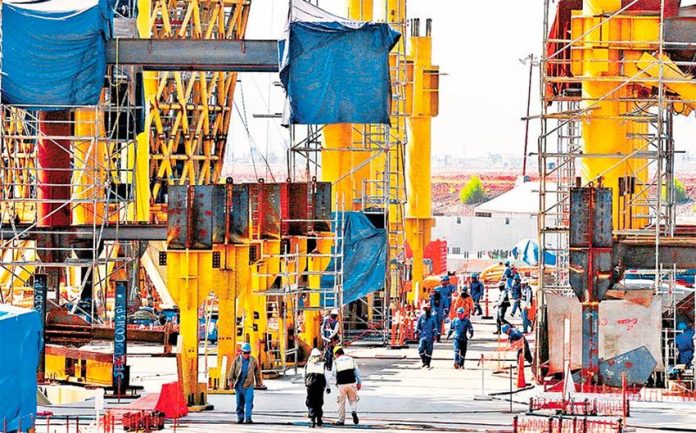
Workers aimlessly carry on building the new airport.

The federal government announced today that it would buy back a portion of the US $6 billion of bonds sold to fund the cancelled Mexico City International Airport project.

The Secretariat of Finance and Public Credit (SHCP) said in a statement that “the Mexico City Airport Trust (MEXCAT) will proceed with a transaction directed at holders of international MEXCAT bonds.”

It added that “the transaction is part of a comprehensive plan to attend to the contractual rights of all parties with interests in the development of airport infrastructure in the Mexico City metropolitan area.”

Under the buyback plan, the airport trust will purchase US $1.8 billion worth of bonds at between 90 cents and the par price of US $1.

The newspaper the Financial Times reported that in exchange the bondholders would have to agree to a loosening of their rights on the remaining debt.

“The principal objective of the repurchase and consent request is to give flexibility to MEXCAT in the event that the new administration makes changes [to the airport project],” the SCHP statement said.

It added that the proposal is “part of a comprehensive plan to attend to the agreements and commitments related to the Texcoco airport with contractors, investors and other shareholders, including holders of FIBRA E shares.”

The statement concluded by saying that the Mexico City Airport Group, the state-owned firm responsible for the airport project, intends to guarantee “fair treatment” to all interested parties “in accordance with market practices in these situations.”

Since the cancellation of the airport project in late October following a public consultation, there has been market concern about the economic impact of the decision and FIBRA E shareholders said late last month that they were evaluating their legal options in light of the government’s decision.

The Financial Times said that investors gave an initial welcome to today’s buyback proposal: a US $3-billion bond due in 2047 increased in value to 86 cents on the dollar whereas prior to the announcement it was trading at 75 cents.

Michael Leithead, a portfolio manager at EFG Asset Management, told the Times that on balance the government’s proposal was a positive development.

“As a bondholder, you invest to be paid back over time and when considered against this alternative, the current offer looks potentially attractive,” he said.

The Mexican peso rallied on news of the buyback and was on track to post its best single-day gain since July, the news agency Reuters reported.

While the bond repurchase process takes place over the next 20 business days, construction of the US $14-billion airport, which is roughly one-third complete, will continue.

However, the government hopes that there will be sufficient take-up of the buyback offer to be able to announce a definitive termination to the project during the second half of this month.

During this year’s election campaign period, President López Obrador rallied against the airport project, charging that it was corrupt, too expensive and not needed.

He also argued that the location – an ancient lake bed in Texcoco, México state – was unsuitable due to its susceptibility to sinking.

Almost 70% of people who participated in a four-day consultation on the new airport’s future voted in favor of building two new runways at the Santa María Air Force Base and upgrading the existing Mexico City airport and that in Toluca over continuing with the current project.

In his inauguration speech Saturday, López Obrador pledged that Santa Lucía would be operating as Mexico City’s new airport in three years.

Source: Milenio (sp), Financial Times (en) 

Mexico’s new president gets in line for commercial flight to Veracruz

0
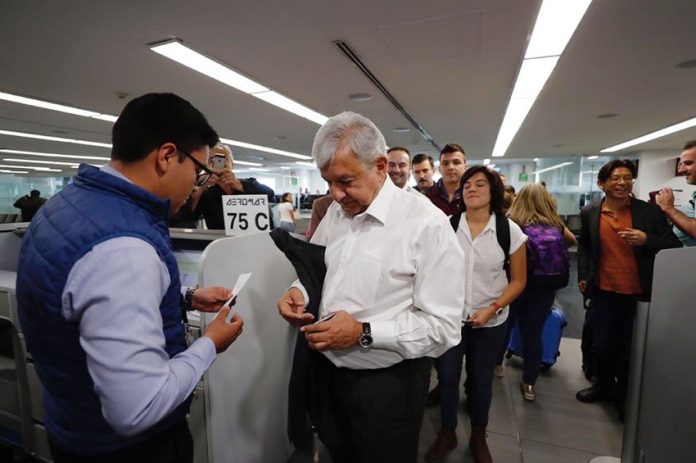
AMLO lines up at the gate to board his flight to Veracruz.
AMLO lines up at the gate to board his flight.

The new era of government austerity that President López Obrador has vowed to deliver was on full display yesterday as he lined up to board a commercial flight to Veracruz.

The day after he was sworn in as president, López Obrador arrived at the Mexico City airport in his Volkswagen Jetta just after 2:00pm in the company of his small, unarmed security detail made up of just three women and two men with no police training.

Gone are the days when it was impossible for ordinary citizens to approach their president due to the presence of the Estado Presidencial Mayor, the institution which until Friday was charged with protecting the nation’s leader.

Yesterday, passengers in the airport and airline staff posed for photos with López Obrador and congratulated the avuncular 65-year-old political veteran on his inauguration, with some even taking the opportunity to give him a hug.

For his part, the new president appeared relaxed, chatting with those who approached him about a soccer match in Mexico City and asking some which  they had enjoyed more: his official swearing-in ceremony at the legislative palace or his indigenous cleansing in the zócalo, the capital’s main square.

Waiting for his flight, López Obrador assured fellow passengers within earshot that the presidential plane is going to be put up for sale.

On board, the newspaper El Universal reported that the airplane’s captain welcomed the new president aboard, a gesture that was met with rapturous applause from the other passengers.

During the flight, López Obrador drank coffee and looked over documents with Daniel Assaf, the head of his informal security detail — known as the presidential ayudantía, a word which literally means assistants or helpers.

He also assured executives of the airline he was traveling on – Aeromar – who accompanied him on his maiden flight as president that he would continue to fly commercial in line with his austerity plan.

Once on the ground in Veracruz, López Obrador declared to waiting reporters and supporters that he was a fellow veracruzano given that his father was a native of the Gulf coast state.

After traveling from Veracruz to the state capital Xalapa, the popular new president addressed some 2,000 supporters at a rally reminiscent of a campaign event in the city’s Lerdo square.

There, he also declared “we are selling all the planes and helicopters that the corrupt politicians used,” a remark that triggered a loud roar of approval.

Earlier yesterday, Finance Secretary Carlos Urzúa told a press conference in Mexico City that the Boeing 787 Dreamliner presidential plane would be put up for sale “very soon” along with about 60 other government planes and 70 helicopters.

A statement issued by the Finance Secretariat said the luxurious US $218 million plane would depart Mexico City today for the Victorville Airport in southern California, where Boeing recommended it be sent to await a new owner.

After yesterday’s rally in Xalapa, at which the new president also outlined other austerity measures including ending past presidents’ pensions and slashing bureaucrats’ salaries, López Obrador returned to the Veracruz airport, where he took another commercial flight – this time on Interjet – to return to Mexico City.

In this new age of austerity, any commercial aircraft has the potential to become the new presidential plane.

Source: El Universal (sp), Reuters (en) 

On day 2 of AMLO’s presidency, protesters march against him

0
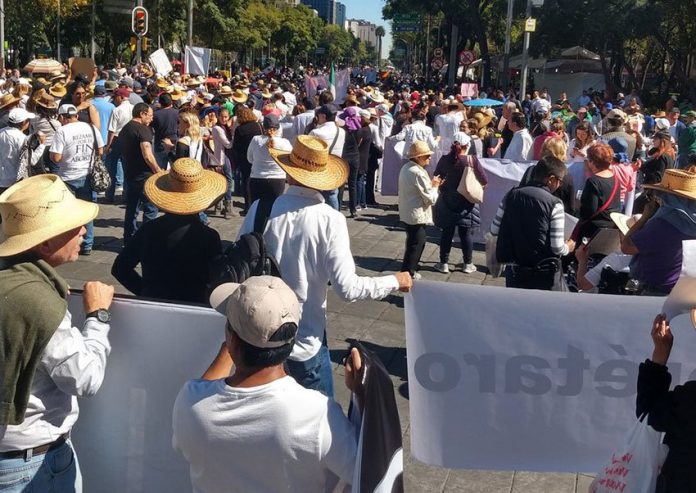
Anti-AMLO protest in Mexico City.

For Mexico’s two most recent past presidents their first days in office were marked with loud protests in Mexico City.

Things are no different this year for President López Obrador but with one exception: he was not leading the demonstrations this time around.

AMLO, as he is commonly known, argued strenuously in 2006 and again in 2012 that the elections had been stolen from him after losing both and staged large protests in the city center.

No one is arguing this year about the validity of the election that put López Obrador in office, but there are worries about what he might do now that he is finally there.

The protesters marched yesterday from the Angel of Independence to the Monument to the Revolution, calling themselves a “responsible front” that will challenge any impositions by the federal government.

Among the group’s slogans were “Mexico, don’t fall asleep, this is how Venezuela started,” “Neither chairos [a pejorative term used to describe extreme left-wingers in general and López Obrador’s supporters in particular] nor fifís [snobs], we’re Mexican,” and “Democracy and federalism, not authoritarianism.”

One of the fears expressed by yesterday’s demonstrators was that social, political and financial conditions in Mexico could duplicate those in Venezuela while others said they were against social polarization, the militarization of the country and pardons for criminals, and in favor of the construction of the new Mexico City airport in Texcoco.

They asked for an end to public consultations whose outcome, they said, is decided beforehand.

“We will be the thorn in his side, but we can be his best collaborators,” said María Elena Herrejón, leader of the Pro-Neighbor Movement, who announced that a national citizens’ front will be created as a counterweight to the new administration.

Source: El Financiero (sp)

Mayors, governors in two states lobby for improvements to highway 45

0
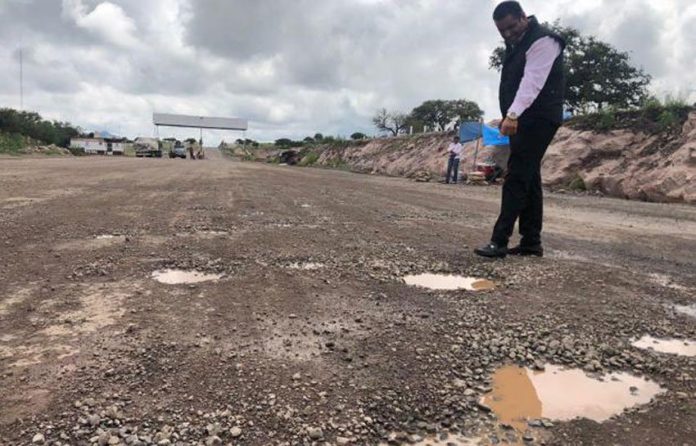
Potholes on highway 45.

The poor condition of the highway between the northern border and Mazatlán has brought mayors and governors from two states together to lobby for improvements.

The mayor of Hidalgo del Parral, Chihuahua, is spearheading the effort to stop further deterioration of the highway and boost the region’s economic activity and tourist appeal.

The two-lane highway runs from Mazatlán, Sinaloa, to Ciudad Juárez, Chihuahua, passing through the cities of Durango and Parral.

But the poor surface means traffic is being lost.

“We are losing transportation and movement of merchandise, yet there is the possibility that the highway could be the best option in the region, without taking into consideration that we could make it one of the best tourist routes in the country, going from the birthplace of [Mexican Revolution general and hero] Pancho Villa to the place where he was assassinated,” said Parral Mayor Alfredo Lozoya Santillán.

Eight municipalities in Durango — Canatlán, San Juan del Río, Rodeo, San Pedro del Gallo, Villa Hidalgo, Villa Ocampo, Indé and the capital city, Durango — would benefit from the renewal of highway 45, along with the Chihuahua municipalities of Parral, Villa Matamoros, Valle de Zaragoza and Satevó.

The mayor said the benefits would be felt in three states with a relatively small investment, which he estimated at 3 billion pesos (US $147 million).

The Chihuahua mayors involved in the project have presented an initiative before the state Congress, which will do the same before the federal Chamber of Deputies, asking for the necessary funds and to finish the work in three years.

Source: El Universal (sp)

The reaction to the president’s inauguration speech: warm, cold or indifferent

0
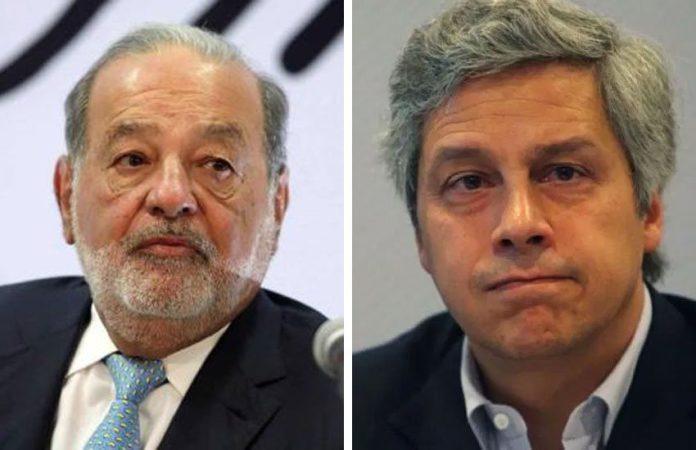
Slim, left, saw positive signs in AMLO's speech, but González did not.

President López Obrador’s inaugural speech on Saturday, in which he vowed to begin a “profound and radical transformation” of Mexico, garnered a mixed reaction from pundits, with assessments focusing on the economic implications of his plans.

Gustavo de Hoyos, president of the Mexican Employers Federation (Coparmex), described López Obrador’s address as unfortunate, charging that the tone struck was that of a candidate rather than a president.

“. . . We heard polarizing and black and white messages, charged with retrograde ideology. The way in which the energy and education reforms . . . were dismissed is concerning,” he said.

While de Hoyos said it was positive that López Obrador had committed to serving only one term, not putting the country into debt and respecting the autonomy of the central bank, he contended that his overall message fell short of what was needed to reassure markets and investors.

“The message that the president sent will not generate calm, above all the fact that he ruled out energy advances, that he said that he won’t allow fracking in Mexico and that he’s going to bet on investing in refineries when it is clear that it is contrary to economic and market logic. They’re not positive announcements; the president could have done a lot more to generate confidence,” de Hoyos said.

The business leader was also critical of the new president’s line in the sand approach to dealing with corruption, arguing that not investigating and punishing past acts of corruption is “a door to impunity.”

On Twitter, businessman and anti-corruption activist Claudio X. González was also critical of López Obrador’s first speech as president, stating that his remarks went “against the free market” and represented a “retrograde, statist, interventionist [and] obsolete [economic] vision” that would have “very bad” consequences.

The president of Mexicanos Contra la Corrupción y la Impunidad (Mexicans Against Corruption and Impunity) said that the president should have struck a more conciliatory tone in his speech rather than one that was “Manichean, simplistic and polarizing.”

The president’s remarks, he said, only served to generate economic uncertainty.

“Uncertainty is not a friend of investment and growth, without which there can be no ‘fourth transformation,” González said, criticizing also the decision to cancel the education reform and to not allow fracking.

Businessman Carlos Slim, Mexico’s richest man, had a different perspective. He gave a comparatively glowing assessment of López Obrador’s inaugural remarks as president, stating that they inspired “certainty and an invitation to work and invest.”

Slim continued: “What is needed, as [López Obrador] said, is job creation [and] to fight poverty. The best investment is to fight poverty, incorporate marginalized people into modernity with education and employment.”

He also agreed with the new president that corruption has been the biggest impediment to Mexico’s development, and identified a lack of “a vision for the future” and excessive spending as other significant problems.

“The speech [López Obrador] gave directly tackles those points,” Slim said.

Business Coordinating Council (CCE) president Juan Pablo Castañón said he was optimistic in light of the new president’s remarks while Ricardo Salinas of the conglomerate Grupo Salinas also interpreted the speech positively.

Duncan Wood, director of the Wilson Center’s Mexico Institute, said that “there were few signs in AMLO’s speech that the full reality of governing has sunk in thus far,” adding that “markets will be deeply concerned about the future of the energy sector and the overly ambitious infrastructure plans without any way of paying for them.”

Alfonso Esparza, an analyst at the financial company Oanda, said the speech was heavy on outlining Mexico’s problems but light on providing solutions.

“There were no great surprises in the speech. It reiterates criticism of the neoliberal model with the example of the energy reform, and puts forward increasing the number of refineries. Lots of problems were raised but not much time was left to get into solutions,” he said.

Alfredo Coutino of Moody’s Analytics also said there were no surprises in López Obrador’s inaugural speech, “since it confirmed the ideas and promises of the campaign.”

He added that there was “an inconsistency in promising to ‘make Mexico an economic power’ but at the same time rejecting liberal and free-market economic policies, which are essential for gaining the confidence of the private sector.”

Source: El Universal (sp), La Silla Rota (sp), Milenio (sp), Reuters (en) 

Mayan activists reject train and megaprojects on Yucatán peninsula

0
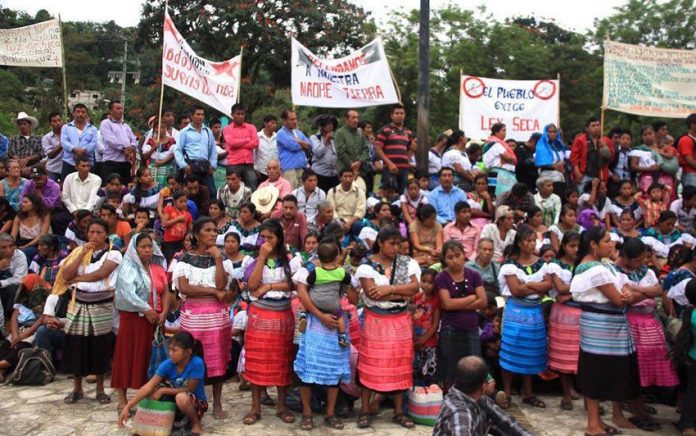
Indigenous women in Chiapas at a protest march against the Maya Train November 25.

Mayan activists on the Yucatán peninsula have raised their voices against megaprojects in the region, including the Maya Train.

A meeting yesterday in Dziuche, Quintana Roo, brought together seven organizations and 33 community leaders from Campeche, Yucatán and Quintana Roo under the slogan “resistance in defense of the territory.”

They contend that the development of megaprojects on the peninsula means stripping their lands, deforestation and contamination of water and food, affects productive activities such as beekeeping, causes health problems and threatens their culture and traditions.

“It is nothing new that they kill our bees, steamroll over our lands or violate our rights; what is new is that the will to defend what is left of our territory has been born. A movement is being born in the Yucatán peninsula,” declared Pedro Uc, an activist and teacher from the region.

“In Campeche, where [the construction of] the Maya Train is going to start, the Chinese are going to acquire — if they haven’t already done so — large expanses of land . . . the first thing the Maya Train will bring will be enormous amounts of Chinese capital,” added Alberto Cahuich, a member of the José María Morelos Maya Indigenous Council,  a social organization created and introduced yesterday during the meeting.

He was scornful of the public consultation by the federal government to gauge opinion on the Maya Train project, calling it a farce and stating that most participants in the process knew nothing about it.

Meanwhile, the train has support from some communal landowners in the ejidos that are on the route. At least three of the 30 —Bacalar, Chetumal and Playa del Carmen — have expressed support for the project and offered land for it.

Source: El Universal (sp), El Economista (sp)

Ancient history, living culture: a visit to the pyramid of Santa Cecilia Acatitlán

0
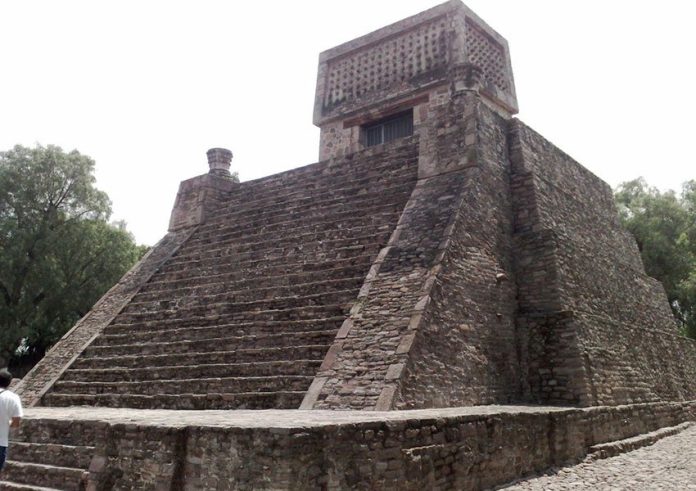
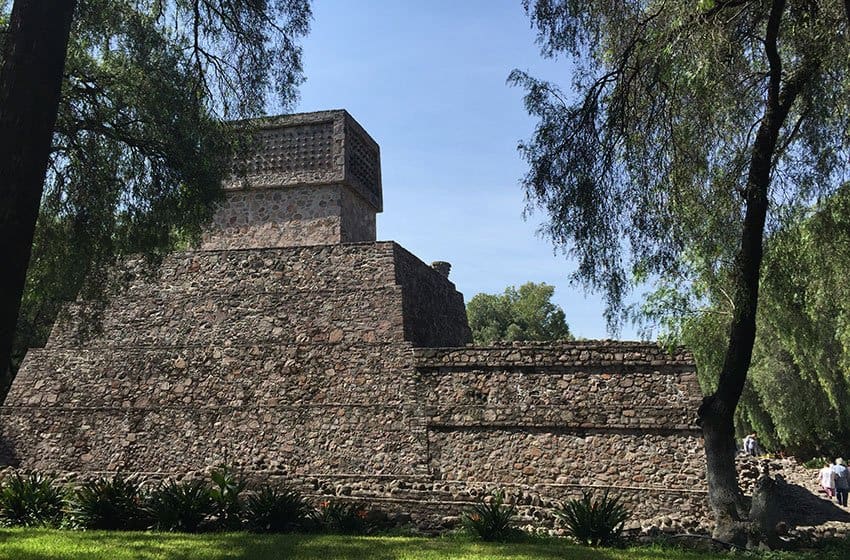
The pyramid at Santa Cecilia Acatitlán
The pyramid at Santa Cecilia Acatitlán. Gunnar Wolf

The rich smell of copal reached my nose at the same time that I heard a deep, rhythmic drumbeat. I felt a rush of excitement run through me as we moved closer to the small Mesoamerican pyramid set just behind what is now the main square of the small town of Santa Cecilia Acatitlán, a few miles over the border from Mexico City into the state of México.

In the main square, the local priest was giving an outdoor sermon in front of the doors of a small chapel that was adorned with a floral display, complete with jumping dolphins, dedicated to Saint Cecilia.

All around there was a buzz of activity. Unbeknownst to us, the town was celebrating its saint’s day that very Sunday.

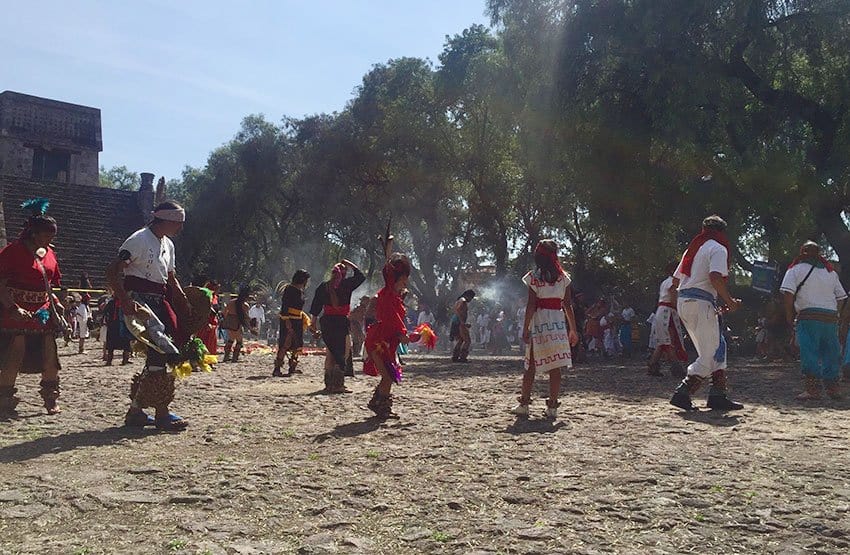
The scent of copal led us on. We traversed past the church towards the pyramid which rose up majestically behind it.  The small but perfectly restored temple with a rectangular god house on top made me stop in my tracks. Below, a group of perhaps 50 or more traditional Aztec or Mexica dancers moved in unison to the beat of the drum — boom, bo-boom, boom bo-boom — the shells of their ankle cuffs adding a shh-shh-shh-shh as their bare feet hit the earth in perfect time.

They moved from foot to foot, turned in circles and prostrated up and down, holding the rhythm together, creating a hypnotic beat that vibrated through my being.  The midday sun scorched the earth but the dancers, who ranged from age seven to 70, continued to move.

Female dancers in colorful, traditional dress.
Female dancers in colorful, traditional dress. susannah rigg

Some of the female dancers were dressed in colorful but simple dresses while many of the men wore simple cotton trousers and shirts tied in the middle with a colorful belt. Some dancers also wore more elaborate outfits with huge headdresses full of feathers with stunning turquoise tips, or they had their faces painted to look warrior-like.

Standing under the shade of a mesquite tree, I watched as their feet pounded the earth, as they moved with a spring-like step from side to side and a bouncing movement, as they turned a half circle on one leg. I was entranced.  The drumbeat continued to ripple through me.

Before I could become fully hypnotized by the rhythm, I was guided towards the pyramid and we climbed up the steps in a diagonal movement, the steps so narrow that we had to place our feet sideways upon them. Reaching the top, we got a view out over the square below, observing the dancers from above and hearing how the sound traveled up to us.

Not too much is known about the pyramid at Santa Cecilia Acatitlán since information about it wasn’t found in any pre-Hispanic sources. The Institute for Archaeology and History in Mexico (INAH) suggest that this means that the temple would have been abandoned long before the arrival of the Spanish in the 16th century.

While the area was known for the Chichimec and Toltec indigenous groups, the Mexica inhabited this area later and the pyramid was rebuilt in the 1960s, taking into account information known about Mexica temples. The rebuilt pyramid makes for a magnificent and impressive sight. Like the perfectly formed temple seen in photos by National Geographic or Archaeology magazine.

On each side of the top of the temple stairway there were two incensarios upon which fires would have blazed and in the middle there was a sacrificial stone. We were told that the pyramid would have been covered in a thick chalk substance making the whole temple white. With a little imagination, it was easy to envisage the imposing sight that this pyramid — that was part of a ceremonial center — would have made.

Another view of the pyramid.
Another view of the pyramid. susannah rigg

We imagined a sacrificial victim arriving at the top of the pyramid, apparently in a rather drunk or drugged state.

“They would be laid over the sacrificial stone and held by the arms and legs before a knife would enter in to their body from under their ribcage to pull the heart out,” our guide told us as the drumbeats continued to echo around the top of the pyramid, a beat as regular as a pulse, as regular as the beat of a living heart.

Something about the scene made it easy to imagine the heady sense of these sacrificial ceremonies and even to imagine how it could be seen as an honor to give your beating heart to the gods.

The god associated with the temple, according to our guide, was Tezcatlipoca, which in Nahuatl means “smoking mirror.”

He was regarded as the god of the night sky and this can be seen in the depiction of stars upon the god house that sits as a magnificent rectangular structure on the top of the temple. On each side there are little round protruding circles that represent stars. We walked around the god house counting them, finding that there were a total of 300.

“This is the number of stars that Tezcatlipoca dominated,” we were told.

Dancers move to hypnotic rhythm at the pyramid of Acatitlán.
Dancers move to hypnotic rhythm at the pyramid of Acatitlán. susannah rigg

The link to astrological bodies is always an important factor in the pyramids of Mesoamerica. This particular pyramid was built facing away from where the sun rises.

“So we know that the rituals here would be performed in spring and summer,” our guide told us before going on to say how people flock to the pyramid for the spring equinox to feel its intense energy at that time.

While busy during the equinox and when there is a Mexica ritual being performed like the day that we visited, the pyramid at Santa Cecilia Acatitlán may have just a handful of visitors each weekend, many preferring to visit the nearby and more well-known Tenayuca pyramids or the impressive site of Teotihuacán.

[wpgmza id=”117″]

I took a seat on the top step of the pyramid and watched as the dancers continued to move from leg to leg to the uninterrupted drumbeat. They had been dancing now for at least the hour that we had been there and probably for another hour or so before. The sun was intense and yet they danced without pause, engulfed in copal smoke, their pounding feet creating a light dust in the air.

I wondered if they too feel the delirium or the hypnotic delight that the sacrificial victims would have felt.  I wondered if the connection that they felt to their roots kept them grounded to the earth upon which their feet pounded. I wondered who would have stood in the spot upon which I was sat in the years when this ceremonial center was in use and who would have been sacrificed there and why they were chosen.

This pyramid might well be a restored version of the original, since many of the original stones were taken from the temple to build the Catholic church we passed by in the town, but the restoration is so majestic that I couldn’t help but be transported back in time, with the little help from a drumbeat and some 50 or so traditional dancers.

  • The pyramid can be reached with a five to 10-minute taxi ride from the Tenayuca Metrobus station, the last station on Línea 3. The taxi should cost 50 pesos.

Susannah Rigg is a freelance writer and Mexico specialist based in Mexico City. Her work has been published by BBC Travel, Condé Nast Traveler, CNN Travel and The Independent UK among others. Find out more about Susannah on her website.