Tuesday, February 24, 2026
Home Blog Page 2084

There will be no conditions on NAFTA negotiations: Guajardo

0
Guajardo: no conditions on NAFTA talks.
Guajardo: no conditions.

Mexico will not change its position regarding the placing of conditions on the negotiation process to reach an updated North American Free Trade Agreement (NAFTA), the economy secretary said yesterday.

“We’ve always believed that NAFTA can’t be conditional upon any other factor outside the negotiation,” Ildefonso Guajardo said during an interview at the official presidential residence, Los Pinos.

His comment came after United States Commerce Secretary Wilbur Ross told a U.S. Senate Committee earlier in the day that metal tariffs imposed on Mexico and Canada on June 1 on national security grounds would be removed if a new trade deal that is favorable to the U.S. is reached.

“Our objective is to have a revitalized NAFTA, a NAFTA that helps America and, as part of that, the [tariffs] would logically go away” for both Canada and Mexico, he said.

Ross also said that United States Trade Representative Robert Lighthizer is optimistic that talks “could pick up steam” after Mexico’s July 1 presidential election.

Canadian Foreign Affairs Minister Chrystia Freeland said last week that the process to renegotiate NAFTA would resume over the summer while her Mexican counterpart Luis Videgaray said Tuesday that he expected the next ministerial NAFTA meeting would be held in July.

Following Guajardo’s lead, the head of Mexico’s technical negotiating team reiterated in two Twitter posts that Mexico would not be pressured into signing a deal due to external factors.

“Mexico has never accepted a link between the steel and aluminum tariffs imposed by the U.S. and the NAFTA negotiation. We will continue to negotiate constructively but never under external pressure or threats,” Kenneth Smith Ramos wrote.

“The only impact that the imposition of steel and aluminum will have on the NAFTA negotiation is to strengthen Mexico’s resolve to ensure that NAFTA 2.0 will prevent the misuse of national security provisions as protectionist tools.”

United States President Donald Trump said Tuesday that progress was being made in NAFTA talks but he didn’t rule out the possibility that the U.S. would seek separate bilateral pacts with Mexico and Canada if a three-way deal couldn’t be reached.

“We’re trying to equalize it. It’s not easy but we’re getting there,” he told a group of small business executives at an event in Washington D.C. “We’ll see whether or not we can make a reasonable NAFTA deal.”

Trump has regularly railed against the 24-year-old trade agreement and has described it as “the worst trade ever made” and a “disaster” for the United States economy.

During his 2016 presidential campaign, he made renegotiating the deal a goal and trilateral talks started in August last year with a scheduled finishing date of December.

But talks have dragged on as the three countries struggle to reach consensus on issues including rules of origin for the automotive sector and a so-called sunset clause which would force a renegotiation of the deal every five years.

The United States’ decision to impose 25% and 10% tariffs on steel and aluminum imports from its neighbors and NAFTA partners was widely seen as a move to increase pressure on the two countries to agree to its demands and was reminiscent of similar hardball tactics that the Trump administration has used previously.

The U.S. president suggested in April that an agreement might be conditional on immigration policy, charging that Mexico “must stop people from going through Mexico and into the U.S.” and he has also threatened on several occasions to terminate the deal.

Mexico quickly rejected linking immigration with NAFTA and has also consistently said that it won’t conduct trade negotiations via social networks.

Freeland said Tuesday the Canadian government believes that an updated deal is still possible while Moisés Kalach, the top international trade official for Mexico’s Business Coordinating Council (CCE), said yesterday that the best way of increasing the chances of concluding a successful new deal is by remaining at the negotiating table.

Source: Notimex (sp), The Canadian Press (en), Reuters (en), El Financiero (sp)

Two more candidates for mayor assassinated in Michoacán

0
Gómez Lucatero, killed yesterday in Aguililla, Michoacán.

The violence against political candidates continued yesterday and today with the murder of two candidates for mayor in the state of Michoacán.

Omar Gómez Lucatero, who was running as an independent in Aguililla, was killed yesterday when armed civilians opened fire on him as he left his home in this Tierra Caliente municipality of about 16,000 people.

Gómez had run for office before with the Institutional Revolutionary Party but this time round he was running as an independent.

A security operation involving municipal and state police was implemented following the murder, but no arrests have been reported.

The second murder took place this morning in Ocampo when three armed men entered the home of Ángeles Juárez and shot and killed him.

Juárez was the Democratic Revolution Party candidate for mayor of Ocampo, a municipality of about 50,000 in the eastern part of the state.

The two murders come just a week after another Michoacán candidate was gunned down. Alejandro Chávez Zavala was killed last Thursday in Taretan.

He too was running for mayor.

There have now been 47 candidates assassinated during the election process that began last September.

Meanwhile, a 10-million-peso ransom (US $491,000) has been posted for information leading to the arrest of two brothers believed to have been behind the assassination of a candidate for federal deputy in Coahuila.

Governor Miguel Riquelme announced the ransom yesterday for information that would lead to locating and apprehending Erik and Ignacio Arámbula Viveros.

They have been identified as the authors of the assassination June 8 of Fernando Purón, the Institutional Revolutionary Party candidate for federal Congress.

Source: El País (sp)

7 die after semi loses brakes on Chiapas highway

0
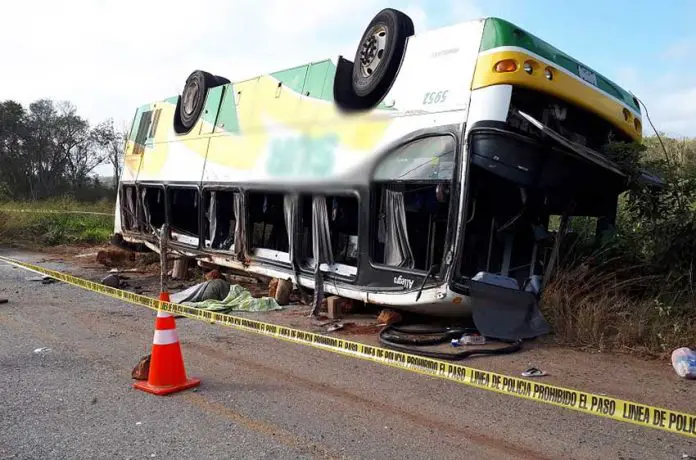
One of the vehicles wrecked in yesterday's accident.

A semi-tractor lost its brakes in Tuxtla Gutiérrez, Chiapas, yesterday and plowed into parked vehicles and taco stands, leaving seven people dead.

Ten people were injured, two of whom died later in hospital. Five died at the scene.

The accident occurred on the outskirts of the city near the site of a protest by teachers belonging to the CNTE union.

Mangled wreckage in Tuxtla Gutiérrez.

Among the victims were police officers who were on hand to monitor the protest.

One report said the double semi traveled for two kilometers without brakes before it struck three parked vehicles, three food stands and several utility poles before coming to a stop at the side of a house.

Authorities observed that a new runaway emergency ramp had been installed on the highway some two kilometers from the location of the accident but were unaware why the driver, who escaped unhurt, didn’t use it.

Source: Alerta Chiapas (sp), Televisa (sp)

Shipment of German pork belly arrives in Mexico

0
Pork belly arrived this week from Germany.

A shipment of German pork arrived in Mexico this week through efforts to diversify foreign trade.

It was the first shipment to arrive since tariffs were imposed on United States pork imports, the federal Agricultural Secretariat (Sagarpa) said yesterday.

The department said in a statement that 25.5 tonnes of frozen pork belly had arrived at the port of Veracruz, a result of its “market diversification policy” that aims to “guarantee the supply of a range of products at accessible prices.”

Mexico introduced a range of retaliatory measures against the United States’ metal tariffs on June 5, including 20% duties on U.S. pork, apples and potatoes.

The Sagarpa statement said the agriculture sanitation authority Senasica has already established sanitation protocols with other countries that allow them to supply agricultural products to the Mexican market.

Pork imports from Canada, Denmark, Spain, France, Chile, Italy, Belgium, Australia, New Zealand and Germany comply with the established sanitation rules.

The German pork was packed in 1,394 individual boxes and came from a Senasica-certified plant in Wiedenbrück, Sagarpa said, adding that it was the result of action taken by Senasica chief Enrique Sánchez Cruz during a meeting with Germany’s agriculture minister in Berlin.

Mexicans consume 2.11 million tonnes of pork annually and produces 1.45 million tonnes, of which 105,000 tonnes are exported. Imports account for the 754,000-tonne shortfall.

One-third of all pork consumed in Mexico comes from the United States and between 2010 and 2017 it supplied almost 90% of all imports. Government data shows that U.S. pork exports to Mexico were worth more than US $1 billion last year.

Jim Heimerl, president of the U.S. National Pork Producers Council, said earlier this month that Mexico’s 20% tariff on tariff on pork legs and shoulders eliminates his country’s ability to compete in the Mexican market.

With regard to apples, also subject to a new tariff, Sagarpa said importers of the fruit could look to countries including Argentina, Canada, Chile, China, Portugal and South Africa in order to maintain accessible costs for consumers.

Even before the United States imposed its 25% and 10% tariffs on Mexican steel and aluminum imports, Mexico was seeking to diversify its export markets due to uncertainty about the future of the North American Free Trade Agreement (NAFTA).

Mexico and the European Union (EU) reached an updated trade agreement in April while Mexico and 10 other Pacific Rim countries formally entered into a revised Trans-Pacific Partnership (TPP) trade pact in March.

Last week officials told the news agency Reuters that Mexico is also considering imposing tariffs on United States corn and soybean imports in case trade tensions with its northern neighbor should increase.

Source: El Economista (sp)

‘Archaeological window’ offers glimpse of ancient temple

0
The temple that was hidden beneath a parking lot.
The platform that was hidden beneath a parking lot.

During the demolition of an old supermarket in the Mexico City neighborhood of Tlatelolco four years ago, an ancient pre-Hispanic temple dedicated to the Aztec god of wind was found beneath the site’s parking lot.

Now the temple can be seen and appreciated through a 361-square-meter “archaeological window” built by the National Institute of Anthropology and History (INAH) and opened to the public yesterday.

The temple’s structure consists of a circular platform that is located three meters below street level, measures 11 meters in diameter, is 1.2 meters high and has graves for 20 children, adults and animals. A range of artefacts was also found at the temple, which is believed to be more than 650 years old.

“It’s a temple [dedicated] to the god of wind [Ehecátl-Quetzalcóatl], who had a close relationship with the god of water Tláloc because this god was the one who swept and prepared everything so that the rains brought by Tláloc would come,” prominent Mexican archaeologist Eduardo Matos Moctezuma told the news agency EFE.

He explained that three temples dedicated to Ehecátl-Quetzalcóatl have now been found in Tlatelolco as well as another three in ancient Tenochtitlan, the precursor to modern-day Mexico City.

One of the platforms that are more than 650 years old.
The platform that is more than 650 years old.

The temples generally face towards the east, Matos explained, because according to Aztec myths Ehecátl-Quetzalcóatl and Xipe-Tótec — a god of spring and new vegetation —  believed that the fifth sun would rise in the east.

The archeological window is part of the Tlatelolco Project, which started two decades ago with the objective of saving archeological sites from threats posed by public and private construction projects in the area.

A total of 30 archaeologists participated in the restoration of the temple and found more than 43,000 objects made out of ceramics, shells, bones and other materials, of which 1,000 were intact and have been set aside for study.

Tlatelolco, located just north of the historic center of Mexico City, is well known for its archeological site of the same name and the adjacent Plaza de las Tres Culturas, or Three Cultures Square, where a massacre of protesting students carried out by the military and police occurred in 1968.

Source: EFE (sp)

Japan issues travel warning for Mexico elections

0
One of many recent funerals for Mexican politicians.

The government of Japan has issued a travel advisory for Mexico, warning its citizens about ongoing violence during the current electoral season.

The advisory was published by the embassy of Japan in Mexico 11 days before the July 1 general election.

The document explains that in past elections, “Confusion was noted in some areas, such as arson in polling stations and attacks against candidates.”

The embassy suggested that Japanese travelers in Mexico gather information and act with caution, as protests could take place while the election date draws near.

Without specifying sources, the document quoted two reports claiming that to date 114 politicians and government officials have been murdered during the electoral season, and that other politicians and their families have been subjected to threats and intimidation.

In case Japanese citizens should be involved in an incident, the document lists the embassy’s address, its phone and fax numbers and its email address.

In May, the German government issued a similar advisory warning about the increasing violence against politicians in Mexico.

“Political demonstrations can develop into violent clashes, and thus should be avoided. Such situations can lead to roadblocks in major thoroughfares by demonstrators throughout the country, and can sometimes turn violent,” said the May 29 document.

Source: El Financiero (sp)

2 Mexican restaurants ranked among world’s top 50

0
Taco de mollejas at Quintonil restaurant in Mexico City.
Taco de mollejas (sweetbreads) at Quintonil restaurant in Mexico City.

Two Mexico City restaurants are on this year’s list of the World’s 50 Best Restaurants, and both are in the top 20.

Quintonil, with its contemporary Mexican style of food, was ranked 11th, just two points ahead of the famous Pujol, which has consistently been rated the best among Mexican restaurants in previous years.

Both are located in the Polanco district of Mexico City.

In its description of Quintonil, which is named after a herb also known as green amaranth, the top-50 list said the restaurant’s standout dish is charred avocado tartare with escamoles (ant eggs), which is part of chef Jorge Vallejo’s tasting menu.

It changes with the seasons, making use of the freshest vegetables and greens from the restaurant’s own urban garden: many of the ingredients travel just 30 meters from origin to plate.

Chef Jorge Vallejo of Quintonil.

Villejo started out by cooking on cruise ships before going to work for chef Enrique Olvera at 13th-place Pujol.

Olvera, described as Mexico’s most famous chef, is credited with proving that rustic Mexican flavours deserve as much attention as any other haute cuisine in the world, according to the top-50 list.

The restaurant’s signature dish is Mole Madre, Mole Nuevo: a perfect circle of fresh mole (the mole nuevo in the name) surrounded by a larger ring of mole (the madre) that has been aged for more than 1,000 days. Served beside a basket of warm tortillas, the dish was described as “a taste of Mexico’s past.”

Olvera has become the only Mexican chef to earn two places on the 50 Best Restaurants list. Cosme, the modern Mexican restaurant he opened in New York in 2014, made its debut on the list last year and this year rose to No. 25.

Another Mexican restaurant didn’t make the top 50 but did finish up in the top 100. Sud777, under chef Édgar Núñez, was ranked 64th. It too draws on traditional Mexican cuisine using contemporary cooking techniques and local products. It is located in the borough of Álvaro Obregón.

The approximate cost of dining at the three restaurants ranges from 2,000 to 3,500 pesos per person.

The top-ranked restaurant on the list was Osteria Francescana in Modena, Italy. It was No. 2 last year and topped the list in 2016.

Mexico News Daily

Authorities arrested wrong man in Ayotzinapa case: commission

0
Attorney General's headquarters in Mexico City
Attorney General's headquarters in Mexico City: did they get the wrong guy?

In a case of mistaken identity federal authorities arrested and imprisoned the wrong man in connection with the 2014 abduction and presumed homicide of 43 teaching students from Ayotzinapa, Guerrero, according to the National Human Rights Commission (CNDH).

The organization said in a statement that it “has undoubted evidence” that Erick Uriel Sandoval Rodríguez was “wrongly arrested” by the federal Attorney General’s office (PGR) after it mistakenly identified him as the man known by the aliases of “El Güereque” and “La Rana” (The Frog).

The real man who is known by those nicknames and was allegedly involved in the students’ disappearance now lives in California, the CNDH said.

Sandoval, formerly a physical education teacher, was allegedly employed as a hired gun, or sicario, for the Guerreros Unidos criminal organization. Federal authorities said that before his arrest he had been considered a priority target.

In March, he became the fourth person to be detained out of seven men identified as being responsible for the disappearance of the 43 students and, according to federal authorities, was one of the last people to have contact with the missing students.

The implication of Sandoval in the crime was supposedly based on statements made by those arrested before him but the CNDH said the physical description they provided of their alleged accomplice did not match Sandoval’s appearance.

“Erick Uriel Sandoval Rodríguez was remanded on two occasions, apprehended and imprisoned without there being a single piece of evidence that he was the person who the alleged perpetrators of the disappearance of the 43 students were referring to,” the statement said.

“The personal characteristics and distinguishing features referred to by the accused men to identify “El Güereque” (age, mole on his face, scar on his left wrist, scars or marks from the use of earrings in both ears, tattoos of flames on both forearms and of a frog on the upper left side of his back, among others) don’t match those of Erick Uriel Sandoval Rodríguez,” the CNDH said.

The organization also said that the arrested men who made statements to the PGR only referred to their alleged accomplice by the nicknames “El Güereque” and “La Rana” and “didn’t mention any [legal] name.”

After conducting an exhaustive review of the preliminary investigation file and other documents related to the case, the CNDH confirmed that there is no evidence that “El Güereque” or “La Rana” is Erick Sandoval.

“That name appeared for the first time in the file, out of nowhere, on the first charge sheet,” the statement said.

The CNDH accused the PGR of conducting a rushed and superficial investigation which led to the detention of the wrong person.

The statement also said the PGR had the opportunity to correct its mistake after being alerted to it by both the wrongfully arrested man and the CNDH. The latter said officials in the federal agency refused to do so and should be sanctioned.

Sandoval and members of his family told the CNDH that they had supplied proof of the PGR’s mistake and that it had reached the assistant general director of the office investigating the case to whom ultimate responsibility could fall.

The CNDH said it also provided the PGR with “a file that contains certified copies of all the evidence” it had obtained — including personal details of a man identified only as Édgar who is allegedly the real “El Güereque” and “La Rana” — but nevertheless the agency had continued to place the onus of proof of innocence on Sandoval.

“Despite the conclusive evidence that the CNDH submitted, the PGR is demanding that the detainee himself prove that he is not the person who the perpetrators of the disappearance referred to,” the statement said.

Family members of the 43 missing students described the PGR’s apparent mistake as “a worrying affront to the victims” and charged that it “violated the right to truth” of victims’ families and society as a whole.

Family members also said that even though responsibility for the investigation now rests with the human rights unit of the PGR, “there is no doubt” that its organized crime investigation unit (SEIDO) “continues to actively participate in the investigation of the Ayotzinapa case despite the multiple irregularities that have been documented by the CNDH” and international investigators.

The CNDH information provides further evidence in support of a June 4 federal court ruling that the investigation “was not prompt, effective, independent or impartial on the part of the PGR,” the family members said.

The Tamaulipas-based First Collegiate Tribunal ordered the creation of a truth and justice commission to undertake a new investigation into the case, stipulating that representatives of the victims and the CNDH will determine the lines of investigation to be followed and that PGR personnel who participate in the new probe must not have been involved in the original one.

According to the federal government’s “historic truth,” corrupt police in Iguala, Guerrero, handed over the students to the Guerrero Unidos criminal gang whose members executed them and burned their bodies at a municipal dump in the nearby town of Cocula.

But that version of events has been widely rejected by independent forensics experts, human rights groups, journalists, family members and others who suspect that the army may have played a role in the students’ disappearance and deaths.

Source: El Financiero (sp), Milenio (sp)

Soccer team asks fans to resist ‘puto’ chant as FIFA investigates

0
Fans chant 'puto' at a soccer match.
Fans chant 'Eh, puto!' at a soccer match.

Mexico’s national soccer team is asking fans to drop the popular “Eh, puto!” chant after FIFA, international soccer’s governing body, announced disciplinary procedures on Monday following its use during Sunday’s World Cup match between Mexico and Germany.

The team issued the plea today on social media, asking fans not to cry puto in the soccer stadiums. “You do not support us with this shout.” One of the team’s stars did the same.

Striker Javier “Chicharito” Hernández posted a message on Instagram today asking fans to stop the practice. “To all Mexican fans in the stadiums, don’t shout puto,” Hernández wrote. “Let’s not risk another fine.”

It’s not the first time that players on the team have appealed to fans to stop the chants, but to little avail.

The practice, which has become traditional at Mexican soccer games, is used by fans to taunt the opposing team’s goalie as he kicks the ball into play. Puto means faggot or male prostitute.

The chant gained international notice during the 2014 World Cup but FIFA took no action at the time.

However, it sanctioned the Mexican Football Federation (FMF) 12 times for fans’ homophobic chanting during the recent World Cup qualifying rounds with two warnings for the first two offences and fines for another 10.

And in Russia the organization is employing three observers at each match to report discriminatory behavior by spectators.

There are thousands of Mexicans in Russia for the big tournament, which is held every four years. At Sunday’s game, Mexico pulled a surprise 1-0 upset over defending champion Germany.

Mexico’s next match is against South Korea on Saturday at 10:00am CDT.

Source: Reuters (en), El Financiero (sp)

UPDATE June 20, 4:16pm CDT: FIFA announced a fine of 10,000 Swiss francs (US $10,000) against the Mexican Football Federation after reviewing evidence of the puto chant on Sunday in Russia.

Skin of a man’s face found at side of México state highway

0
The gruesome find in Tlalnepantla.

Some residents of Tlalnepantla, México state, made a gruesome discovery on the Mexico City-Pachuca highway this week: the skin of a man’s face.

The skin was lying on the side of the road near San Juan Ixhuatepec next to a plastic bag, whose contents were not revealed.

Mexico City prosecutor Edmundo Garrido said it appeared the remains were related to the murders of two men whose bodies were found Sunday in a Metrobús lane on Insurgentes Norte near Nonoalco Tlatelolco.

The skin had been removed from the face of one of the bodies.

The western side of Tlalnepantla is considered one of the most violent areas of the municipality, particularly Lázaro Cárdenas and Jorge Jiménez Cantú.

Source: SDP Noticias (sp)