Home Blog Page 2097

2 long established music festivals coming up in February

0
Oskar, left, and Rotundo perform in Oaxaca this week.

Musical events are coming up this month in Huatulco, Oaxaca, and San Pancho, Nayarit.

The second and final Blues on the Beach concert of the year will take place on Valentine’s Day in Huatulco, featuring the David Rotundo Band with special guest Lee Oskar.

Rotundo — already well known to Huatulco audiences — and Oskar are both award-winning harmonica players. The former has been nominated in Canada for a Maple Blues Award for 11 consecutive years, while Oskar is considered among the best rock-blues-soul players around, according to festival organizers.

They will perform together on Thursday at the Sea Soul beach club at Chahué beach. Admission is a 400-peso donation, the proceeds of which go to Un Nuevo Amanecer, a local charity that supports disabled children.

The organization receives little government funding and most families of the 100 children who benefit can ill afford to pay for the help they receive.

The three-hour concert starts at 8:00pm. More information can be found on the festival’s Facebook page.

Farther north on the Pacific coast, on the Riviera Nayarit, is the San Pancho Music Festival.

The event started 19 years ago in the back yard of an expat from the United States, and true to its origins it continues to be free to the public through the generosity of the artists, volunteers, donations from the public and friends of the festival.

The festival features many talented regional performers along with artists artists from Mexico, the United States, Canada and Latin America.

It will present continuous music on its two stages from 5:00 to 11:00pm for three nights starting February 22. A schedule of acts performing each night will be published on the festival’s website and its Facebook page.

The festival will take place in the Plaza del Sol, across from San Pancho church. Along with music, food, alcohol and non-alcohol beverage options will be sold on site, as well as handicrafts.

Mexico News Daily
Mexico City initiates strategy to counter Metro kidnapping attempts

0
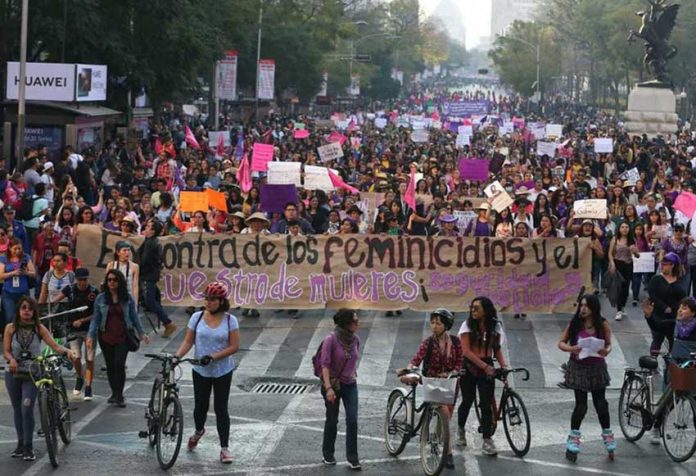
Marchers in Mexico City yesterday protest femicides and kidnappings.

The Mexico City government has announced a plan of action in response to dozens of women’s accounts on social media of kidnapping attempts on the Metro subway system.

Mayor Claudia Sheinbaum told reporters that the city government had met with victims and organizations on Thursday.

“As of yesterday, we understand that something is going on outside of many Metro stations,” she said on Friday. “How serious is the problem? How widespread is it? Frankly, we just don’t have all the facts.”

She added that many of the victims had been frustrated in their attempts to file official complaints because from a police perspective, some do not constitute consummated criminal acts.

Zúe Valenzuela was one such victim when she was assaulted outside the Coyoacán station by a man who pretended to know her in order to confuse passersby. She said she told police that her assailant had attempted to force her into a vehicle, but officers ignored that and focused instead on the fact that nothing had been stolen.

The mayor said that as part of the initiative to combat the kidnapping attempts, the Attorney General’s office will install dedicated mobile help centers in Metro stations at Coyoacán, Mixcoac, Martín Carrera, Tacubaya and UAM Iztapalapa.

The Attorney General will also review all related incidents and cases.

Sheinbaum assured the public that a map of 85 different kidnapping attempts in 2018 and 2019, created by victims and activists and circulated on social media, will be used by police in their investigation.

The city will also increase the police presence and the number of security cameras inside the Metro and install better lighting outside stations.

Activists say that kidnapping attempts of this sort have been frequent since at least the beginning of last year. Attackers often pretend to know their target or be her significant other.

In one incident, Estela Tagle, 21, was attacked outside the Chilpancingo station by a man who covered her mouth and nose before cornering her against a wall and biting her lower lip so hard that she later required stitches. Tagle managed to yell for help and escape. She said she lives close to the station and had always felt safe there in the past.

While detailed accounts of failed attacks exist by the dozens on social media and other outlets, it is not clear how many of the kidnapping attempts were successful.

Source: ADNPolítico (sp)

Dog pack kills woman during 11-minute attack in México state

0
Video clip shows the dogs just before they attacked.

Surveillance video has revealed that a 34-year-old woman found dead in Tecámac, México state, was killed by a pack of 11 dogs.

The woman was on her way to work a night shift at a toll booth on the Mexico City-Pachuca highway when the dogs attacked her at 10:40pm Monday.

The video indicates the attack lasted 11 minutes. Her body was discovered the following day.

Tecámac Mayor Mariela Gutiérrez Escalante ordered animal control agents to round up the dogs but area residents attempted to prevent them from doing so by hiding them.

However, the mayor said several had been captured.

Source: Milenio (sp), Impacto (sp)

After union negotiates 20% salary increase, job action proves contagious

0
There was a work stoppage on Thursday at Arca Continental.

The prospect of a juicy pay raise and a bigger annual bonus is making strike action contagious in Matamoros, Tamaulipas.

At least 30,000 factory workers went on strike in the northern border city on January 25, demanding a 20% salary increase and an annual bonus of 32,000 pesos (US $1,700).

The demands, presented by the Union of Laborers and Industrial Workers of the Maquiladora Industry (SJOIIM), have now been met by 37 companies.

Spurred on by the workers’ victories, employees of three more companies also started job action in the past two days.

Yesterday morning, 150 employees at dairy distributor Liderlac, a subsidiary of milk bottler Vakita, walked off the job as did 170 workers at Blanquita, a water purification company.

The non-unionized employees of the former said their salaries only increased by 1% at the start of this year when the minimum wage was doubled in the northern border region. They too want a 20% increase and a 32,000-peso bonus.

Blanquita workers, who are calling for the same raise and bonus, denounced what they called exploitation by their employer and condemned the indifference of the union to their cause.

They said they expected to receive an annual bonus of 10,000 pesos (US $525) last year but got just 1,300.

The strike action by employees of those two companies followed a work stoppage Thursday by workers at Arca Continental, the second largest Coca-Cola bottler in Latin America. The workers are also demanding a 20% pay rise and 32,000-peso bonus.

“The plant and the distribution of products stopped,” said Juan Carlo Hernández, president of the Matamoros branch of the Mexican Employers Federation (Coparmex), adding that some employees have returned to work.

Arca Continental said in a statement that it was open to dialogue with the workers, who are also represented by the SJOIIM, but stressed that “none of our employees earn the minimum wage and their annual income, including benefits above those required by the law, is higher than the salaries recently negotiated by some factories.”

Company sources said that fewer than 100 workers out of a total of 600 had gone on strike, a figure much lower than that cited in some media reports, which said that as many as 500 employees had walked off the job.

Arca said there were some delays in the delivery of products but the situation had returned to normal by Thursday afternoon.

Abel Morón, president of the Matamoros chapter of the Mexican Chamber of Commerce (Canaco), said that workers’ demands for higher pay and benefits will ultimately lead to a loss of jobs in the city.

Luis Aguirre Lang, president of the National Council of the Maquiladora Industry (Index Nacional), said earlier this week that strike action in Matamoros will result in 15 manufacturers leaving the city.

In a statement, Coparmex Matamoros also said that the work stoppages threatened the local economy.

“The labor conflict that is taking place in Matamoros is a clear expression of the lack of the rule of law . . . Work stoppages threaten to create unemployment and the closure of companies,” it said.

Coparmex also said that factories had incurred heavy losses because they had been unable to meet their production obligations and warned that foreign investment could fall.

The employers’ federation called on federal and state authorities to intervene and solve the outstanding disputes between disgruntled workers and employers.

Source: Milenio (sp), El Financiero (sp) 

62 buildings damaged in 6.5 earthquake in Chiapas, but no fatalities

0
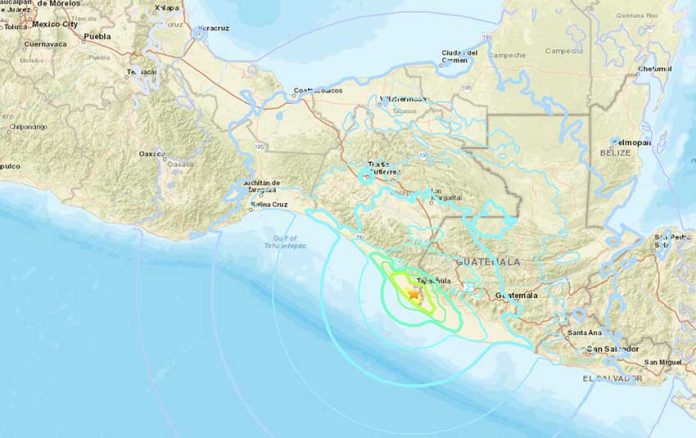
The epicenter of yesterday's earthquake in Chiapas.

A 6.5-magnitude earthquake yesterday damaged at least 62 buildings in Chiapas, according to Civil Protection officials, but no fatalities have been reported.

The damaged structures included 39 homes, eight schools, two churches, 10 government buildings, two businesses and a historic building. The coastal municipality of Acapetahua was hit especially hard, with 32 damaged homes.

Most damages were minor: cracked walls, ceilings and sheetrock, though a child in Suchiate was hospitalized for injuries.

The quake struck at 10:14am 37 kilometers southwest of Ciudad Hidalgo.

Chiapas’ dam system survived the quake unscathed, and the tsunami warning center reported no risk for communities along the Pacific coast in the aftermath of the tremor.

In Guatemala, the earthquake left three people injured and damaged buildings in seven states.

Source: Reforma (sp)

Remittances hit a new record high of $33 billion in 2018

0
More dollars are migrating southward.

The fear of deportation fed by United States President Donald Trump’s hardline rhetoric on immigration and a strong U.S. labor market and economy drove remittances from Mexicans outside the country to an all-time high in 2018.

Mexicans working abroad, mainly in the United States, sent US $33.48 billion to Mexico last year, an increase of 10.5% over the 2017 figure, according to the Bank of México (Banxico).

The remittances were sent in 103.9 million separate transactions, a 6% increase on the 2017 figure, and each one was on average $322 compared to $309 the year before, Banxico data shows.

Almost 98% of remittances were sent by electronic means and just over 94% came from the United States.

The total dollar amount sent to Mexico made remittances the country’s second largest foreign currency earner after auto exports, which totaled around $142 billion.

Just seven states received half of all remittances sent.

Michoacán took in just under $3.4 billion followed by Jalisco, with almost $3.3 billion; Guanajuato, with just over $3 billion; México state, with $1.9 billion; Oaxaca, with $1.7 billion; Puebla, with $1.7 billion; and Guerrero, with $1.6 billion.

Financial analysts say that Trump’s tough stance on illegal immigration has encouraged Mexicans in the United States to send more money home.

The Mexican government estimates that around 12 million Mexicans live in the United States and about half that number are there illegally.

Analysts at the Mexican bank Banorte say they expect the flow of remittances from the United States to remain strong in 2019 because the fundamentals of the U.S. economy are strong.

However, the International Monetary Fund (IMF) is predicting growth in that country will slow to 2.5% this year compared to 2.9% in 2018, which could slow the growth of remittances to below the double-digit spike seen in 2018.

But anti-immigration rhetoric is likely to continue to encourage remittances, Banorte said, provided that no measures are taken to limit them.

While a candidate for president, Trump threatened to cut off remittances to Mexico, proclaiming that such a move would pressure the Mexican government to cough up “a one-time payment of $5-$10 billion” for his border wall.

However, the United States government has never tried to put the plan into place and, according to a migration expert, it would likely backfire on the U.S. president.

“My first reaction was, ‘That sounds counterproductive,’” Andrew Selee, president of the Migration Policy Institute, told The Washington Post last month.

“Mexican migration [to the United States] is dropping in part because Mexican migrants are sending money home so more Mexicans can have a dignified life,” he said.

Cutting off remittances would potentially disrupt lives in Mexico and result in more migration to the United States, Selee added.

Source: Milenio (sp) 

AMLO presents massive, 500,000-hectare tree-planting program

0
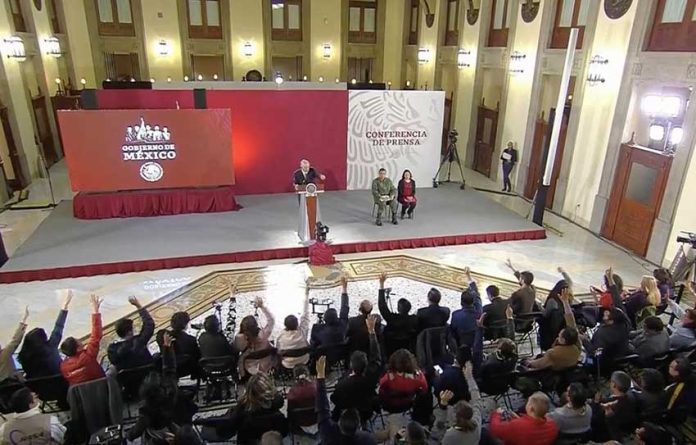
The president presented the tree-planting program at his morning press conference.
The president presented the program at his morning press conference.

President López Obrador has presented the government’s ambitious program to plant trees on one million hectares of land over the next three years, declaring that it will give a “boost” to rural Mexico.

Speaking at his morning press conference, López Obrador said that 24 million pesos (US $1.2 million) will be invested this year in the plan known as “Sembrando Vida” (Sowing Life).

In an initial stage, timber-yielding and fruit trees will be planted on 570,000 hectares of land in eight states in Mexico’s south and southeast as well as 14 municipalities in Durango. López Obrador said the aim is to create 200,000 jobs this year.

“The countryside is the most important factory of Mexico, it’s just that it was abandoned, shut down. Now we’re going to give it a boost,” he said.

The president added that one of the main objectives of the program is to provide people with opportunities to make a living close to home and thus curtail migration.

“There are around 100 million hectares of social property that were abandoned during the neoliberal period, that’s why migration grew so much. The countryside, which has a great economic potential for the country, was abandoned . . .” López Obrador said.

Farmers, ejidatarios, or communal landowners, and others who participate in the tree-planting program will receive a monthly salary of 5,000 pesos (US $260) for working six days a week.

Labor Secretary María Luisa Alcalde explained that 4,500 pesos will be paid in cash and 500 pesos will go into a savings fund.

In 2020, an additional 10 states will be incorporated into the program to take the total number to 19. An additional 200,000 jobs are expected to be created.

The army will be responsible for supplying the saplings, which will be grown in 11 nurseries, of which eight are already operational. A new military-run nursery will be built in Cárdenas, Tabasco, this year.

Mahogany, cedar, cacao, rubber, cinnamon and soursop will be among the trees planted.

Source: El Financiero (sp), El Economista (sp) 

Not your average art fair: affordable art, inclusive vibes at Mexico City’s Material

0
This year's Material Art Fair will bring work from 73 galleries in 22 countries.

Mexico City’s Material Art Fair has built itself over the past six years to become one of the world’s preeminent independent contemporary art fairs, this year featuring 73 galleries from 22 countries and 37 cities – the most geographically diverse to date.

In addition to the international showing, the fair features 18 Mexican galleries, with Mexico City favorites, LABOR, joségarcia and Lulu among them. Material has made a name for itself partly for its fellowship with the community it espouses, welcoming art fans of all levels with open arms.

This will mark Material’s second year at Frontón México, a breathtaking Art Deco-era jai alai stadium at the foot of the Monument to the Revolution in Colonia Tabacalera. Inside the stadium, gallery booths are situated throughout a two-story structural feat of scaffolding designed by the Mexico City-based architectural studio, APRDELESP, to display a full horizontal and vertical panorama of the offerings.

“Material is a home for wild ideas and, each year, we question everything. Our last edition was a huge step forward for us in terms of making the fair we had always imagined Material could be. Now we get to build on that foundation, which is incredibly exciting,” says Material partner and creative director Brett W. Schultz.

Expect to see some of contemporary art’s most intriguing international works – a wide array of new voices and established talents – often available at prices even budding collectors can manage. Thanks to Material’s growing reputation, this year’s gallery selection process became even more fiercely competitive.

Rodrigo Feliz, partner and exhibitor liaison, says, “We’ve never seen this level of competition in the fair’s application process. The selection committee had a very difficult task set out for them this year, but we couldn’t be happier with the results. It’s a very strong statement and it reflects Mexico City’s continued ascendance within the international contemporary art world.”

Offering a cross-section of the current state of the art world, Material’s exhibitors are broken into the fair’s principal section, showcasing both emerging and acclaimed commercial galleries, and the projects sections, featuring fresh perspectives from artist-run and non-profit spaces, as well as the future generation of commercial galleries.

Silke Lindner-Sutti, director of Jack Hanley Gallery of New York City, says of the fair, “I think that Material reflects and represents its city and contemporary art scene more than most fairs do. The fair’s program outside of its actual venue seems to be very engaged and involved in the city, its galleries, museums, restaurants, bars and events that initially were the breeding ground the fair emerged from.”

A first-time exhibitor, Jack Hanley Gallery will be showing Massachusetts-based painter Emma Kohlmann’s stylized hieroglyphic works on paper, representations of a sort of modern artifact. Lindner-Sutti explains, “The imagery of Emma’s works is heavily influenced by ancient figurines, statues and mythological narratives which relate perfectly to a city like Mexico City with such a rich history and culture. In a more practical sense, her works on paper are still very affordable which makes them accessible to a broad, young audience and collector base.”

Also incorporated in the experience is the fair’s immersive performance program, IMMATERIAL, known to pop up unexpectedly throughout the fair. IMMATERIAL Volume 3, called “an experiment in camouflage and relational practices,” brings performers to intermingle directly with fairgoers to create insurgent, surrealistic situations. Material is known for its low-key atmosphere, more of an effervescent party than an uptight transaction.

The fair will certainly continue to grow within the establishment as the years progress, but its fresh outlook is a welcome comfort. Future Gallery, showing an international roster this year of Romanian artist Botond Keresztesi, Lithuanian duo Pakui Hardware and Mexican artist Julieta Gil, has been an exhibitor since the fair’s inception.

Mercedes Gómez, director of Future Mexico City, explains, “Mexico hasn’t fully defined itself in the international art community and neither has Material. It’s as if they’re both finding their identities together.”

Material opens to the public at 3:00pm on Thursday, February 7 and runs through Sunday. Admission is 180 pesos for a one-day admission, 90 pesos for teachers, students and seniors.

El Chapo’s wife stands by her man, ‘excellent father, friend, brother, son, partner’

0
coronel and guzman
Coronel and her man.

During a period of 10 weeks at the New York trial of Joaquín “El Chapo” Guzmán, a total of 56 witnesses gave testimony against the former drug lord, portraying him not only as a drug trafficker but a ruthless killer and an insatiable womanizer.

But his wife sees him rather differently.

Sitting in a reserved seat in the public gallery of the Brooklyn federal court almost every day of the trial, 29-year-old Emma Coronel Aispuro heard just about every word spoken against her husband of more than a decade.

And despite the evidence that continued to mount against the father of her twin seven-year-old daughters, Coronel continues to stand by her man.

“Everything that has been said in court about Joaquín, the good and the bad, has done nothing to change how I think about him after years of knowing him,” she said in a post on Instagram yesterday.

“I don’t know my husband as the person they are trying to show him as,” Coronel told the New York Times in an interview. “But rather I admire him as the human being that I met, and the one I married.”

Although he has either been in prison or on the run during the entirety of their nearly 12-year marriage, Coronel said that Guzmán is an “excellent father, friend, brother, son and partner.”

If convicted – the jury will start deliberating on Monday – the 61-year-old former head of the Sinaloa Cartel will face a likely sentence of life imprisonment, meaning that until the day he dies, he will have to conduct those personal relationships from behind bars.

Such was the overwhelming evidence against Guzmán, that his legal team presented a defense Tuesday that lasted for just 30 minutes. The prosecution rested its lengthy case Monday.

During the trial, Guzmán has been held at an undisclosed location, where the only approved visitors are his daughters, Emali and María Joaquina, who attend school in Mexico.

Coronel has not been allowed to visit or speak to him, and before his trial started the presiding judge ruled that she couldn’t give him a brief hug.

Even so, Coronel, who was born in California but grew up in Durango, told the Times that she didn’t consider herself a single mother.

“More so, a mother who in this moment doesn’t have the support of her husband, but trusts that the family will be well,” she said while conceding, “obviously our life has changed.”

Coronel said that Guzmán “was a father very present to the attention of our daughters,” adding that the girls are “the adoration of their father and he is the adoration of them.”

Coronel, who wed Guzmán in a “very simple ceremony” when she was just 18, didn’t take the witness stand herself as married couples cannot be compelled to testify against each other but she was nevertheless implicated in the trial.

One witness, Dámaso López Núñez, named her as a co-conspirator in Guzmán’s infamous 2015 prison break via a tunnel, and a recording of a telephone call between the couple was played to the jury.

During the conversation, Coronel passed the telephone to her father, also a former cartel member, and Guzmán told him about a drug shipment into the United States.

Prosecutors also shared text messages that the couple exchanged in 2012, which revealed that Coronel was preparing for a potential raid by authorities.

“Any weapons there, love? Do you have a gun?” Guzmán asked in one message. “I have one of yours. That you gave me,” she responded.

The evidence presented has led many to wonder how Coronel has managed to avoid criminal charges herself. Prosecutors declined to answer questions about why she is not in danger of being charged.

“My name was often mentioned and called into question,” Coronel admitted.

“I can only say that I have done nothing to be ashamed of. I am not perfect, but I consider myself a good human being who never intentionally hurt anyone.”

Source: AFP (sp), The New York Times (en) 

‘The people will look after the president:’ party unfazed by cartel threat

0
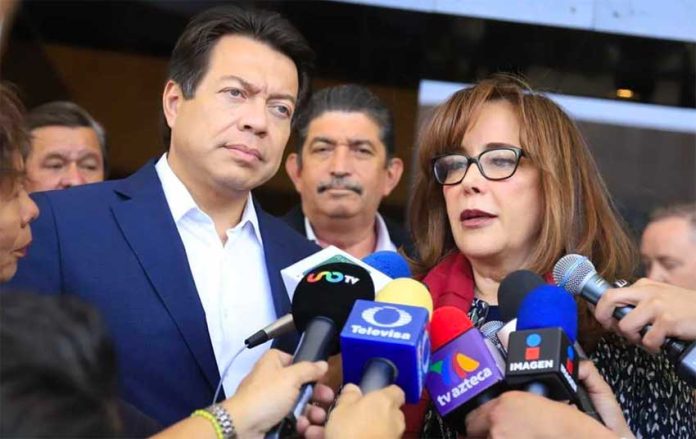
Delgado and Polevnsky speak with reporters yesterday.

President López Obrador’s confidence in his Pollyanna approach to personal security is shared by key members of his party, despite a recent threat from a cartel boss.

Morena party president Yeidckol Polevnsky said in an interview yesterday that the narco-banner placed outside the Pemex refinery in Salamanca, Guanajuato, would not deter the administration in its fight against fuel theft and corruption and the president trusts the people to look after him.

The banner’s message, presumably signed by José Antonio “El Marro” Yepez, presumed leader of the Santa Rosa de Lima Cartel warned López Obrador to withdraw troops from the state or innocent people would die.

“We will not retreat because of a narcomanta or anything so that they can continue with their crimes, corruption, and fuel theft,” Polevnsky said. “That’s unacceptable.”

She also denied that explosive devices had been found in a pickup outside the refinery, hours before the government suddenly changed its story and said there were explosives in the truck.

“There weren’t any explosive devices [outside the refinery] as was reported. The president trusts the people to look after him, and I believe they will, and although personally I would like much more security, I believe he has done well in marking the difference between the previous government and what the government is now.”

Mario Delgado, Morena’s leader in the Chamber of Deputies, also affirmed his belief in President López Obrador’s safety. He added that he believed the threats to be a sign that the president’s anti-fuel theft strategy was working and represented a threat to corruption and criminal interests.

Presidential spokesman Jesús Ramírez, who also told reporters initially that reports of explosives near the Salamanca refinery had been a false alarm, confirmed that police had in fact found explosives in a parked pickup and told the newspaper Milenio that the devices had been destroyed.

He told reporters that the president was unconcerned by the gang leader’s threat, repeating the party’s mantra that “the people will look after the president.”

Source: Milenio (sp)