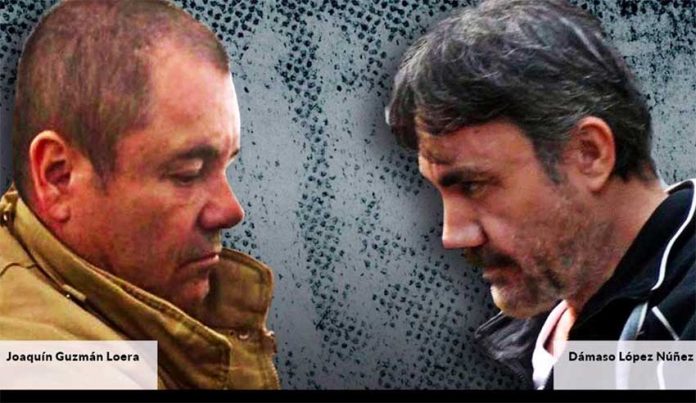
File photo of Guzmán, left, and former prison official López.
A former security chief at the Jalisco prison from which Joaquín “El Chapo” Guzmán escaped in 2001 testified yesterday that he and other prison officials took bribes from the former drug lord in exchange for providing him with a range of perks.
On his first day on the witness stand at the New York trial of the former Sinaloa Cartel chief, Dámaso López told jurors that among the privileges afforded to Guzmán while he was locked up in the Puente Grande maximum-security prison were new shoes, a mobile telephone and secret visits with his wife, brother and brother-in-law.
López, who joined the Sinaloa Cartel after resigning from his prison job, said that in exchange he received at least US $10,000, a house valued at 1.5 million pesos and assistance to pay medical expenses for one of his sons.
The witness told jurors that he quit his security job in September 2000 because the federal government was conducting an investigation into corruption at the prison.
However, López said that before he left he had a final meeting with Guzmán, who asked him to speak with the new security chief so that his perks would be preserved.
Known by the nickname “El Licenciado” (The Graduate), López later became a fixer and ultimately a leader in the Sinaloa Cartel. He is believed to have been chosen by Guzmán to be his successor.
However, “El Licenciado” was arrested in Mexico City in May 2017 and extradited last year to the United States, where he pleaded guilty to importing cocaine into the U.S and was sentenced to life in prison.
The sole accomplice to the escape was a guard known as “El Chito” who worked in the prison’s laundry section, he said, adding that Guzmán was later upset that other guards were falsely accused of aiding his breakout.
The 52-year-old witness also told the court about several executions that Guzmán allegedly ordered during his years at the helm of the cartel.
López is one of many cartel witnesses who have appeared over the past two months at Guzmán’s trial on charges of trafficking, conspiracy, money laundering and weapons offenses.
The former kingpin’s lawyers have attempted to portray the witnesses as unreliable “degenerates” who are speaking in the hope that their own prison sentences will be reduced.
If convicted, Guzmán faces probable life imprisonment.
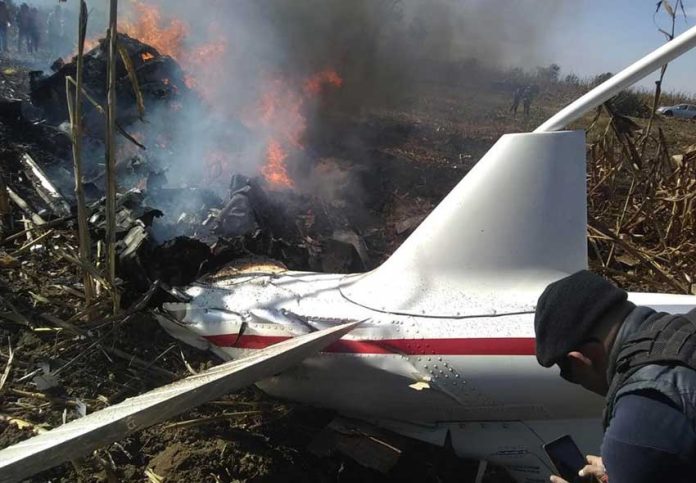
The helicopter shortly after it crashed December 24 in Puebla.
The manner in which a helicopter fell in a crash that killed the governor of Puebla was described today as unusual by federal transportation officials.
The Italian-made Agusta helicopter plunged almost vertically and upside down on December 24, killing Martha Erika Alonso, her husband the ex-governor, an assistant and two pilots.
“Yes, it was unusual, it was not normal [and] it is one of the things that catches the eye,” said transportation undersecretary Carlos Alfonso Morán Moguel.
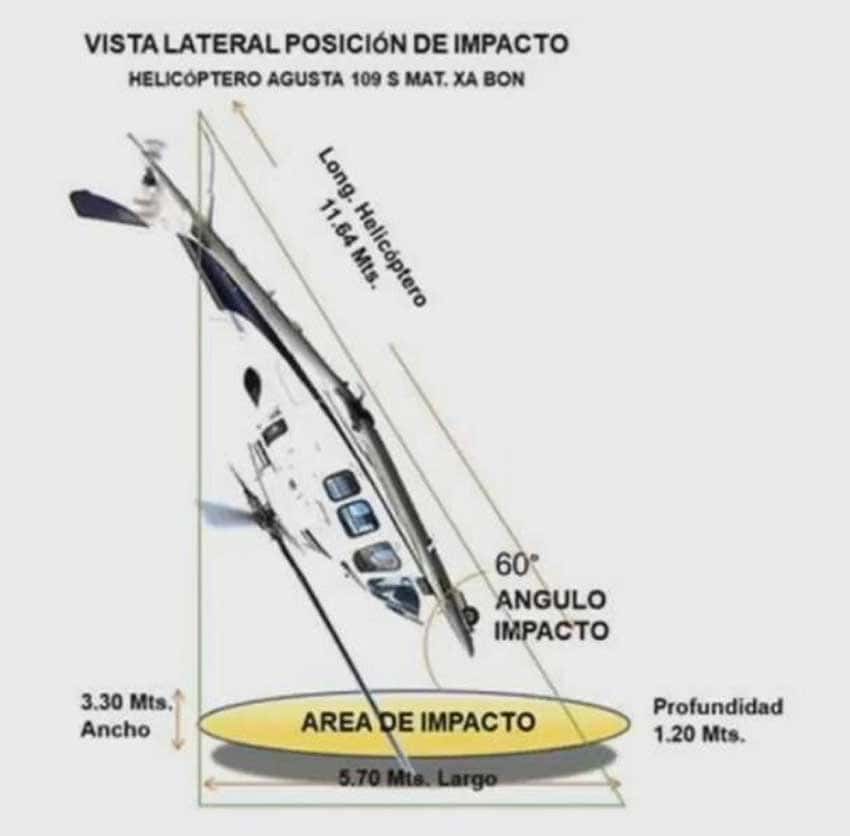
The fall was “almost vertical, at 60 degrees, and furthermore inverted,” he said.
Another unusual factor was that the heads of several bolts on the main rotor had had their heads sheared off, but investigators have concluded that the impact of the aircraft hitting the ground was the cause.
Transportation Secretary Javier Jiménez Espriú said the cause of the accident remains unknown. The investigation has not been able to determine if it was a mechanical failure, human error or weather.
Illustration prepared by the Transportation Secretariat demonstrates how the helicopter fell.
Authorities are now waiting for the results of studies of various components of the helicopter that are being carried out in Italy, the United States and Canada.
When gasoline started gushing out of a punctured pipeline in a field in Tlahuelilpan, Hidalgo, on Friday afternoon, word spread quickly.
Hundreds of local residents rushed to the rupture with containers in hand, determined to get some free fuel as gasoline shortages continued to make the commodity hard to come by.
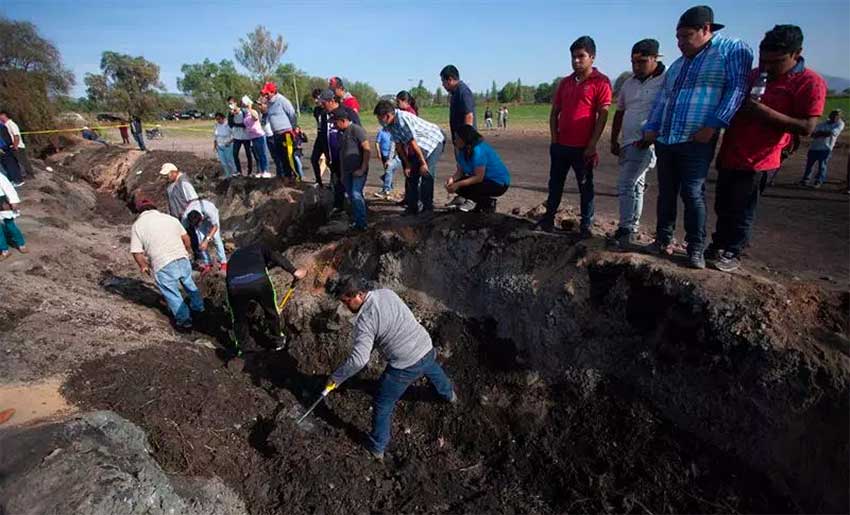
Hours later, amid an atmosphere that has been described as festive, the pipeline exploded, a huge fire spread across the field and more than 100 people were engulfed in flames. At least 95 people lost their lives and more than 40 others remain in hospital with severe burns.
In the days since the tragedy, a debate has raged across the country.
Were the victims who flocked to the illegal pipeline tap out-and-out criminals, or were they merely desperate opportunists whose actions were influenced both by the gasoline shortages afflicting Hidalgo and their own precarious economic situations?
Even President López Obrador weighed in on the debate, rejecting the former view and arguing that people’s poverty had compelled them to get in on the act.
“We have the conviction that the people are good, that they are honest, that if they arrived at these extremes, these practices, it’s because they were completely abandoned” by past governments, he told reporters at a press conference last weekend.
Poverty has long afflicted Tlahuelilpan, a municipality around 120 kilometers north of Mexico City, but according to many local residents, the situation has got even worse over the past two years.
According to the social development agency Coneval, 55% of Tlahuelilpan’s 18,531 residents live in poverty and 7% are in situations of extreme poverty.
The economic means of almost a quarter of all residents are so limited that they find it extremely difficult to buy enough food to have three meals a day, statistics show.
Education levels are low – only three in 10 residents have finished middle school – and more than 70% of people don’t have a formal job, meaning they don’t have access to social security services and other employment benefits.
Searchers look for remains of the missing at the scene of the explosion.
More than 10% of homes in Tlahuelilpan lack basic services such as running water, electricity and adequate drainage and many have only dirt floors. Almost half the municipality’s houses are without a washing machine and a quarter have no fridge.
The situation leaves little doubt in the mind of Tlahuelilpan Mayor Juan Pedro Cruz that poverty was to blame for people’s reckless decision to get so close to the geysers of gasoline last Friday and place themselves in a position of such obvious risk.
Ernesto Cardenas, a writer who chronicles the life and times of Tlahuelilpan, agrees.
But he also points his finger at Pemex, alleging that while poverty is the main culprit in the tragedy, the state oil company has played a role in exacerbating it.
More than 40 years ago, Pemex opened the Miguel Hidalgo oil refinery in Tula, a municipality just 15 kilometers from Tlahuelilpan. But Cardenas contends that the refinery has brought few benefits to the local townsfolk.
“They came, according to them, to create jobs but as the campesino [small-plot farmer] wasn’t prepared, they started to bring their own people. We made an effort to gain access to a job and many people went for training. We were ready but in the end, they didn’t give us an answer, they just brought their own unionized workers,” he said.
In recent years, the municipality’s economy has become increasingly dependent on fuel theft, known colloquially as huachicoleo, as more and more residents looked for a way to lift themselves out of poverty.
Before huachicoleo, Contreras said, Tlahuelilpan’s economy was based on agriculture, especially the cultivation of crops such as alfalfa, wheat and corn.
But residues from the nearby refinery contaminated the fields, he explained, and with gasoline prices rising, many people – especially young men – saw a lucrative alternative in the tapping of Pemex pipelines and the sale of stolen fuel.
“I got into the business two years ago. I needed money and as a farmhand or farmer, I wouldn’t have been able to get out of poverty,” an unnamed young huachicolero, or fuel thief, told the newspaper Milenio.
He explained that from a young age, he tried to earn an honest living in a range of different, poorly-paid jobs but unable to make ends meet, he accepted an offer from a friend to get in on the illegal fuel theft racket.
In January 2017, when the federal government imposed a sharp increase in the price of gasoline, many others also decided to join the illegal business, the huachicolero recalled.
“In the beginning, we only sold it [the stolen fuel] here but the competition has grown a lot and for that reason we took it to other municipalities. It’s a profitable business because we sell the stolen fuel at six pesos a liter and the reseller sells it at 12. Everybody wins. On a normal day I used to take home 10,000 or 12,000 pesos [US $520 to $630],” he said.
But now, the federal government has made cracking down on fuel theft a priority, threatening the livelihoods of huachicoleros all over the country but especially in states such as Hidalgo, Puebla and Guanajuato, which led the country in illegal taps in 2018.
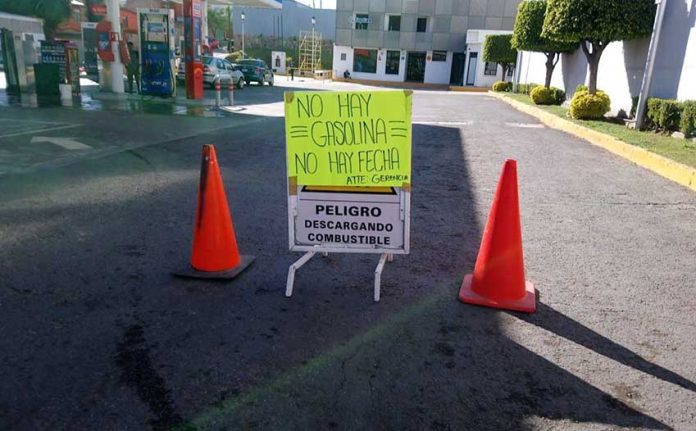
'There is no gasoline' nor is there a date on which it can be expected, says sign in Guanajuato.
Almost three weeks after gasoline shortages began affecting Guanajuato, 70% of gas stations in the state have no fuel, according to authorities.
Gas station closures have been reported in most parts of the state including the cities of Guanajuato, León and Irapuato as well as rural municipalities.
Mauricio Usabiaga, Secretary for Sustainable Economic Development, said the shortages have affected at least 50% of Guanajuato’s economy.
“The [economic] impact due to the lack of gasoline in Guanajuato has been severe, especially in cities like León and Irapuato, which represent more than 85% of the state’s wealth,” he said.
“Now we’re trying to raise awareness of the situation with the federal government . . . in order to receive support, we’re also looking for options such as attracting investment for a [new fuel] storage center . . . Business people are looking for legal, economic and social certainty” Usabiaga added.
Paulo Bañuelos Rosales, a lawmaker for Guanajuato’s ruling National Action Party (PAN), said that if shortages persist, agriculture could be among the sectors that are hardest hit.
The industry has already recorded losses of more than 200 million pesos (US $10.5 million), according to the state Agricultural Development Secretariat.
Bañuelos said that farmers in municipalities such as Abasolo, Cuerámaro and Pueblo Nuevo are becoming increasingly angry about the situation and have threatened to protest.
“They’ve been telling me that they were going to block the highways but I told them that was not something that would help us to solve the problem,” he said.
The lawmaker said the fuel shortages have meant that many farmers have been unable to harvest their crops.
“We’re talking about 15% or 20% of more than 130,000 producers [who are affected]. It’s mainly those who grow vegetables . . . The corn is still a little bit pale and you can keep it on the plant but you can’t do that with onions and bell peppers. Of course, they get marked and they no longer meet the quality to be exported . . . It’s having a very big impact on the agricultural sector,” Bañuelos said.
Meanwhile, in Jalisco, where 85% of gas stations in Guadalajara and 80% in the rest of the state remained closed yesterday, Governor Enrique Alfaro took to Twitter to question why the shortage crisis was worse there than in other parts of Mexico.
“It’s not controversial to say that the size of the fuel shortage problem . . . in Jalisco is very different to the rest of the country. It’s worrying that here it’s been going on almost 19 days while in other places, such as Mexico City, they only had three days of crisis,” he wrote in the first of several tweets on the subject.
Alfaro also took aim at the state oil company and the federal government, charging that they had let Jalisco down despite the state government doing everything that was asked of it.
“We helped to reinforce security for the tanker trucks and guaranteed their entry to the city, we’re collaborating with the protection and surveillance of pipelines, we strengthened the patrolling of distribution centers and operations to combat fuel thieves,” he wrote.
“However, as we have said from the beginning, Pemex and other federal agencies haven’t shared precise information that is useful to take the necessary decisions . . . so that the citizens suffer the negative effects as little as possible . . . It’s very concerning that the metropolitan area of Guadalajara is receiving just 40% of the daily fuel it requires,” the governor continued.
“We’ve complied with all the requests that have been made to us but if the federal government doesn’t assume its responsibility and generate certainty for the residents of Jalisco, we will take preventative measures on a larger scale to contain the impact of this unprecedented crisis on Jalisco and the country.”
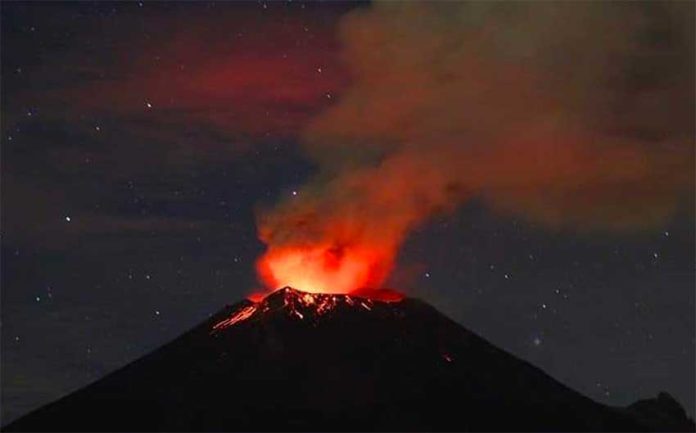
The Popocatépetl volcano sent a two-kilometer ash plume in an eruption last night, triggering an ash fall alert for communities in the vicinity.
The 9:06pm eruption was accompanied by the emission of incandescent material that fell a few meters from the crater on the eastern slope of the volcano and the two-kilometer-high plume of ash, water vapor and gases.
The explosion was heard in nearby towns and caused windows and doors to vibrate as far away as Puebla city, located 44 kilometers to the east of the volcano.
Authorities have issued recommendations following the low-scale eruption, including limiting open-air activities, bringing pets indoors and avoiding eating meals outside.
Anyone who goes outside is advised to wear a face mask, a long-sleeved garment and a hat. Once back indoors, people should rinse their eyes and throats with water.
Special attention should be given to water tanks and other water sources for human and animal use, keeping them covered and protected from the volcanic ash.
Hiking near the crater is not advised, as the emission of incandescent material and other ballistic fragments is expected to continue.
The alert for Popocatépetl remains at yellow, Phase 2, which means that the release of water vapor and gas plumes is to be expected, as is the light fall of ash in nearby areas along with incandescent fragments.
The alert level also warns of the possibility of eruptions causing pyroclastic flows and mudslides carrying debris, although at such a small scale that evacuation of inhabited areas is not required.
A Veracruz lawmaker has backed down after suggesting there be a 10:00pm curfew for women as a measure to counter femicide.
Ana Miriam Ferráez generated an uproar on social media after saying women in Veracruz should remain indoors after 10:00pm to prevent femicides “until the situation is fixed.”
She has since apologized for the statement.
The legislator’s comments, along with the disbelief of reporter Gabriela Rosgado, were captured in a video that has since received thousands of views and comments on social media.
The reporter can be heard saying “No freaking way!” in an immediate reaction to Ferráez’s comment.
In an interview later Rosgado said she did not know she was being recorded, though she does not regret her initial response. She added that while she believed the idea to be absurd, she had not intended to be disrespectful or to make fun of the legislator.
The latter told a press conference that she made the comment out of a profound personal sense of pain over gender-motivated violence in Veracruz.
She added that she never intended to victimize women or to limit their freedoms and expressed solidarity for those who suffer from discrimination, misogyny and gender-based violence.
“Humans make mistakes, and it is with humility that I would like to reiterate my apology to all of the women who were hurt by my comments.”
Veracruz was the state with the highest number of recorded femicides in 2018 and is also one of the states with the highest rates of violent crimes against women.
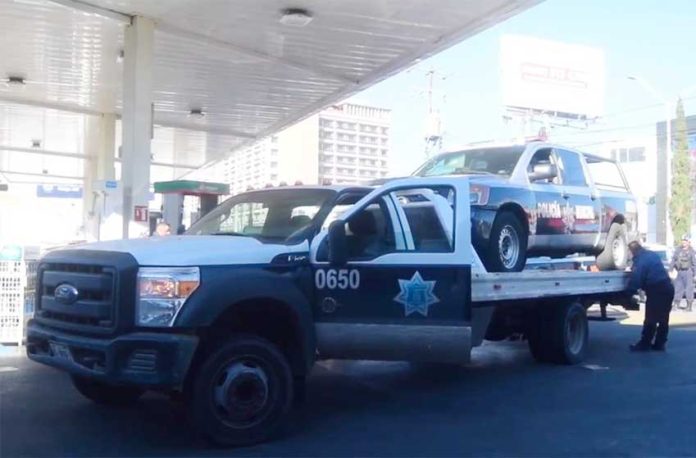
A police vehicle in Aguascalientes had to be towed to the nearest gas station.
Pemex says the gasoline supply in the state of Aguascalientes is gradually improving, but the shortages are still causing problems — even for local police.
The state oil company said it distributed 3.2 million liters of gasoline and diesel on Sunday and Monday, focusing its efforts on the gas stations with the lowest reserves.
Half that volume was distributed on Monday to 149 stations.
But it wasn’t soon enough for a municipal police vehicle. After running out of gas, it had to be towed to the nearest gas station.
That brought criticism from one motorist who was filling up at the time.
Mario Torres suggested that police departments should have their own fuel supplies and tankers, and pointed out that three of the four gas pumps were being used exclusively for police vehicles.
” . . . We need security, but we also need to work,” he said.
A local businessman took a more positive view even though he arrived at the gas station pushing his truck after it ran out of fuel.
“It’s an effort . . . but if corruption comes to an end with all of this, I don’t mind pushing my truck for 10 blocks,” said Francisco Santoyo.
Cab driver Héctor de León said he was not working as much as he could because he needs to line up at a gas station and lose precious time while potential customers are looking for transportation.
People are waiting for buses that don’t stop because they’re already full, he said.
At least 17 people were hospitalized Sunday after consuming roast chicken that turned out to contain methamphetamine.
Customers who bought the chicken from a street vendor in Nuevo Casas Grandes, Chihuahua, reported symptoms of rapid heart rate, insomnia, cerebral hemorrhaging, extreme agitation and convulsions among others.
A 57-year-old woman had to be transferred to Ciudad Juárez for more urgent care after she experienced convulsions and a possible stroke.
In light of the symptoms, a local health official ordered antidoping tests, which came back positive for methamphetamine. Alma Rosa Valles said the health department would continue to investigate and urged the victims and their families to file police reports to denounce the incident.
Meth can be deadly in high dosages and can cause heart attacks, strokes and respiratory arrest.
A family member of one of the victims turned a piece of the suspect chicken over to authorities, who sent it to the state capital for laboratory analysis.
State authorities are investigating, although the whereabouts of the chicken vendor, who operated under the name Pollos Rigo, remains unknown.
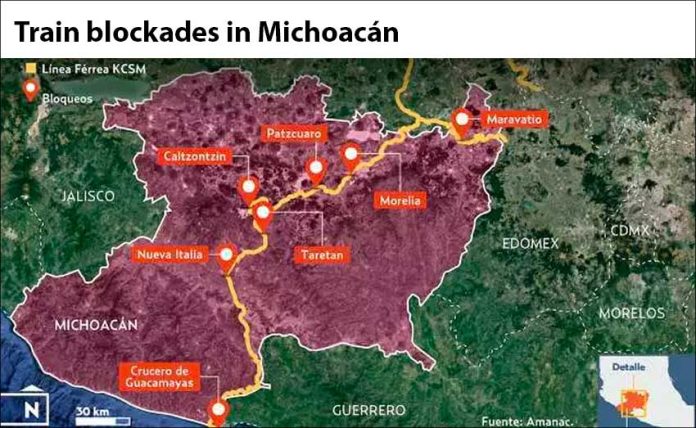
Railroad operator Kansas City Southern de México said the petroleum industry is one of those most affected. One of the trains consists of 96 tanker cars destined for the refinery in Tula, Hidalgo, said company president José Zozaya.
Another rail operator said other industries are also suffering from the impact of the blockades. Ferromex spokeswoman Lourdes Arana said 8,000 containers of goods are awaiting shipment in the ports of Lázaro Cárdenas, Michoacán, and Manzanillo, Colima.
She urged that education officials in the Michoacán government negotiate with the teachers, members of the CNTE union, who are demanding the payment of monies that they claim have been owed since 2017.
Zozaya called on teachers to negotiate away from the railroad tracks.
“We understand that the teachers have their reasons [for the blockades] but I would invite them to negotiate away from the railway because they are not only impacting industry in Michoacán and Mexico but railroad workers and those in other sectors whose incomes have been affected by the blockades.”
President López Obrador today offered money to pay the teachers, but insisted that it would be in the form of a loan.
“It’s the Michoacán government’s problem because they haven’t paid the teachers.”
He said the federal government won’t be blackmailed by the state.
The Mexican Association of Shipping Agents said yesterday that losses total 820 million pesos (US $43 million) as a result of the stoppage although other estimates put the cost at closer to 8 billion pesos.
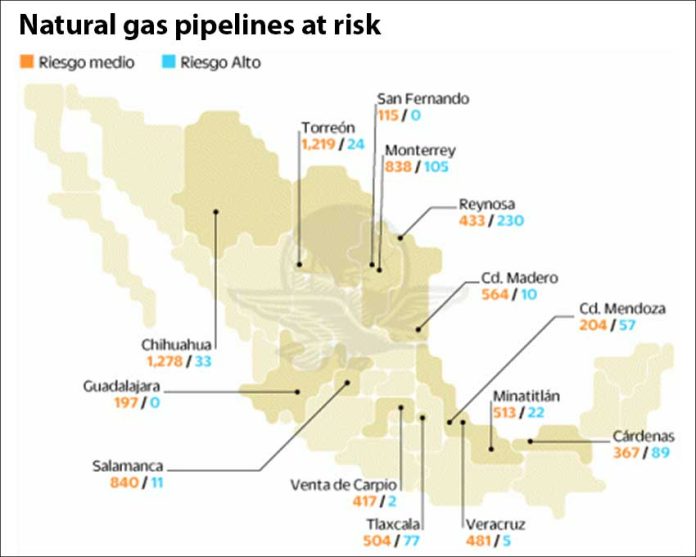
In orange, aging pipelines at medium risk; in blue, those that are high risk. Figures indicate kilometers. el universal
The vulnerability of Mexico’s petroleum pipelines to theft is well known but the country’s natural gas lines are also cause for concern.
The National Gas Control Center (Cenagas), the federal agency responsible for the surveillance and maintenance of Mexico’s 12,678-kilometer-long natural gas pipeline network, has detected that 70% of the ducts have been in operation for 35 years or longer and have deteriorated to such an extent that they don’t meet current safety and regulatory requirements.
On average, natural gas pipelines function at an optimal level for 30 years, after which they should undergo extensive maintenance to extend their lifespan or be replaced.
Some sections of the pipeline network, including parts located in the cities of Reynosa, Monterrey, Torreón and Chihuahua, have been identified as requiring urgent attention because they could create “dangerous conditions” for residents and the environment.
Their state of disrepair could also threaten the continued supply of fuel to customers, Cenagas said.
The agency, a division of the Secretariat of Energy (Sener) that was created in 2014, inherited responsibility for the outdated gas pipeline network from Pemex.
Two years ago, it requested almost 200 billion pesos (US $10.4 billion at today’s exchange rate) to carry out maintenance and modernization of the pipeline network including its monitoring and control systems.
But despite the importance of the projects and the inherent risks of out-of-date pipelines, the modernization work, which should have been completed last year, has not even begun, the newspaper El Universal reported.
Just under 666 kilometers of pipelines in the natural gas network — or 5% — are considered to be high risk and 8,166 kilometers — 64% — are classified as medium risk, according to Cenagas.