Home Blog Page 2244

Judge sentences Aguascalientes man to 87 years for sexual abuse of minors

0
García was a spiritual guide to his victims.

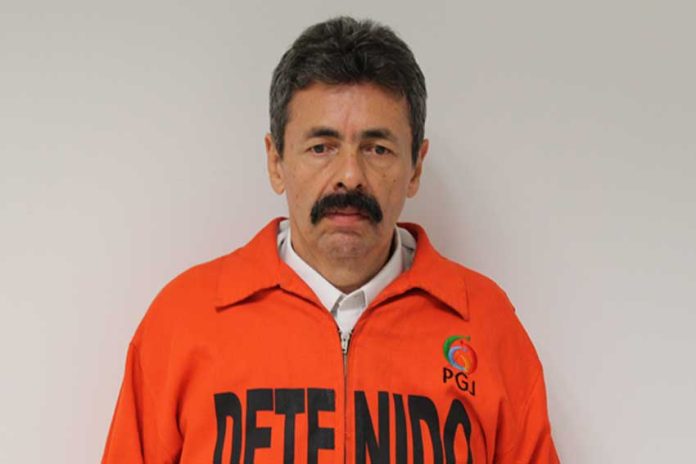
A man who acted as a “spiritual guide” to youngsters in the city of Aguascalientes has been sentenced to 87 years in jail for sexual abuse.

José Manuel Aguilar García was charged with sexual abuse and sexual assault against eight youngsters who attended his religious classes at a Catholic organization in the city.

The incidents took place in 2006 and 2007, the state Attorney General said. When accusations of abuse were made against him, he fled to the city of Querétaro, where he taught theology at a private university until his arrest in 2014.

Aguilar would take his students to solitary locations, various beach resorts and a corner grocery store he owned where he would engage in sexual acts with them.

In addition to the jail sentence, he was fined 67,000 pesos.

Source: El Universal (sp)

AMLÓpolis is new government’s blueprint for better living

0
AMLÓpolis, the new government's development plan.

Stimulating regional development, ensuring that cities are well-managed, sustainable and safe, meeting housing needs and improving transportation services are all on the agenda for Mexico’s next federal government, according to a development plan known colloquially as AMLÓpolis.

The plan says the administration of president-elect Andrés Manuel López Obrador, also known as AMLO, will seek to “improve the environment in which millions of Mexicans live through the provision of quality infrastructure, public spaces, facilities [and] affordable and well-located housing.”

Román Meyer Falcón, an architect and academic who specializes in urban development, will be responsible for executing the plan as secretary of agrarian development and urban planning.

In keeping with López Obrador’s pledge to improve the standard of living for millions of poor Mexicans and to make economic growth and development more equitable across the country, the development plan says the administration will seek to “stimulate greater public and private investment in the country’s most disadvantaged regions.”

Directing public resources to the country’s poorest regions to carry out new infrastructure projects will be a priority.

In the nation’s metropolitan areas, the AMLÓpolis document says the government’s objective is to have “harmonious” urban development which contributes to making cities more connected, sustainable and inclusive.

Prudent water management, the provision of adequate sewage treatment services and the security of citizens are also priorities.

To halt or at least slow the uncontrolled march of urban sprawl, the AMLO-led administration will promote higher-density living closer to the center of Mexico’s large cities with both public and private investment slated to contribute to new housing developments.

The government will also develop “alternative models” to help people on low incomes purchase land, while a new housing policy that involves all three levels of government and the private sector will be designed to meet families’ needs.

“New homes will be well-located and have adequate urban facilities,” the document says, adding that financial assistance will be made available to people on low incomes and young people so they can access adequate housing.

With regard to public transportation, AMLÓpolis states that the next government will modernize existing transit systems to make them more integrated and to improve accessibility to essential services and facilities.

It also says the government will seek to make public spending more equitable across all modes of transportation by considering the needs of cyclists and pedestrians as well as users of public transit. Citizen participation in public transportation decisions will be encouraged.

In rural regions, the document states, the government will protect the rights of land-owning collectives and promote democratic participation in decisions related to agrarian and natural resources.

The priorities of the incoming López Obrador-led administration are becoming clearer through documents such as AMLÓpolis and a 12-point plan AMLO outlined this week that sets the next government’s legislative agenda.

López Obrador will be sworn in as president for a six-year term on December 1. He named the members of his prospective cabinet last December.

He won the July 1 presidential election in a landslide and has pledged to stamp out government corruption and transform Mexico.

His sweeping victory gives him a mandate to fulfill his campaign promises and with the three-party coalition he leads winning majorities in both houses of federal Congress, he will have the congressional backing to do so.

Source: Milenio (sp)

Earthquake damage triggers discovery of temple in Morelos

0
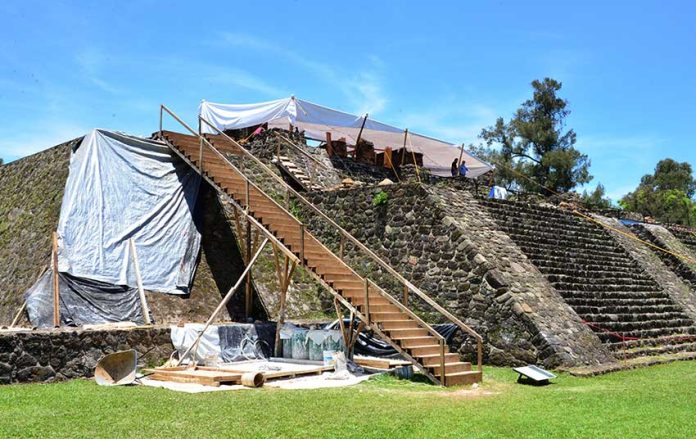
Archaeological work under way at the pyramid in Morelos.
Archaeologists at work at the pyramid in Morelos. Melitón Tapia, INAH

Last September’s second major earthquake caused widespread damage in central Mexico and claimed hundreds of lives but it also helped to reveal a tightly-held archaeological secret in the state of Morelos.

While carrying out post-quake restoration work on the main pyramid at the Teopanzolco archaeological site in Cuernavaca, archaeologists from the National Institute of Anthropology and History (INAH) found the remains of a temple inside the structure.

INAH Morelos director Isabel Campos Goenaga explained that the discovery of the substructure was made while carrying out exploratory drilling of the pyramid to determine its structural integrity after it was damaged in the September 19 earthquake.

She also said the find indicates that the site built by the Tlahuica people dates back to the early stages of the Mexica period, which makes it older than previously thought.

“Despite the damage the earthquake caused we have to be thankful that because of this natural phenomenon, this important structure appeared that changes the dating of the archaeological site,” Campos said.

The discovery includes walls of what is believed to have been a temple and the remains of a stucco column that probably supported a roof.

No remains of a roof were found, however, leading archaeologists who worked on the project to believe that it may have been made out of a biodegradable material.

The archaeologists contend that the architectural relics date back to the first construction phase of the pyramid during the middle of the Post-classic period, or between 1150 and 1200 AD.

In addition, they claim that the structures built at Teopanzolco served as a source of inspiration for the inhabitants of Tenochtitlán, the Aztec capital that became Mexico City.

“This discovery changes the chronology of Teopanzolco because an open-air basement was built first and then, in the image of this type of construction, the Templo Mayor [Main Temple] of Tenochtitlán was built,” INAH archaeologist Bárbara Konieczna said.

“The Mexicas [Aztecs] didn’t bring this architectural style to the region, on the contrary, the Tlahuica constructions inspired them to build the Templo Mayor,” she added.

Konieczna and her colleague Georgia Yris Bravo López think there may have been another temple on the site.

The newly-uncovered temple may have been dedicated to Tláloc — the god of rain — while if, as suspected, another place of worship exists, it may have been dedicated to Huitzilopochtli — the deity of sun, war and human sacrifice, Konieczna said.

The archaeologists also recovered ceramic artifacts and a censer featuring Tlahuica motifs as well as a significant amount of charcoal that could have been left over from either rituals carried out at the temple or from a disaster.

The recovered pieces will undergo testing to determine their approximate age.

Mexico News Daily

International election observer notes waits were long but voters patient

0
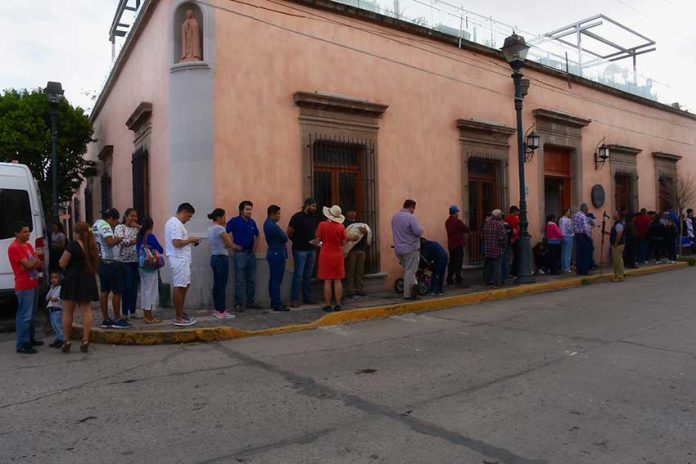
Voters line up at a polling station in Durango on July 1.

On December 1, Andrés Manuel López Obrador (AMLO) will be sworn in as the 65th president of Mexico, having won over 50% of the vote in the recent election. It was historic.

Months prior, the prestigious National Autonomous University (UNAM) and their program, Dialogos por la Democracia (Dialogues for Democracy), issued a request on social media seeking international election observers.

The requirements involved visiting polling stations to supervise how votes are cast and counted. It’s also about civic interest, being impartial and defending democracy. Mexico’s election authority, the autonomous National Electoral Institute (INE) does not pay or supervise observers.

Over 700 volunteers from around the world served as election observers on July 1. My interest in the election stemmed from various reasons: I had been a poll worker in California and wanted to see how the process worked in Mexico.

Most importantly, given the concern for free and transparent elections in Mexico it was imperative to participate. After receiving accreditation, INE provided observers with web links to documents related to duties and responsibilities, including manuals addressing all aspects of voting.

I served as an observer in the state of Durango and also hired a local photographer that knew his way about. This was a plus given that we were going to be visiting various polling locations through the day.

As in the U.S., all polling places need to be set up and ready to go by 8:00am. However, even though I arrived at 7:30, by the time election officials had arrived and set up boxes and ballots, it was 8:55am before the first ballot was cast.

The wait was long but people were patient. One person I interviewed stated, “After six years of Enrique Peña Nieto, waiting one hour for change is not that long.” One INE official told me that a large number of voters were expected at the polls.

If a one-hour wait to vote was long, those that had to do so at the special polling place, called the casilla especial, had a much longer wait. The casilla is used by nationals that are traveling and aren’t able to vote at their designated polling place.

By electoral law, only 750 ballots are available at each casilla especial. I witnessed Mexicans waiting up to two to four hours to vote. Once 750 ballots were distributed, officials closed the doors. Many people left without having voted and some left once wait times became excessive.

INE claimed that it was not their fault. However, it was old news. Previous elections have seen voters turned away also. A comment from one of the persons in line was, “If this is going to change, the law needs to change. However, Elecciones 2018 are in the past and Mexico legislators have a lot of priorities in light of the new administration.”

Preparation to be an observer involved interviewing party officials from the Institutional Revolutionary Party (PRI), the National Action Party (PAN) and the eventual winner, Morena. The center-right PAN and the PRI represent the two dominant political parties in Mexico.

The PRI representative acknowledged that the public had lost trust in the PRI since dozens of current and former governors are facing corruption charges. Also, under the watch of PRI, there were over 30,000 homicides in 2017.

He added that their candidate, José Antonio Meade, the Yale-educated economist, would successfully address these issues so as to restore confidence in the PRI, a party founded in 1929 that held power uninterrupted in the country for 71 years from 1929 to 2000.

My next visit was to the state PAN office. The party of Ricardo Anaya had millennials setting up high-tech equipment to monitor the elections. The PAN representative claimed that their candidate would be victorious. Corruption and money laundering allegations against him during the campaign would be proven erroneous.

My last visit was to Morena headquarters. The representative thanked the contingent of international observers. He believed that this time the presidency would not be snatched from AMLO. It was the will of the people and change was necessary.

Six years from now I may not be alive to see the post-AMLO administration let alone serve as an observer but I came away admiring the Mexican voters— their amazing patience, their civic-minded service to their fellow voters and their hope for a better future for themselves and generations to come.

Mexicans expect much of the new president. Cielito lindo.

Yvonne Guerra lives in Los Angeles and travels frequently to Mexico.

Auto parts production could set a record despite NAFTA uncertainty

0
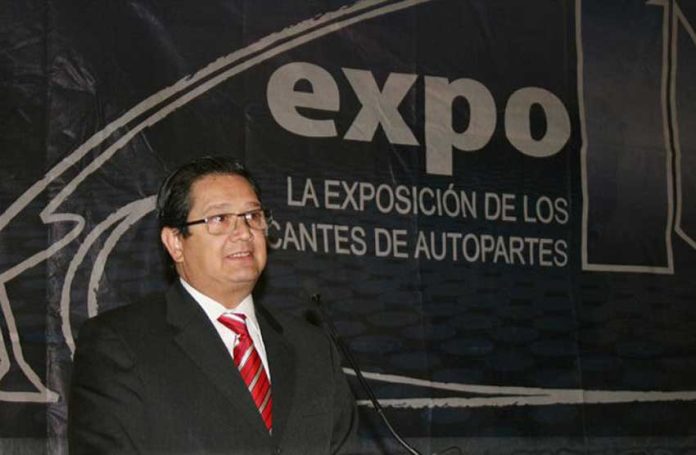
Oscar Albin of the National Auto Parts Industry.

In spite of uncertainty over the North American Free Trade Agreement (NAFTA), the auto parts manufacturing industry could set a production record this year.

National Auto Parts Industry president Oscar Albin estimated that the value of parts manufacturing will come close to reaching US $90 billion.

It would not be a big increase over last year’s $88 billion but Albin thought it a good one given current conditions. He also said foreign investment continues to come into the country.

In the first half of the year foreign investors — mostly from the United States, Japan and Germany — invested close to $1.4 billion in the sector.

For the year, the industry expects total investment to reach between $3 billion and $4 billion, down somewhat from last year’s $6 billion.

Albin said there has been no decline this year in production for either the domestic or export market and new factories are still being built.

The industry is hopeful that a new NAFTA can be negotiated before the end of the current government’s term in November. Otherwise, Albin said, it would become complicated.

Source: Milenio (sp)

No casualties after Mexico City commercial center collapse

0
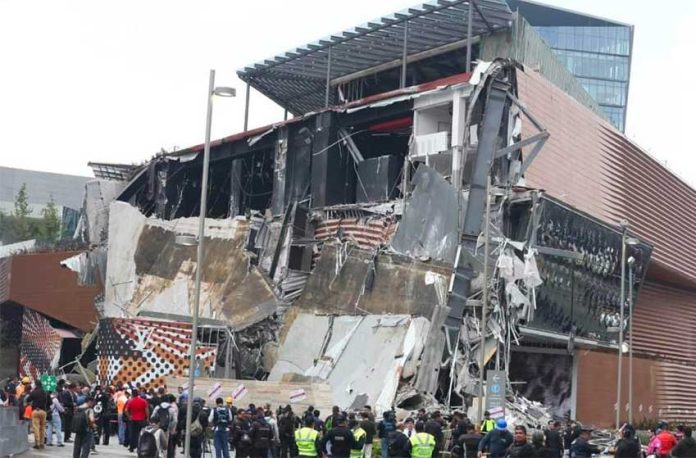
Wreckage in today's collapse of part of a building in Mexico City.

A section of a new commercial center in a southern neighborhood of Mexico City collapsed today but there have been no reports of casualties.

Civil Protection Secretary Fausto Lugo said that the partial collapse of the Artz Pedregal Commercial Plaza, located on the Periférico Sur ring road in Jardines de Pedregal, was caused by a structural fault.

“What happened is that a retaining wall collapsed . . . It was mainly due to an accumulation of water from a crack in a pipe that ran across the top of the wall,” he said.

Lugo said there were no casualties and no one had been trapped in the rubble, adding that the collapse didn’t pose a risk to nearby buildings.

An investigation into the incident, which occurred just after 11:00am, is currently under way and authorities have closed the entire center as well as some lanes on the busy ring road. Authorities have warned motorists to avoid the area.

Mexico City Attorney General Edmundo Garrido said that after the city government has received expert reports and accounts from witnesses, it will seek to determine who is responsible for the structural fault and the collapse.

Garrido added that his office will summon everybody who is in any way connected to the incident to make a statement.

The center’s management said in a statement that it would fully cooperate with authorities in the investigation and that it would keep the public informed about its findings.

Rescue dogs, who were an invaluable help to authorities when searching for survivors after last September’s earthquakes, have contributed to efforts to search through the rubble in case a person who is unaccounted for is trapped.

The commercial center, which was built on land that had previously been abandoned for 30 years, opened in March. Just over half of the plaza’s space is made up of offices while most of the remaining area, including the collapsed section, houses shops.

The newspaper El Financiero reported that the 400,000-square-meter center, which includes three luxury office towers, was built by Grupo Sordo Madaleno with an investment of 4.86 billion pesos (US $256.6 million).

Video footage of the collapse was captured by people in the vicinity of the commercial center and has circulated widely today on social media and news websites.

Source: Milenio (sp), El Financiero (sp), Expansión (sp)

An extract of UNAM’s super chayote proves successful in fighting cancer

0
Chayote: another weapon in the fight against cancer.

Cancer patients undergoing chemotherapy treatments are accustomed to cocktails of chemicals designed to combat malignant tumor cells, but now a Mexican scientist has developed a chayote-based alternative.

It took cellular biologist Edelmiro Santiago Osorio and his team at the Zaragoza Higher Studies School (FES) of the National Autonomous University (UNAM) a decade of research and trials to prove the effectiveness of their hybrid chayote as tumor-fighting agent.

Chayotes, also known as pear squash or mirliton, are eaten around the world, but Santiago explained that the varieties found in stores and markets would be of no use in the fight against cancer.

“We would have to eat many kilograms of market chayotes to obtain the effect we get from the hybrid,” he said.

Santiago’s chayote is the result of combining two wild varieties found in Mexico, and it becomes antitumoral after it is processed to obtain a raw extract.

He claimed that his chayote extract is 1,000 times more potent than what could be obtained from common chayote varieties, and is as effective as cytarabine, a chemotherapy medication used to treat several types of cancer.

Santiago and his team used mice to test the chayote extract and found that it greatly inhibited the proliferation of some cancer-producing cell lines.

After creating his hybrid chayote strain, Santiago is now looking to create and fund a business that can grow it commercially to bring his “super chayote” to market.

Santiago remarked that the goal of the fight against cancer is not to have a single cure-all molecule or substance, but to gather an arsenal: “We must find the way to attack the tumoral cell at different stages of its development with different molecules.”

Mexico News Daily

Video celebrates Mexico-South Korea friendship with fusion of popular songs

0
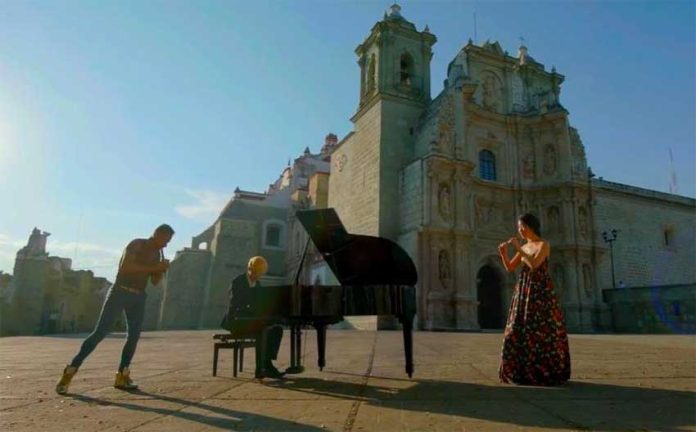
Several sites in Oaxaca were scenes for the Mexican-Korean video.
Several sites in Oaxaca were scenes for the Mexican-South Korean video.

A new musical recording that blends the popular Mexican song Cielito Lindo with a famous South Korean folk song celebrates the growing friendship between the two countries.

Two weeks after the South Korean soccer team helped Mexico to qualify for the second round of the World Cup by beating Germany — triggering an outpouring of love for the east Asian nation — musicians from Mexico and South Korea this week launched their music video entitled Cielito Lindo Coreano at the official residence of South Korea’s ambassador to Mexico.

Starring Korean-born pianist KL Joon, Mexican flautist Horacio Franco and Korean multi-instrumentalist Gamin Kang, the video also features some of Oaxaca’s most famous and stunning sights, while a trio of mariachi trumpeters makes a cameo appearance.

The natural rock formations at Hierve el Agua, the streets of the state capital’s historic center, the city’s cathedral and Santo Domingo church and the Tule tree — which has the widest trunk in the world — all get their moment in the limelight in the five-minute clip directed by Carlos Santos, ensuring that it will also be a good advertisement for tourism in the state.

Speaking at yesterday’s presentation, South Korean Ambassador Sang-Il Kim said the recording was not just a video but a production that extols the goodness of humanity.

He also said the song could serve as comfort for people who are suffering and hope for those who are attempting to overcome difficult times in their lives.

The folk song Arirang, which is often considered the unofficial national anthem of South Korea, also features in the musical fusion, which Joon and Franco played live at Tuesday’s presentation.

“Mexican and Korean music combine with the beautiful landscapes of Oaxaca, which was the location for this magnificent video,” Sang-Il Kim said.

KL Joon, who was born in South Korea but moved to Mexico during his teenage years and is now a Mexican citizen, said he has loved songs such as Cielito Lindo since he was a young boy but he didn’t realize that it was a Mexican song until he moved to the country.

He later decided that he wanted to find a way to combine the music of his country of birth with that of his adopted homeland, explaining that initially people thought it was a strange idea but eventually he found a willing accomplice in Franco.

The aim of the pair — along with New York-based Gamin Kang — is to show that instrumental music is not boring, Joon said.

“The world is full of reggaeton and pop and a lot of people think that instrumental music is boring but it’s not and it’s also very cultural. That’s why we wanted to make this fusion . . .” he explained.

Franco — an acclaimed musician who plays both flute and recorder in the song — said that for him the musical project is representative of the democratic transition that Mexico is currently passing through, adding that he thought that Korea’s development could serve as a model for progress here.

“It’s a dialogue with another country, another culture. I hope that Korea, with its example of economic growth and technological development, inspires us to change for the better,” he said.

Source: El Universal (sp), NVI Noticias (sp)

AMLO will cancel purchase of 8 Seahawk military helicopters

0
Cancelled: an order for eight Seahawk helicopters will be cancelled by the new president.

Andrés Manuel López Obrador won’t be sworn in as the next president of Mexico for more than four months, but he is already moving ahead on campaign promises.

Speaking after a meeting with his party’s elected lawmakers, López Obrador said yesterday that his administration will cancel the purchase of eight MH60R combat helicopters worth US $1.2 billion.

The Navy has ordered the eight Seahawk aircraft from the United States manufacturer Lockheed-Martin and in April the U.S. State Department authorized the sale, on the grounds that the helicopters would improve the security operations of a regional strategic partner and would aid in the fight against organized crime.

When the purchase was announced, López Obrador asked that the order be cancelled.

“That purchase is going to be cancelled because we cannot make that expenditure,” said the president-elect yesterday.

He made this announcement as he prepares for his first meeting with representatives of the U.S. government as president-elect.

Secretary of State Mike Pompeo and Jared Kushner, senior advisor to President Donald Trump, are scheduled to travel to Mexico City tomorrow.

On the campaign trail López Obrador was critical of federal spending on military equipment.

He also plans to sell the presidential airplane, a Boeing 787 Dreamliner purchased by the federal government two years ago. The president-elect has said he would never “board that plane.” Instead he plans to continue flying on commercial flights.

Source: Milenio (sp)

4 police officers, 2 civilians killed in Veracruz attacks

0
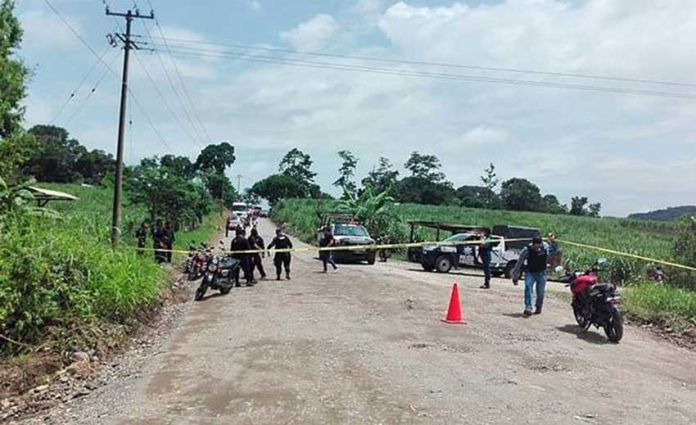
Scene of one of yesterday's attacks on police in Veracruz.

Violence in Veracruz yesterday took the lives of four municipal police officers who were attacked and killed in the municipality of Tezonapa, located in the central mountainous region of the state and an area where petroleum theft is common.

Armed civilians in the town of Motzorongo drove up to a municipal police patrol car and started shooting, killing an officer and severely injuring another.

Minutes later, a second group of police officers was attacked on the highway between Tezonapa and Laguna Chica by armed commandos who opened fire. Three police officers lost their lives, along with two civilians.

In the south of the state two men were found dead in a street in the port city of Coatzacoalcos; they had been tortured.

A woman’s body, minus the head, was found in the municipality of Puente Nacional, adjoining the port of Veracruz.

Source: El Universal (sp)