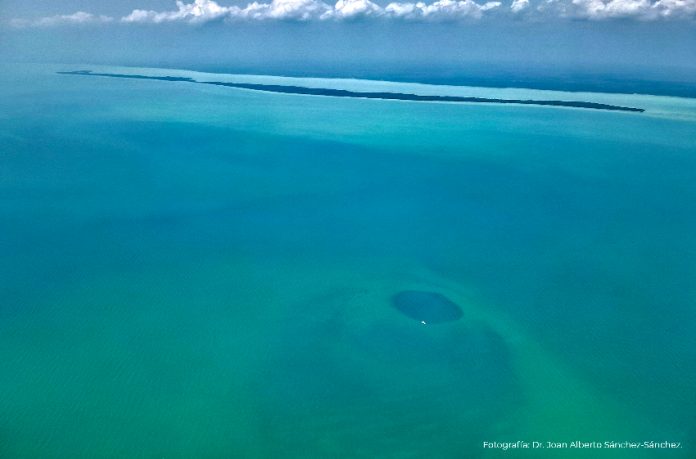
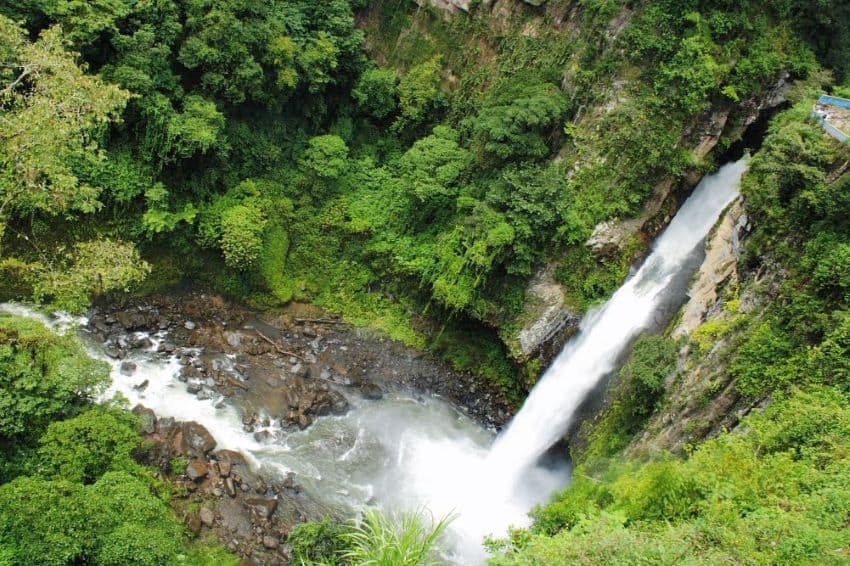
The Taam ja’ Blue Hole is over 420 meters deep, making it the deepest yet discovered. (Joan Alberto Sánchez Sánchez/Ecosur-Conahcyt)
An underwater sinkhole off the southeast coast of the Yucatán Peninsula has been confirmed as the deepest in the world — and researchers haven’t even reached its bottom yet.
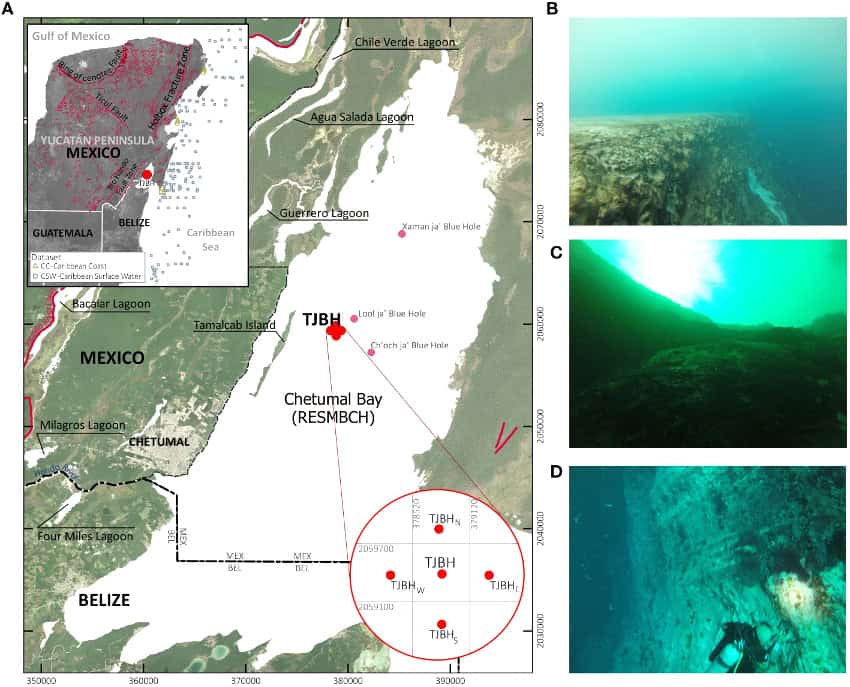
A map of the location of the Taam ja’ Blue Hole off the coast of the Yucatán peninsula. (Frontiers in Marine Science)
Blue holes are generally circular, steep-walled depressions, and get their name from the dramatic contrast between the dark blue, deep waters of their depths and the lighter blue of the shallows around them.
The Taam ja’ Blue Hole had been named the second-deepest in the world in research conducted in March of last year via bathymetric mapping employing echo sounder technology.
In December 2023, the Conahcyt-Ecosur team utilized a CTD Profiler to measure the water depths within the blue hole and found it “surpassed 420 [meters below sea level] with no bottom yet reached.”
A CTD (conductivity, temperature and depth) profiler is a device with a set of probes that read and transmit water properties to the surface in real time via a cable.
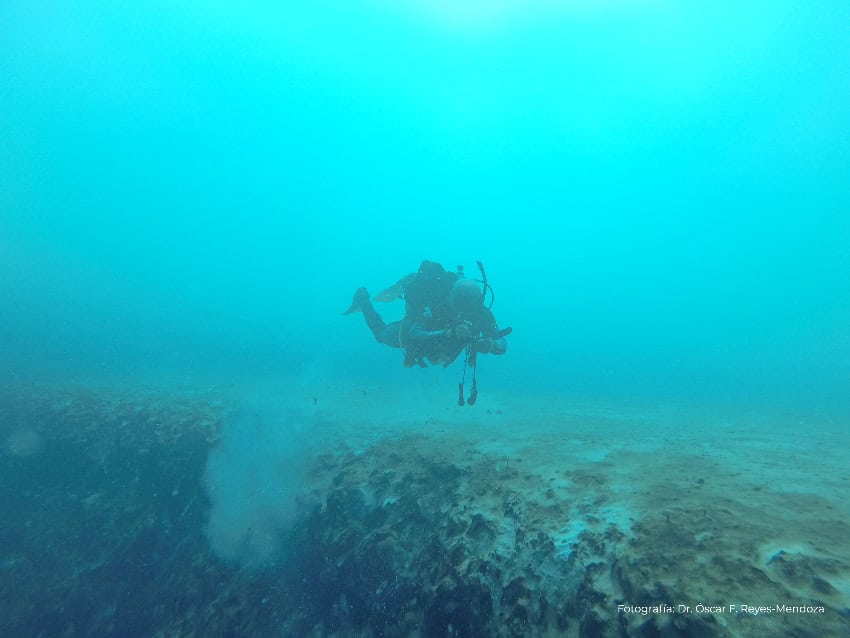
A diver exploring the Taam’ ja Blue Hole. (Oscar F. Reyes Mendoza/Ecosur-Conahcyt)
The latest research indicates Taam ja’ is significantly deeper than the former No. 1, China’s 301-meter-deep (990 feet) Sansha Yongle Blue Hole, also known as the Dragon Hole, in the South China Sea.
A temperature-salinity diagram was also devised to identify a potential relationship between the waters of the blue hole and those in coastal and open-sea waters in the Caribbean.
The researchers noted different layers of water within Taam ja’, including a layer below 400 meters where the temperature and salinity conditions resembled those of the Caribbean and nearby coastal reef lagoons, reported the website Live Science.
This means that Chetumal Bay and the Caribbean could be connected via a hidden network of tunnels and caves.
“In this regard, the CTD measurements hint at potential undiscovered connections with the seawater of either the coastal reef lagoons or deeper coastal zones of the Mesoamerican Barrier Reef System,” the Conahcyt-Ecosur team wrote in their research report.
The report recommends further exploration to compare the Taam ja’ Blue Hole’s relationship with regional water bodies, hydraulic connections and water quality dynamics, while suggesting exploration of the biodiversity found within the blue hole.
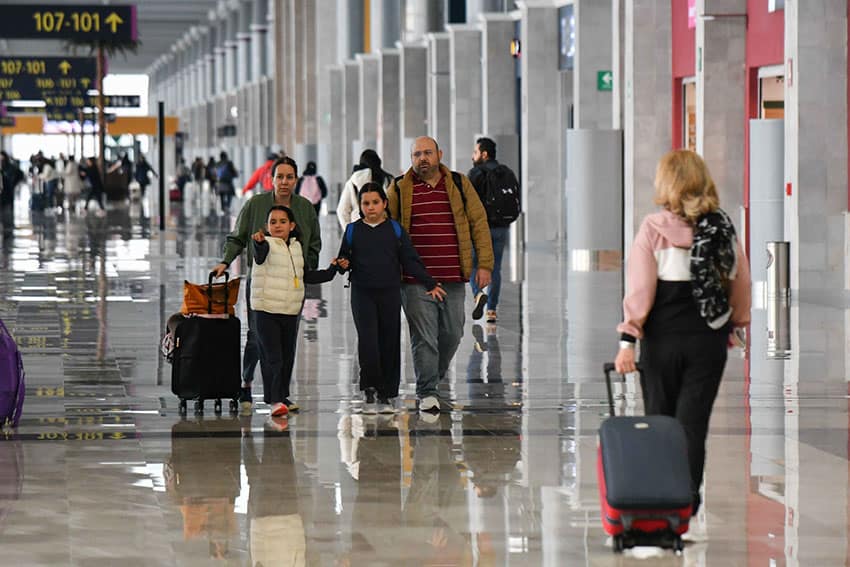
The new rail line will connect Pachuca, the capital of Hidalgo, with the México state airport AIFA. (Mario Jasso/Cuartoscuro)
The Felipe Ángeles International Airport (AIFA) outside of Mexico City will no longer receive government subsidies to cover operational costs, President Andrés Manuel López Obrador said Tuesday.
“It already has a lot of air traffic — both passengers and cargo. It is already the airport with the most cargo movement in the country,” López Obrador said at his morning press conference. “All this has allowed it to have income to finance its operation with a little profit in a very short time.”
Although Felipe Ángeles (AIFA) struggled in its first year, 18 airlines now operate passenger flights in and out of the México state airport. (File photo by Mario Jasso/Cuartoscuro)
Located 35 kilometers north of Mexico City in México state, AIFA opened in March 2022 and experienced heavy losses in year one before its recent climb in usage. An emblematic work of López Obrador’s presidency, the airport has been run and managed by the Defense Ministry (Sedena).
In its first year of operation, AIFA had losses in the millions — expenses that were nine times higher than revenue — and transported over 1 million fewer passengers than the 2.4 million the National Transparency Platform had projected. As a result, AIFA’s government subsidies had to be tripled in 2022, the newspaper El Financiero reported.
Last week, however, it was reported that AIFA saw a 78 million pesos (US $4.6 million) profit in 2024’s first quarter, thanks to revenues of 490 million pesos and operating expenses of only 412 million pesos.
Slightly more than 1 million people used the airport during 2024’s first three months, an 82% increase over the same period in 2023, according to the report from the Federal Civil Aviation Agency (AFAC). That works out to approximately 11,000 AIFA users per day.
The reason for the increase, according to AFAC, is simple: more airlines, a greater frequency of flights and a larger list of destinations.
One success story at AIFA, according to Mexico’s civil aviation agency, is the newly revived Mexicana Airlines, now run by the Defense Ministry. The airline saw a 39.6% increase in passengers carried to and from AIFA between February and March. (Omar Martínez/Cuartoscuro)
Also, the previously defunct private airline Mexicana, whose brand name was purchased by Lopez Obrador’s government and brought back into operation by the Defense Ministry in December 2023, offers flights to 18 destinations in Mexico from AIFA. According to the newspaper Milenio, it is looking to buy new planes.
In March, Mexicana transported 24,140 passengers to and from AIFA, an increase of 39.6% over the previous month, AFAC noted.
At his press conference, AMLO was asked if government subsidies for AIFA would still be given. “Not for [its] operation,” he replied.
Though critics say the two-year-old airport is too remote from Mexico City and requires a journey from the capital that can exceed one hour, López Obrador said the facility is located “strategically” and offers flights “to any point in the country without the need to enter Mexico City.”
He also noted that AIFA traffic is likely to increase even more because the Interurban Train will be inaugurated in July. It can take travelers from the Buenavista commuter railway station in central Mexico City to AIFA, reportedly in 45 minutes, although some sources remain skeptical about that time estimate.
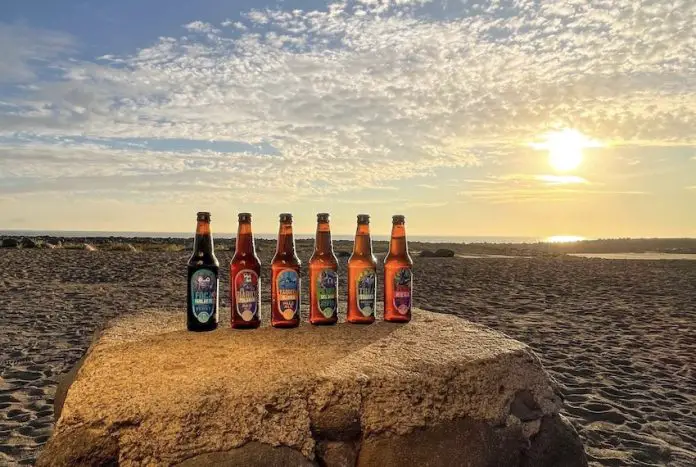
Ensenada-based Cervecería Wendlandt took home two awards at the 2024 World Beer Cup. (@cerveceriaw/Instagram)
Mexico in 2024 had its best year ever at the world’s “most prestigious” beer competition, with breweries in Hermosillo, Querétaro and Ensenada winning a total of four awards including two golds.
The World Beer Cup, a United States Brewers Association event which promotes itself as “the most prestigious beer competition in the world,” was held last week in Las Vegas.
Judges tasted beers across a total of 110 categories, including ones for American wheat beer, German-style pilsener, Belgian-style sour ale, English mild or bitter, robust porter, and even gluten-free beer and non-alcoholic beer.
Cervezas mexicanas came out on top in the German-style kölsch and export stout categories, and took the silver awards in the American-style pale ale and American-style black ale or American-style stout categories.
It was the first time ever that two Mexican breweries won gold at the same edition of the World Beer Cup, which was first held in 1996.
Over 2,000 breweries from 50 countries entered 9,300 beers in this year’s competition. A total of 280 judges from 37 countries including Mexico tasted the beers.
The winning beers were selected by 280 experts from around the world. (World Beer Cup/Facebook)
Without further ado, here are the Mexican breweries and beers that won awards at the 2024 World Beer cup, which is also known as “the Olympics of beer competitions.”
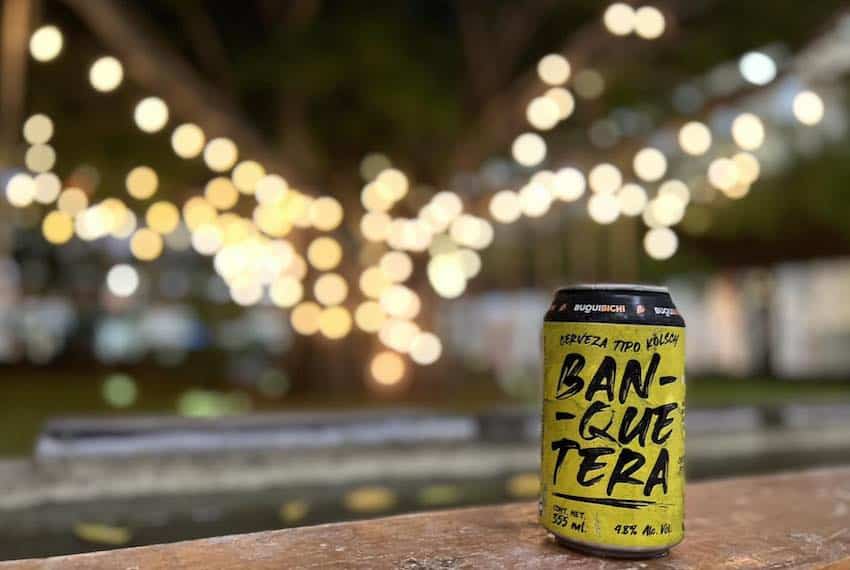
Buqui Bichi Brewing takes the gold for its German-style kölsch
Located in Hermosillo, Sonora, this brewery‘s German-style kölsch was deemed the best among 151 entries.
Called Banquetera, the 4.8% ABV brew is described as “light” and “refreshing” by Buqui Bichi Brewing.
Buqui Bichi Brewing’s Banquetera beer got the gold in the German-Style Koelsch category. (Buqui Bichi Brewing/Facebook)
Ramón Osuna, a founding partner of the brewery, attributed the win at the World Beer Cup to the dedication of Buqui Bichi’s team to improve every day.
“After winning the prize for the best brewery in the country at the Copa Cerveza México, our next objective was to win an award at the World Beer Cup. With this gold award for our kölsch, Banquetera, we’ve managed to achieve this goal. As a Sonoran and Mexican company we are very proud,” he said.
In a tongue-in-cheek comment on its website, Buqui Bichi says that “a few Banqueteras is the best therapy for this life.”
The beer’s name is a derivative of banqueta, the Spanish word for sidewalk.
The brewery recommends drinking a Banquetera on the sidewalk with friends while sharing “life’s best stories.”
Compañia Cervecera Hércules wins gold for its export stout
Querétaro city’s Hércules also won a gold award, taking the top prize in the export stout category for its 7.5% Irish export stout Pueblito. There were a total of 45 entries in the category.
The recognition shows “we’re on the right path,” said head brewer Josh Brengle, who last year spoke to Mexico News Daily about the beers he and his team make at Hércules.
According to the brewery, Pueblito is an “extremely dark” beer with “predominantly toasted notes” reminiscent of coffee and dark chocolate.
Querétaro-based brewery Hércules was another gold medal winner, taking home the top prize for its Irish export stout, Pueblito. (Compañía Cervecera Hércules/Instagram)
It is a “robust, complex and elegant beer of Irish origin that now feels 100% queretana,” Hércules says.
At the 2022 edition of the World Beer Cup, the brewery’s “summer ale” Caballo Blanco was awarded bronze in the English ale category.
Cervecería Wendlandt takes silver for its American-style pale ale and stout
“We’re full of happiness and pride at being the first Mexican craft brewery to take home two awards at the same edition of the World Beer Cup,” the brewery said in a post to Instagram.
Morelos Attorney General Uriel Carmona visited the retired bishop at the hospital in Cuernavaca, where he remained unconscious as of Tuesday morning. (Fiscalía de Justicia de Morelos/Cuartoscuro)
A retired Roman Catholic bishop who was well-known for his willingness to engage with criminal groups was allegedly drugged and kidnapped on Saturday and is now recovering in a hospital in Cuernavaca.
Morelos Attorney General Uriel Carmona said that Salvador Rangel Mendoza, former bishop of the Chilapa-Chilpancingo diocese in the state of Guerrero, may have been a victim of an “express kidnapping” given that a number of withdrawals were made from his bank account.
He was allegedly abducted after leaving his home near Cuernavaca in his vehicle on Saturday morning. His SUV was allegedly stolen by unidentified criminals.
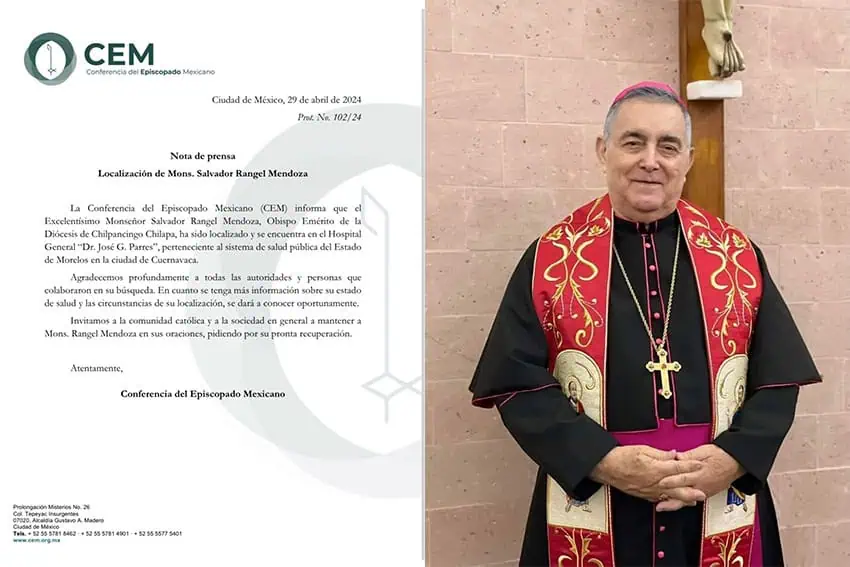
The Mexican Episcopal Conference (CEM) said in a statement on Monday afternoon that Rangel, 78, had been missing since Saturday, but it later came to light that the retired bishop had in fact been in hospital since Sunday.
The CEM called on federal, state and municipal authorities to work together to bring the retired bishop home “safe and sound.”
It also called on “those who keep Monsignor Rangel Mendoza in captivity” to allow him to take “the medications he requires for his well-being.”
The church association CEM announced Monday evening that Rangel had been located. (Twitter)
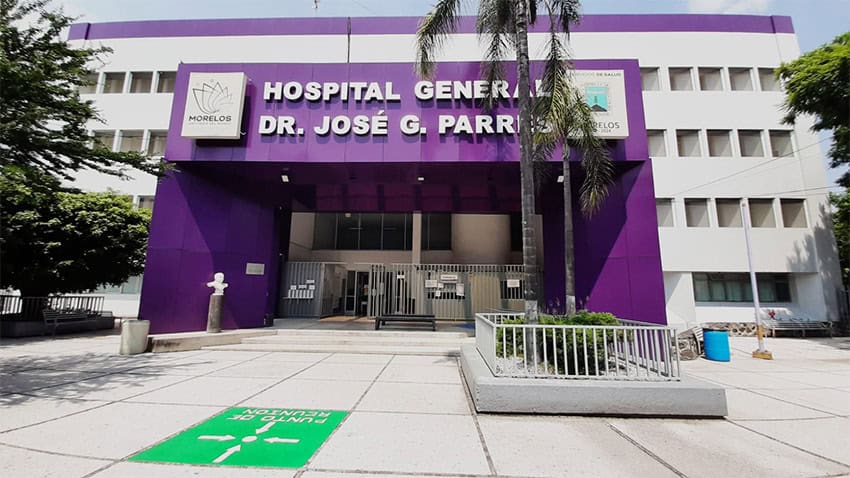
In a statement published on Monday evening, the bishops’ association said that Rangel had been located and was in the Dr. José G. Parres General Hospital in Cuernavaca, the capital of Morelos. The retired bishop lives in the neighboring municipality of Jiutepec.
According to Pedro Martínez Bello, a lawyer for Rangel, hospital staff realized they were treating the retired bishop after the CEM released its initial statement. The Morelos Health Ministry said in a statement on Monday that Rangel was admitted to hospital on Sunday night.
On Monday night, Rangel left the General Hospital and was taken to a private hospital, according to the Health Ministry.
Martínez told reporters on Tuesday morning that Rangel is “well, but not conscious.”
The retired bishop is expected to talk to authorities and make a formal criminal complaint when he is in a condition to do so.
Martínez asserted that his client was drugged during his kidnapping ordeal, and noted that his doctor said it could take him another three days to recover.
He said that Rangel was located at approximately 5 p.m. Sunday in Ocotopec, a community in the municipality of Cuernavaca. Security sources cited by the La Jornada newspaper said he was found lying on the street and that it appeared he had been beaten.
At Dr. José G. Parres General Hospital in Cuernavaca, staff realized their John Doe patient was Salvador Rangel after hearing of the retired bishop’s disappearance. (Gobierno de Morelos)
However, Martínez said Tuesday that Rangel did not have any serious injuries. He noted that his client suffers from high blood pressure and has a pacemaker. He also said it was unclear how he got to the hospital on Sunday night.
“We don’t know how he arrived, or whether it was a citizen who put him in an ambulance. … He arrived [at the hospital] as an unknown person,” Martínez said.
The lawyer said that people close to the retired bishop realized something was wrong when they became aware that money had been withdrawn from Rangel’s account from different locations in Cuernavaca.
The lawyer said that the retired bishop left his mobile telephones at his home when he went out on Saturday morning, indicating that he planned to return soon. It appears that people close to the bishop became aware of withdrawals and purchases with Rangel’s cards when they saw bank messages on his phones.
Rangel, who retired in 2022, was an outspoken bishop and became famous for engaging with instigators of violence and seeking truces between feuding cartels in Guerrero. Earlier this year, President Andrés Manuel López Obrador endorsed the efforts of bishops and priests to pacify Mexico via dialogue with criminals.
López Obrador, seen here giving a speech after his landslide victory in 2018, has embodied a populist anti-globalization narrative. But analyst Luis Rubio argues that Mexico needs to continue to embrace globalization to prosper. (Cuartoscuro)
The advent of populist movements, from the left and the right, has been accompanied by a rejection of globalization and a systematic call for the reappearance of an all-powerful government, aimed at correcting the ills that afflict humanity.
This populist narrative does not deny the extraordinary progress in terms of prosperity and poverty reduction that has characterized the world in recent decades, but it argues that “savage” or unfettered capitalism has caused extreme income inequality, benefiting mainly the rich.
The narrative is appealing, but it has served less to improve the welfare of the population than to consolidate new interests in power. This poses a clear dilemma in the context of electing Mexico’s next president: Closing the country’s doors to the world, or finding ways for the entire population to reap the benefits of the enormous opportunities that come with proximity to our two northern neighbors.
The economic liberalization that Mexico embarked on since the 1980s was little more than an acceptance that global technological change opened opportunities the country couldn’t seize without significantly changing its economic strategy and institutional framework. Today, the Mexican economy is much larger and more productive than it was half a century ago, and citizens enjoy political freedoms previously unimaginable.
The election of a new president, regardless of the winner, will determine the state’s willingness to chart a course that allows the entire population to live in an environment of security and certainty, or to persist in the institutional and economic destruction initiated by the outgoing government of President Andrés Manuel López Obrador.
The key point for those seeking progress for Mexico has to be accepting that globalization is an inexorable reality that has been extraordinarily beneficial for the country. The ills often associated with it — such as violence, inequality and poor-quality education — have been the result of what has not been done. The country can only attempt to isolate itself from globalization if it is willing to pay the price in terms of low growth, increased poverty and more inequality, losing out on the technological change upon which future progress depends.
The outgoing administration has attempted to play two contradictory games. On the one hand, it has allowed the continuation of integration with our northern neighbors, but did nothing to improve infrastructure or opportunities for the population to participate in that economic space. On the other hand, the administration has undermined the country’s security, hindered the development of energy capacity and created an environment of enormous uncertainty regarding the future, including the conditions necessary for the USMCA to continue after the review in 2026.
All of this calls into question the sustainability of current sources of growth. The winner of the election in June will have to define policy on this matter immediately.
Nations that, in recent decades, chose to face up to these challenges share very similar characteristics: They focused on improving the quality of their educational systems, built the necessary infrastructure and modified legislation to facilitate the transition of their economies. Above all, they changed their way of understanding development and embarked on a crusade to ensure that all of society could join the process.
By observing nations that thrive and those that lag behind, the path is evident. The successful countries embraced globalization and continue to do so, in parallel with adjusting and adapting their strategies and policies to ensure that their populations have access to every possible opportunity.
Mexico has followed a less consistent and more uncertain path. While there was a clear and consistent vision in the first iteration of Mexican reforms in the 1980s and 90s, the truth is that this did not last long. The liberalization of the economy was inconsistent with the way companies and banks were privatized, and many of the reforms, especially those undertaken in the previous administration of Enrique Peña Nieto (extraordinarily ambitious in themselves), were executed in such a way that they never gained legitimacy, and were therefore politically vulnerable.
The crucial point is that Mexico has spent decades pretending to reform when, in reality, it has only adapted at the lowest possible cost, preventing more successful and attractive results from being achieved for the population. That is the real dilemma for the next government.
Mexico has not embraced the need to be successful, has not accepted the imperative (and inevitable) nature of the new reality, all of which has made possible the attacks the country is now experiencing against its own future.
Globalization has not ceased to exist; the question is whether Mexico will eventually make it its own, or continue to pretend that its economic and political impoverishment is merely a matter of chance.
Luis Rubio is the president of México Evalúa-CIDAC and former president of the Mexican Council on International Affairs (COMEXI). He is a prolific columnist on international relations and on politics and the economy, writing weekly for Reforma newspaper, and regularly for The Washington Post, The Wall Street Journal and The Financial Times.
Disclaimer: The views expressed in this article are solely those of the author and do not necessarily reflect the views of Mexico News Daily, its owner or its employees.
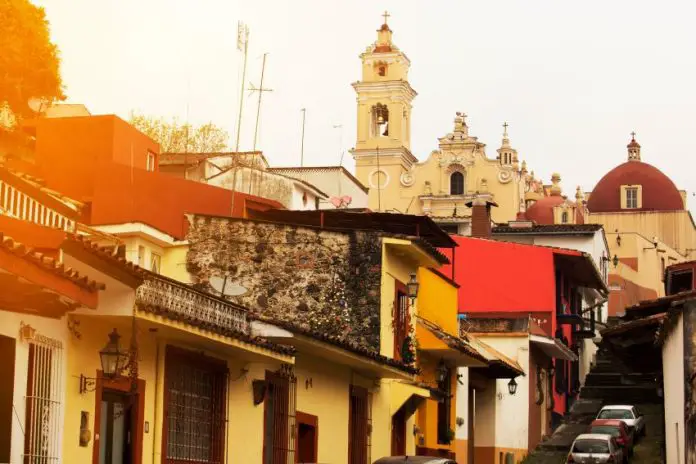
Ulysses S. Grant called Xalapa "decidedly the most beautiful place I ever saw in my life." It's not hard to see why. (Matt Gush/Shutterstock)
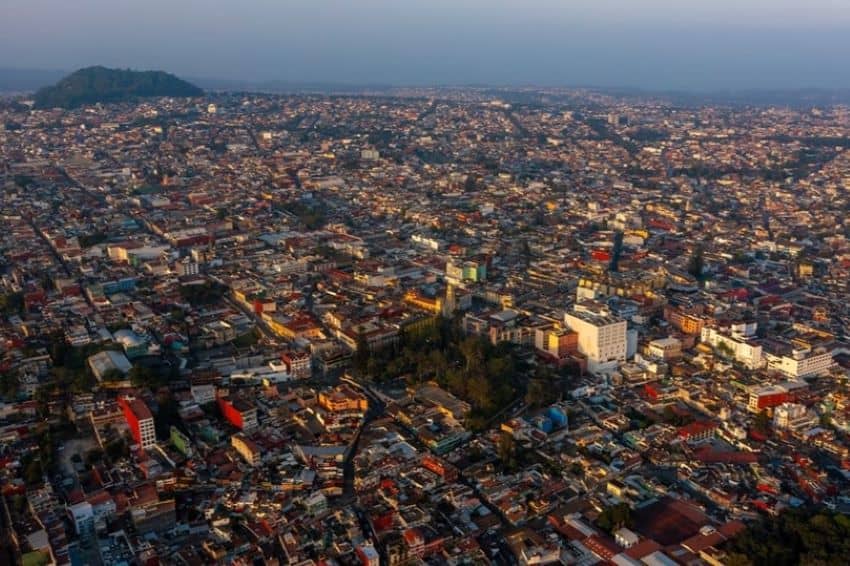
Despite its volcanic mountain ranges, virgin beaches, cloud forests, coastal sand dunes, tropical savanna, and a seemingly unending list of nearby ecological features, this college town that was once dubbed the “Athens of Veracruz” is barely on the map from an international tourist perspective. Former U.S. president and commander of the Union Army Ulysses S. Grant once referred to this town as “decidedly the most beautiful place I ever saw in my life” and its climate as “the best in the world.”
We’re talking about the birthplace of the king of peppers — the mighty jalapeño — Mexico’s hidden gem, Xalapa! There’s a sense of kinetic energy as you stroll the downtown colonial streets, with the scent of locally grown coffee pulling you up, down and around this mountainous city.
Between the coffee, chile peppers, and centuries of history, Xalapa has played an important role in the development of Mexican culture. (Ayuntamiento de Xalapa)
I’d like to share why this place has captured so many people’s imagination, including my own.
Start your morning with the famous latte-like lechero from La Parroquia, sure to warm you up on a foggy xalapeño morning. When walking through Xalapa’s streets, you’re treading on cobblestone streets steeped in history.
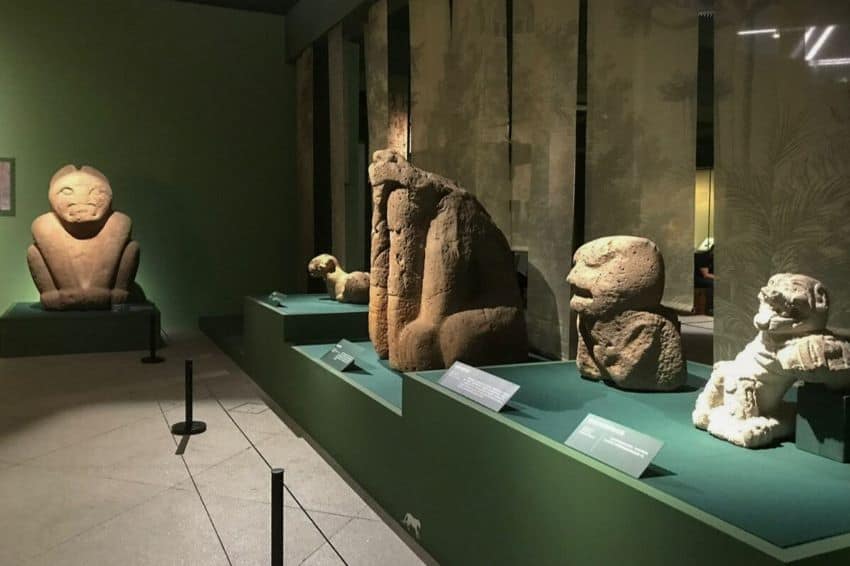
The city’s heart beats around the Anthropology Museum, home to some of the world’s most significant pre-Hispanic Olmec artifacts. These colossal stone heads, mysterious in their origin and awe-inspiring in their execution, are only the beginning of what’s on offer here.
Xalapa is a place where history isn’t just stored behind museum glass but is lived in the festivals and markets, in the music that spills from the local jazz university’s windows and in the stories locals are more than willing to share if you ask.
The Anthropology Museum is a hub for the city and showcases the long and rich cultural history of Veracruz. (Museo de Antropología de Xalapa)
Who’s hungry? Xalapa’s culinary scene mirrors its cultural diversity. Here, food is a narrative of Indigenous roots and Spanish influence, all served with a side of fresh, locally grown ingredients. You might find yourself savoring a breakfast of antojitos (literally “cravings”) at Cerro Gordo just outside of town. Their wood-fired tortillas make for the most flavor-packed enchiladas you can find anywhere — thank me later.
Or try some huachinango a la Veracruzana — red snapper, Veracruz style — at La Perla oyster bar. This dish features a whole snapper cooked in a sauce made from tomatoes, capers, olives, and herbs. It’s a testament to the Spanish influence on the region’s cuisine.
Another must-try is mole xiqueño. Coming from the Pueblo Mágico of Xico, a town near Xalapa, this variation of mole is less known than its Oaxacan cousin, but highly cherished in the region. It’s made with a variety of chiles, seeds, nuts, chocolate and spices, offering a complex and slightly sweeter flavor profile than most moles.
Xalapa’s natural surroundings could fill the pages of a nature journal with tales of misty walks through lush cloud forests that cling to the slopes of nearby mountains. These forests, shrouded in perpetual fog, create an almost mythical setting where epiphytes hang from every tree and the air is perpetually cool and moist.
The nearby Pueblo Mágico of Xico combines dazzling nature and an inventive twist on classic mole. (Gobierno de México)
It’s a stark contrast to the tropical imagery often associated with Mexico, offering a haven for those who find solace in the quietude and greenery. Don’t miss the Clavijero Botanical Garden; it’s on the way to the neighboring coffee capital Coatepec, a town that is also a must-see.
Looking for a unique night out in Xalapa? A few miles past the botanical garden is restaurant Futuro Primitivo, found on the second level of a reclaimed quicklime factory. While you’re there, stop by Calera, a powerhouse of a restaurant whose sole cooking fuel is wood. It perfectly combines traditional methods with new and locally inspired flavors. Head over to their disco floor, with a rotating roster of live DJs, to dance off the hearty meal you just devoured, and enjoy a cocktail or two.
Another excellent option if you’re staying downtown, is Mexican wrestling-themed restaurant and bar Doña Lucha, which is is always full an eclectic mix of college students and regulars. Order the sharing-sized cazuela de mezcal, served in a glorious clay jar with no pretense, just pure, unadulterated enjoyment.
Xalapa’s Futuro Primitivo offers incredible local cuisine and great mezcal. (Futuro Primitivo/Facebook)
Perhaps the most compelling reason to visit Xalapa is its people. Xalapeños are known for their warmth and hospitality and for their willingness to share a piece of their world with you. In this city, you’re not just a spectator; you’re a guest. You might find yourself drawn into a discussion over a game of chess in the beautiful Parque Juárez that overlooks the urban hillside or offered a taste of something unfamiliar and delightful at the local Mercado Jáuregui.
Xalapa doesn’t clamor for attention or have the polished grandeur of bigger tourist spots. Instead, it offers a chance to dive into an experience that feels more intimate — a slower pace of discovery that’s spiced just right, not unlike their famed jalapeños. Here, every corner offers a story, and every meal is a conversation.
So, why visit Xalapa? Because in the quiet moments between the bites and beats, you’ll find something unexpectedly profound. This is a city for those who travel not just to see but to understand, to immerse themselves in a place’s essence.
Dare to venture off the beaten path, make a visit and get wrapped in the feeling of discovery — like the surrounding mountains wrap this hidden gem of a place called Xalapa.
Stephen Randall has lived in Mexico since 2018 by way of Kentucky, and before that, Germany. He’s an enthusiastic amateur chef who takes inspiration from many different cuisines, with favorites including Mexican and Mediterranean.
Is this drink a "rusa" or a "suero"? The answer, as always, depends on where you are in Mexico. (Keesha's Kitchen/Unsplash)
As you may know, Mexicans are fond of limes and the citrus fruit is used extensively in many dishes and drinks throughout the country. Previously on MND, we discussed what is perhaps the most famous lime-based drink in Mexico, the michelada. Today, it’s time to talk about another very popular drink made with lime: the “rusa” or “suero.”
What is a rusa (or suero)?
This drink is one of the most refreshing alternatives to alcohol (as it’s made with lots of ice) and is perfect if you don’t want to drink, or are recovering from a hangover. A suero is essentially three ingredients: sparkling water, lime and salt. This combination also makes it a perfect hangover remedy — its hydrating properties combat dehydration and help relieve stomach upsets and nausea. Moreover, lime is a good source of vitamin C. Since salt helps retain liquids, the suero will also assist in maintaining fluids in your body, which is ideal for a hangover.
Meet the popular drink made with lemon, salt and mineral eater: the “rusa” or “suero.” (OpenAI)
Furthermore, according to the Cleveland Clinic, this combination of ingredients will alleviate a sore throat, promote optimal digestion and aid in protecting against mouth ulcers and other diseases. Drinking mineral water with salt enables us to replenish the electrolytes we lose throughout the day.
This drink tastes delightful, and honestly, it feels like heaven on a hot day, thanks to the super cold temperature at which it is typically served.
As a tip, many restaurants may not have it on their menu, but you can typically request it as it is super easy to prepare. Just ask for mineral water with lemon and salt, and it will be served!
Do I call it rusa or suero?
As with the michelada (also called chelada in some parts of Mexico), the name rusa or suero depends on where in the country you are.
The suero is one of Mexico’s most popular hangover cures. (OpenAIx).
Suero
This drink is called a “suero” in places like Mexico City and its surrounding areas such as México state, Puebla, Tlaxcala, etc. In this region, some people also refer to it as “Tehuacán preparado” (Tehuacán used to be a popular brand of mineral water), but it is largely known as “suero.”
Some popular sports drinks, such as Electrolit or Suerox are often known as sueros as well. These are available from most stores and pharmacies, but often come in a variety of flavors, not just lime.
Rusa
In places like Guadalajara, Veracruz and the northern part of Mexico, lime juice, mineral water and salt is called “rusa.” People sometimes add Squirt soda and tequila in Guadalajara.
In Zacatecas, people refer to suero as “agua loca” (crazy water).
Ana Paula de la Torre is a Mexican journalist and collaborator for various outlets including Milenio, Animal Político, Vice, Newsweek en Español, Televisa and Mexico News Daily.
Actors Ryan Reynolds and Rob McElhenney have bought a stake in the Club Necaxa soccer team, seen here in July last year. (Cuartoscuro)
Which Major League Baseball teams played in Mexico City over the weekend? Which star Mexican soccer player is possibly moving from Europe to the U.S.? Get caught up on the weekend in sports news in Mexico with this roundup.
Ryan Reynolds and Rob McElhenney buy stake in Mexican soccer team
U.S.-based actors Ryan Reynolds and Rob McElhenney have received a lot of publicity for buying a low-level pro soccer team in Wales and trying to get it promoted to the third tier of English soccer.
Their endeavor even generated a popular TV docu-series on FX titled “Welcome to Wrexham,” winner of multiple Emmy Awards.
Welcome To Wrexham | Season 3 Trailer
Now that the two celebrities have bought a stake in Mexico’s Club Necaxa, will a series titled “Welcome to Aguascalientes” be in the offing?
Probably not.
Club Necaxa already plays in Mexico’s top professional league, Liga MX, and even though it could be considered an underdog — three titles in 78 years, none since 1998 — it doesn’t offer the same drama of a well-loved, small-town team looking to move up from the fourth division.
Wrexham has a population of 135,000 and a soccer stadium that has been hosting matches for 147 years — whereas the city of Aguascalientes has a population of 950,000 and Victoria Stadium, considered the first modern stadium in Mexico when it opened in 2003.
News of the Reynolds’ and McElhenney’s Necaxa purchase first came from Variety, which noted that while the size of the stake is “unclear,” it is a “minority interest” of “significant” size.
Reynolds, 47, has starred in a range of films, including the highly successful action-comedy “Deadpool” in 2016, and he was named People’s Sexiest Man Alive in 2010. McElhenney, also 47, is known for his work on the TV comedy “It’s Always Sunny in Philadelphia.”
Actress Eva Longoria is another celebrity co-owner and investor in CF Necaxa. (Club Necaxa/X)
Club Necaxa, which was founded in 1923, also counts actress Eva Longoria among its investor-owners. NX Football USA — a group that includes Longoria, Major League Baseball star Justin Verlander, model Kate Upton and NFL player Odell Beckham Jr. — has owned about 50% of the team since 2021.
Reynolds and McElhenney and the other owners will work to enhance Club Necaxa’s standing and grow its profile in a league dominated by popular teams such as Club América and Cruz Azul in Mexico City, Chivas de Guadalajara, Monterrey and Tigres UANL of Monterrey.
Liga MX plays two seasons each calendar year, and one just came to a conclusion. Necaxa (pronounced ne-cox-suh) finished in a tie for eighth with 7 wins, 6 ties and 4 losses — good enough to qualify for the play-in round of the playoffs. Necaxa will play Querétaro on Thursday.
Coming into this season, Necaxa’s record in the 2020s of 36 wins, 29 ties and 74 losses included two last-place finishes and one second-to-last.
According to Transfermarkt.com, the value of the franchise is US $34.3 million, although Sportico.com places its value “in the mid- to low-$200 million range.”
Major League Baseball back in CDMX
The Houston Astros swept two games from the Colorado Rockies at Alfredo Harp Helú Stadium in the MLB World Tour: Mexico City Series.
The Astros won 12-4 on Saturday in front of a crowd of 19,934 and 8-2 on Sunday with 19,841 fans on hand.
The Houston Astros faced off against the Colorado Rockies at the Alfredo Harp Helú stadium in Mexico City over the weekend. (Screen capture)
The 5-year-old ballpark, home to the Mexico City Diablos Rojos of the Mexican League (LMB), has a capacity of 20,062.
The Astros entered the series on a five-game losing streak and were off to their worst start since 1969 with a 7-19 record. But playing at a high altitude helped them hit six home runs in the series, including two each by Kyle Tucker and Cuban native Yordan Álvarez.
The struggling Rockies, who hit only one home run, have now dropped 11 of their last 14 games.
The stadium is situated 2,239 meters (7,349 feet) above sea level, more than 2,000 feet higher than MLB’s highest-elevation stadium, Coors Field in Denver. Batted balls sail further in a higher atmosphere with less air resistance.
When Major League Baseball made its debut in Mexico City last year, the San Diego Padres pounded the San Francisco Giants 16-11 in a game that featured 11 home runs.
In late March, the New York Yankees played the Diablos Rojos in a pair of exhibition games at Harp Helú Stadium. Mexico City won 4-3 and 2-0, although the Yankees had left most of their star players back in Florida for spring training.
President López Obrador, an ardent baseball fan, posted photos with management of both the Houston Astros and Colorado Rockies to his X account. (López Obrador/X)
The Astros seemed to benefit from the support of the crowd in Mexico City. Even though the Rockies were designated to be the home team, many fans were wearing Astros colors.
“We did not feel like the visiting team,” said Astros manager Joe Espada. “There was a tremendous passion and energy in the stadium, and it really felt like home.”
Baseball in Querétaro and San Diego FC courts Hirving Lozano
Baseball fans in Querétaro are aflutter: their city has an expansion team in the LMB (Liga Mexicana de Béisbol) this season. One problem: The new stadium wasn’t ready for their home opener on April 16. So the Querétaro Conspiradores played their first “home series” in Puebla, then finally opened at their real home last Friday, drawing a crowd of 4,100 in a 14-5 win over the Yucatán Leones.
Finsus Stadium, which isn’t yet a finished product, is located in a countryside setting in the municipality of Huimilpan — a fan-unfriendly 40-minute drive from downtown Querétaro. When finished, it will have a capacity of 6,500 for baseball.
The Athletic is reporting that the MLS expansion team San Diego FC is in “advanced talks” to sign Mexican national team star Hirving “Chucky” Lozano away from his team in Europe, PSV Eindhoven in the Netherlands. San Diego, which will enter MLS in 2025 and would love a marquee player like the 28-year-old Lozano, would pay a transfer fee of around US $12 million to the Dutch club, The Athletic added.
Traffic cameras show northbound commercial traffic at a standstill at the Ysleta-Zaragoza port of entry on Monday afternoon. (City of El Paso)
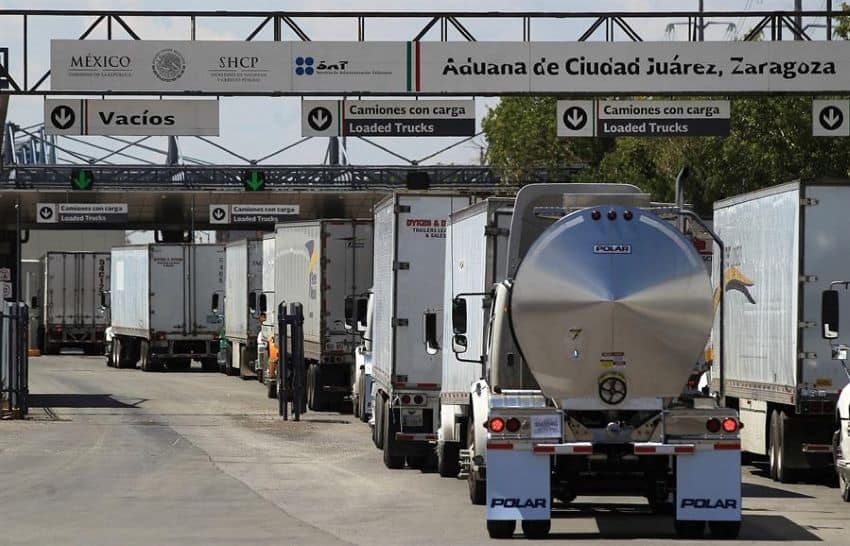
Trucks are facing long delays at the northern border with Texas after authorities in the Lone Star state once again ramped up inspections of commercial vehicles.
Since Saturday, the Texas Department of Public Safety (DPS) has been stopping and inspecting all cargo trucks entering the state via the Ysleta–Zaragoza International Bridge between Ciudad Juárez, Chihuahua, and El Paso, Texas, according to the news website Freight Waves.
The news outlet Border Report said Monday that trucks are waiting eight hours or more to enter the United States at the Ysleta port of entry due to “enhanced inspections of commercial vehicles.” The usual wait time is about one hour, according to the U.S. Customs and Border Protection (CBP) website.
Both Freight Waves and Border Report cited a message sent by CBP to the trade community advising stakeholders of the DPS inspections. The Texas government has conducted stringent inspections of northbound trucks at certain times in recent years, ostensibly to combat the entry of undocumented migrants and narcotics.
The inspections — which are in addition to checks carried out by United States federal agencies — are seen as a way to pressure U.S. and Mexican authorities to increase enforcement against migrants. Texas Governor Greg Abbott is an outspoken critic of United States President Joe Biden and what he characterizes as weak and ineffective U.S. government policies at the border.
As of late Monday afternoon, the DPS had not made a public announcement about the inspections that began on Saturday.
Increased cargo inspections at border crossings from Mexico into Texas also caused backlogs in October 2023. (Comentario U de C/X)
The current operation “may expand to other El Paso [port of entry] cargo facilities and will affect wait times and the flow of commercial vehicles making entry into the U.S.,” Fernando Thome, a CBP official in El Paso, said in an e-mail to the trade community. “The duration of these enhanced inspections by DPS is unknown.”
The current DPS operation commenced after large numbers of migrants began arriving in Ciudad Juárez, according to Border Report.
“Some of those migrants have been coming across the Rio Grande into El Paso, walking several miles along the levee to skirt the Texas Army National Guard and razor wire in place there,” the website reported.
The Texas National Guard reinforces barriers razor wire barriers, part of a strategy designed by Texas Governor Greg Abbott. (Gov. Greg Abbott/X)
“You can imagine what it is to be a supply chain manager when something like this happens. It just creates major havoc in the entire supply chain,” Jerry Pacheco, president and CEO of the New Mexico-based Border Industrial Association, told Border Report.
“The worst thing is it’s uncertain when it’s going to end. You can’t even plan for this. It completely disrupts our cross-border trade,” said Pacheco, whose organization is based just west of El Paso in Santa Teresa.
“Whenever Texas DPS has done this, they never found anything substantial on trucks coming across the border,” he added.
In light of the inspections at the Ysleta port of entry, CBP has expanded inspection hours at two other crossings — the Santa Teresa port of entry and the Marcelino Serna port of entry between the municipality of Guadalupe in Chihuahua and Tornillo, Texas.
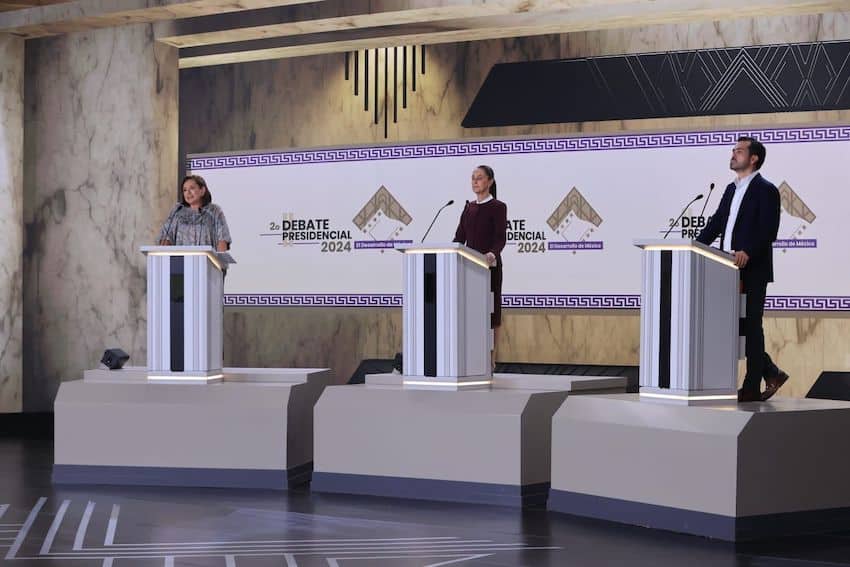
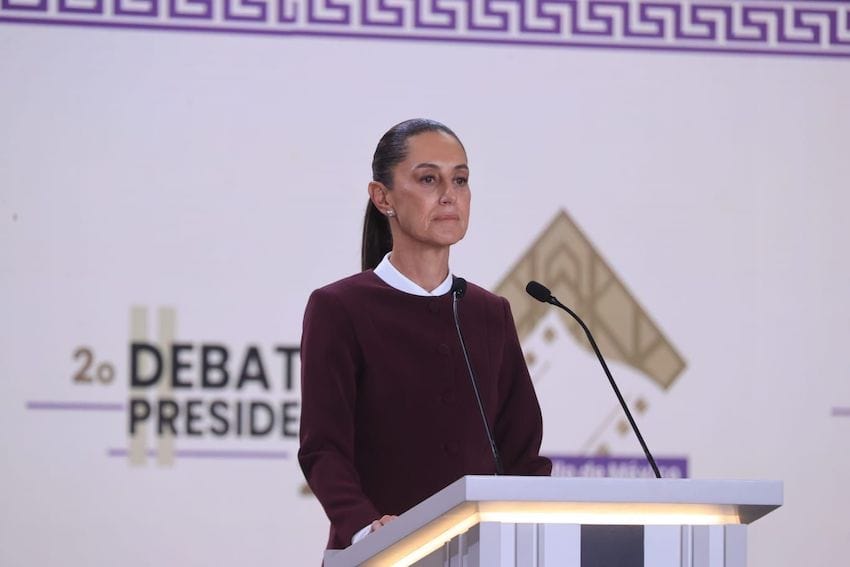
Xóchitl Gálvez, Claudia Sheinbaum and Jorge Álvarez Máynez tackled economic and energy issues at Mexico's second presidential debate on Sunday. (GRACIELA LÓPEZ /CUARTOSCURO.COM)
Economic growth, employment and inflation. Poverty and inequality. Infrastructure and development. Climate change and sustainable development.
They were the four designated topics at Mexico’s second presidential debate on Sunday night, but personal attacks and accusations of corruption were also a prominent aspect of the encounter between the three candidates five weeks ahead of the June 2 election.
Xóchitl Gálvez, candidate for a three-party opposition bloc, went on the offensive early, accusing front-runner and ruling party aspirant Claudia Sheinbaum of being the candidate for a “narco-party” and repeatedly referring to her as “the candidate of lies.”
Sheinbaum, who is aiming to perpetuate the so-called “fourth transformation” of Mexico initiated by her political mentor President Andrés Manuel López Obrador, dubbed her rival “la corrupta” (the corrupt one) and frequently highlighted that she represents parties that were previously in power and therefore stands for an “old” economic model “that already failed.”
The third candidate, Jorge Álvarez Máynez of the minor Citizens Movement party, stayed above the fray more than his two rivals, although he too launched a number of verbal attacks, more of which were directed at Gálvez.
During a two-hour debate in Mexico City, the aspirants were tasked with responding to questions from citizens. The format also allowed the candidates to directly interact with each other to a greater extent than was possible in the first debate.
The format of the second presidential debate allowed more interaction between candidates than in the first debate. (INE/Cuartoscuro)
Economic issues are front and center in the lead-up to the June 2 elections, in which Mexicans will not only elect a new president but also thousands of municipal, state and federal representatives.
Gálvez: Candidate for the National Action Party (PAN), the Institutional Revolutionary Party (PRI) and the Democratic Revolution Party (PRD)
The opposition bloc candidate highlighted that prices for a range of basic products such as tortillas and eggs have increased significantly during the current government, and emphasized that many Mexicans are unable to make ends meet.
“The main economic problem for Mexicans is extortion,” she said, claiming that criminals cause prices to rise by demanding regular payments from businesses across a range of different sectors.
“The criminals already have a party. Morena has become a narco-party,” Gálvez said.
Presidential candidate Xóchitl Gálvez, representing the PAN-PRI-PRD coalition, arrives at Estudios Churubusco, where the second presidential debate was held. (Graciela López/Cuartoscuro)
“… Morena abandoned you by not combating crime. So that prices of products go down, I’m going to punish the criminals, extortion will end,” she said.
The candidate also said that a government she leads will get to “work so that you have a good job.”
In addition, it will “take advantage of the relocation of companies,” Gálvez said, referring to the growing nearshoring trend.
Among the candidate’s specific economic proposals was one to eliminate income tax for workers who earn less that 15,000 pesos (US $880) per month, a measure she said would benefit 20 million Mexicans.
Gálvez also pledged to create a government institute that will provide loans to entrepreneurs.
“We’re going to support you with cheap credit, with training. Of the three of us, the only one who knows how to create jobs is me,” said the tech entrepreneur turned politician.
Sheinbaum: candidate for the National Regeneration Movement (Morena), the Labor Party (PT) and the Ecological Green Party of Mexico (PVEM)
The Morena candidate spent considerable time defending the economic record of the current government, highlighting that the economy has grown at a faster rate than during the so-called “neoliberal” period and that the minimum wage has more than doubled.
“These are not words nor lies, they are facts,” Sheinbaum said.
Claudia Sheinbaum touted López Obrador’s minimum wage increases as an example of the ruling party’s economic record. (INE/Cuartoscuro)
The former Mexico City mayor acknowledged that there is still work to do, and committed to closing the salary gap between men and women, making additional increases to the minimum wage and building 100 industrial parks in order to capitalize on the nearshoring phenomenon.
The leading contender said that her main rival “has accepted that she is the candidate of the PRI and the PAN, of the old model, of the past, of the neoliberalism that already failed.”
For her part, Sheinbaum plans to continue López Obrador’s so-called “Mexican humanism” model of governance.
“… We represent the transformation and the transformation has given well-being to the people of Mexico. That’s why we’re going to continue with the transformation and advance with the transformation,” she said.
Álvarez Máynez: candidate for the Citizens Movement (MC) party
The 38-year-old former federal lawmaker asserted that the two states governed by the MC — Jalisco and Nuevo León — are Mexico’s job creation powerhouses.
Jalisco and Nuevo León have implemented a model that has yielded results, with investment, with decent jobs for the people,” said Máynez, as the candidate prefers to be known.
“That is the model with which we are going to govern the country,” he said.
MC candidate Jorge Álvarez Máynez celebrates as he leaves the second presidential debate. (Graciela López/Cuartoscuro)
Máynez, who is in a distant third place in the polls, pledged to raise the minimum wage to 10,000 pesos ($590) per month, an increase of around 33% from its current level.
He also highlighted that he is in favor of initiatives such as a five-day, 40-hour working week (Monday-Saturday is currently standard) and increasing the length of paternity leave.
With regard to nearshoring, Máynez said that Mexico can take advantage of the opportunity if it combats insecurity, invests in renewable energy, addresses water scarcity and carries out an “education revolution that allows equality of opportunities so that everyone is part of the prosperity.”
Among his other economic proposals was one to provide students with free access to “concerts, books, artistic shows, theater and dance” performances.
“In that way we’re going to educate an audience who will continue consuming culture throughout their whole life [and] strengthen the creative industries … that today are practically abandoned,” Máynez said.
Other proposals and remarks
Gálvez:
The PAN-PRI-PRD candidate declared that she wants to build a “united Mexico without hate, without division — a Mexico without poverty, …[with citizens] who can go out to the street without feeling fear.”
She sought to land an early blow on Sheinbaum by referring to her as “the candidate for a narco-party.”
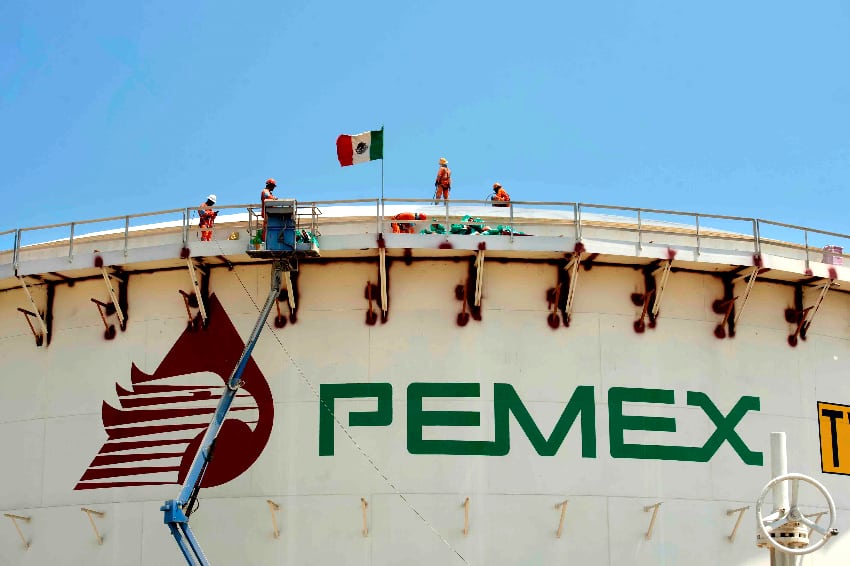
Gálvez said that claims about her planning to privatize Pemex, Mexico’s state-owned oil company, were false. (Cuartoscuro)
While Gálvez accuses the Morena government of being soft on crime with its non-confrontational “hugs, not bullets” security strategy, at the beginning of the debate she supported her “narco-party” claim by noting that the ruling party had promoted a T-shirt featuring Santa Muerte (Holy Death).
While she spent a significant amount of time attacking Sheinbaum for her alleged dishonesty, and asserting she is to blame for poor water quality in parts of Mexico City, the collapse of a school during a powerful 2017 earthquake and the 2021 metro disaster, the PAN-PRI-PRD candidate also outlined a number of undertakings and proposals.
She pledged to maintain the current government’s welfare and social programs — and “strengthen” them. “I know how poverty hurts,” she said before indicating that she agreed with López Obrador’s maxim “For the good of all, the poor come first.”
She committed to building a range of public works including water, renewable energy, health care and education projects. She said her government would listen carefully to determine “regional needs” before going ahead with projects.
She promised that a government she leads would not privatize Pemex — as Sheinbaum claimed it would — and pledged to stanch the state oil company’s economic losses. “Pemex is going to be a company with a new business model in which money is invested where it is profitable, which is … [in oil] exploration,” she said.
She pledged that a government she leads would comply with Mexico’s international commitments to mitigate climate change. “This government is a government of oil, of fuel oil. … My bet is on renewable energy,” she said.
Sheinbaum:
“The only declared narco-government that has existed is that of Felipe Calderón, of the PAN,” the Morena candidate declared in response to accusations leveled at her by Gálvez.
Sheinbaum repeatedly referred to her main rival as “the PRIAN candidate” in an attempt to link here to previous PRI and PAN government she characterized as corrupt and self-serving.
Sheinbaum promised to continue the current administration’s work to expand the country’s passenger rail system. (Maya Train/X)
Under those governments, there were “privatizations with corruption, conversions of private debt into public debt, … starvation pensions, low salaries and tax increases,” she said.
“In contrast, the transformation model, which began with this government, is a humanist model, an honest model … with better salaries and better pensions without raising taxes. There have been programs for well-being and strategic projects for national development,” said Sheinbaum, who leaned heavily on her closeness to López Obrador and association with his administration.
The Morena candidate accused Gálvez of acting illegally to obtain contracts for her companies when she was a senator, mayor of the Mexico City borough of Miguel Hidalgo and director of the federal Indigenous people’s agency during the 2000-06 presidency of Vicente Fox. She subsequently referred to the PAN-PRI-PRD candidate as “la corrupta.“
“From now on [I’ll call you] narco-candidate,” shot back Gálvez, who denied all accusations of corruption.
Sheinbaum also denied the allegations her main rival made against her, and outlined a range of initiatives she would undertake if she wins the election and succeeds López Obrador on Oct. 1.
She pledged to maintain the government’s social programs, increase their payments above the level of inflation on an annual basis and enshrine them in the constitution. “It’s false that the PRIAN candidate will maintain them,” she asserted.
She committed to extending social security benefits to agricultural day laborers known as jornaleros.
She pledged to implement a National Water Plan that will include “the application of technology” in the agricultural sector in order to “release water for human consumption” and “produce more food.” She also pledged to lead a government that is committed to recycling more water.
She promised to “develop 18,000 kilometers of rail tracks” so that passenger trains can run on them.
Máynez and Sheinbaum both discussed projects to mitigate the effects of the drought conditions much of Mexico has face in recent years. (Wikimedia Commons)
Máynez:
The MC candidate said that his party is “committed to making changes in this country that favor the majority” of people.
He said that a government he leads would turn the Special Tax on Production and Services into a “green tax” with revenue going to “electro-mobility and public transport” projects. He also promised to implement solar panels on government buildings such as schools.
He pledged to extend scholarships for students for a year after they complete high school or university to assist them as they make the transition to the workplace.
He argued that “the new generations” should not just have access to pensions when they retire, but also social housing via a program that guarantees the right to a home.
He pledged to increase public investment and dedicate additional resources to a “national regional development program” so that infrastructure works “reach the whole country.”
He said that a government he leads would make support for the agricultural sector a priority. “We have to provide justice to those who fill our tables with food. But without water there is no countryside. That’s why the main problem we have to fix in terms of infrastructure is … water,” he said.
The three candidates will face off in one final debate on May 19, exactly two weeks before voters go to the polls to elect a new president for a six-year term that will conclude in 2030.
By Mexico News Daily chief staff writer Peter Davies (peter.davies@mexiconewsdaily.com)