Home Blog Page 923

Citizens, police investigated for cruelty in brutal killing of bear cub in Coahuila

0
torture of bear cub in town of Castanos, Coahuila
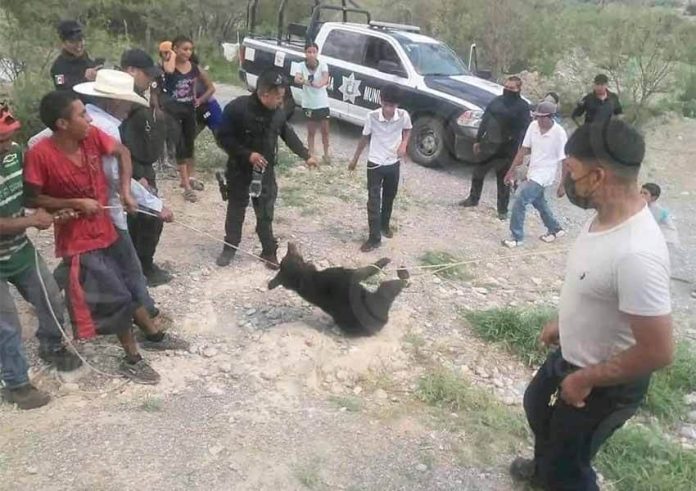
The federal environmental protection agency Profepa said it would file a criminal complaint for a "crime against biodiversity" against those responsible. Arturo Islas Allende/Facebook

Environmental authorities are investigating the brutal slaying of a black bear cub in a Coahuila town where residents tortured the protected animal before killing it as police officers looked on.

Believed to be looking for water, the approximately four-month-old cub entered the town of Castaños, located in the Castaños municipality near Monclova, where locals beat it, tied its legs together, dragged it along the ground and choked it to death with a rope. Photos posted to social media show police observing the cruelty and even smiling as it occurred.

Federal environmental protection agency Profepa said Tuesday that it was preparing a criminal complaint against those responsible for the killing of the bear, which could be classified as a “crime against biodiversity.”

It said that the perpetrators could face jail time and fines and stressed that it is committed to the protection of wildlife.
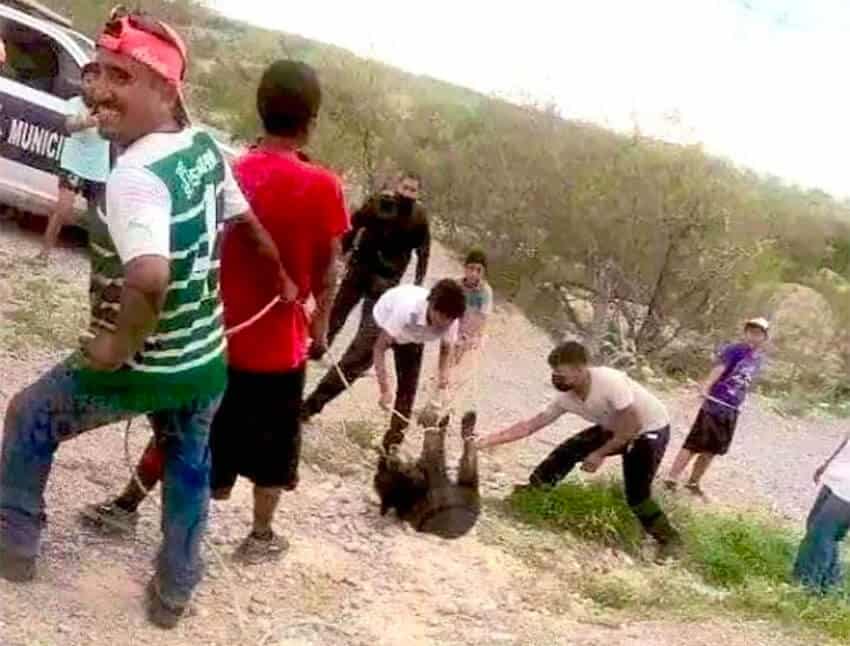
The hog-tied bear in Castaños, Coahuila.

High-profile environmental activist Arturo Islas Allende tweeted about the attack a day earlier, urging Coahuila Governor Miguel Riquelme and Profepa to act quickly to sanction police and the “misfits” that “tied up, beat, dragged and choked” the cub, which “came down [to the town] to drink water.”

In a subsequent Facebook post, Islas asserted that the bear was treated “worse than the cruelest criminal in Castaños.”

“What they did to this animal is a federal crime. … It’s infuriating to see … that police were present and they did nothing more than smile and enjoy themselves as if it was a circus event,” he wrote. “… What a thought – there’s a bear looking for water, let’s kill it as a team. What a disgrace Coahuila!”

A few hours after Profepa acknowledged the barbaric torture and killing of the bear, Governor Riquelme said that his government “vigorously rejected the outrageous actions” of those involved.

“Profepa and the Coahuila environmental protection agency are in charge of the investigations into the death of an endangered specimen and the mistreatment to which it was subjected,” he wrote on Twitter.

The governor said the state Attorney General’s Office was also investigating and would seek to punish those responsible for abusing the animal.

“The black bear is a living symbol of conservation in Coahuila. We must all respect its life and environment,” Riquelme added.

With reports from El Universal and Milenio

Puebla town goes after record for world’s biggest chile en nogada

0
The giant chile en nogada required 2,500 poblano peppers.

The Independence Day holiday in Mexico brings many delights, but none quite so famous as the iconic dish chile en nogada.

This year San Nicolás de los Ranchos, in the state of Puebla, set out to break a record by creating the biggest chile en nogada in the world. The record-breaking dish was served last weekend during the 21st International Chile En Nogada Festival held each year in August when the dish’s ingredients are most available.

The most common legend associated with chile en nogada was that its creation was the inspiration of Catholic nuns from the Santa Monica convent, who made it for Agustín de Iturbide as he marched through Puebla with his army after signing the Córdoba accords, the official agreement of Mexico’s independence between the Spanish and the revolutionary generals in 1821. There are other versions of the story, but the Poblano nuns are a likely guess for the creation of this dish as many local specialties reportedly came out of their kitchens (mole poblano and many local candies to name a few).

The dish starts with a large poblano pepper stuffed with a mixture of ground beef and pork, dried fruits and nuts, then is sometimes breaded and cooked, covered with a slightly sweet walnut sauce and sprinkled with pomegranate seeds and parsley sprigs. The colors of the dish — red, white and green — are the colors of the Mexican flag and also the uniforms of Iturbide’s soldiers.

The record-breaking dish in San Nicolás was crafted from 2,500 poblano peppers stuffed with 40 kilos of apples, 40 kilos of peaches and 81 kilos of ground meat, covered in a walnut sauce that took 31 kilos of walnuts to make and sprinkled with 12 kilos of pomegranate seeds. The proceeds from the event went to help the families of two children with cancer.

With reports from E-Consulta

After threat of legal action, WHO comes through with 10 million vaccine doses

0
COVAX program
The COVAX program is expected to ship the vaccine in September.

After the federal government threatened on Monday to take legal action against the COVAX vaccine initiative for failing to supply all the COVID-19 shots it promised, the World Health Organization-backed program promptly indicated it would ship an additional 10 million doses to Mexico.

President López Obrador told his morning press conference on Tuesday that COVAX – which aims to ensure equitable vaccine distribution across the world – contacted the government on Monday and offered to send 10 million Pfizer shots to inoculate Mexican children. The offer came after López Obrador on Monday threatened to initiate legal action against the WHO initiative for not keeping its end of a US $160 million agreement.

Deputy Health Minster Hugo López-Gatell – the federal government’s coronavirus czar – said Tuesday that just over 10 million shots should arrive by September. He said the government could still take legal action if COVAX reneges on what he described as a “formal offer.”

“We don’t yet have a delivery guarantee [but] the news is positive,” López-Gatell said before stressing that “we can’t relax” until the vaccines have been “correctly delivered.”

He said that Mexico paid $160 million to COVAX to have access to up to 52 million vaccines. However, the country has only received 24 million so far. López Obrador said Monday that Mexico is owed $75 million worth of vaccines.

López-Gatell told reporters that “the access to vaccines through the COVAX mechanism has been very turbulent for Mexico,” explaining that there have been “late deliveries” and “scant clarity” about the criteria followed to allocate shots to different countries around the world.

In addition to entering into an agreement with COVAX, the federal government has purchased COVID-19 vaccines on the open market and received millions of donated doses from the United States and Canada. The Canadian government late last month sent over 3 million Pfizer shots to Mexico to inoculate children.

About three-quarters of all Mexicans (adults and children) are vaccinated with at least one shot, according to The New York Times vaccinations tracker, but López-Gatell put the figure at 81%. The government long maintained that vaccination wasn’t necessary for minors, but eventually offered shots to adolescents before extending its vaccination program to younger kids more recently.

Mexico is still amid a fifth wave of COVID infections, but López-Gatell said Tuesday that case numbers have been on the wane for six consecutive weeks. He said the country is now heading toward a “point of recess” in the pandemic, but warned that case numbers could spike as the weather becomes cooler.

Future waves of COVID could “synchronize with the cold season,” López-Gatell said, although he acknowledged that outbreaks haven’t yet become seasonal in Mexico, where the fifth wave began in the spring and extended into the summer.

“In our case we still have epidemic waves outside the cold season,” the coronavirus point man said.

“… We don’t rule out that in October, November and December there could again be an increase [in COVID cases] that means the establishment of a more regular pattern in the cold season,” he added.

Across Mexico, there are currently just over 42,000 estimated active cases, according to federal data, while the country’s accumulated tally is approaching 7 million. The official COVID-19 death toll rose to 329,103 on Monday, but that figure – like the case count – is widely believed to be a vast undercount.

López-Gatell said that COVID fatalities are trending downwards and highlighted that just 6% of general care hospital beds set aside for coronavirus patients are occupied and that only 2% of those with ventilators are in use.

With reports from Reforma and Milenio

Court grants injunction to suspend bullfights at Zacatecas fair

0
bullfighting event in Zacatecas city
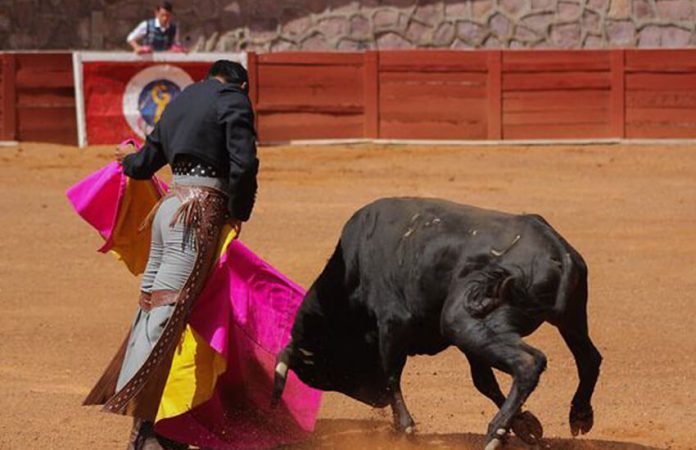
Bullfighting event in Zacatecas city at the Plaza de Toros Monumental bullfighting ring in June.

Late last month, a cool, animated poster for the upcoming Zacatecas state fair in Zacatecas city was unveiled, featuring a colorful matador moving his cape and an angry-looking bull raking the ground with his hooves. An accompanying poster listed details about the 10 bullfights scheduled at the 12,000-capacity Plaza de Toros Monumental during the Sept. 3–18 fair. 

Those posters will likely be coming down now after the Second District Court in Zacatecas granted an environmental organization an injunction on Monday to provisionally shelve the series.

The court decision ruled in favor of a coalition lawsuit that asserted that fighting bulls experience “pain and suffering” that includes “increased heart rate, hypertension, hyperventilation, sweating and stress and muscle stiffness,” among other discomforts. The lawsuit listed in detail how the bull is pummeled and penetrated with spears and swords, eventually suffering paralysis and death.

All of this is “incompatible or irreconcilable with [people’s] right to a healthy environment,” provided for in article 4 of the Mexican Constitution, “to the detriment of the people who inhabit the state of Zacatecas,” the court’s ruling noted.

Governor of Zacatecas visiting bullfighting ring in Zacatecas city
Despite Monday’s ruling, bullfighting clearly has support in the state: Governor David Monreal Ávila supervised remodeling at the Plaza de Toros Monumental in June. Government of Zacatecas

The Zacatecas decision follows several similar rulings across Mexico in recent months: in Mexico City in June, a judge turned a provisional suspension of bullfights at Plaza México into a definitive ban. And just last week, organizers of an apple fair in Zacatlán, Puebla, called off an August 20 bullfight following protests by citizens and a district court ruling against the event, the newspaper Urbano Pueblo reported.

That decision came despite Puebla’s governor Luis Miguel Barbosa Huerta speaking out against banning bullfights and cockfights in June, “considering them to be part of the national culture.” Also in June, the Mexican Supreme Court invalidated a Nayarit decree that gave bullfights and cockfights intangible cultural heritage status.

In the Zacatecas case, animal rights organizations and other activists, led by the Civil Association of the National Anticorruption Collective (Colecna), filed a lawsuit when it became known that the Feria de Zacatecas would resume this year after two years off due to the pandemic and would include bullfighting. 

Bullfighting is popular in Zacatecas. In April, the state Congress voted to add bullfights and cockfights as “intangible cultural heritage” in its cultural heritage law, according to the newspaper El Sol de Zacatecas. “… and in the fields of Zacatecas, there is a presence of some of the best ranches in Mexico,” the paper added, alluding to the quality of bulls that would have been involved. 

Last year, although there was no fair, there were two bullfights in the city’s Plaza Monumental in July, with a capacity of 1,500 people and COVID-19 protocols enforced.

A court-scheduled hearing on Aug. 29 will give organizers of the Zacatecas fair an opportunity to speak. But the newspaper La Jornada called it an “incidental hearing,” at which the suspension will be finalized.

With reports from La Jornada and El Sol de Zacatecas

Historian warns second Morelos river is in danger of disappearing

0
The Cuautla River in Morelos.

A Morelos historian has called on citizens and authorities alike to take action against the disappearance of the Cuautla River, which starts near the Popocatépetl volcano and winds its way through México state and Morelos.

Although the river is located in an officially protected natural area, it has been affected by pollution, diversion and urban sprawl.

Historian Enrique Anzures Carrillo and some fellow researchers presented a report on the river last weekend at an event in Tepoztlán, warning of the risks to its survival if the status quo remains.

Anzures reminded attendees that not so long ago another regional river disappeared. The Chiconahuapan flowed from the springs that now feed the swimming complex Las Tazas, which he mentioned has also seen a drop in water levels in recent years. The Chiconahuapan River’s flow was gradually reduced because of its redirection for local agriculture, mostly sugar cane production, until it disappeared altogether between 1940 and 1950. Anzures suggested that a 2021 flood in Cuautla in a part of the city called El Hospital resulted in that river’s return, but it carries little water.

“You could say that the river still passes through, but now there is hardly any water,” said Anzures. He called for a greater commitment from local authorities and residents to keep the Cuautla River from being further polluted and prohibiting its diversion, as well as working to rebuild the capacity and health of local springs.

In June, the state’s Sustainable Development Ministry took citizens on a hike along the river where they explored the outdoor activities available there and spoke about the importance of keeping the area clean and free of trash. More activities are planned for the future.

With reports from El Sol de Cuautla

Oaxaca artisans accuse governor’s wife of copying their designs

0
Moran with her husband the governor
Moran with her husband the governor and some of her fashion brand's designs.

International fashion brands such as Mango, Zimmerman and Caroline Herrera have incurred the wrath of indigenous Mexicans who have accused them of plagiarizing their designs. Now, the wife of the governor of Oaxaca is feeling the same heat.

Ivette Morán, wife of Governor Alejandro Murat and honorary president of the state’s DIF family services agency, presented indigenous-inspired garments made by her fashion brand Moravy during last week’s Mercedes-Benz Fashion week in Oaxaca city. It’s safe to say that indigenous artisans from the southern state are not among the fans of the collection.

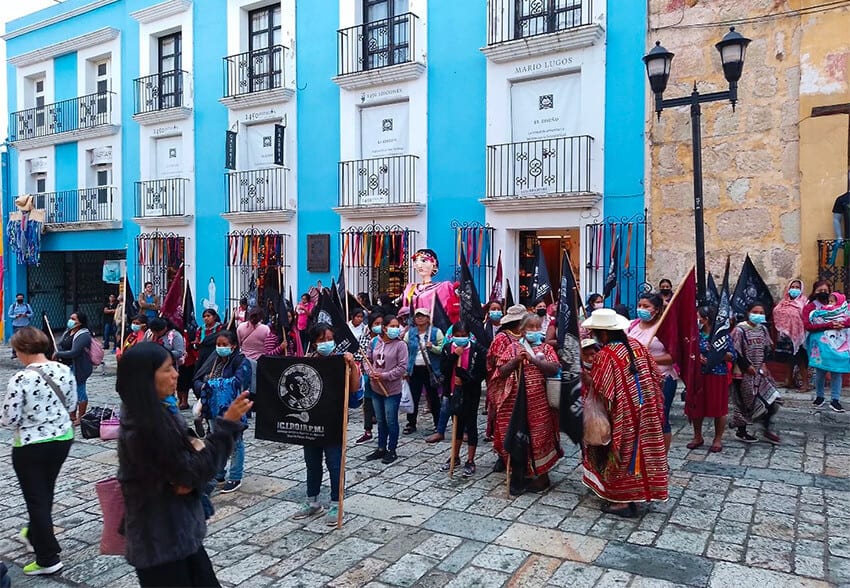
Some took to the streets of the state capital last week to denounce the cultural appropriation of Morán’s company, which, for its part, asserts on its website that it is focused on “generating a positive impact on society, especially in indigenous communities” and that it “activates the economy of artisan families.”

The disgruntled artisans chanted and held up placards with messages such as “Ivette, cutting off [existing patterns] isn’t designing” and “Our culture doesn’t fit in your store windows,” according to a report by the EFE news agency.

A demonstration in Oaxaca against alleged plagiarism
A demonstration in Oaxaca against alleged plagiarism by Ivette Morán.

They also showed off their original designs on an improvised runway in the streets of the historic center of Oaxaca city.

“We want to tell [Morán] that she’s looting Oaxaca, that she’s engaging in unfair competition,” a representative of the artisans’ collective Texturas de Oaxaca told EFE.

The representative, who asked to remain anonymous, asserted that Morán was using public resources to promote her fashion brand, although there didn’t appear to be any concrete evidence of that. Governor Murat stressed that the state government didn’t provide any funding for the Mercedes-Benz Fashion week.

A member of another artisans’ collective called Emprendimiento Yalalteca also condemned Morán’s use of traditional indigenous designs.

“I started to embroider as a girl … and it’s not fair for a lady to come along and steal our culture. What she did with our huipiles, which she presented all mutilated and cut away, is a complete lack of respect because our clothing has history,” she said.

Morán and her Institutional Revolutionary Party governor husband also earned a rebuke from the Morena party-dominated state Congress for their use and alleged exploitation of Oaxacan culture.

The former hasn’t publicly responded to the criticism, but in an Instagram post on Saturday her company appeared to defend itself, saying that it appreciated the “magic hands of our artisans” who made the garments presented during the fashion week.

The post only attracted about 100 “likes” from almost 200,000 followers as well as negative comments such as “you destroyed the huipiles,” “you’re violating the [artisans’] ownership right” and “pirate, pirate.”

With reports from El Sol de México and Infobae 

Government blames Aeroméxico for causing delays at Mexico City airport

0
aeromexico

Aeroméxico has hit back at the federal government after it was accused of causing delays at the Mexico City International Airport (AICM).

The head of the consumer protection agency Profeco said Monday that the flag carrier was the subject of the majority of complaints due to flight cancellations and delays this summer.

“The Mexico City airport is where most complaints have been filed,” Ricardo Sheffield told President López Obrador’s regular news conference.

He said that Aeroméxico “loves to blame” the airport and the federal government for its delays, but “the reality” is that they are often caused by staffing problems. Sheffield asserted that it has been “very common” for the airline to have incomplete flight crews.

“When a flight attendant is missing in the morning they have to wait for sometime to replace him or her and that has caused a large number of delays,” he said.

The Profeco chief said that the “rumor in the airport corridors” is that Aeroméxico employees “very much like” to call in sick.

“They probably have COVID … but with just one person absent the flight doesn’t leave, they have to look for someone to replace the flight attendant,” Sheffield said, adding that members of the cabin crew were most prone to absenteeism.

He stressed that Aeroméxico has been the airline most affected by the issue and asserted that it has been most prevalent at the AICM, where delays at the baggage carousel and in immigration and taxi queues have also been reported recently.

Aeroméxico responded to Sheffield’s claims in a statement, saying that it has been the most punctual airline at the AICM this summer. The airline said that 81.3% of its departures and 78.8% of its arrivals have been on time since the start of July.

“These results are four percentage points above the general average of that airport, and 13 percentage points above the other two main operators,” Aeroméxico said in reference to Volaris and VivaAerobús. It also said that 99.9% of its scheduled flights have gone ahead since the start of last month and that it has only received one complaint for every 20,000 passengers.

José Humberto Gual Ángeles, general secretary of the Association of Air Pilots of Mexico, rejected Sheffield’s claim about high levels of absenteeism among Aeroméxico workers.

“We don’t have data from the grapevine, we have hard, truthful data that [the airline] doesn’t have absenteeism at the levels they assert. We’ve had outbreaks of COVID-19 among crews but that’s an issue” that has affected all airlines, he said.

The ASSA flight attendants union made similar remarks, saying that it categorically rejected that its Aeroméxico-affiliated members were responsible for delays at the AICM this summer vacation period. Aeroméxico flight attendants report to work on time “in accordance with the operational requirements of the company,” it said.

Despite the pushback, Sheffield renewed his criticism of the national flag carrier on Monday afternoon. “For a second consecutive year @Aeroméxico ranks first for complaints filed with @Profeco in the area of cancellations and delays,” he wrote on Twitter.

“In 2021 there were 488 and this year there have been 498. They’ve implemented the practice of putting passengers on board and having them wait up to an hour to take off,” Sheffield added. “Without a doubt, they have a wide area of opportunity to improve the quality of their service … for the benefit of the consumer.”

With reports from Reforma 

Family realizes too late that 3-year-old girl was alive during her funeral

0
Camila, found to be alive at own funeral in San Luis Potosi
At Camila's funeral, her mother first noticed fog on the coffin's glass but was told by other mourners that her grief was making her hallucinate.

Hope turned to despair for a San Luis Potosí family when a three-year-old girl who was found to be alive during her wake was pronounced dead for a second time.

Little Camila fell ill last Wednesday with symptoms including stomach pain, fever and vomiting, according to the girl’s mother, Mary Jane Mendoza Peralta.

Mendoza told the newspaper El Universal that she took her daughter to a pediatrician in the municipality of Villa de Ramos and that he advised her to take Camila to hospital because she was suffering from dehydration. The girl was taken to a community hospital in the neighboring municipality of Salinas, where she was treated with wet towels and suppositories.

“After an hour they gave her back to me, telling me that she was fine,” Mendoza said. “They prescribed two sachets of rehydration solution and 30 drops of paracetamol.”

Mary Jane Peralta, mother of girl found alive at her own funeral
Mary Jane Mendoza Peralta says she doesn’t hold a grudge against the doctors who declared her daughter dead but does want them removed from their posts.

The family followed the instructions but didn’t see any improvement in the girl’s health. They subsequently consulted another doctor who prescribed different medications, but Camila was unable to keep anything down, Mendoza explained.

After seeing yet another doctor, Camila was taken back to the community hospital in Salinas, to which she was admitted last Wednesday night. The three-year-old was put on a drip and given oxygen but was erroneously declared dead due to dehydration shortly after she was admitted.

“Ten minutes later … [she was] disconnected; they didn’t do an electrocardiogram,” Mendoza said, adding that her daughter embraced her when she picked her up. “I felt the strength of my girl [but] they took her from me and said, ‘Let her rest in peace,’” she said.

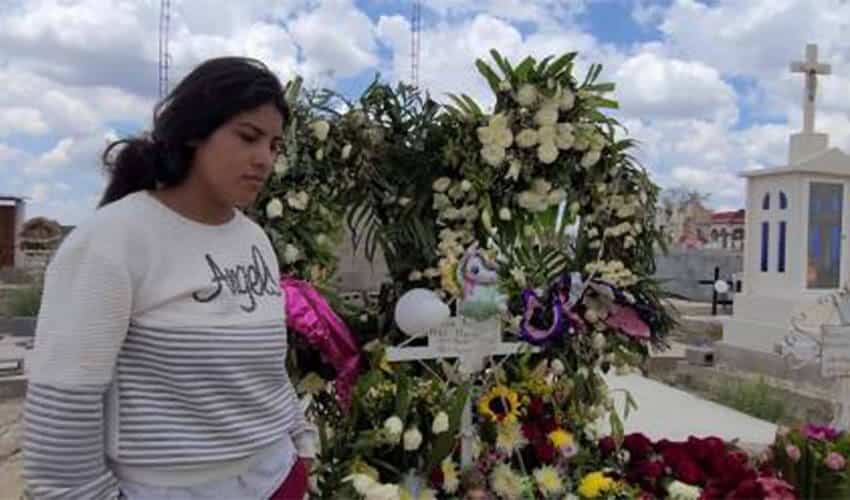
The next time Mendoza saw her daughter, she was in a coffin at her wake, held last Thursday. She noticed that the glass on the top of the coffin was fogged up – a sign that her daughter was breathing – but other mourners told her that she was hallucinating as a result of her loss.

Camila, found to be alive at own funeral in San Luis Potosi
State Attorney General José Luis Ruiz said that an investigation into Camila’s death is underway.

Minutes later, according to an El Universal report, Mendoza’s mother-in-law noticed that Camila’s eyes were in fact moving. The girl was removed from the coffin and confirmed by a nurse attending the funeral to be still alive, with a heart rate of 97 beats per minute. The girl’s family called an ambulance, which took her to a hospital in San Luis Potosí city.

Her condition had deteriorated by the time she arrived, and doctors were unable to prevent her death. Subsequently — for the second time in two days — Camila was pronounced dead.

“It was there [in San Luis Potosí city] where [the life of] my baby really ended,” Mendoza said. “We’re devastated because my girl was a very happy person; she got along with everyone,” she said.

Mendoza told El Universal that she has two death certificates for her daughter: one issued in Salinas that states that the cause of death was dehydration and another issued in the state capital that says that Camila died due to cerebral edema.

“What I really want is for justice to be served,” she said. ”I don’t hold a grudge against [all] the doctors … I’m just asking them to change the doctors, nurses and directors [at the hospital in Salinas] so that this doesn’t happen again.”

State Attorney General José Luis Ruiz said that an investigation is underway, but Mendoza complained that she hasn’t been contacted by his office or by San Luis Potosí health authorities.

A similar case occurred a year ago in Coahuila, where a premature baby was mistakenly pronounced dead upon birth. Morgue personnel subsequently realized that the baby boy was in fact breathing, and his health stabilized for a period before he died four days after his birth.

With reports from El Universal 

Massive girder collapses during bridge construction in Querétaro

0
queretaro bridge
No people or vehicles were nearby when the girder fell on Sunday, officials said.

A huge girder collapsed from a bridge under construction in Querétaro city on Sunday, just hours after it was fixed in place.

No injuries have been reported after the support beam crashed onto the tarmac near the city center on Bernardo Quintana Boulevard, near the intersection with Sombrerete Avenue.

Traffic on Bernardo Quintana Boulevard was temporarily rerouted in one direction.

The curved metallic structure is some 50 meters long and formed part of a vehicular bridge which is about 10 meters above the boulevard’s surface. The infrastructure project cost more than 118 million pesos (US $5.9 million).

The state government said that no people or vehicles were in the vicinity of the bridge at the time of the collapse, meaning that no injuries were recorded. It later said in a statement that an investigation had been opened to determine who was responsible.

The Querétaro Ministry of Urban Development and Public Works said the girder was placed by workers from the construction company Soluntitec. The ministry added in a statement that Soluntitec “was contracted by the state government based on the law and procedures in force.”

The gaffe is particularly embarrassing for state Governor Mauricio Kuri González, who had toured the construction and celebrated its progress on Saturday. “We are very happy because we are putting the last girder here on the Sombrerete bridge … we are very grateful to the people who have shown a lot of patience and a lot of tolerance … this is the way to take Querétaro to the next level,” Kuri said on Saturday, after touring the construction.

Kuri said at the time that the construction was at 60% completion, far ahead of the 37% completion scheduled. He added on Saturday that the bridge was set to be finished in early October, earlier than January 2023 as had been originally planned.

With reports from El Capitalino and La Razón

Conservationist urges Mexico adopt ‘blue label’ standard to protect vaquita

0
Industries have to meet certain environmental standards to qualify for the Marine Stewardship Council blue label certification.
Industries have to meet certain environmental standards to qualify for the Marine Stewardship Council blue label certification. MSC

A prominent Mexican conservationist has highlighted the importance of sustainable fishing to the ongoing survival of the vaquita marina, a critically endangered porpoise that is endemic to the upper Gulf of California.

Lorenzo Rojas-Bracho, director of the VaquitaCPR (Conservation, Protection and Recovery) Project, told the newspaper Zeta Tijuana that the Marine Stewardship Council’s blue label needs to be promoted in Mexico as part of measures to protect the vaquita, of which as few as nine are believed to remain.

“The blue MSC label is only applied to wild fish or seafood from fisheries that have been certified to the MSC Fisheries Standard, a set of requirements for sustainable fishing,” Marine Stewardship Council says on its website.

“… Sustainable seafood comes from fisheries that catch fish in ways that ensure the long-term health of a stock or species and the well-being of the ocean.”

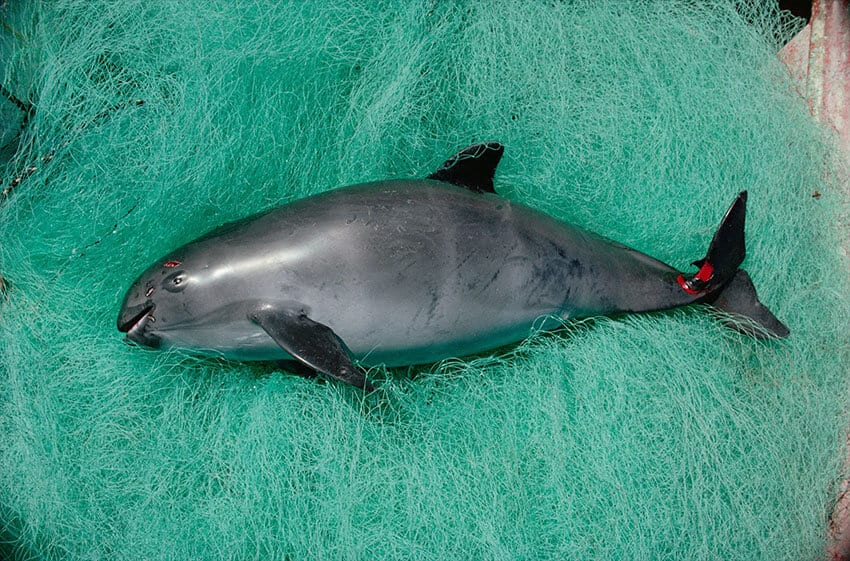
This dead vaquita was recovered from the Gulf of California in 2018.

Rojas-Bracho noted that vaquitas become entangled and die in gillnets used to catch both totoaba — a fish prized in China for its swim bladder — and shrimp.

If businesses such as supermarkets and restaurants only bought and sold blue label seafood, fishermen who want to sell their catch here would presumably be dissuaded from using such nets. Gillnets — which also entangle marine species such as sea turtles and small sharks — are already banned in the upper Gulf of California, but enforcement has been lax.

Rojas-Bracho observed that the “blue market” for sustainable seafood is already well developed in the United States and Europe. But the same can’t be said about Mexico.

However, the conservationist believes there is an opportunity to develop a sustainable seafood market that is a source of national pride. According to the Marine Stewardship Council,  four Mexican fisheries are already MSC certified: a red lobster fishery, two small open sea fisheries and a tuna fishery.

“The Mexican market is … increasingly interested in sustainable seafood products,” the non-profit organization says on its website.

“In collaboration with the Mexican campaign PescaConFuturo, the MSC has highlighted the importance of maintaining healthy fish stocks to guarantee food and economic security for future generations and to safeguard the natural wealth of the Mexican waters.”

With reports from Zeta Tijuana