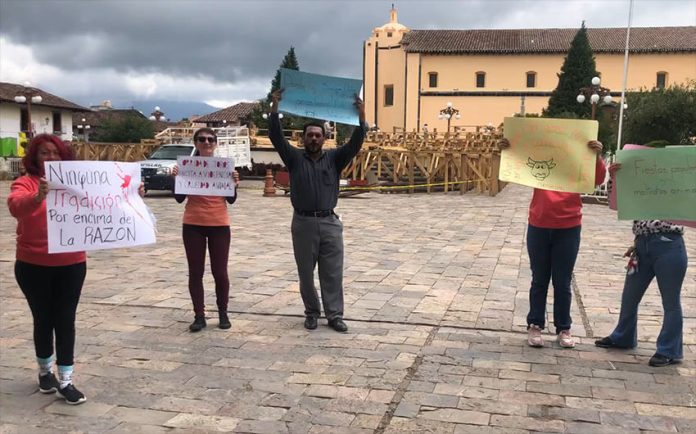
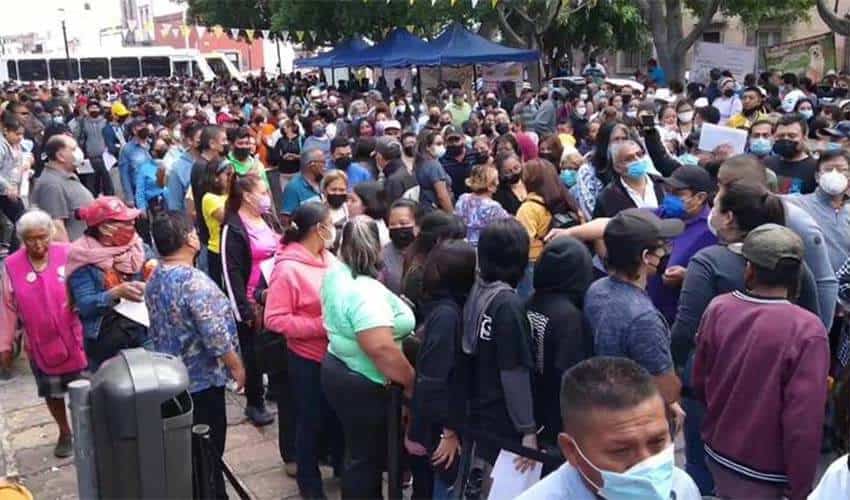
Protesters said there was no need for bullfighting at the annual apple festival. Facebook / Protectores Animalistas de Zacatlán
Protesters in a Magical Town in Puebla have demanded that a bullfight be pulled from the schedule of an upcoming festival.
Members of animal rights groups and other citizens protested peacefully outside the Zacatlán government building last week to demand that the event be scrapped from the town’s 80th Feria de la Manzana (“Apple Festival”).
Mayor Pepe Márquez previously announced the event would take place and, speaking at the coronation of the festival’s beauty queen, said the bullfight had been requested by citizens.
However, protesters denied that the blood sport was in popular demand and said it wasn’t traditional to the festival. “It’s an activity requested by a very small group, what the residents of Zacatlán really want is for our traditions to be promoted, not for animals to be killed,” one protester said, according to the newspaper E-Consulta.
“Our municipality has many things that make it unique which have nothing to do with animal abuse. That is why it’s a Magical Town,” another protester told the news site.
The festival runs from August 13-21 and the bullfight is planned for August 20.
Bullfighting is an ancient tradition which was repopularized in medieval Spain and later exported to its empire. In more recent times, the sport’s future has been put in doubt: in some parts of Spain, it is now illegal.
Likewise, in Mexico, there have been a number of high-profile court decisions on bullfighting. A definitive ruling in June banned bullfights at Mexico City’s Plaza México and later that month the Supreme Court invalidated a three-year-old decree that gave bullfights and cockfights intangible cultural heritage status in Nayarit.
Cristerna's first body modification was a nose piercing at age 12. Guinness World Records
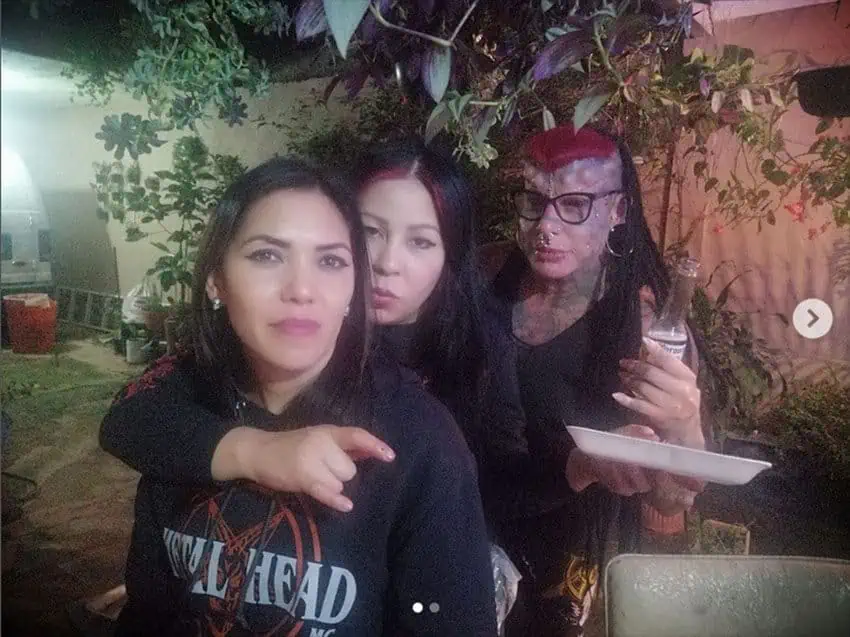
The “Mexican Vampire Lady” is still turning heads a decade after Guinness World Records recognized her as having the most body modifications of any woman in the world.
María José Cristerna of Guadalajara, Jalisco, “has a total of 49 body modifications, including significant tattoo coverage, a range of transdermal implants on her forehead, chest and arms, and multiple piercings in her eyebrows, lips, nose, tongue, ear lobes, belly button and nipples,” Guinness World Records said in February 2012.
Ten years later, she is still the world’s most modified woman, and continues to catch the curious — and sometimes envious — eyes of passersby when she’s out in public, according to a Milenio report.
Cristerna — who is also a mother, lawyer, tattooist, exercise fanatic and avid beer drinker — spoke to that newspaper about the modifications she has made to her body, the meaning behind them and the discrimination she faces due to her unusual appearance.
Cristerna on a night out with friends. Instagram
“The first piercing [I got] was one I did myself in my nose when I was about 12,” said the mujer vampiro, who was given her nickname during an appearance on Mexican TV.
“Then [I got] a tattoo of the logo of a black metal band when I was 14,” added Cristerna, who is now in her mid-40s. “It was strange, something different for our culture, and even more so at that time.”
She told Milenio that she began making more extreme modifications to her body after leaving an abusive relationship while still a teenager. However, the transformation of her appearance occurred over a period of years.
“After I turned 18 is when I started doing more things,” Cristerna said. “I worked in the tattooing and piercing field, but [the transformation] has been gradual, it’s taken several years.”
She explained that each of her tattoos and piercings has meaning and is very important to her. “They’re usually [related to] internal things and [getting a tattoo or piercing] is my way of bringing what’s on the inside to the outside,” Cristerna said.
Making a modification to one’s body is a meaningful commitment, she said, adding that she thinks deeply about any potential changes to her appearance. “I’m not the kind of person who gets a tattoo every day,” Cristerna said.
She advised others to think carefully before making a permanent body modification and urged caution “because I’ve heard of cases of women suffering assaults” committed by tattooists and other body modification artists.
Although tattoos and other body modifications are more common now than 10 years ago when Cristerna officially became a world record holder, she told Milenio that she still faces discrimination.
“There are still a lot of prejudiced people,” she said. “… [Body modification is] demonized mainly due to religion but it’s an ancient art, as Meso-Americans we must understand that it’s cultural.”
Cristerna said people should realize that “a tattoo doesn’t make the person” and warned that those who least suspect it might one day find that their own child has adorned their body with ink. “You’re not going to discriminate against your child” so there’s no reason to discriminate against other people with tattoos, she implied.
“People have to understand that there is an evolution and we have to progress hand in hand with what’s new out there,” Cristerna said.
As for the criticism she receives for the extensive modifications she has made to her own body, the mujer vampiro — who has embraced her nickname and even named her Instagram account after it — says it’s like water off a duck’s back.
“It slips off me, I don’t give it any importance,” she said, because “I’m a person like anybody else.”
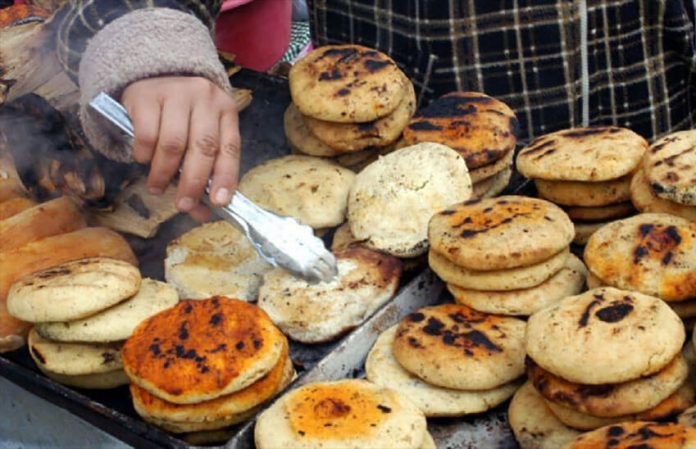
A wide variety of the fried or baked dough balls known as gorditas can be found across Mexico.
Many of Mexico’s favorite snacks are noted for their colorful names, but one term for a stuffed corn tortilla has fallen foul of some social media users.
Gordita is the feminine form of the word for “chubby,” which some say is inherently discriminatory and should therefore be changed.
Proposals for a new name include masa con relleno (“dough with filling”) and masa frita (“fried dough”), the newspaper Proceso reported. Baked and deep-fried variants of gorditas are found all over Mexico.
Although the proposal gained some support on social media, other users considered the campaign misguided.
“They’ve been called that for a lifetime. It’s like wanting to change the name of burritos,” wrote one user, referring to another stuffed corn snack which translates literally as “little donkeys.”
“They have been, are and always will be gorditas. If anyone is offended, lose weight,” another user crudely suggested.
It’s not the first time a snack’s name has caused controversy. In 2013, the bread company Bimbo changed the name of its cake from Negrito, a racially derived nickname common in Mexico, roughly translating to “black boy,” to the less controversial Nito.
Faced with a similar issue last year, Swiss food giant Nestlé changed the name of a cookie from Negrita, roughly meaning “black girl,” to Chokita.
The kindergarten teacher was at his new post for less than four months before the group of mothers reported him, leading to his resignation. Kimberly Farmer / Unsplash
A kindergarten teacher in a remote village in Guanajuato is accused of sexually abusing six girls.
Ernesto “N,” known by his students as “Teacher Ernesto,” was a trainee teacher who had only arrived at the José Joaquín Fernández de Lizardi kindergarten in Camino Real on March 1, but was deemed ready to teach classes alone. He allegedly abused the children after covering the windows of the classroom under the pretext of showing movies, the newspaper Reforma reported.
Mothers from the village of some 280 inhabitants became concerned about Ernesto’s unconventional teaching style but were assured by the kindergarten that his classes were educational. Suspicions of abuse surfaced after a 5-year-old girl told her mother that Ernesto had touched her.
Other parents asked their children, and their fears were confirmed: five other children also said they were abused. The 25 square meter (82 square feet) kindergarten only had a total of 18 students, from 3-6 years old.
On June 24, the victims’ mothers made a legal complaint in Silao and said their concerns had been ignored by officials at the kindergarten. That same day, Ernesto resigned.
According to education experts in the state who spoke to Reforma, it’s common for trainee teachers to teach groups alone in remote communities, a decision which rests with the administrator of the kindergarten.
An investigation was launched into Ernesto on June 27 and the administrative officials at the kindergarten have been suspended.
The Guanajuato Education Ministry (SEG) has offered legal and psychological support to the victims and parents. A new trainee teacher was assigned to the kindergarten on July 4.
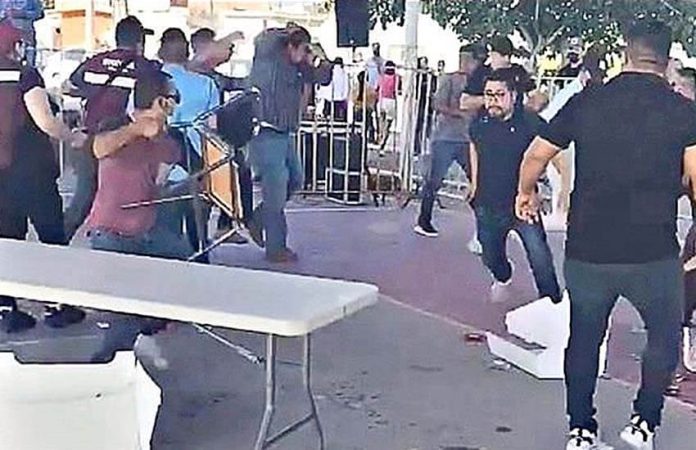
A man, left, holds up a chair as if to throw it at opponents at a polling station in Durango on Sunday. Voting was suspended at some polls across Mexico due to such violence. Internet
The ruling Morena party’s internal elections were marred by violence and other irregularities for a second consecutive day on Sunday, but President López Obrador nevertheless characterized the democratic exercise as a success.
Morena members went to the polls Saturday and Sunday to elect party officials across 300 districts. Some of the successful candidates will take a seat in Morena’s National Congress, the party’s most important decision-making body.
Incidents of violence, vote-buying and acarreo — in which voters were not only given an incentive to vote for certain candidates but also transported to polling places — sullied the elections, according to various reports.
Violence led to the suspension of voting at polling places in some parts of the country, such as Gómez Palacio, Durango, where there was a clash Sunday between supporters of opposing candidates. The newspaper Reforma reported that chairs were thrown, ballots were burned and one man was hit with a baseball bat during the confrontation.
Ballots set on fire in Chiapas. Internet
Ballots and/or voting booths were also burned at polling places in some other states such as México state and Chiapas.
Vote buying and acarreos were reported in several states including San Luis Potosí, Morelos, Guanajuato and Querétaro.
In Morelos, Governor Cuauhtémoc Blanco was accused of supplying government buses to transport Morena members to polling places so that they could cast a vote for his brother. In Guanajuato, voters were taken to polling places in taxis, buses and Uber rideshare vehicles, El Financiero reported. Their votes were allegedly “bought” for packed lunches, groceries, or cash — 1,500 pesos or about US $75 — in some cases.
Similar incentives — which were widely used by the once-omnipotent Institutional Revolutionary Party — were on offer in other states: social media posts showed that some accareados — as herded voters are known — carried slips of paper to remind them who to vote for.
Morena party members also denounced other irregularities such as the failure to guarantee a secret ballot, inadequate checking of voters’ credentials and the exclusion of designated scrutineers.
John Ackerman, a Morena supporter, academic and husband of former cabinet minister Irma Sandoval, denounced “shameless acarreo and voter pressure” in Coyoacán, a Mexico City borough. “Enormous disappointment. We’re gathering an unbelievable volume of evidence,” he tweeted Saturday.
In another Twitter post on Monday, Ackerman said the Morena National Convention would put together a “fraud expo to demonstrate that the irregularities … weren’t ‘isolated’ but generalized.”
He also said that the national convention was committed to “cleaning up the process” used to elect party officials.
Morena members elected party officials in 300 districts. Some polling sites saw large crowds; in Cuernavaca, hundreds slept overnight in the Palace of Government’s atrium.
Alejandro Rojas, an advisor to Morena Senate leader Ricardo Monreal, described the internal elections as “the fraud Olympics.”
“We saw all the practices of coercion and vote buying as well as manipulation, deceit [and] the rude and outrageous mobilization of beneficiaries of the [government’s] social programs,” he said in an interview.
On Twitter, Rojas called the elections “a carnival of acarreo and simulation” and asserted that Morena had “opened the doors to the scourges of politics: patronage, self-interest and cronyism.”
“This is the first step toward a new state party and an anti-democratic and authoritarian regression,” he added.
For his part, Morena national president Mario Delgado said Saturday that where there was evidence of acarreo, election results would be annulled. Old practices of other parties won’t be allowed in Morena, he said.
López Obrador – Morena’s founder – accepted that the elections were marred by acarreo and other bad “practices,” but rejected claims of widespread irregularities.
“[The irregularities occurred] at very few polling places. It wasn’t generalized,” he told reporters at his regular news conference on Monday. “It wasn’t as the opposition would have liked.”
AMLO highlighted that some 2.5 million people cast a vote and declared that the elections were a good democratic exercise. “The participation was massive for an internal election,” he added.
Morelos Governor Cuauhtémoc Blanco was accused of using government-owned vans like these to transport voters to the polls so that they could vote for his brother.
The president also responded to criticism from opposition political figures, asserting that the irregularities reported over the weekend were nothing compared to those that have plagued their own parties.
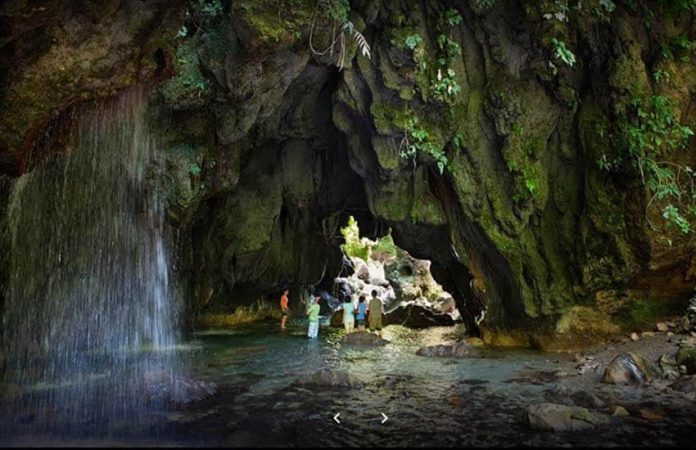
The Sierra Gorda Biosphere Reserve offers some amazing natural beauty. Google
Way back in 2011, my husband Alex and I did a road trip from Mexico City to the Sierra Gorda in northern Querétaro. I remember being pleasantly surprised at the good road conditions on the libre highway from the town of San Juan del Río northwards. More recently, someone told me that she had done the drive and liked it as well.
So in June 2022, I decided to drive the road once again. This time, my goal was to make it to Xilitla, San Luis Potosí, to see the Edward James surrealist gardens. I’m happy to report that the drive is still very enjoyable, but do it leisurely as there is so much to see along the way.
Whether you come from or pass through Mexico City or Querétaro, your adventure should start at the rapidly growing city of San Juan del Río on Route 120 north; but the sightseeing really begins at the Pueblo Mágico of Tequisquiapan.
Filled with colonial charm and wrought iron, it has become popular both with weekenders from various cities as well as a growing population of expats. It is also the beginning of the state’s Wine and Cheese Route (Ruta de Vino y Queso), celebrating Mexico’s second largest wine-producing area, which also happens to have dairy farms as well.
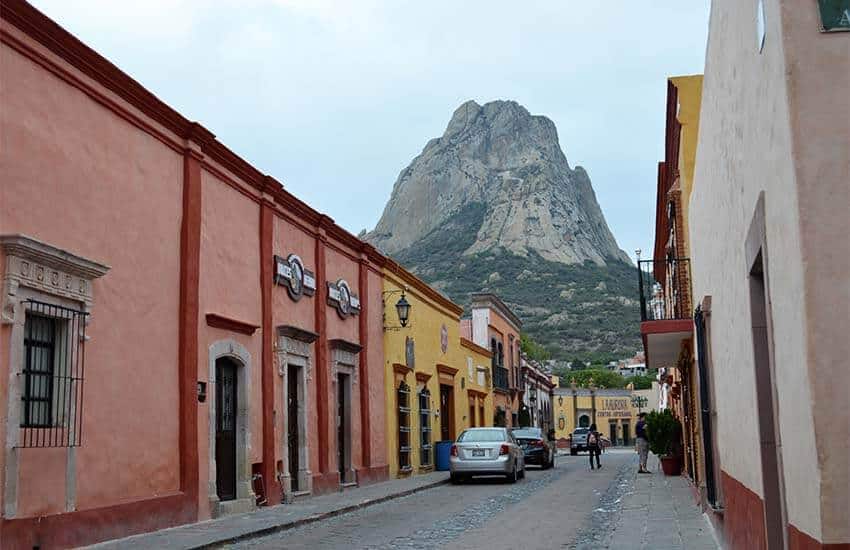
The Peña de Bernal monolith looms over the Magical Town of Bernal in Querétaro’s wine country. Alejandro Linares García
From Tequisquiapan, you will want to veer off Route 120 onto 200, then onto 100 toward Bernal. Along the way, you will see a number of vineyards helpfully marked, allowing easy visits.
Bernal is another of Querétaro’s Pueblos Mágicos, most famous for its Peña de Bernal monolith rock formation, one of the largest in the world and one of Mexico 13 Natural Wonders. It, too, is popular with weekenders, in part because the big rock has a reputation for having positive energy, so services such as ritual cleanses and temazcals (like a sweat lodge) are available here.
A little further up the road is Tolimán, an area noted for its strong Otomi-Chichimeca traditions, which prompted UNESCO to add the town’s culture onto its list of Intangible Cultural Heritage in 2009.
Route 100 rejoins Route 120 to continue onto the Sierra Gorda of Querétaro.
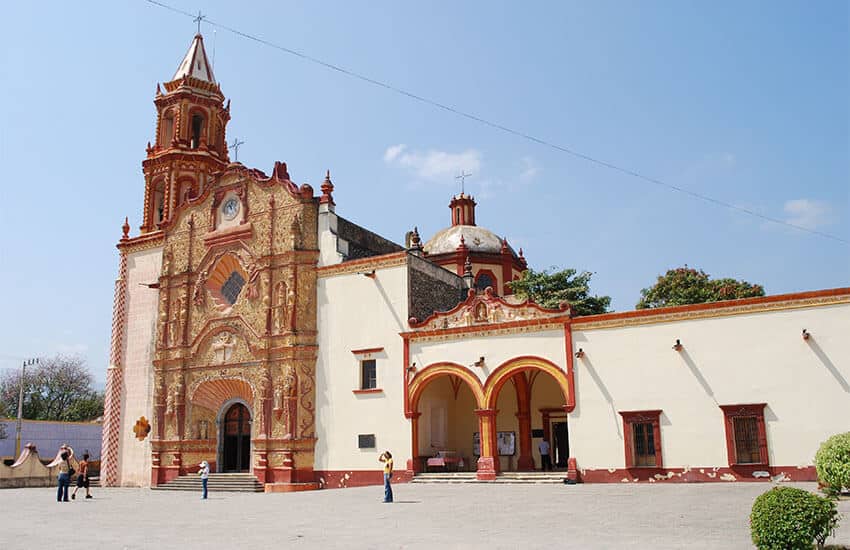
Father Juniper Serra started his mission building not in California, but in Querétaro, like this church in Jalpan. Alejandro Linares García
The Sierra Gorda essentially is a high, rugged mountain area that blocks much of the moisture coming in from the Gulf of Mexico. As you make it up and over, the changes in the vegetation are quite noticeable in a short distance (as the crow flies).
It is a rugged region with various microclimates and an important national biosphere reserve. Until you reach the town of Peñamiller, which calls itself the gateway to the Sierra Gorda, the climate is dry; the land relatively flat; and the road relatively free of potholes, speed bumps and really tight curves.
From here on, your luck with potholes and speed bumps continues, but not with the curves.
To be fair, I have been on far curvier roads in far worse condition with far fewer guardrails, but in more than a few places, there are curves where you can just see yourself just going off a cliff. And there are crosses on the side of the roads to drive that idea home.
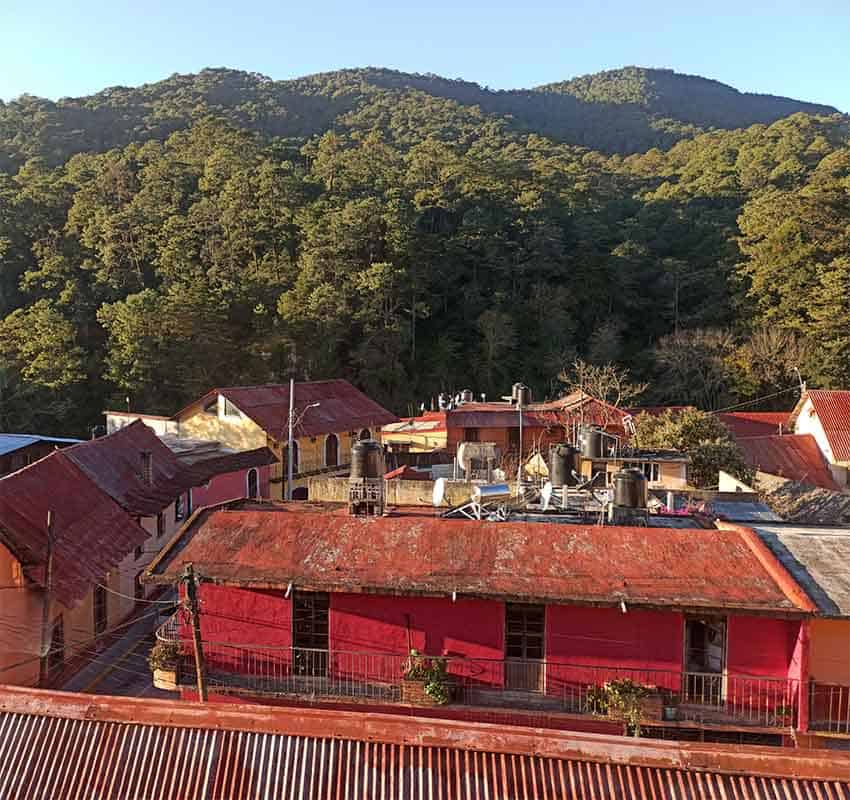
View of the town of Pinal de Amoles, Querétaro, and its surrounding forest. Juan Carlos Fonseca Mata/Creative Commons
Peñamiller, on the southwest edge, is bone-dry, but as you make your way up to Pinal de Amoles, the flora gradually changes to cloud forest — pines at the highest elevations. From that point, the descent begins, the air gets more humid and the pine forest eventually gives way to semi-tropical.
When you cross the Querétaro border into the Xilitla municipality in San Luis Potosí, there is no doubt you are in rainforest. The abundance of rain here is quite striking.
But before you jump into Xilitla — another Pueblo Mágico — the Sierra Gorda has a lot to offer in the way of natural beauty and history. It is home to the second largest pit cave in the world, the Sótano de Barro, with its numerous hiking trails and camping.
It is also home to five Franciscan missions established by Father Juníper Serra in the 18th century, the forerunners of his famous California missions. The most noted is in Jalpan de Serra, which is yet another Pueblo Mágico.
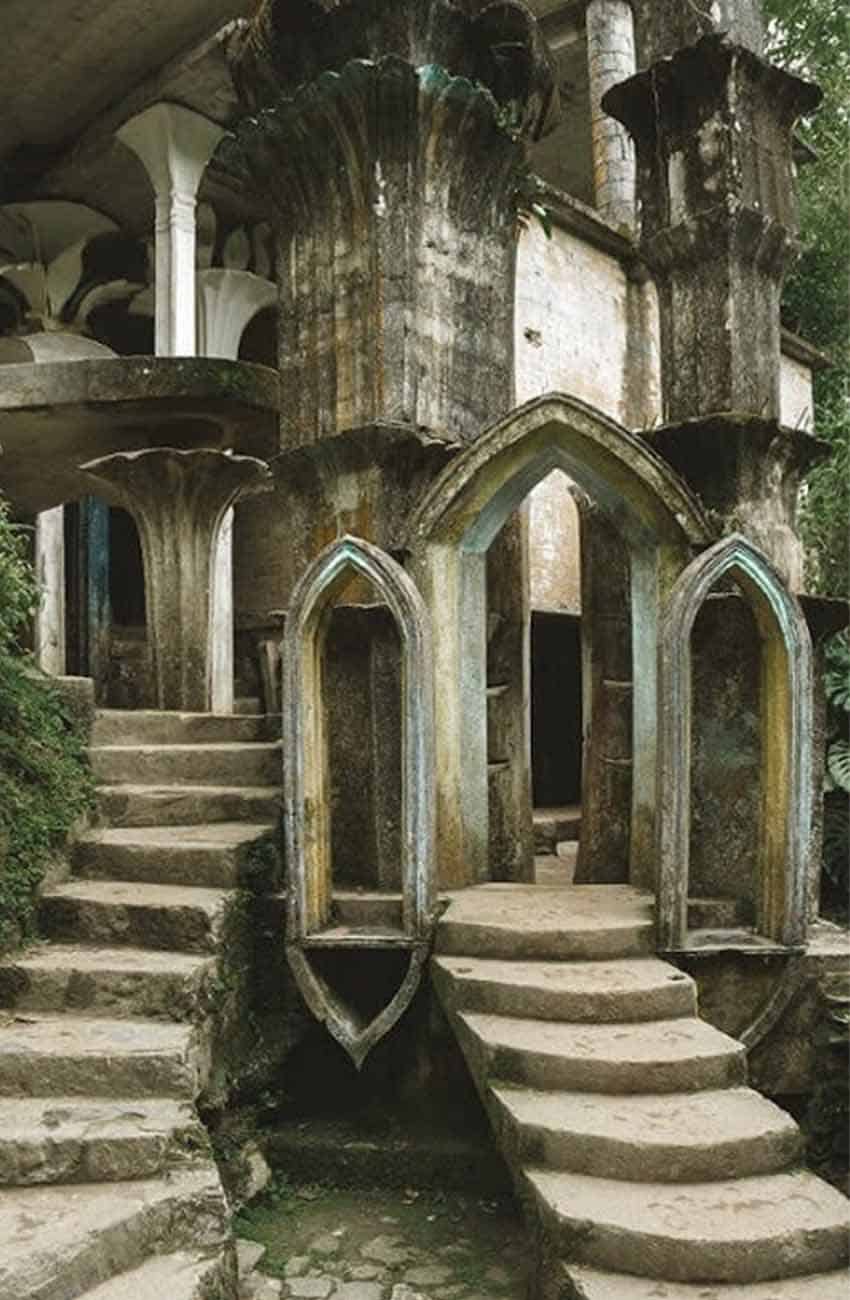
Salvador Dalí famously quipped about Edward James — who built this sculpture garden in San Luis Potosí’s rainforest — that he was ‘crazier than all the Surrealists together.’
It and the other four in Tancoyol, Concá, Tilaco and Agua de Landa together are a UNESCO World Heritage Site.
Upon crossing the border into San Luis Potosí, you leave the natural protected area, but there is no lack of natural beauty. While very rainy and humid, the area is only semi-tropical because of its elevation. It is a coffee-growing region, which becomes apparent in Xilitla with the prevalence of cafes and tours to the coffee fincas (farms).
But the real reason people come here is the former house and gardens of British surrealist poet Edward James.
Built over time in the mid 20th century, the remains of his never-finished compound continue a valiant battle against the constant moisture, moss and jungle growth that threatens everything here with complete ruin. The box canyon with its waterfall is still beautiful and was probably every bit the paradise that James called it when he came to the area in the mid 20th century.
As good as the road conditions are, I would not recommend driving back the same way. The stretch in the Sierra Gorda is challenging. You drive that road to enjoy the journey, taking it bit by bit.
For the return, I recommend Xilitla to the city of San Luis Potosí (worth visiting as well), then south back to the city of Querétaro. Yes, it is longer, but it is certainly faster and easier.
Leigh Thelmadatter arrived in Mexico 18 years ago and fell in love with the land and the culture in particular its handcrafts and art. She is the author of Mexican Cartonería: Paper, Paste and Fiesta (Schiffer 2019). Her culture column appears regularly on Mexico News Daily.
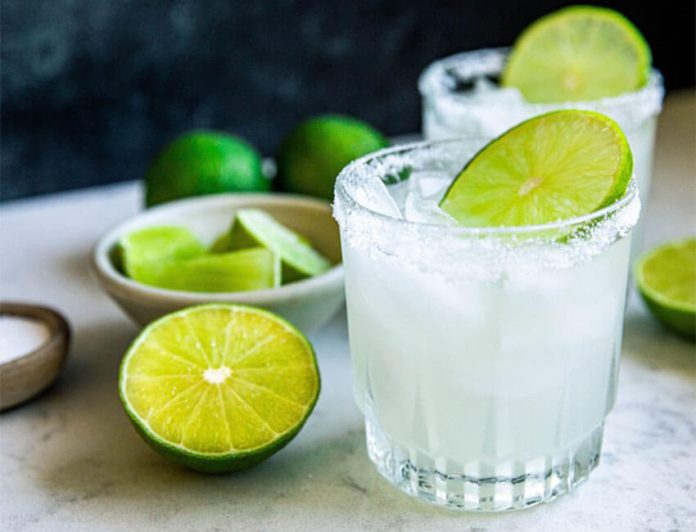
On a hot day, there's nothing to help you cool off like a classic frozen margarita.
Margarita lovers know there’s a world of difference in how this classic drink can be made; packaged mixes and mixtures may save time and a few pennies, but like the saying goes, ain’t nuthin’ like the real thing.
You want to use the best ingredients you can afford. This is the premise for any simple recipe, from salad dressing to tacos. The fewer the ingredients, the more the quality and freshness of each one matters.
If you’re a devoted margarita fan, it’s worth taking the time to research tequilas available in your area. Talk to a knowledgeable bartender or chef and do your own tasting with margaritas made with different tequilas. It’s never too late to train your palate!
For a classic margarita, use clear, unaged blanco tequila for a bright, refreshing taste. For a warmer, more mellow flavor, reposado tequila can be used.
A Sriracha-Mango margarita is the perfect blend of sweet and spicy.
The kind of orange liqueur you use also matters. Each brand has its own characteristics, depending on what kind of oranges and alcohol are used in the distilling process, as well as other factors. But then it gets confusing: are Cointreau, Curacao and Triple Sec the same thing? I’ll let the experts in this link explain here.
The French brand Cointreau mixes sweet and bitter orange for a distinctive balanced taste. Curaçao — made with Laraha oranges grown only on the Caribbean island of the same name — has a unique sweetness. Triple Sec either means it’s made with three kinds of oranges or is triple distilled.
And Grand Marnier, with a brandy base, lends subtle flavors of oak and vanilla along with orange.
Margaritas, a contemporary classic, are consistently rated in the top 5 of the 100 most popular drinks in the world, says Drinks International, a ranking confirmed by the IBA (The International Bartenders Association). Here’s how to make yours prizeworthy too!
Classic Margarita
3 oz. blanco tequila
2 oz. Cointreau
1 oz. fresh lime juice
Garnish: lime wedges, coarse salt for glass rims
Run lime wedge around rims of 2 rocks glasses; dip in salt. Set aside. In a cocktail shaker, combine tequila, Cointreau and lime juice. Fill with ice and shake until thoroughly chilled, about 15 seconds. Strain margarita into glasses straight-up or on the rocks. Garnish with lime.
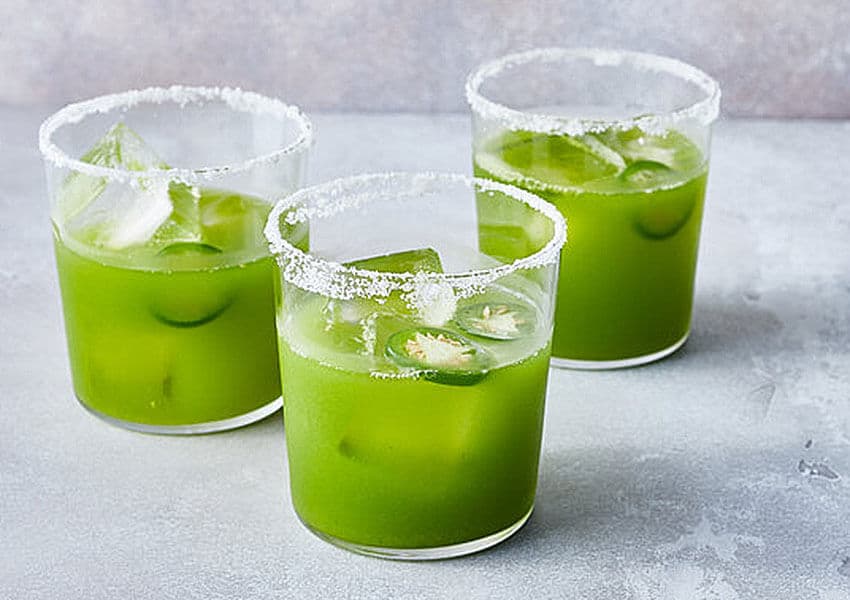
Spicy Cucumber Margaritas
1 lb. Persian cucumbers (about 7 cucumbers), roughly chopped
½ cup chopped cilantro leaves and tender stems
⅓ cup sugar
1½ tsp. finely grated lime zest
¼ cup fresh lime juice
2 tsp. minced jalapeño plus slices for garnish
Salt
6-8 oz. tequila blanco
Ice
In blender on high speed, process cucumbers, cilantro, sugar, lime zest, lime juice and minced jalapeño until foamy and blended. Strain through a fine-mesh sieve set; you should have 1½ cups strained liquid; discard solids. Add 1/8 tsp. salt.
Mix cucumber liquid with tequila; set aside or refrigerate up to 8 hours. When ready to serve, rim glass with salt. Fill rocks glasses with ice.
Working in batches, shake margaritas in ice-filled cocktail shaker. Garnish each glass with slices of jalapeño.
Use smaller, more tender Persian cucumbers for this Spicy Cucumber margarita. And don’t forget the jalapeño!
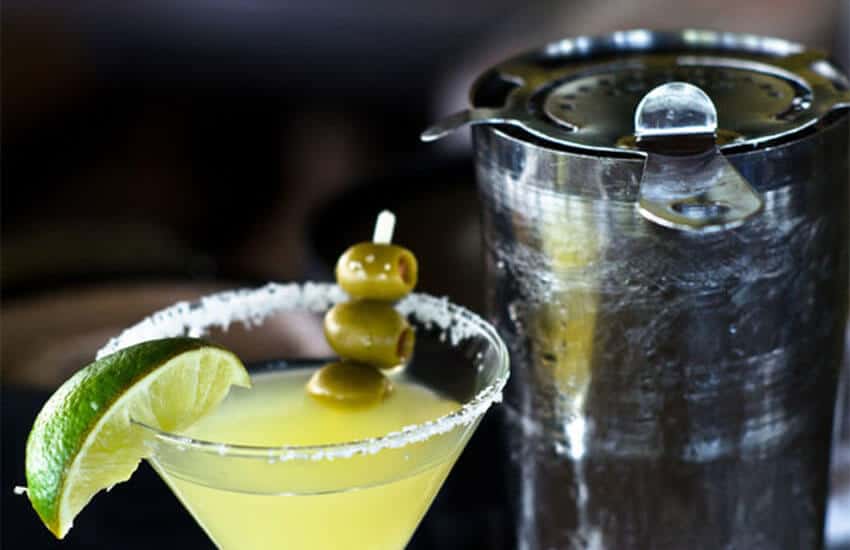
Mexican Martini
2 oz. tequila reposado
1 oz. Cointreau
1 oz. fresh lime juice
¾ oz. fresh orange juice
2 green olives
½ oz. olive brine
Salt
Wet half the lip of a martini glass and dip in salt; chill in refrigerator. Pour tequila, the lime and orange juices and the olive brine into a cocktail shaker; fill with ice and shake vigorously for 10 seconds. Strain into glass. Garnish with olives on a spear. — www.cookingnytimes.com
Moisten rim of 1 cocktail glass with lime wedge. If desired, rim glasses in salt. Place tequila, mango nectar, lime juice, Sriracha and frozen mango in blender; cover and process until smooth. Pour into prepared glass. Garnish with lime wedge and sliced mango.
In blender, mix pineapple, lemon juice, lime juice, simple syrup, salt, tequila and Cointreau with ice cubes. Blend on high until smooth and frothy. Pour into pitcher; serve over ice.
Frozen Margarita
8 oz. blanco tequila
1 cup lime juice
4 oz. Cointreau
2 oz. simple syrup or agave syrup
4 cups ice
Garnish: lime wheels or wedges
In a blender, process all ingredients until slushy, adding more ice as necessary. Serve immediately, garnished with lime.
Mexican Margarita anyone?
Margarita Shandy (for a crowd)
1 (12-oz.) can frozen limeade concentrate
8 oz. reposado tequila
12 oz. water
1 lime, thinly sliced
24 oz. lager or pilsner beer, chilled
Salt for rimming glasses
In large pitcher, mix limeade concentrate, tequila and water; stir well to mix. Refrigerate up to 6 hours or proceed immediately to next step.
Just prior to serving, fill pitcher with ice, lime slices and beer, stirring gently. Serve immediately in salt-rimmed glasses.
Watermelon Margarita
6 oz. fresh watermelon juice from 1½ cups of chopped seedless watermelon, blended and strained
2 oz. tequila blanco
2 oz. fresh lime juice, rinds reserved
1 Tbsp. salt
1 tsp. Tajín (find it in your Mexican market’s spices section)
Ice, as needed
Optional: 2 oz. Cointreau
On a small plate, combine salt and Tajín. Set aside. In a shaker filled with ice, combine watermelon juice, tequila, Cointreau (if using) and lime juice; shake well. Rim 2 rocks glasses with lime juice and salt mixture. Fill glasses with ice; strain margaritas into the glasses and serve. — cookingnytimes.com
Jamaica Tequila Cooler
½ cup sugar
½ cup water
1/3 cup dried jamaica (hibiscus) flowers
2 oz. lime juice
1 tsp. lime zest
1 cup homemade hibiscus-lime syrup (see below)
1 cup blanco tequila
2 cups tonic water, chilled
1 lime, sliced thin
To make the hibiscus-lime syrup: in small saucepan, simmer sugar and water over medium-high heat, stirring occasionally. Remove from heat; add jamaica and lime zest. Stir, cover and steep 15 minutes. Strain, cool and add lime juice.
In a pitcher, place lime slices, hibiscus-lime syrup and tequila. Refrigerate up to 6 hours or add tonic water, stir and serve over ice.
The president was buoyant this week despite announced budget cuts and a prediction by the credit rating agency Moody's that Mexico will likely enter a recession in 2023. Photos: Presidencia
President López Obrador was in Nayarit last weekend, eating seafood, checking up on a new canal and welcoming Cuban doctors.
Monday
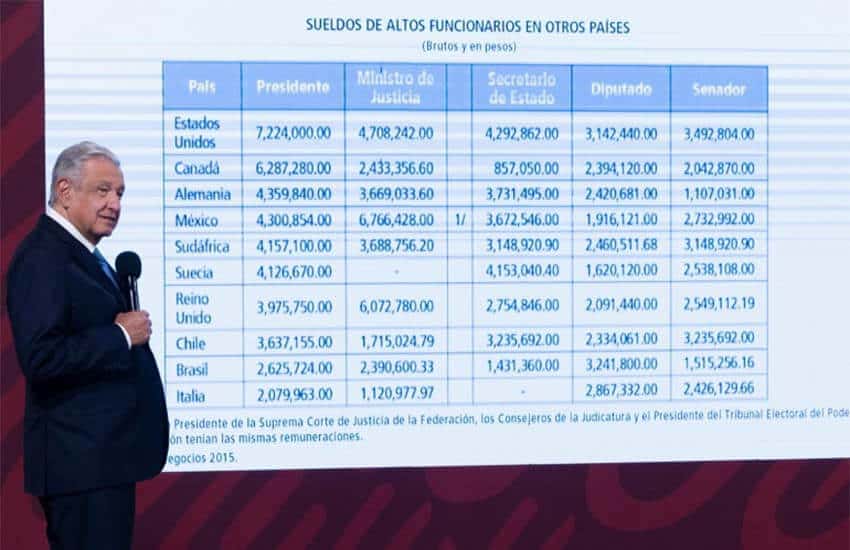
As he had promised, the president revealed the salaries of Mexico’s public servants who earn more than him. Despite a law change obliging state workers to earn less than the head of the executive, some had “applied for amparos or did not care about what the constitution establishes,” the president said, referring to a legal defense often used as a delaying tactic.
The head of the consumer protection agency Profeco, Ricardo Sheffield, dished out the numbers and job titles. Among the 11 government officials earning more than AMLO are the Attorney General, Alejandro Gertz Manero; the head of the National Statistics Institute, Graciela Márquez; and the head of the National Electoral Institute, Lorenzo Córdova.
Other “little angels” in the judiciary, Sheffield added, were earning more than twice the president’s salary.
Mexico’s top civil servant salaries are more economical than those of the U.S., Canada and Germany, but AMLO was miffed that some are higher than his, in violation of the law.
Further legal fog arose later in the conference when the president confirmed it was full steam ahead for his Maya Train project. “There is no legal problem,” he insisted, following renewed construction on the project, which was recently declared a project of national security despite a standing suspension order on construction from the courts.
The tabasqueño chief executive then detailed the pressing security threat to which the train’s national security designation referred: “A foreign government is intervening,” he said, naming the United States government as the offending foreign party. He also added that a loss of “the people’s money” due to delays was another security issue.
Tuesday
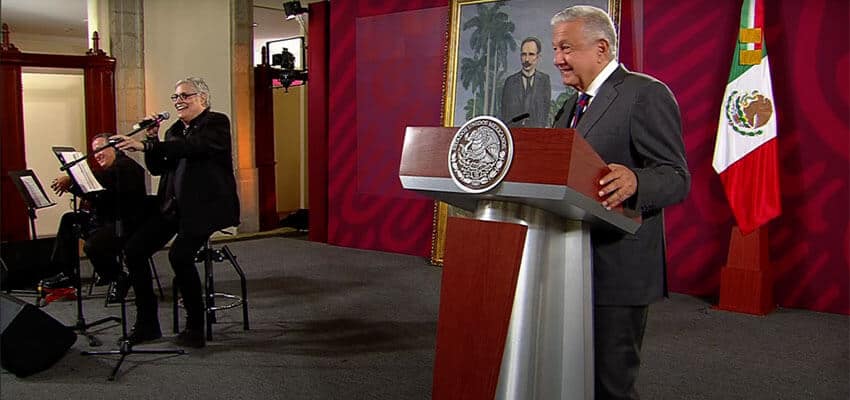
The next day, Cuba took center stage as the president commemorated a symbolic date of the Cuban Revolution. A lifesize painting of Cuban politician and poet José Martí hung at the back of the stage, and the president announced that one of his favorite Cuban singers, Amaury Pérez, would perform.
Foreign Minister Marcelo Ebrard also announced the return of 8,970 globally dispersed pieces of heritage art during AMLO’s administration. In a separate, somewhat counterintuitive victory, Ebrard said the U.S. would bump visas for Mexicans by 45,000 this year — from 310,000 — and that 55,000 U.S. visas would be available for Central Americans and Haitians.
“I want to … thank the president and his cabinet for the solidarity, the courage, the generosity with which they have been at Cuba’s side, defending Cuba, helping Cuba, understanding Cuba, opening up to Cuba in a brave way … I want to tell the president that Cuba … respects him and loves him,” Pérez said, backed by an acoustic guitarist providing a melody.
Pérez performed three songs, the second dedicated to the Mexican Catholic patroness the Virgin of Guadalupe.
“Should I sing another?” Pérez asked the room, met by an affirmative response from journalists. “That’s how the Mexican press is; I love them,” he told the gleeful reporters, who were probably long starved of affection at AMLO’s morning conferences.
AMLO’s ‘favorite Cuban singer’ Amaury Pérez performed at Tuesday’s press conference.Wednesday
“We’ve brought a lie and a piece of good news,” the government’s media monitor Elizabeth García Vilchis said to introduce her usual “Who’s who in the lies of the week” portion of Wednesday’s press conference. García assured that the press was wrong to link the “pothole” on a runway at Mexico City Airport (AICM) to the cancellation of the semi-built airport in Texcoco in 2018.
The large chunk of missing asphalt temporarily closed the runway at AICM days earlier.
García turned to Bloomberg for kinder reading, which had lauded “Mexico’s super peso.”
“Amid the carnage in emerging-market currencies this year, there’s been a surprisingly resilient outlier: the Mexican peso,” García read from the article, which pointed to Chinese factories moving to Mexico as a major contributor.
Yet, despite the super peso, the president announced that he was committed to even greater governmental frugality. “We are going to pass from the phase of republican austerity to a more advanced phase, that of Franciscan poverty,” he told reporters, referring to a Catholic order that forbade its members from owning property and forced them to beg while preaching.
In practice, the president said public servants would travel abroad less, before commending the fact that not a single new vehicle had been bought for state workers during the administration.
Thursday
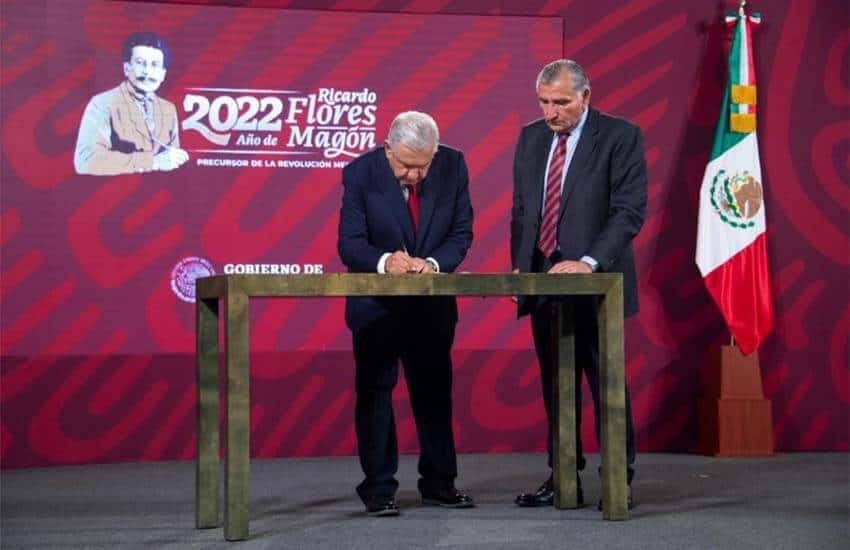
The president signed a decree to ensure drinking water would remain available to the drought-stricken state of Nuevo León.
After announcing severe belt-tightening on Wednesday, Thursday was a day to revel a bit in one’s accomplishments: 2.5 trillion pesos were saved through AMLO’s austerity plan in 2021, the president said, and this year, the government has saved even more.
Given the apparent strength of the coffers, AMLO was unperturbed by credit rating agency Moody’s prediction that Mexico was heading for a recession in 2023. “They are measurement models that go hand in hand with neoliberal politics but are in a clear decline; the neoliberal model is in crisis in the world,” he said.
“Honesty,” the president added “is the greatest wealth of Mexico … even if there is a crisis, if there is honesty, if there is no corruption, we can handle it.”
That resilience may soon be put to the test after the governments of the U.S. and Canada initiated legal proceedings over a possible breach of the USMCA trade agreement. Mexico’s two northern neighbors have complained that Mexico is unfairly favoring state energy companies.
“Even in the case of the most important market in the world, if having access … means us giving up sovereignty, we can’t accept it. We can’t hand over our independence to any foreign government,” the president insisted before reading Chapter 8 of the USMCA document, which protects Mexico’s ownership of hydrocarbons.
Friday
Discussion of an even more natural resource headed Friday’s conference: water. Access to clean water for drinking and sanitation is a human right, but it can be scarce in Mexico, where droughts are severe. Conversely, at some times of year, flooding can pose an even greater immediate threat.
The president signed a decree to support the Nuevo León government to ensure drinking water would remain available. Since early June, in the metropolis of Monterrey, running water has only been available six hours per day, if at all. López Obrador added that the state was a victim of its own success and that infrastructure hadn’t kept up with the growth of its population.
Later in the conference, there was more economic news to celebrate.
“I’m going to say it to boast a little. There was economic growth for the second quarter. We had 2% growth last quarter in relation to the previous one, while in other countries it is being reported that [economies] are declining,” the president announced, briefly before striding away to attend to the nation.
Oversized pickup truck parked on a Houston, Texas, street. Facebook
As I write this, I’m snuggled up under a thick, navy blue blanket, velvet on one side, wool on the other. My feet are tucked under me to prevent them from turning into ice cubes.
Outside, it’s literally 101 degrees.
Frigid air conditioning! My old nemesis, I’d nearly forgotten about you.
Last week, I wrote about how I arrived in Mexico from Texas a full 20 years ago. So, this week, I’ve decided to write about my impressions of being back in the States after a full two and a half years of not having returned here.
I wasn’t really sure what to expect when our plane touched down. After all, it’s been a pandemic-long while since I was here last. The narrative of U.S. political life seems like it’s been extracted from the first few pages of some futuristic dystopian novel.
I’m an avid reader of the news, and every time I’ve had a conversation with a paisano of mine in Mexico over the past couple of years, my main question has been, “What the hell is going on up there?”
So far, though, my experience with people on the ground has been pretty good. Thank goodness!
One of the things I was a little worried about was our masks: in Mexico, everyone is still wearing them … some even wear them outdoors when they’re walking alone along the street!
While I’m a bit flexible depending on the situation, my 8-year-old daughter is at a time in her life when everything is very black-and-white, and she has worn her mask religiously on every trip out of the house.
But here, no one is wearing them — even indoors — except me and my kid. I’d heard stories of the types of people who thought COVID-19 was a hoax mocking people in masks, and I was nervous about encountering them. Even commenters on my articles have been a bit mean about it, the most memorable of them calling masks “face diapers.”
Fortunately, I’ve been reminded several times since arriving here that Texans are mostly just really, really nice despite some pretty crazy voting patterns (though I insist that Texas is easily a purple state at worst, which is more of a voting problem that an ideological one). Several people a day strike up friendly little conversations, and many women especially have complimented me on my tattoos (it’s too hot for sweaters here).
The things that have taken me aback?
Monster trucks. Like, a lot of them. They’re as big as houses, and I don’t get it. I don’t think most people driving them are building contractors that have to haul tons of bricks from one place to another, so what’s the deal?
The air conditioning also really is extreme. I don’t know how to dress for the day. It’s 100 F heat outside, and 65 degrees inside which, to me, is way too cold. Isn’t there anything between a sauna and a refrigerator? Right now, I’m wearing pants and a T-shirt. I brought shorts and dresses with me, but I’m too cold inside houses and buildings to put them on. It’s not the worst problem to have, I suppose, but it seems absurd that our extreme differences in temperatures must mirror our extreme political differences.
There are pro-life billboards everywhere. Dudes, you won. Whom are you trying to convince? I’d be really impressed if the money spent on these billboards went instead to helping families care for all those “saved babies” that they insist should be born instead of just saying to them upon birth: “You’re welcome, now start pulling on those bootstraps, kid.”
Prices. They’re high. On our second day here, some friends invited us to a water park. It was cool and nice, but tickets were about $60 apiece, so how many people can afford that kind of fun around here? Even a local (somehow nonprofit) production of The Wizard of Oz (very cute) was $25 per ticket. As in most places, there’s a correlation between race/ethnicity and economic prosperity, and it was a bit unnerving to see a sea of almost exclusively blonde heads in these places when white people make up less than half of the Texan population. How’s everyone else having fun?
Well, at least really good ice cream is cheap and plentiful (Blue Bell, you will always have my heart), and I’ve got some tightening pants to prove it.
My daughter is also having a good time, though she’s still a bit disoriented language-wise; her “stranger language” is Spanish, so while she speaks English perfectly, she mostly just stares at people, stunned, when they say something to her here.
I don’t blame her: on my first days back in the States, I often say things absentmindedly in Spanish; it’s my “stranger language,” too. I gave some money to someone standing on the sidewalk asking for help on the way home from the airport (there seem to be a lot more of them now) and said, “Tenga, señor.”
My sister thought I’d said it in Spanish to avoid striking up a conversation, but I honestly didn’t realize I’d not used the right language until she pointed it out.
It’s been a few days, so I’ve finally stopped embarrassing myself by wishing people “buen provecho” as I leave restaurants. But the trip is young! I’ve got a week and a half left of adventures here.
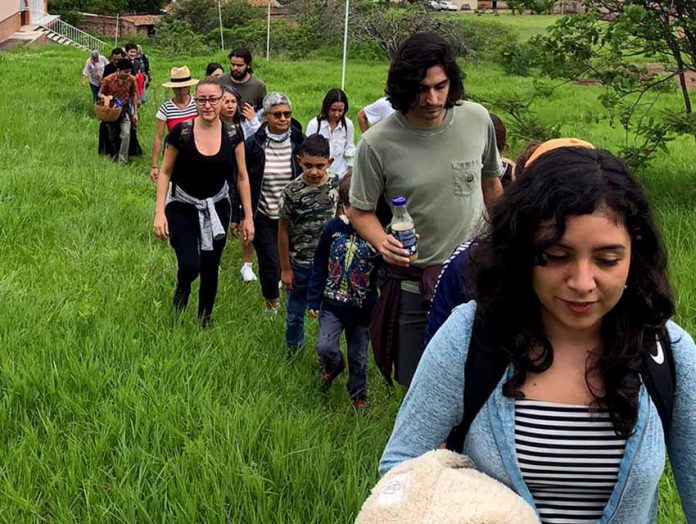
During it's annual festival, a group of visitors leaves Mixtlán in search of mushrooms, each group accompanied by an expert. Robert Ornelas
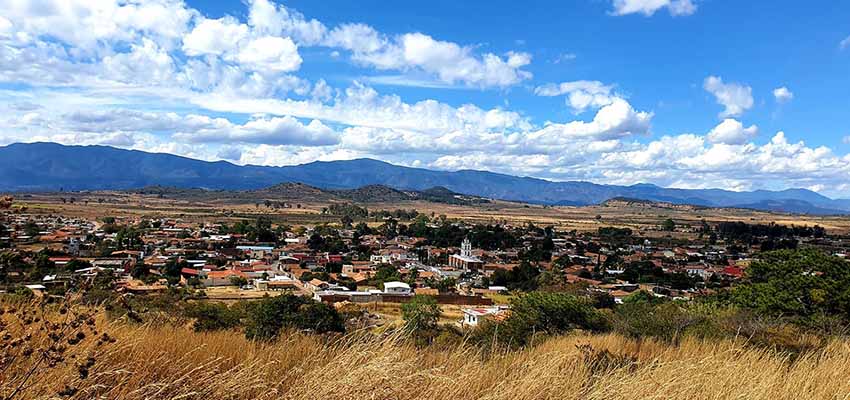
Mixtlán is a very small town located about halfway between Guadalajara and Puerto Vallarta in Jalisco. Its name means “the place of the clouds,” but in recent years it has become better known as the land of mushrooms.
This is thanks to Mixtlán’s Director of Tourism, José de Jesús Preciado de León, founder of the town’s popular Feria del Hongo: the Mixtlán Mushroom Festival, which was held this year over the weekend of July 15 to 17.
“I founded the Feria in 2016,” Preciado told me, “so this is the seventh edition of the event. This festival is educational, with emphasis on science and ecology. For example, we have activities that take place during guided tours in the woods. On Saturday and Sunday mornings, groups leave town at 8 a.m. and they head up into the highest parts of the hills surrounding us.
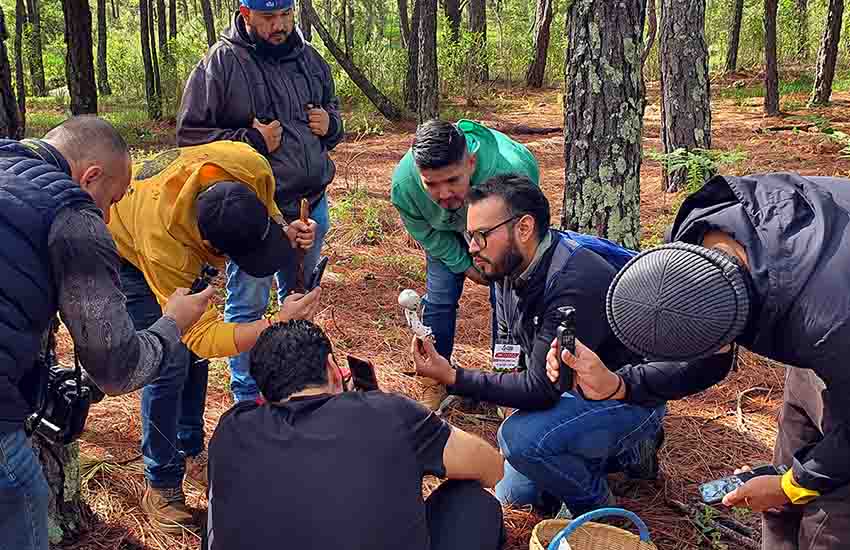
“Each group is accompanied by an expert mycologist from the University of Guadalajara. The mycologists identify the varieties of mushrooms the group finds and explain how to distinguish them from other mushrooms and also how to pick them and how to transport them.”
Over 160 species of mushroom grow in the vicinity of Mixtlán, 40 of which are edible. Jesús Preciado
I was surprised to learn that there is a proper way to pick and transport mushrooms. The correct way to collect a mushroom, Preciado says, is to cut it off at its base with a knife. Grabbing and pulling it is all wrong because that mushroom is just the “fruit” of the fungus, which is actually a network of mycelium fibers hidden from view under the ground and literally connecting together all the trees in the forest.
While we commonly think of mushrooms as plants, it seems they are really more closely related to the animal kingdom.
Once you cut the mushroom, comments Preciado, you should deposit it in a basket: the woven kind, made from wicker or reeds. The reason for this is that the mushroom is constantly liberating spores in order to reproduce itself. So, the construction of a traditional basket allows the spores to fall to the ground.
“Yes,” confirms Preciado. “As we walk about collecting mushrooms, we are also distributing its spores all over the woods.”
A University of Guadalajara mycologist, center, answers questions about mushrooms.
This ecological aspect of the festival takes place out in the hills, and when the mushroom gatherers get back to town, they find an extensive exhibition laid out on tables. Here the mushrooms have been cleaned, classified and tagged by the mycologists and then carefully placed on a decorative bed of moss and other wild plants.
At each table, there are experts to explain or clarify doubts the visitors might have about mushrooms. The public can admire them and photograph them, but they’re not allowed to touch them.
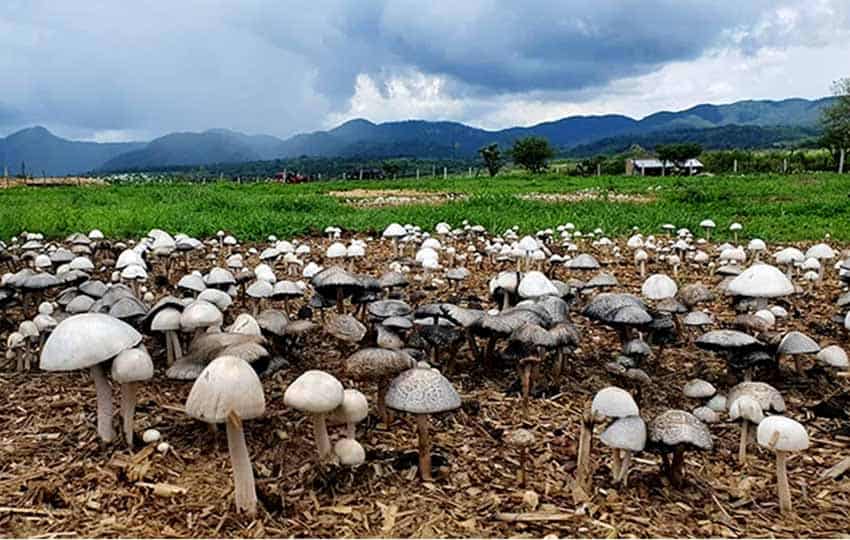
“In Mixtlán, we have over 160 kinds of wild mushrooms,” says Preciado. “With the first rains, they start popping up in the meadows and clearings. Here we call them porras or champiñones silvestres (wild mushrooms).
“As the rains continue and the temperature drops, all kinds of them begin to appear in the high forest, reaching their maximum in July and August. Of the 160 types that grow around here, 40 species are edible: that’s a lot!”
By carrying freshly picked mushrooms in a wicker basket, their very fine spores are spread far and wide. HomEr-MotayAyin
The town of Mixtlán is full of mushroom eaters, he says.
“When the rains are upon us, families head for the woods to collect mushrooms: children, grandparents, everybody goes out together to pick mushrooms! So this festival of ours is a homage to these traditional hongueros (mushroomers) who are passing down from generation to generation the culture of mushroom-gathering.”
Preciado says that Mixtlán is the most “mushroom crazy” of all the communities in Mexico’s Sierra Occidental, “We eat the most and have the greatest respect for them: so that’s why we have a mushroom festival, to commemorate the benefits that Mother Nature provides for us.”
Mushrooms are considered a “complete food,” containing a lot of protein — although not as much as meat or milk. They have all the essential amino acids required by human beings and even a little fat. It is said that if they had to choose between meat and mushrooms, many of Mixtlan’s citizens would opt for the latter. “This,” states Guzmán Ávalos of the University of Guadalajara Mycology Lab, “is definitely not the norm in Jalisco.”
The people of Mixtlán traditionally eat only four kinds of mushrooms. “But,” says Preciado, “in 2015, I began looking at some of the other species. I brought mycologists here, and based on what they told us, we begin to try some of the others … and now we are enjoying 10 edible species … and there are still 30 edible species more that we haven’t even tasted yet, out of an abundance of caution.”
With a picture like this, it’s easy to see how Mixtlán residents get excited about hunting down mushrooms! Art Guevara
“They are safe to eat, but we don’t know how to prepare them, and we’re afraid to eat them. But little by little, thanks to the Feria, we are slowly exploring this panorama of options — all those other edible mushrooms that are never taken out of the woods.”
Jesús Preciado became Director of Tourism in 2016. “At that time,” he says, “I got the idea for a festival, but I wanted something well-organized, not a pachanga (noisy party). No, we wanted our festival to be ecologically sound, educational, scientific, gastronomical, cultural, musical and a source of income for the townspeople.
“This year, we inaugurated the festival on Friday, July 15. We had walks to the woods on Saturday and Sunday mornings from 8 a.m. to 12 p.m., and in the afternoons, there were workshops and conferences conducted by experts from the University of Guadalajara. Then there was a Best Drawing Competition for kids, followed by the Biggest Mushroom Contest. We had 11 entries for that, and the largest measured 32 centimeters in diameter.
“It was a brown Ganoderma, and the person who picked it received 1,000 pesos. We also had stands offering mushrooms to eat. Mixtlán has a population of 2,000 people, but over this three-day festival, our little town received around 6,000 visitors!”
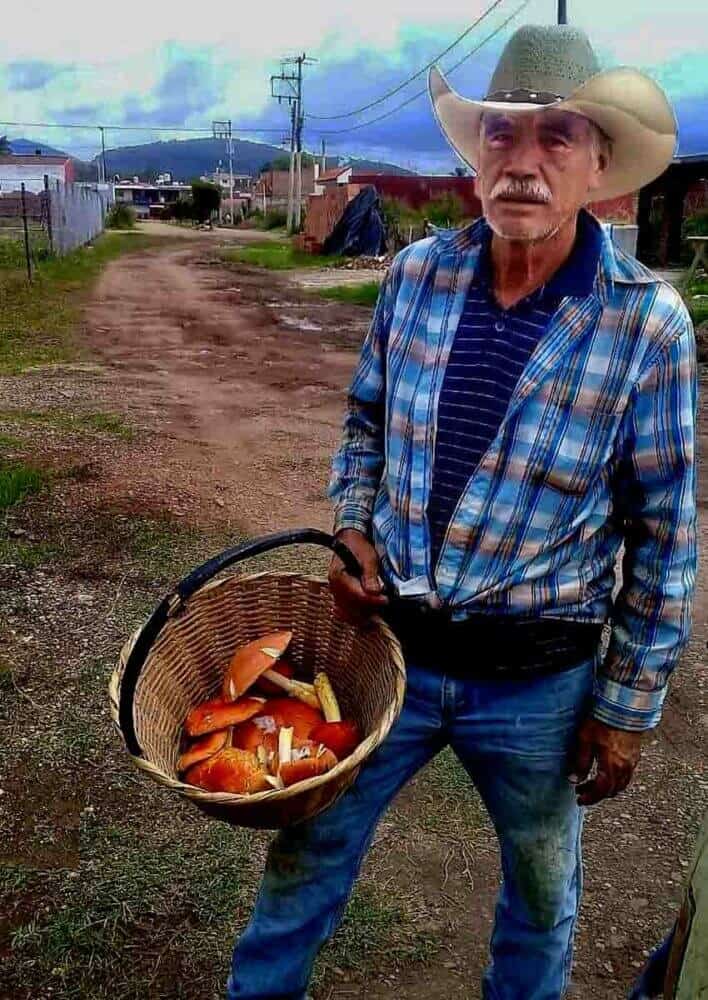
Experienced mushroomer Lorenzo Preciado displays his Caesar’s mushrooms (Amanita caesarea).
Besides the Feria del Hongo, what else does Mixtlán have to offer?
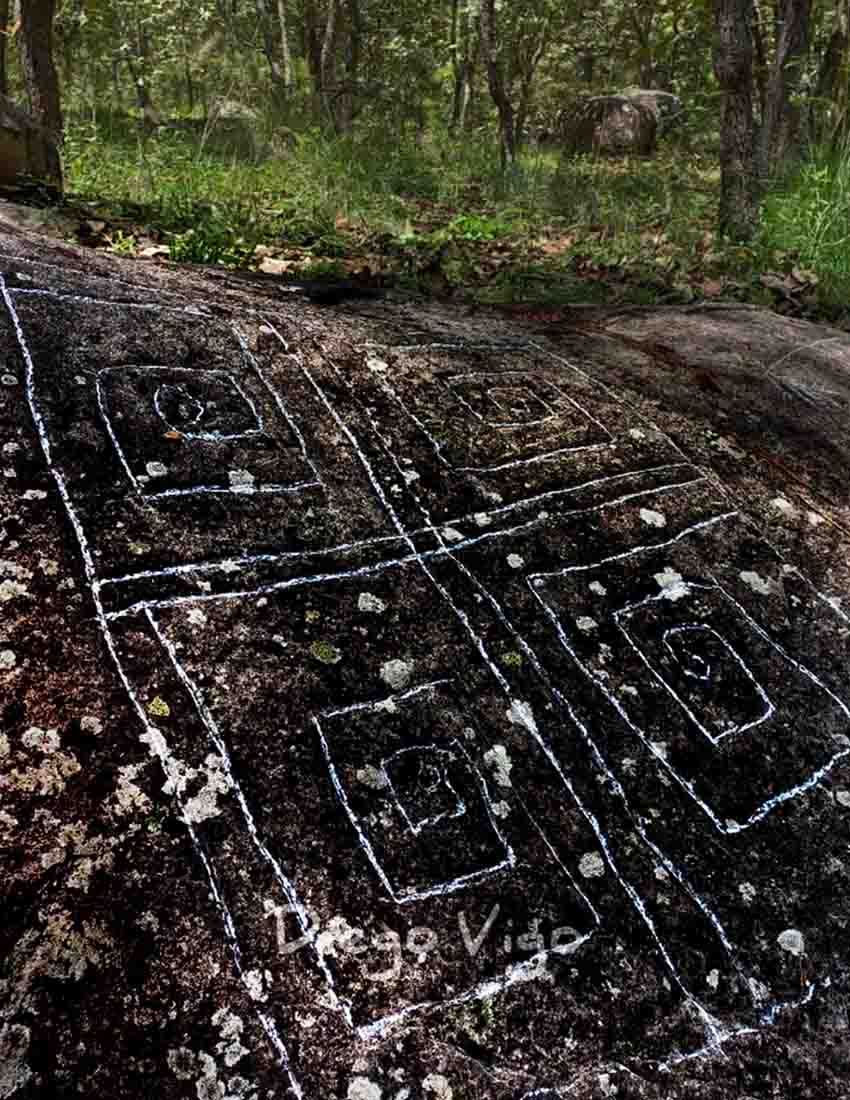
Rock art is one option. Mixtlán has four or five sites with petroglyphs. as well as the ruins of pre-Hispanic settlements. There is also a spring with naturally carbonated water. Local people add salt, chile and limòn (lemon-lime) to make a drink called “la rusa” in Mexico. Finally, for the brave-hearted, there is a lovely waterfall and pool called El Charco del Condenado (The Pool of the Damned), into which, a legend says, the irate townsfolk once threw a local man who had been transformed into the Devil.
“This is a great place for a swim, but people still fear that if they jump in, they will grow horns,” Preciado told me.
To appreciate everything that little Mixtlán has to offer, mark your 2023 calendar right now. Next year, the Feria del Hongo will take place on Friday, Saturday and Sunday, July 14–16 — and don’t forget your wicker basket!
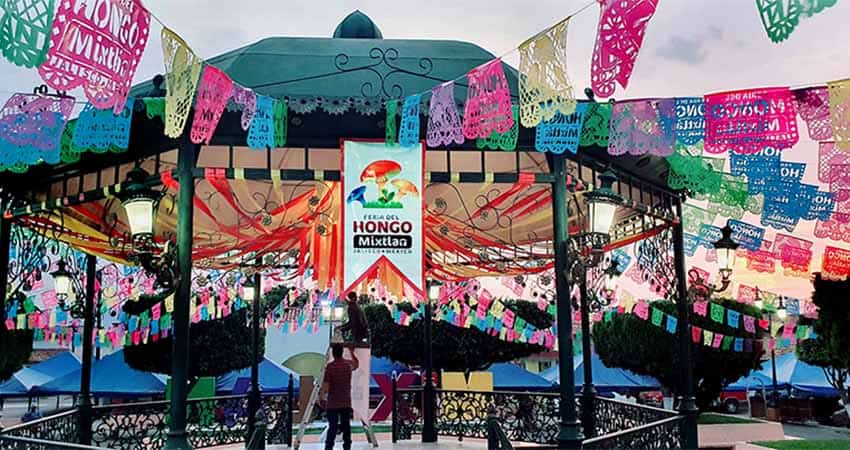
The kiosk of Mixtlán, decorated and ready to receive visitors to the annual Feria del Hongo.
The writer has lived near Guadalajara, Jalisco, since 1985. His most recent book is Outdoors in Western Mexico, Volume Three. More of his writing can be found on his blog.
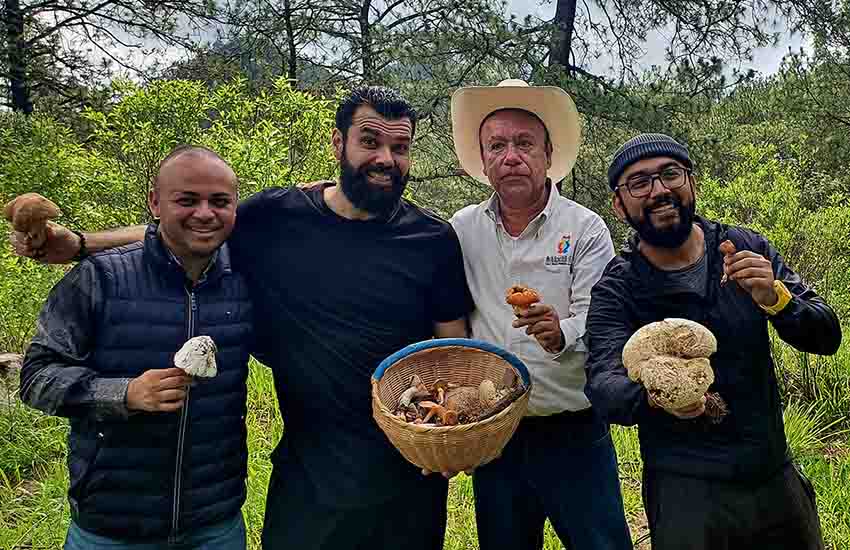
Mixtlán’s Director of Tourism, Jesús Preciado, in the sombrero, introduces the press to the area’s local mushrooms.
Mushrooms collected in the woods are cleaned, classified and laid out for exhibition by mycologists. Magaly Rayita
Mixtlán gets its name from the Náhuatl words mixtli (cloud) and tlan, which means ‘place.’ Jesús Preciado
This petroglyph, located not far from Mixtlán, appears to be a patolli, a kind of ancient “board game” popular in pre-Hispanic times. Diego Vigo