Michelle Arellano plans to study medicine first, but is also interested in marine biology and acting.
After passing middle school and high school exams earlier this year, a nine-year-old child genius from Chiapas is planning to commence university studies in medicine next month.
Michelle Arellano Guillén of Tuxtla Gutiérrez also aspires to become a marine biologist and actor, but will first focus on graduating as a doctor so she can follow in the footsteps of her mother. According to the Milenio newspaper, Michelle is currently awaiting acceptance into a university program, but other reports said she was starting a degree online on August 29.
“I’d like to be like my mom,” she said, referring to her dream of becoming a cardiovascular surgeon. “… I like medicine, … I know that because I’ve been to surgery with my mom to see what the organisms inside the body are like,” she said in an interview with Uno TV.
Michelle, who has Asperger’s Syndrome, stood out from a very young age, learning to speak English at the age of one and a half and to read and write at four, according to her mother.
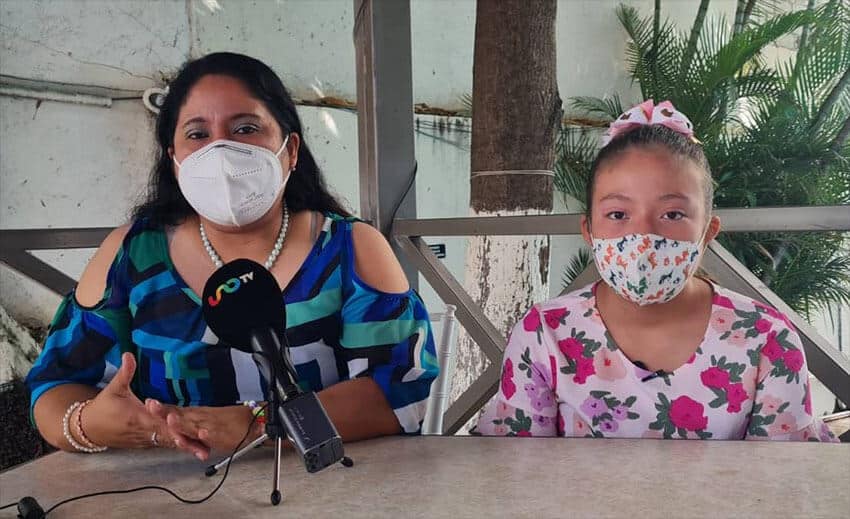
Michelle with her mother, a medical doctor.
“She speaks four languages [in addition to Spanish]; she speaks English, German, French and Italian. She speaks English at an advanced level and German, French and Italian at a basic level,” Karina Guillén said. “She’s been a state swimming champion [and] she’s a black belt in taekwondo. She has eight trophies and 890 medals in total because she’s a great athlete as well.”
Karina initially believed that her daughter’s intellectual gifts were simply the result of the way she and her husband interacted with her when she was very young. “As I’m a doctor we gave her a lot of early stimulation,” she said.
However, medical and psychological testing later determined that Michelle was a gifted child. Michelle’s time in primary school — from which she graduated last year — was abbreviated because she skipped grades due to her impressive intellect.
Her parents subsequently found out that she could demonstrate that her skills and knowledge were up to middle school and high school standard by preparing for and sitting single exams offered by Ceneval, a national education assessment center. Michelle, who will turn 10 at the end of August, passed the middle school exam in March and the high school one earlier this month, paving the way for her entry to university.
Testing has also deemed she has an IQ of 158, just two points below Albert Einstein’s estimated intelligence quotient. Although her educational achievements are well beyond her years, Michelle retains some hobbies common among girls of her age, such as playing with dolls, music and sports.
“I really like doing sports, like swimming, basketball and taekwondo. I also know how to play the piano. When I grow up I want to be a doctor and a marine biologist because I really like animals,” she said.
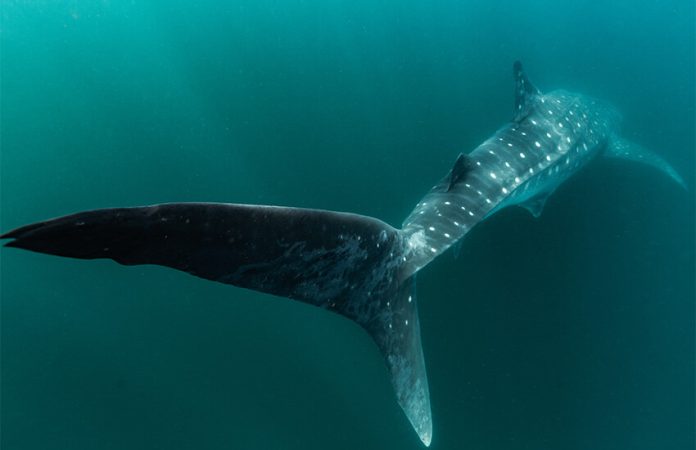
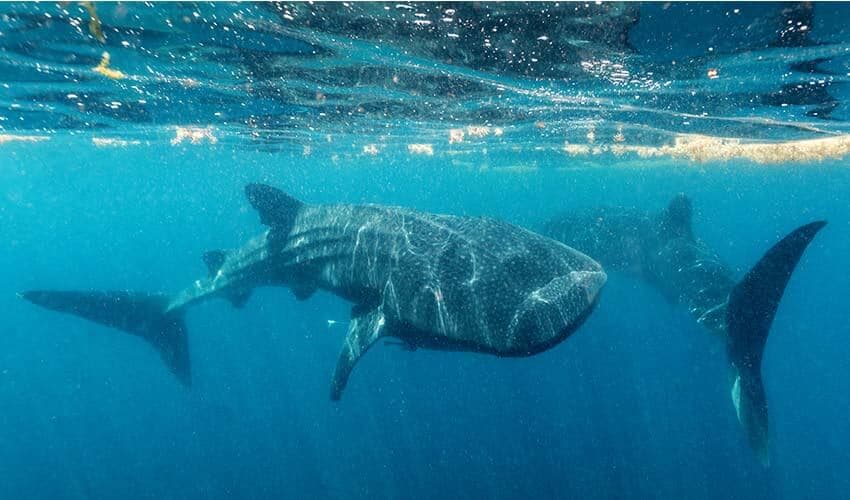
Whale sharks can reach 19 meters in length. They're about the same size as their ancient cousin, the megalodon. Gustavo Costa
The skin of a whale shark reminds me of a domino I had as a child.
Whale sharks (Rhincodon typus) are the largest living vertebrates, after the baleen whales. Reaching 19 meters in length, these giant fish avoid cold water and thus roam the world’s tropical and subtropical seas.
Some of these ancient migratory fish spend a substantial part of their lives in the Caribbean Sea, where they are particularly fond of Mexico’s Yucatán Peninsula, as sea turtles are.
Whale sharks are as big as their legendary cousins, the now extinct megalodon (Carcharodon megalodon) — a black-eyed white shark equipped with 3-meter-long jaws that patrolled the warm seas of the Neogene era — the second of three divisions of the Cenozoic Era — 28 to 2 million years ago, devouring whales, sea turtles, other sharks, dugongs and any large creature that dared cross its path.
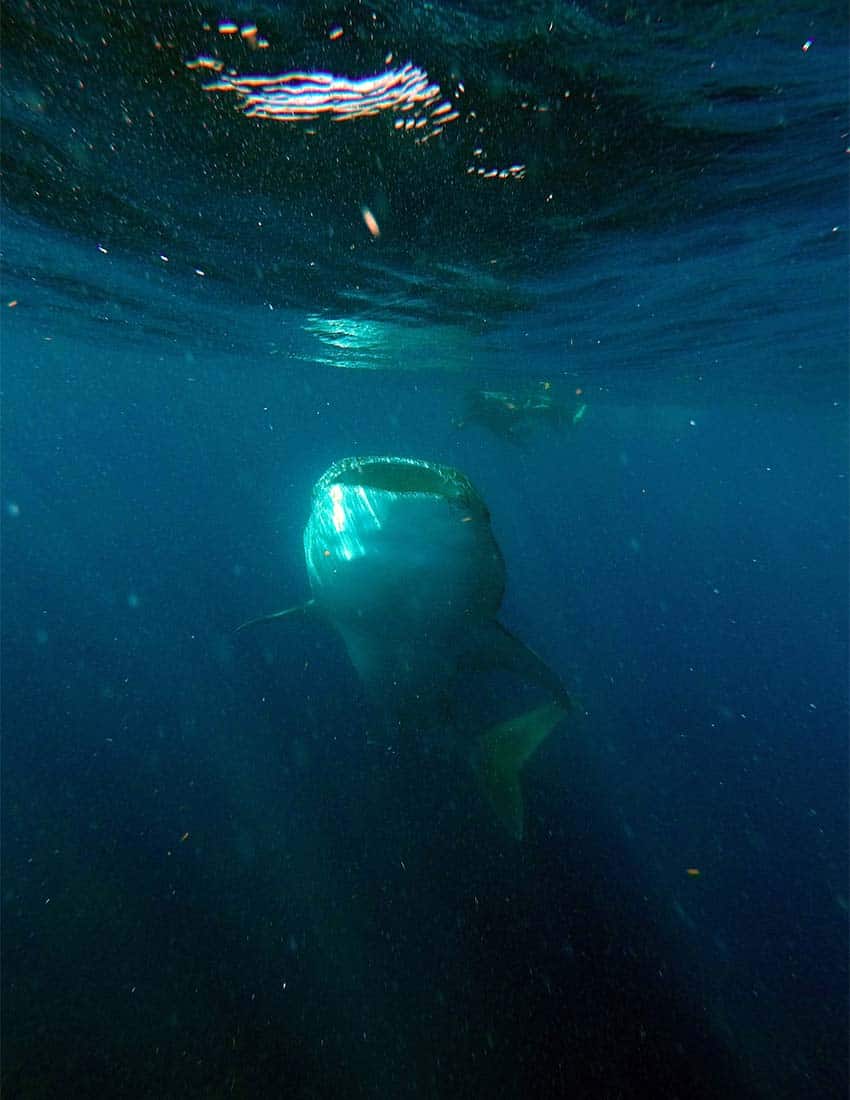
Despite their enormous size and their 3,000 teeth, whale sharks pose no real danger to human divers. They feed on plankton and small fish. Emanuel Mimila
Whale sharks are one of only three species of filter-feeding sharks: they feed by sucking huge amounts of water at high speeds into their mouth — which passes through unique filtering pads in the throat that trap plankton and small fishes — and then spew the “cleaned” water out through their gills.
They capture massive amounts of plankton. Their jaws have more than 3,000 minuscule teeth that they use to macerate the larger bits of food.
The second shark that feeds this way is also the second largest fish (up to 12 meters long), after the whale shark. The basking shark (Cetorhinusmaximus) is a big-nosed, gentle creature endangered by overfishing to satisfy our insatiable appetite for their meat, skin, and fins.
And the third one is the smallest of the three — up to 5.5 meters long: the megamouth (Megachasma pelagios), a queer-looking, flaccid-bodied, bioluminescent, deep-water shark very rarely seen or captured.
My first face-to-face encounter with a whale shark was 15 years ago near Holbox Island in the Mexican Caribbean; the second was eight years ago in Bahía de La Paz, in the Gulf of California. In both cases, I was swimming with my young daughter.
In Holbox, as we stared intently at its left eye — the size of a headlight on my wife’s car — the whale shark looked back at us as if asking, “Who the hell are you and what are you doing here?”
I saw that wide-open left eye wink at me, even knowing that sharks don’t have eyelashes — an intimate stare down, during which I sensed the mysteries of nature and the strength of an ancient creature longing to live.
A few days ago, I came back from my third close encounter with whale sharks, this time in El Azul, some 20 kilometers off Cancún in the state of Quintana Roo. Here, and in a few other nearby sites, scientists have identified more than 1,000 different whale sharks that seasonally gather to feed in these rich waters.
Only in 2019 was the first recording of whale sharks mating captured. A birth has never been seen. Gustavo Costa
The world’s largest known aggregation of these sharks — 420 of them in just 18 square kilometers — was found between Contoy and Mujeres Islands, not far from where I was swimming.
This time, being so close to these gentle giants, I couldn’t help but imagine myself gulped down by those huge jaws — like Jonah — and then spewed out with the water through the formidable gills — like Pinocchio — in the process that nourishes the world’s largest fish.
As with nearly all animal species, female whale sharks are more attractive, vigorous, charismatic, enigmatic and elegant than males. They are also larger and longer-lived, travel much farther and carry hundreds of shark pups in their belly.
These sharks are born alive, yet no human being has ever witnessed this natural miracle. In fact, off the shores of the Galapagos Islands is the only place where pregnant whale sharks have been observed with any regularity.
Most whale shark populations across the world are shrinking. They are threatened by overfishing, mainly in Asian seas, where people are still eating their fins, meat and liver.
But they survive despite being frequently struck by boats and despite the changes in water temperature, productivity and marine currents brought about by global warming — and despite some whale shark tourism operators in their habitat who ignore the guidelines that regulate this multimillion-dollar industry.
Every year, from May through September, whale sharks return to El Azul to feed and build their energy reserves. We know a good deal about their lifestyle while they are here, but we don’t know exactly where they go or what they do once they leave El Azul.
However, it is clear that Mexican waters are a whale shark paradise: the Yucatán Peninsula in the Caribbean. In the Pacific, it’s the Gulf of California, the islands of the Revillagigedo Archipelago and the states of Nayarit and Oaxaca.
Whale Shark vertical feeding in "El Azul" aggregation of Mexico
A video of a whale shark feeding during the annual El Azul whale shark aggregation.
Scientists working for Pronatura Península de Yucatán — one of Mexico’s most important nongovernmental organizations — have studied whale sharks for a long time. They told me that one of every three sharks that visit El Azul is a female; the rest are males, mainly immature ones.
Unfortunately, I will never know whether the last whale shark I swam with was a female or a male. But I witnessed how she/he swam, rhythmically brandishing its bifurcated tail from right to left and from left to right while its gills slowly opened and closed like an accordion, allowing the warm waters of the Caribbean to flow through them like a melodious salty river.
As I gazed for one last time at the gargantua in the water with me, the whale shark’s colossal body, like a titanic domino, slowly vanished into Mexico’s blue sea, El Azul — a place where, occasionally, souls come to heal.
In loving memory of Priscilla Pinzón de Vidal (May 10, 1931–June 27, 2022) who taught me to respect and love all living creatures.
Omar Vidal, a scientist, was a university professor in Mexico, is a former senior officer at the UN Environment Program and the former director-general of the World Wildlife Fund-Mexico.
At left, "El Mayito Gordo." At right, the DEA wanted poster for his father, "El Mayo" Zambada.
The eldest son of a Sinaloa Cartel drug lord was released from U.S. prison on Thursday.
Ismael Zambada Imperial, also known by the moniker “El Mayito Gordo,” is the first son of Ismael “El Mayo” Zambada García, one of the leaders of the Sinaloa Cartel.
Zambada Imperial was imprisoned in a federal penitentiary in San Diego, California, after being extradited from Mexico in December 2019. In April 2021, he pleaded guilty to importing and distributing methamphetamine, cocaine and marijuana.
He was sentenced to nine years in prison on June 24. Thanks to time already served, only a little over one year remains on his sentence, which he will serve on conditional release. He was originally arrested in November 2014 in Culiacán, Sinaloa.
Zambada Imperial will be put back behind bars if he’s found in possession of drugs and must undergo a drugs test within 15 days of his release, and two further tests thereafter. He will also have to participate in a domestic violence reeducation program.
El Mayito Gordo’s criminal activities are part of a family tradition. His brother, Ismael Zambada Sicairos, was indicted alongside him, as was the son of imprisoned drug lord Joaquín “El Chapo” Guzmán, Iván Archivaldo Guzmán Salazar. Both men are fugitives.
Zambada Imperial is the third son of Zambada García to be imprisoned in the U.S. Vicente Zambada Niebla was arrested in Mexico in 2009 and extradited to the U.S. a year later. He was sentenced in May 2019 to 15 years in prison, but is no longer in the U.S. prison system and was likely released as a protected witness, the newspaper Milenio reported.
Serafín Zambada Ortiz was the second son to face U.S. prison. He was arrested in November 2013 after trying to cross into the U.S. on foot from Sonora. He was sentenced to five and a half years in prison and was released in September 2018.
U.S. officials increased their reward for information leading to the capture of Zambada García in September. The whereabouts of the former poppy field worker was deemed to be worth US $15 million.
Seduced by low prices, some builders are using wiring with risks of short circuits and fires. DepositPhotos
Lured by low prices, many construction companies are using electrical materials that are not authorized for use in Mexico, according to the head of a public-private electricity safety initiative.
“We’ve been finding in recent years that important construction developers are using electrical conductors that aren’t authorized,” Mari Carmen Ruiz, coordinator of the Programa Casa Segura (Safe House Program), told the newspaper Milenio.
In some cases, the materials are “banned in more than 30 countries, but we have more than 43,000 homes with these kinds of wires,” she said.
According to a Milenio report, unauthorized electrical components enter the country after passing customs “irregularly” and are subsequently sold here. They’re attractive because of their low price — especially considering that construction materials in general have increased significantly over the past year — but their use comes with risks such as short circuits and fires.
Not all wiring in Mexico is up to code.
Ruiz said that one of the most frequently detected unauthorized materials is copper-clad aluminum wire, which can contribute to short circuits and cause fires if not of sufficient quality. “If we didn’t allow ourselves to be seduced by the low costs we wouldn’t have that problem,” she said.
Milenio found a difference of up to 2,000 pesos (US $98) between prices for 100 meters of electrical wire. A survey conducted by Programa Casa Segura found that a majority of construction company respondents were using wires that aren’t authorized in Mexico due to their high fire risk.
Ruiz called on companies and individual consumers to buy electrical materials from established businesses and to check that their packaging confirms that they meet official Mexican standards. She also said that people buying a new home should ask developers about the kind of wire used and confirm that it is authorized. People who discover the use of unauthorized electrical components can file a complaint with Programa Casa Segura, which is backed by government and industry organizations.
The CEO of lighting company Signify said that some lights — including Christmas lights— sold in Mexico don’t meet official standards either. “The importation of lights is not properly … [monitored], customs is very porous,” Pedro Martín said.
“Of everything that comes in, there is a large percentage of product that doesn’t meet [official] standards,” he said, warning that there is a risk of electric shocks from poor-quality, unauthorized lights.
Martín gave consumers similar advice to that offered by Ruiz, but added a caveat. “We have to make sure that the packaging has the official Mexican standard stamp, but that’s not enough because there are packages that have the stamp … but in reality [the product] doesn’t meet [the standard],” he said.
“For example, there are LED tube lights that don’t have a safety circuit and if you touch it by mistake you can get a 130-volt shock,” Martín said. Prices of unauthorized lighting products can be 20% lower, but the risk they entail easily outweighs the saving, he said.
Maribel Domínguez talks with a team member. Facebook / MiSeleccionMX
The coach of the Mexican under-20 women’s soccer team has broken her silence after being placed on leave on the eve of the World Cup, amid allegations of sexual harassment against her and her backroom staff.
Maribel Domínguez, 43, was placed on leave on Wednesday and the national soccer federation (FMF) announced the following day that her staff had also been placed on leave after it received undisclosed complaints.
The sports newspaper Cancha quoted anonymous players who alleged Domínguez requested kisses and would invite players to her room and on dates. Domínguez allegedly persisted despite refusals. The newspaper Proceso reported that a member of the coaching staff was previously dismissed by the FMF after a separate complaint.
However, Domínguez rejected the accusations. “What I will not allow, under any circumstances is non-material damage to my person and my family, which have been caused by alleged accusations that impact my values, integrity, honesty and transparency that have characterized me throughout my career as a footballer and coach,” she said in a statement.
Domínguez added that she would “proceed legally … if the opinions and distorted, malicious and unsubstantiated assertions are maintained, since this trial has been held on social media.”
FMF President Yon de Luisa said the federation wouldn’t be commenting further during the investigation. Ana Galindo has been put in temporary charge of the team, just weeks before the U-20 Women’s World Cup starts in Costa Rica on August 10.
Domínguez played in Mexico, Spain and the U.S. in her career and represented the national team 116 times, more than any other female player. She scored 82 goals for the team — more than any Mexican player in the men’s or women’s game at the national level — and earned the nickname “Marigol” for her propensity to find the back of the net.
Domínguez coached the under-15 girls’ national team before taking over as under-20 women’s coach in January last year.
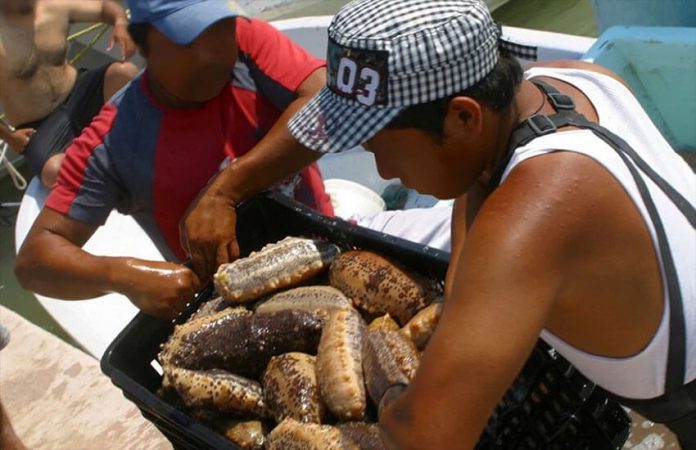
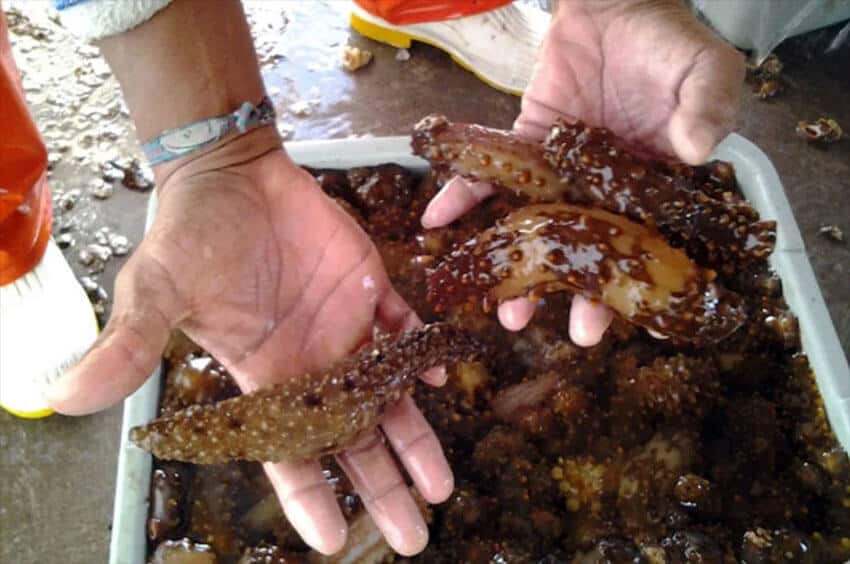
Sea cucumber fishing was banned off the coast of the Yucatán Peninsula in early 2013, but almost 10 years later the marine animals are still being removed from the sea, leading to concerns that they could go extinct.
A Noticias Telemundo report examines the precarious situation faced by the sea cucumber, which is a sought-after commodity in Asia — especially China — and also exported to the United States.
“The sea cucumber was not something special, until the prices began to rise a lot,” Ricardo Domínguez Cano, a Yucatán-based fisherman and diver, told Noticias Telemundo.
“Many people then came from other states and settled in Yucatán for the cucumber. And they continued fishing, despite the ban,” he said. “The sea cucumber could be finished,” the third-generation fisherman added forlornly.
He’s far from the only person concerned about the future of the invertebrate animals, whose population off the Yucatán coast declined so much due to overfishing that the federal government enacted a ban on their removal from the sea in February 2013. Other fishermen, conservationists, scientists and scholars are also sounding the alarm, according to Cuauhtémoc Ruiz Pineda, a researcher at the National Institute of Fishing (Inapesca).
Although numbers remain low and the ban remains in place, sea cucumbers — known for “cleaning” the seabed by eating the organic detritus in the sand — are still being fished off the Gulf of Mexico coast of the Yucatán Peninsula. In 2020 alone, almost 1,600 tonnes of sea cucumber were fished in Mexico, according to the United Nations Food and Agriculture Organization. Mexican government data shows that 100% of sea cucumbers are exported, primarily to China, but the second largest export market is the United States.
In Hong Kong and other Chinese cities, a kilo of large, well-processed sea cucumbers can sell for over US $3,500, Noticias Telemundo said. The lucrativeness of the product — used in sauces, soups and traditional Chinese medicines — only encourages its illegal fishing.
Alicia Virginia Poot Salazar, a biologist and Inapesca representative in Yucatán, told Noticias Telemundo that sea cucumber fishing off the coast of the Yucatán Peninsula has been spurred by Chinese demand.
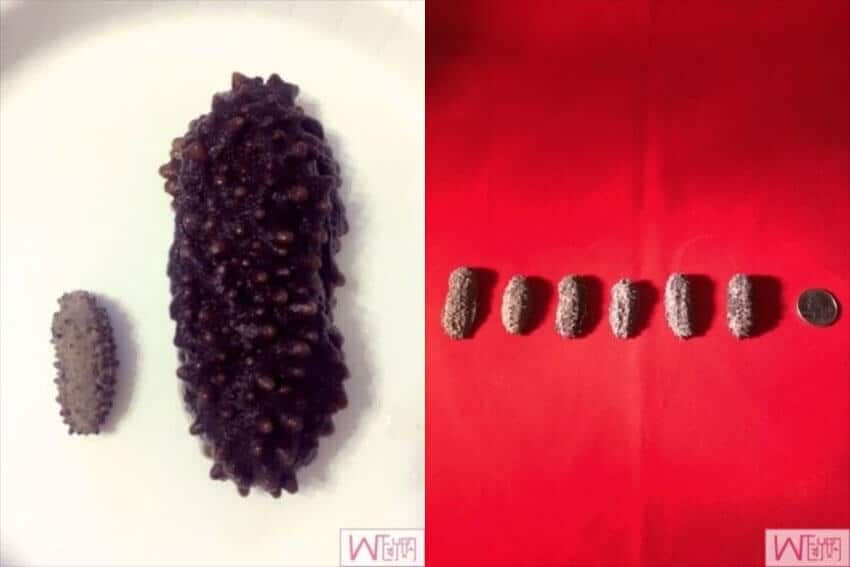
An unspecified quantity of this “Mexican baby sea cucumber” goes for US $490 on eBay.
“Chinese businessmen came … [and] encouraged local fishermen to extract it when they saw the great value it has,” she said.
However, not all illegally extracted sea cucumbers are reaching their intended destination. A recent academic study found that Mexican and U.S. authorities seized over 100 tonnes of sea cucumber worth an estimated US $29.5 million between 2011 and 2021.
“The 97 incidents analyzed revealed 125 arrests, with an average of 1.29 arrests and 1037 kg of sea cucumbers seized per incident,” the paper said.
“… A qualitative review of these incidents reveals a number of key practices, including false identification, mislabelling, misreporting, stockpiling and invoice manipulation and fraud as means of laundering illicit catches. Also documented is corruption, the use of clandestine drying sites, and private vehicles for transportation. Media coverage of sea cucumber poaching and smuggling operations in Mexico frame the crime as being organized and conspicuous for its association with armed violence.”
Teale N. Phelps Bondaroff — the paper’s lead author, an illegal fishing expert and co-founder of the OceansAsia organization — said in a recent interview that “illegal fishing undermines conservation efforts, destroys wildlife populations and ecosystems, harms legal fishermen, steals dollars from governments, undermines good governance and social order, and fuels organized crime.”
Ruiz Pineda, the Inapesca researcher, said that without the sea cucumber, the ocean floor is changed as the animal’s cleaning of the seabed remineralizes and oxygenates it, which benefits other marine creatures.
The academic study found that Mexican authorities — despite the seizures and arrests — have been unable to stop the illegal fishing and trafficking of sea cucumbers.
Wherever the opportunity for fat profits exist in Mexico, the presence of organized crime groups can be expected, and illegal fishing — including that of sea cucumbers — is no exception. Cartels’ involvement in the lucrative totoaba trade — the fish’s swim bladder is considered a delicacy in China — has received significant attention, but there has been less focus on organized crime’s sea cucumber interests.
“[The] direct connection between Chinese traders and Mexican fishers is now being altered by Mexican criminal groups. The Mexican criminal groups have pushed out Chinese traders from direct purchases from local fishermen in an effort to monopolize the illegal and legal fishing industries,” the think tank report said.
“The totoaba and abalone poachers are now compelled to sell to Mexican criminal groups who then sell to the Chinese brokers. This insertion of criminal groups into the seafood chains also developed in Yucatán sea cucumber harvesting. Although the sea cucumber has not recovered and ongoing poaching produces only a small harvest, Mexican organized crime groups in Yucatán now buy from local fishers and themselves sell to Chinese brokers, who are no longer allowed to buy directly from the fishers,” it said.
“… Mexican organized crime groups now operate from the get-go and deal with Chinese brokers to capitalize on new seafood commodities highly desired in Chinese markets.”
Among the crime groups that operate within Mexico’s illegal fishing industry are the Jalisco New Generation Cartel and the Sinaloa Cartel, the report said.
Written by security expert Vanda Felbab-Brown, the report also acknowledged the decimation of Yucatán sea cucumber stocks due to overfishing.
“Promoted by the Mexican government in the early 2000s, the commercial fishing of the several sea cucumber species took off in Yucatán and the offshore Campeche Bank about a decade ago when Chinese brokers started organizing the harvesting for Chinese markets, where sea cucumber is a pricey, sought-after delicacy, with putative traditional Chinese medicine qualities,” it said.
“But regulatory management and law enforcement measures could not keep pace and the harvesting turned into a gold-rush madness that ignored quotas and seasonal bans. … The harvesting also set off violent conflict among fishing communities, maritime banditry, and piracy as rival groups of fishermen sought to steal each other’s increasingly rare catch, and gave rise to village self-defense groups among the indigenous populations. The fishing led to the collapse of the ecologically vital species, which filters organic debris from oceans,” the report said.
“The sea cucumber population in the Campeche Bank went from 20,000 tonnes in 2009 to 1,900 tonnes in 2013, and fewer since. Bans imposed to allow the species to recover were ignored, with some 1,000 sea cucumber poachers operating in the Campeche Bank in 2018.”
The report said that legal and illegal fishing of several sea cucumber species for export to China also takes place along Mexico’s Pacific coast, where crime groups are also involved in the illicit seafood trade.
“In the Gulf of California, illegal sea cucumber harvesting has become rampant. Some of the species are gravely depleted, and in these highly protected species only very small quantities are permitted to be harvested. However, illegal harvesting over the quota and by unlicensed fishers continues to take place,” it said.
A crane moves one of the confiscated armored vehicles. FGR
Federal authorities on Sunday destroyed 23 makeshift armored vehicles that were confiscated from organized crime groups.
The federal Attorney General’s Office (FGR) collaborated with the army to destroy the improvised fighting vehicles, or narco-tanks, at FGR facilities in Reynosa, Tamaulipas.
The FGR said the destruction of the so-called monstruos (monsters) occurred in accordance with the National Criminal Procedures Code, which specifies that “objects that are instruments of crime” can be destroyed.
“The destruction event … is related to 13 [criminal investigation] files drawn up in the period between March and June of the current year,” the FGR said in a statement, adding that the 23 vehicles had “handcrafted armor-plating” and were “monstruos allegedly used by people belonging to organized crime.”
Confiscated armored vehicles. FGR
The army has seized a total of 630 armored vehicles from organized crime since 2018, including 66 with blindaje artesanal, or improvised armor-plating.
A National Defense Ministry (Sedena) report shows that such confiscations have increased in recent years, reaching 184 in 2020 — a 130% increase compared to 2018 — before declining slightly to 172 last year.
Over one-third of the 630 vehicles — 231 — were seized in Tamaulipas, where the Gulf Cartel and the Zetas are involved in a turf war. Michoacán — currently Mexico’s second most violent state in terms of homicides — ranks second with 88 seizures of armored vehicles from organized crime since 2018. Most confiscations in that state occurred in the Tierra Caliente region, especially the municipality of Tecalcatepec.
Jalisco ranks third for armored vehicle seizures with 27 in the past 4 1/2 years, including five with blindaje artesanal. The National Guard confiscated one monstruo in the municipality of Jamay in April after finding it in a semi-trailer.
In July last year, authorities located a factory in Tuxpan, Jalisco, where vehicles were converted into narco-tanks by armoring them with bulletproof steel plates. Authorities also confiscated weapons and ammunition at the factory, which was allegedly operated by the CJNG.
The cartel’s armoring efforts have apparently been assisted by three employees of a vehicle armoring company who were kidnapped by armed men in Tlaquepaque last year. According to Jalisco officials cited by the newspaper Milenio, the victims were released after a period of three days during which they gave armoring tutorials to cartel members. The company at which the men worked later closed after receiving a series of threats, Milenio said.
Asylum seekers in April protest conditions and the slow application process in Tapachula, in imitation of the biblical story of the Stations of the Cross.
Solutions to the humanitarian migrant crisis in Tapachula, a city on the southern border, are being overlooked due to the divergent priorities of the governments of Mexico and the United States, the Mexico director of the advocacy organization The Washington Office on Latin America (WOLA) said.
Mexico received a record-breaking number of asylum applications in 2021 — over 130,000 — 100 times more than in 2013. Ninety percent of those were made in Tapachula, according to WOLA’s data.
The refugee agency COMAR only resolved 38,054 applications last year, 72% of which were approved, the newspaper Milenio reported.
WOLA’s Mexico director Stephanie Brewer said that Mexican officials were reluctant to provide migrants with visas due to U.S. pressure.
Ninety percent of Mexico’s asylum applications in 2021 were made in Tapachula, Chiapas.
“I would say that there is a humanitarian crisis for migrants in Tapachula and that the crisis can be avoided … it’s understood that the resistance of the Mexican authorities to facilitate [migrants with] access to legal channels and visas can be explained by the United States government. Because for [the U.S. government], a migrant with legal status is a person who would have the opportunity to go to their border,” she said.
Brewer added that the Mexican government had the resources to process the migrants, but that racism and institutional incompetence had created obstructions.
“As a country, it certainly can respond to demand. It’s a big country, with a large population, but a single city like Tapachula can’t. It’s not logical to think it can meet the demand.”
“[Migrants] experience different types of racism, both with authorities and members of the population and different types of xenophobia … The system has not evolved in terms of human resources … to meet the situation,” she said.
Washington Office on Latin America Mexico director Stephanie Brewer believes that Mexican officials are reluctant to provide migrants with visas because of U.S. pressure. President López Obrador Twitter
Migrants from Haiti, who make up a large part of the migrant population in Tapachula, were having a harder time gaining legal status in Mexico, Brewer said.
“Certain nationalities, notably Venezuelans, Hondurans and Salvadorans, have a fairly high rate of gaining asylum, compared to Haitians for example,” she said.
Brewer added that the militarized strategy to combat undocumented migrants was inappropriate.
“The National Guard, it must be said, is an organization of military force … focused on confronting enemy forces. It is not the right institution to be the first points of contact with the refugee population, [which] is mainly families,” she said.
The military is not the right institution to be the first point of contact with the refugee population, says Brewer.
WOLA is calling on the government to stop containing migrants in Tapachula, end migrant detentions, provide visas and increase COMAR’s budget. It argues that the U.S. government should prioritize migrant protection and should provide refuge for unaccompanied minors.
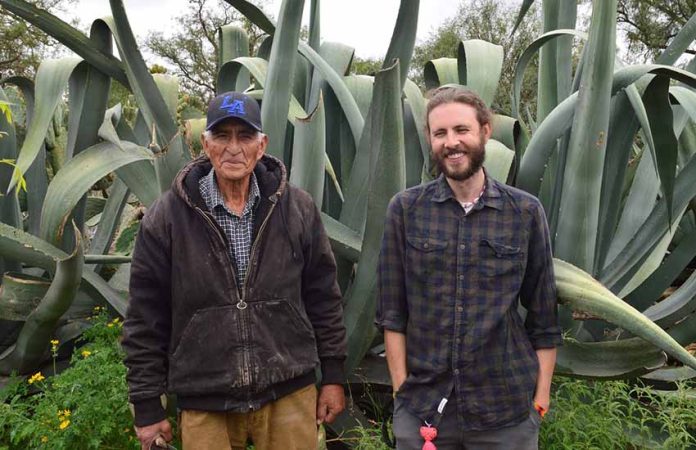
Carlos Nava at Don Tomás Solares' farm just outside of San Luis Potosí city. The Navas' interest in promoting Mexican-made liquor started with mezcal and with Solares' pulque.
Tomás and Carlos Nava just might be the future of alcoholic beverages in San Luis Potosí, and it all started by reviving one of their old hangouts.
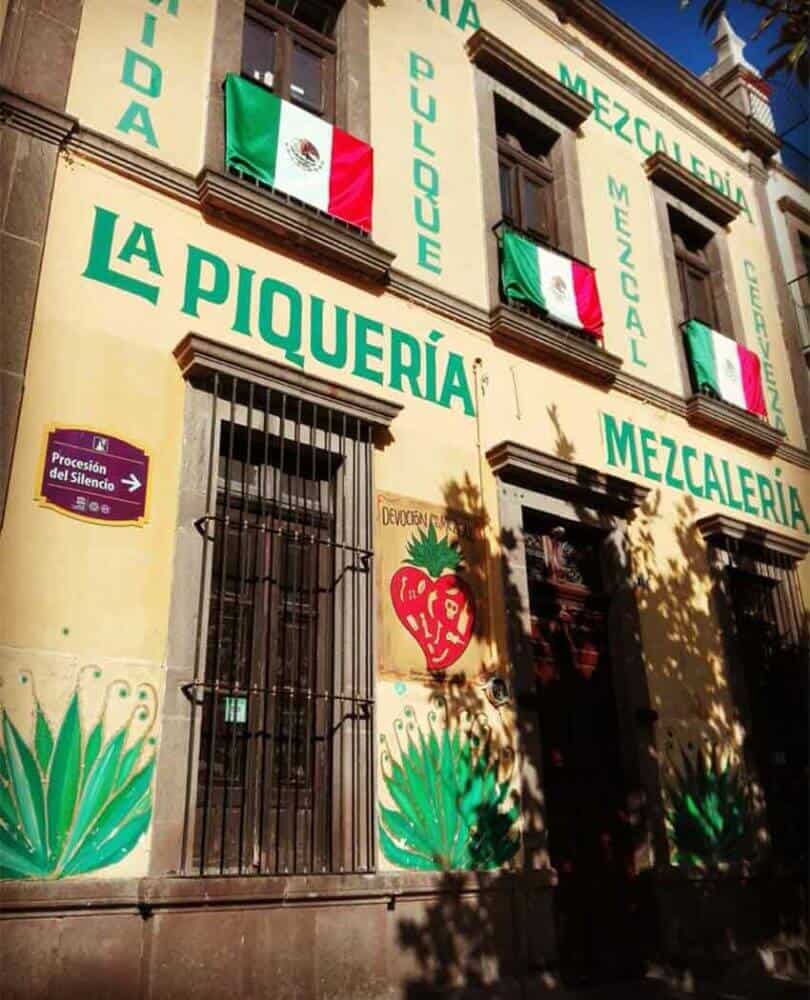
La Piquería calls itself a pulque and mezcal bar, but it is really a full-service establishment, with all kinds of beverages and bar food. Located in an old mansion in the historic center of San Luis Potosí, its backstory makes the place special.
Twenty or so years ago, they frequented a bar called El Delirio Azul (Blue Delirium). It was an alternative kind of place, with a large portrait of Che Guevara and frequented by people wanting to change the world.
The bar ran into problems when one owner became involved with resistance to the opening of a mine on San Pedro Mountain by a Canadian company. In the end, this owner became a political refugee, ironically in Canada, and the business withered and disappeared.
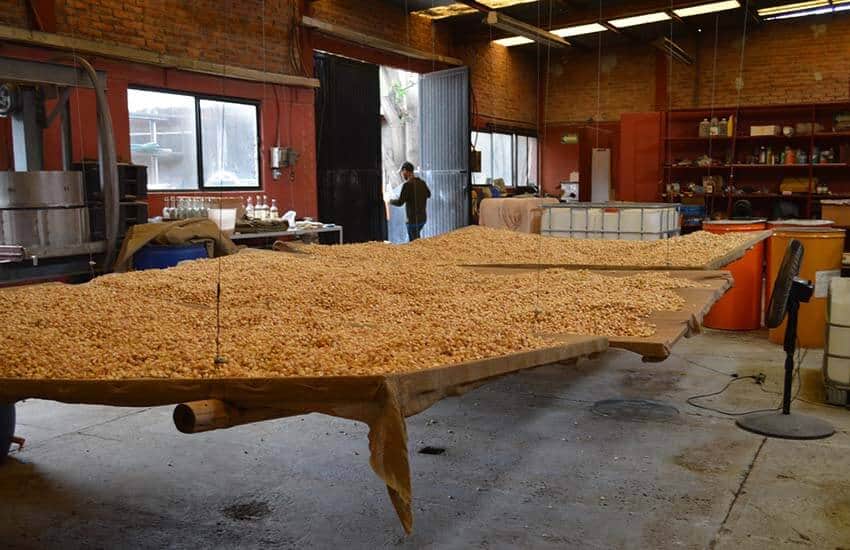
Germinating 300 kilos of cacahuatzintle, a Mexican corn variety used to make pozole. The Navas are searching for the best native variety to make whiskey.
The building came up for rent in 2010. The brothers’ fond memories of Delirio Azul prompted them to reestablish a bar in the building, which opened in 2011. At first, the bar was mostly a beer joint, but that would soon change. The business was successful enough, but they wanted to do something distinctive, so they looked to mezcal, which had been very traditional in San Luis Potosí but had fallen out of favor many years ago. Even as late as the early 2010s, it was considered far inferior to vodka and whiskey.
They researched local mezcal as well as those from Oaxaca and Durango. Their city was a little behind the times, but when mezcal’s popularity saw a resurgence, the Navas were ready.
Success with mezcal inspired them to try yet another out-of-favor alcoholic beverage — pulque. San Luis Potosí’s pulque is made from the maguey plant that Mesoamericans brought here in the early colonial period, but the flavor is a bit different than other pulques elsewhere, likely because of the local soils and more arid conditions.
“If we were considered insane for selling mezcal, we were considered raving mad for selling pulque.” Carlos says. The beverage was considered to be something only for the lowest of the low classes, served in places that rival any dive bar in the world.
Undeterred, the brothers found a good, authentic source for pulque in one Tomás Solares, who at nearly 80 still makes it how he learned as a small child on the land he grew up on.
It took a little time, but in a couple of years, the bar went from selling 5 liters a week to over 200 before the pandemic. It’s back up again to over 100 now.
The Navas’ success is not in making or improving mezcal or pulque but rather in offering a bit of the area’s history in an environment that is more comfortable for more kinds of people. Carlos admits it is a kind of “gentrification,” but they are proud that their establishment attracts everyone from the guy who needs bodyguards to the guy working construction.
Going on year 12, La Piquería is now the brothers’ bread and butter, and just the start of their entrepreneurship.
Carlos and Tomás Nava’s mezcalería in San Luis Potosí.
Research into mezcal and pulque has inspired Tomás to try his hand at production. A local family, the Navarros, was instrumental in helping him get a feel for their method of making mezcal, which is distilled in large, heavy clay pots.
But he also gained an appreciation for the values behind their work. For that reason, he did not try to take on mezcal production with them.
In 2019, a friend in the fruit export business found that a client in California was distilling alcohol from prickly pears and asked Tomás if he could do that. He told him, “Give me six months” and bought a small still the next day. This was the start of El Gran Tunal (The Great Prickly Pear Fruit), what he calls an experimental distillery.
Quickly, his attention also turned to Mexico’s heirloom corn varieties. He has joined with other craft and experimental Mexican whiskey makers to not only figure out which corn varieties are best for distilling but also how to define and protect a new and rapidly growing industry.
Nava wants people like him to define what “Mexican whiskey” is before some large international concern does it.
Thanks to an Australian mother, the Navas are native English speakers. This has allowed him to contact and get mentored by craft whisky and moonshine makers in the United States, who are more than happy to work with someone south of the border. From them, Tomás has gained access to new technology and techniques, such as electric coils for heating, which he integrates with what knowledge he has acquired in Mexico.
I learned a LOT about the process of turning Mexican corn into whiskey. Mexican corn holds many promises, especially in flavor profiles, as well as challenges. One challenge is its low alcohol-by-volume (ABV) content. For this reason, 300 kilos of corn at most produces 90 liters of whiskey.
Tomás’ experimentation is not limited to corn. While I was there, his first still was pumping out a delicious gin variant flavored with cardón cactus fruit instead of using juniper berries. He also had batches of spirits made with mango, beetroot and sugar cane. He no longer distills pulque, however, as it produces too little distillate and ruins a lot of pulque in the process.
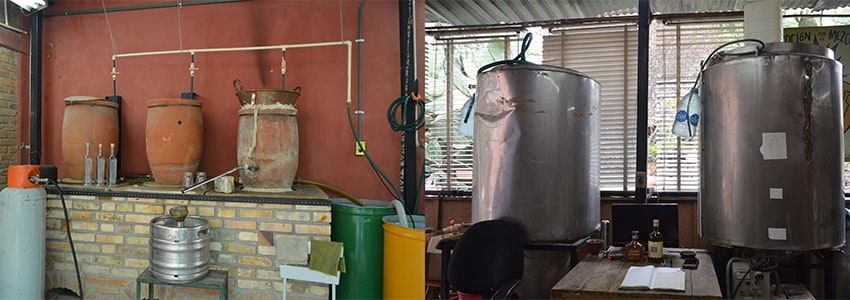
Old-fashioned clay distilling pots sit near newer metal ones. Both types of pots have their advantages and disadvantages.
The Navas are modern businessmen, but both have the social consciousness that drew them to the original bar. They worry about balancing the economic needs of producers with preserving Mexico’s beverage traditions and the threats posed by the modern world.
With two years and a lot of money invested in his small distillery, the concern is not simply altruistic. He says that at any time, someone could come to his door to “ask him what his price is,” and he knows he needs an answer.
Leigh Thelmadatter arrived in Mexico 18 years ago and fell in love with the land and the culture in particular its handcrafts and art. She is the author of Mexican Cartonería: Paper, Paste and Fiesta (Schiffer 2019). Her culture column appears regularly on Mexico News Daily.
Chorizo on the grill — it doesn't get any better than this.
Chorizo is essentially an unassuming pork sausage. But all you need is one bite to taste its spicy Hispanic roots and realize the world of possibilities for using it in the kitchen.
Chorizo’s bold, zesty chile flavor is complemented by the warmth of cinnamon and cloves and balanced by herbs and spices like oregano, paprika and garlic. And pork — ahhh, pork! — imparts its unparalleled richness and depth of flavor.
First things first: there’s Mexican chorizo and Spanish chorizo, and they’re completely different things: Mexican chorizo is raw, made with fresh pork, herbs and spices. It must be cooked before eating. On the other hand, Spanish chorizo is smoked and can be eaten as-is, sliced like salami and often sold chilled. This is an important distinction, so be sure you know what you’re buying.
(The spicing is different too.) We’ll be talking about Mexican chorizo here.
Tacos with chorizo is a classic dish for a reason — because it’s delicious!
Mexican chorizo is sold in sausage-like tubes or links; they can be sauteed or grilled whole, like any other sausage, but another more versatile option is to cut open one end, squeeze out the filling and sauté it. Then the crispy, zesty crumbles can be used in a myriad of ways: mixed into any pasta dish or sauce where you usually use ground beef — like lasagna, Bolognese or Carbonara; added to scrambled eggs, omelets or frittata; crumbled atop papas locas(ask your local street food vendor) or nachos; added to quesadillas or tacos; or mixed into chili.
Chorizo is a simple “secret” ingredient that adds pizazz to any dish and turns “ho-hum” into “wow!” And it’s easy to keep in the fridge so you always have some on hand.
In the grocery store or market, you’ll find many brands of chorizo, all with different spicing. It may take some trial and error to find a couple that work for you. Butcher shops will often make their own as well. You’ll also find vegetarian chorizo, made with soy protein and traditional flavorings and even lower-fat chicken or turkey chorizo.
Feel like making chorizo yourself? Check out this recipe, head to the butcher and have at it. Let me know how it turns out!
Black Bean-Chorizo-Sweet Potato Tacos
Substitute regular white potatoes if you like.
1 Tbsp. olive oil
1 medium sweet potato, peeled, in ¼-inch dice
1 lb. fresh Mexican chorizo, removed from casing
1 (15-oz.) can black beans, drained
Salt and pepper
For serving: corn tortillas, crema, pickled red onions, cilantro, queso fresco, salsa
Heat olive oil over medium heat in large skillet. Add sweet potato. Cook, stirring, 4–5 minutes. Push sweet potatoes to edges of the skillet; add chorizo.
Brown chorizo for 4–5 minutes, breaking it into bite-sized crumbles as it cooks. Once the chorizo is browned, mix with sweet potatoes. Add black beans to skillet, stirring to combine with chorizo/sweet potato mixture. Cook until heated through, about 2 minutes. Taste and season with salt or pepper as needed. Spoon into tortillas, add toppings and serve.
Rachel Ray’s Chorizo Sloppy Joes (meat and veggie versions)
For Sauce:
1 (8-oz.) can tomato paste
½ cup beef stock
2 Tbsp. Worcestershire sauce
2 Tbsp. hot sauce
2 Tbsp. cider vinegar
2 Tbsp. brown sugar or grated piloncillo
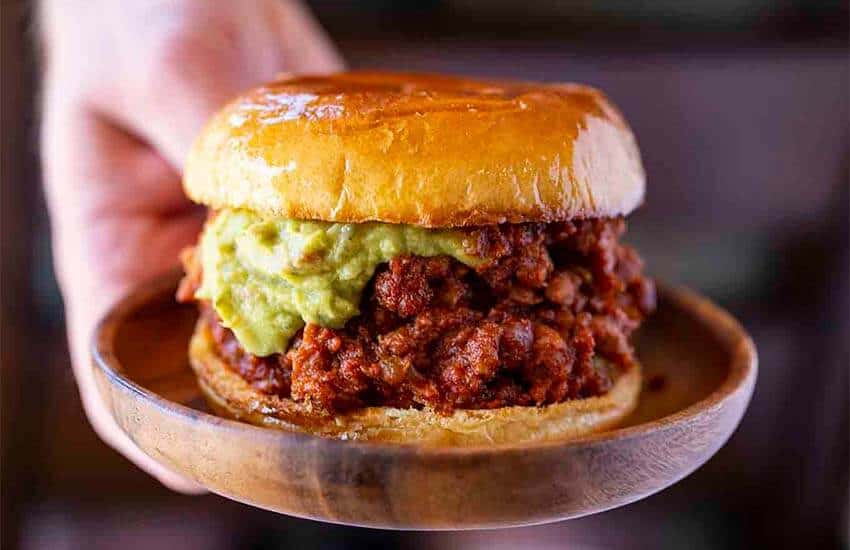
Who knew you could make a Sloppy Joe sandwich with chorizo?
½ lb. fresh beef or pork chorizo (or soy-based chorizo substitute)
For serving: Soft burger rolls, chopped white onion, pickles
Heat oil in cast-iron skillet or Dutch oven over medium-high heat. Add onions, peppers and celery, season with salt and pepper; stir and cook a few minutes. Stir in garlic.
Add beef and chorizo. Cook till browned and crumbly.
Stir in the sauce, reduce heat to low. Simmer a few minutes to combine flavors. Serve with rolls and toppings.
1 large red onion, cut into 1/2-inch rounds, skewered horizontally
2 avocados, cut into ½-inch slices
6 oz. Oaxaca, Chihuahua or Mozzarella cheese, thinly sliced or grated
4 bolillos (sandwich rolls)
1/3 cup chipotle mayonnaise
For grill cooking: 4 bricks wrapped in heavy-duty aluminum foil
If using a grill, prepare the fire and grate for cooking. (If using a griddle, follow same instructions for chorizo; char poblanos over an open flame using tongs; sauté onions in skillet or on griddle.)
Place chorizo, poblanos and onions on grill. Cook chorizo until browned all over, about 8 minutes; transfer to cutting board. Cook poblanos until charred all over, about 10 minutes; transfer to bowl, cover with plastic wrap. Let rest until cooled.
Cook onions until softened and charred on both sides, about 5 minutes per side; transfer to cutting board, remove skewers. Place bricks on grill and cover.
Remove charred skin from poblanos; stem, seed and cut peppers into long strips. Halve chorizo lengthwise.
Place 1 chorizo link on bottom half of bolillo, top with poblano strips, onions, avocados and cheese. Spread chipotle mayonnaise on other side of roll; place on top of sandwich. Repeat with remaining rolls.
Regular sandwiches don’t hold a candle to tortas stuffed with chorizo and all the fixings.
On grill: place prepared sandwiches on grill. Wearing well-insulated grilling gloves, carefully place one brick on top of each sandwich, gently pushing down to press. Cover grill and cook until sandwich has flattened and bread has crisped, 5–10 minutes.
On griddle or skillet: place prepared sandwiches on preheated griddle sprayed with cooking oil. Use foil-covered bricks, cast-iron pan or other heavy, heatproof object to press down sandwich, cooking at medium-high heat until cheese melts and bread crisps, 5–10 minutes.