The U.S. government’s Federal Voting Assistance Program (FVAP) estimated that 91,000 eligible voting-age U.S. citizens lived in Mexico in 2022. But FVAP also estimated that only 3.1% of these American citizens in Mexico voted in the 2022 U.S. midterm elections.
This low rate may be because U.S. citizens in Mexico have questions and doubts about voting in U.S. elections that this article will address one by one.
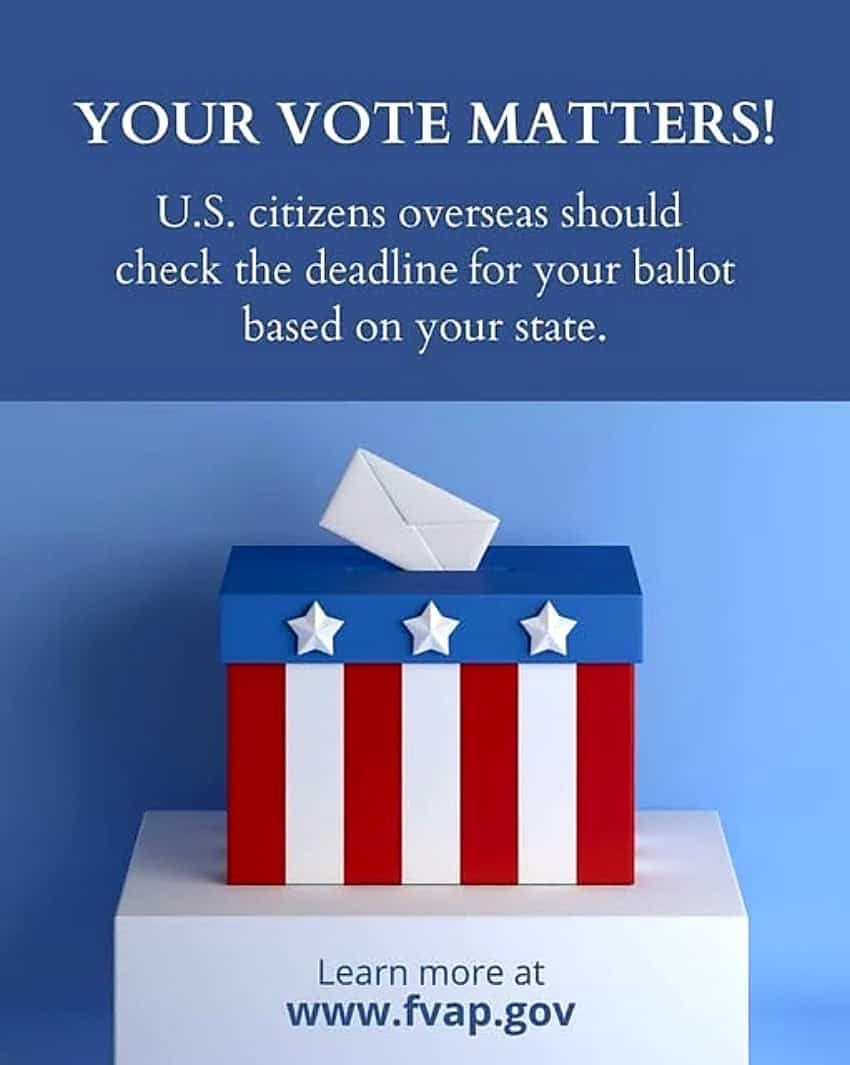
People are hearing a lot in the news lately about efforts by the U.S. government to restrict absentee and mail-in voting, including for overseas citizens. But Congress recessed without passing the SAVE America Act, the voting legislation backed by President Donald Trump.
U.S. courts, including the Supreme Court, have blocked the Trump administration’s restrictions on mail-in voting before the midterms. So U.S. citizens in Mexico can take this opportunity to vote with some confidence that their ballots will be delivered and could make a difference.
Maybe you are a dual citizen, and you wonder if you can vote. U.S. government websites make it clear that if you are a U.S. citizen with dual citizenship, you can vote in U.S. elections from abroad.
How can I vote in the US elections as a US citizen living in Mexico?

Debunking tax myths for overseas voters
Some myths and misunderstandings about the connection between voting abroad and paying taxes may be fueling the low turnout by U.S. overseas voters in Mexico. The U.S. State Department makes clear that “voting for federal candidates from abroad does not affect your federal or state tax liability.”
That is, voting for president, vice president and U.S. Congress does not influence your tax profile or status. Voting below the federal level, in state or local elections, could incur state tax liability in some states.
The most important elections in the upcoming midterms are the federal elections for the House of Representatives and the Senate, so voters abroad can still have an important impact without any danger of affecting their taxes by voting only at the federal level and leaving the rest of the ballot blank.
For U.S. citizens living abroad, the right to vote in federal elections is guaranteed by law and more manageable than you may think.
If you are outside the U.S., your voting rights stay with you, even if you are a first-time voter. There are tools to help you out and walk you through it.
Registration and ballot request tools
The U.S. Vote Foundation and the Overseas Vote websites provide clear, nonpartisan guidance on how to register and vote from abroad.
Try the U.S. Vote Foundation’s user-friendly interactive tools, like the “Journey Map for How to Vote in America,” to help plan and track your process. It can even help you track your ballot as it moves between you and your election office.
Many states also offer sample ballots to help you plan your choices before you are faced with the actual ballot.
The rights of overseas voters are protected by U.S. federal law under the Uniformed and Overseas Citizens Absentee Voting Act. This law requires states to allow eligible overseas citizens to register and vote absentee and to transmit ballots in a timely manner.
Voters abroad should use the Federal Post Card Application, which combines voter registration and a request for an absentee ballot. You can request this online, and your ballot can be sent to you electronically. To complete the form, you will be asked to give your last U.S. residential address. This does not have to be an address where you still live.
All voting ballots in the U.S. are local ballots, so you must give an address in the U.S. to receive a ballot, but it needs to be a place where you lived last, or even where your parents lived last.
How to safely return your completed ballot
Once states receive your request for a ballot, federal law requires that blank absentee ballots must be available electronically to overseas voters. Fill out your ballot when it arrives and arrange for it to be sent back to the U.S. Notarization of the ballot is not required.
Overseas voter ballots must be sent from abroad, so do not ask a friend to take it back to the U.S. for you and mail it there.
There are three possible return routes:
- Mexican mail, with international postage.
- Electronic return, but only if the voter’s state permits it.
- FedEx, DHL, UPS or Estafeta, particularly if time is short.
While the U.S. Embassy or consulate can forward ballots to the United States, the embassy itself warns that this can take up to four weeks to reach the final U.S. election office, while other sources say it can take as long as six weeks. Since time is of the essence right now, that is no longer a reliable route.
The best option is to take your ballot to the post office or carriers such as FedEx, DHL or UPS, and make sure it is postmarked with the mailing date and place.
Now is the moment to take action to make sure your ballot arrives on time.
Research on voter participation has found that personal contact can increase turnout. In practice, that suggests informal networks — friends, colleagues and community groups — can play a meaningful role in encouraging Americans abroad to vote. People in Mexico can remind their American friends and neighbors that U.S. elections have far-reaching consequences for Mexico and for the world.
Kathryn Sikkink is the Ryan Family Professor of Human Rights Policy at the Harvard Kennedy School.