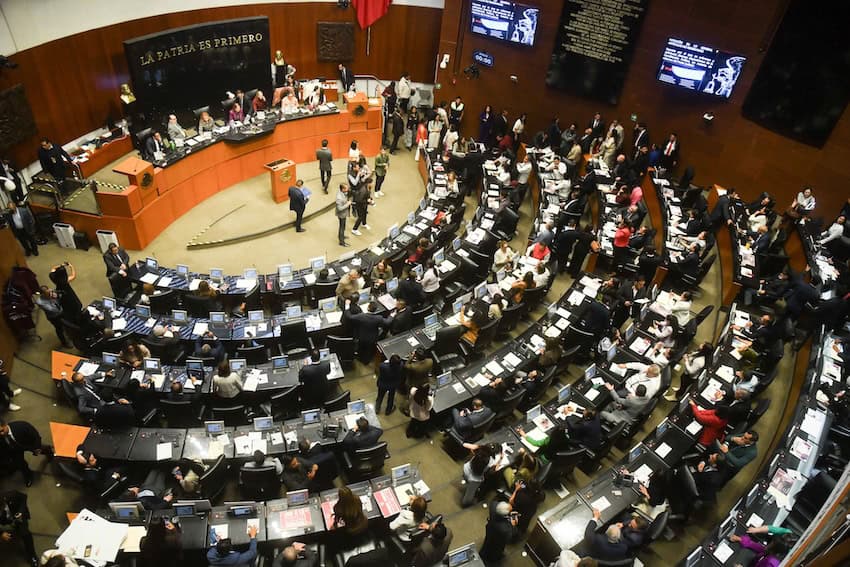
Congress concluded a marathon 32-hour special session after approving a controversial reform allowing the nullification of elections tainted by foreign interference, a surprise addition to the legislative calendar.
The bill, sponsored by Morena Deputy Ricardo Monreal, was heavily amended in an effort to more narrowly define the discretionary powers granted to election authorities.

Critics have voiced concern that the reform could make it easier for losers to overturn results.
It eventually passed the Chamber of Deputies 307-128, before winning passage in the Senate on an 85-42 vote. As a constitutional reform, it will next be sent to the states where at least 17 of the 32 state legislatures must vote to approve it.
Earlier, both houses of Congress had approved an equally controversial judicial reform bill that was also not on the original agenda. This reform authorizes the re-election of judges on the Superior Chamber of the Electoral Tribunal — the very court body that would determine the legitimacy of any foreign intervention accusations.
Congress also approved a bill postponing judicial elections from 2027 to 2028 and another reforming the Electoral Law to bar candidates with proven ties to organized crime from competing in elections.
The contentious session in the Chamber of Deputies was marked by voting irregularities, near-brawls, recess requests and accusations of narco-politics displayed on banners placed in the galleries of the San Lázaro Legislative Palace by the opposition.

The last-minute inclusion of the foreign intervention bill caught the deputies by surprise as the various party leaders had not been advised that it would be on the agenda of the special session.
President Claudia Sheinbaum defended the bill earlier this week, warning about the risk of foreign actors interfering in Mexico’s politics through financing, digital campaigns or indirect support for organizations linked to electoral issues.
While the ruling party Morena and its allies said the reform would serve as a measure to safeguard Mexican democracy, opposition lawmakers warned of potentially ambiguous interpretations that could be exploited for political purposes due to the lack of clarity in the definition of what qualified as interference.
Some Morena legislators also voiced objections. Deputy Olga Sánchez Cordero, a former Supreme Court minister, asked that greater specificity be included.
“As a judge, I can assure you that we are facing an open-ended rule that could allow any number of normative assumptions,” stated the Morena party legislator.
The debate led to the inclusion of the definition of foreign interference as “illicit financing, propaganda, the systematic dissemination of disinformation, digital manipulation and the intervention of foreign governments or agencies.”
The final bill also included “acts of political, economic, diplomatic or media pressure intended to influence public opinion.”
Sheinbaum sees risk of foreign interference in Mexican elections: Thursday’s mañanera recapped
Even so, the opposition resisted the reform, arguing that the breadth of the concept of “foreign intervention” could be applied arbitrarily against civil organizations, media outlets or international actors involved in election observation or the financing of social projects.
Debate on the judicial reform bill also prompted some Morenistas to oppose party leadership, with 22 Morena deputies abstaining from voting on the final bill.
Again, Sánchez Cordero was among the naysayers who pointed out that this reform would effectively give judges who were elected to one term via the Judicial Reform enacted in September 2024 seven extra years (one year due to the postponement of the election plus a new six-year term).
Those who took office in 2016 and whose terms were due to end in 2024 could find themselves serving 18 years.
“This violates the Constitution,” said Deputy Alfonso Ramírez Cuéllar, considered a political operative for Sheinbaum in the Chamber of Deputies. “We have always fought against the elites who held perpetual control of the courts; and now we are creating elites of our own who ought not to continue to exist.”
The judicial reform bill eventually passed the Chamber of Deputies 322 to 132, despite the 22 abstentions.
With reports from Reuters, Infobae, La Jornada and Reforma