Mexicans view China and Chinese President Xi Jinping more favorably than the United States and U.S. President Donald Trump, according to the results of a poll conducted by the Pew Research Center.
Between Feb. 20 and April 10, the Washington, D.C.-based think tank surveyed 1,017 Mexican adults for its Spring 2026 Global Attitudes Survey. People from dozens of other countries also participated in the survey.
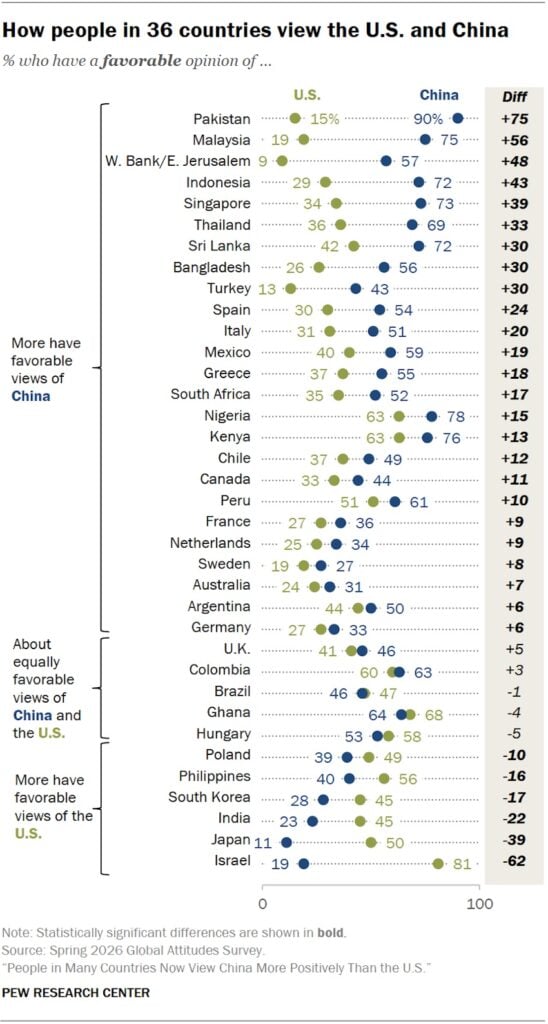
Pew asked the respondents whether they had a “very favorable, somewhat favorable, somewhat unfavorable or very unfavorable opinion of China.”
Among Mexican respondents, 44% said they had a “somewhat favorable” view of the single-party East Asian economic powerhouse while 15% said they had a “very favorable” view of the country. Thus, 59% of Mexican respondents indicated they had a favorable view of China.
By contrast, only 27% of Mexican respondents said they had an unfavorable view of China. Among that cohort, 12% said they had a “very unfavorable” view of China — the world’s second largest economy and second most populous country — and 15% said they had a “somewhat unfavorable” view of the Asian nation that has been led by Xi since 2013. Thirteen per cent of Mexican respondents said they didn’t know whether they had a favorable or unfavorable view of China or declined to answer the question.
The overall percentage of Mexican respondents who told Pew they had a favorable view of China is 19 percentage points higher than the 40% of Mexican adults who said they had a favorable view of the United States.
Mexico is not unique in this respect. Citing its 2026 survey results, Pew reported that in “most of the 36 countries surveyed, more people have a favorable view of China than of the U.S.”

Among those countries is Canada, where 44% of respondents said they had a favorable view of China versus 33% who said the same about the United States.
Pew reported this week that for “the first time in almost two decades of Pew Research Center surveys, both Canadians and Mexicans now view China more favorably than their neighbor, the United States.”
“Our spring 2026 global survey marks the first time that Canadians have expressed a significantly more positive view of China than the U.S.,” the think tank said.
“Mexicans, by contrast, have viewed China more favorably than the U.S. in several previous Center surveys — all of them conducted during President Donald Trump’s time in the White House.”
Trump, of course, is known for making disparaging remarks about Mexico, including his infamous 2015 claim that Mexico was sending “rapists” to the United States. Such remarks certainly don’t endear the U.S. president to the Mexican people.
Beyond Trump’s rhetoric, there are real tensions in the Mexico-U.S. relationship, including ones related to trade — think U.S. tariffs on Mexican vehicles, steel and aluminum, and the Trump administration’s refusal to renew the USMCA in its current form. There are also pressure points related to security, sovereignty and the treatment of Mexicans in the United States, of whom at least 17 have died while under the custody of U.S. Immigration and Customs Enforcement (ICE) or in ICE operations since Trump returned to the White House in January 2025.
Due to geography, Mexico’s relationship with China is not nearly as close as the one it has with its northern neighbor. However, trade between Mexico and China has increased in recent years. In fact, China is now Mexico’s second-largest trade partner as it is Mexico’s third-largest export market and second-largest source of imports, according to the Mexican bank Banorte.
China was not impressed when the Mexican government made the decision to implement new and higher tariffs on a wide range of its exports on Jan. 1, a move that has had a significant impact on the East Asian nation.
Trump vs. Xi
Respondents to Pew’s Spring 2026 Global Attitudes Survey were asked how much confidence they had in Xi and in Trump to “do the right thing regarding world affairs.”
Among Mexican respondents, 7% said they had “a lot of confidence” in Xi to do the right thing while 29% said they had “some confidence” in the Chinese president.
By contrast, only 1% of Mexican respondents said they had “a lot of confidence” in Trump to do the right thing while 10% said they had “some confidence” in the U.S. president.
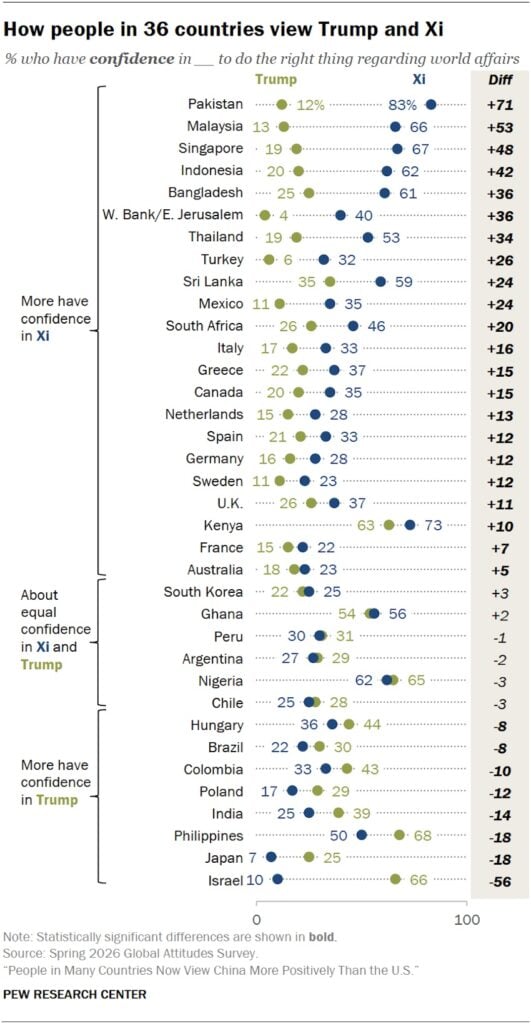
Pew summarized the results as such: “In Mexico, 35% of adults have confidence in Xi and 11% in Trump.”
The think tank also noted that in its 2025 survey, “Canadians and Mexicans both named the U.S. as their country’s top ally and top threat.”
In its latest survey, Pew found that 65% of Mexican respondents had “no confidence at all” in Trump to do the right thing regarding world affairs, while an additional 23% had “not too much confidence” in the U.S. president.
Twenty-four per cent of Mexican respondents had “no confidence at all” in Xi to do the right thing regarding world affairs, while an additional 25% had “not too much confidence” in the Chinese leader.
In a report published on Monday, Pew noted that Mexicans are “much more likely to call China a reliable partner to Mexico than to say this about the U.S. (58% vs. 34%).”
“This is the largest gap on this question across the six Latin American countries we surveyed this year,” the think tank added.
Other results from Pew’s latest survey
- Pew found that 70% of Mexican respondents aged 18-34 have a favorable view of China. Among Mexicans aged 35-49, the percentage declined to 61%, while among Mexicans aged 50 and older it was lower again at 44%.
- Pew also found that young Mexican adults view the U.S. more favorably than older Mexicans. Among those aged 18-34, 52% had a favorable view of the U.S. compared to 39% among the 35-49 cohort and 28% among the 50+ cohort.
- Pew noted that in Mexico, “views of the U.S. and China don’t differ much by ideology,” whereas “Canadians who place themselves on the ideological left are much more likely than those on the right to have a favorable view of China and an unfavorable view of the United States.”
- Thirty-five per cent of Mexican respondents said that the Chinese government “respects the personal freedoms of its people” whereas just 20% said the same about the U.S. government. Pew said that in Mexico, “the share of adults who say the U.S. government respects its people’s freedoms has reached an all-time low in our surveys,” adding that “for the first time in the nearly two decades we’ve asked this question, Mexicans are now more likely to say this about the Chinese government than the U.S. government.”
- Only 28% of Mexican respondents said that the United States contributes “a great deal” or “a fair amount” to “peace and stability around the world,” down from 50% in 2023 when former U.S. President Joe Biden was in office.
- Forty-seven per cent of Mexican respondents said that China contributes “a great deal” or “a fair amount” to “peace and stability around the world,” up from 41% in 2023.
- Almost three-quarters of Mexican respondents (73%) said that the United States interferes in the affairs of other countries, while only 45% said the same about China.
- Forty-seven per cent of Mexican respondents said that China takes the interests of countries like Mexico into account when making international policy decisions, while 49% said it does not. Pew noted that “around three-in-four” Mexican respondents “say that the U.S. does not take these interests into account” when making international policy decisions.
Mexico News Daily