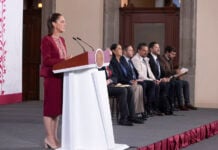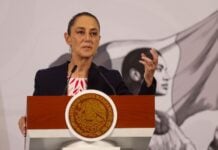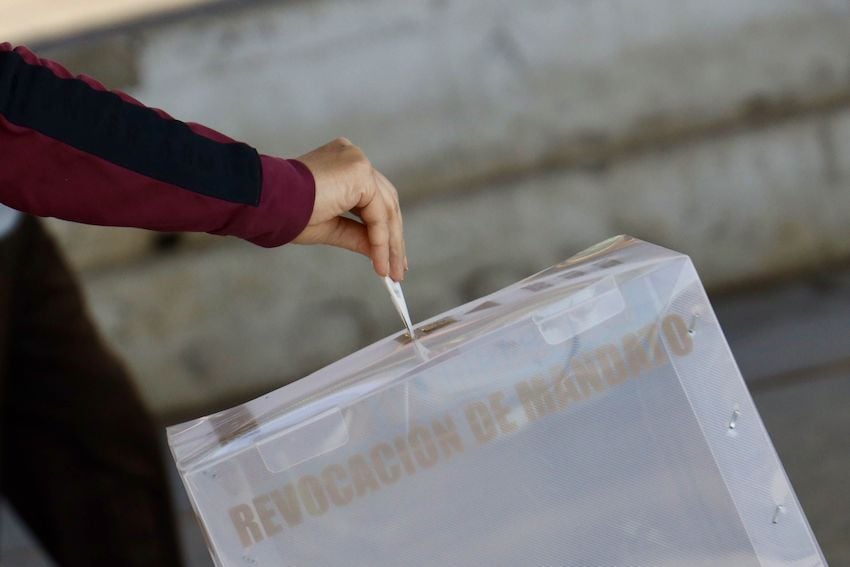
President Claudia Sheinbaum said Tuesday that her as-yet undisclosed electoral reform proposal will help stamp out the funding of political parties by organized crime groups, which have long injected money into election campaigns in Mexico.
At her morning press conference, Sheinbaum was asked whether the reform proposal she intends to submit to Congress this month will “shield” elections in Mexico from organized crime money.
“Yes,” the president responded, explaining that her reform proposal will seek to enable “more oversight” of campaign funding.
Sheinbaum said her reform proposal will not only seek to reduce the cost of holding elections, but also exert tighter control over how parties use their funds, which, by law, primarily come from the state.
A reporter from the newspaper El Financiero asked the president whether reducing the amount of money used to stage elections and to fund political parties wouldn’t “increase the incentive” for funding from organized crime groups.
“No, no,” Sheinbaum responded.
Asked what other “measures” would need to be taken to stop organized crime groups from funding political parties, the president only replied that her reform proposal will soon be made public.

She said that her goal is to have the reform proposal ready for next week, before assuring reporters that she will send it to Congress this month.
How Sheinbaum plans to reshape Mexico’s elections: Friday’s mañanera recapped
Sheinbaum expressed confidence that the Morena party’s allies, the Labor Party and the Green Party, will support her proposal, ensuring its passage through both houses of Congress.
She said last month her proposal would aim to increase “citizen participation” in various facets of Mexico’s democracy.
“People should express their opinions and participate, that’s democracy,” said Sheinbaum, who also said that her proposal would aim to make it easier for Mexicans abroad, especially those in the United States, to “exercise their right to vote.”
She also asserted that the National Electoral Institute — the authority responsible for organizing elections in Mexico and the nation’s electoral umpire — will not lose its autonomy as a result of the reform, as opposition politicians have claimed.
Narco money in Mexican politics
Jorge Álvarez Máynez, the national coordinator of the Citizens’ Movement party and a candidate in the 2024 presidential election, wrote on social media last month that “the most serious problem” related to elections in Mexico today is “the illegal and criminal financing of politics.”
“This is where organized crime’s territorial and institutional control over much of the country comes from. That should be the main focus of an [electoral] reform,” he wrote.
In a 2020 academic paper titled “Illegal financing of political campaigns in Mexico,” Luis Carlos Ugalde, president of Mexico’s Federal Electoral Institute between 2003 and 2007, wrote that organized crime is a “recurrent contributor” to political parties “in certain regions of the country.”
“… This kind of financing occurs in certain areas of the country where drug trafficking has a greater presence. It generally occurs at the municipal level and its objective is to control the territory so that criminals can continue to carry out their illicit activities,” he wrote.
In a 2024 article published by the Wilson Center, a Washington D.C.-based think tank, Mexico expert María Calderón identified “the rapidly increasing involvement of criminal groups in election finances through illicit campaign funding” as a major concern in Mexico.
“Criminal groups demand that ‘investments’ in electoral campaigns bestow advantages over competitors or, more clearly, demarcate lines of territorial control. Problems arise when their demands are unmet,” she wrote.
In 2024, ProPublica, Deutsche Welle and Insight Crime all published reports that said that people working for former president Andrés Manuel López Obrador’s unsuccessful 2006 presidential election campaign received between US $2 million and $4 million from drug traffickers affiliated with the Beltrán-Leyva Organization and the Sinaloa Cartel.
López Obrador described the reports as “completely false.”
PAN: Sheinbaum’s electoral reform aims to ‘formalize narco-politics’
Although Sheinbaum’s reform proposal has not yet been publicly disclosed, the National Action Party (PAN) released a statement last month under the title:
“Morena’s electoral reform seeks to formalize narco-politics, the PAN challenges President Sheinbaum to block illegal money.”
💥 PAN rechaza reforma electoral y defiende a los pluris
Durante la plenaria del PAN, @JorgeRoHe expresó su rechazo a la reforma electoral que impulsa la 4T, en donde se buscaría elimina a los legisladores de representación proporcional. Además, salió en defensa de los pluris al… pic.twitter.com/OQu9xX8MK5
— Político MX (@politicomx) January 31, 2026
The Jan. 25 statement noted that PAN national president Jorge Romero Herrera told a press conference that “reducing public funding [of political parties] and weakening electoral controls without strengthening oversight does not clean up politics, but rather normalizes criminal money in campaigns.”
“When illegal money reaches power, justice comes to a halt. Reducing electoral controls in this context is to formalize organized crime’s interference in campaigns,” Romero said.
Similarly, the consultancy firm Integralia said in a recent report that reducing public funding of political parties could lead to greater “illegal financing” of election campaigns.
Rosario Robles — a cabinet minister in the 2012-18 government of former president Enrique Peña Nieto — also believes that an electoral reform that entails a reduction in spending on elections, including by cutting funding for political parties, will result in more financing from organized crime groups, unless other measures are taken to stamp the scourge out.
“Make elections cheaper? For what? So that organized crime continues financing campaigns?” Robles, who in 2023 was absolved of charges related to a major embezzlement case, said at an event in Acapulco on Wednesday.
“There is already illegal financing … and illicit resources that go into electoral processes,” she said.
“… We cannot normalize organized crime deciding who governs or who dies,” Robles said.
With reports from El Financiero and Quadratín