King Felipe VI of Spain acknowledged on Monday that during the Spanish conquest and colonization of America, “there were significant abuses” and “moral and ethical controversies,” marking an unprecedented statement on the matter for a king of Spain.
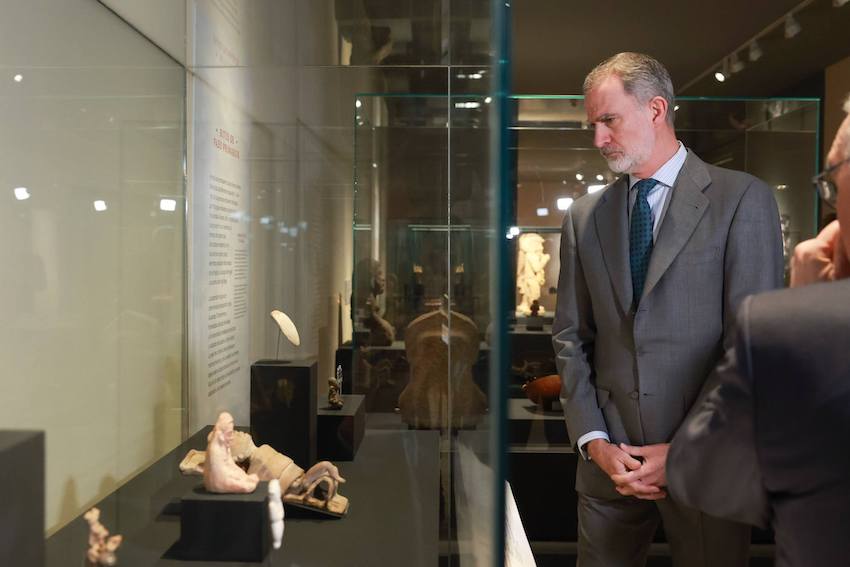
The statement came during the king’s visit to the exposition “Half the world. The women of Indigenous Mexico” at the National Archaeological Museum (MAN) in Madrid, Spain.
Recorrido del Rey por la exposición “La mitad del mundo. La mujer en el México indígena” en el Museo Arqueológico Nacional (MAN).
La exposición, centrada en el ámbito humano, permite indagar en el conocimiento del México indígena a través de la figura de la mujer. pic.twitter.com/BDwH8KIijl
— Casa de S.M. el Rey (@CasaReal) March 16, 2026
In a video posted by the Royal House on social media, the monarch can be heard saying that “there are things that, when we study them, in our judgment, with our current values, obviously cannot make us proud. But we must understand them, in their proper context, not with excessive moral presentism, but with an objective and rigorous analysis.”
He added that since the time of the Catholic Monarchs and the Laws of the Indies – the legislation issued by the kings of Spain to regulate life in the overseas territories, including the Americas and the Philippines – there had been a “desire to protect” the Indigenous people, but that in reality, “this protection is not fulfilled as intended, and there is much abuse.”

King Felipe VI also spoke of “many moral and ethical controversies regarding how power has been exercised from the very beginning” of Spanish royalty.
This is the first time Felipe VI has directly addressed the context of the Spanish conquest and colonization after years of diplomatic tension between Mexico and Spain. The tension started in 2019, when President Andrés Manuel López Obrador — of the current ruling party Morena — sent a letter to Spain requesting an apology by the Crown and the Catholic Church for the wrongs committed against Indigenous peoples.
The letter went unanswered, leading to increased friction between Spain and Mexico. As a result, the current president, Claudia Sheinbaum, did not extend an invitation to King Felipe VI to her presidential inauguration ceremony in 2024.
Yet, diplomatic relations between the two countries have remained active and there are signs of increased bilateral cooperation. In fact, earlier this year, the International Tourism Fair (FITUR), which is held every year in Madrid and is regarded as one of the largest fairs of its kind, featured Mexico as its partner country.
What did President Claudia Sheinbaum say?
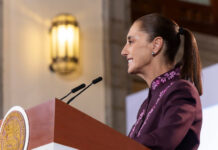
This morning, President Clauida Sheinbaum addressed the king’s statement, describing it as “a gesture; an approach that we acknowledge.”
“This might not be everything we were hoping for,” she said, while also recognizing the monarch’s “gesture” of visiting the exposition. “But this is undoubtedly a gesture of rapprochement by the king.”
In October, at the inauguration of the very exhibition that King Felipe VI visited on Monday, Spanish Foreign Minister José Manuel Albares acknowledged the “pain and injustice” inflicted upon “the Indigenous peoples” of the Americas.
At the time, Sheinbaum welcomed these words, stating they were the “first step” by the Spanish government toward recognizing the abuses committed. And although the recent words by the king of Spain are not a formal apology, Sheinbaum insisted that “we must recognize [the king’s statement] and continue to move forward with the dialogue.”
“We must keep working on the process of recognizing the great civilizations that existed in Mesoamerica and in other parts of Latin America — what we now call Latin America,” she said.