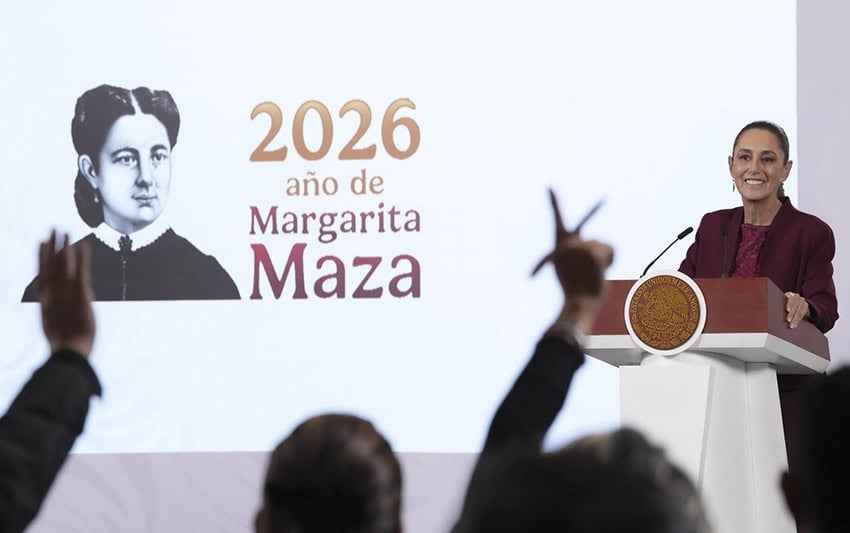
President Claudia Sheinbaum held her Thursday morning press conference at the National Palace in Mexico City before traveling to Puebla to take part in a Mexican Army Day event.
Here is a recap of the president’s Feb. 19 mañanera.
CDMX-AIFA rail line scheduled to open before Easter
Sheinbaum told reporters that the train line between the Buenavista station in central Mexico City and the Felipe Ángeles International Airport (AIFA) in México state will begin operations “before Holy Week.”
Holy Week begins this year on March 29 — Palm Sunday — and concludes on Easter Sunday on April 5.
Before Sheinbaum indicated that the CDMX-AIFA line will open next month, the government’s rail czar Andrés Lajous said that railroad verification tests were concluding and the commencement of “dynamic tests” was just one day away.
The train line to AIFA is an extension of Mexico City’s suburban railroad, which links Buenavista to Cuautitlán in México state.

Construction of the line between the Lechería station and AIFA began during the presidency of Andrés Manuel López Obrador, whose government built the airport.

AIFA opened in March 2022, and passenger numbers have gradually increased since then.
The airport is located about 50 kilometers north of central Mexico City in the México state municipality of Zumpango. The federal government hopes that the opening of the train line will lead to an increase in passenger numbers at AIFA. The trip from Buenavista to the airport will take around 40 minutes.
Mexico seeking extradition of U.S. businesspeople allegedly involved in fuel smuggling
Sheinbaum told reporters that more arrests are still to be made in connection with the crime of huachicol fiscal — i.e. the evasion of taxes on gasoline and diesel brought into the country.
Members of the Mexican Navy are among the people who have already been arrested in connection with the crime, but the president stressed that Navy Minister Raymundo Pedro Morales Ángeles is not under investigation.
She also said that Mexico has requested the extradition of “some businesspeople” from the United States who were allegedly involved in the “entry of fuel to Mexico without paying taxes.”
Anti-corruption chief reveals sophisticated fuel tax evasion network costing Mexico billions
Sheinbaum said that it was up to the Federal Attorney General’s Office to provide the names of those businesspeople, if it is in a position to do so.
Asked whether authorities were seeking the extradition of “the Jensens,” the president responded that they, “among others,” are wanted in Mexico.
The Jensens are a Utah couple and their adult sons, all of whom face charges in the United States for allegedly smuggling US $300 million worth of crude oil in collaboration with Mexican criminal organizations.
Fentanyl-laced tamales?
A reporter asked the president what information she had about the case of a 10-year-old girl who tested positive for fentanyl after eating a tamal at a street food stand in the municipality of Huauchinango, Puebla.
The Puebla government said on Tuesday that seven children received medical care after they presented symptoms of food poisoning “allegedly resulting from the consumption of tamales.”
Six of the children were “stabilized” and discharged from hospital, but a 10-year-old girl remains “under medical observation” after she tested positive for fentanyl, the government said in a statement. It said that the relevant authorities were advised of the situation and would investigate.
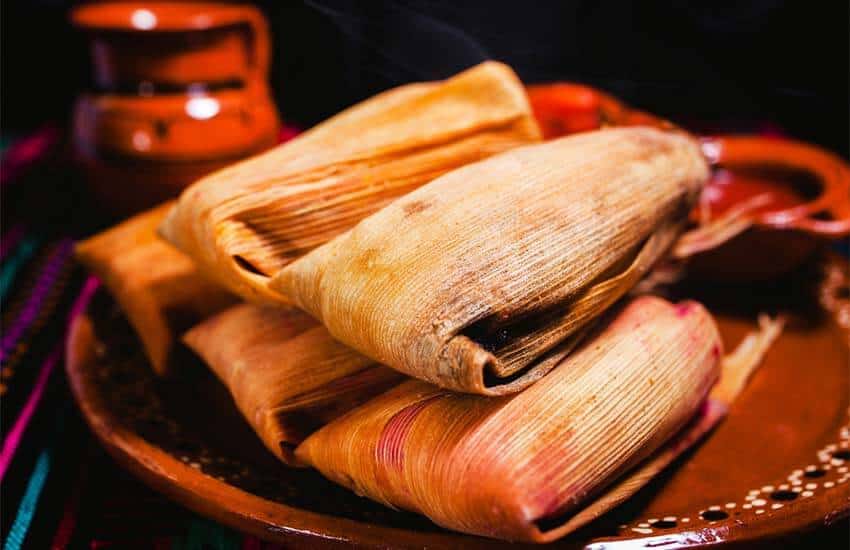
Sheinbaum said she asked federal Attorney General Ernestina Godoy and security and health officials to find out “if it really was fentanyl” that made the girl ill, and if so, to investigate how the drug got into the tamales.
Later on Thursday, the Puebla Attorney General’s Office (FGE) said that the girl’s positive test for fentanyl was due to medication she was administered in hospital, rather than something she ate.
It said that urine samples were collected from children and adults who ate the tamales in question, and testing didn’t detect the presence of any “drugs of abuse.”
The FGE also said that samples of the tamales were being tested to “determine with precision the possible origin of the poisoning.”
By Mexico News Daily chief staff writer Peter Davies (peter.davies@mexiconewsdaily.com)