The United States has established a new “counter cartel coalition” made up of Western Hemisphere nations, but Mexico isn’t part of the group even though U.S. President Donald Trump asserted on Saturday that the country is the “epicenter of cartel violence.”
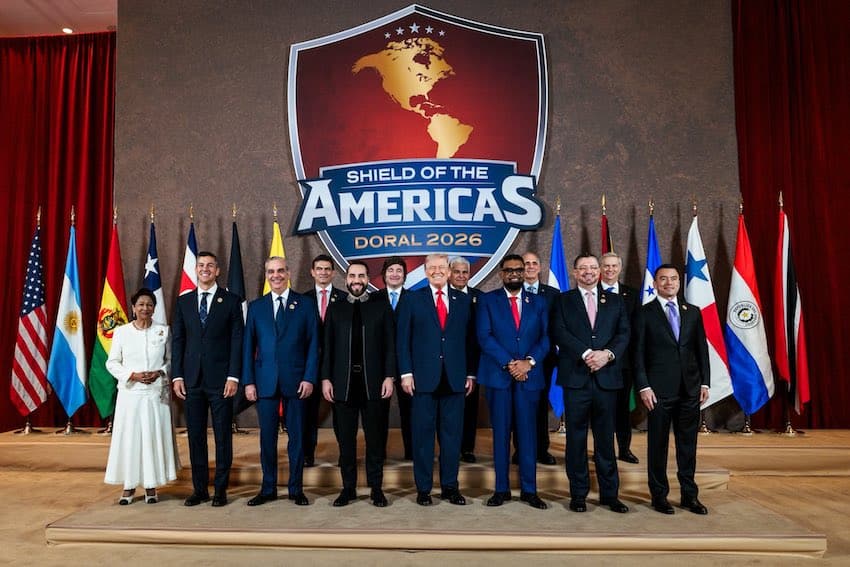
The Americas Counter Cartel Coalition (ACCC) — also known as the “Shield of the Americas” — was established last Thursday during the Americas Counter Cartel Conference in Miami. Among the coalition partners are the United States, Argentina, Ecuador, El Salvador, Panama, Paraguay and Peru. In addition to Mexico, countries including Colombia, Brazil, Canada and Cuba are not part of the coalition.
At an event on Saturday that the White House called the “Shield of the Americas” summit, Trump signed a proclamation that states that U.S. Secretary of War Pete Hegseth “established the Americas Counter Cartel Coalition, a pledge from military leaders and representatives from 17 countries demonstrating that the region is ready to operationalize hard power to defeat these threats to our security and civilization.”
At the summit, held in Doral, Florida, the U.S. president said that the aim of the coalition is to “eradicate the criminal cartels plaguing our region.”
“And you have a lot of it,” Trump told regional leaders, including President Javier Milei of Argentina, President Daniel Noboa of Ecuador and President Nayib Bukele of El Salvador.
He said that the United States is currently “knocking the hell out of [cartels] where we can, and we’re going to go heavier.”
Introducing the Americas Counter Cartel Coalition, designed to crush dangerous criminal cartels in the Western Hemisphere.
“The heart of our agreement is a commitment to using lethal military force to destroy the sinister cartels and terrorist networks.” – President Donald J.… pic.twitter.com/zPr8ghkoBk
— The White House (@WhiteHouse) March 7, 2026

Trump said that the “heart” of the agreement between the ACCC partners is “a commitment to using lethal military force to destroy the sinister cartels and terrorist networks.”
During his address, he also said that “as part of our commitment to countering the cartel presence in our region, we must recognize the epicenter of cartel violence is Mexico.”
“The Mexican cartels are fueling and orchestrating much of the bloodshed and chaos in this hemisphere and the United States government will do whatever is necessary to defend our national security and to protect the safety of the American people,” said Trump, who in January asserted that the U.S. was going to start “hitting” Mexican cartels on land.
“… It’s coming through Mexico,” he said, referring to narcotics smuggled into the United States.
“And I like the president very much,” Trump said, referring to Claudia Sheinbaum, who on Jan. 12 appeared to defuse the U.S. president’s threat to launch strikes on Mexican cartels, at least temporarily.
“She’s a very good person. She’s got a beautiful voice, a beautiful woman, but beautiful voice,” he said before attempting to imitate it.
“… I said, ‘Let me eradicate the cartels.’ [She said:] “No, no, no, please, president.’ We have to eradicate them. We have to knock the hell out of them because they’re getting worse. They’re taking over their country. The cartels are running Mexico. We can’t have that. Too close to us. Too close to you,” Trump said, alluding to his stated willingness to use the U.S. military to attack Mexican cartels.
The U.S. president announced last Thursday that Kristi Noem, the former secretary of homeland security, would be “Special Envoy for The Shield of the Americas, our new Security Initiative in the Western Hemisphere,” a region that the U.S. government has declared a strategic priority as part of the so-called “Trump Corollary” to the Monroe Doctrine.
Why isn’t Mexico part of the ACCC?
There appears to be a range of reasons why Mexico is not part of the ACCC, including that it has a separate bilateral security agreement or “understanding” with the U.S., the Mexican government is not ideologically aligned with the Trump administration and Sheinbaum is vehemently opposed to any kind of U.S. military action in Mexican territory.
Mexico was reportedly not invited to either the “Shield of the Americas” summit or the Americas Counter Cartel Conference. However, a U.S. Department of State spokesperson told the EFE news agency that the door is not closed to Mexico joining the ACCC at some point in the future.
Raquel Saed, an academic in the International Studies department of the Ibero-American University in Mexico City, told the newspaper Milenio that Mexico will have “different treatment” in its security relationship with the United States in comparison with the ACCC countries.
She noted that Mexico and the United States have their own intense bilateral agenda.
“We have to share a lot of things [including] a border,” Saed said, noting also that Mexico and the U.S. have their own bilateral social, political and economic relationship.
Eunice Rendón, a security and migration expert, asserted that countries such as Mexico and Brazil were excluded from the “Shield of the Americas” summit because their governments don’t align ideologically with the Trump administration.
The leaders who were invited are more aligned with “the thinking and vision” of Trump, Rendón told Milenio. Some of those leaders “are also part of that fascist, xenophobic, right-wing movement,” she said.
Reuters reported that “many of the leaders” who attended the summit in Florida on Saturday “share Trump’s hardline view of crime and migration, favoring crackdowns over deeper social fixes and private business over the state.”
Christopher Sabtani, senior research fellow for Latin America at the British think tank Chatham House, wrote that the attendees at the “Shield of the Americas” summit were all “centre- to hard-right leaders,” while the presidents of Brazil, Mexico and Colombia — “all of them of the left” — were “pointedly absent.”
“This is significant: those three countries represent more than half of the region’s GDP. And they host a large part of the region’s illicit markets including narcotics production and trade – the supposed targets of the summit,” Sabatini wrote.
A coalition whose central stated commitment is to use “lethal military force” against cartels is not congruent with Sheinbaum’s condemnation of U.S. attacks targeting alleged drug boats. She has advocated arresting suspected drug traffickers at sea, rather than killing them, and at her Monday morning press conference, said it was “good” that Trump on Saturday had publicly acknowledged her rejection of his offer to send the U.S. army into Mexico to combat Mexican cartels, six of which have been designated as foreign terrorist organizations by the U.S. government.
Sheinbaum is adamant that Mexico can — and must — act on its own against cartels in its own territory, while limiting security collaboration with the United States to things such as intelligence sharing. In contrast, Ecuador — now a ACCC partner — collaborated with the United States on “lethal kinetic operations against Designated Terrorist Organizations within Ecuador” last Friday, according to the U.S. Southern Command. The U.S. could conceivably seek to carry out similar operations with other ACCC partners.
Indeed, during his address on Saturday, Trump told leaders of the ACCC countries that “we’re working with you to do whatever we have to do.”
“We’ll use missiles, [if] you want us to use a missile, they’re extremely accurate. Pew! Right into the living room,” he said, mimicking the sound of a missile.
“That’s the end of that cartel person. But we’ll do whatever you need if you want. A lot of countries don’t want to do that,” Trump said.
Hegseth said at last week’s Counter Cartel Conference that the U.S. “is prepared to take on these threats and go on the offense alone if necessary.”
“However, it is our preference … [that] we all do it together with you,” he said.
While Sheinbaum is steadfastly opposed to a U.S. military attack against cartels in Mexico, and to joint operations with the U.S. on Mexican soil, her government — under pressure from Trump — has taken a more proactive and aggressive approach to combating criminal organizations, as demonstrated by the recent military operation targeting Nemesio Rubén “El Mencho” Oseguera, the now deceased leader of the Jalisco New Generation Cartel.