
Puebla has become the 14th state in Mexico to decriminalize abortion.
Despite the efforts of far-right groups to disrupt Monday’s session of the Puebla state Congress, the legislative body voted 29-7, with four abstentions, to allow abortions within the first 12 weeks of pregnancy.
Abortion hasn’t been a federal crime in Mexico since a 2021 ruling by the Supreme Court struck down a law criminalizing abortion in the northern state of Coahuila.
That decision was bolstered in September 2023 when Mexico’s 11 Supreme Court justices ruled unanimously that state laws that criminalize the voluntary termination of a pregnancy are unconstitutional.
That more comprehensive ruling opened the door to accessing free, legal abortions in public health institutions across the country — although the laws in Mexico still vary by state.
Jalisco became the 13th state to decriminalize abortion in April, and now Puebla is on the list that also includes Oaxaca, Hidalgo, Veracruz, Coahuila, Baja California, Colima, Sinaloa, Guerrero, Baja California Sur, Quintana Roo, Aguascalientes and Mexico City.
Despite the federal rulings, 18 of Mexico’s 32 states have yet to fully decriminalize early-term abortions.

The states where it has been decriminalized all allow terminations up through the 12th week of a pregnancy — something that once might have seemed nearly impossible in a Catholic country where women were jailed for ending pregnancies.
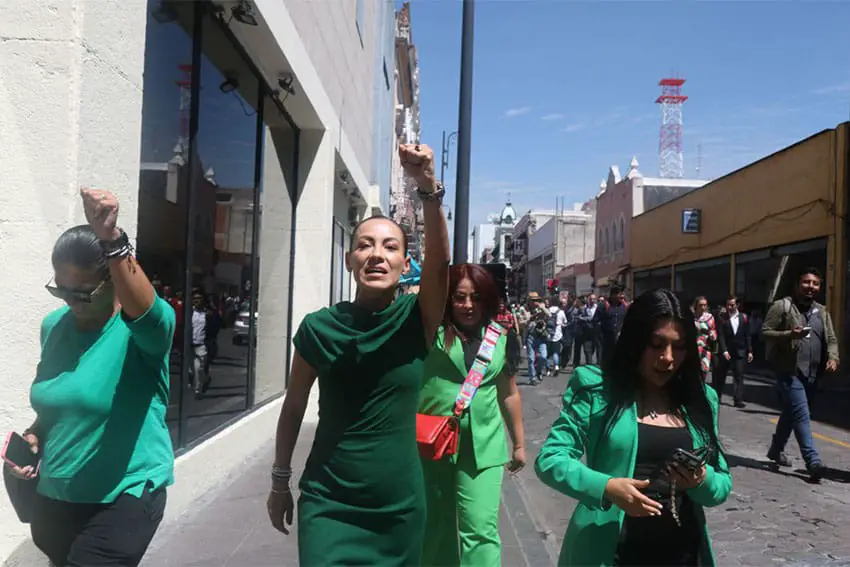
The decision in Puebla to modify its state Constitution was received with joy by green-clad feminist activists who gathered outside.
They had been advocating for such a vote since October 2022, when a district judge in Puebla granted an injunction “so that no woman, trans man or pregnant nonbinary person, or medical personnel, who receive advice, assistance or defense from [several pro-choice] organizations is criminalized for having an abortion or helping someone to have an abortion.”
However, that achievement had limited effect, so advocates had been lobbying the Puebla Congress to change the state’s penal codes.
Those who end a pregnancy after a 12-week period in Puebla could receive prison terms of up to one year, which is similar to statutes in other states.
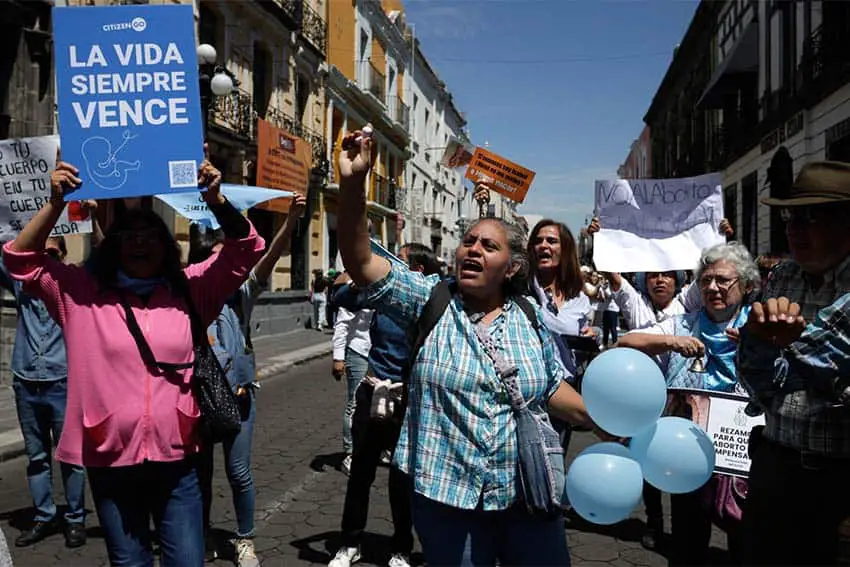
Before Monday’s vote, members of the National Front for the Family and others blocked both entrances into Congress in an attempt to prevent legislators from achieving quorum.
Amidst pushing and shoving, 40 of 41 legislators managed to enter with the help of activists, although the session was delayed 90 minutes. There also was a motion to remove the agenda item, but it was supported by only five National Action Party (PAN) legislators.
A day before the vote, during Mass in the Puebla Cathedral, Archbishop Víctor Sánchez Espinosa called on legislators to “not stain their hands with blood.” He reminded them that he had baptized many of their children and officiated many of their marriages.
The long and arduous movement to decriminalize abortion in Mexico received a boost in 2007 when Mexico City became the first state/entity to decriminalize abortion up to 12 weeks. That set an important precedent in Mexican law, but years of struggle and debate ensued.
That struggle continues in Jalisco, where the Information Group on Chosen Reproduction (GIRE) says that state Congress has yet to comply with a decriminalization mandate from the Jalisco-based Tribunal Colegiado, a federal court not part of the state judiciary.
With reports from La Jornada, Proceso and El País