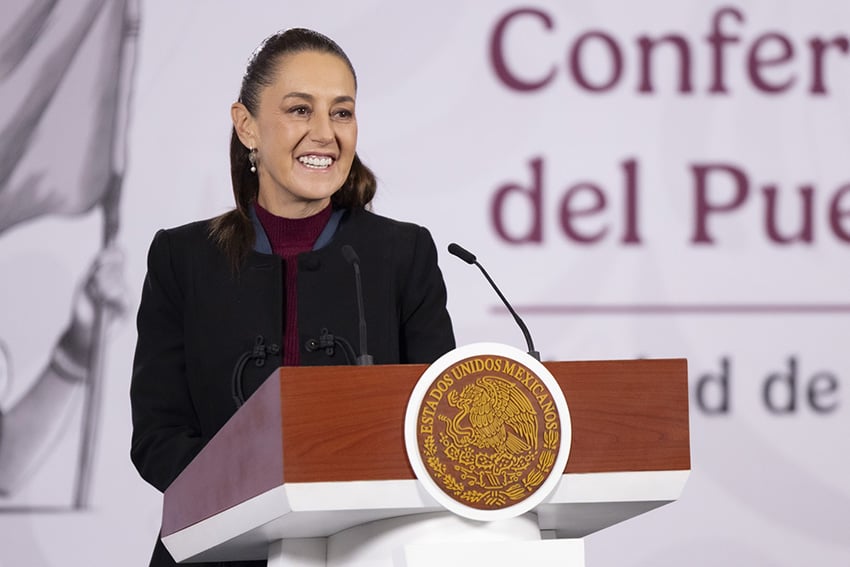
Trade was a key focus of President Claudia Sheinbaum’s Friday morning press conference.
Sheinbaum spoke about Mexico’s recently-approved tariffs as well as the USMCA review, which will take place next year.
At the end of the mañanera, the president was asked whether she partakes in the “twelve grapes” ritual, a tradition in which people eat 12 grapes at the stroke of midnight on Jan. 1.
Sheinbaum: With tariffs, government doesn’t want to cause inflation or production problems
During her Q&A session with reporters, Sheinbaum stressed that her government doesn’t want to “cause inflation” as a result of the implementation of tariffs on imports from countries with which Mexico doesn’t have trade agreements.
Approved by Congress this month, new and higher tariffs up to 50% on imports from various countries including China, India, South Korea, Indonesia, South Africa and Brazil will take effect on Jan. 1.
Economy Minister Marcelo Ebrard estimated on Monday that the tariffs would only add 0.2 percentage points to Mexico’s inflation rate.
Sheinbaum also said that her government doesn’t want to cause problems for manufacturers that rely on inputs from countries with which Mexico doesn’t have free trade agreements.

In that context, Ebrard said last week that Mexico is mainly targeting “finished goods” with the new tariffs, rather than intermediate goods, which he noted are needed to “produce, assemble and export.”
On Friday morning, Sheinbaum noted that that the tariff bill she submitted to Congress in September was significantly modified by Congress after consultation with stakeholders, including manufacturers.
She said that her government “completely agreed” with the changes — i.e. a lowering of many of the tariffs that were originally proposed.
Sheinbaum noted that the Economy Ministry (SE) has the authority “within the framework of the law” to make further reductions to the tariffs if deemed necessary.
In other words, if the new tariffs are having an outsized impact on inflation, or on manufacturers, they could be altered by the SE.
Congress approves new tariffs on goods from China and non-FTA countries
Mexico discussing tariffs with China, India and South Korea
Sheinbaum said that Mexico, through the Ministry of Foreign Affairs and the Economy Ministry, is discussing the soon-to-be enacted tariffs with China, India and South Korea.
Representatives of the Chinese, Indian and South Korean governments have all made public remarks about the tariffs as they seek to get a better deal for their exports to Mexico.
Asked whether Mexico would seek trade agreements with those countries, Sheinbaum responded:
“Well, I don’t know if … [there will be] a treaty, a trade agreement, some kind of scheme. We don’t want to make enemies with any country, any people or any government. What we’re seeking is national development within a plan we established that we call Plan México.”
Among the objectives of the 2025-30 plan are to reduce reliance on imports from China and other Asian countries; increase the production of manufactured goods in Mexico; and create 1.5 million new jobs.
The new tariffs seek to support all of those goals.
Mexico Approves Up to 50% Tariffs on China, Other Asian Nations
“According to the legislation, Chinese cars face among steepest tariffs at 50%. The country’s massive auto sector currently holds 20% of Mexican market, up dramatically from minimal vehicle imports just 6 years ago” pic.twitter.com/2mecdFd9A8
— Danielle DiMartino Booth (@DiMartinoBooth) December 11, 2025
While Mexico is willing to engage with China, India and South Korea and listen to their concerns about the tariffs, it appears unlikely that it will grant any significant concessions to them in the short term.
Indeed, Ebrard said last week that the legislation approved by Congress is “quite reasonable” and opined that he didn’t believe it would “change in the short term.”
Sheinbaum said on Friday that her government will provide updates on its dialogue with officials from the countries that will be affected by the new tariffs that will take effect on Jan. 1.
Sheinbaum ‘very optimistic’ about USMCA review
Sheinbaum stressed that a “review” of the USMCA free trade pact will take place next year rather than a “renegotiation,” as U.S. President Donald Trump has indicated will occur.
“The agreement says that,” the president said.
Sheinbaum noted that the Trump administration has imposed a lot of tariffs this year — including on imports from Mexico and Canada — but declared that she is nevertheless “very positive” and “very optimistic” about the USMCA review.
Striking how uniquely exposed to Trump’s tariffs India is:
– 33% effective tariff rate (among the highest now)
– 19% of exports went to US last year (not Mexico, but high-ish) pic.twitter.com/qpDqUXicFp— Justin Sandefur (@JustinSandefur) December 5, 2025
She highlighted that U.S. Trade Representative Jamieson Greer spoke to U.S. lawmakers this week and paraphrased him as saying “the [USMCA] agreement has been very good, but some issues have to be reviewed.”
“More or less, in a few words [that’s what he said]. His speech is quite long,” Sheinbaum said.
“That, in addition to the talks we’ve had [with the U.S.], gives us the view that we’re on the right track. And the Mexican economy will be fine in 2026,” she said.
The government’s priorities in 2026
A reporter asked the president what the government needs to “consolidate” in 2026, and also inquired whether she partakes in the 12 grapes ritual and if so what her 12 wishes for the new year would be.
Sheinbaum responded that the most important thing for her government is “the people of Mexico” and “their well-being.”
“And in that sense, we always work,” she said.
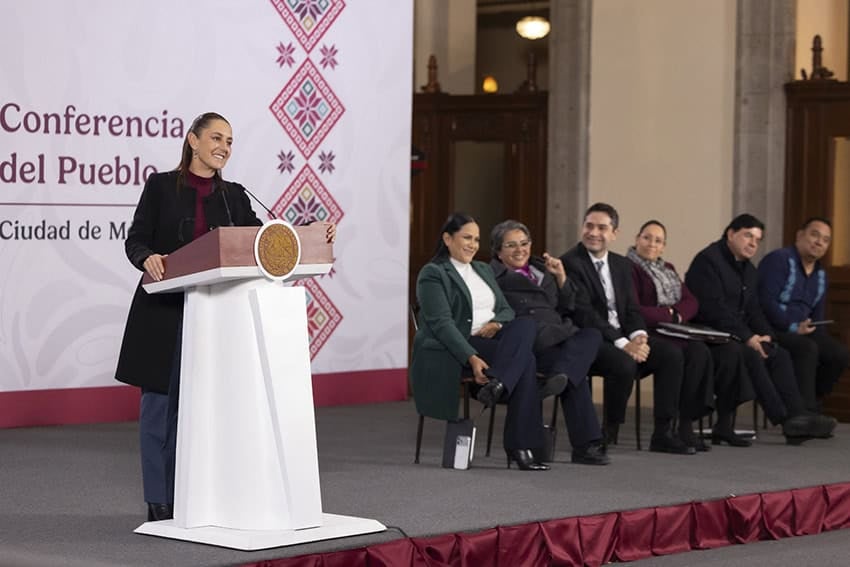
Sheinbaum went on to say that the fourth transformation political movement that was founded by former president Andrés Manuel López Obrador and which she now leads “has to be consolidated,” as to date there have only been “seven years of transformation.”
“Next year, we’re going to dedicate a significant amount of time to public investment,” she added.
“We’re going to continue dedicating significant time to the issue of security because … [improving security] must always be our goal,” Sheinbaum said.
She also said that citizens’ social and human rights, education, health care, housing and welfare programs would be priorities for her government in 2026.
“I’m very positive,” Sheinbaum said.
“And [with] the 12 grapes [my wishes go to] family, neighbors, nature, the homeland and then pueblo, pueblo, pueblo, pueblo, pueblo, pueblo,” she said, referring to the people of Mexico.
By Mexico News Daily chief staff writer Peter Davies (peter.davies@mexiconewsdaily.com)