Sheinbaum’s mañanera in 60 seconds
- 📝 Transparency decree signed: Sheinbaum signed a new “Decree to Strengthen Transparency in the Federal Government,” which she said eliminates public servants’ discretion over what information is disclosed and establishes specific guidelines on what must be made transparent, with exemptions mainly for national security documents.
- 🗄️ Buenrostro details replacement system: Anti-Corruption and Good Governance Minister Raquel Buenrostro said the decree will compel government departments to publish information beyond what’s legally required. She also told reporters that her ministry has “stabilized” the National Transparency Platform (PNT), which she said was previously always offline.
- 🏛️ Broader disclosure push: Buenrostro said the decree seeks greater transparency around public contracts, government audits and information related to Pemex and the Federal Electricity Commission. She said that the federal government will invite state and municipal governments to also adhere to a “principle of maximum disclosure.”
- 🇺🇸 Sheinbaum on governors’ US visas: Asked about the cancelation of state governors’ U.S. visas, Sheinbaum laughed and called it “a personal matter for each person,” before pivoting to note that her government has arrested mayors and officials from various parties when there is proof of criminal links.
Why today’s mañanera matters
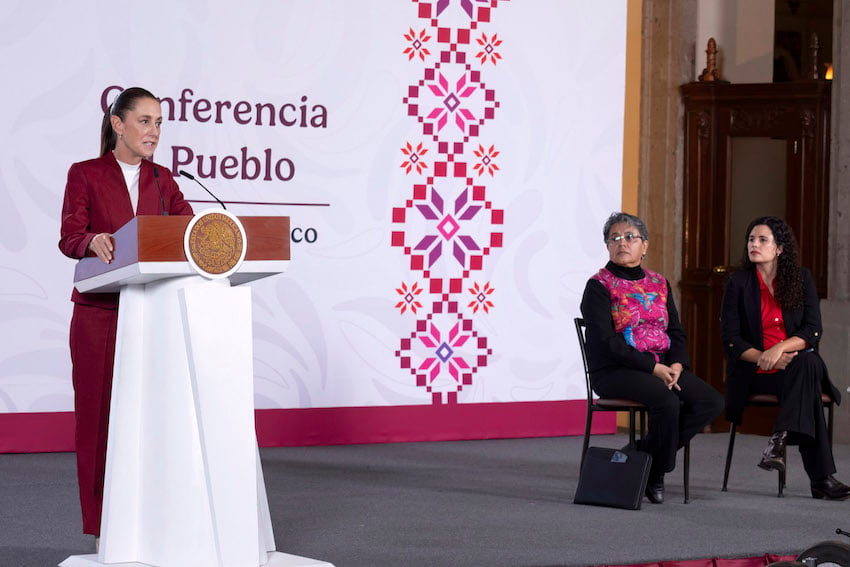
At her Tuesday morning press conference, President Claudia Sheinbaum signed a decree that seeks to obligate the government she leads to be more transparent.
Her signing of the decree comes after the Mexican Congress, in late 2024, approved a controversial constitutional bill that eliminated seven watchdog agencies, including INAI, the national transparency agency.
On Tuesday morning, Sheinbaum defended the decision to eliminate INAI, saying that funding the agency entailed “enormous” expenditure and that its personnel engaged in corruption.
Today’s mañanera was significant as the government provided details about the system it is developing as a replacement for INAI.
Also of note at the press conference was Sheinbaum’s response to a question about the cancelation of Mexican state governors’ U.S. visas. While the cancelation of only one governor’s U.S. visa is confirmed, a recent media report claimed that two other governors have also been stripped of their visas.
Sheinbaum signs transparency decree
Early in her press conference, Sheinbaum told reporters that Anti-Corruption and Good Governance Minister Raquel Buenrostro would present “a decree we’re going to sign today to guarantee government transparency.”
“… This is in the constitution, it’s in the guidelines, but we’re going to do even more,” she said.

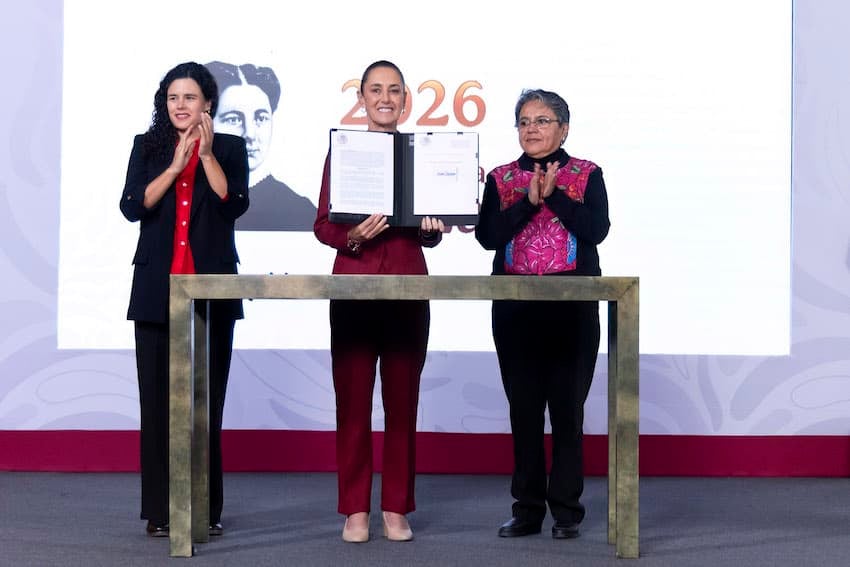
Buenrostro said that the new presidential decree will compel all government departments to publish information “beyond” what they are legally required to disclose.
She subsequently told reporters that the ministry she leads has “stabilized” the National Transparency Platform (PNT), a website she said was previously “always offline.”
Buenrostro said that the PNT allows “everyone” to have “timely” access to government information. She said that “new tools” have been added to the site to make it easier for people to download information.
Buenrostro said that the new decree seeks to ensure greater transparency regarding public contracts, audits of government departments and information related to Pemex and the Federal Electricity Commission.
“This information will be centralized and kept up to data on the National Transparency Platform,” she said.
Buenrostro said that the federal government will invite state and municipal governments and “other powers” to also adhere to the “principle of maximum disclosure” by being more transparent and publishing information of public interest in a timely manner.
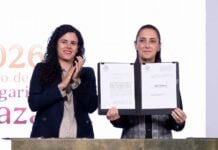
After her presentation, Sheinbaum signed the decree, officially titled “Decree to Strengthen Transparency in the Federal Government.”
She said that the decree eliminates the discretion of public servants to decide what information is disclosed and what information is reserved.
“There is now a specific guideline of what must be transparent,” Sheinbaum said, noting that documents related to national security are among the information that may be exempt from disclosure.
“… It’s total transparency from the government of Mexico,” she said.
Sheinbaum also said that her transparency decree will be incorporated into the General Transparency Law in order to “guarantee access to information” for all Mexicans.
Sheinbaum: Cancelation of officials’ US visas is a ‘personal’ matter
A reporter asked Sheinbaum whether she had spoken to state governors about “the situation” regarding their U.S. visas. “What are the reasons why they would be canceled?” she asked the president.
Baja California Governor Marina del Pilar Ávila Olmeda revealed last year that her U.S. tourist visa had been revoked, but denied any criminal wrongdoing. However, in a recently leaked telephone conversation with one man identified as an “external” FBI adviser and another man identified as an FBI “special agent,” Ávila said she was willing to cooperate with U.S. authorities, apparently in order to avoid possible criminal charges in the United States and extradition to that country.

In June, The Los Angeles Times published a report that stated that the United States was investigating Sonora Governor Alfonso Durazo and Tamaulipas Governor Américo Villarreal Anaya for alleged criminal offenses. Both men have “been stripped of their U.S. visas amid criminal probes, according to people familiar with the cases,” the Times reported.
Ávila, Durazo and Villarreal all represent the ruling Morena party, as does Sinaloa Governor Rubén Rocha Moya, who is currently on leave after the unsealing in April of a U.S. indictment accusing him and various other current and former Sinaloa-based officials of drug trafficking in league with the Sinaloa Cartel.
On Tuesday morning, Sheinbaum’s first reaction to the reporter’s question was to laugh.
“It’s a personal matter for each person,” she subsequently said.
The reporter pointed out that the people whose U.S. visas have been canceled or reportedly canceled are public servants.
“Yes, but it’s a personal matter,” Sheinbaum reiterated.
The president then pivoted to speaking about the actions her government has taken against officials who have allegedly committed crimes.
“Mayors have been arrested, officials from different political parties have been detained where there is proof of their links to crime,” she said.
“… When there is evidence, action is taken,” said Sheinbaum, who has endorsed the Federal Attorney General Office’s view that the United States didn’t provide sufficient proof to warrant the extradition of Rocha Moya.
By Mexico News Daily chief staff writer Peter Davies (peter.davies@mexiconewsdaily.com)