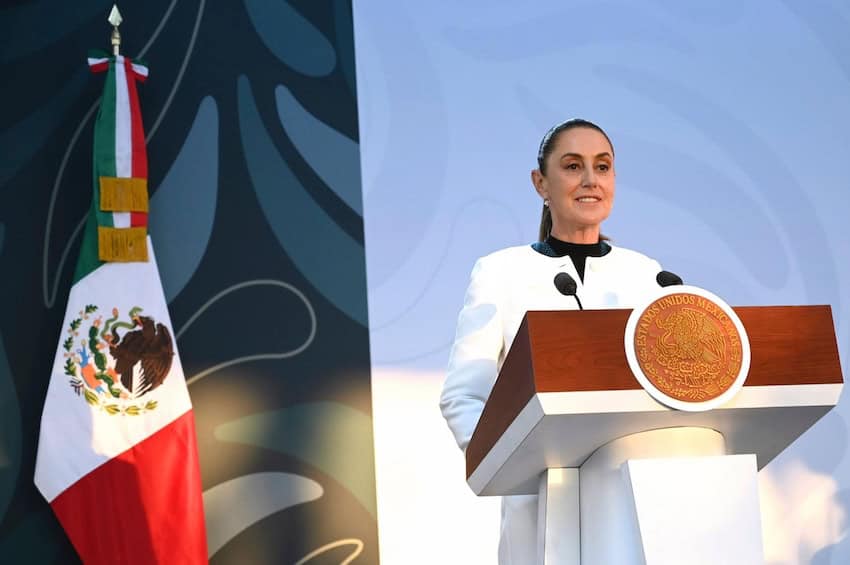
Responding to another sharp U.S. criticism of Mexico’s progress on security issues, President Claudia Sheinbaum on Friday defended her country’s record and reiterated her rejection of repeated U.S. offers of military intervention.
The U.S. government had issued a terse statement on Thursday after Mexican Foreign Minister Juan Ramón de la Fuente and U.S. Secretary of State Marco Rubio discussed strategies to confront shared security threats this week.
🇺🇸#Sheinbaum defiende #estrategia de seguridad tras dichos del #Departamento de #Estado🇺🇸
Nota: https://t.co/et43OlvyCz pic.twitter.com/UgVJ723zVm— Ventanavermx (@Ventanavermx) January 16, 2026
Acknowledging that progress on bilateral security matters is being made, De la Fuente and Rubio — who also spoke on Sunday — agreed that significant challenges remain.
In a joint statement on security cooperation released on Thursday, the State Department said that the two diplomats “reaffirmed the importance of the U.S.-Mexico partnership, grounded in mutual respect for sovereignty, while acknowledging that more must be done to confront shared threats.”

But the State Department’s Bureau of Western Hemisphere Affairs took a harder line in a social media post issued later Thursday:
“The United States made clear that incremental progress in facing border security challenges is unacceptable.”
It added that Mexico is being asked to provide “concrete, verifiable outcomes to dismantle narcoterrorist networks and deliver a real reduction in fentanyl trafficking.”
Thursday’s diplomatic exchange came three days after Sheinbaum personally told U.S. President Donald Trump that U.S. intervention against Mexican cartels is unnecessary. Sheinbaum had requested the dialogue after Trump said he was prepared to confront drug cartels on the ground while again claiming that cartels run Mexico.
In her Friday morning response to the U.S. demand for increasingly stringent security measures and greater results, Sheinbaum asserted that Mexico has achieved significant progress.
“Fentanyl seizures at the U.S.-Mexico border have declined by 50 percent, according to official U.S. data,” she said, adding that the reduction means larger shipments are being seized on the Mexican side of the border.
The United States made clear that incremental progress in facing border security challenges is unacceptable. Upcoming bilateral engagements with Mexico will require concrete, verifiable outcomes to dismantle narcoterrorist networks and deliver a real reduction in fentanyl…
— Bureau of Western Hemisphere Affairs (@WHAAsstSecty) January 16, 2026
What Sheinbaum thinks the US should do
While insisting that bilateral cooperation is based on mutual respect and shared responsibility, Sheinbaum told reporters at her Friday morning press conference that it is incumbent upon the U.S. to more aggressively address the illicit flow of weapons into Mexico and to conduct an intensive campaign among young people to prevent drug addiction.
“It ought not be assumed that the issue of drug trafficking can be solved on this side of the border,” she said. “The consumption crisis they have there must be addressed from a public health perspective, with prevention campaigns and education. Because the consumption is there.”
With regards to arms trafficking, Sheinbaum noted that according to data from the U.S. Department of Justice, 75% of the weapons entering Mexico originate in the United States.
She added that just this week Mexico’s Defense Ministry seized a shipment of 21 rifles and 30 handguns being smuggled across the border into Tijuana.
Sheinbaum also said that Mexico has requested the support of technological surveillance equipment to reinforce operations carried out exclusively by Mexican agencies.
Thursday’s joint statement revealed that the bilateral Security Implementation Group — established last year to coordinate actions against drug/arms trafficking, financial crimes and fuel theft, and first convened in September 2025 — will meet next on Jan. 23. It has been tasked with “delivering tangible actions to strengthen security cooperation and meaningful outcomes to counter cartels.”
At next week’s meeting, the Group will “follow up on bilateral initiatives to promote information-sharing” and will reassess already established cross-border security initiatives.
The North American neighbors will also hold a Security Ministerial in Washington, D.C., in February, which “will provide an opportunity to assess progress, identify gaps and set clear expectations for further collaboration.”
With reports from El Financiero, La Jornada and CNN