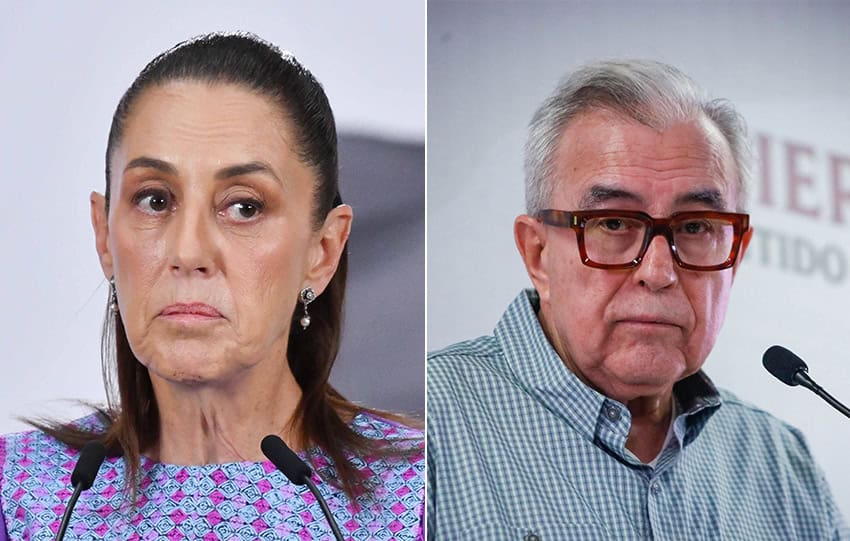
President Claudia Sheinbaum on Thursday responded to U.S. prosecutors’ drug trafficking accusations against Sinaloa Governor Rubén Rocha Moya and nine other Mexicans, saying that her government won’t provide cover for anyone who has committed a crime. However, she also asserted that without “clear proof” the objective of the U.S. charges is “political.”
Reading a prepared statement at her morning press conference, Sheinbaum said that her government won’t allow “meddling or interference” from a foreign government in decisions that are Mexico’s to make.
🚨“Verdad, justicia y defensa de la soberanía”, dice la presidenta Claudia Sheinbaum tras acusaciones de EU contra Rubén Rocha Moya y otros funcionarios mexicanos
“Nosotros no vamos a cubrir a nadie que haya cometido un delito. Sin embargo, si no existen pruebas claras, es… pic.twitter.com/iK4Sfa7xzL
— Azucena Uresti (@azucenau) April 30, 2026
The president’s remarks came after the unsealing on Wednesday of a U.S. indictment accusing Rocha and nine other Sinaloa-based current and former officials of drug trafficking and related weapons offenses. The defendants — including a Morena party senator and the mayor of Culiacán — are accused of colluding with the Sinaloa Cartel.

Rocha, who has been governor of Sinaloa since 2021, rejected the U.S. accusations, as did other suspects. He told reporters on Wednesday that “nothing” would happen to him and declared he had the support of the president.
The governor represents Morena, the party founded by former president Andrés Manuel López Obrador and which backed Sheinbaum at the 2024 presidential election. Rocha is a political ally of Sheinbaum, putting the president in a very difficult situation as the U.S. requests his extradition.
The Ministry of Foreign Affairs (SRE) issued a statement on Wednesday saying that it had received extradition requests for “several individuals” from the U.S. government.
The SRE said that “the information received” had been referred to the Federal Attorney General’s Office (FGR) “to evaluate the requests under Mexican law.”
“Based on the legal review conducted by the Ministry of Foreign Affairs under the bilateral Extradition Treaty, the documents received from the U.S. Embassy do not contain sufficient evidence to establish the responsibility of the individuals whose provisional arrest for extradition purposes is being requested,” the SRE said.
“Nonetheless, as is standard procedure in such cases, it will be the Attorney General’s Office that determines whether there is sufficient evidence under the Mexican legal system and whether to grant the provisional arrest requests,” the ministry said.
The SRE also said that “the treaties in force include specific provisions establishing the confidentiality of the information,” — i.e. a superseding indictment that was published online by the Justice Department —adding that “a formal protest will therefore be sent to the U.S. Embassy regarding the manner in which the information was disclosed.”
Ulises Lara, a special prosecutor in the FGR, subsequently said that the FGR will “launch an investigation to gather all the necessary information to determine whether there is evidence establishing a reasonable likelihood that the charges brought by U.S. authorities have a legal basis for requesting arrest warrants. ”
He also said that the United States’ request for the provisional arrest for extradition purposes of the 10 suspects is “not accompanied by sufficient probative elements that provide conclusive evidence regarding the events narrated.”
The full superseding indictment against Sinaloa governor Rubén Rocha Moya is out and it’s brutal. He faces Narcotics Importation Conspiracy along with various Sinaloa officials. “To protect and grow this drug trafficking empire, the Cartel has partnered with corrupt politicians.” pic.twitter.com/tqy9XWKPsA
— Ioan Grillo (@ioangrillo) April 29, 2026
Sheinbaum referred to the SRE’s press release and Lara’s remarks in the statement she read out on Thursday morning.
Here is a full translation of Sheinbaum’s statement:
“To the people of Mexico: On the evening of April 28, the Ministry of Foreign Affairs received 10 documents requesting the provisional detention of 10 Mexican citizens for the purpose of extradition. On April 29, in accordance with current regulations, the Ministry forwarded the information received to the Federal Attorney General’s Office for evaluation of these requests, in accordance with Mexican law.
At noon on Wednesday, April 29, the U.S. Department of Justice for the Southern District of New York announced charges against 10 Mexican citizens, including the sitting governor of Sinaloa, the senator from Sinaloa [Enrique Inzuna Cazarez], and the mayor of Culiacán.
Attached to this indictment, a document was published with the title, in Spanish, Acusación de reemplazo bajo reserva [superseding indictment under seal]. This prompted a legal protest from the Ministry of Foreign Affairs, given that such proceedings are confidential, in accordance with relevant treaties.
Yesterday afternoon, the Federal Attorney General’s Office issued a statement setting forth the following: Based on the Political Constitution of the United Mexican States, the National Code of Criminal Procedure, and the applicable laws in this matter, it is the obligation of the Attorney General’s Office, through the Special Prosecutor’s Office for International Affairs, to analyze the documentation received in order to determine, with complete accuracy, whether the necessary evidence exists for this purpose [provisional arrest] and, if applicable, the feasibility of the request.
At the same time, the Federal Attorney General’s Office stated that it will launch an investigation to gather all necessary information to determine whether there is evidence establishing that the allegations made by U.S. authorities have a legal basis for requesting arrest warrants.
The Federal Attorney General’s Office established that Mexican law clearly states that to request an arrest warrant from a judicial authority, it is necessary to present evidence inferring the possibility that a person has committed a crime.
Since I assumed the presidency of Mexico, I have sworn to uphold the Constitution and the laws. Likewise, I have made a firm commitment to safeguard the well-being of the people and defend national sovereignty. Mexico is a great country, with a generous and hardworking people. Mexico establishes a relationship of equals with all nations, never one of subordination and certainly not of subservience.
As President of the Republic, my stance on these events is: truth, justice, and the defense of sovereignty.
In other words, if the Attorney General’s Office — which is the competent authority — receives compelling and irrefutable evidence in accordance with Mexican law, or if its own investigation uncovers elements constituting a crime, it must proceed in accordance with the law under our jurisdiction.
I have always stated this clearly, and we have acted accordingly: we will not cover up for anyone who has committed a crime. However, if there is no clear evidence, it is evident that the objective of these charges by the Department of Justice is political.
Let this be crystal clear: under no circumstances will we allow the meddling or interference of a foreign government in decisions that fall exclusively within the purview of the Mexican people. Truth, justice, and the defense of sovereignty. This is our position.”
Mexico News Daily