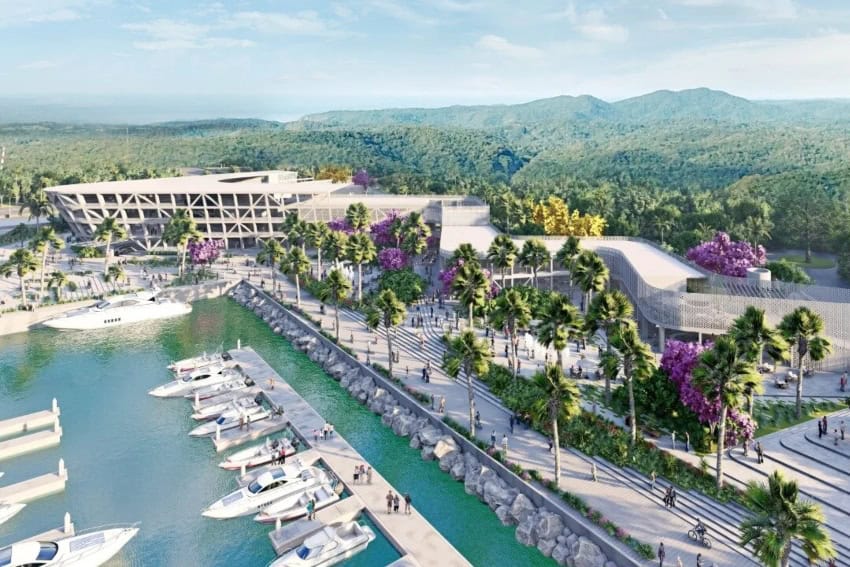
The contrast is stark. One site is defined by manicured green fairways; the other, a near-empty marina dominated by an architecturally striking but unfinished waterfront building. Both sit along the Gulf of Tehuantepec, where warm Pacific breezes move through overgrowth at the marina and across the groomed palms and fairways of the golf course. Yet at each, something is missing: activity, purpose, and the steady flow of people they were built to attract.
The cost of immobilizing large tourism assets is felt well beyond the offices where legal, political and administrative decisions are made. In Huatulco, two major tourism assets have been rendered inactive, leading to lost employment and tourism revenue, along with prolonged uncertainty for existing businesses and for investment decisions tied to facilities expected to be operating, not waiting.
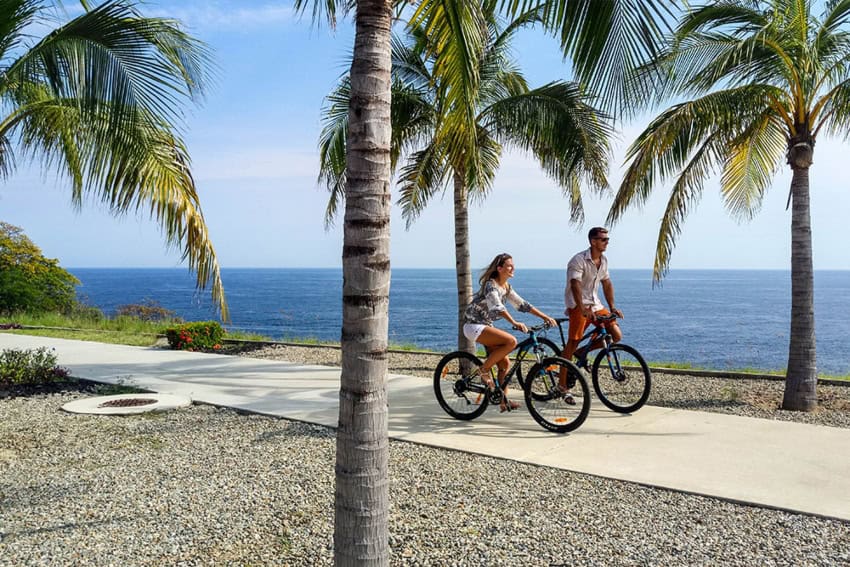
These impacts are rooted in two very different cases: one is an unfinished convention center; the other, a professionally maintained golf course placed in legal suspension.
The Huatulco Convention Center: From flagship project to legal standstill
On Dec. 11, 2025, formal seizure notices were posted across the unfinished structure of the Huatulco Convention Center overlooking the Chahué Marina. Issued by the Specialized Anti-Corruption Prosecutor’s Office of Oaxaca, the notices designated the building as evidence in an ongoing criminal investigation, legally halting any further work on the site. With that act, a project once promoted as a cornerstone of Huatulco’s future tourism economy entered a new phase, no longer merely incomplete, but legally immobilized.
The Huatulco Convention Center began as a relatively modest proposal, a single line item of 70 million pesos (US $3.7 million) within a package of 118 infrastructure projects announced by then-Gov. Alejandro Murat in 2019. The package was presented as a state effort to stimulate employment and reduce poverty across Oaxaca.
Only months after the infrastructure projects were announced, the COVID-19 pandemic upended construction schedules worldwide and delayed the start of work on the Huatulco Convention Center. Over roughly two years of inaction, the convention center’s role quietly expanded. State officials began to describe it not as a regional facility but as a “strategic trigger,” one capable of lifting Huatulco into the international convention market, alongside destinations such as Cancún and Los Cabos.
When vision and practical realities collide
To realize this expanded vision, the state of Oaxaca engaged Enrique Norten, founder of TEN Arquitectos, a Mexican firm internationally recognized for contemporary civic and cultural projects. The proposed design called for an approximately 11,000-square-meter facility integrated into the Chahué Marina, including a 1,285-seat auditorium with advanced acoustics capable of hosting concerts, theatrical productions, and academic conferences. Public plazas and landscaped green spaces were also incorporated. What emerged was no longer a modest, 70-million-peso infrastructure line item, but a highly visible, architecturally ambitious waterfront complex with regional and international aspirations.

Vision and aspiration soon collided with the practical realities of constructing a large-scale performance venue on reclaimed waterfront land, introducing significant technical challenges. Once the bidding process was completed based on the finalized architectural plans, the projected cost had risen to 323.7 million pesos (US $16.1 million), more than four times the original budget allocation. Construction formally broke ground in February 2022.
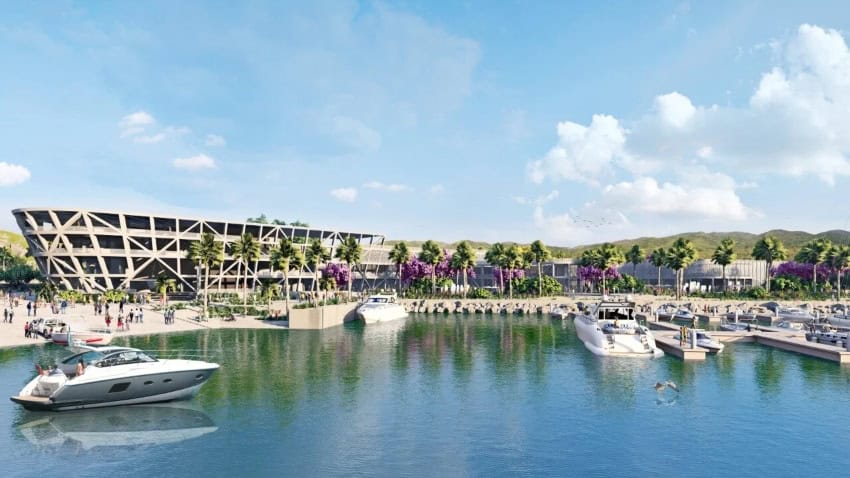
Forty-eight hours before his term ended in November 2022, Murat formally inaugurated the Huatulco Convention Center in its then-current state, largely complete but not yet operational. What was once framed as a catalyst for economic growth now sits silent on the waterfront. Sealed and unused, the striking structure awaits judicial resolution rather than further development, its fate emblematic of how large public assets can slip from promised engines of growth into prolonged limbo.
The Tangolunda golf course: From strategic asset to legal limbo
Central to each of the five master-planned tourist resorts developed by FONATUR (the National Fund for Tourism Promotion) was the inclusion of a golf course, conceived as a strategic anchor within Mexico’s planned resort model. In Huatulco, that role was filled by the Tangolunda golf course (Las Parotas Golf Club), which opened in 1991 and functioned for decades as a core component of the destination’s tourism infrastructure.
In 2012, following several years of operating losses, FONATUR opted to lease the Tangolunda golf course to a private operator under a 10-year concession. The decision was intended to stabilize finances, attract third-party investment, and upgrade the facility to professional-level standards. Those objectives were largely met. The course was extensively redesigned by Mexican golf architect Agustín Pizá and reopened in 2014 as a first-class, professionally maintained facility.
A period of uncertainty
With the expiration of the 10-year lease in 2022, the golf course entered a period of uncertainty. Federal authorities initially indicated the property would be sold, publicly referencing a proposed sale price of 600 million pesos and granting the existing leaseholder a first option to purchase. In October 2023, however, the federal government announced that no purchase offers had been received and that the Tangolunda golf course would instead be designated a national park, abruptly removing a core component of Huatulco’s planned resort model.
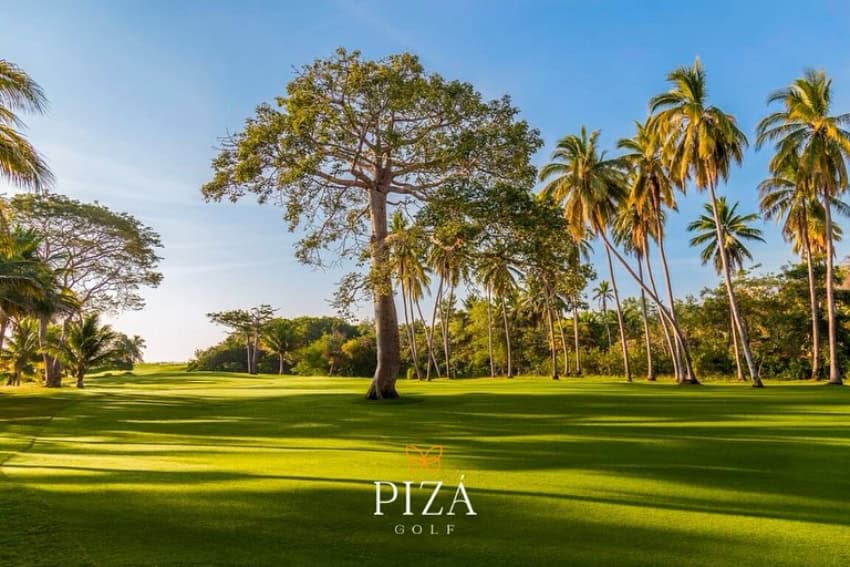
On March 14, 2024, National Guard personnel closed and secured the Tangolunda golf course to enforce the national park designation. Since then, the site has remained closed to the public while maintenance has continued, as legal challenges over its status proceed through the courts.
The designation of the Tangolunda golf course as a national park has effectively shuttered what had functioned as Oaxaca’s only championship-grade, 18-hole golf facility, leaving it closed despite continued maintenance. Without a resolution, or even a timeline for one, a functioning, attractive tourist asset remains in limbo.
Shared pattern: Governance paralysis and stranded public assets
Neither of these stalled tourism assets failed for lack of a clear economic purpose, yet neither has a clear path forward. In both cases, uncertainty, not market failure, has become the defining condition, illustrating how governance paralysis can strand otherwise viable public assets.
For Huatulco, the cost of this uncertainty is not theoretical. Each year without resolution brings foregone employment, lost tourism activity, and an erosion of confidence among local businesses and potential investors. Public funds, meanwhile, remain tied up in assets that function neither as economic engines nor as public amenities. Private operators and municipal authorities cannot plan around facilities that remain unusable. In this kind of limbo, delay is a multifaceted, unnecessary loss that accumulates over time.
What ultimately distinguishes stranded assets from failed ones is not their economic logic, but the absence of timely resolution. As legal and administrative processes unfold, often over years, there is no parallel mechanism to determine interim use, conditional operation, or negotiated outcomes. In practice, inaction becomes the default decision, leaving viable public assets suspended indefinitely.
Randy Jackson is a seasonal resident of Huatulco and a regular contributor to the Huatulco Eye magazine. He writes on tourism, infrastructure and local governance. Email: box95jackson@gmail.com