Grand Prix racing has finally reached Coyoacán, but not with any actual Grand Prix racing. Instead, Formula 1 is returning to Mexico City’s streets with its internationally renowned exposition, The Formula 1 Exhibition. It’s a historical and contemporary look at F1 in the form of an interactive gallery, which made its debut in Spain in 2023. And it’s bringing in thousands of Mexican F1 fans, who have established themselves as a passionate Grand Prix audience over the years, primarily through F1’s annual pilgrimage to Mexico City as part of the league’s World Championship series. With the arrival of the exhibition, fans are getting to learn about the sport’s history, technology and its social impacts up close.
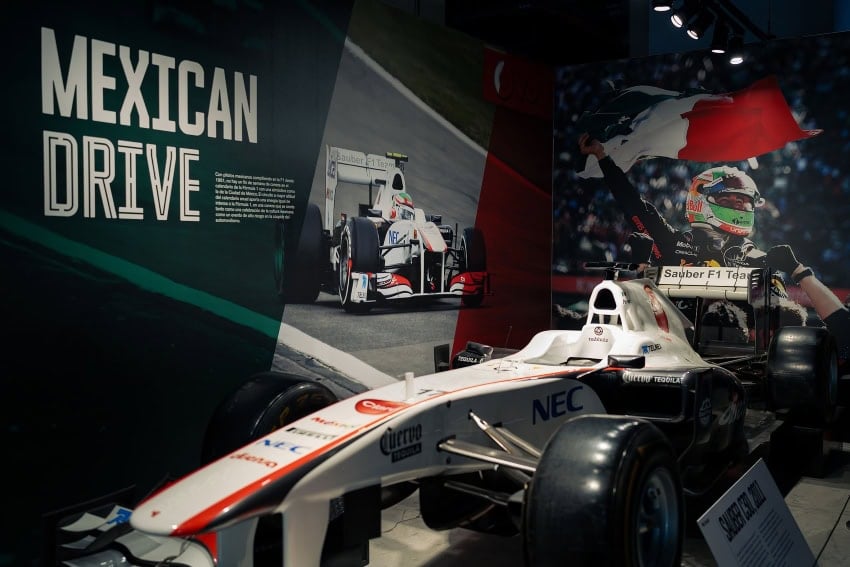
Located inside the Yama Punto Museum — a museum dedicated to automotive fandom and culture, which is hidden on the third floor of a relatively generic mall on Mexico City’s southern end — the newly minted exhibit makes CDMX the ninth city in the world (and only the second in Latin America) to host the officially sponsored event. Having opened March 20, the space will display everything F1-related: driver lore, ephemera, racing simulators, engines, digitally customizable racer helmets, and of course, a few F1 cars themselves (including Mexican driver Checo Pérez’s Sauber C30 from 2011, the year he debuted in F1, signed by the man himself).
📣¡𝗡𝗨𝗘𝗩𝗔𝗦 𝗙𝗘𝗖𝗛𝗔𝗦 𝗲𝗻 𝗙𝟭® 𝐋𝗮 𝗘𝘅𝗵𝗶𝗯𝗶𝗰𝗶𝗼́𝗻 𝗲𝗻 𝗖𝗗𝗠𝗫!🇲🇽
Debido a la increíble demanda, con muchos días ya agotados, abrimos 2️⃣ nuevas fechas.
📅 24 y 31 de marzo ya disponibles: https://t.co/EKHD51bqGI
No te quedes fuera – asegura tu lugar.
— F1 Exhibition (@F1Exhibition) March 21, 2026

The F1 Experience
Upon entering, fans are asked to download The F1 Experience app on their smartphones. Doing so allows for a self-guided tour, in which an audio accompaniment for each section and gallery can be selected from the phone in various languages. It all begins with a snazzy video of high-intensity F1 moments throughout its 75 years (the inaugural World Championship Grand Prix occurred in 1950, at Silverstone Circuit in Northamptonshire, England, and has been running full speed ever since).
Afterwards, guests are lightly herded through a winding one-way path that covers the entirety of F1’s history: from its inception, to its evolution and main characters throughout each decade (there’s even a brief section about F1 as it has been portrayed in cinema; another on how the sport is incorporating more diversity through women driver programs; and one on the league’s focus on climate and energy sustainability). It’s not only about hairpin turns and high-octane speeds; the exhibit visibly provides a spectrum of information about F1 as a multidimensional entity that goes beyond the checkered flag.
Expect long lines and flocks of avid fans gathering around the museum’s items and artifacts to take photos and videos. There is a ticket option to circumvent some of the longer wait times to get into the actual exhibit, but once inside, it’s a waiting game to be able to get up close to some of the higher-demand attractions (particularly the actual race cars, of which there are a few spread out through the exhibit, from different time periods in F1’s existence). Overall, it’s manageable though, and one never feels at a standstill — there are six galleries, so you can always wander ahead and return to a former space.
Mexicans in Formula 1
Perhaps the coolest feature, though — which is exclusive to the Mexico City edition of The F1 Experience — is that it includes an entire gallery room dedicated solely to Mexicans in F1. It lists every Mexican driver who has ever competed in the sport (six total, ranging from the aforementioned Rodriguez brothers and Perez to Moisés Solana, Héctor Rebaque, and Esteban Gutiérrez) and gives a brief rundown of their racing backgrounds and accomplishments. There’s also a showcase that includes a trophy from Pedro Rodríguez’s 1970 first-place finish in Belgium and a replica of his 1963 helmet.
Maybe the best, and most random thing, though, is a magnum-sized bottle of Moet champagne that was poured out in celebration of Nigel Mansell’s 1992 victory in the Mexico Grand Prix; the bottle is signed by all three of the drivers who finished at the podium that afternoon. Next to that, there’s a race-worn outfit and helmet from Esteban Gutiérrez’s 2016 season with Haas. In addition, there’s a timeline of the sport’s introduction and development in Mexico, and a detailed map of the Autódromo Hermanos Rodríguez track. The Mexican-themed gallery covers a large amount of ground in a relatively compact space.
A growing interest
The rest of the exhibit is worthwhile and extensive. It’s also thoughtful. There’s a wall dedicated to former drivers who have passed away — either on the race track, or from natural causes — and the experience feels inviting and informative rather than being overly burdensome or too technical. All ages are welcome, and that’s apparent when going through the exhibit on a busy weekend afternoon: young girls wearing their favorite racer’s hat stand beside middle-aged men excitedly pointing out a detail to their friends, next to mothers fully dressed in a team outfit of choice, while couples are on a date.
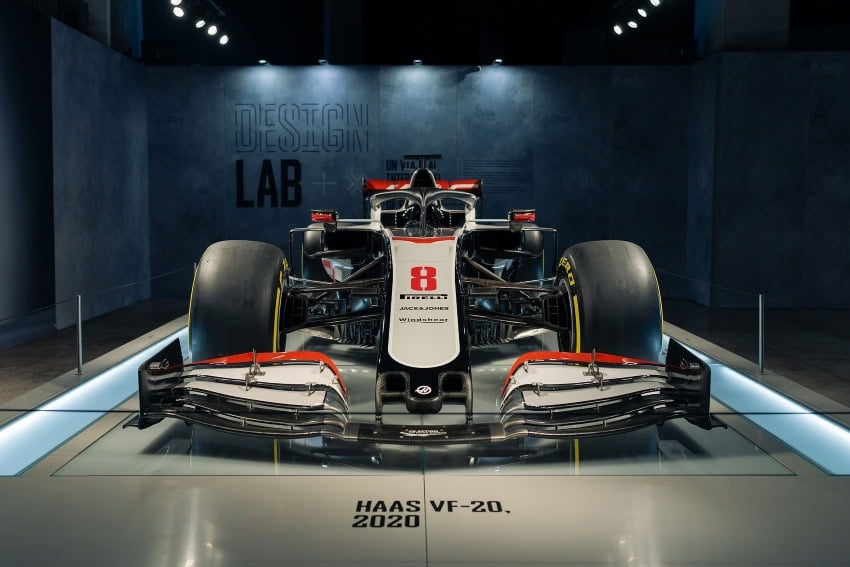
It’s for new and old fans alike, and highlights the fact that there is a serious growing interest within Mexico — particularly Mexico City — surrounding F1 and all that it offers. It represents an aspirational kind of living, a sport that is by nature expensive and unforgiving, but as a result, offers a kind of status through fanship: for better or worse, it presents a luxurious appeal and refinement.
A test of skill
Regardless of your skill level behind the wheel or how long you’ve been an F1 petrol head, there’s a racing simulator for visitors to compete in, too. Before entering the exhibit, or upon leaving, if you prefer, you can take a seat in a makeshift F1 cockpit, put on your headphones, and go to town behind a virtually rendered 1,000-horsepower turbocharged engine on an official F1 track. Afterwards, your score will be posted among the afternoon’s other competitors. It’s a rare chance to prove to yourself that you have the drive to survive. And if nothing else, that experience alone is worth the cost of admission.
Alan Chazaro is the author of “This Is Not a Frank Ocean Cover Album,” “Piñata Theory” and “Notes From the Eastern Span of the Bay Bridge” (Ghost City Press, 2021). He is a graduate of June Jordan’s Poetry for the People program at UC Berkeley and a former Lawrence Ferlinghetti Fellow at the University of San Francisco. His writing can be found in GQ, NPR, The Guardian, L.A. Times and more. Originally from the San Francisco Bay Area, he is currently based in Veracruz.