One of the signal achievements of Miguel Alemán Valdés’ six-year term as president of Mexico (1946-1952) was the building of important new roads. The most notable of these — at least symbolically — was the completion of Mexico’s portion of the Pan-American Highway, the world’s longest road, which stretches over 30,600 kilometers (19,000 miles) from Prudhoe Bay, Alaska, to Ushuaia, Argentina, crossing through 14 countries en route.
All 14 nations involved had agreed to cooperate back in 1937, when they signed a pact (the Convention on the Pan-American Highway) to complete their sections as expeditiously as possible. Mexico was the first of the Latin American countries to do so in 1950, when it put the finishing touches on its 3,440 kilometers of highway between Ciudad Juárez, Chihuahua and Ciudad Cuauhtémoc, Chiapas.
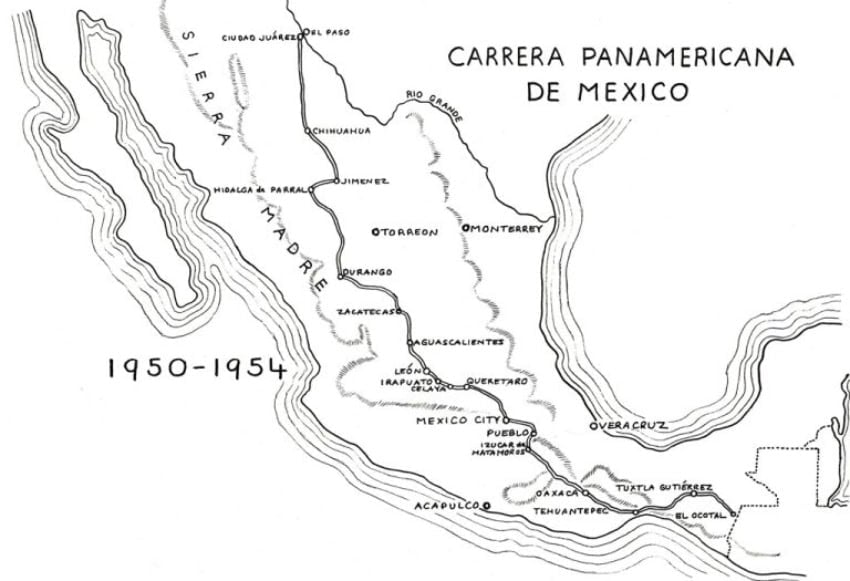
It was an achievement worth celebrating. Guillermo Ostos’ idea, which the executive in the Secretariat of Communications and Public Works had as far back as 1947, was for an open-road race the length of Mexico along the newly minted Pan-American Highway. President Alemán agreed, and the first Carrera Panamericana was held May 5-10, 11 days before the president officially inaugurated the highway on May 21, 1950.
The longest race in the world
By the middle of the 20th century, several major open-road endurance races had been established in Europe. However, none of them — not the 1,080-kilometer Targa Florio in Sicily, the 1,600-kilometer Mille Miglia in Italy, or the 24 Hours of Le Mans in France — would cover as much ground as the Carrera Panamericana race contested in Mexico in 1950.
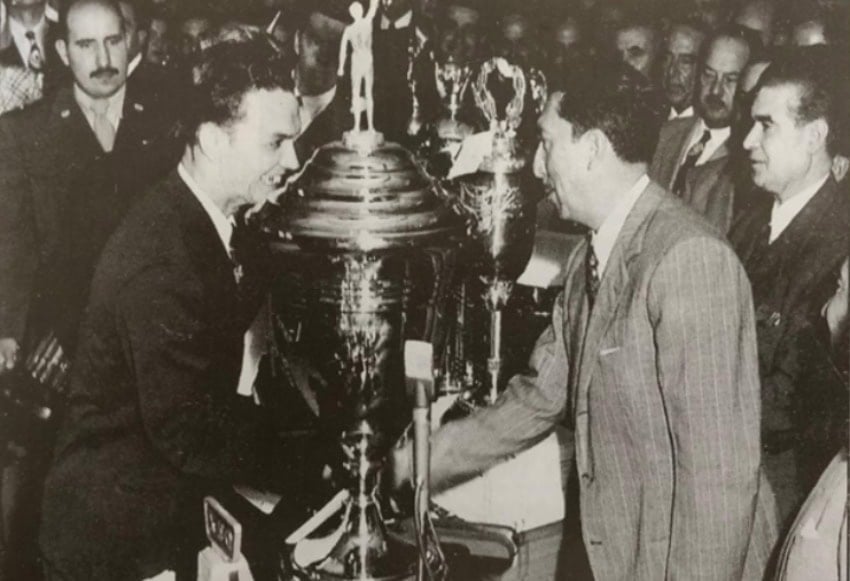
Indeed, the 2,135-mile border-to-border Carrera Panamericana from Ciudad Juárez to El Ocotal, Chiapas, was to be the longest race in the world, a fact that no doubt contributed to the excitement that surrounded its initial running — not just in Mexico, but also in the U.S. Eddie Rickenbacker, the World War I fighter ace and Medal of Honor recipient was enthusiastic, as was Wilbur Shaw, the president of the Indianapolis Motor Speedway, and even California governor Earl Warren. The latter, however, who later became Chief Justice of the Supreme Court, contributed to a gaffe on the trophy he donated. The Mexican jeweler, instructed by Warren to inscribe “won by,” misinterpreted it as “one buy,” and engraved una compra instead.
The competitors in the first Carrera Panamericana
The government-funded race and its 334,000 peso prize pool (150,000 of which was earmarked for the winner) drew a veritable who’s who of acclaimed race car drivers. Felice Bonetto, for example, won the 1952 Targa Florio in Sicily for Lancia. Piero Taruffi was a winner of the 1957 Mille Miglia for Ferrari, and like Bonetto, a noted Formula One driver. Herschel McGriff would later be elected to the NASCAR Hall of Fame and Johnny Mantz raced in the 1948 and 1949 Indianapolis 500 races before heading to Mexico to try his luck in 1950. Afterward, he would declare the Indy 500 easy by comparison.
But many of the 132 entrants in the first Carrera Panamericana were not professionals. Well … the Mexican taxi drivers who competed were professionals of a sort. Not so with the women drivers, who, according to Johnny Tipler in his 2008 book “La Carrera Panamericana: The World’s Greatest Road Race,” ranged from a movie actress, Jacqueline Evans, to a few adventurous grandmothers.

“Mrs. H.R. Lammons from Jacksonville, Texas, was one who made it to the final leg,” he wrote. “Her 1948 Buick was sponsored by a local brassiere manufacturer and the car sported a fine example of the company’s product painted on each side.”
The cars they drove
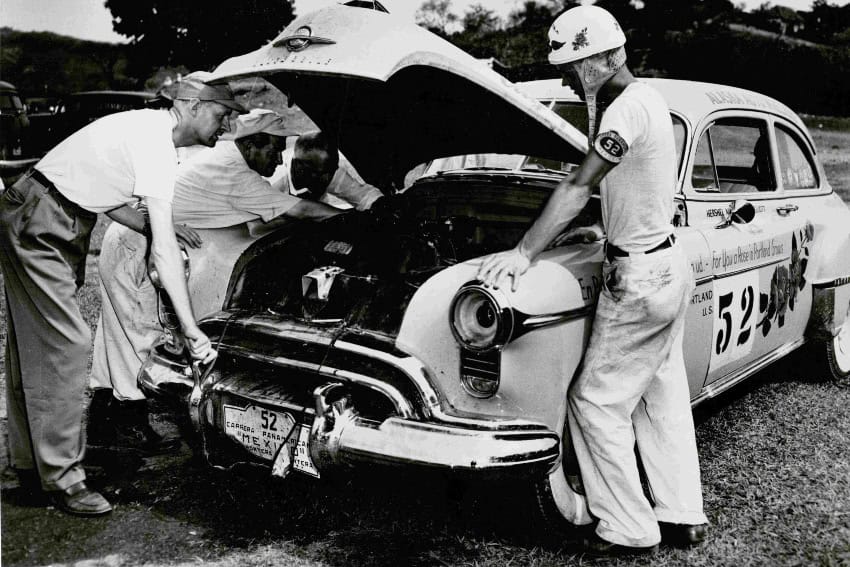
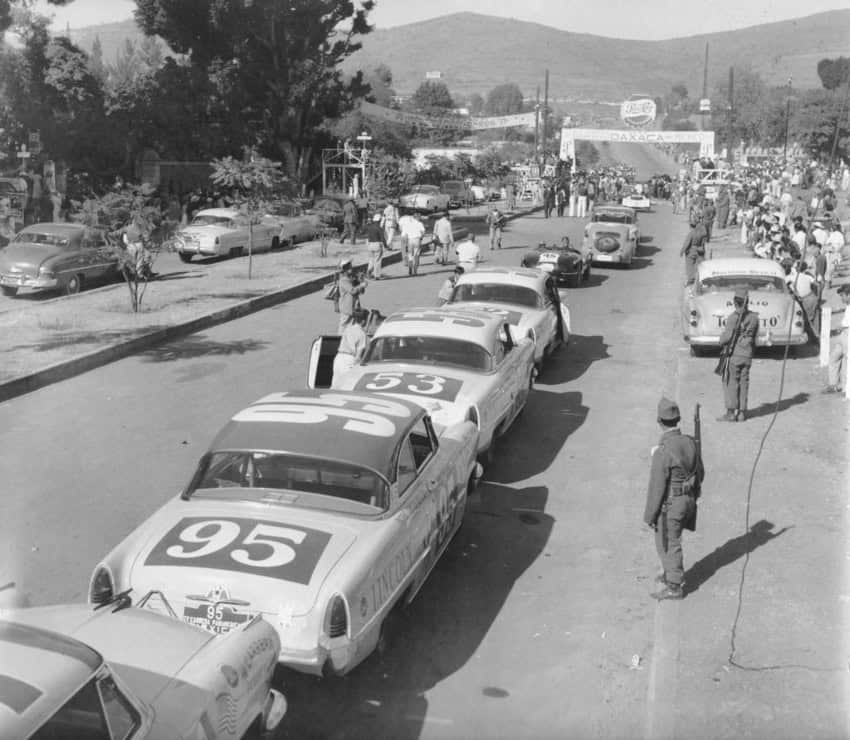
The automobiles they drove were, by race regulation, stock cars sold to the public with seating for at least five people. Sports cars were not allowed, at least in 1950. The resulting field of cars was overwhelmingly American-made and consisted primarily of Cadillacs, Buicks, Oldsmobiles and Lincolns, with the odd Nash, Packard or Studebaker.
“President Alemán himself sponsored two cars,” Tipler noted. “A 1950 Cadillac known as ‘Coche Mexico’ piloted by Rodolfo Castañeda, which rolled twice, injuring its co-driver, and a 1950 Studebaker, entered on behalf of the national university (UNAM) from which the president had graduated with a law degree 20 years earlier.”
The most dangerous race in the world
The Carrera Panamericana in its initial incarnation lasted for only five years (1950-1954) and part of the reason was its undeniable danger, as 31 drivers and spectators were killed, four in 1950 alone. The same danger dogged the Mille Miglia and Le Mans, and when the latter race suffered a tragedy in 1955, with a crash killing upwards of 80 people, most of them spectators, it marked the end of some governments’ support for these kinds of races under their existing form. The Carrera Panamericana shut down before its 1955 running, as it lacked the support of Alemán’s successor, Adolfo Ruiz Cortines. The Mille Miglia followed suit in Italy in 1961.
These contests, however, were challenging even for those who survived them; the Carrera Panamericana, particularly so, due to its high elevation, with mountainous roads featuring precipitous drops. The race was largely routed at over 4,000 feet before it reached Oaxaca, climbing to over 7,000 feet in Mexico City, Toluca and Puebla, and topping 10,000 feet at one pass near the Popocatepetl volcano. Herschel McGriff, who won the six-day, nine-leg race in 1950 in his “City of Roses” Oldsmobile 88, was scared to death when he drove back home afterward at a sedate pace and suddenly noticed all the sheer cliff drop-offs near the side of the highway.
McGriff also had to battle another challenge; neither he nor his co-driver, Ray Elliott, liked Mexican food. As a consequence, they would lose a combined 43 pounds during the nearly week-long race.
The revival
Three decades after the last of the Carrera Panamericana races was run in 1954, it was revived by race driver Eduardo “Lalo” León in 1988. León had attended one of the original races with his father and still had a great nostalgia for its charms. However, the format would change, becoming much safer as it was transformed into a vintage rally race.
He wasn’t the only one who loved it, as it turns out. The race is still being run today, with the 2025 edition concluding in October with a victory by Mexicans Ricardo Cordero and Marco Hernández. It was the seventh victory in the reconstituted race for Cordero, tying him with France’s Pierre de Thoisy for the most ever by a driver. Hernández, meanwhile, now has the most Carrera Panamericana titles by a navigator, with eight.
“People love the race and we respect them,” Karen León, Eduardo’s daughter and the race’s organizer, told Autoweek in 2022. “The people respect the race and love being part of it. You see the hospitality of Mexico, that Mexico that we love, and that Mexico that we want to people to know and to enjoy.”
Chris Sands is a writer and editor for Mexico News Daily, and the former Cabo San Lucas local expert for the USA Today travel website 10 Best and writer of Fodor’s Los Cabos travel guidebook. He’s a contributor to numerous websites and publications, including The San Diego Union-Tribune, Marriott Bonvoy Traveler, Forbes Travel Guide, Porthole Cruise and Travel, and Cabo Living.