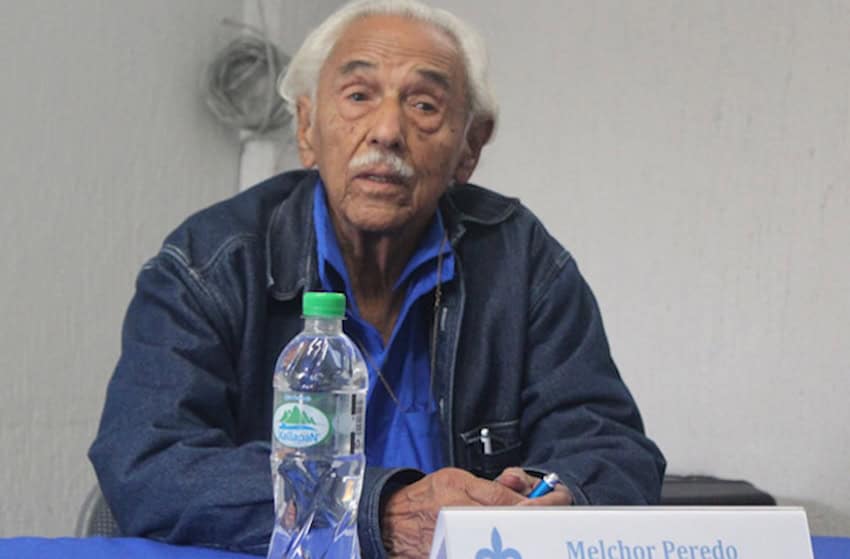
Melchor Peredo García, considered the last living representative of Mexican muralism and a student of Diego Rivera, José Clemente Orozco and David Alfaro Siqueiros, died early Wednesday in Xalapa, Veracruz. He was 99.
His partner, Lourdes Hernández Quiñones, confirmed the death in a Facebook post cited by several sources.
“Melchor Peredo, my life partner, has just passed away,” she wrote. “A muralist, before being a painter, an artist with a creative vision. Today he flies high, already in an infinite sky of light and color.”
Peredo died of a stroke and kidney complications at his Xalapa home, surrounded by family and friends, the newspaper La Jornada reported. Hernández told outlets Peredo had a urinary problem that progressed to severe dehydration.
Born Jan. 6, 1927, in Mexico City, Peredo studied under Rivera, Orozco and Siqueiros, training at “La Esmeralda” (the National School of Painting, Sculpture and Engraving) and other prestigious Mexican institutions.
He created at least 25 murals across Mexico, the United States, France and Canada.

His major domestic works include titles that translate to “Heroic Resistance of the Veracruz People Against the Invasions” (1979–1980) in Veracruz’s Government Palace and “A Continuous Revolution” (2010) in Xalapa City Hall.
International commissions took his work to the Université Paris-Est Créteil, Clemson University in South Carolina and Southern Arkansas University.
An expert in fresco painting, Peredo often worked with a bamboo cane more than 10 meters long or from scaffolding at great heights. He also developed an innovative method of applying murals on cement panels, allowing works to be moved and exhibited in multiple locations.
Peredo described his art as “a continuation of Mexican muralism in its nationalist characteristics, but also humanist, democratic and if you will, socialist,” in a 2018 interview with EFE.
When asked that year whether muralism was dead in Mexico, he replied: “As long as I’m not dead, muralism isn’t dead.”
He stayed combative to the end. In January, Peredo publicly protested after Mexico’s Tax Administration Service (SAT) demanded he produce a mural — worth an estimated 200,000 pesos (US $11,560) — to settle a tax debt of just 32,000 pesos (US $1,849) under a payment-in-kind program for artists, La Jornada reported.
At the time of his death, he was awaiting publication of his book “A Revolution Continues,” a project six years in the making to be published by the Veracruz Ministry of Culture.
En el Palacio de Gobierno se encuentran las obras del maestro muralista Melchor Peredo, xalapeño que trabajó con gran dedicación. Hoy rendimos homenaje y expresamos nuestro pésame a su familia; pronto podrán contemplar sus obras. pic.twitter.com/VUeYFgT4u5
— Rocío Nahle (@rocionahle) April 8, 2026
Veracruz Gov. Rocío Nahle announced that the currently under-renovation Government Palace, which houses several of Peredo’s murals, will at some point open to the public in his honor.
In a loosely translated video interview, Hernández said, “Unlike many painters of the Mexican muralist movement, he was a man who always valued everything popular in our country — all manifestations of popular art . . .
“I believe that his value does not lie solely in the work he did — particularly in Xalapa, where he did most of his mural work — but also in the fact he was a man concerned with spreading muralism.”
With reports from La Jornada, EFE, Expansión and Mi Morelia