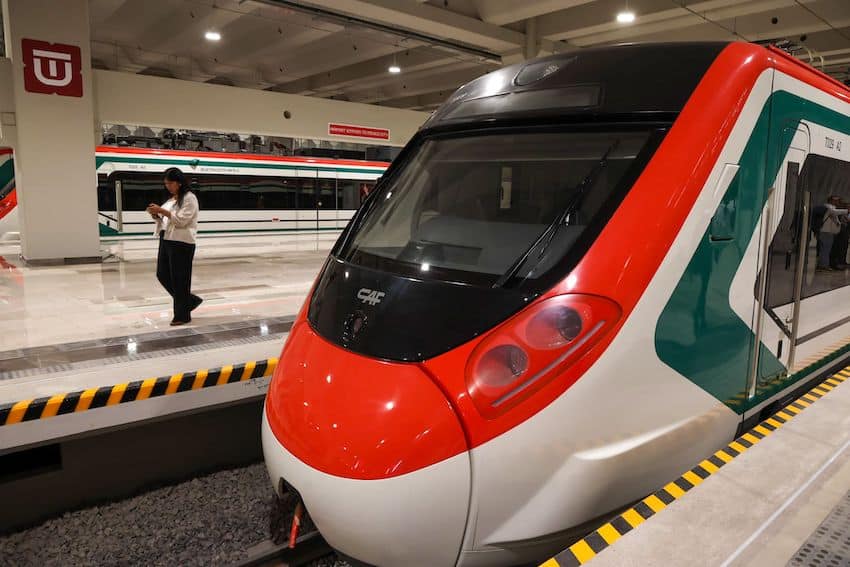
The brand new train service from downtown Mexico City to the Felipe Ángeles International Airport (AIFA) has quickly become a hit with passengers, having transported 206,515 passengers in its first week of operations, Mexico’s Infrastructure, Communications and Transportation Ministry (SICT) reported on Monday.
The train, inaugurated on April 26, connects Mexico City’s Buenavista station with AIFA, located around 40 kilometers north of the city.
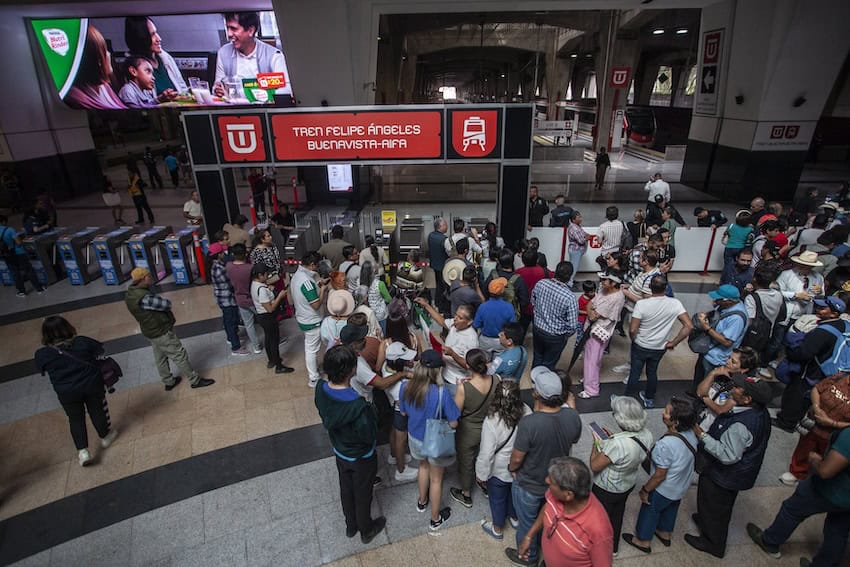
The route includes six new stations — Cueyamil, La Loma, Teyahualco, Prados Sur, Cajiga and Xaltocan, plus the Clara Krause Terminal at AIFA. The Clara Krause Terminal station has six escalators and three longer platforms with capacity for nine trains, according to the SICT’s statement.
The stations are equipped with 294 surveillance cameras and 448 speakers to protect and maintain communication with passengers, the SICT said.
The line operates with 10 trains, each 100 meters long, serving 719 passengers. While initially the route will operate with only four of its 10 trains, running every half hour, the frequency will eventually increase to every 12 minutes, with a maximum capacity to transport 80,000 passengers daily. The journey time from Buenavista to AIFA is around 50 minutes, with speeds of between 65 km per hour and 130 km per hour.
Based on its initial passenger numbers, the train is currently operating at near-maximum capacity. During peak demand, it may be possible to couple two trains together to transport 1,400 passengers in a single trip, according to the statement.
For the first month of operation, a fare of 45 pesos (US $2.60) has been set, which could increase as soon as next month.

The SICT emphasized that the trains operate with the European Rail Traffic Management System (ERTMS), which is designed to allow for centralized and standardized speed, controlled distance between trains, track switches and route deviations, all of which enhance operational safety and make estimated travel times more accurate.
The train link forms part of the Morena government’s strategy to recover Mexico’s passenger rail services, which started during the López Obrador administration (2018-2024) and has accelerated with the current Sheinbaum government.
With reports from La Jornada